
1232022 1 OCCUPATIONAL CANCER Prof DR Waqar Al


- Slides: 33
1/23/2022 1
OCCUPATIONAL CANCER Prof DR. Waqar Al – Kubaisy 2
Occupational Disease Definition International Labour Organization (ILO) The term “occupational disease” covers any disease contracted as a result of an exposure to risk factors arising from work activity. Two main elements are present in the definition of an occupational disease: 1) The causal relationship between exposure in a specific working environment or work activity and a specific disease; and 2) The fact that the disease occurs among a group of exposed persons with a frequency above the average morbidity of the rest of the population. 3
OCCUPATIONAL CANCER Occupational cancer is a serious problem in Industry What is occupational cancer? • Cancer specifically attributed to significant* levels of exposure to an agent* in the workplace and occurring among substantial* numbers of workers. • Substantial: > 10, 000 workers • Significant: As much as, or more than, in the general environment *An agent that has been causally linked with development of cancer (carcinogen) Siemiatycki et al, Environ Occupational cancer is cancer caused by occupational hazards Several cancers have been directly tied to occupational hazards, including chimney sweep’s carcinoma, mesothelioma, and others. 4
Historical landmarks 1775, Percivall Pott in London- scrotal cancer among chimney sweeps • 1895, Rehn, in Germany- cluster of three cases of bladder cancer in workers at a local factory producing aniline dyestuffs from coal tar • Early 20 th century- certain constituents of tar, soot, and oils, known as polycyclic aromatic hydrocarbons, were found to cause cancer in laboratory animals • 1970, IARC recommended that a compendium ( concise , detailed information ) on carcinogenic chemicals be prepared by experts 5
Epidemiology The Global Burden of Cancer Annually v 5 million female and 6 million male new cancer cases annually worldwide v >6 million deaths worldwide annually v >50% of patients with cancer live in developing countries, • which have <10% of the resources for cancer therapy occupational cancer: v It is difficult to determine a true figure for occupational cancers Ø because of the latent nature of the disease. Ø An individual might be exposed to a cause of cancer and not develop any noticeable symptoms until many years later. Ø With current people moving between different job roles and companies, it can be difficult to determine a specific exposure or cause. 6
Cont. …. . Epidemiology occupational cancer v It is estimated that 19% of cancers globally are attributed to environmental exposures (including work-related exposures). • Thousands of people die each year from cancer due to occupational causes. • It is estimated that occupational cancers are a leading cause of work-related death worldwide. q in the United States (US) an estimated q 48, 000 cancers are diagnosed yearly that come from occupational causes; § this represents approximately 4 -10% of total cancer in the USA 7
occupational cancer Cont. …. . Epidemiology In the United Kingdom (UK), there an estimated v 2. 5 million people living with cancer and v study in UK, over one year, 5% of cancer deaths (8, 000 deaths) Ø were attributable to occupational exposure. v The number of workplace deaths caused by accidents in the same period was around 200 – so almost 40 times more deaths are attributable to occupational cancer than to accidents. v In UK, it is also estimated that there are 13, 500 cancer/year registrations (newly occurring cases) attributable to occupations. v Therefore it is very important to reduce exposure to carcinogens and potential carcinogens 8
occupational cancer Cont. …. . Epidemiology v More than 200 000 people, die each year from a workplace related cancer, v most of them in the DEVELOPED world, (WHO has said ) v The Developed world presently has a higher rate of occupational cancer, the result of the wide use 20 to 30 years ago of various carcinogenic substances such as blue asbestos, 2 -naphthylamine, and benzene, v These countries now have much tighter controls on the presence of these known carcinogens in the workplace v A major rise in the incidence of occupational cancer can be expected in DEVELOPING countries in the coming decades as work processes involving the use of carcinogens shift to countries with less stringent enforcement of occupational health standards, WHO warns. v These processes involve substances such as chrysotile asbestos and pesticides and those used in production of tyres and dyes. 9
What is the relevance of occupational cancer epidemiology? 1. 50% of known human carcinogens are substances found principally in the workplace 1. Many cases of cancer are directly attributable to occupational exposure 3. Control measures can often be implemented once an occupational carcinogen has been identified 4. The discovery of occupational carcinogens has importance outside the factory walls 5. Provides a basis for compensating victims 6. Improves our understanding of carcinogenesis 7. Occupational cancer affords significant opportunities for research • Epidemiological surveys § Animal experimentation (toxicological studies) 10
The characteristics of occupational cancer are : v Occupationally related cancers are characterized by a long latent period v they appear after prolonged exposure v Time between first exposure and clinical presentation (usually >10 -15 years) and up to 40 -50 years in some cases v the disease may develop even after the cessation of exposure, v (i. e. presentation can be in retirement rather than while still at work). v An occupationally related tumour does not differ substantially, either pathologically or clinically, from its “naturally occurring” counterpart. v the average incidence is earlier than that for cancer in general, v the localization of the tumours is remarkably constant in any one occupation. v Personal hygiene is very important in the prevention of occupational cancer 11
What causes occupational cancer? Occupational cancer is caused by exposure to carcinogens in the workplace. There are three different types of occupational carcinogens: I. Biological carcinogens some micro-organisms such as viruses have been known to cause cancer, , for example Hepatitis B, HIV viruses and so on. I. Chemical carcinogens a number of chemicals are known to be carcinogenic. These chemicals may occur naturally, such as asbestos, be manufactured like vinyl chloride, or be by-products of industrial processes, for example, polycyclic aromatic hydrocarbons. III. Physical carcinogens agents such as ionising and ultraviolet (UV) radiation have the potential to cause cancer. Examples of ionising radiation include X-rays and alpha, beta and gamma radiation. UV radiation some of which are known to cause skin cancer. 12
factors that play a role in cancer An individual’s risk of developing a cancer is influenced by a combination of factors including: § Personal characteristics such as age, sex, and race • Family history of cancer • Diet and personal habits such as cigarette smoking and alcohol consumption • The presence of certain medical conditions or past medical treatments, including chemotherapy, radiation treatment, or some immune-system suppressing drugs. • Exposure to cancer-causing agents in the environment (for example, sunlight, radon gas, air pollution, and infectious agents) 13
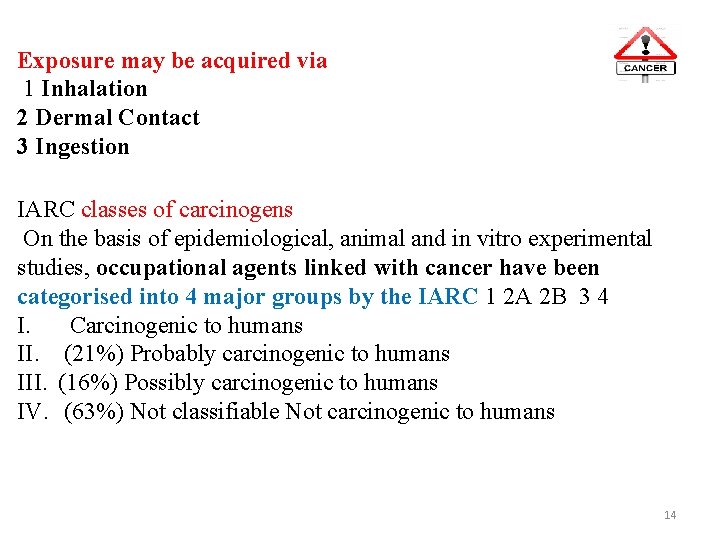
Exposure may be acquired via 1 Inhalation 2 Dermal Contact 3 Ingestion IARC classes of carcinogens On the basis of epidemiological, animal and in vitro experimental studies, occupational agents linked with cancer have been categorised into 4 major groups by the IARC 1 2 A 2 B 3 4 I. Carcinogenic to humans II. (21%) Probably carcinogenic to humans III. (16%) Possibly carcinogenic to humans IV. (63%) Not classifiable Not carcinogenic to humans 14
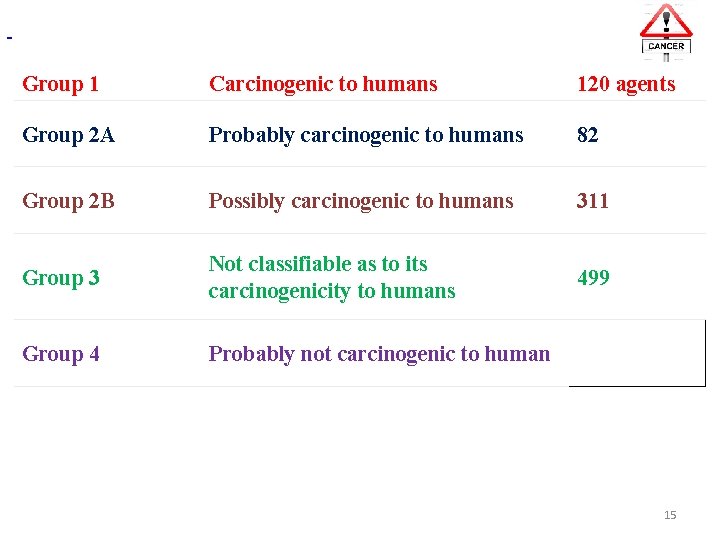
Group 1 Carcinogenic to humans 120 agents Group 2 A Probably carcinogenic to humans 82 Group 2 B Possibly carcinogenic to humans 311 Group 3 Not classifiable as to its carcinogenicity to humans 499 Group 4 Probably not carcinogenic to human 15
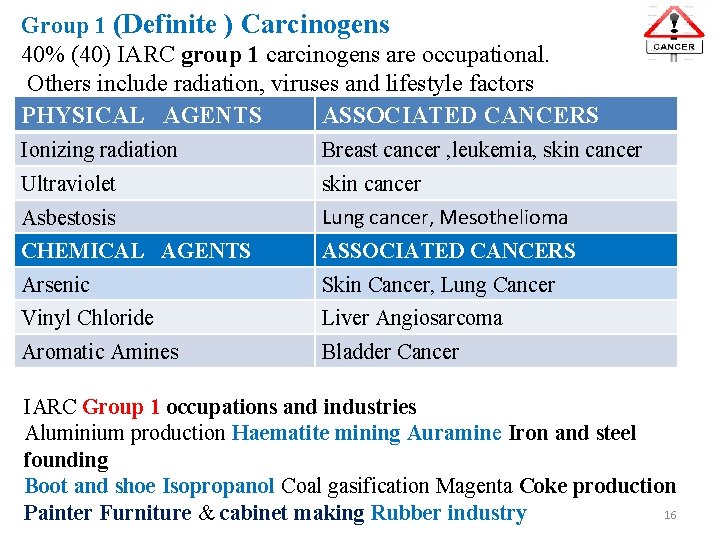
Group 1 (Definite ) Carcinogens 40% (40) IARC group 1 carcinogens are occupational. Others include radiation, viruses and lifestyle factors PHYSICAL AGENTS ASSOCIATED CANCERS Ionizing radiation Breast cancer , leukemia, skin cancer Ultraviolet Asbestosis skin cancer Lung cancer, Mesothelioma CHEMICAL AGENTS ASSOCIATED CANCERS Arsenic Skin Cancer, Lung Cancer Vinyl Chloride Liver Angiosarcoma Aromatic Amines Bladder Cancer IARC Group 1 occupations and industries Aluminium production Haematite mining Auramine Iron and steel founding Boot and shoe Isopropanol Coal gasification Magenta Coke production 16 Painter Furniture & cabinet making Rubber industry
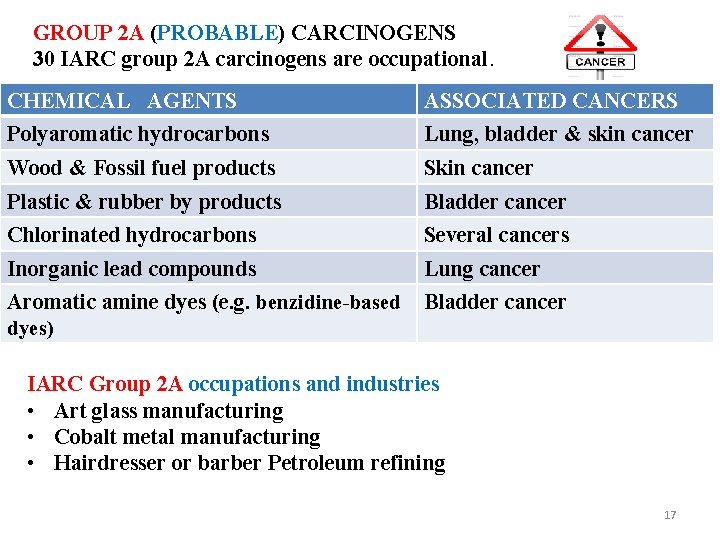
GROUP 2 A (PROBABLE) CARCINOGENS 30 IARC group 2 A carcinogens are occupational. CHEMICAL AGENTS ASSOCIATED CANCERS Polyaromatic hydrocarbons Lung, bladder & skin cancer Wood & Fossil fuel products Skin cancer Plastic & rubber by products Bladder cancer Chlorinated hydrocarbons Several cancers Inorganic lead compounds Lung cancer Aromatic amine dyes (e. g. benzidine-based dyes) Bladder cancer IARC Group 2 A occupations and industries • Art glass manufacturing • Cobalt metal manufacturing • Hairdresser or barber Petroleum refining 17
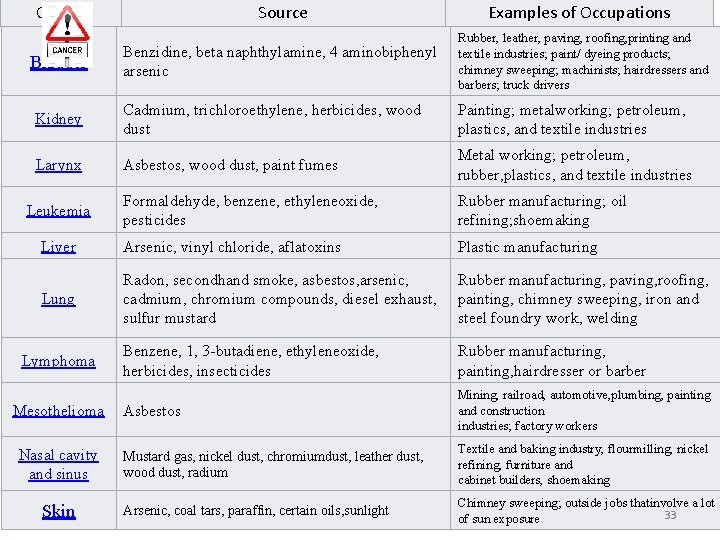
Types of occupational cancers Cancers associated with occupational exposure include: • bladder cancer (arsenic; aromatic amines; coal tars and pitched, diesel engine exhaust; work as a hairdresser or barber; metalworking fluids and mineral oils; work as a painter; work in the rubber industry) • bone cancer (ionising radiation) • brain and other central nervous system cancers (ionising radiation ) • breast cancer (ionising radiation; ethylene oxide • colon and rectal cancer (asbestos, ionising radiation) • kidney cancer (arsenic, cadmium; coke production; trichloroethylene) • laryngeal cancer (asbestos; work in the rubber industry: strong inorganic acid mists including sulphuric acids) • leukaemia (benzene, ethylene oxide, formaldehyde, ionising radiation, non-arsenical insecticides) • liver and biliary cancer (ionising radiation; trichloroethylene, vinyl chloride ) 18
Types of occupational cancers lung cancer (arsenic; asbestos; beryllium; cadmium; chromium; coal gasification, coal tar and pitches, cobalt; coke production, diesel engine exhaust, dioxins; inorganic lead; iron and steel foundry work, mineral oils; nickel; work as a painter; natural radon in workplaces, ; ionising radiation, rubber production; silica; strong inorganic acid mists; work as a welder) • melanoma of the eye (welding) • mesothelioma (asbestos) • nasal and sinus cancer (chromium, formaldehyde, leather dust, nickel, textile industry, wood dust) • non-hodgkin’s disease (work as a hairdresser or barber, non-arsenical insecticides, work as a painter, tetrachloroethylene, trichloroethylene) • non-melanoma skin cancer (coal tars and pitches, mineral oils, solar radiation) • oesophageal cancer (soots; tetrachloroethylene) • pharyngeal cancer (asbestos) 19 • stomach cancer (asbestos).
Occupational cancer is a serious problem in Industry. The sites of the body most commonly affected are Ø skin, Ø lungs, Ø bladder, and Ø blood-forming organs. 20
1. Skin cancer Ø First attention was drawn by Percival Pott to cancer of scrotum in chimney sweepers in 1775 Ø It was subsequently found that cancer of the scrotum and of the skin in other parts of the body was caused by § coal tar, § X-rays, § certain oil sand dyes. Ø Statistics now show that nearly 75%of occupational cancers Ø are skin cancer. v Occupational skin cancers are predominantly ‘squamous cell carcinomas’ v Only characteristic feature of occupational skin cancers their occurrence on exposed parts of the body (head, neck, hands, arms) that have remained in direct contact with a carcinogenic source 21
Skin cancer Carcinogens implicated in occupational skin cancers include § § § UV light, ionizing radiation, coal products, petroleum products, lubricating oils, fuel oils, etc. Skin cancers are an occupational hazard among § Gas Workers, § Coke Oven Workers, § Tar Distillers, § Oil Refiners, § Dye-stuff Makers, § Road Makers and in industries associated with the use of mineral oil, pitch, tar and related compounds 22
2. Lung cancer is a hazard in Ø gas industry, Ø asbestos industry, Ø nickel and chromium work, Ø arsenic roasting plants and Ø in the mining of radio-active substances (e. g. , uranium). proved carcinogens for the lungs are: Nickel, chromates, asbestos, coal tar (presumably 3 -4 benzpyrene), benzene radio-active substances and cigarette-smoking suspected carcinogens Arsenic, beryllium and isopropyl oil 23
Lung cancer . More than nineteenths of lung cancer are attributed to § tobacco smoking, § air pollution and occupational exposure. Ø A 10 th of lung cancer deaths are closely related to risks in the workplace, and Ø workers who are heavily exposed to second hand tobacco smoke at their workplaces are twice as likely as those working in a smoke free environment to develop lung cancer 24
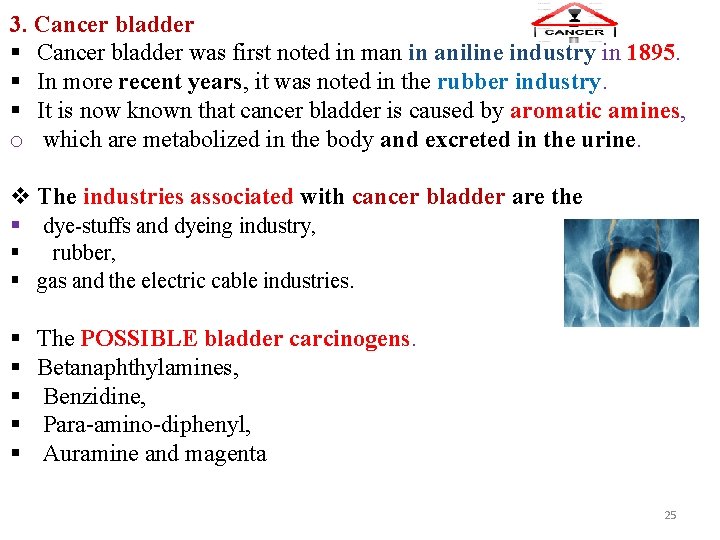
3. Cancer bladder § Cancer bladder was first noted in man in aniline industry in 1895. § In more recent years, it was noted in the rubber industry. § It is now known that cancer bladder is caused by aromatic amines, o which are metabolized in the body and excreted in the urine. v The industries associated with cancer bladder are the § dye-stuffs and dyeing industry, § rubber, § gas and the electric cable industries. § § § The POSSIBLE bladder carcinogens. Betanaphthylamines, Benzidine, Para-amino-diphenyl, Auramine and magenta 25
4. Leukaemia Exposure to § benzol, § roentgen rays and § radio-active substances give rise to leukaemia. q Thousands of people working in the chemical and diamond industries die from leukaemia caused by exposure to benzene, which is widely used by workers as an organic solvent in such industries Benzol is a dangerous chemical and is used as a solvent in many industries. Leukaemia may appear long after exposure has ceased. 26
Compensable cancers The specific forms of occupational cancers which are currently compensable under the Department for Work and Pensions Industrial Injuries and Disablement Benefit (IIDB) Scheme are listed below: • leukaemia or cancer of the bone, breast, testis or thyroid due to exposure to electromagnetic radiation or ionising particles • acute non-lymphatic leukaemia due to exposure to benzene • skin cancer due to exposure to arsenic, arsenic compounds, tar, pitch, bitumen, mineral oil (including paraffin) or soot • sinonasal cancer due to exposure to nickel compounds or to wood, leather and fibre-board dust • lung cancer due to exposure to asbestos or nickel compounds or to work as a tin miner, exposure to bis(chloromethyl) ether, zinc, calcium or strontium chromates or silica exposure. • bladder cancer due to exposure various compounds during chemical manufacturing or processing, including 1 -naphthylamine, 2 -naphthylamine, benzidine, auramine, magenta, 4 aminobiphenyl, Mb. OCA, orthotoluidine, 4 -chloro-2 -methylaniline, and coal tar pitch volatiles produced in aluminium smelting. • angiosarcoma of the liver due to exposure to vinyl chloride monomer 27
prevention of occupational cancer Prevention Many occupational cancers are preventable. § Personal protective gear, § workplace controls, and § worker education can prevent exposure to carcinogens in the workplace. § Tobacco smoking has also been shown to increase the risk of work-related cancers; decreasing or abstaining from smoking can decrease cancer risk. § Agencies like the US Food and Drug Administration, Environmental Protection Agency, the International Agency for Research on Cancer (IARC) and Occupational Safety and Health Administration have developed safety standards and limits for chemical and radiation exposure. WHO says that Ø prevention of exposure to carcinogens in the workplace may be the most efficient way to prevent cancer. Ø “The control of carcinogens in the workplace should be a key component of every national cancer control programme 28
Cont. . . prevention of occupational cancer To protect workers from occupational cancer, WHO recommends § stopping the use of asbestos; § introducing benzene-free organic solvents and § technologies that convert the carcinogenic form of chromium into a noncarcinogenic form; § banning smoking in the workplace; and § providing protective clothes for people who work in the sun. These simple interventions could prevent hundreds of thousands of unnecessary deaths and suffering from occupational cancer, it adds. v Recently WHO issued an official statement warning countries to stop using Ø asbestos or face an epidemic of cancer in the coming years. v It suggested using pine fibers ﺃﻠﻴﺎﻑ ﺍﻟﺼﻨﻮﺑﺮ in producing cement building materials as a safe alternative to asbestos 29
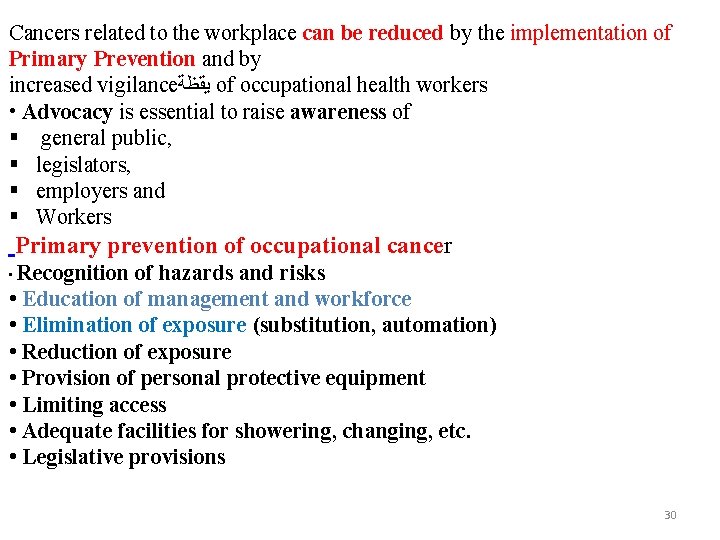
Cancers related to the workplace can be reduced by the implementation of Primary Prevention and by increased vigilance ﻳﻘﻈﺔ of occupational health workers • Advocacy is essential to raise awareness of § general public, § legislators, § employers and § Workers Primary prevention of occupational cancer • Recognition of hazards and risks • Education of management and workforce • Elimination of exposure (substitution, automation) • Reduction of exposure • Provision of personal protective equipment • Limiting access • Adequate facilities for showering, changing, etc. • Legislative provisions 30
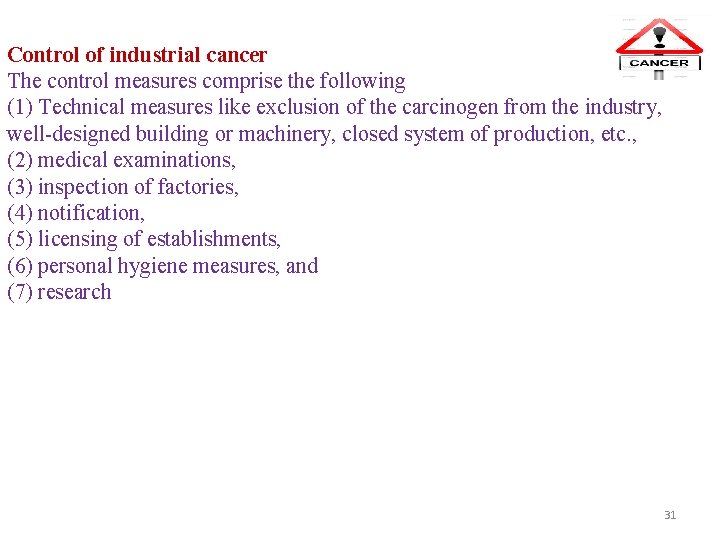
Control of industrial cancer The control measures comprise the following (1) Technical measures like exclusion of the carcinogen from the industry, well-designed building or machinery, closed system of production, etc. , (2) medical examinations, (3) inspection of factories, (4) notification, (5) licensing of establishments, (6) personal hygiene measures, and (7) research 31
32
Cancer Source Examples of Occupations Benzidine, beta naphthylamine, 4 aminobiphenyl arsenic Rubber, leather, paving, roofing, printing and textile industries; paint/ dyeing products; chimney sweeping; machinists; hairdressers and barbers; truck drivers Kidney Cadmium, trichloroethylene, herbicides, wood dust Painting; metalworking; petroleum, plastics, and textile industries Larynx Asbestos, wood dust, paint fumes Metal working; petroleum, rubber, plastics, and textile industries Formaldehyde, benzene, ethyleneoxide, pesticides Rubber manufacturing; oil refining; shoemaking Liver Arsenic, vinyl chloride, aflatoxins Plastic manufacturing Lung Radon, secondhand smoke, asbestos, arsenic, cadmium, chromium compounds, diesel exhaust, sulfur mustard Rubber manufacturing, paving, roofing, painting, chimney sweeping, iron and steel foundry work, welding Benzene, 1, 3 -butadiene, ethyleneoxide, herbicides, insecticides Rubber manufacturing, painting, hairdresser or barber Asbestos Mining, railroad, automotive, plumbing, painting and construction industries; factory workers Mustard gas, nickel dust, chromiumdust, leather dust, wood dust, radium Textile and baking industry, flourmilling, nickel refining, furniture and cabinet builders, shoemaking Arsenic, coal tars, paraffin, certain oils, sunlight Chimney sweeping; outside jobs thatinvolve a lot 33 of sun exposure Bladder Leukemia Lymphoma Mesothelioma Nasal cavity and sinus Skin