
12302021 Study Types 1 Study Types Afshin Ostovar

- Slides: 26
12/30/2021 Study Types 1
Study Types Afshin Ostovar Bushehr University of Medical Sciences 12/30/2021 Study Types 2
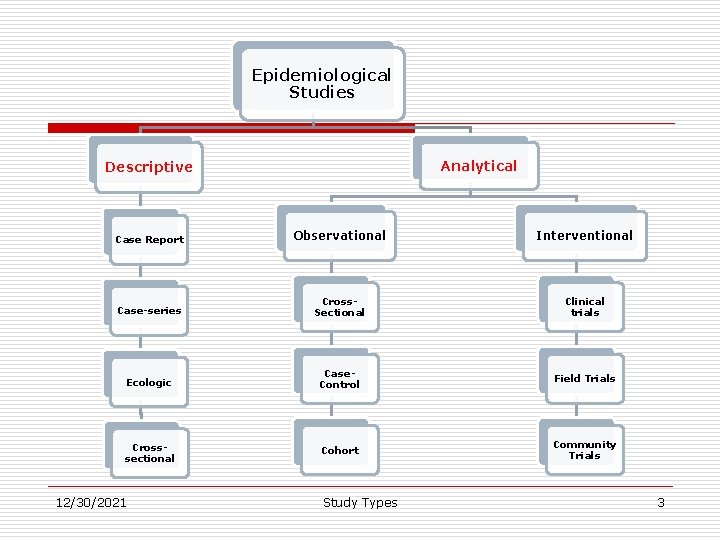
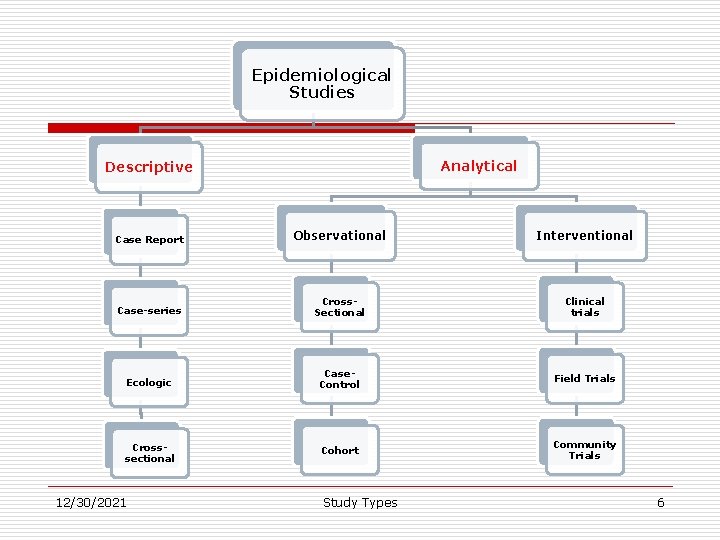
Epidemiological Studies Analytical Descriptive Case Report Observational Interventional Case-series Cross. Sectional Clinical trials Ecologic Case. Control Field Trials Crosssectional Cohort Community Trials 12/30/2021 Study Types 3
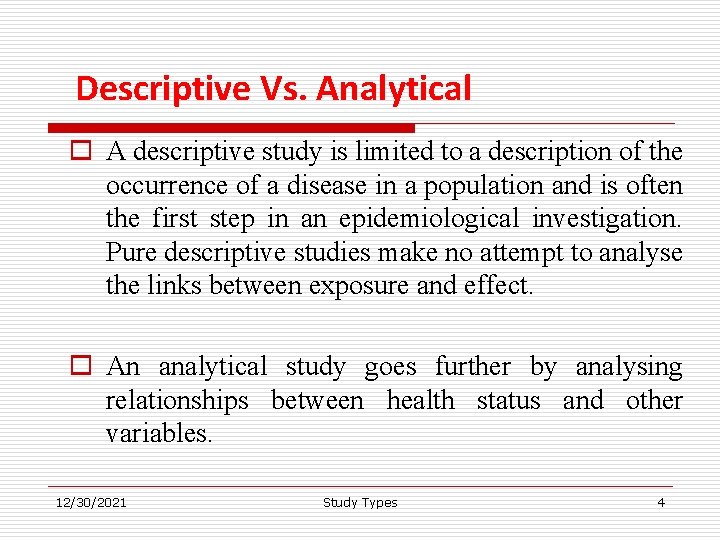
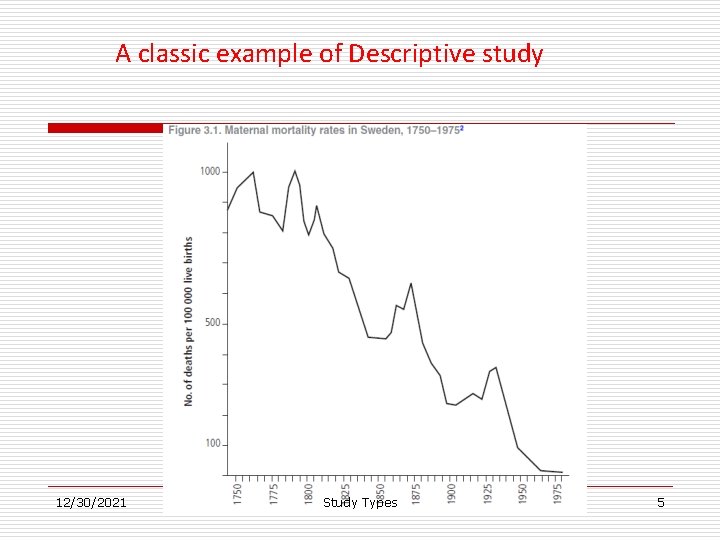
Descriptive Vs. Analytical o A descriptive study is limited to a description of the occurrence of a disease in a population and is often the first step in an epidemiological investigation. Pure descriptive studies make no attempt to analyse the links between exposure and effect. o An analytical study goes further by analysing relationships between health status and other variables. 12/30/2021 Study Types 4
A classic example of Descriptive study 12/30/2021 Study Types 5
Epidemiological Studies Analytical Descriptive Case Report Observational Interventional Case-series Cross. Sectional Clinical trials Ecologic Case. Control Field Trials Crosssectional Cohort Community Trials 12/30/2021 Study Types 6
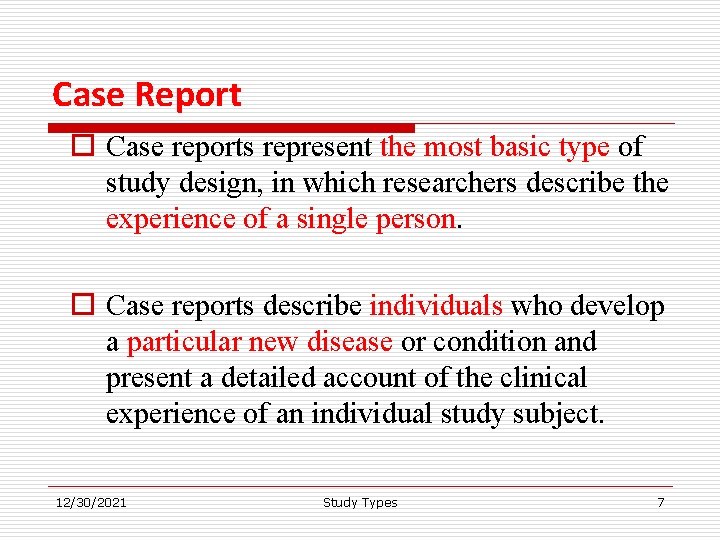
Case Report o Case reports represent the most basic type of study design, in which researchers describe the experience of a single person. o Case reports describe individuals who develop a particular new disease or condition and present a detailed account of the clinical experience of an individual study subject. 12/30/2021 Study Types 7
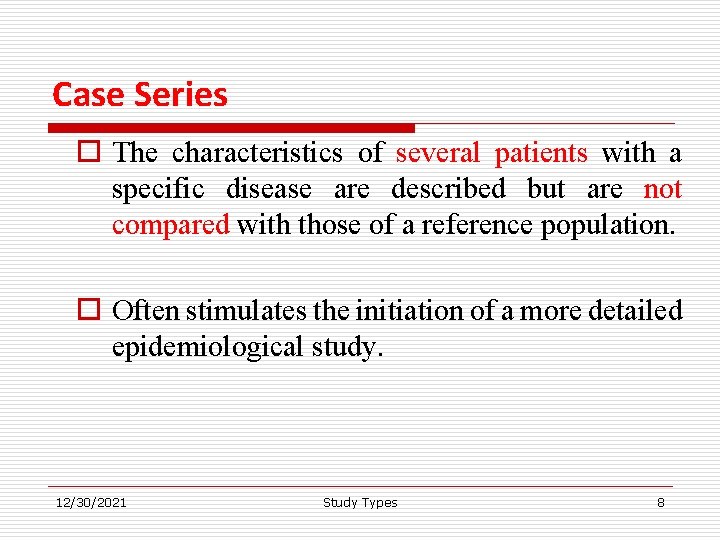
Case Series o The characteristics of several patients with a specific disease are described but are not compared with those of a reference population. o Often stimulates the initiation of a more detailed epidemiological study. 12/30/2021 Study Types 8
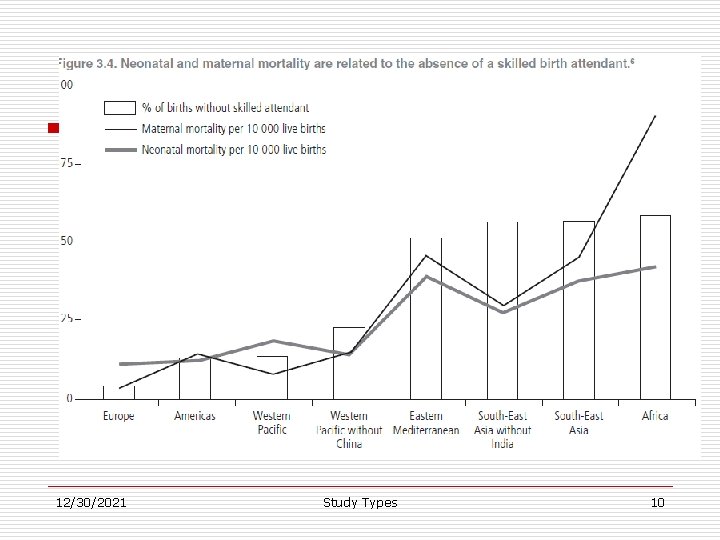
Ecological studies o In an ecological study, the units of analysis are groups of people rather than individuals. o Ecological studies can also be done by comparing populations in different places at the same time or, in a time series, by comparing the same population in one place at different times. 12/30/2021 Study Types 9
12/30/2021 Study Types 10
Ecological fallacy o An ecological fallacy or bias results if inappropriate conclusions are drawn on the basis of ecological data. o The bias occurs because the association observed between variables at the group level does not necessarily represent the association that exists at the individual level 12/30/2021 Study Types 11
Cross-sectional studies o Measure the prevalence of disease and thus are often called prevalence studies. o The measurements of exposure and effect are made at the same time. o The key question to be asked is whether the exposure precedes or follows the effect. 12/30/2021 Study Types 12
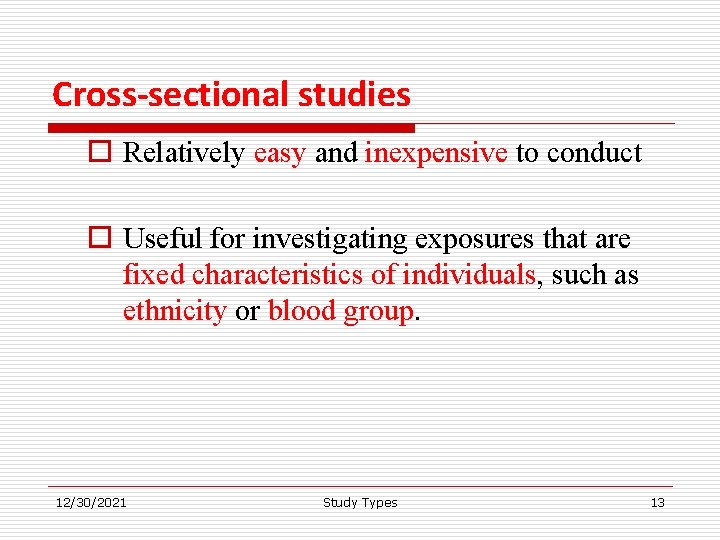
Cross-sectional studies o Relatively easy and inexpensive to conduct o Useful for investigating exposures that are fixed characteristics of individuals, such as ethnicity or blood group. 12/30/2021 Study Types 13
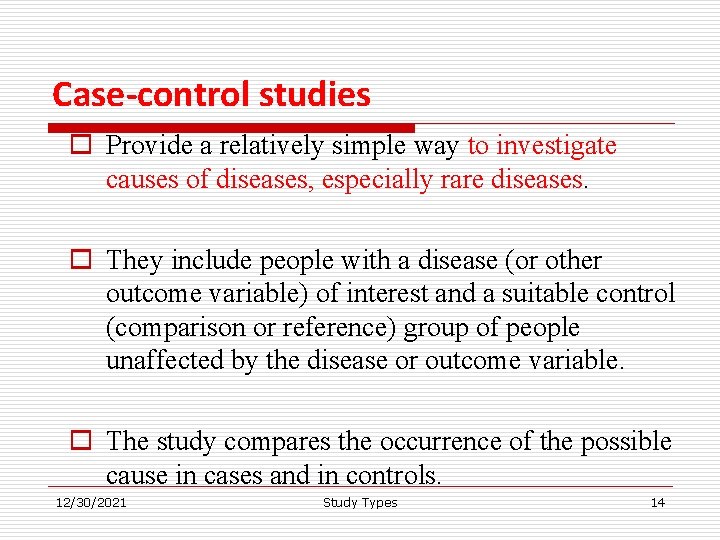
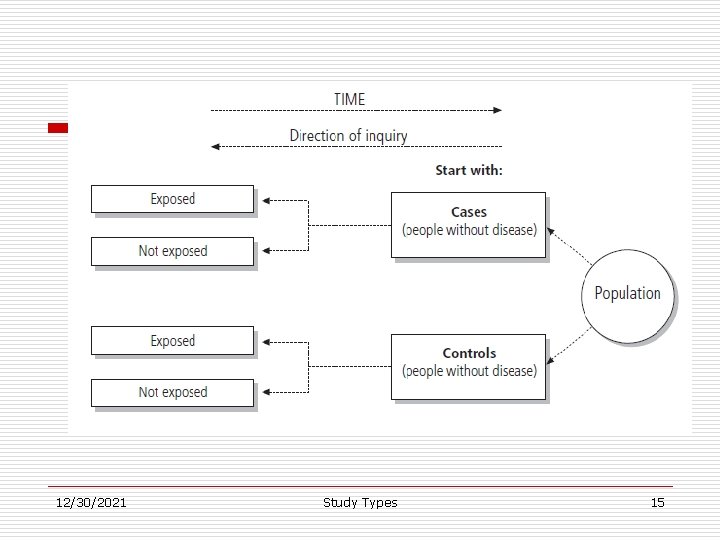
Case-control studies o Provide a relatively simple way to investigate causes of diseases, especially rare diseases. o They include people with a disease (or other outcome variable) of interest and a suitable control (comparison or reference) group of people unaffected by the disease or outcome variable. o The study compares the occurrence of the possible cause in cases and in controls. 12/30/2021 Study Types 14
12/30/2021 Study Types 15
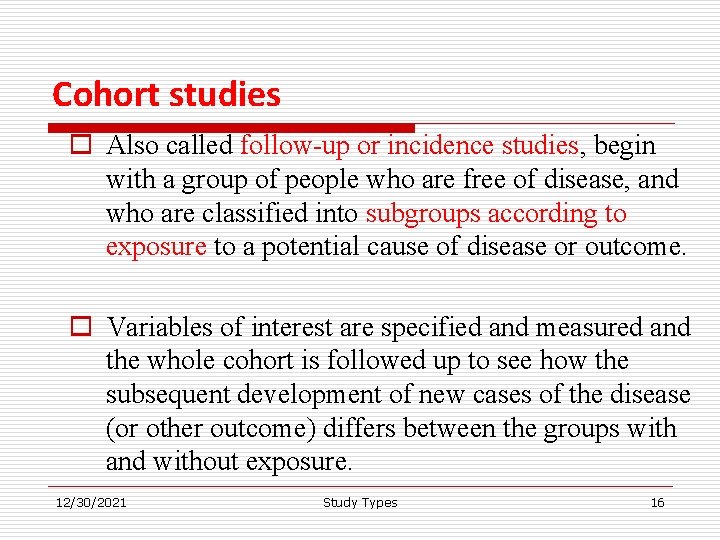
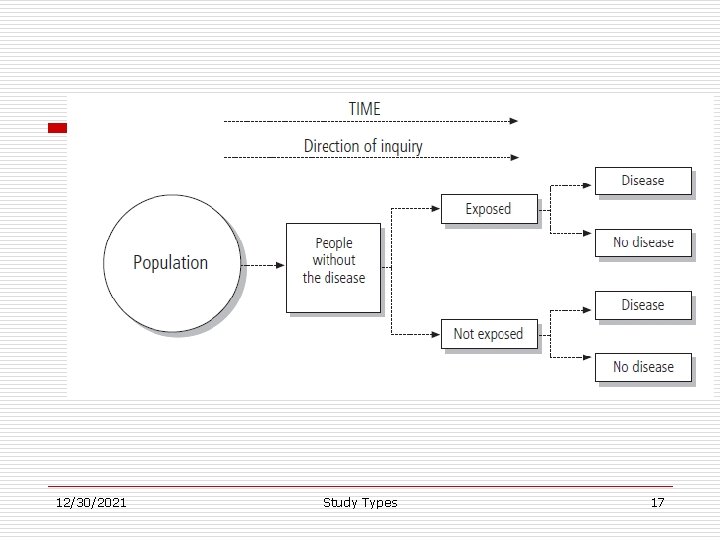
Cohort studies o Also called follow-up or incidence studies, begin with a group of people who are free of disease, and who are classified into subgroups according to exposure to a potential cause of disease or outcome. o Variables of interest are specified and measured and the whole cohort is followed up to see how the subsequent development of new cases of the disease (or other outcome) differs between the groups with and without exposure. 12/30/2021 Study Types 16
12/30/2021 Study Types 17
12/30/2021 Study Types 18
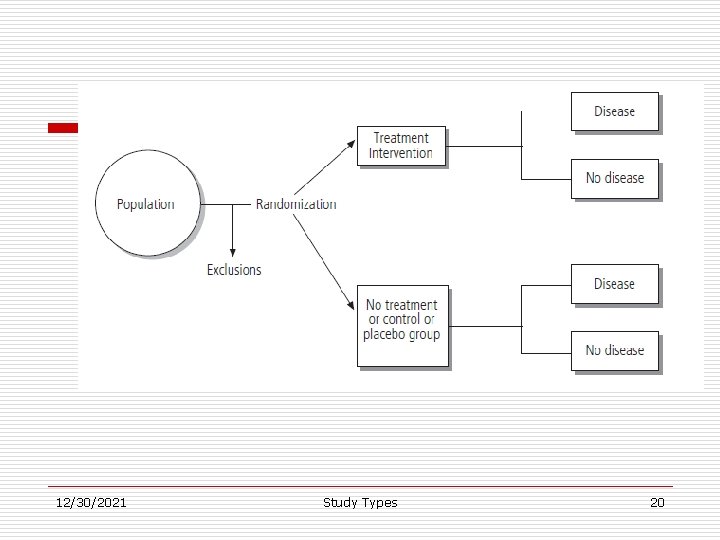
Randomized controlled trials o A randomized controlled trial is an epidemiological experiment designed to study the effects of a particular intervention. o Subjects in the study population are randomly allocated to intervention and control groups, and the results are assessed by comparing outcomes. 12/30/2021 Study Types 19
12/30/2021 Study Types 20
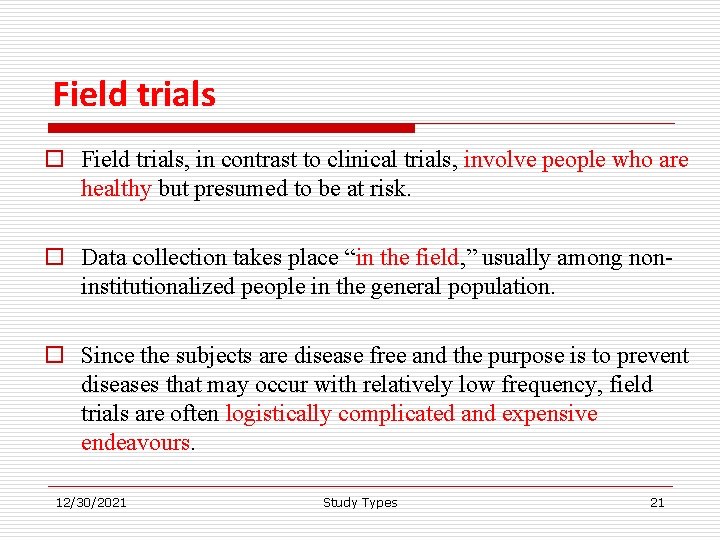
Field trials o Field trials, in contrast to clinical trials, involve people who are healthy but presumed to be at risk. o Data collection takes place “in the field, ” usually among noninstitutionalized people in the general population. o Since the subjects are disease free and the purpose is to prevent diseases that may occur with relatively low frequency, field trials are often logistically complicated and expensive endeavours. 12/30/2021 Study Types 21
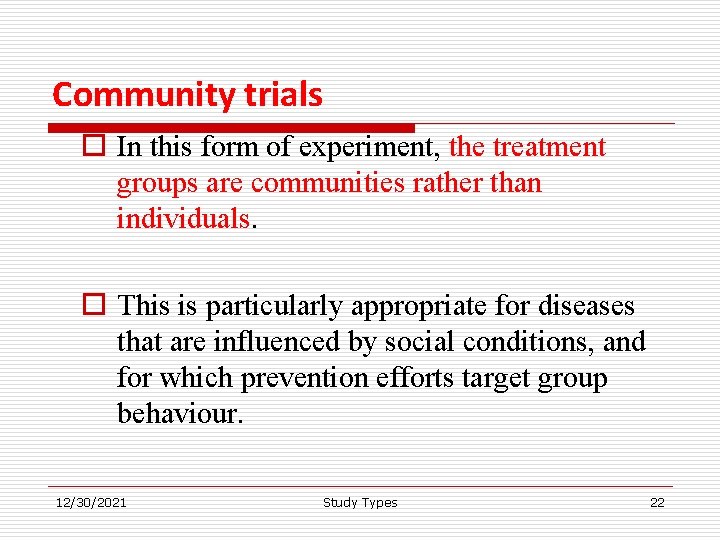
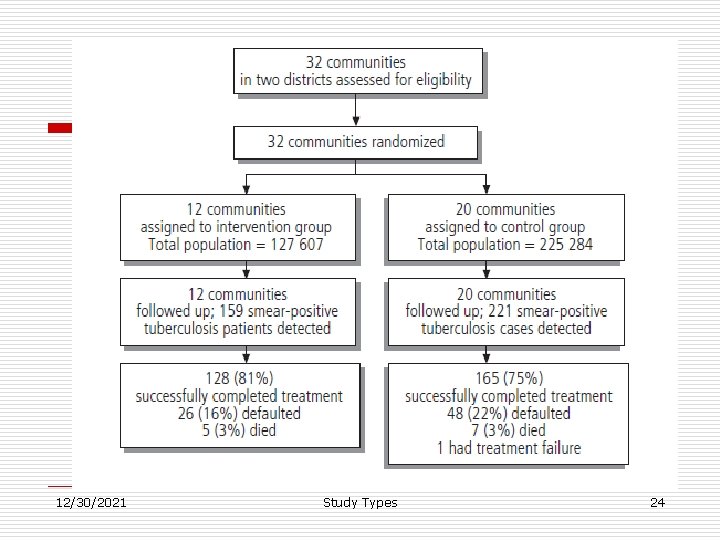
Community trials o In this form of experiment, the treatment groups are communities rather than individuals. o This is particularly appropriate for diseases that are influenced by social conditions, and for which prevention efforts target group behaviour. 12/30/2021 Study Types 22
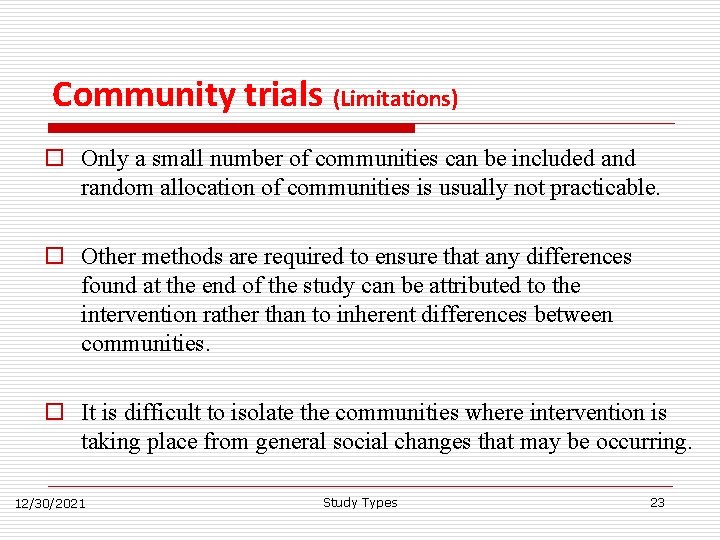
Community trials (Limitations) o Only a small number of communities can be included and random allocation of communities is usually not practicable. o Other methods are required to ensure that any differences found at the end of the study can be attributed to the intervention rather than to inherent differences between communities. o It is difficult to isolate the communities where intervention is taking place from general social changes that may be occurring. 12/30/2021 Study Types 23
12/30/2021 Study Types 24
Systematic review o A systematic review attempts to collate all empirical evidence that fits pre-specified eligibility criteria in order to answer a specific research question. o It uses explicit, systematic methods that are selected with a view to minimizing bias, thus providing more reliable findings from which conclusions can be drawn and decisions made. 12/30/2021 25
Thanks for your kind attention! Any questions? 12/30/2021 Study Types 26