
12262021 L Relyea PERIODIC TABLE 1 GOOD MORNING
12/26/2021 L. Relyea PERIODIC TABLE 1
GOOD MORNING! TAKE OUT YOUR NOTES FROM YESTERDAY AND BE READY TO START 12/26/2021 Todays agenda – November 8, 2016 L. Relyea Cornell notes Periodic Table Questions Review Element Bingo 2
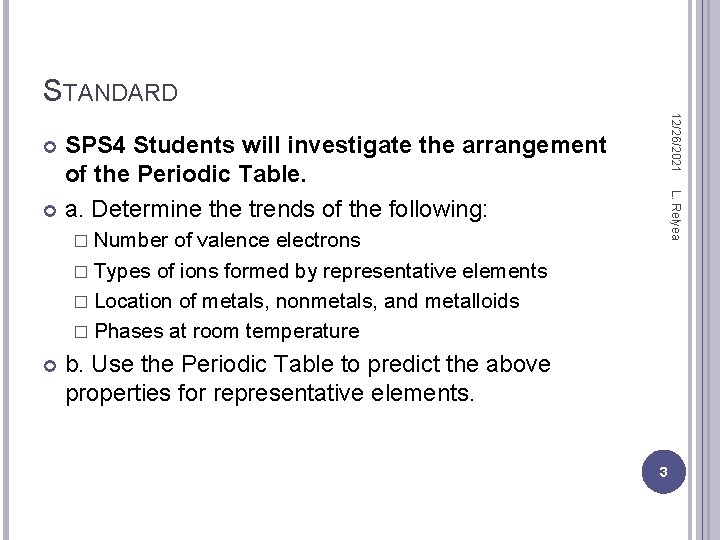
STANDARD 12/26/2021 SPS 4 Students will investigate the arrangement of the Periodic Table. a. Determine the trends of the following: L. Relyea � Number of valence electrons � Types of ions formed by representative elements � Location of metals, nonmetals, and metalloids � Phases at room temperature b. Use the Periodic Table to predict the above properties for representative elements. 3
ESSENTIAL QUESTION 12/26/2021 How and why is the periodic table arranged? L. Relyea 4
ORGANIZATION OF THE ELEMENTS 12/26/2021 Periodic Table 1 st organized by Dmitri Mendeleev in the 1860’s L. Relyea � There were only 60 known elements � First organized by atomic mass and chemical properties, now by atomic number � There were gaps in the table because other elements had not yet been discovered 5
PERIODIC LAW Also organized by metals, metalloids, nonmetals L. Relyea Elements are organized by atomic number and similar chemical properties 12/26/2021 � Metals tend to be solids at room temperature � Nonmetals tend to be gases at room temperature Exception – Hydrogen is a gas at room temperature � Metalloids are also called Semiconductors 6
PERIODS From left to right elements become less metallic L. Relyea Each row is a period 12/26/2021 7
GROUPS Each group has the same number of valence electrons Because of the valence electrons each group has similar properties L. Relyea Each column 12/26/2021 8
PERIODIC TABLE LABELING We are going to label it L. Relyea Need periodic table 12/26/2021 9
12/26/2021 L. Relyea ION FORMATION AND OXIDATION NUMBERS 10
OCTET RULE Octet Rule � Elements What do they do if they don’t have 8 electrons? L. Relyea want 8 electrons to be stable and happy 12/26/2021 11
IONS L. Relyea Elements will either lose or gain electrons from other elements in order to get the number of electrons they need to be stable 12/26/2021 12
IONS Easier to lose a few electrons L. Relyea The number of electrons lost or gained depends upon the number of valence electrons 12/26/2021 � Group 1 – gives up its 1 electron easily � Group 17 – wants to gain 1, not lose 7 13
IONS This causes the element to have either a positive or negative charge = Ion L. Relyea As an electron is lost or gained, the number of electrons no longer equal to the number of protons (atomic number) 12/26/2021 14
LOSE ELECTRON Ex: Lithium, valence electron = 1, Li+ Ex: Beryllium, valence electron = 2, Be+2 L. Relyea Lose an electron get a positive charge 12/26/2021 15
GAIN ELECTRON Ex: Fluorine, valence electrons = 7, F- Ex: Oxygen, valence electrons = 6, O 2 - L. Relyea Gain and electron get a negative charge 12/26/2021 16
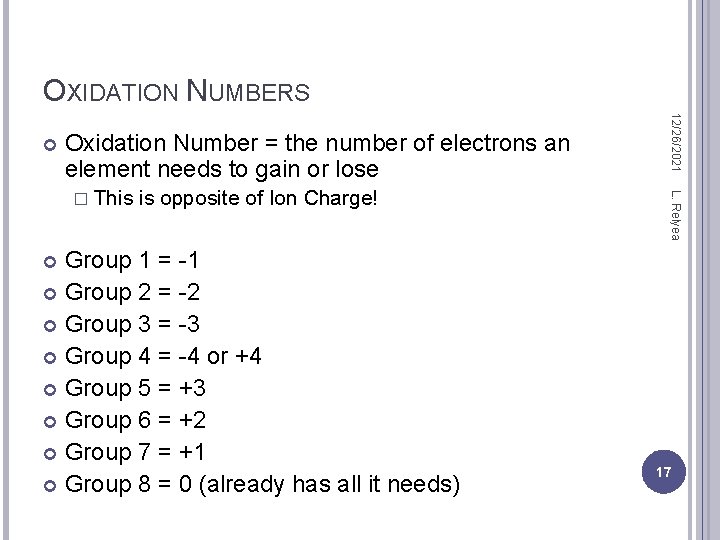
OXIDATION NUMBERS Oxidation Number = the number of electrons an element needs to gain or lose is opposite of Ion Charge! Group 1 = -1 Group 2 = -2 Group 3 = -3 Group 4 = -4 or +4 Group 5 = +3 Group 6 = +2 Group 7 = +1 Group 8 = 0 (already has all it needs) L. Relyea � This 12/26/2021 17
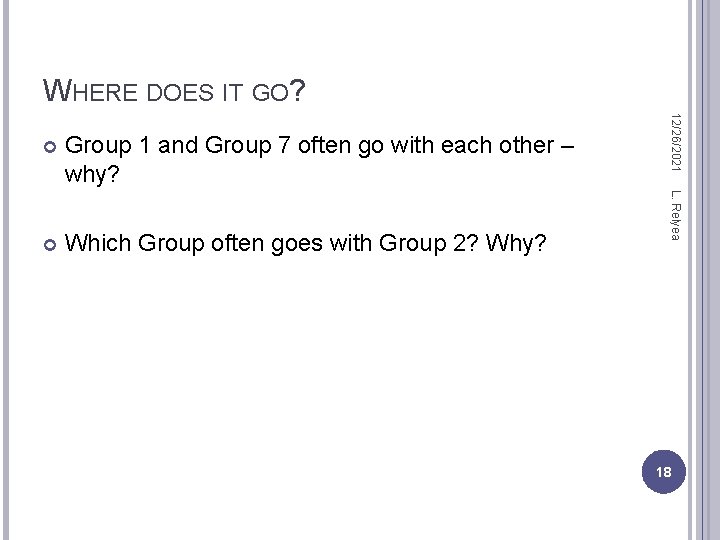
WHERE DOES IT GO? Which Group often goes with Group 2? Why? L. Relyea Group 1 and Group 7 often go with each other – why? 12/26/2021 18
- Slides: 18