
12182021 1 Chapter 3 Introduction To Risk Management

- Slides: 38
12/18/2021 1
Chapter 3 Introduction To Risk Management 12/18/2021 After studying this chapter, you should be able to; • Define risk management • Describe the steps in the risk man agent process • Explain the major risk control techniques • Explain the major risk financing techniques 2
Risk Management: • Risk management is a process to identify loss exposures faced by an organization or individual and to select the most appropriate techniques for treating such exposure. 12/18/2021 3
Objectives Of Risk Management: – Risk management has several important objectives. • Pre-loss objectives include the goals of the economy, reduction of anxiety, and meeting legal obligations. • Post-loss objectives include survival of the firm, continued operation, stability of earnings, continued growth, and social responsibility. 12/18/2021 4
Steps In The Risk Management Process: – There are four steps in the risk management process: • Identify loss exposure • Analyze the loss exposure • Select appropriate techniques for treating the loss exposures. • Implement and monitor the risk management program. 12/18/2021 5
Select The Appropriate Techniques For Treating The Loss Exposure. –Risk control: • Risk control refers to techniques that reduce the frequency and severity of losses. Major riskcontrol techniques include avoidance, loss prevention, and loss reduction. 12/18/2021 6
Risk Control • Avoidance: – Means that a loss exposure is never acquired or an existing loss exposure is abandoned. • Loss prevention: – Refers to measure that reduce the frequency of a particular loss. • Loss reduction: – Refers to measures that reduce the severity of a loss after it occurs. 12/18/2021 7
Risk Financing • Risk financing refers to techniques that provide for the finding of losses after they occur. Major risk financing techniques include retention, noninsurance transfers, and commercial insurance. 12/18/2021 8
Risk Financing; Retention Means that the firm retains part or all of the losses that result from a given loss exposure. This technique can be used if no other method of treatment is available, the worse possible loss is not serious, and losses are highly predictable. Losses can be paid out of the firm’s current net income; an unfunded or funded reserve can be established to pay losses; a credit line with a bank can provide funds to pay losses; or the firm can form a captive insurer. 12/18/2021 9
Retention – Advantage of retention: • The advantages of retention are the savings of money on insurance premiums, lower expenses, greater incentive for loss prevention, and increased cash flow. – Disadvantage: • Major disadvantages are possible higher losses that exceed the loss component in insurance premiums, possible higher expenses if loss-control and claims personnel must be hired, and possible higher taxes. 12/18/2021 10
Retention – Determining retention level : • The dollar amount of losses that the firm will retain – Paying losses • Current net income • Unfunded revenue • Funded revenue • Credit line 12/18/2021 11
Captive Insurer A captive insurer is an insurer owned by a parent firm for the purpose of insuring the parent firm’s loss exposure. – A single parent captive (also called pure captive) is an insurer owned by only one parent. – An association or group captive is an insurer owned by several parents. 12/18/2021 12
Captive Insurer Reasons forming captive insurers: –Difficulty in obtaining insurance –Lower costs –Easier access to a reinsurer –Formation of a profit center. 12/18/2021 13
Captive Insurer Income tax treatment of captives –Premiums paid to a single parent captive are not income-tax deductible. –Premiums paid to group captive are usually income-tax deductible. 12/18/2021 14
Self Insurance Self-Insurance –Self-insurance or self-funding is a special form of planned retention by which part or all of a given loss exposure is retained by the firm. 12/18/2021 15
Risk Retention Group Risk retention group –Is a group captive that can write any type of liability coverage except employer liability, workers compensation, and personal lines. 12/18/2021 16
Retention Cont…… – Advantage; • Save money • Lower expenses • Encourage loss prevention • Increase cash flow – Disadvantage; • Possible higher losses • Possible higher expenses • [possible higher taxes 12/18/2021 17
Noninsurance Transfer Noninsurance transfer; –Noninsurance transfers are methods other than insurance by which a pure risk and its potential financial consequences are transferred to another party. 12/18/2021 18
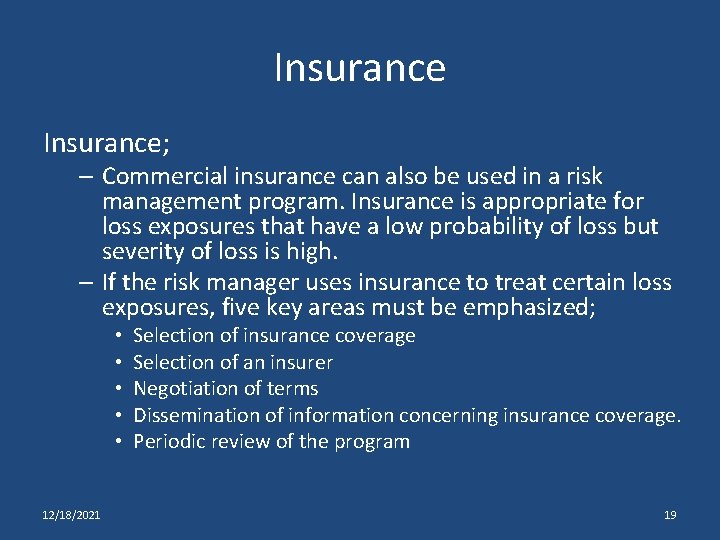
Insurance; – Commercial insurance can also be used in a risk management program. Insurance is appropriate for loss exposures that have a low probability of loss but severity of loss is high. – If the risk manager uses insurance to treat certain loss exposures, five key areas must be emphasized; • • • 12/18/2021 Selection of insurance coverage Selection of an insurer Negotiation of terms Dissemination of information concerning insurance coverage. Periodic review of the program 19
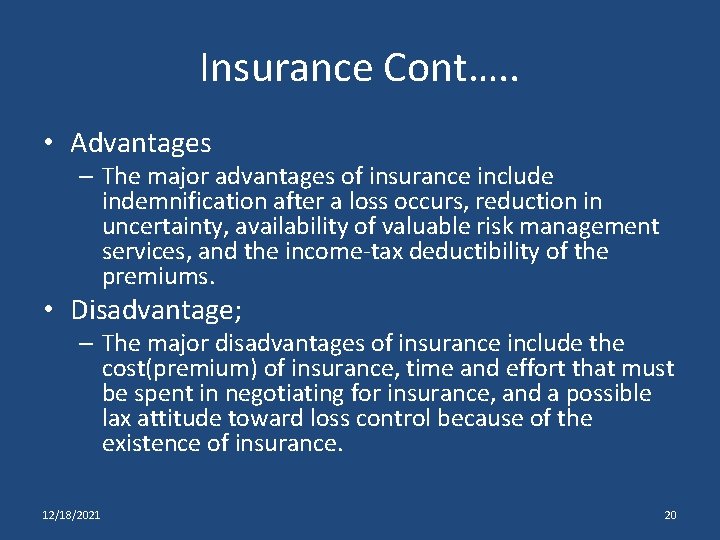
Insurance Cont…. . • Advantages – The major advantages of insurance include indemnification after a loss occurs, reduction in uncertainty, availability of valuable risk management services, and the income-tax deductibility of the premiums. • Disadvantage; – The major disadvantages of insurance include the cost(premium) of insurance, time and effort that must be spent in negotiating for insurance, and a possible lax attitude toward loss control because of the existence of insurance. 12/18/2021 20
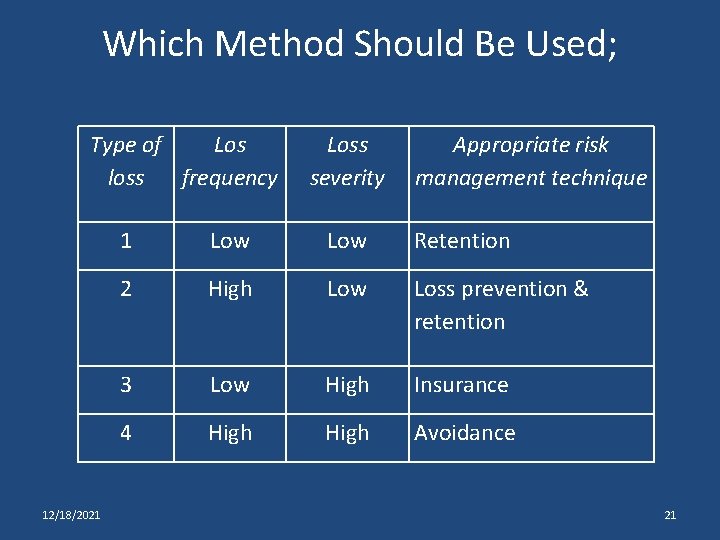
Which Method Should Be Used; Type of Los loss frequency 12/18/2021 Loss severity Appropriate risk management technique 1 Low Retention 2 High Low Loss prevention & retention 3 Low High Insurance 4 High Avoidance 21
Implement And Monitor Risk Management Program; • It involves preparation of risk management policy statement, close cooperation with other individuals and departments, and periodic review of the entire risk management program. – Risk management policy statement ; • It outlines the risk management objectives of the firm, as well as company policy with respect to treatment of loss exposures. 12/18/2021 22
Personal Risk Management • It refers to the identification of pure risks faced by and individual or family, and to the selection of the most appropriate technique for treating such risks. – Steps in personal risk management; • Identify loss exposure • Analyze the loss exposure • Select appropriate techniques for treating the loss exposures, and • Implement and review program periodically 12/18/2021 23
Steps in Personal Risk Management • Identify loss exposure; –Personal loss exposures –Property loss exposure –Liability loss exposures 12/18/2021 24
Steps in Personal Risk Management • Analyze the loss exposure; –The frequency and severity of potential losses should be estimated so that the most appropriate technique can be used to deal with the exposure. 12/18/2021 25
Steps in Personal Risk Management • Select appropriate techniques for treating the loss exposures; – Avoidance – Risk control – Retention – Noninsurance transfer – Insurance 12/18/2021 26
• Implement and monitor the program periodically; – At least every two or three years, you should determine whether all major loss exposures are adequately covered. You should also review your program at major events in your life, such as a divorce, birth of a child, purchase of a home, change of jobs, or death of a spouse or family member. 12/18/2021 27
Chapter 3 a Identifying Loss Exposures; The first step in the risk management process is to identify all major and minor loss exposures. This step involves a painstaking analysis of all potential losses. 12/18/2021 28
1. Property Loss Exposure Building, plants, other structure Furniture, equipment, supplies Inventory Accounts receivable, valuable papers and records • Company vehicles, planes, boats, mobile equipment • • 12/18/2021 29
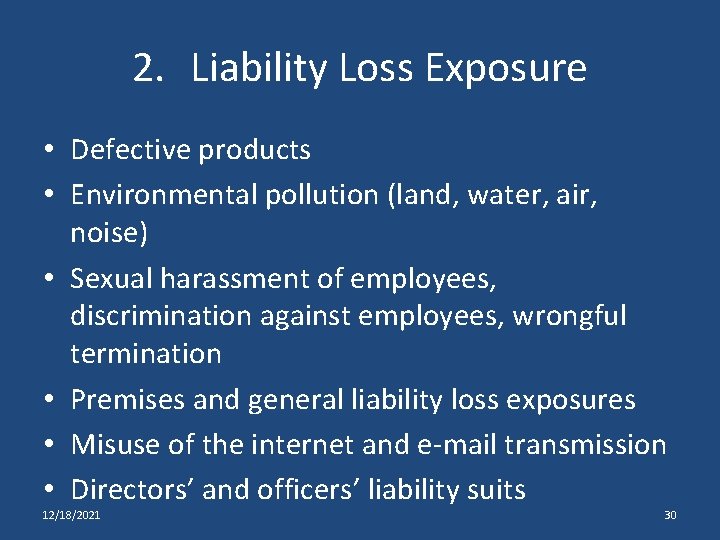
2. Liability Loss Exposure • Defective products • Environmental pollution (land, water, air, noise) • Sexual harassment of employees, discrimination against employees, wrongful termination • Premises and general liability loss exposures • Misuse of the internet and e-mail transmission • Directors’ and officers’ liability suits 12/18/2021 30
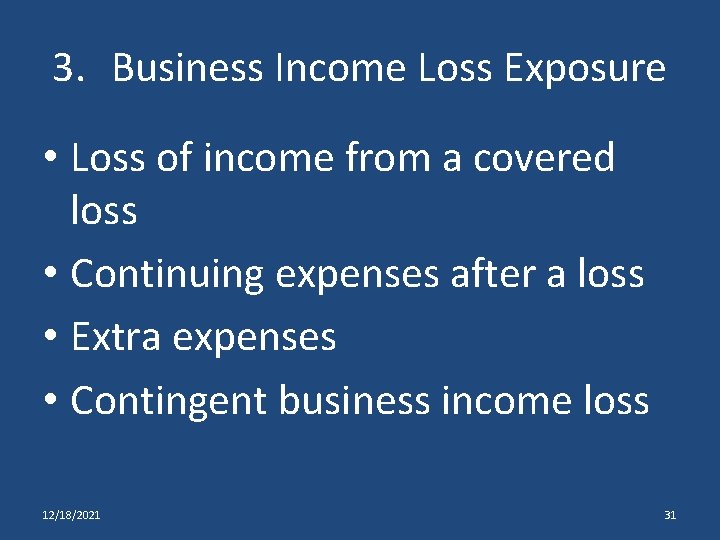
3. Business Income Loss Exposure • Loss of income from a covered loss • Continuing expenses after a loss • Extra expenses • Contingent business income loss 12/18/2021 31
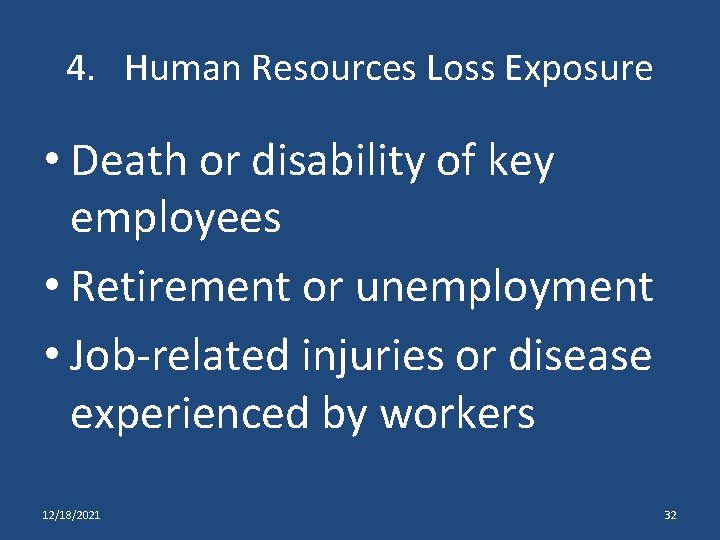
4. Human Resources Loss Exposure • Death or disability of key employees • Retirement or unemployment • Job-related injuries or disease experienced by workers 12/18/2021 32
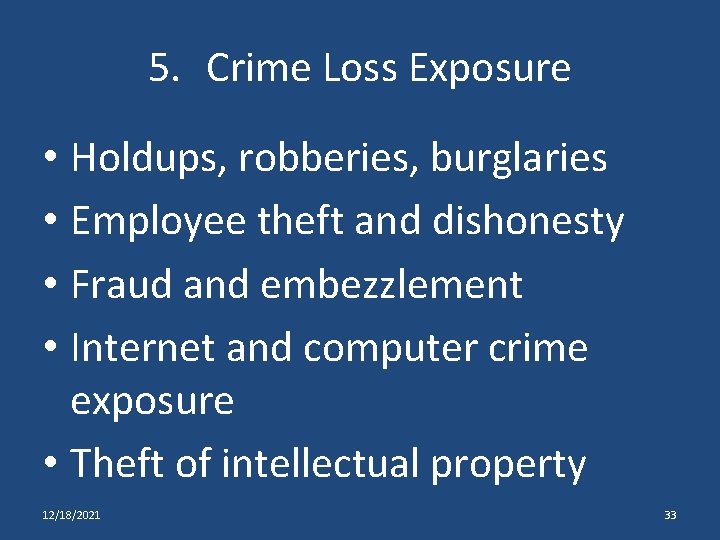
5. Crime Loss Exposure • Holdups, robberies, burglaries • Employee theft and dishonesty • Fraud and embezzlement • Internet and computer crime exposure • Theft of intellectual property 12/18/2021 33
6. Employee Benefit Loss Exposure • Failure to comply with government regulations • Violation of fiduciary responsibilities • Group life and health and retirement plan exposures • Failure to pay promised benefits 12/18/2021 34
7. Foreign loss exposure • Acts of terrorism • Plants, business property, inventory • Foreign currency risks • Kidnapping of key personal • Political risks 12/18/2021 35
8. Market reputation and public image of the company 9. Failure to comply with government laws and regulations 12/18/2021 36
Sources of Information to Identify Loss Exposure • Risk analysis questionnaires; • Physical inspection; • Flowchart; • Financial statement; • Historical loss data; 12/18/2021 37
Key Concepts and Terms • Association or group captive • Avoidance • Captive insurer • Cost of risk • Deductible • Excess insurance • Loss exposure • Loss frequency • Loss prevention • Loss reduction • Loss severity • Manuscript policy • Maximum possible loss 12/18/2021 • • • Maximum probable loss Noninsurance transfer Personal risk management Retention level Risk control Risk financing Risk management Risk retention group Self-insurance Single parent captive (pure captive) 38