
12172021 Using knowledge Scripts False memory Eyewitness memory
- Slides: 23
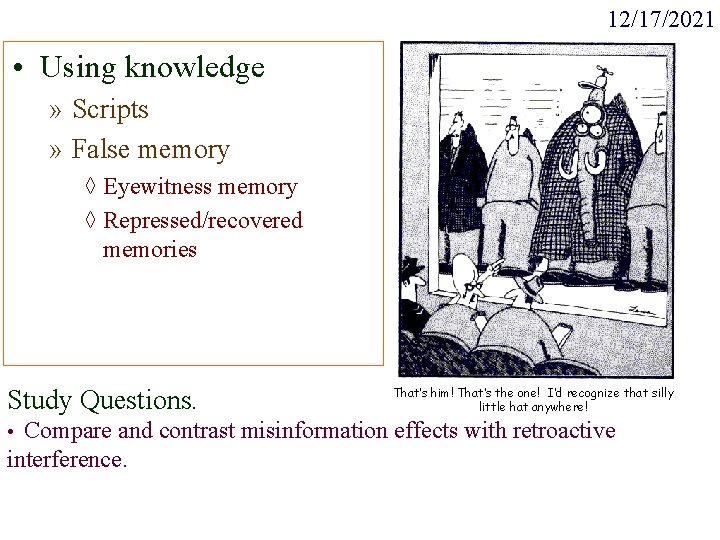
12/17/2021 • Using knowledge » Scripts » False memory ◊ Eyewitness memory ◊ Repressed/recovered memories Study Questions. That’s him! That’s the one! I’d recognize that silly little hat anywhere! Compare and contrast misinformation effects with retroactive interference. •
Using Knowledge • Scripts » Schema for common activities » Bower et al. (1977) ◊ Asked people to write down component actions of scripts ◊ Determined which were most central or typical » When events happen that are not in a script, they can be either: ◊ More salient and more likely to be remembered – if they are important story events that interrupt the usual routine of the script E. g. , The waiter trips and spills his tray. (restaurant script) ◊ Less salient and less likely to be remembered – if they are largely irrelevant “asides” E. g. , The was a picture of a flower on the menu. (restaurant script)
Using Knowledge • Scripts » Smith & Graesser (1981) ◊ Memory for typical and atypical script actions ◊ Found better memory for atypical events » Schank & Abelson (1977) ◊ Headers: Words that activate a script – E. g. , Menu, Waiter, etc. activate restaurant script – Two headers will ‘prime’ a script ◊ Frames: Details about specific events in the script ◊ Default value: The common, typical concept that occupies a frame – Unmentioned details get filled in with default values ◊ Cognitive ergonomics
Using Knowledge • Scripts » Bower, Black & Turner (1979) ◊ Participants read 18 stories based on scripts ◊ 1, 2, or 3 stories based on each script (I. e. , 3 versions ) ◊ Not all actions or events included in each story ◊ Recognition test for memory for stories
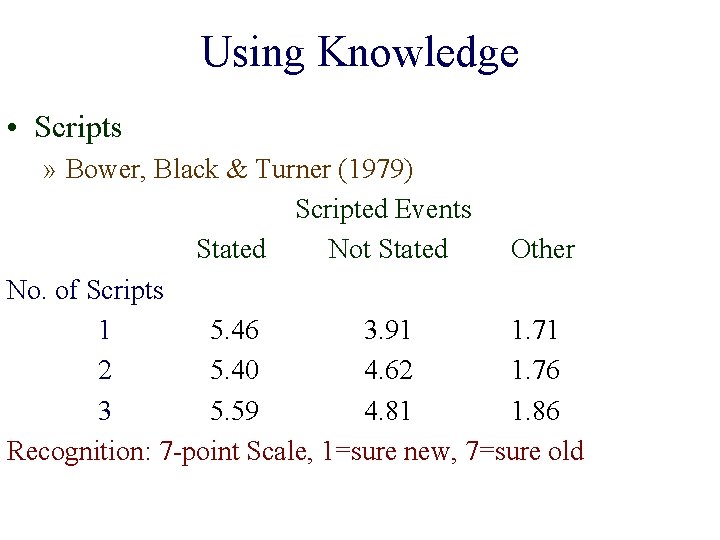
Using Knowledge • Scripts » Bower, Black & Turner (1979) Scripted Events Stated Not Stated Other No. of Scripts 1 5. 46 3. 91 1. 71 2 5. 40 4. 62 1. 76 3 5. 59 4. 81 1. 86 Recognition: 7 -point Scale, 1=sure new, 7=sure old
Using Knowledge • Scripts » The Script-Pointer-Plus-Tag theory ◊ When a script is activated: – Store script in episodic memory – Script represents both stated and inferred typical events – “Tag on” atypical actions of story to script
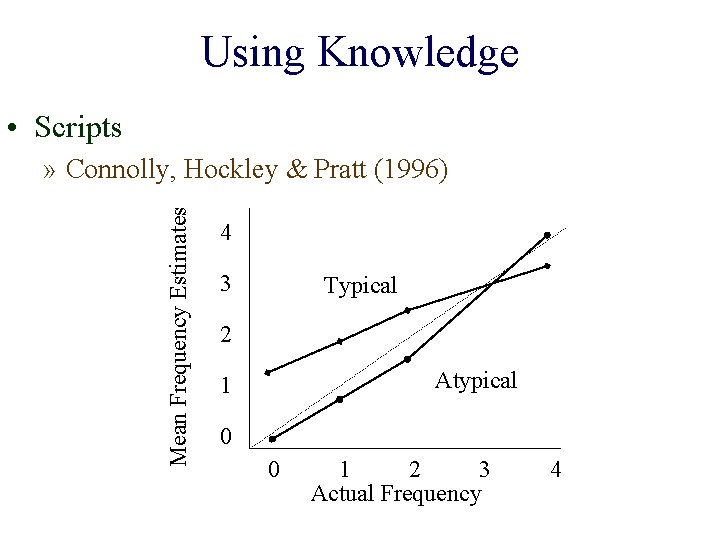
Using Knowledge • Scripts » The Script-Pointer-Plus-Tag theory ◊ Connolly, Hockley & Pratt (1996) – presented 6 different stories based on scripted routines – typical and atypical actions presented 0 -4 times – surprise frequency test - subjects asked to judge how often different actions were presented
Using Knowledge • Scripts Mean Frequency Estimates » Connolly, Hockley & Pratt (1996) 4 3 Typical 2 Atypical 1 0 0 1 2 3 Actual Frequency 4
Using Knowledge • False Memory <Video: 60 Minutes: Eyewitness testimony >
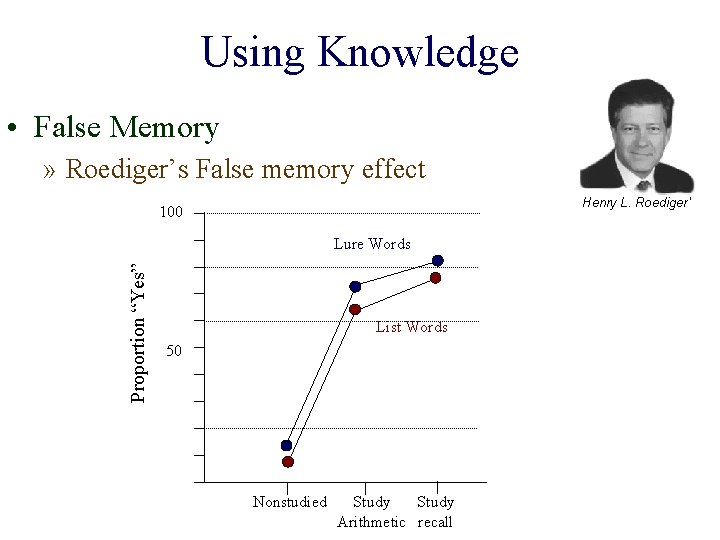
Using Knowledge • False Memory » Roediger’s False memory effect ◊ Study list of related words: – E. g. , Royal, Queen, Palace, Crown, etc. ◊ A period of distraction – E. g. (8 X 6) / 3 = (3 + 7 - 2) X 3 = – Etc. ◊ Test recall on “list” words – E. g. , Royal, Queen, . . ◊ And “lure” words – E. g. , King (did not appear in original list) Henry L. Roediger'
Using Knowledge • False Memory » Roediger’s False memory effect Henry L. Roediger' 100 Proportion “Yes” Lure Words List Words 50 Nonstudied Study Arithmetic recall
Using Knowledge • False Memory » Leading Questions <Video: When Eyes Deceive >
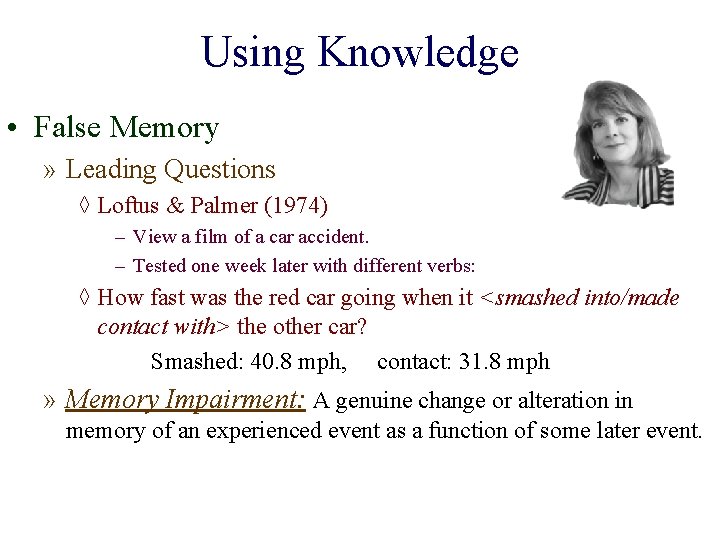
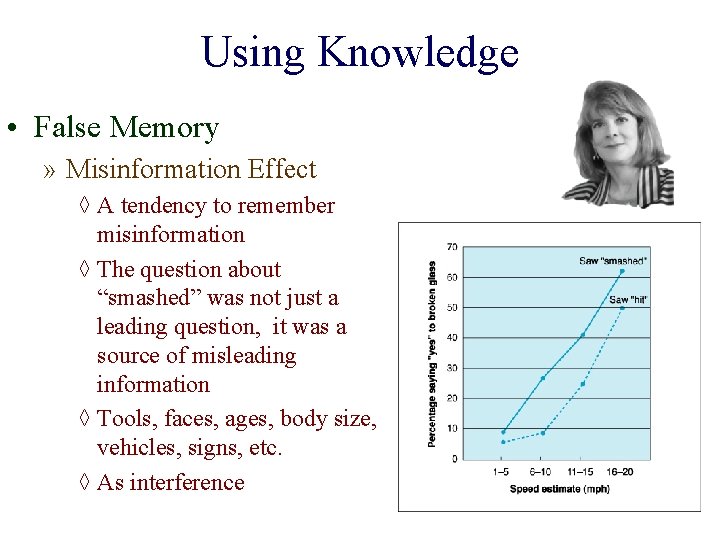
Using Knowledge • False Memory » Leading Questions ◊ Loftus & Palmer (1974) – View a film of a car accident. – Tested one week later with different verbs: ◊ How fast was the red car going when it <smashed into/made contact with> the other car? Smashed: 40. 8 mph, contact: 31. 8 mph » Memory Impairment: A genuine change or alteration in memory of an experienced event as a function of some later event.
Using Knowledge • False Memory » Misinformation Effect ◊ A tendency to remember misinformation ◊ The question about “smashed” was not just a leading question, it was a source of misleading information ◊ Tools, faces, ages, body size, vehicles, signs, etc. ◊ As interference
Using Knowledge • False Memory » Source Misattribution: error in identifying the true source of a memory » Misinformation Acceptance: accepting that additional information was part of the original memory » Confidence and accuracy ◊ There is little or no relationship between memory accuracy and confidence ◊ Juror instructions
Using Knowledge • False Memory » In children <Video: Steve Ceci - Children’s eyewitness testimony >
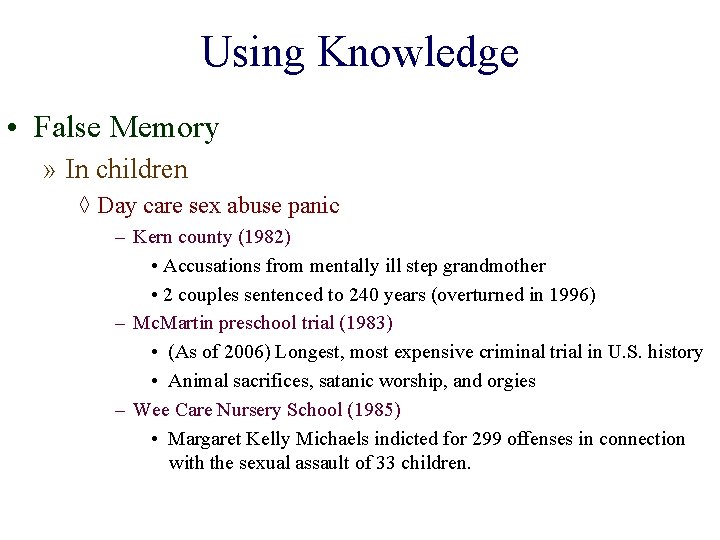
Using Knowledge • False Memory » In children ◊ Day care sex abuse panic – Kern county (1982) • Accusations from mentally ill step grandmother • 2 couples sentenced to 240 years (overturned in 1996) – Mc. Martin preschool trial (1983) • (As of 2006) Longest, most expensive criminal trial in U. S. history • Animal sacrifices, satanic worship, and orgies – Wee Care Nursery School (1985) • Margaret Kelly Michaels indicted for 299 offenses in connection with the sexual assault of 33 children.
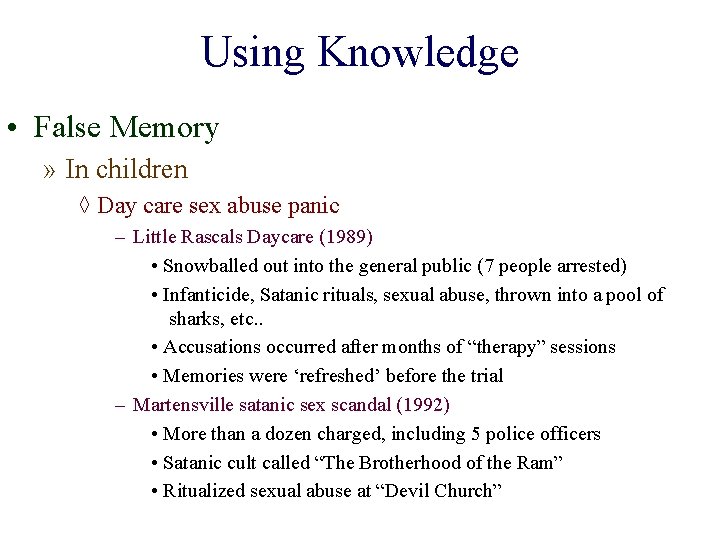
Using Knowledge • False Memory » In children ◊ Day care sex abuse panic – Little Rascals Daycare (1989) • Snowballed out into the general public (7 people arrested) • Infanticide, Satanic rituals, sexual abuse, thrown into a pool of sharks, etc. . • Accusations occurred after months of “therapy” sessions • Memories were ‘refreshed’ before the trial – Martensville satanic sex scandal (1992) • More than a dozen charged, including 5 police officers • Satanic cult called “The Brotherhood of the Ram” • Ritualized sexual abuse at “Devil Church”
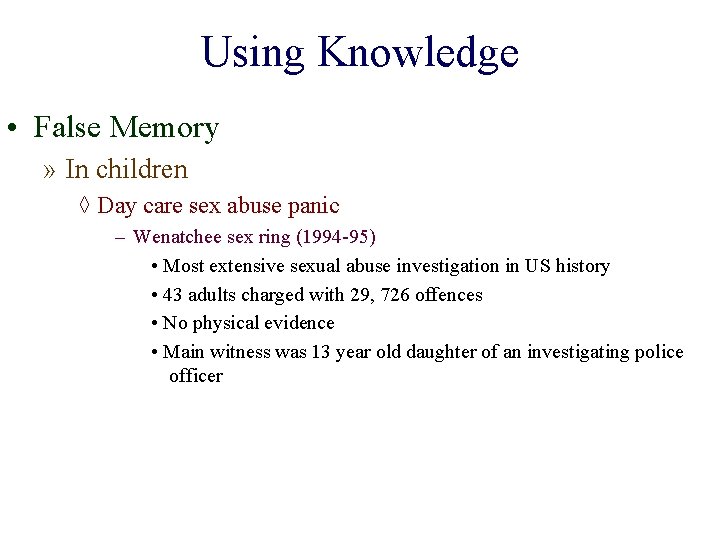
Using Knowledge • False Memory » In children ◊ Day care sex abuse panic – Wenatchee sex ring (1994 -95) • Most extensive sexual abuse investigation in US history • 43 adults charged with 29, 726 offences • No physical evidence • Main witness was 13 year old daughter of an investigating police officer
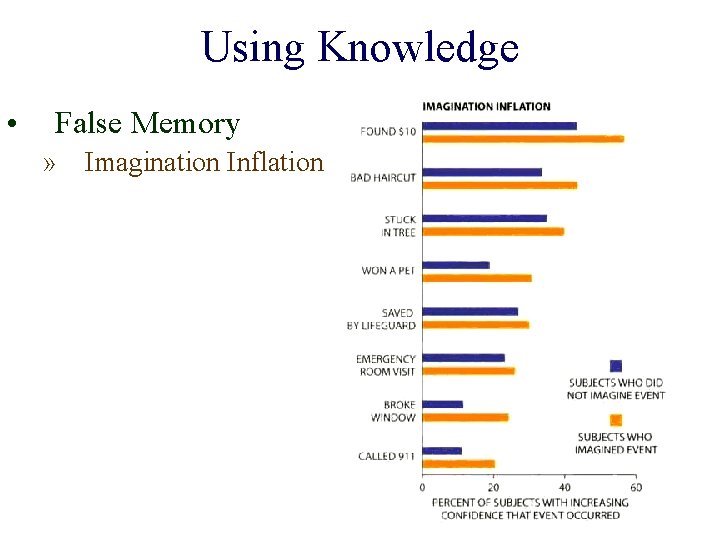
Using Knowledge • False Memory » Implanted Memory ◊ Meeting Bugs Bunny at Disneyland ◊ Being lost in the mall ◊ Being abducted by aliens » Imagination Inflation ◊ Rated the likelihood that 40 events happened to them ◊ 2 weeks late, asked to imagine that they did happen ◊ Later responded to the original list
Using Knowledge • False Memory » Imagination Inflation
Using Knowledge • False Memory » Stronger memory distortions ◊ Repeated exposure ◊ Repeated recall of false information ◊ Repeated questioning ◊ Imagery/hypnosis ◊ Occur even when warned about them » Repressed and recovered memory