
12 th MSQH Surveyors Training Programme STANDARDS 9
- Slides: 54
12 th MSQH Surveyors’ Training Programme STANDARDS 9 B and 4 November 13 2019 th Hospital Pusrawi
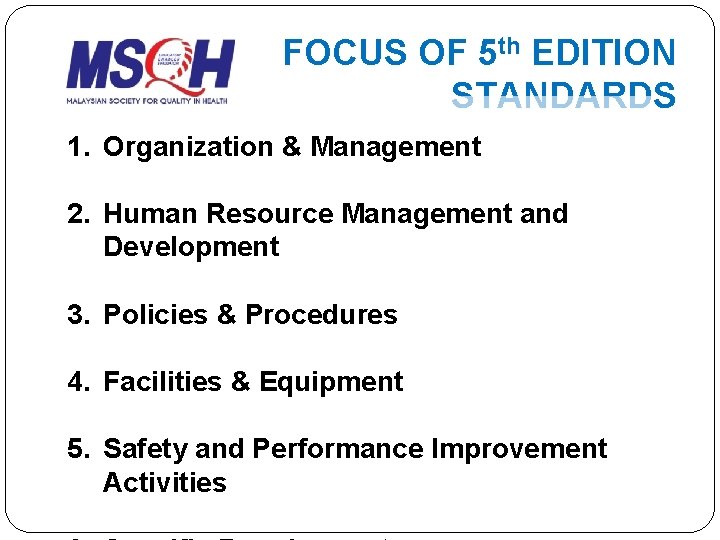
FOCUS OF 5 th EDITION STANDARDS 1. Organization & Management 2. Human Resource Management and Development 3. Policies & Procedures 4. Facilities & Equipment 5. Safety and Performance Improvement Activities
What are they? SERVICE STANDARD 9 B : CLINICAL SERVICES – SURGICAL RELATED SERVICES
What are they? SERVICE STANDARD 13 : CRITICAL CARE SERVICES – ICU/CICU/CRW/HDU/BU RNS CARE UNIT
Definition of Accreditation The process in which an entity, separate and distinct from the hospital, (usually nongovernmental), assesses the hospital to determine if it meets a set of standards designed to improve quality and safety of care
Why the need for Accreditation? To ensure the correct implementation of health interventions according to established norms and procedures, which satisfy the health system’s clients and maximize health outcomes without creating health risks or
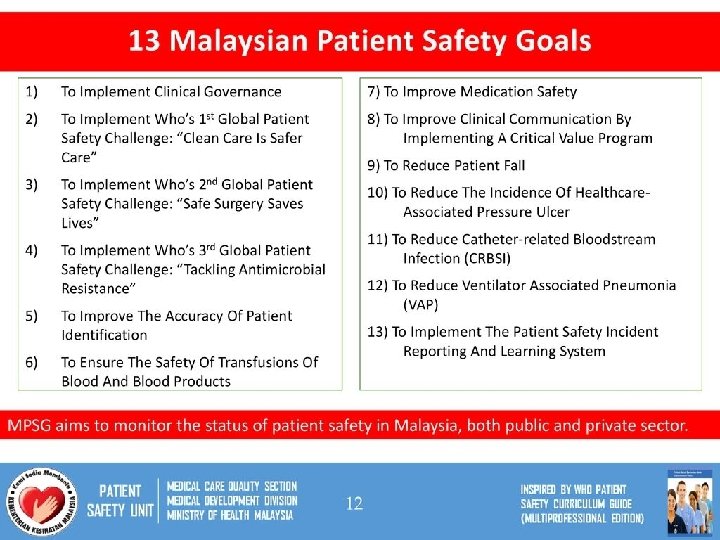
13 Malaysian Patient Safety Goals 1. 2. 3. To implement Clinical Governance To implement WHO’s 1 st Global Patient Safety Challenge: “Clean Care is Safer Care” To implement WHO’s 2 nd Global Patient Safety Challenge: “Safe Surgery Saves Lives”
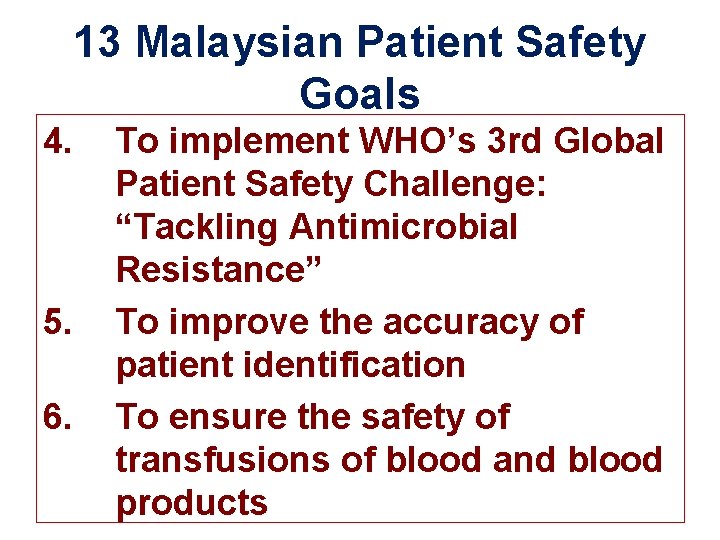
13 Malaysian Patient Safety Goals 4. 5. 6. To implement WHO’s 3 rd Global Patient Safety Challenge: “Tackling Antimicrobial Resistance” To improve the accuracy of patient identification To ensure the safety of transfusions of blood and blood products
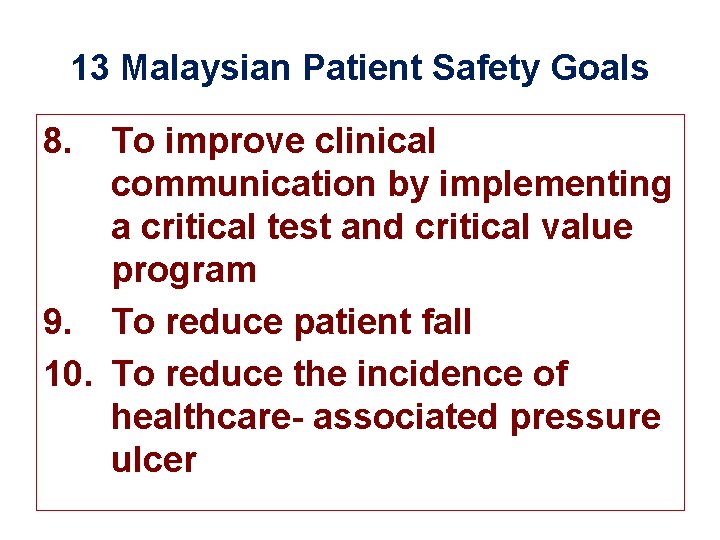
13 Malaysian Patient Safety Goals 8. To improve clinical communication by implementing a critical test and critical value program 9. To reduce patient fall 10. To reduce the incidence of healthcare- associated pressure ulcer
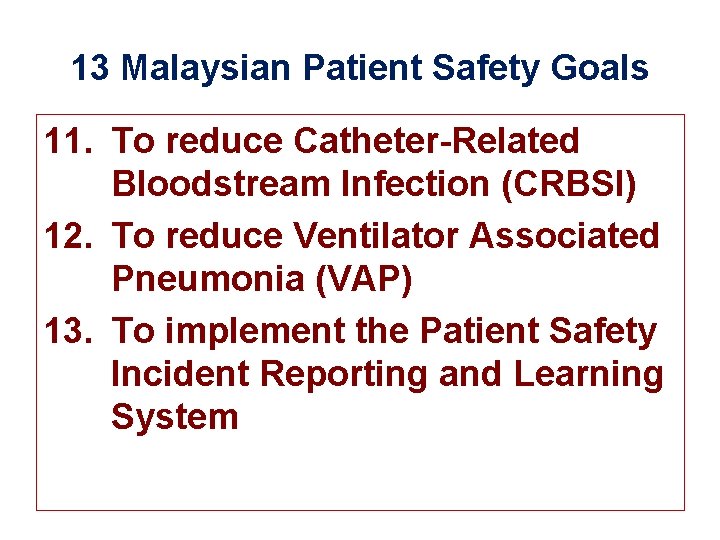
13 Malaysian Patient Safety Goals 11. To reduce Catheter-Related Bloodstream Infection (CRBSI) 12. To reduce Ventilator Associated Pneumonia (VAP) 13. To implement the Patient Safety Incident Reporting and Learning System
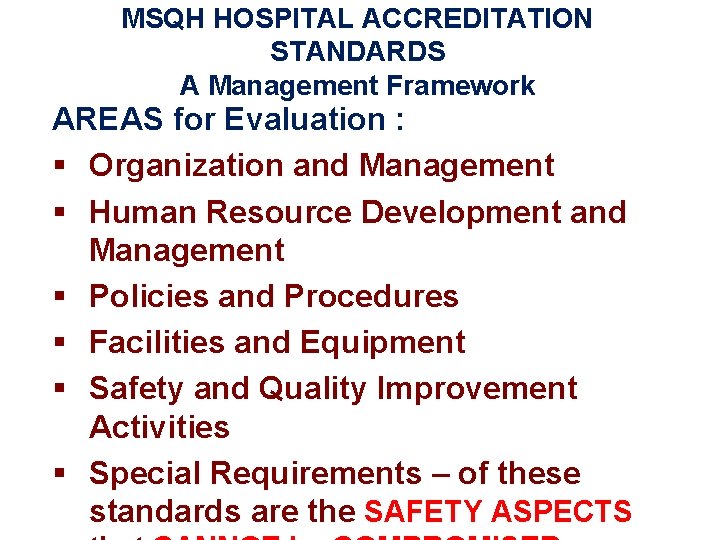
MSQH HOSPITAL ACCREDITATION STANDARDS A Management Framework AREAS for Evaluation : § Organization and Management § Human Resource Development and Management § Policies and Procedures § Facilities and Equipment § Safety and Quality Improvement Activities § Special Requirements – of these standards are the SAFETY ASPECTS
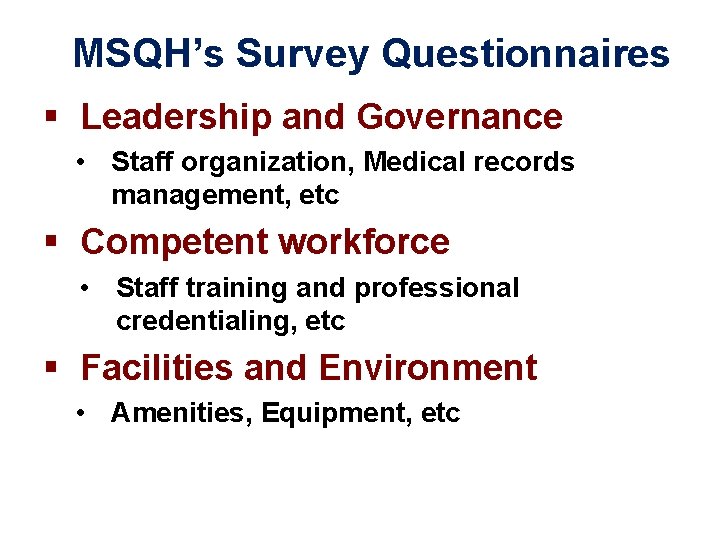
MSQH’s Survey Questionnaires § Leadership and Governance • Staff organization, Medical records management, etc § Competent workforce • Staff training and professional credentialing, etc § Facilities and Environment • Amenities, Equipment, etc
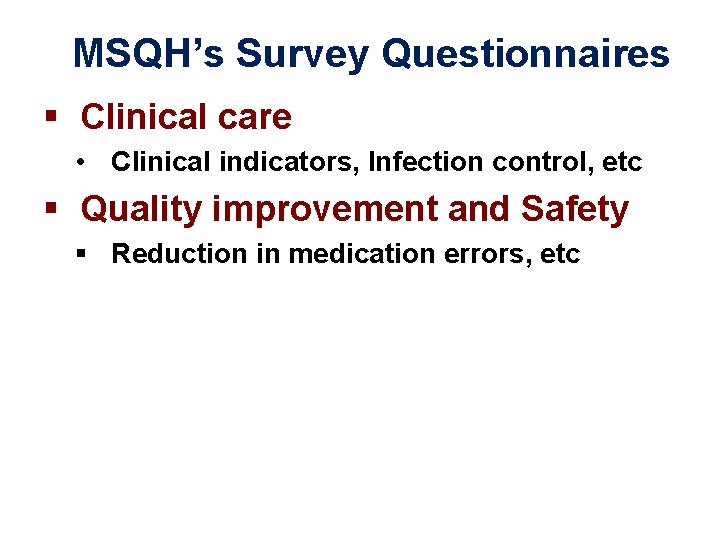
MSQH’s Survey Questionnaires § Clinical care • Clinical indicators, Infection control, etc § Quality improvement and Safety § Reduction in medication errors, etc
Special Requirements
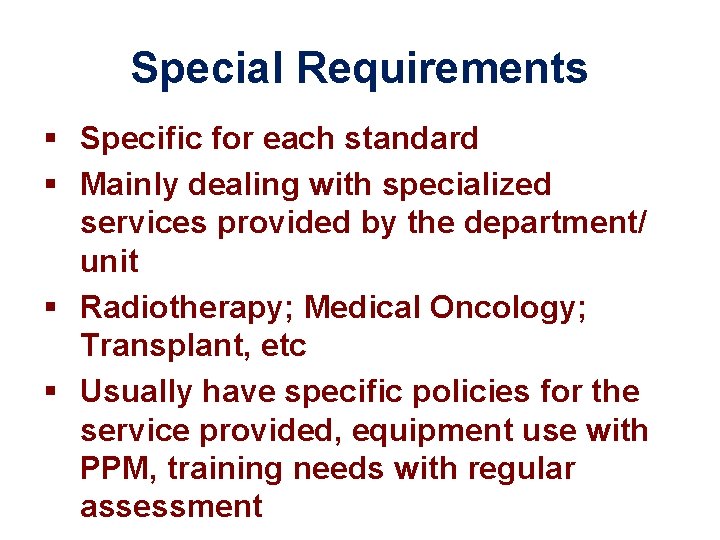
Special Requirements § Specific for each standard § Mainly dealing with specialized services provided by the department/ unit § Radiotherapy; Medical Oncology; Transplant, etc § Usually have specific policies for the service provided, equipment use with PPM, training needs with regular assessment
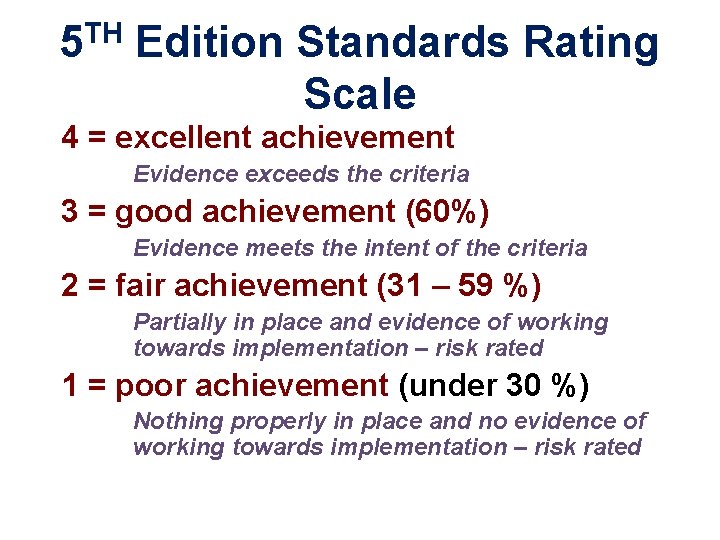
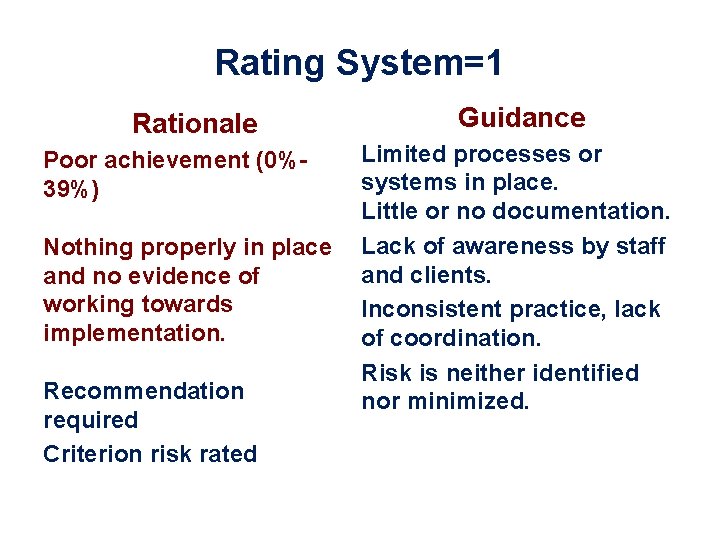
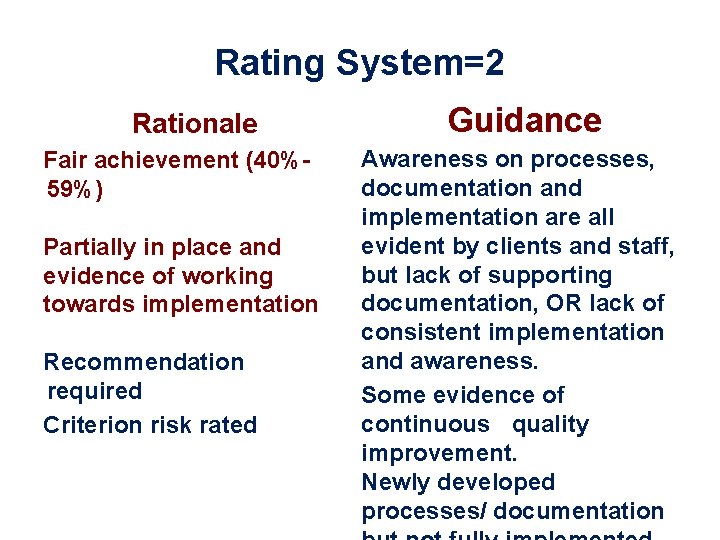
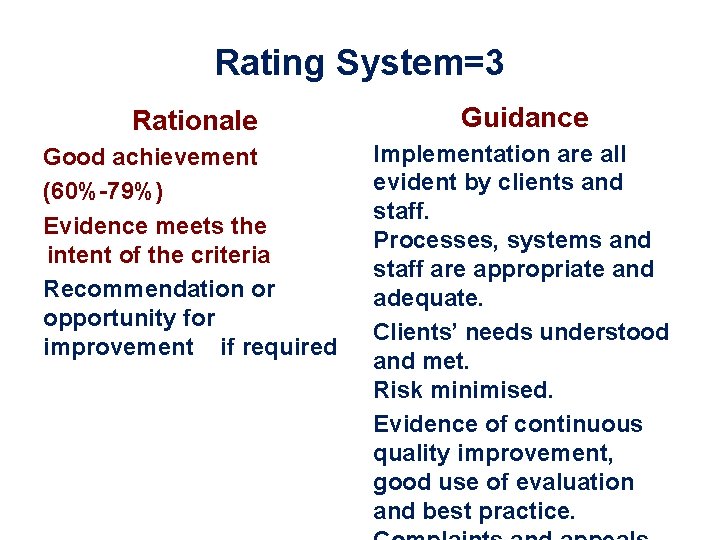
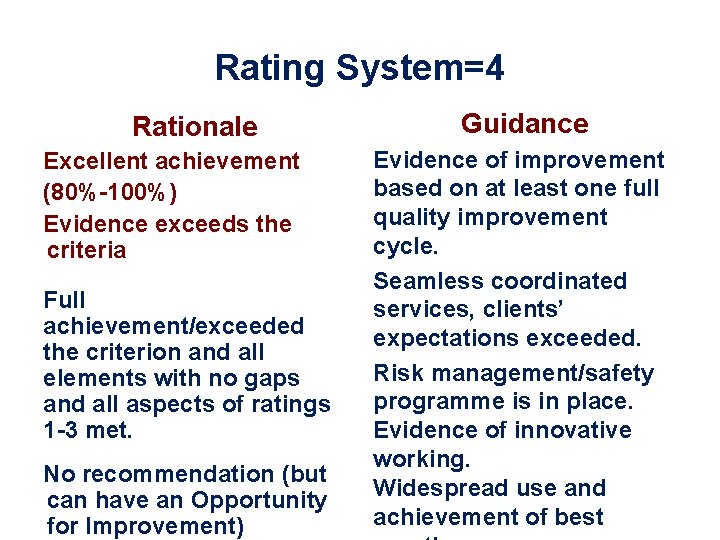
TH 5 Edition Standards Rating Scale 4 = excellent achievement Evidence exceeds the criteria 3 = good achievement (60%) Evidence meets the intent of the criteria 2 = fair achievement (31 – 59 %) Partially in place and evidence of working towards implementation – risk rated 1 = poor achievement (under 30 %) Nothing properly in place and no evidence of working towards implementation – risk rated
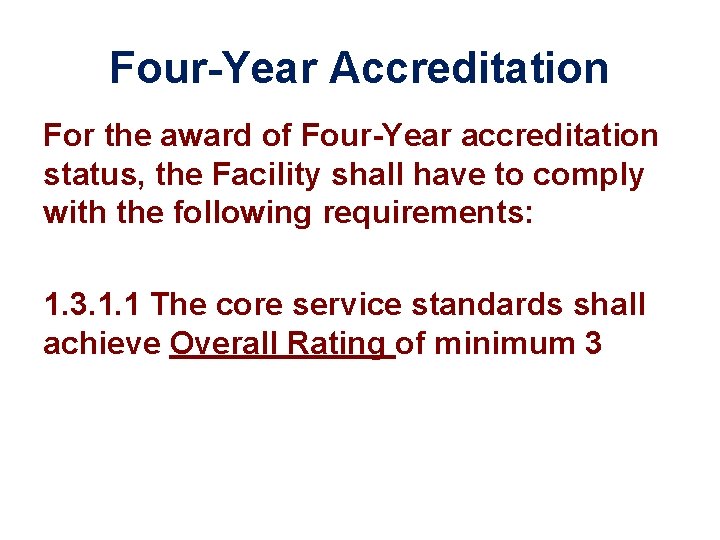
Four-Year Accreditation For the award of Four-Year accreditation status, the Facility shall have to comply with the following requirements: 1. 3. 1. 1 The core service standards shall achieve Overall Rating of minimum 3
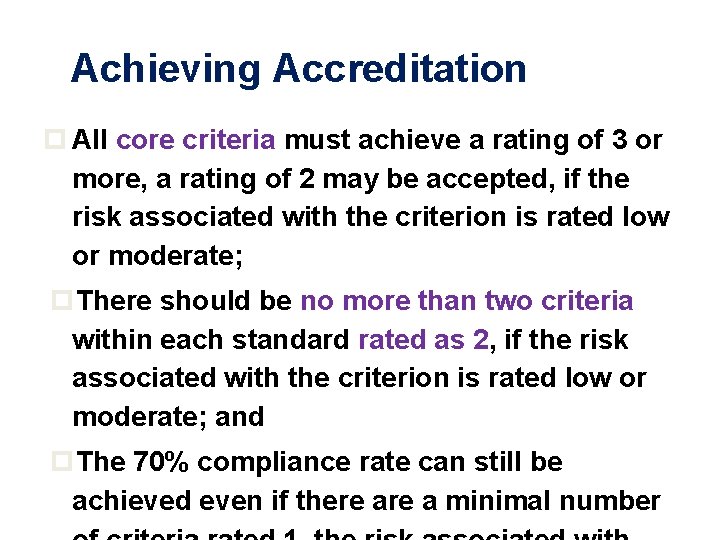
Achieving Accreditation p All core criteria must achieve a rating of 3 or more, a rating of 2 may be accepted, if the risk associated with the criterion is rated low or moderate; p. There should be no more than two criteria within each standard rated as 2, if the risk associated with the criterion is rated low or moderate; and p. The 70% compliance rate can still be achieved even if there a minimal number
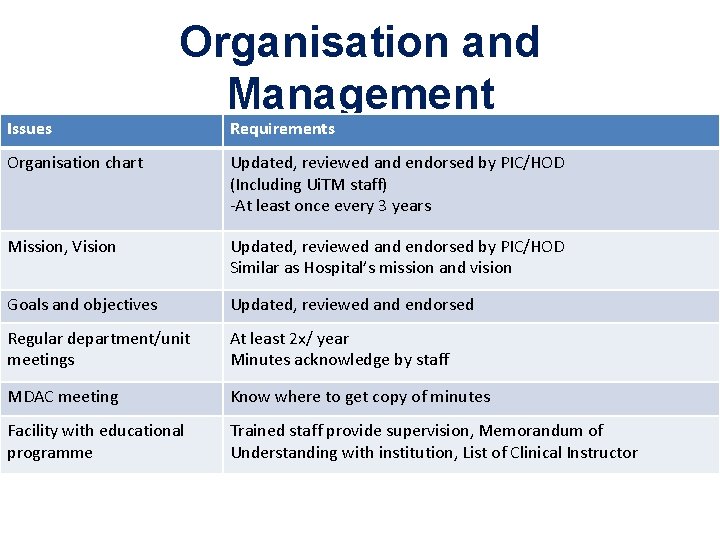
Issues Organisation and Management Requirements Organisation chart Updated, reviewed and endorsed by PIC/HOD (Including Ui. TM staff) -At least once every 3 years Mission, Vision Updated, reviewed and endorsed by PIC/HOD Similar as Hospital’s mission and vision Goals and objectives Updated, reviewed and endorsed Regular department/unit meetings At least 2 x/ year Minutes acknowledge by staff MDAC meeting Know where to get copy of minutes Facility with educational programme Trained staff provide supervision, Memorandum of Understanding with institution, List of Clinical Instructor
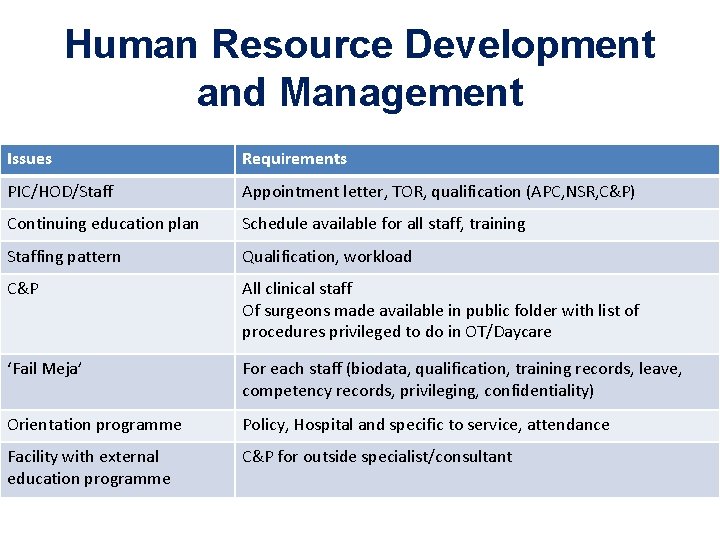
Human Resource Development and Management Issues Requirements PIC/HOD/Staff Appointment letter, TOR, qualification (APC, NSR, C&P) Continuing education plan Schedule available for all staff, training Staffing pattern Qualification, workload C&P All clinical staff Of surgeons made available in public folder with list of procedures privileged to do in OT/Daycare ‘Fail Meja’ For each staff (biodata, qualification, training records, leave, competency records, privileging, confidentiality) Orientation programme Policy, Hospital and specific to service, attendance Facility with external education programme C&P for outside specialist/consultant
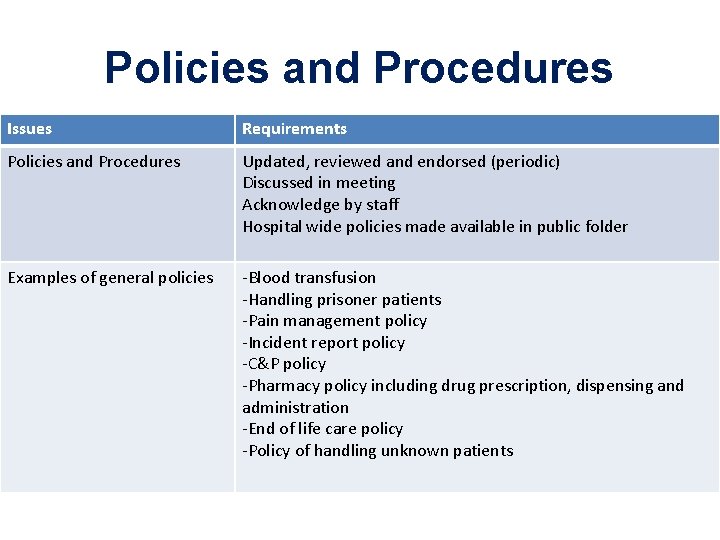
Policies and Procedures Issues Requirements Policies and Procedures Updated, reviewed and endorsed (periodic) Discussed in meeting Acknowledge by staff Hospital wide policies made available in public folder Examples of general policies -Blood transfusion -Handling prisoner patients -Pain management policy -Incident report policy -C&P policy -Pharmacy policy including drug prescription, dispensing and administration -End of life care policy -Policy of handling unknown patients
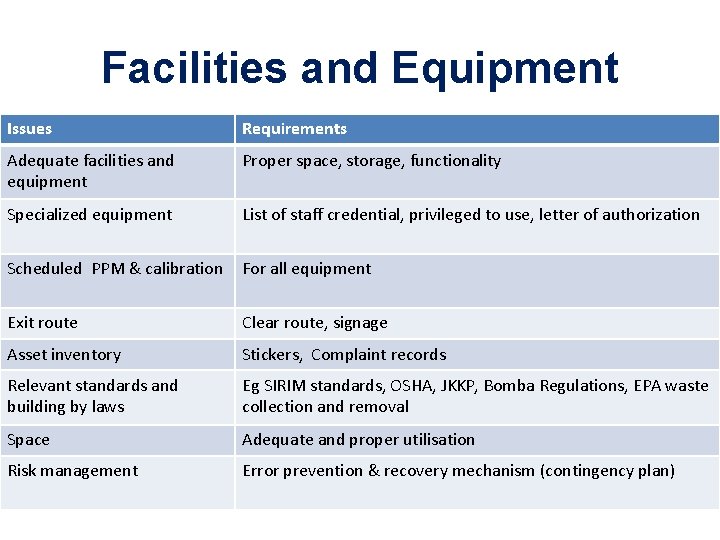
Facilities and Equipment Issues Requirements Adequate facilities and equipment Proper space, storage, functionality Specialized equipment List of staff credential, privileged to use, letter of authorization Scheduled PPM & calibration For all equipment Exit route Clear route, signage Asset inventory Stickers, Complaint records Relevant standards and building by laws Eg SIRIM standards, OSHA, JKKP, Bomba Regulations, EPA waste collection and removal Space Adequate and proper utilisation Risk management Error prevention & recovery mechanism (contingency plan)
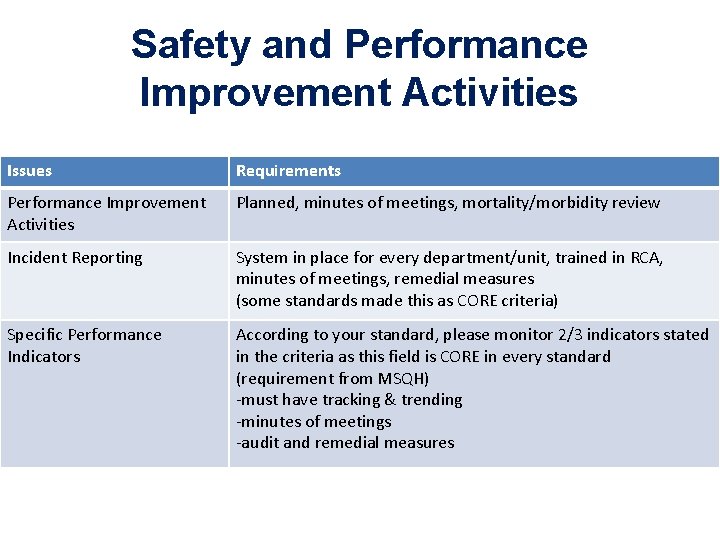
Safety and Performance Improvement Activities Issues Requirements Performance Improvement Activities Planned, minutes of meetings, mortality/morbidity review Incident Reporting System in place for every department/unit, trained in RCA, minutes of meetings, remedial measures (some standards made this as CORE criteria) Specific Performance Indicators According to your standard, please monitor 2/3 indicators stated in the criteria as this field is CORE in every standard (requirement from MSQH) -must have tracking & trending -minutes of meetings -audit and remedial measures
Rating System=1 Rationale Poor achievement (0%39%) Nothing properly in place and no evidence of working towards implementation. Recommendation required Criterion risk rated Guidance Limited processes or systems in place. Little or no documentation. Lack of awareness by staff and clients. Inconsistent practice, lack of coordination. Risk is neither identified nor minimized.
Rating System=2 Rationale Fair achievement (40%59%) Partially in place and evidence of working towards implementation Recommendation required Criterion risk rated Guidance Awareness on processes, documentation and implementation are all evident by clients and staff, but lack of supporting documentation, OR lack of consistent implementation and awareness. Some evidence of continuous quality improvement. Newly developed processes/ documentation
Rating System=3 Rationale Guidance Good achievement (60%-79%) Evidence meets the intent of the criteria Recommendation or opportunity for improvement if required Implementation are all evident by clients and staff. Processes, systems and staff are appropriate and adequate. Clients’ needs understood and met. Risk minimised. Evidence of continuous quality improvement, good use of evaluation and best practice.
Rating System=4 Rationale Excellent achievement (80%-100%) Evidence exceeds the criteria Full achievement/exceeded the criterion and all elements with no gaps and all aspects of ratings 1 -3 met. No recommendation (but can have an Opportunity for Improvement) Guidance Evidence of improvement based on at least one full quality improvement cycle. Seamless coordinated services, clients’ expectations exceeded. Risk management/safety programme is in place. Evidence of innovative working. Widespread use and achievement of best
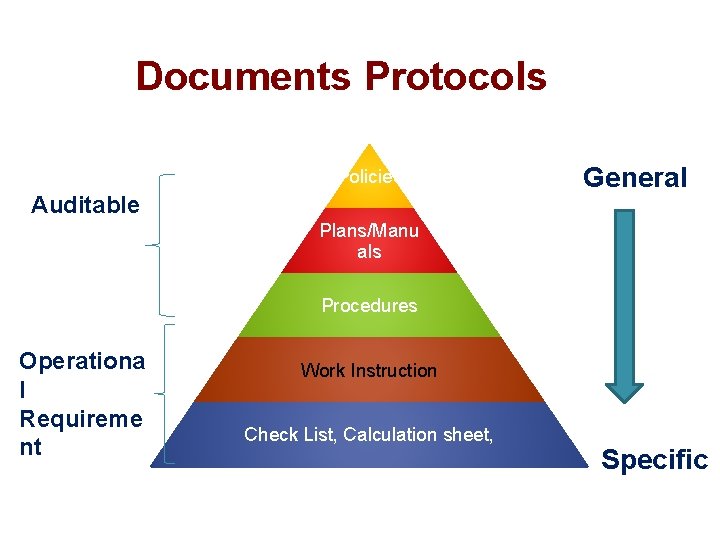
Documents Protocols Policies Auditable General Plans/Manu als Procedures Operationa l Requireme nt Work Instruction Check List, Calculation sheet, Specific
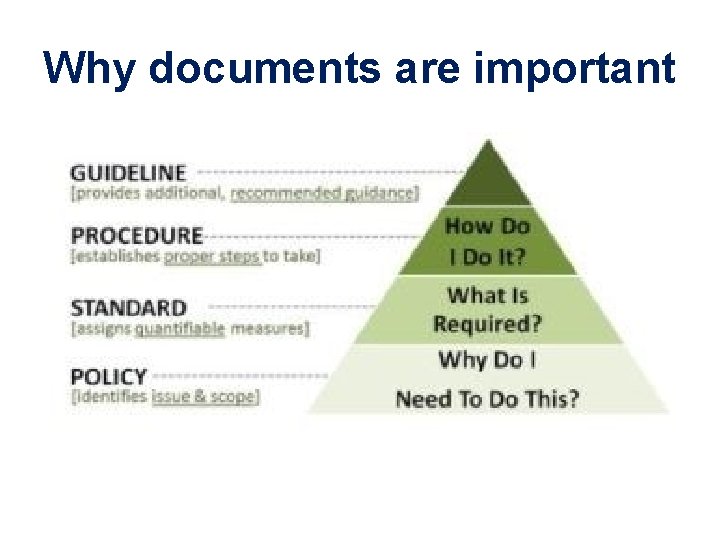
Why documents are important
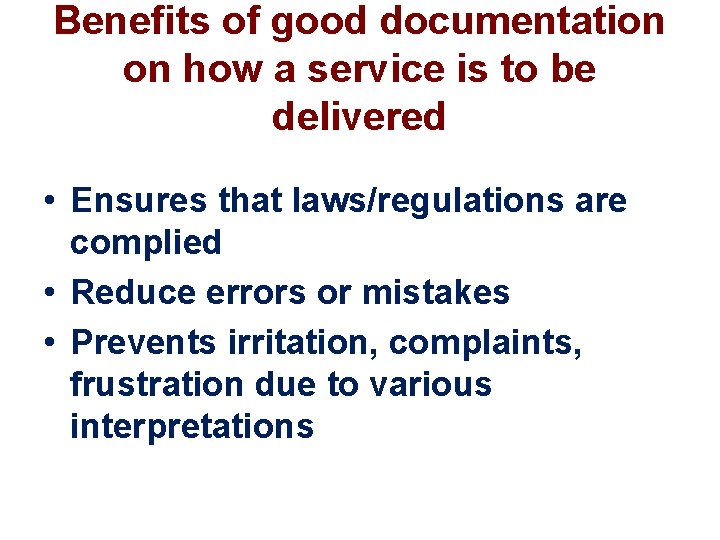
Benefits of good documentation on how a service is to be P&Ps delivered • Ensures that laws/regulations are complied • Reduce errors or mistakes • Prevents irritation, complaints, frustration due to various interpretations 31
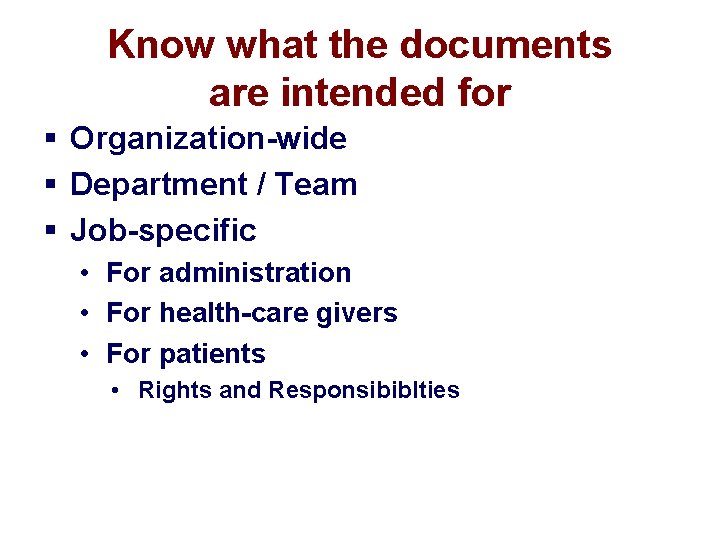
Know what the documents are intended for § Organization-wide § Department / Team § Job-specific • For administration • For health-care givers • For patients • Rights and Responsibiblties 32 P&Ps
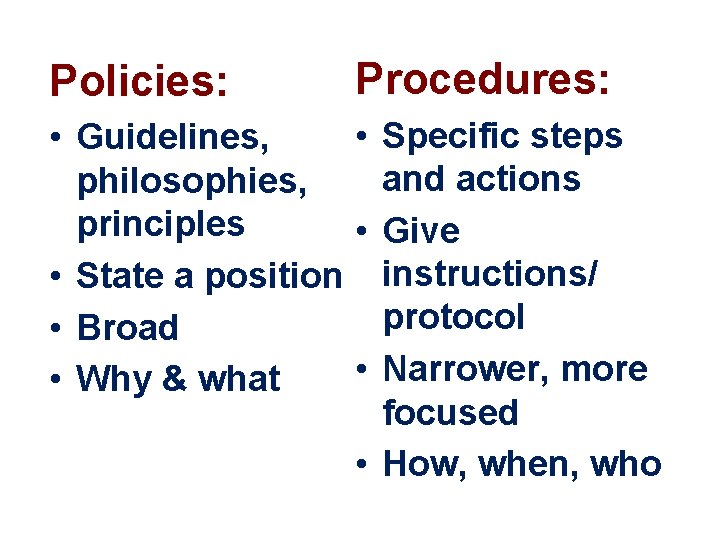
Policies: Policies vs. Procedures: • Specific steps • Guidelines, and actions philosophies, principles • Give • State a position instructions/ protocol • Broad • Narrower, more • Why & what focused • How, when, who 33
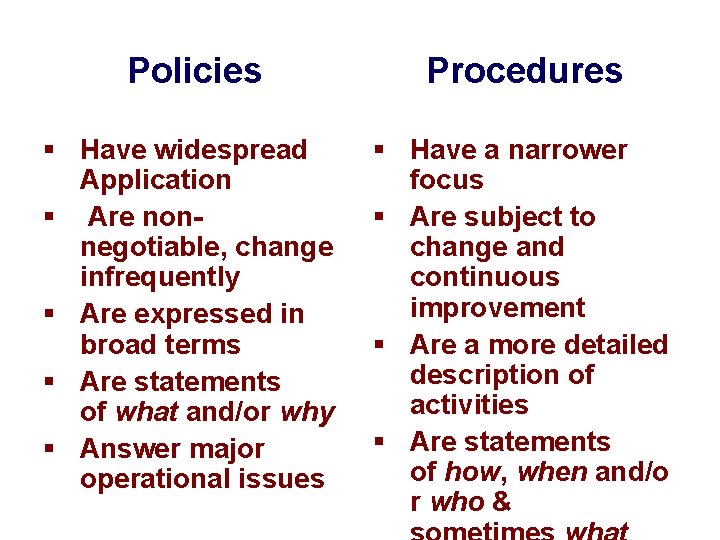
Policies Procedures § Have widespread Application § Are nonnegotiable, change infrequently § Are expressed in broad terms § Are statements of what and/or why § Answer major operational issues § Have a narrower focus § Are subject to change and continuous improvement § Are a more detailed description of activities § Are statements of how, when and/o r who &
Why documents are important
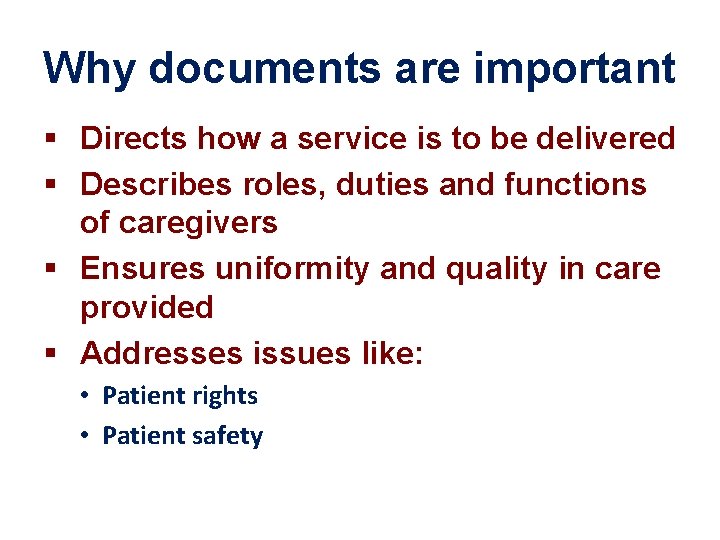
Why documents are important § Directs how a service is to be delivered § Describes roles, duties and functions of caregivers § Ensures uniformity and quality in care provided § Addresses issues like: • Patient rights • Patient safety
What is a Policy A policy is a guiding principle used to set direction in an organization. It should be used as a guide to decision making under a given set of circumstances within the framework of objectives, goals and management philosophies. Usually reviewed once very three years or earlier if necessary
What is a Procedure? Procedures aim to describe how, when, and who of processes
What is a Procedure? A procedure is a particular way of accomplishing something. It should be designed as a series of steps to be followed as a consistent and repetitive approach or cycle to accomplish an end result
What are Clinical Practice Guidelines? § “Clinical practice guidelines are systematically developed statements to assist practitioner and patient decisions about appropriate health care for specific clinical circumstances. ” (Institute of Medicine, 1990)
What are Key Performance Indicators? § A healthcare KPI is a well-defined performance measurement that is used to monitor, analyze and optimize all relevant healthcare processes to increase patient satisfaction § Different service departments will normally have different KPI’s
Standards § Standards are mandatory actions or rules that give formal policies support and direction.
Credentialing and Privileging
Certification and Privileging § Goal is for quality and safety § Credentialing verifies whether provider meets certain criteria relating to professional competence and conduct § Privileging authorizes access and delineates scope
Credentialing …. a process whereby a professional preparation program meets the specific standards established by a credentialing body Ensures that the healthcare giver is competent to perform the duties expected of them
Depending on the skills expected: Credentialing may take the form of: § Formal training and certifications • Lectures, training, exams • (Specialist, Post-basic ICU nursing, etc) § Institutional Training programmes – Supervised training (eg handling equipment) – For specific set of skills (APS nurse)
Certification § …a process by which a professional organization grants recognition to an individual who, upon completion of a competency-based curriculum, can demonstrate a predetermined standard of performance.
Certification “of competency” § Establishes a standard § Attests to individual’s knowledge and skills § Assists employers in identifying qualified and trained practitioners § Sense of pride and accomplishment § Promotes continued professional development
Common Problems and Noncompliance Issues And how to address them
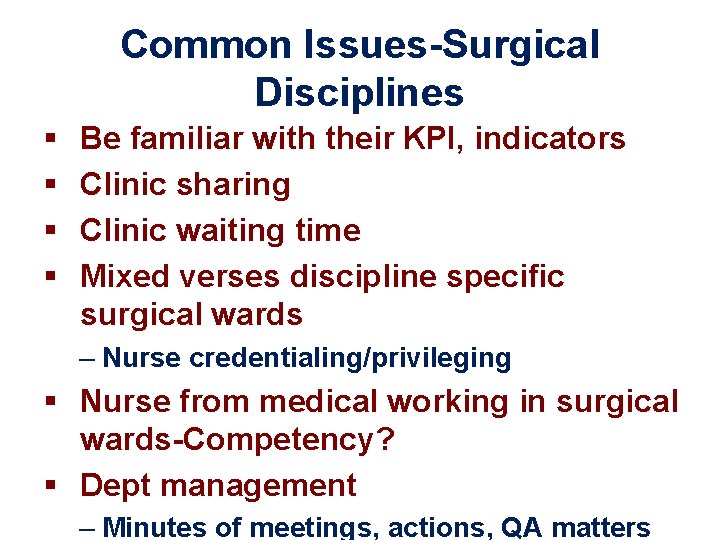
Common Issues-Surgical Disciplines § § Be familiar with their KPI, indicators Clinic sharing Clinic waiting time Mixed verses discipline specific surgical wards – Nurse credentialing/privileging § Nurse from medical working in surgical wards-Competency? § Dept management – Minutes of meetings, actions, QA matters
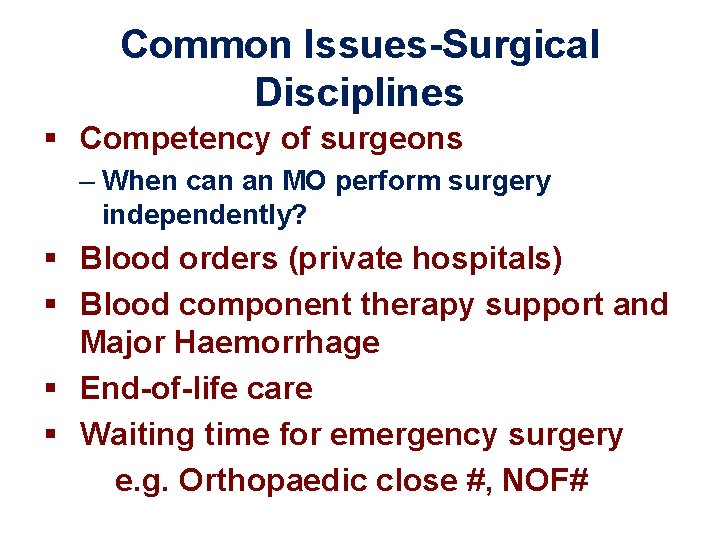
Common Issues-Surgical Disciplines § Competency of surgeons – When can an MO perform surgery independently? § Blood orders (private hospitals) § Blood component therapy support and Major Haemorrhage § End-of-life care § Waiting time for emergency surgery e. g. Orthopaedic close #, NOF#
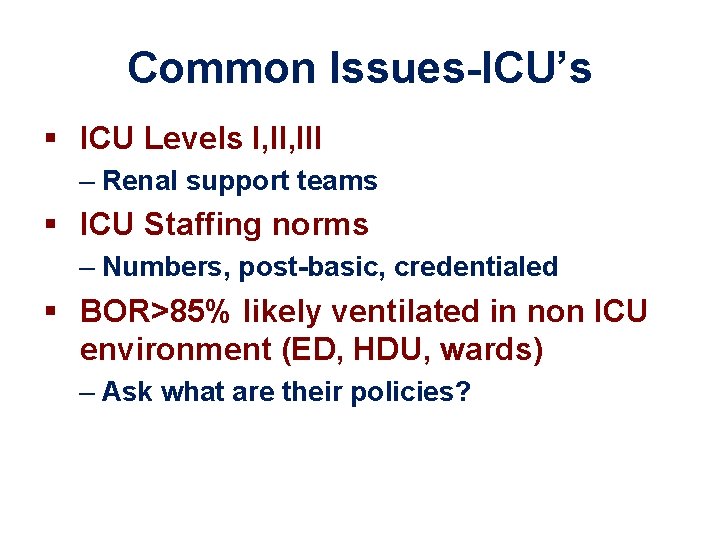
Common Issues-ICU’s § ICU Levels I, III – Renal support teams § ICU Staffing norms – Numbers, post-basic, credentialed § BOR>85% likely ventilated in non ICU environment (ED, HDU, wards) – Ask what are their policies?
Common Issues-ICU’s § Admission policies § Patient Care in the ICU – Primary Consultant and Referrals § Emergency response
Common Issues-ICU’s § Isolation room for contact Hosp Acquired Infections § Negative pressure isolation roomairborne infections § Positive pressure isolation room for immuno-suppressed patient (Medical oncology) § Hand-washing rate in critical care areas – (before and after contact with patient)