
12 Pricing Decisions Including Target Costing and Transfer


- Slides: 39
12 Pricing Decisions, Including Target Costing and Transfer Pricing
The Pricing Decision and the Manager OBJECTIVE 1: Identify the objectives and rules used to establish prices of goods and services, and relate pricing issues to the management process.
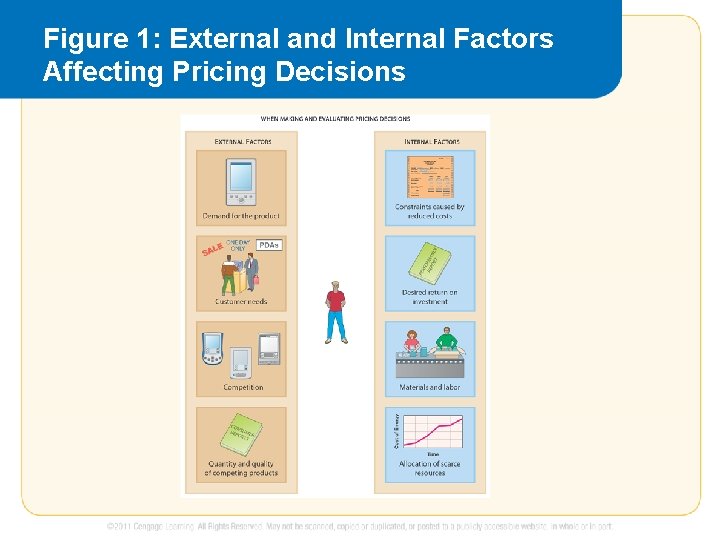
Figure 1: External and Internal Factors Affecting Pricing Decisions
The Pricing Decision and the Manager • Pricing issues are addressed at each stage of the management cycle.
The Pricing Decision and the Manager • Possible pricing policy objectives include the following: – Identifying and adhering to both short- and longrun pricing strategies – Maximizing profits – Maintaining or gaining market share – Setting socially responsible prices – Maintaining a minimum rate of return on investment – Being customer focused
The Pricing Decision and the Manager • Pricing and the management process – For a company to stay in business, the selling price of its product or service must • Be competitive with the competition’s price • Be acceptable to the customer • Recover all costs incurred in bringing the product or service to market • Return a profit – Breaking these pricing rules for a long period will lead to bankruptcy.
The Pricing Decision and the Manager • When making and evaluating pricing decisions, managers must consider both external and internal factors.
© 2011 Cengage Learning All Rights Reserved. May not be scanned, copied or duplicated, or posted to a publicly accessible website, in whole or in part.
Economic Pricing Concepts OBJECTIVE 2: Describe economic pricing concepts, including the auction-based pricing method used on the Internet.
Figure 2 a: Microeconomic Pricing Theory
Figure 2 b: Microeconomic Pricing Theory
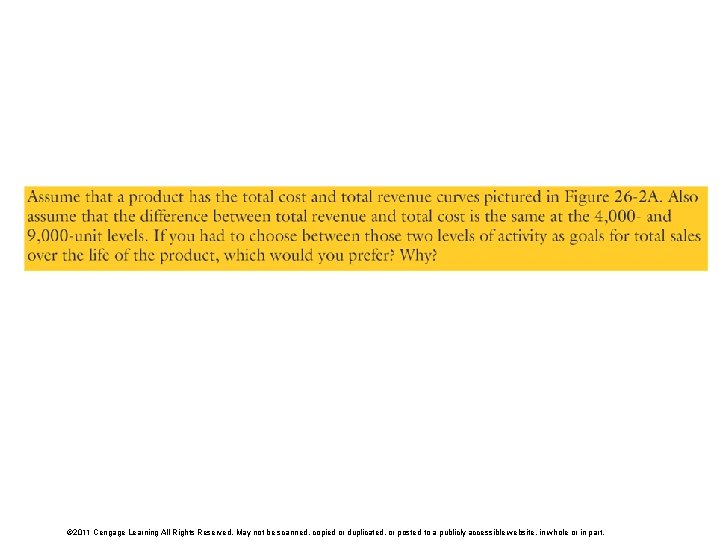
Economic Pricing Concepts • Economic pricing concepts are based on microeconomic theory. – Profits are maximized when total revenue minus total cost is greatest. – On a graph, profits are maximized at the point at which the marginal revenue and marginal cost curves intersect. • Marginal revenue is the increase in total revenue from one additional unit. • Marginal cost is the increase in total cost from one additional unit.
Economic Pricing Concepts • Significant uncertainty and the necessity of using estimates make the microeconomic approach difficult to apply. • Because of the increasing amount of business conducted over the Internet by both companies and individuals, auction-based pricing has become an important pricing mechanism.
© 2011 Cengage Learning All Rights Reserved. May not be scanned, copied or duplicated, or posted to a publicly accessible website, in whole or in part.
Cost-Based Pricing Methods OBJECTIVE 3: Use cost-based pricing methods to develop prices.
Figure 3: Cost-Based Pricing Methods: Bookit Company
Cost-Based Pricing Methods • In a competitive environment, market prices and conditions influence price, but if prices do not cover a company’s costs, the company will eventually fail.
Cost-Based Pricing Methods • Gross margin pricing – Emphasizes the use of income statement information to determine a selling price. – The price is computed using a markup percentage based on a product’s total production costs.
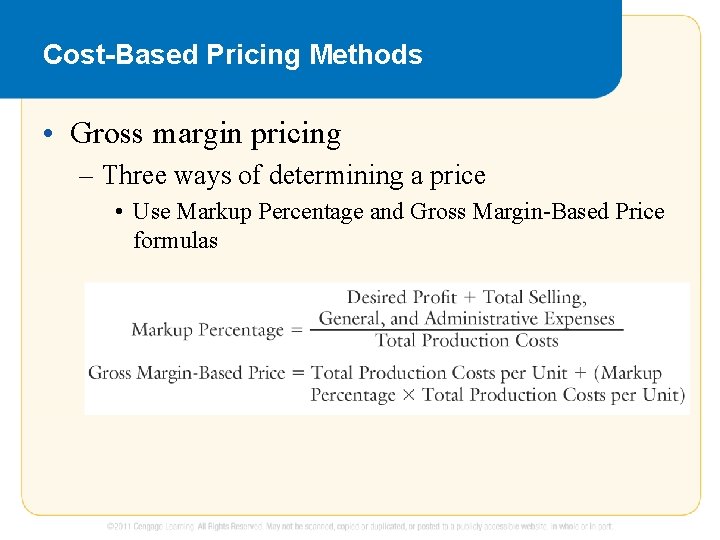
Cost-Based Pricing Methods • Gross margin pricing – Three ways of determining a price • Use Markup Percentage and Gross Margin-Based Price formulas
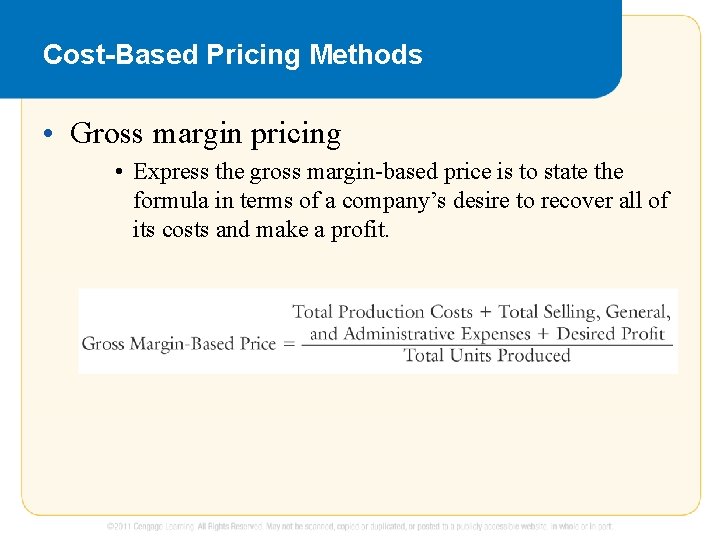
Cost-Based Pricing Methods • Gross margin pricing • Express the gross margin-based price is to state the formula in terms of a company’s desire to recover all of its costs and make a profit.
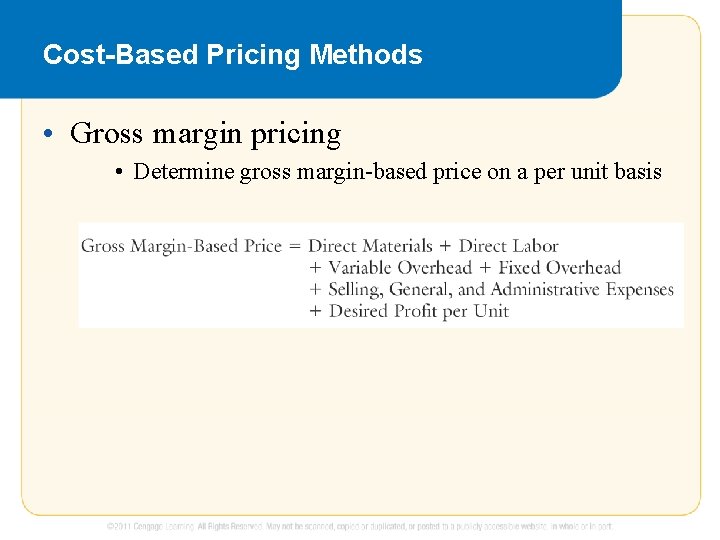
Cost-Based Pricing Methods • Gross margin pricing • Determine gross margin-based price on a per unit basis
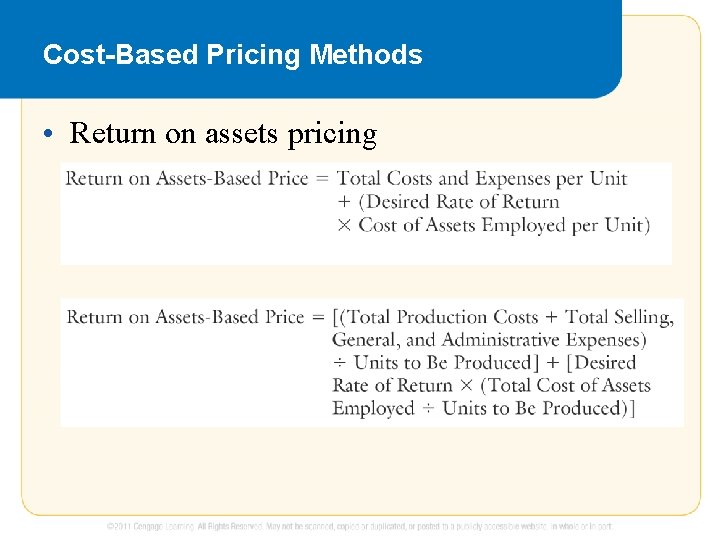
Cost-Based Pricing Methods • Return on assets pricing
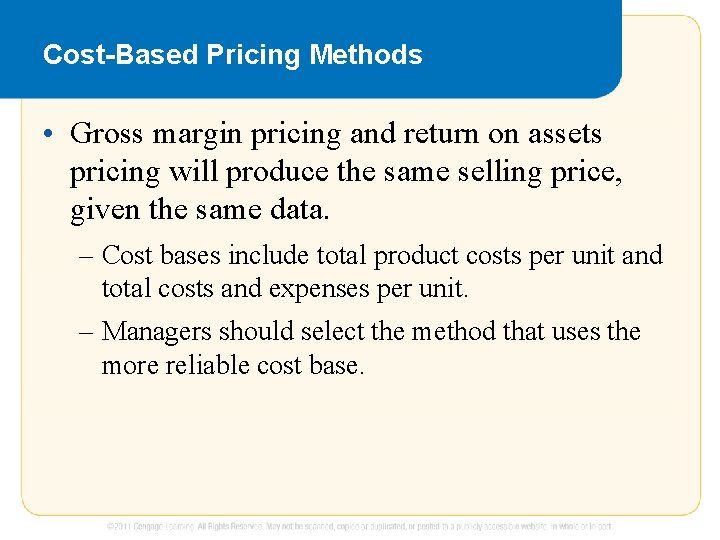
Cost-Based Pricing Methods • Gross margin pricing and return on assets pricing will produce the same selling price, given the same data. – Cost bases include total product costs per unit and total costs and expenses per unit. – Managers should select the method that uses the more reliable cost base.
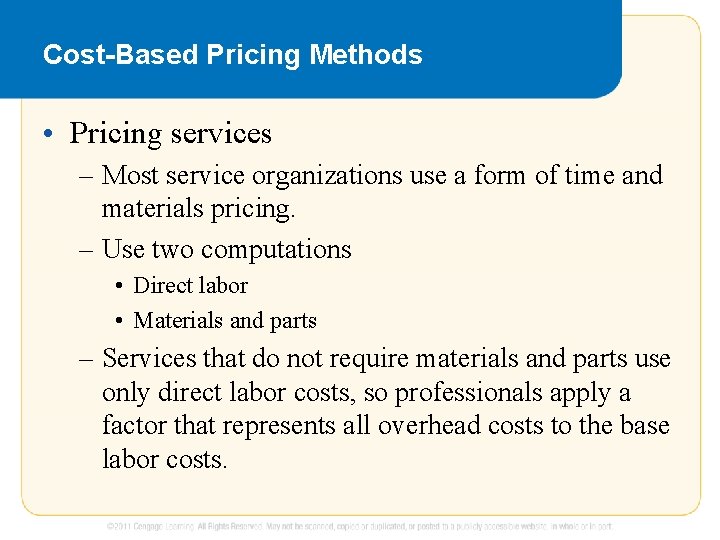
Cost-Based Pricing Methods • Pricing services – Most service organizations use a form of time and materials pricing. – Use two computations • Direct labor • Materials and parts – Services that do not require materials and parts use only direct labor costs, so professionals apply a factor that represents all overhead costs to the base labor costs.
Cost-Based Pricing Methods • Factors Affecting Cost-Based Pricing Methods – To set a price, managers should combine their experience with an appropriate pricing method.
© 2011 Cengage Learning All Rights Reserved. May not be scanned, copied or duplicated, or posted to a publicly accessible website, in whole or in part.
Pricing Based on Target Costing OBJECTIVE 4: Describe target costing, and use that concept to analyze pricing decisions and evaluate a new product opportunity.
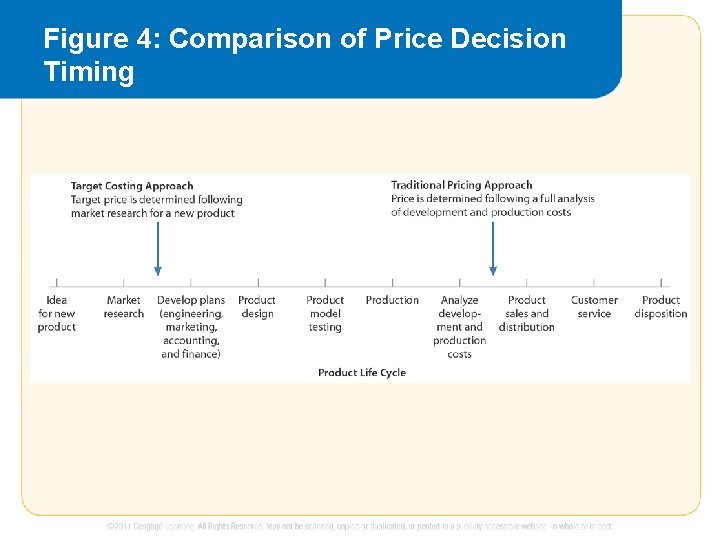
Figure 4: Comparison of Price Decision Timing
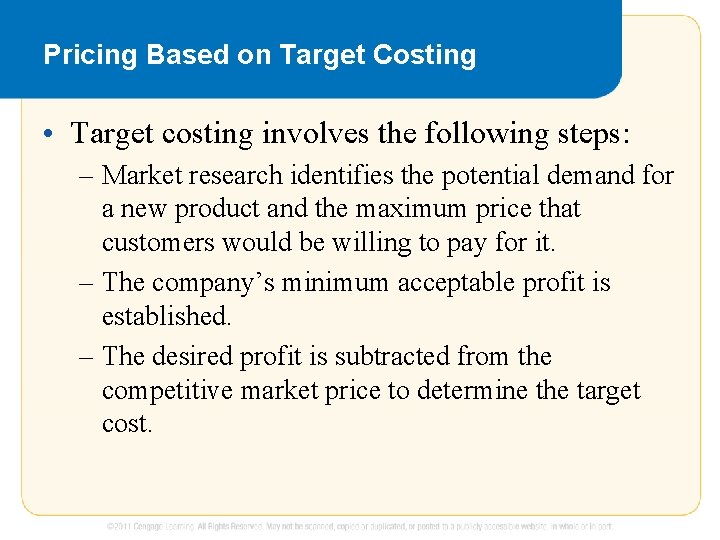
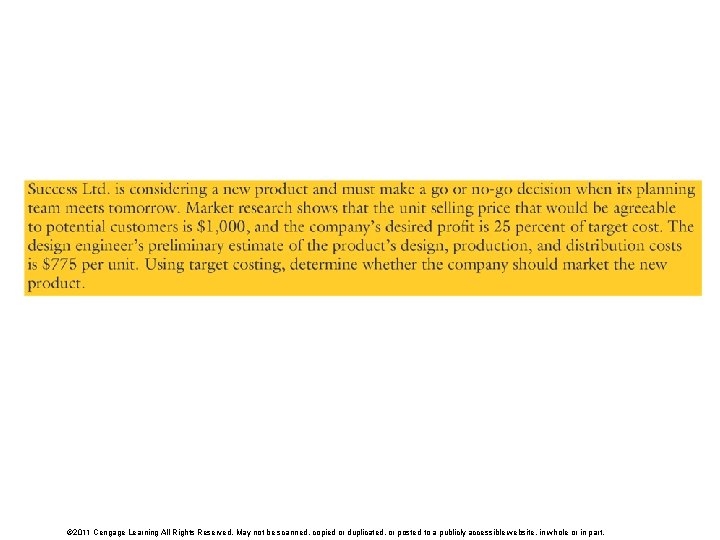
Pricing Based on Target Costing • Target costing involves the following steps: – Market research identifies the potential demand for a new product and the maximum price that customers would be willing to pay for it. – The company’s minimum acceptable profit is established. – The desired profit is subtracted from the competitive market price to determine the target cost.
Pricing Based on Target Costing • Differences between Cost-based pricing and Target pricing – The target cost is the maximum cost to be incurred in designing and manufacturing the product; if the cost goal cannot be met, the product is not manufactured. – Cost-based pricing methods focus on controlling incurred costs. • Incurred costs occur after the product reaches the marketplace. – Target costing focuses on controlling committed costs. • Committed costs occur during production.
Pricing Based on Target Costing • Target costing analysis in an activity-based management environment – Find the target cost per unit. – Find the projected unit cost. – Make a decision.
© 2011 Cengage Learning All Rights Reserved. May not be scanned, copied or duplicated, or posted to a publicly accessible website, in whole or in part.
Pricing for Internal Providers of Goods and Services OBJECTIVE 5: Describe how transfer pricing is used for transferring goods and services and evaluating performance within a division or segment.
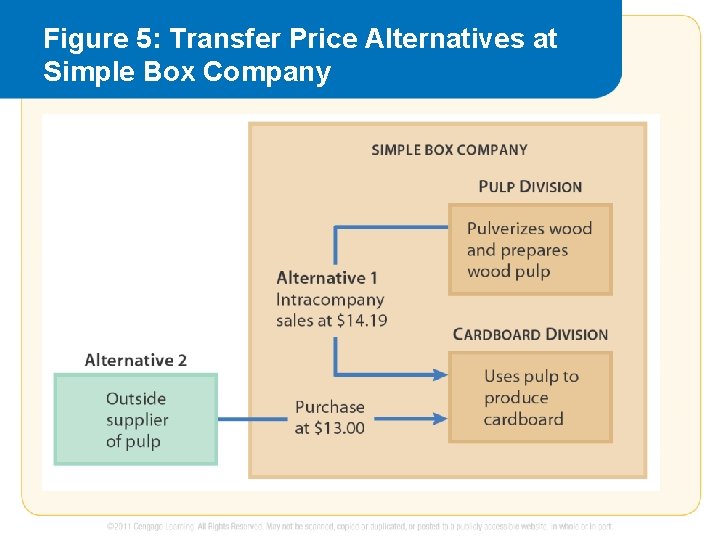
Figure 5: Transfer Price Alternatives at Simple Box Company
Exhibit 1: Transfer Price Computation
Exhibit 2: Performance Report Using Transfer Prices
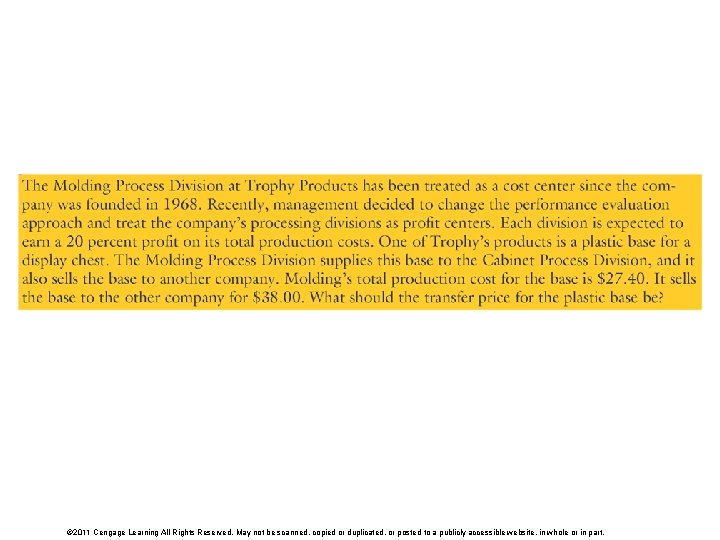
Pricing for Internal Providers of Goods and Services • Transfer price – A transfer price is an artificial price at which goods and services are exchanged among a company’s divisions or segments. – Transfer prices are internal prices used only to evaluate the performance of a division or segment. – Three basic kinds of transfer prices • Cost-plus transfer price • Market transfer price • Negotiated transfer price
Pricing for Internal Providers of Goods and Services • Using Transfer prices to measure performance – Because a transfer price contains an estimated amount of profit, a manager’s ability to meet a targeted profit can be measured.
© 2011 Cengage Learning All Rights Reserved. May not be scanned, copied or duplicated, or posted to a publicly accessible website, in whole or in part.