
12 P VectorValued Functions Copyright Cengage Learning All


- Slides: 24
12 P Vector-Valued Functions Copyright © Cengage Learning. All rights reserved.
12. 4 Tangent Vectors and Normal Vectors Copyright © Cengage Learning. All rights reserved.
Objectives n Find a unit tangent vector and a principal unit normal vector at a point on a space curve. n Find the tangential and normal components of acceleration. 3
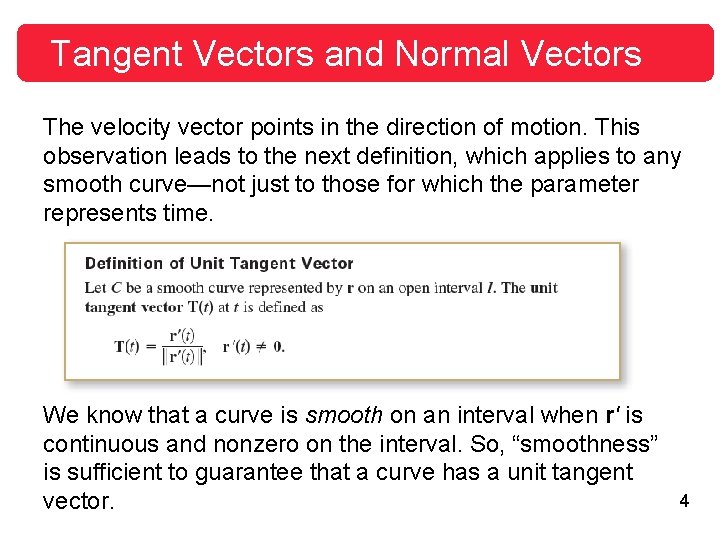
Tangent Vectors and Normal Vectors The velocity vector points in the direction of motion. This observation leads to the next definition, which applies to any smooth curve—not just to those for which the parameter represents time. We know that a curve is smooth on an interval when r' is continuous and nonzero on the interval. So, “smoothness” is sufficient to guarantee that a curve has a unit tangent vector. 4
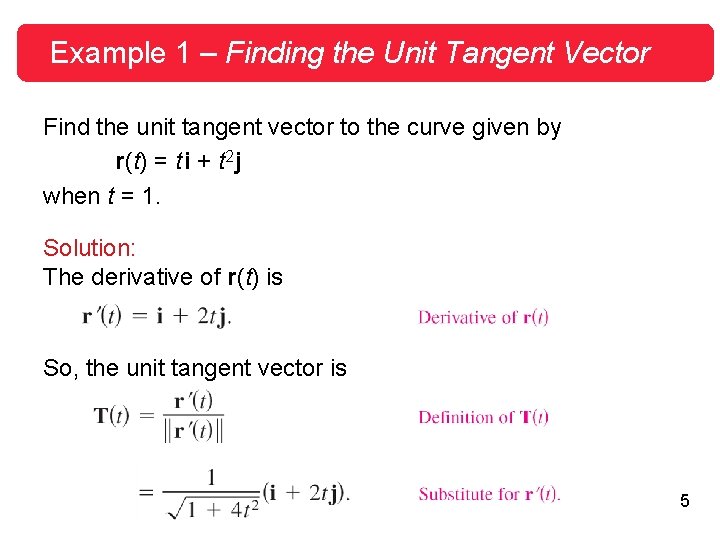
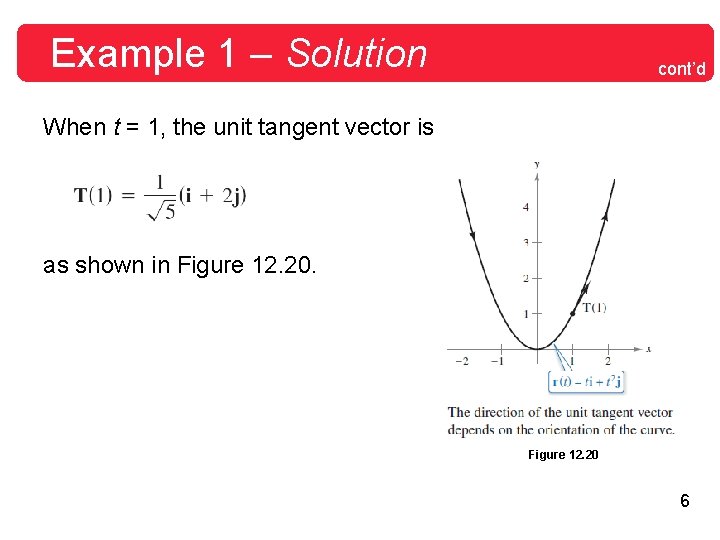
Example 1 – Finding the Unit Tangent Vector Find the unit tangent vector to the curve given by r(t) = t i + t 2 j when t = 1. Solution: The derivative of r(t) is So, the unit tangent vector is 5
Example 1 – Solution cont’d When t = 1, the unit tangent vector is as shown in Figure 12. 20 6
Tangent Vectors and Normal Vectors The tangent line to a curve at a point is the line that passes through the point and is parallel to the unit tangent vector. In Example 2, the unit tangent vector is used to find the tangent line at a point on a helix. 7
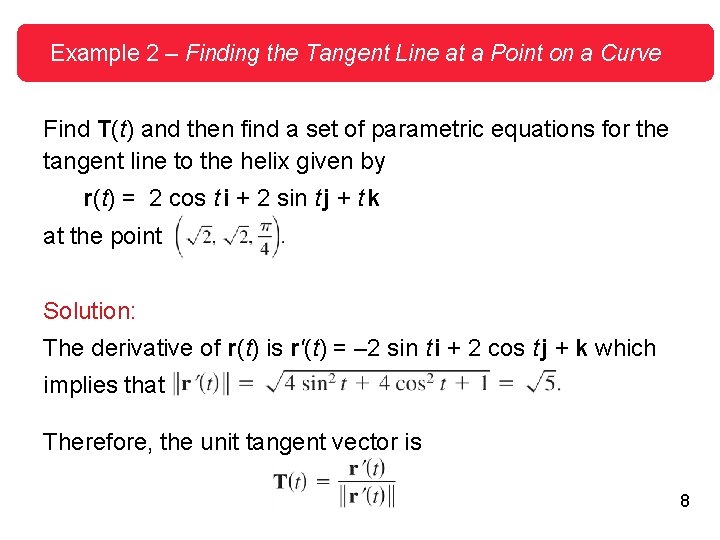
Example 2 – Finding the Tangent Line at a Point on a Curve Find T(t) and then find a set of parametric equations for the tangent line to the helix given by r(t) = 2 cos t i + 2 sin t j + t k at the point Solution: The derivative of r(t) is r'(t) = – 2 sin t i + 2 cos t j + k which implies that Therefore, the unit tangent vector is 8
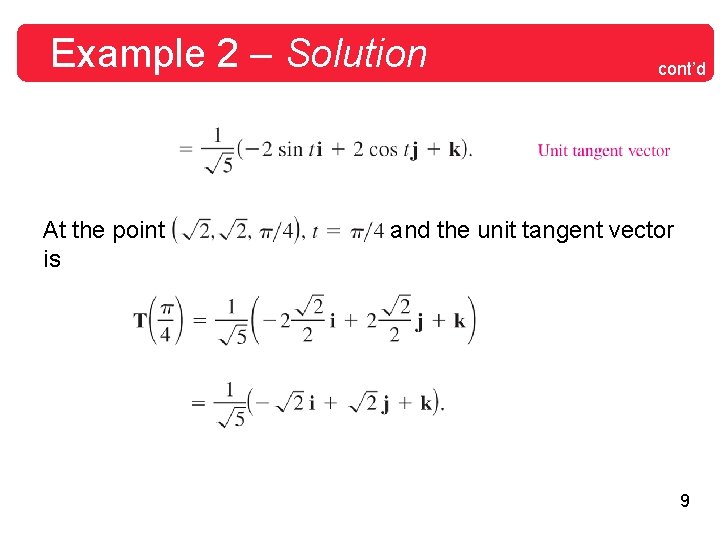
Example 2 – Solution At the point is cont’d and the unit tangent vector 9
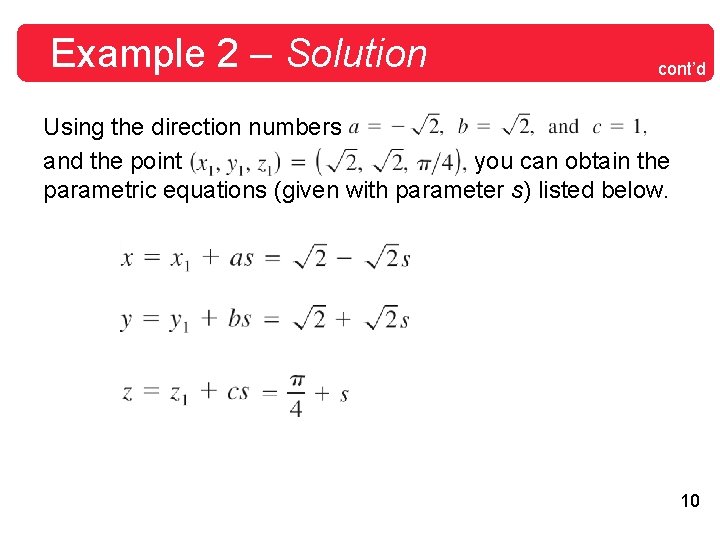
Example 2 – Solution cont’d Using the direction numbers and the point you can obtain the parametric equations (given with parameter s) listed below. 10
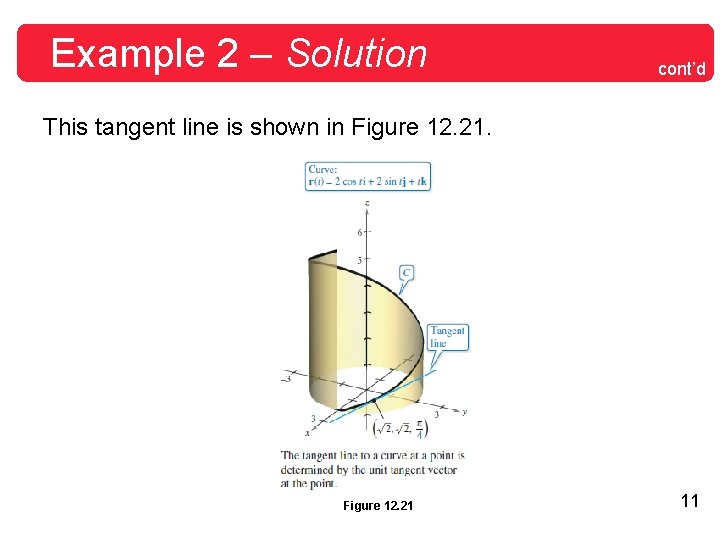
Example 2 – Solution cont’d This tangent line is shown in Figure 12. 21 11
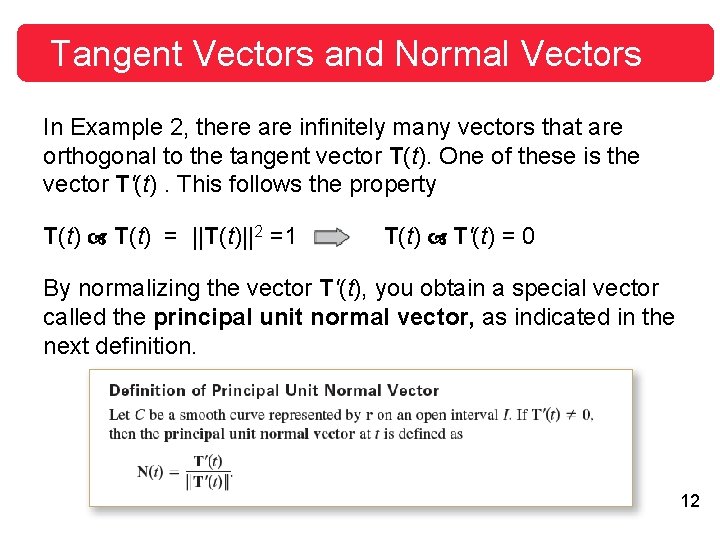
Tangent Vectors and Normal Vectors In Example 2, there are infinitely many vectors that are orthogonal to the tangent vector T(t). One of these is the vector T'(t). This follows the property T(t) = ||T(t)||2 =1 T(t) T'(t) = 0 By normalizing the vector T'(t), you obtain a special vector called the principal unit normal vector, as indicated in the next definition. 12
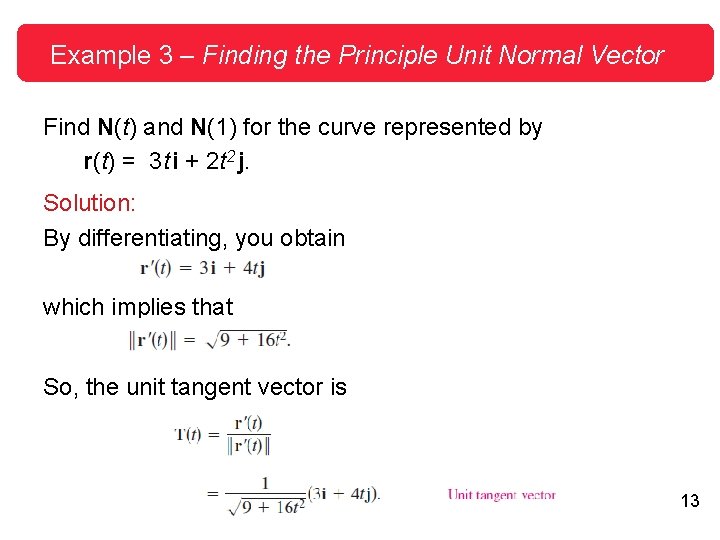
Example 3 – Finding the Principle Unit Normal Vector Find N(t) and N(1) for the curve represented by r(t) = 3 t i + 2 t 2 j. Solution: By differentiating, you obtain which implies that So, the unit tangent vector is 13
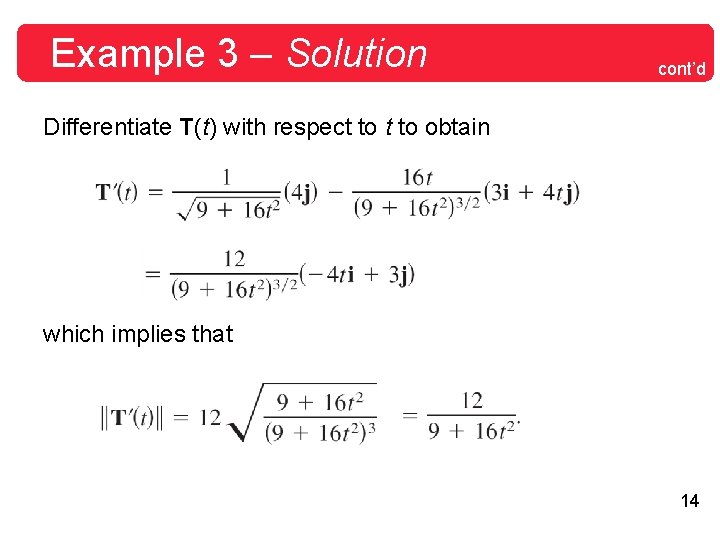
Example 3 – Solution cont’d Differentiate T(t) with respect to obtain which implies that 14
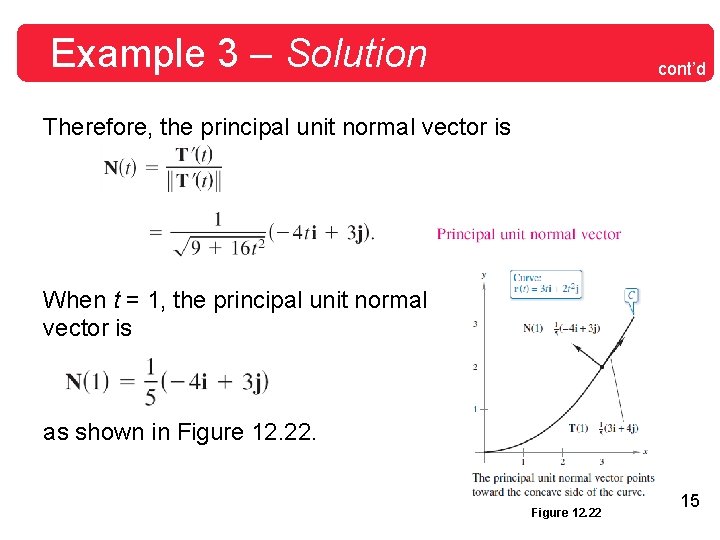
Example 3 – Solution cont’d Therefore, the principal unit normal vector is When t = 1, the principal unit normal vector is as shown in Figure 12. 22 15
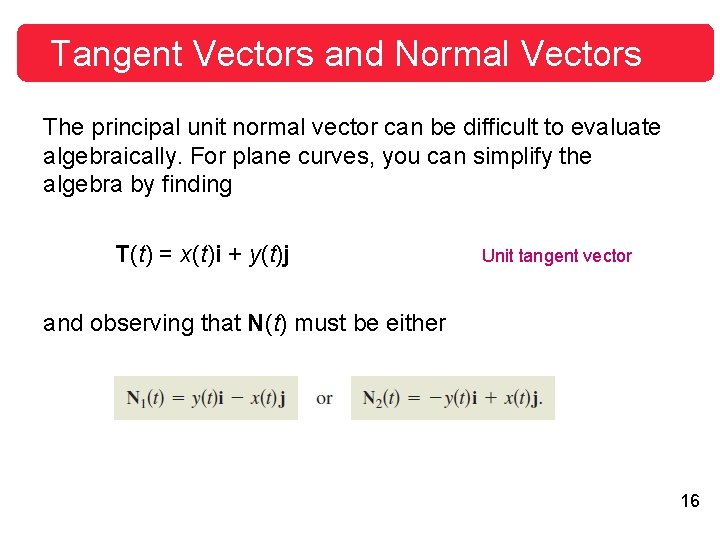
Tangent Vectors and Normal Vectors The principal unit normal vector can be difficult to evaluate algebraically. For plane curves, you can simplify the algebra by finding T(t) = x(t)i + y(t)j Unit tangent vector and observing that N(t) must be either 16
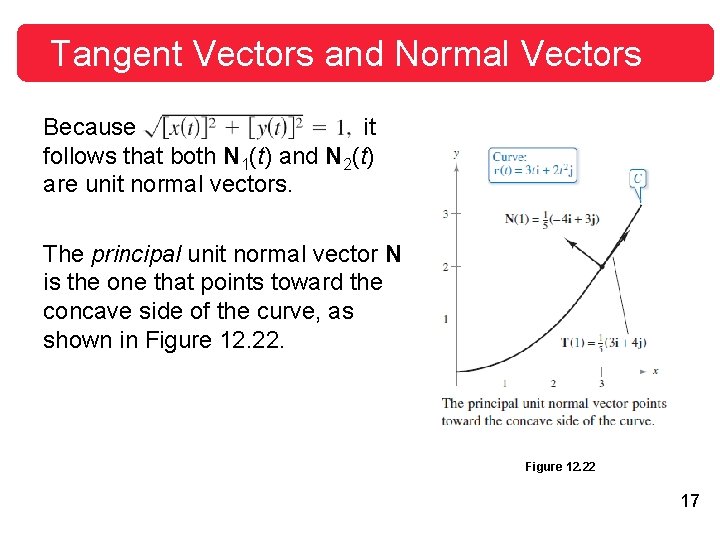
Tangent Vectors and Normal Vectors Because it follows that both N 1(t) and N 2(t) are unit normal vectors. The principal unit normal vector N is the one that points toward the concave side of the curve, as shown in Figure 12. 22 17
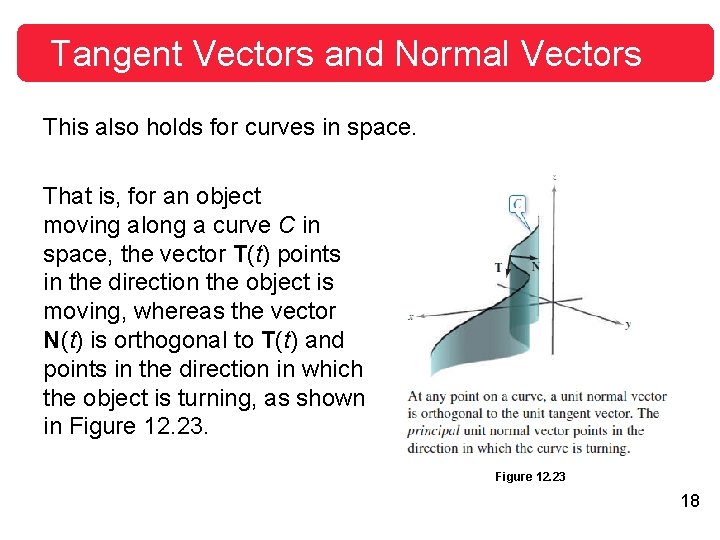
Tangent Vectors and Normal Vectors This also holds for curves in space. That is, for an object moving along a curve C in space, the vector T(t) points in the direction the object is moving, whereas the vector N(t) is orthogonal to T(t) and points in the direction in which the object is turning, as shown in Figure 12. 23 18
Tangential and Normal Components of Acceleration 19
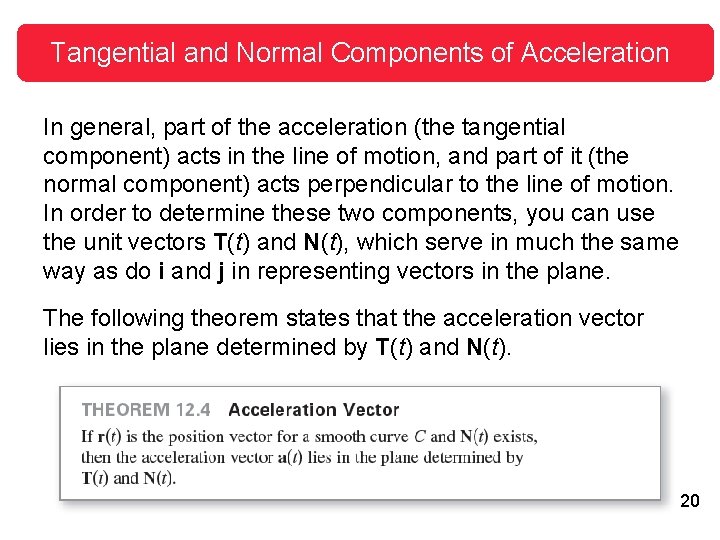
Tangential and Normal Components of Acceleration In general, part of the acceleration (the tangential component) acts in the line of motion, and part of it (the normal component) acts perpendicular to the line of motion. In order to determine these two components, you can use the unit vectors T(t) and N(t), which serve in much the same way as do i and j in representing vectors in the plane. The following theorem states that the acceleration vector lies in the plane determined by T(t) and N(t). 20
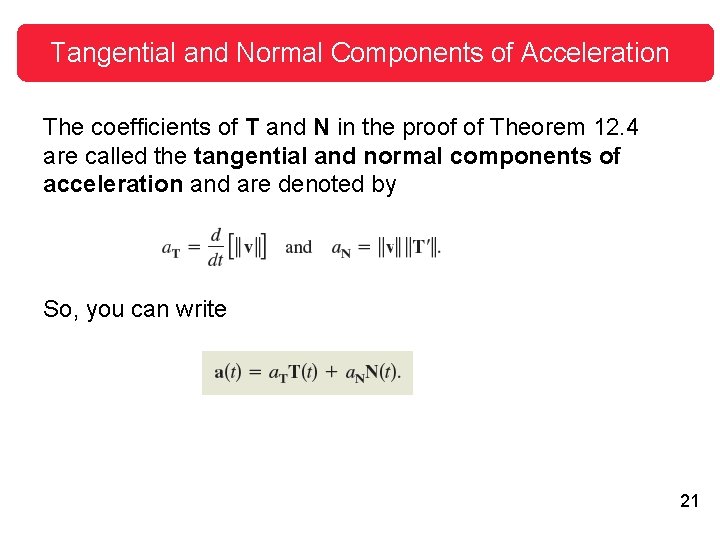
Tangential and Normal Components of Acceleration The coefficients of T and N in the proof of Theorem 12. 4 are called the tangential and normal components of acceleration and are denoted by So, you can write 21
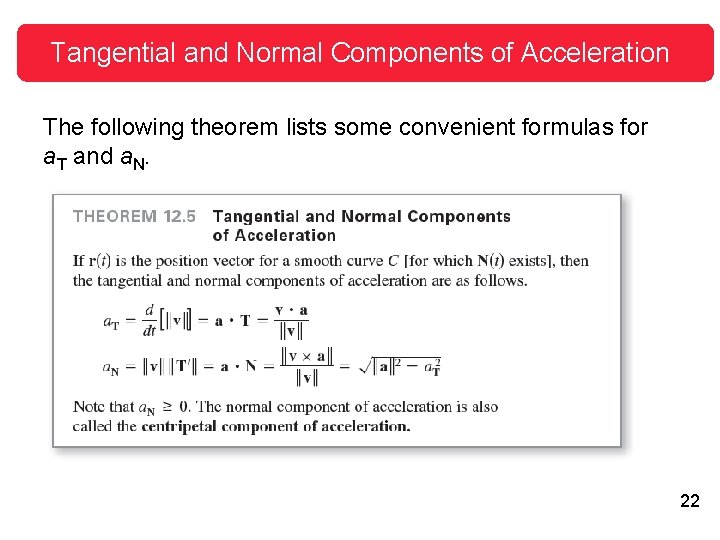
Tangential and Normal Components of Acceleration The following theorem lists some convenient formulas for a. T and a. N. 22
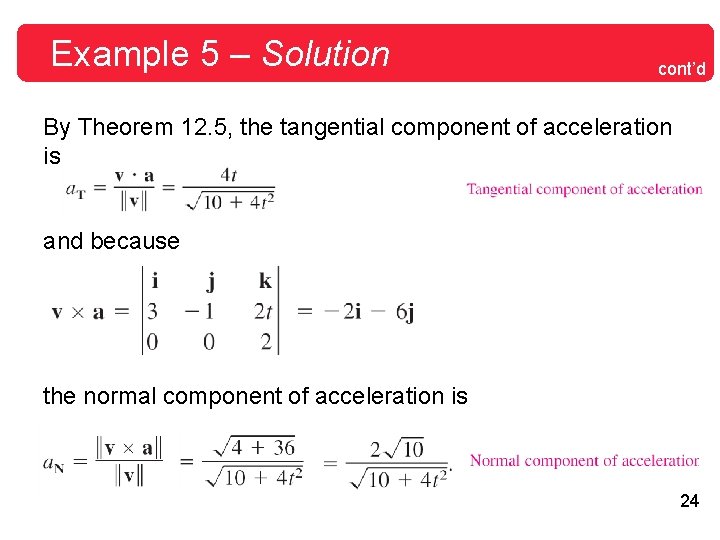
Example 5 – Tangential and Normal Components of Acceleration Find the tangential and normal components of acceleration for the position vector given by r(t) = 3 t i – t j + t 2 k. Solution: Begin by finding the velocity, speed, and acceleration. 23
Example 5 – Solution cont’d By Theorem 12. 5, the tangential component of acceleration is and because the normal component of acceleration is 24