
12 MustKnow SAT Grammar Rules You can do

- Slides: 26
12 Must-Know SAT Grammar Rules You can do this!
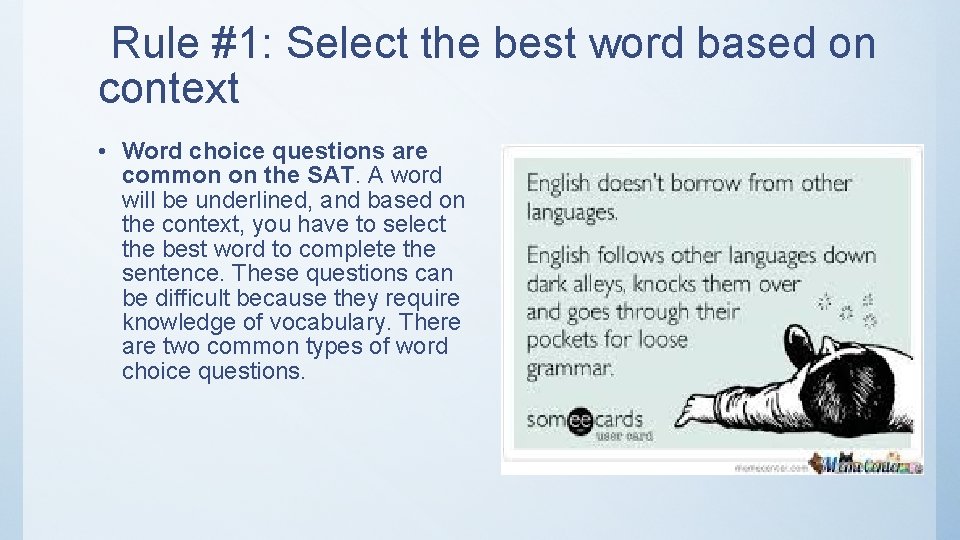
Rule #1: Select the best word based on context • Word choice questions are common on the SAT. A word will be underlined, and based on the context, you have to select the best word to complete the sentence. These questions can be difficult because they require knowledge of vocabulary. There are two common types of word choice questions.
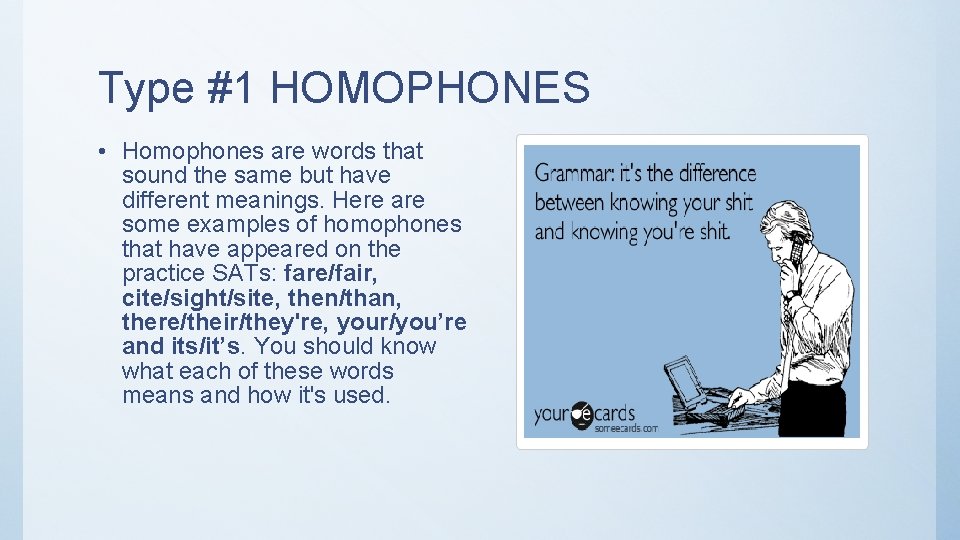
Type #1 HOMOPHONES • Homophones are words that sound the same but have different meanings. Here are some examples of homophones that have appeared on the practice SATs: fare/fair, cite/sight/site, then/than, there/their/they're, your/you’re and its/it’s. You should know what each of these words means and how it's used.
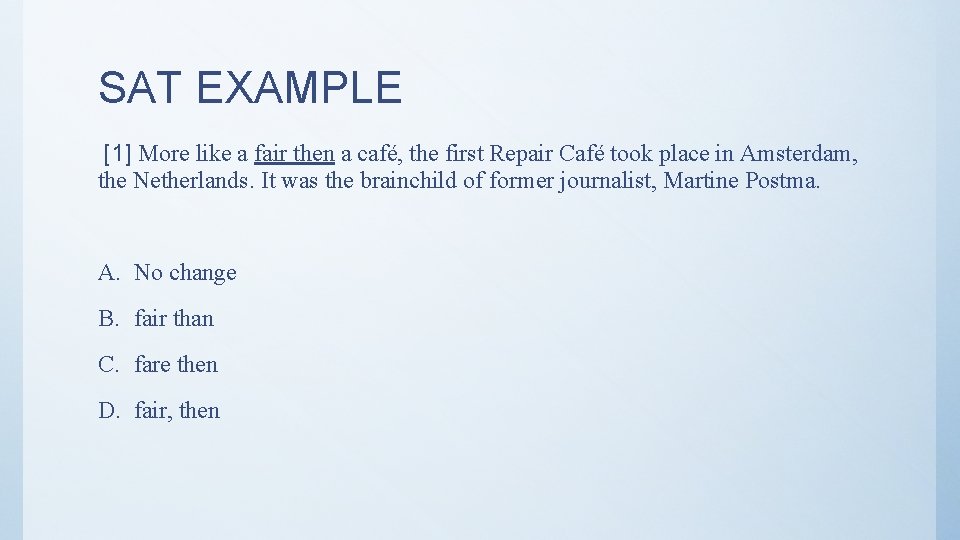
SAT EXAMPLE [1] More like a fair then a café, the first Repair Café took place in Amsterdam, the Netherlands. It was the brainchild of former journalist, Martine Postma. A. No change B. fair than C. fare then D. fair, then
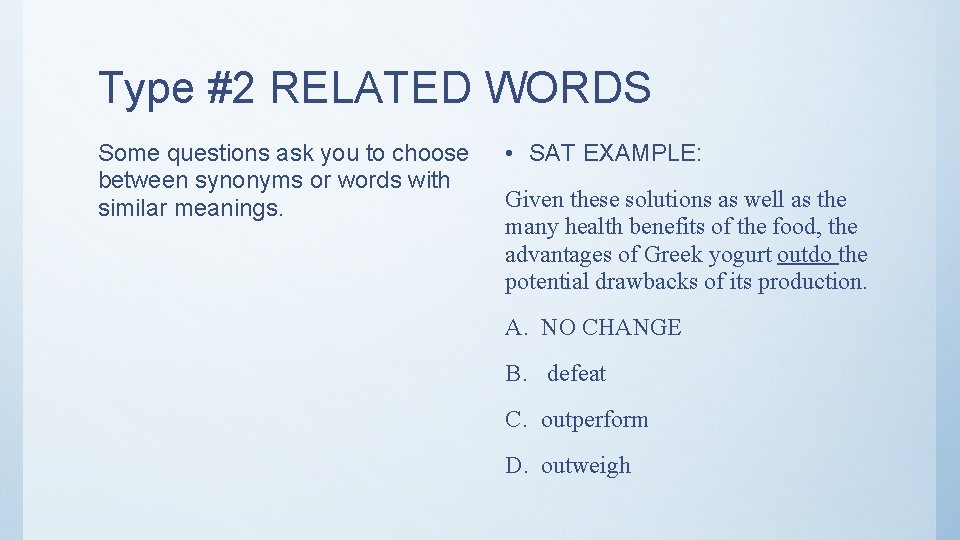
Type #2 RELATED WORDS Some questions ask you to choose between synonyms or words with similar meanings. • SAT EXAMPLE: Given these solutions as well as the many health benefits of the food, the advantages of Greek yogurt outdo the potential drawbacks of its production. A. NO CHANGE B. defeat C. outperform D. outweigh
Rule #2: Use the fewest words possible. When choosing to revise for conciseness, always use the fewest words possible. SAT Example: Though the concept remained a local trend at first, International Repair Cafes, all affiliated with the Dutch Repair Café, via its website, have since arisen in France, Germany, South Africa, the United States and other countries on top of that. A. NO CHANGE B. in addition C. likewise D. Delete the underlined portion and end with period.
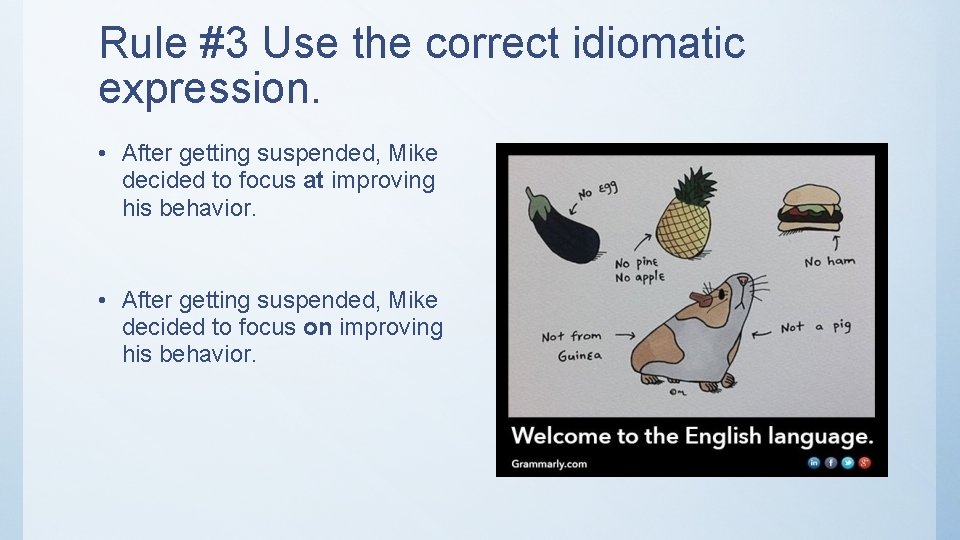
Rule #3 Use the correct idiomatic expression. • After getting suspended, Mike decided to focus at improving his behavior. • After getting suspended, Mike decided to focus on improving his behavior.
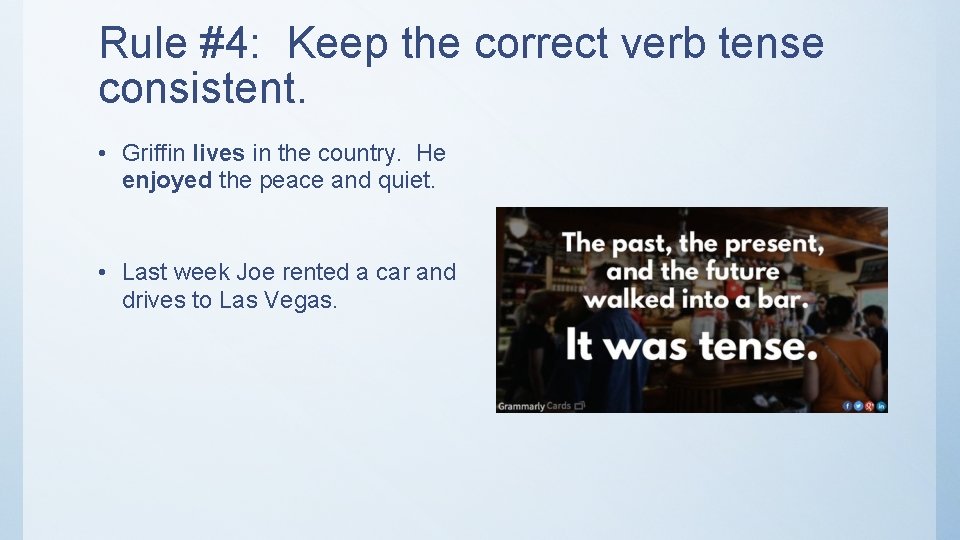
Rule #4: Keep the correct verb tense consistent. • Griffin lives in the country. He enjoyed the peace and quiet. • Last week Joe rented a car and drives to Las Vegas.
Rule #5: Surround a nonrestrictive clause or appositive with commas. Do not use commas for essential (restrictive) clauses or phrases. • Essential clauses are necessary to the meaning of the sentence. You can’t take a restrictive clause out of a sentence without effectively changing the meaning of the sentence. Here’s an example: • Students who read regularly are prepared for the SAT. • A non-restrictive clause isn't essential to the meaning of the sentence. If you got rid of the clause, you'd have less information, but the overall meaning of the sentence would remain the same. Here's an example sentence with the nonrestrictive clause underlined. • Joe’s parents, who constantly call him, are very overprotective.
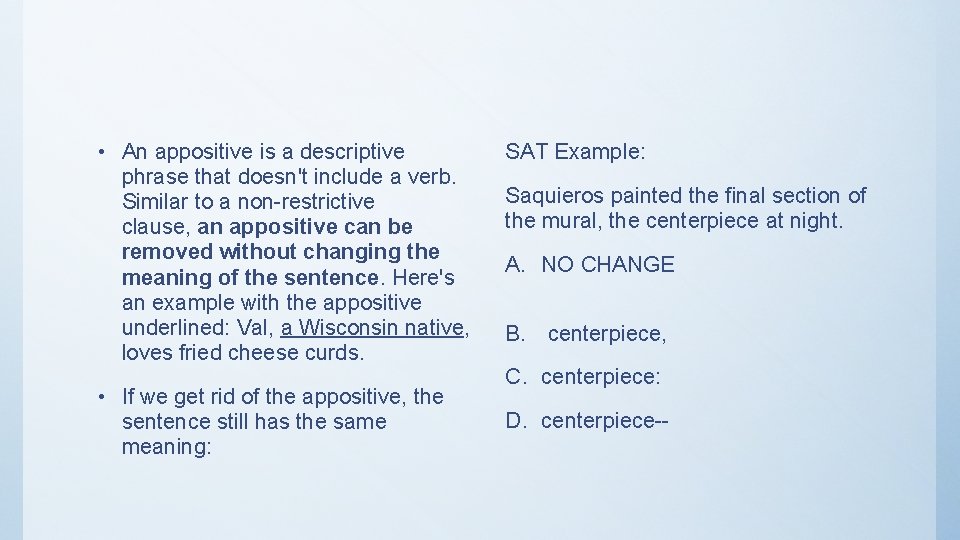
• An appositive is a descriptive phrase that doesn't include a verb. Similar to a non-restrictive clause, an appositive can be removed without changing the meaning of the sentence. Here's an example with the appositive underlined: Val, a Wisconsin native, loves fried cheese curds. • If we get rid of the appositive, the sentence still has the same meaning: SAT Example: Saquieros painted the final section of the mural, the centerpiece at night. A. NO CHANGE B. centerpiece, C. centerpiece: D. centerpiece--
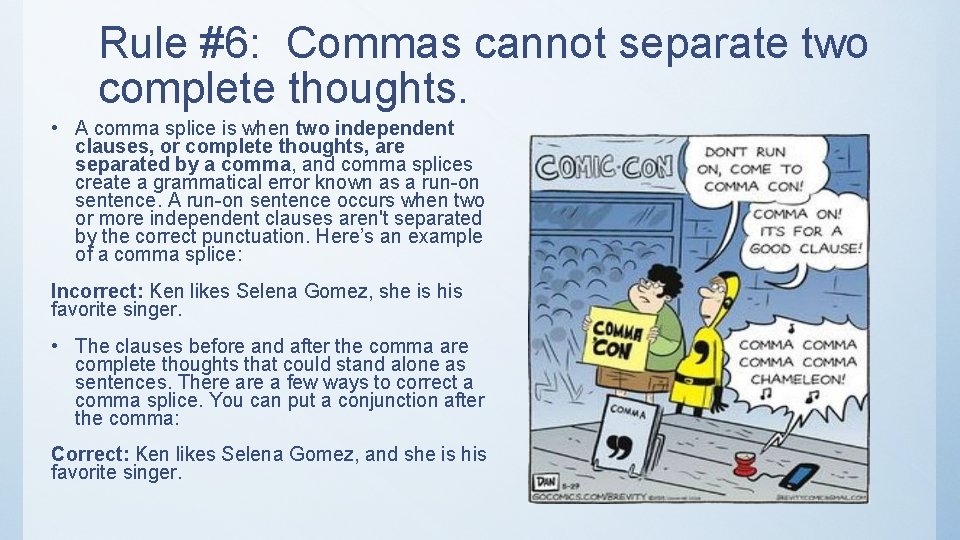
Rule #6: Commas cannot separate two complete thoughts. • A comma splice is when two independent clauses, or complete thoughts, are separated by a comma, and comma splices create a grammatical error known as a run-on sentence. A run-on sentence occurs when two or more independent clauses aren't separated by the correct punctuation. Here’s an example of a comma splice: Incorrect: Ken likes Selena Gomez, she is his favorite singer. • The clauses before and after the comma are complete thoughts that could stand alone as sentences. There a few ways to correct a comma splice. You can put a conjunction after the comma: Correct: Ken likes Selena Gomez, and she is his favorite singer.
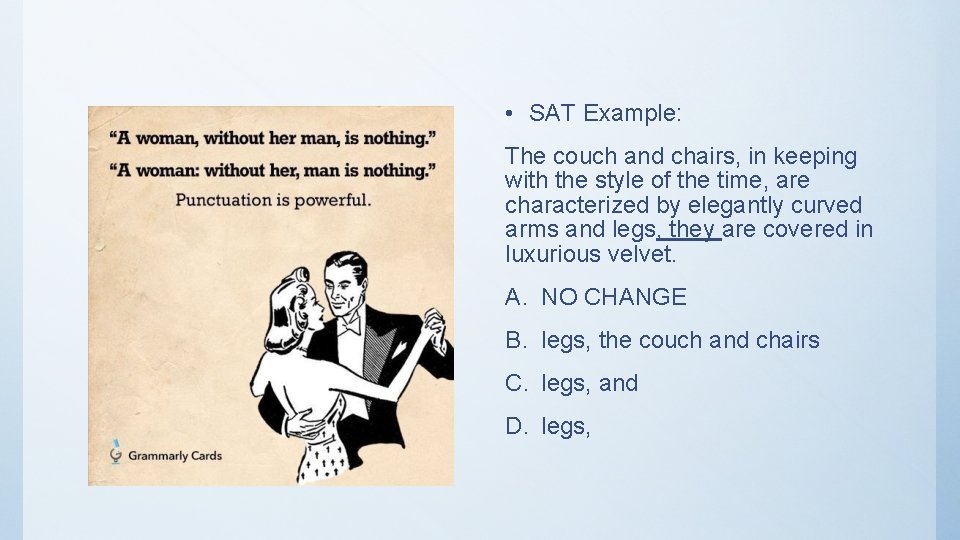
• SAT Example: The couch and chairs, in keeping with the style of the time, are characterized by elegantly curved arms and legs, they are covered in luxurious velvet. A. NO CHANGE B. legs, the couch and chairs C. legs, and D. legs,
Rule #7: Semicolons separate complete thoughts. • Semicolons function like periods; they separate two independent clauses. You should be able to replace semicolons with periods. On the SAT, you may find a randomly placed semicolon, or you may need to replace a comma with a semicolon to fix a comma splice. Here are example sentences with semicolons used correctly and incorrectly: • Incorrect: Because Teresa wanted to please her family; she became a doctor. • Correct: Teresa wanted to please her family; she became a doctor. • The second sentence is correct because the clauses on both sides of the semicolon are independent and could stand alone as sentences.
• An independent clause has a subject and a verb and expresses a complete thought. It can stand by itself as a sentence. • The outfielders were missing fly balls. • The infielders were throwing wildly. • The outfielders were missing fly balls; the infielders were throwing wildly. • SAT Example: Living independently and demonstrating an intense work ethic; the Harvey girls became known as a transformative force in the American West. A. NO CHANGE B. ethic: C. ethic, and D. ethic,
Rule #8: A colon must come after an independent clause. • Colons are usually used to introduce lists or explanations. The key rule for colons is that they must come after a complete sentence. If you end the sentence where the colon is placed, the sentence should make sense and be a complete thought. • Incorrect: Meena enjoys multiple genres of music like: alternative, rap, heavy metal, and country. • Correct: Meena enjoys multiple genres of music: alternative, rap, heavy metal, and country. • Correct: You know what to do: practice. • Correct: He got what he worked for: he really earned that promotion.
SAT Example: Over time, I’ve gotten to know several of my coworking colleagues: another website developer, a graphic designer, a freelance writer, and several code developers. A. NO CHANGE B. colleagues; C. colleagues, D. colleagues
Rule #9: Use apostrophes to form possessives. The SAT tests you on how to use apostrophes to correctly form possessives. Luckily, the rules forming possessives are pretty straightforward. If the word is singular or plural but doesn’t end in “s, ” then you add an “s” after the apostrophe to form a possessive. Here a couple of examples: • I shall be paying a visit to the men’s restroom. • My computer’s monitor is rather dirty. • To create a possessive for a plural word that does end in “s, ” just add an apostrophe after the “s. ” Check it out: • Juan thinks his parents’ rules are too strict. • Also, only use apostrophes for possessives or contractions. Contractions are formed when you combine two words. Examples include it’s (it is), don’t (do not), and isn’t (is not). Don’t use apostrophes to create plural nouns.
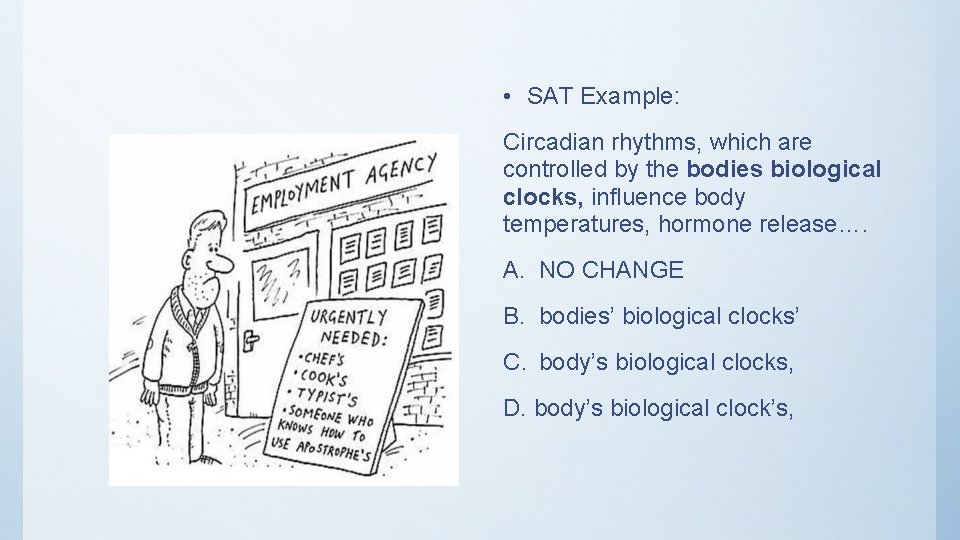
• SAT Example: Circadian rhythms, which are controlled by the bodies biological clocks, influence body temperatures, hormone release…. A. NO CHANGE B. bodies’ biological clocks’ C. body’s biological clocks, D. body’s biological clock’s,
Rule #10: Subjects and verbs must agree. • Subjects and verbs must agree, meaning that you must use the singular form of a verb with a singular subject and the plural form of a verb with a plural subject. Here’s an example: • Incorrect: High school students loves learning grammar rules. • Correct: High school students love learning grammar rules.
• On the SAT, subject verb agreement questions can be more difficult because there may be a phrase separating the subject from the verb. Check out this example: • Incorrect: The members of the committee meets every Tuesday. • Correct: The members of the committee meet every Tuesday. • The subject of the sentence is “members, ” which is plural. Therefore, the verb should be in the plural form. The prepositional phrase “of the committee” separates the subject from the verb. If a verb is underlined on the SAT, make sure that you identify the subject that corresponds with that verb to ensure that the subject and verb agree. Also, keep in mind that a subject can never be part of a prepositional phrase. SAT Example: Yet some of the earliest known works of art, including paintings and drawings thousands of years old found on cave walls in Spain and France, portrays animals. A. NO CHANGE B. portraying C. portray D. has portrayed
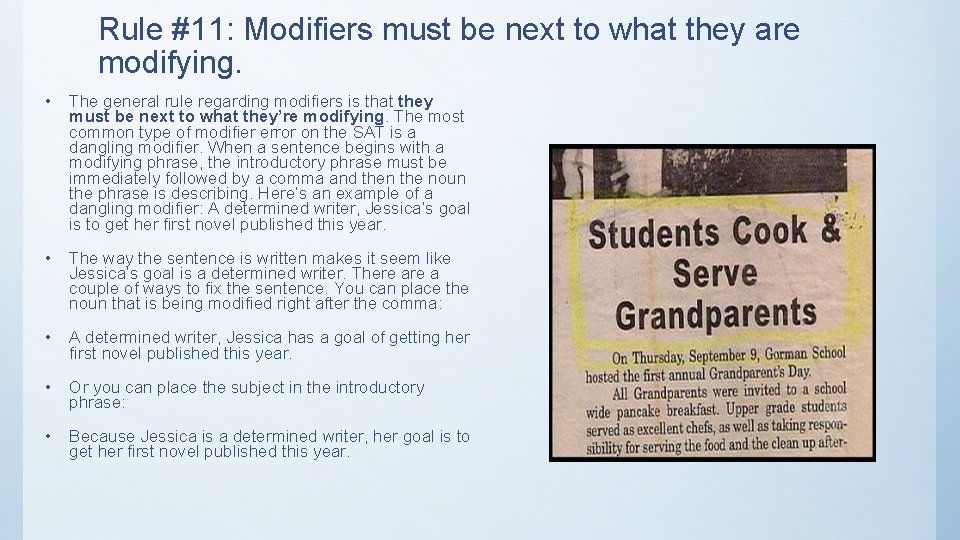
Rule #11: Modifiers must be next to what they are modifying. • The general rule regarding modifiers is that they must be next to what they’re modifying. The most common type of modifier error on the SAT is a dangling modifier. When a sentence begins with a modifying phrase, the introductory phrase must be immediately followed by a comma and then the noun the phrase is describing. Here’s an example of a dangling modifier: A determined writer, Jessica’s goal is to get her first novel published this year. • The way the sentence is written makes it seem like Jessica’s goal is a determined writer. There a couple of ways to fix the sentence. You can place the noun that is being modified right after the comma: • A determined writer, Jessica has a goal of getting her first novel published this year. • Or you can place the subject in the introductory phrase: • Because Jessica is a determined writer, her goal is to get her first novel published this year.
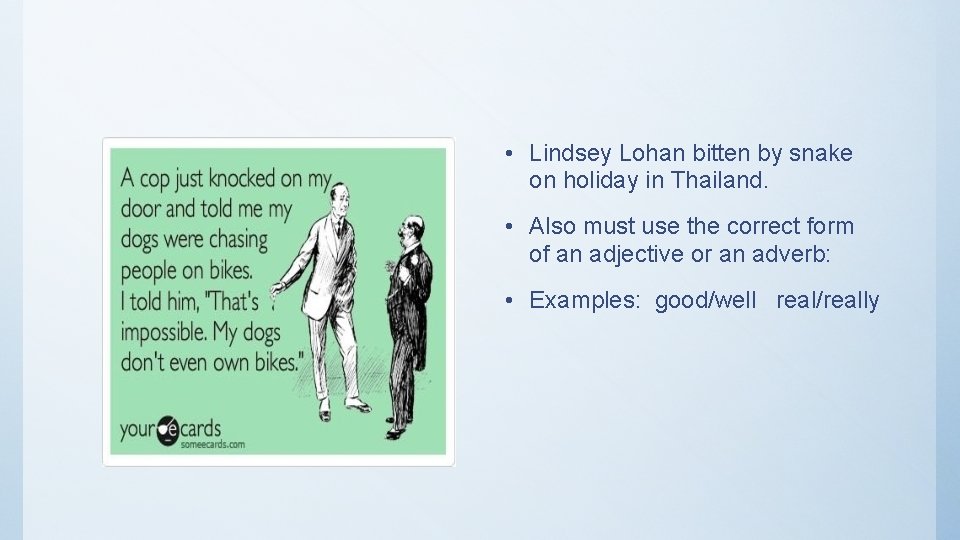
• Lindsey Lohan bitten by snake on holiday in Thailand. • Also must use the correct form of an adjective or an adverb: • Examples: good/well real/really
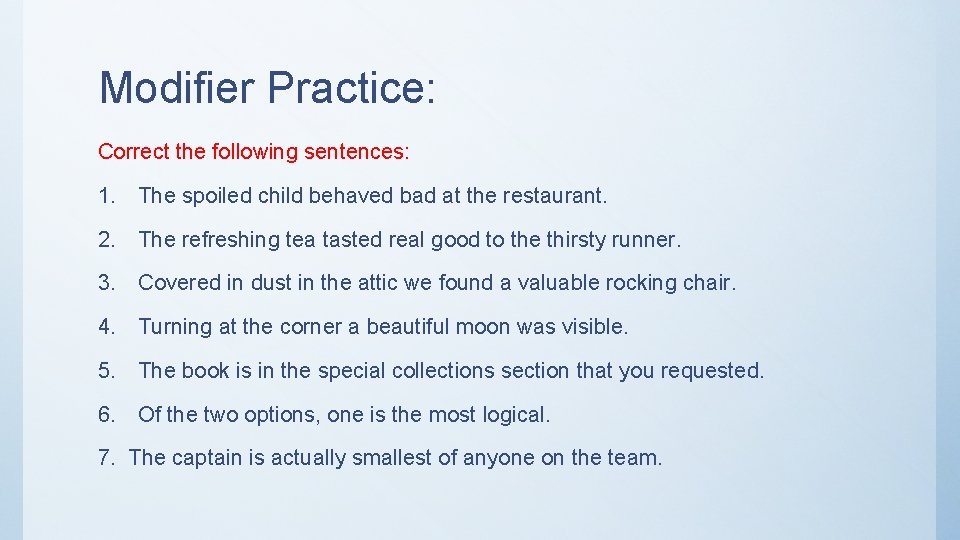
Modifier Practice: Correct the following sentences: 1. The spoiled child behaved bad at the restaurant. 2. The refreshing tea tasted real good to the thirsty runner. 3. Covered in dust in the attic we found a valuable rocking chair. 4. Turning at the corner a beautiful moon was visible. 5. The book is in the special collections section that you requested. 6. Of the two options, one is the most logical. 7. The captain is actually smallest of anyone on the team.
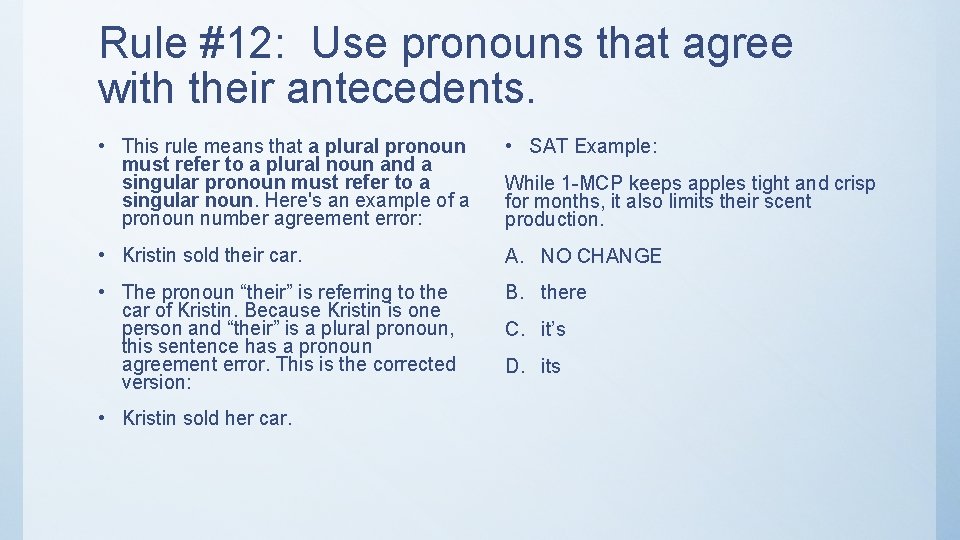
Rule #12: Use pronouns that agree with their antecedents. • This rule means that a plural pronoun must refer to a plural noun and a singular pronoun must refer to a singular noun. Here's an example of a pronoun number agreement error: • SAT Example: • Kristin sold their car. A. NO CHANGE • The pronoun “their” is referring to the car of Kristin. Because Kristin is one person and “their” is a plural pronoun, this sentence has a pronoun agreement error. This is the corrected version: B. there • Kristin sold her car. While 1 -MCP keeps apples tight and crisp for months, it also limits their scent production. C. it’s D. its
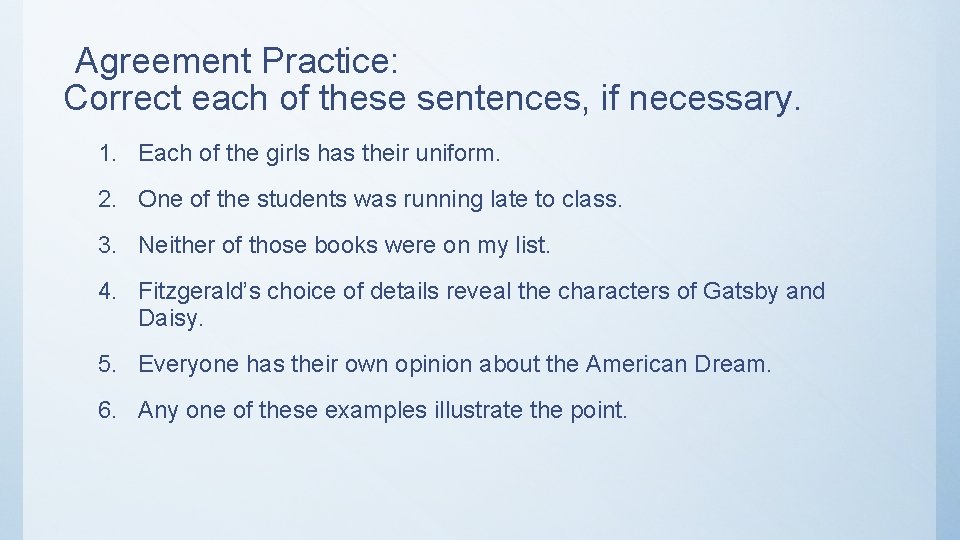
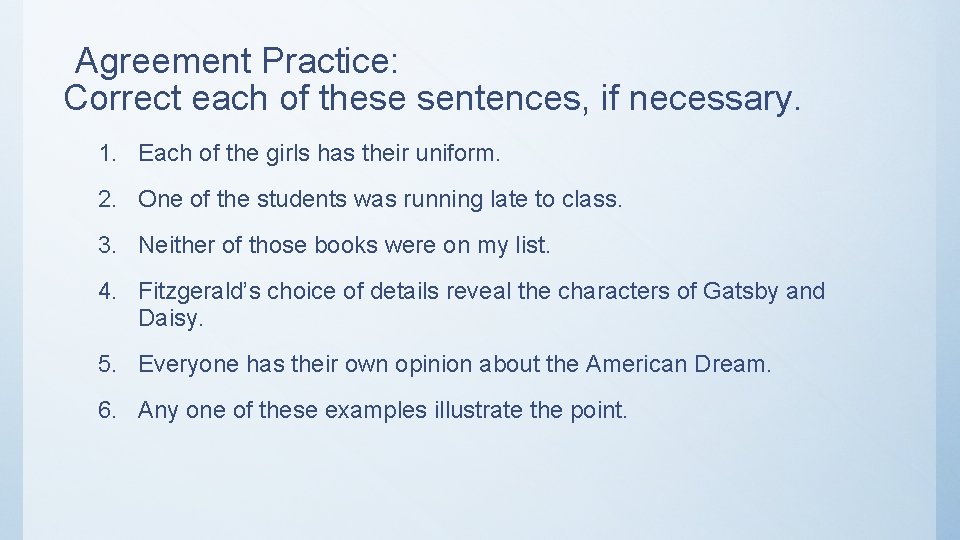
Agreement Practice: Correct each of these sentences, if necessary. 1. Each of the girls has their uniform. 2. One of the students was running late to class. 3. Neither of those books were on my list. 4. Fitzgerald’s choice of details reveal the characters of Gatsby and Daisy. 5. Everyone has their own opinion about the American Dream. 6. Any one of these examples illustrate the point.
Agreement Practice: Correct each of these sentences, if necessary. 1. Each of the girls has their uniform. 2. One of the students was running late to class. 3. Neither of those books were on my list. 4. Fitzgerald’s choice of details reveal the characters of Gatsby and Daisy. 5. Everyone has their own opinion about the American Dream. 6. Any one of these examples illustrate the point.