
12 Lead ECGs Axis Determination Deviation Terry White

- Slides: 12
12 Lead ECGs: Axis Determination & Deviation Terry White, RN
Axis Determination & Deviation Why Axis Determination? u Definitions u Axis Quadrants u Axis Determination u Axis Deviation u l Physiologic vs Pathologic
Axis Determination & Deviation u Why Axis Determination? l u “Paramedics don’t need to know this” The ability to identify hemiblocks (“fascicular blocks”) is the main reason you need to be able to determine axis l “But paramedics don’t need to know this either” Should they know this?
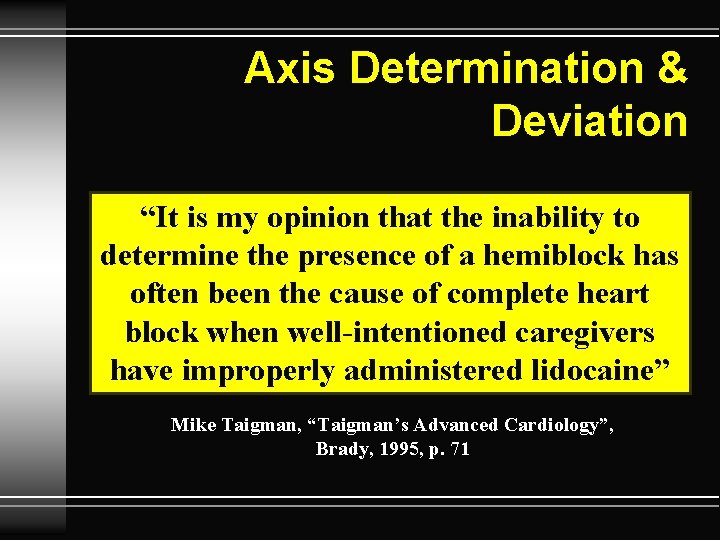
Axis Determination & Deviation “It is my opinion that the inability to determine the presence of a hemiblock has often been the cause of complete heart block when well-intentioned caregivers have improperly administered lidocaine” Mike Taigman, “Taigman’s Advanced Cardiology”, Brady, 1995, p. 71
Axis Determination & Deviation u What is Axis? l l l “the general (mean vector) direction of electrical impulses as they travel through the heart” “the sum total of all electrical currents generated by the ventricular myocardium during depolarization” normally from upper right to lower left
Axis Determination & Deviation u What do you need to determine the axis of an ECG? l l The 12 Lead ECG Leads CORRECTLY placed on the patient u RA on the right arm u LA on the left arm u LL on the left leg u Not on the chest or abdomen l Knowledge of axis deviation
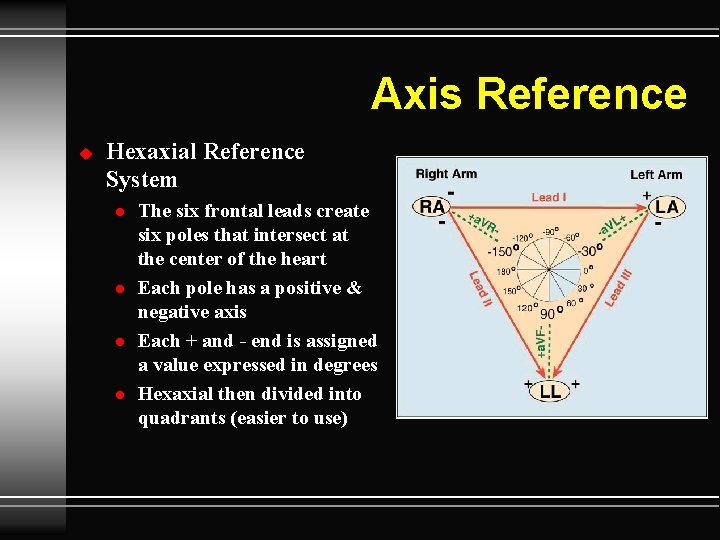
Axis Reference u Hexaxial Reference System l l The six frontal leads create six poles that intersect at the center of the heart Each pole has a positive & negative axis Each + and - end is assigned a value expressed in degrees Hexaxial then divided into quadrants (easier to use)
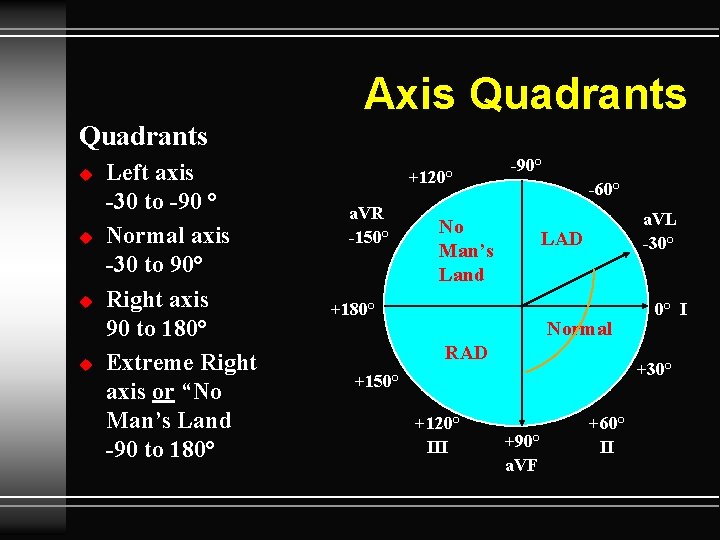
Axis Quadrants u u Left axis -30 to -90 ° Normal axis -30 to 90° Right axis 90 to 180° Extreme Right axis or “No Man’s Land -90 to 180° +120° a. VR -150° -90° -60° No Man’s Land a. VL -30° LAD +180° Normal RAD +30° +150° +120° III 0° I +90° a. VF +60° II
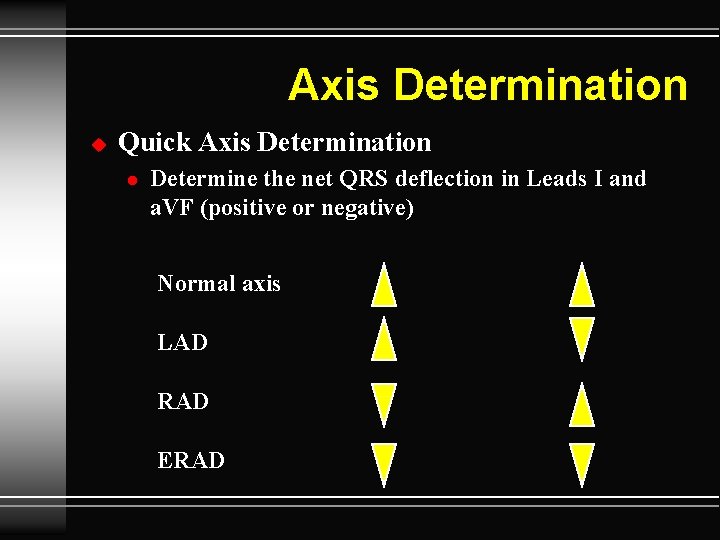
Axis Determination u Quick Axis Determination l Determine the net QRS deflection in Leads I and a. VF (positive or negative) Lead I Normal axis LAD RAD ERAD a. VF
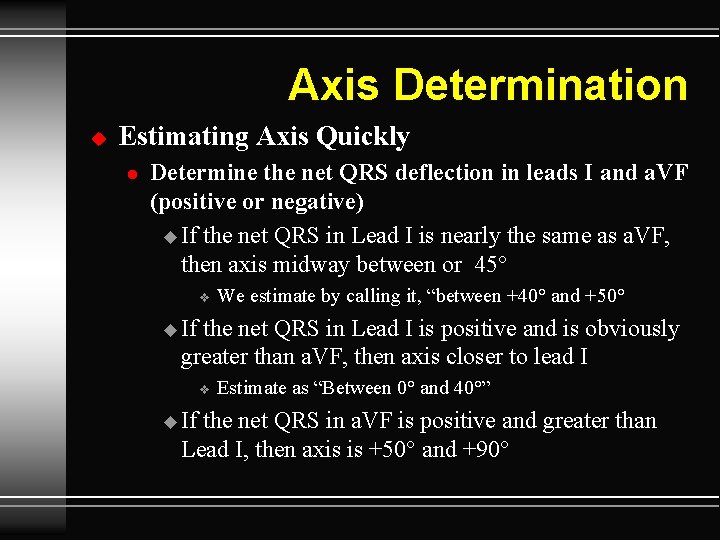
Axis Determination u Estimating Axis Quickly l Determine the net QRS deflection in leads I and a. VF (positive or negative) u If the net QRS in Lead I is nearly the same as a. VF, then axis midway between or 45° v We estimate by calling it, “between +40° and +50° u If the net QRS in Lead I is positive and is obviously greater than a. VF, then axis closer to lead I v u If Estimate as “Between 0° and 40°” the net QRS in a. VF is positive and greater than Lead I, then axis is +50° and +90°
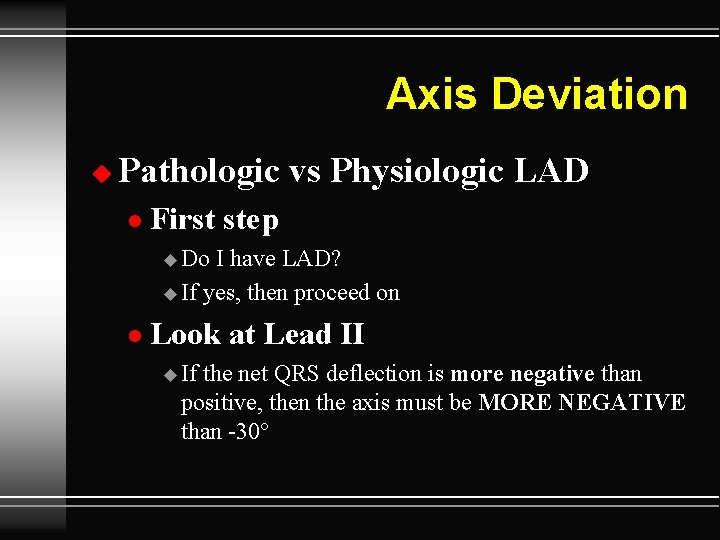
Axis Deviation u Pathologic vs Physiologic LAD l First step u Do I have LAD? u If yes, then proceed on l Look at Lead II u If the net QRS deflection is more negative than positive, then the axis must be MORE NEGATIVE than -30°
Axis Determination & Deviation Examples for Practice