
12 Knife Skills Objective Prepare a workstation for
12 Knife Skills
Objective • Prepare a workstation for knife work. Copyright Goodheart-Willcox Co. , Inc. May not be posted to a publicly accessible website.
Preparing the Workstation • Follow these steps to prepare your workstation: – Select a cleaned and sanitized cutting board – Place a damp towel between the cutting board and worktable to prevent the board from shifting – Adjust the height of the worktable and cutting board as necessary continued Copyright Goodheart-Willcox Co. , Inc. May not be posted to a publicly accessible website.
Preparing the Workstation – Select the appropriate knife and make sure the edge is sharp – Stand with feet shoulder-width apart and weight evenly distributed on both feet facing the worktable Copyright Goodheart-Willcox Co. , Inc. May not be posted to a publicly accessible website.
Objective • Execute the proper technique for cutting with a chef’s knife. Copyright Goodheart-Willcox Co. , Inc. May not be posted to a publicly accessible website.
Using the Chef’s Knife • The chef’s knife is the most important knife in the kitchen • A chef’s knife can be used to chop, slice, cut, and mince a wide range of foods • The most common sizes are 8 - and 10 -inch knives Copyright Goodheart-Willcox Co. , Inc. May not be posted to a publicly accessible website.
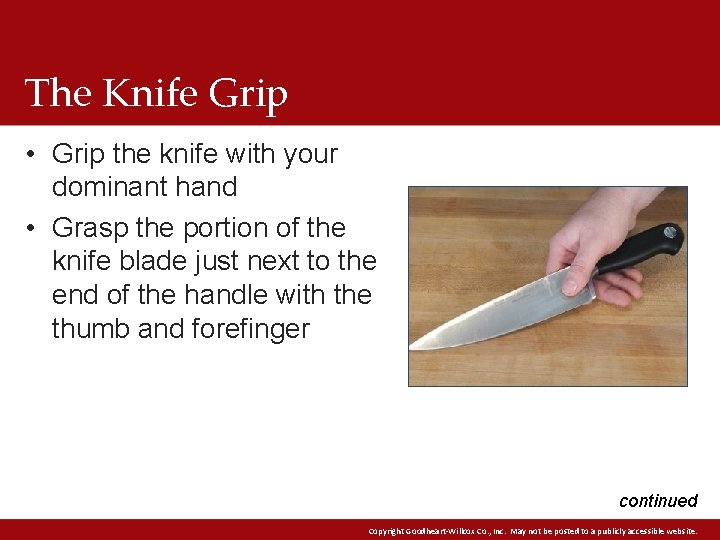
The Knife Grip • Grip the knife with your dominant hand • Grasp the portion of the knife blade just next to the end of the handle with the thumb and forefinger continued Copyright Goodheart-Willcox Co. , Inc. May not be posted to a publicly accessible website.
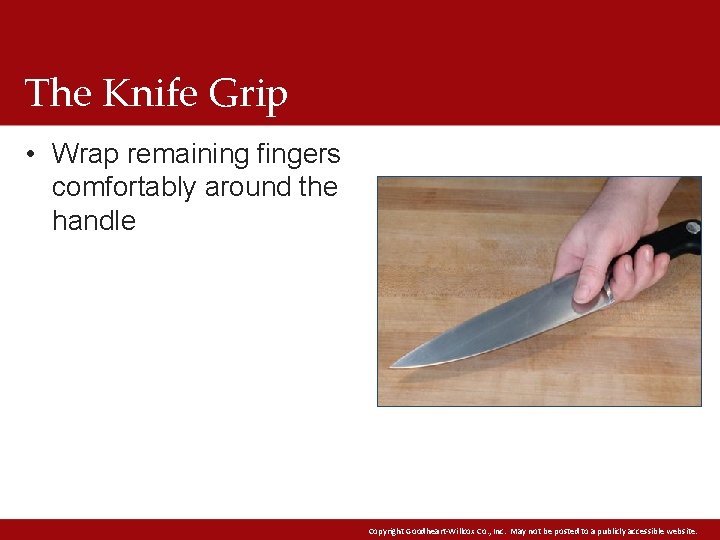
The Knife Grip • Wrap remaining fingers comfortably around the handle Copyright Goodheart-Willcox Co. , Inc. May not be posted to a publicly accessible website.
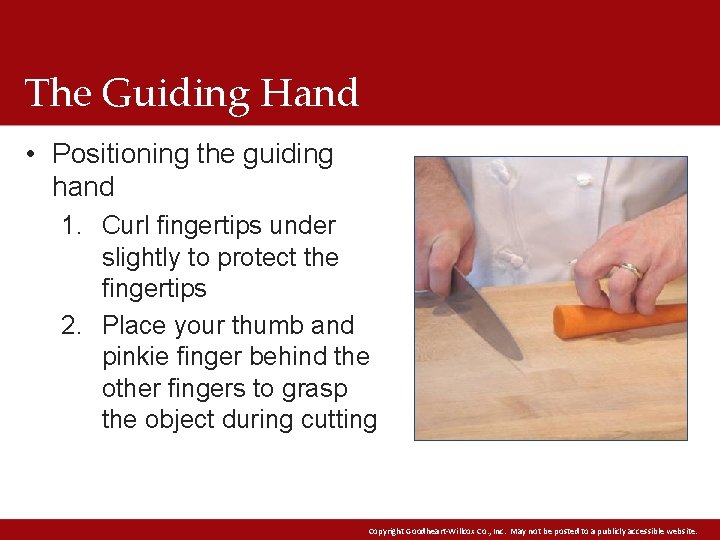
The Guiding Hand • Positioning the guiding hand 1. Curl fingertips under slightly to protect the fingertips 2. Place your thumb and pinkie finger behind the other fingers to grasp the object during cutting Copyright Goodheart-Willcox Co. , Inc. May not be posted to a publicly accessible website.
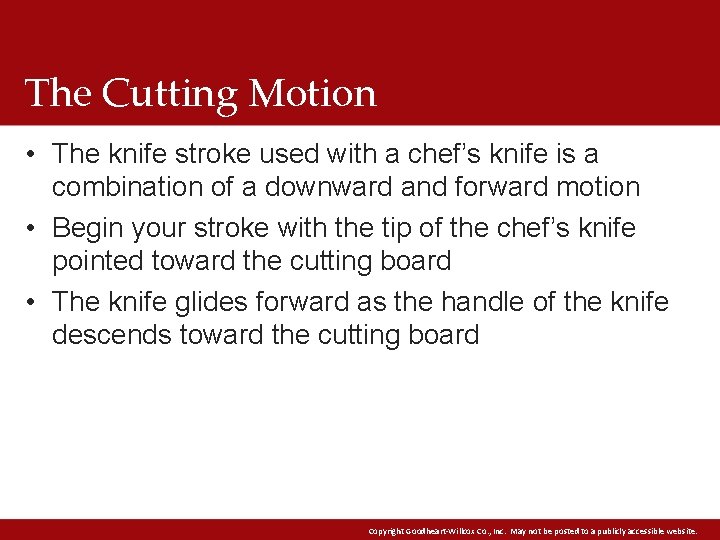
The Cutting Motion • The knife stroke used with a chef’s knife is a combination of a downward and forward motion • Begin your stroke with the tip of the chef’s knife pointed toward the cutting board • The knife glides forward as the handle of the knife descends toward the cutting board Copyright Goodheart-Willcox Co. , Inc. May not be posted to a publicly accessible website.
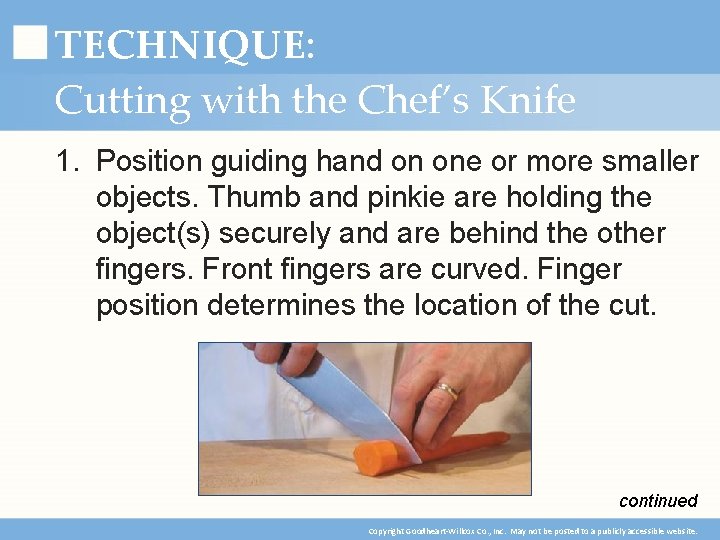
TECHNIQUE: Cutting with the Chef’s Knife 1. Position guiding hand on one or more smaller objects. Thumb and pinkie are holding the object(s) securely and are behind the other fingers. Front fingers are curved. Finger position determines the location of the cut. continued Copyright Goodheart-Willcox Co. , Inc. May not be posted to a publicly accessible website.
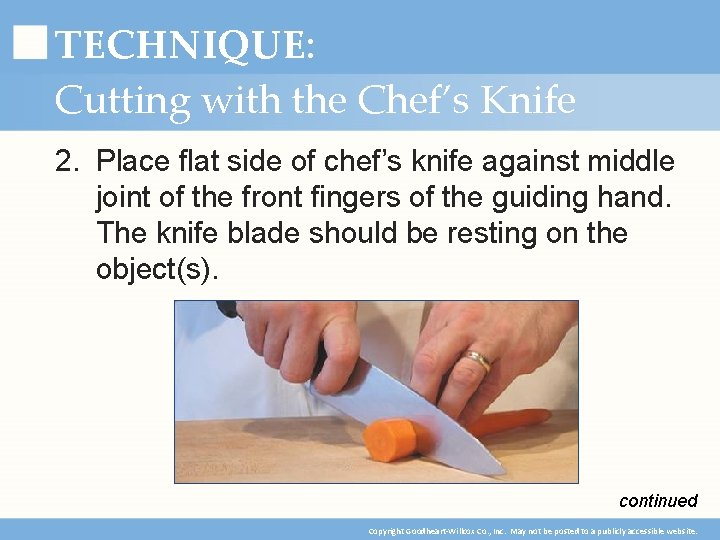
TECHNIQUE: Cutting with the Chef’s Knife 2. Place flat side of chef’s knife against middle joint of the front fingers of the guiding hand. The knife blade should be resting on the object(s). continued Copyright Goodheart-Willcox Co. , Inc. May not be posted to a publicly accessible website.
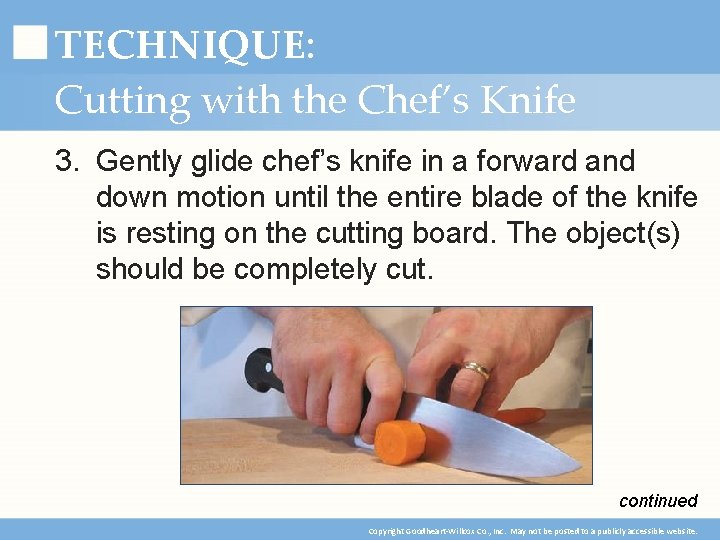
TECHNIQUE: Cutting with the Chef’s Knife 3. Gently glide chef’s knife in a forward and down motion until the entire blade of the knife is resting on the cutting board. The object(s) should be completely cut. continued Copyright Goodheart-Willcox Co. , Inc. May not be posted to a publicly accessible website.
TECHNIQUE: Cutting with the Chef’s Knife 4. Lift the back end of the knife so the tip remains pointing down. Slide guiding hand to the location of the next cut. Verify the position of the guiding hand begin again at step one. Copyright Goodheart-Willcox Co. , Inc. May not be posted to a publicly accessible website.
Objective • Execute three basic knife cuts. Copyright Goodheart-Willcox Co. , Inc. May not be posted to a publicly accessible website.
Basic Knife Cuts • Foodservice professionals must be able to produce consistently cut shapes • The three basic knife cuts are – slice – stick – dice • Chefs become proficient at producing basic knife cuts with practice Copyright Goodheart-Willcox Co. , Inc. May not be posted to a publicly accessible website.
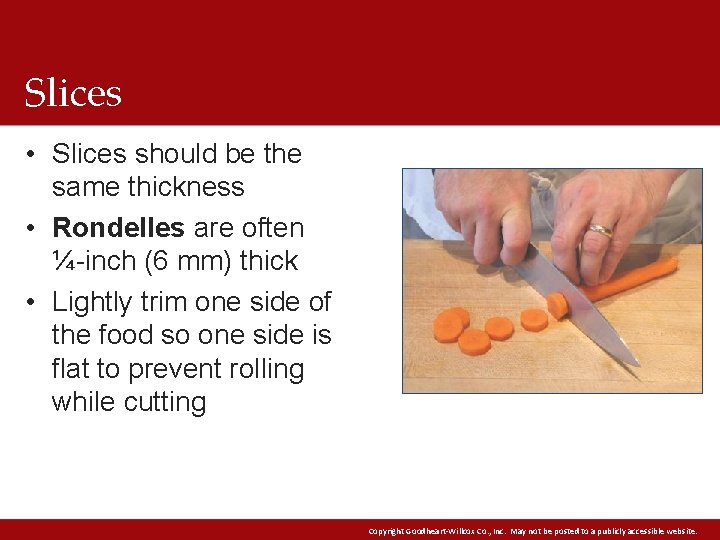
Slices • Slices should be the same thickness • Rondelles are often ¼-inch (6 mm) thick • Lightly trim one side of the food so one side is flat to prevent rolling while cutting Copyright Goodheart-Willcox Co. , Inc. May not be posted to a publicly accessible website.
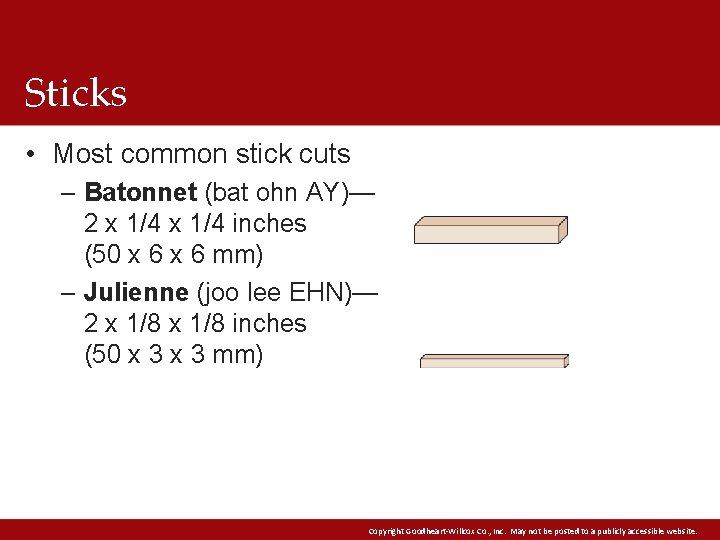
Sticks • Most common stick cuts – Batonnet (bat ohn AY)— 2 x 1/4 inches (50 x 6 mm) – Julienne (joo lee EHN)— 2 x 1/8 inches (50 x 3 mm) Copyright Goodheart-Willcox Co. , Inc. May not be posted to a publicly accessible website.
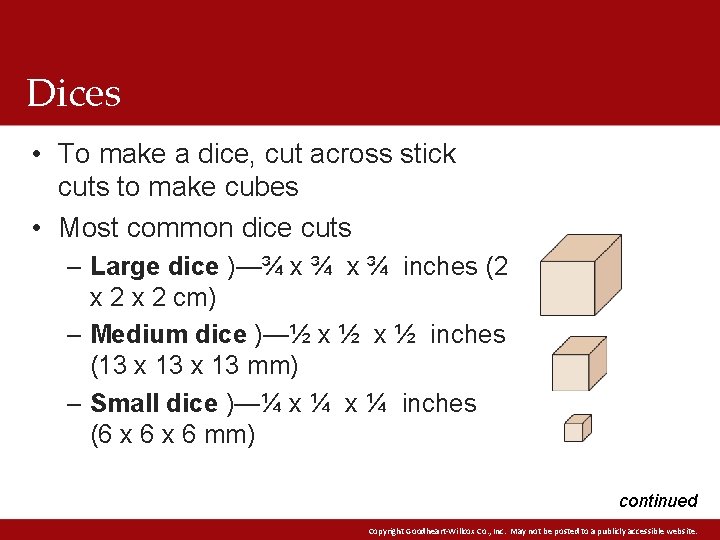
Dices • To make a dice, cut across stick cuts to make cubes • Most common dice cuts – Large dice )—¾ x ¾ inches (2 x 2 cm) – Medium dice )—½ x ½ inches (13 x 13 mm) – Small dice )—¼ x ¼ inches (6 x 6 mm) continued Copyright Goodheart-Willcox Co. , Inc. May not be posted to a publicly accessible website.
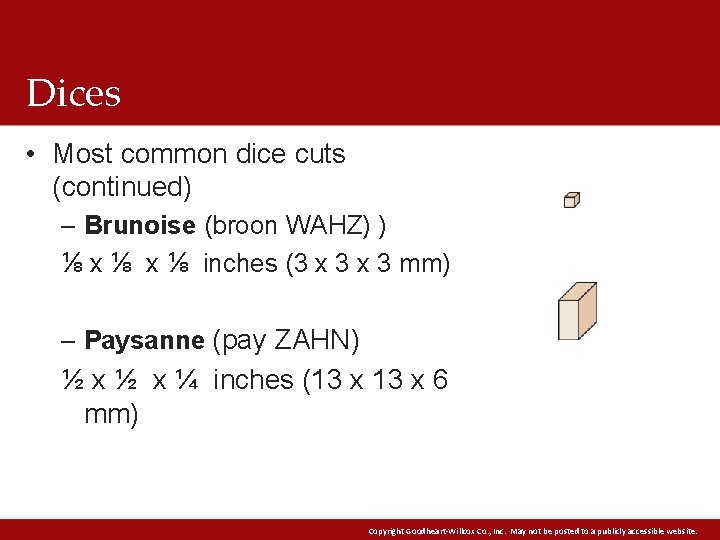
Dices • Most common dice cuts (continued) – Brunoise (broon WAHZ) ) ⅛ x ⅛ inches (3 x 3 mm) – Paysanne (pay ZAHN) ½ x ¼ inches (13 x 6 mm) Copyright Goodheart-Willcox Co. , Inc. May not be posted to a publicly accessible website.
TECHNIQUE: Preparing Stick and Dice Cuts 1. Trim food item so it is flat on one side. 2. Trim the other five sides of the food to create a rectangular box. continued Copyright Goodheart-Willcox Co. , Inc. May not be posted to a publicly accessible website.
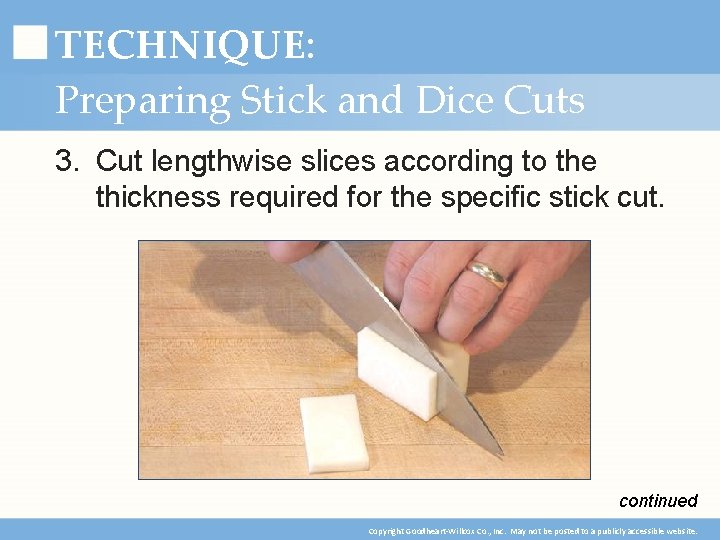
TECHNIQUE: Preparing Stick and Dice Cuts 3. Cut lengthwise slices according to the thickness required for the specific stick cut. continued Copyright Goodheart-Willcox Co. , Inc. May not be posted to a publicly accessible website.
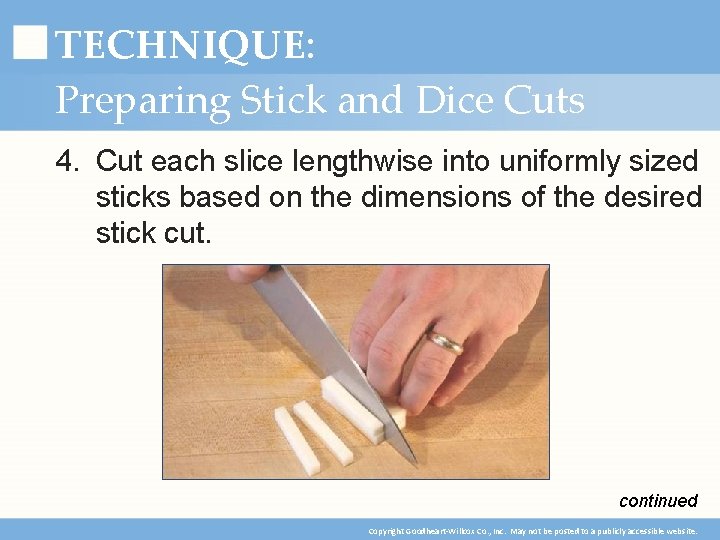
TECHNIQUE: Preparing Stick and Dice Cuts 4. Cut each slice lengthwise into uniformly sized sticks based on the dimensions of the desired stick cut. continued Copyright Goodheart-Willcox Co. , Inc. May not be posted to a publicly accessible website.
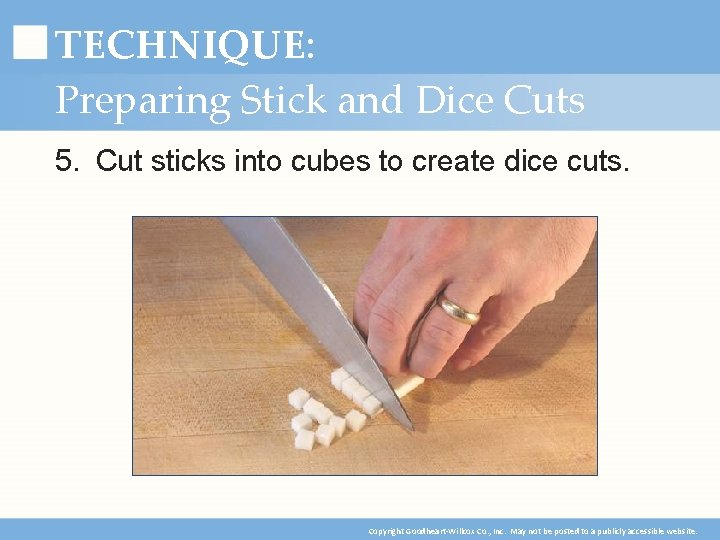
TECHNIQUE: Preparing Stick and Dice Cuts 5. Cut sticks into cubes to create dice cuts. Copyright Goodheart-Willcox Co. , Inc. May not be posted to a publicly accessible website.
Mincing • The chef’s knife is also used for mincing foods, such as fresh herbs, garlic, and olives • Remove food that sticks to the blade during mincing by dragging a finger from the back of the knife toward the edge • Drag the knife blade across the cutting board to push food back into a neat pile Copyright Goodheart-Willcox Co. , Inc. May not be posted to a publicly accessible website.
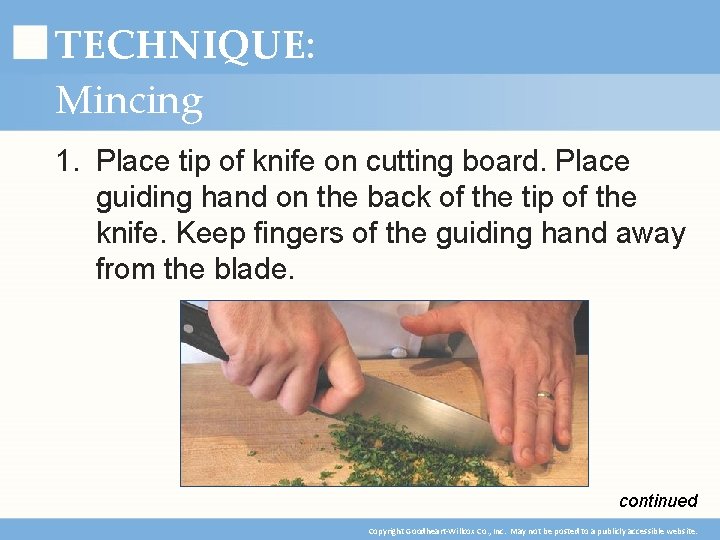
TECHNIQUE: Mincing 1. Place tip of knife on cutting board. Place guiding hand on the back of the tip of the knife. Keep fingers of the guiding hand away from the blade. continued Copyright Goodheart-Willcox Co. , Inc. May not be posted to a publicly accessible website.
TECHNIQUE: Mincing 2. To mince a product, lower and raise the chef’s knife repeatedly while pivoting the knife on the rounded front section of the blade. Copyright Goodheart-Willcox Co. , Inc. May not be posted to a publicly accessible website.
Objective • Apply the correct techniques for using a boning knife. Copyright Goodheart-Willcox Co. , Inc. May not be posted to a publicly accessible website.
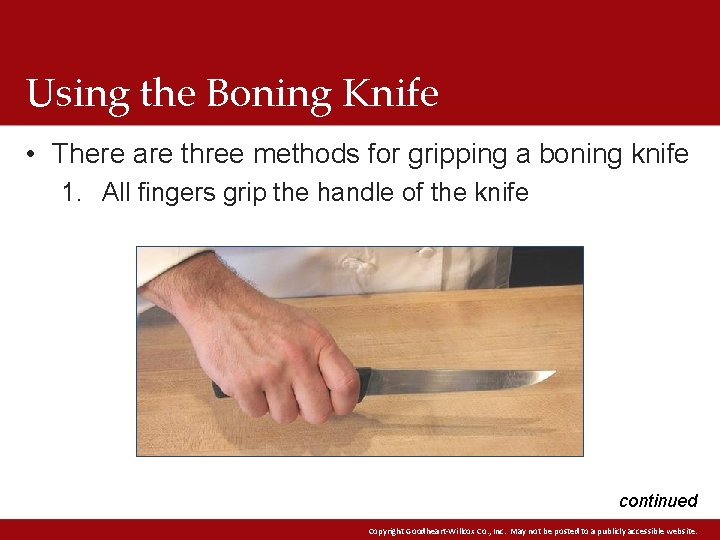
Using the Boning Knife • There are three methods for gripping a boning knife 1. All fingers grip the handle of the knife continued Copyright Goodheart-Willcox Co. , Inc. May not be posted to a publicly accessible website.
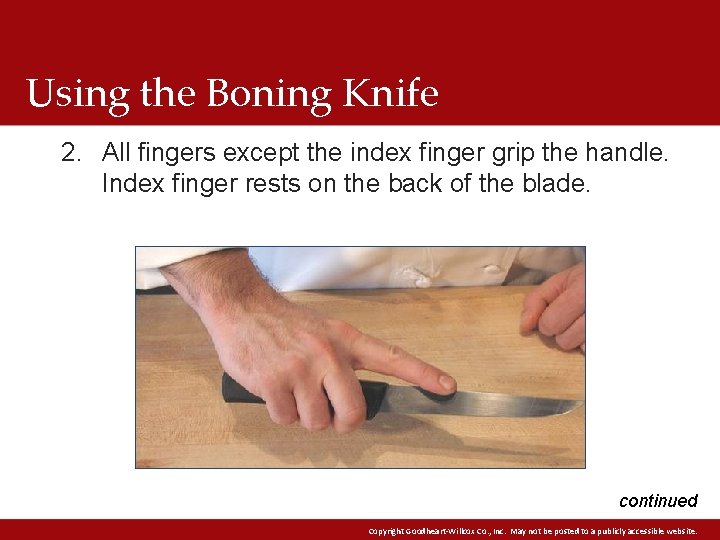
Using the Boning Knife 2. All fingers except the index finger grip the handle. Index finger rests on the back of the blade. continued Copyright Goodheart-Willcox Co. , Inc. May not be posted to a publicly accessible website.
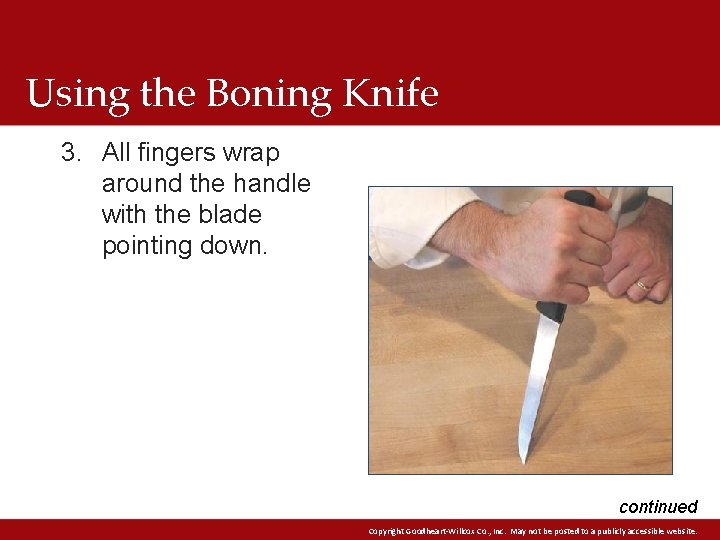
Using the Boning Knife 3. All fingers wrap around the handle with the blade pointing down. continued Copyright Goodheart-Willcox Co. , Inc. May not be posted to a publicly accessible website.
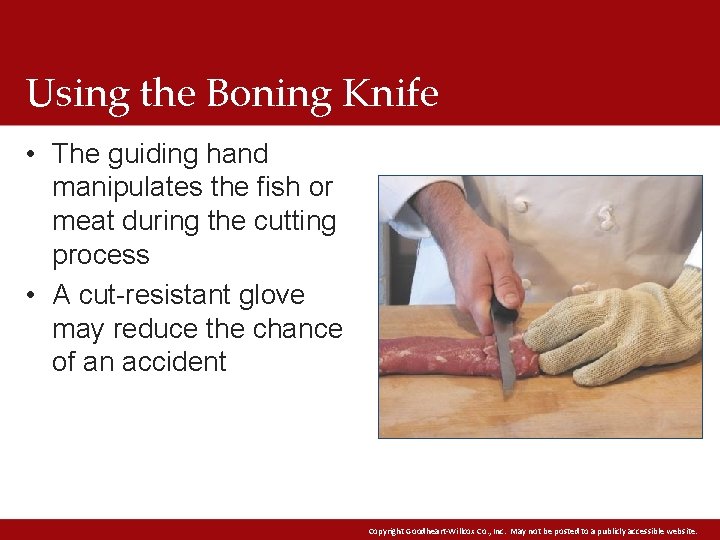
Using the Boning Knife • The guiding hand manipulates the fish or meat during the cutting process • A cut-resistant glove may reduce the chance of an accident Copyright Goodheart-Willcox Co. , Inc. May not be posted to a publicly accessible website.
Objective • Demonstrate the correct use of a paring knife. Copyright Goodheart-Willcox Co. , Inc. May not be posted to a publicly accessible website.
Using the Paring Knife • The paring knife can be used for a wide variety of small tasks, such as – carving, trimming, or peeling vegetables and fruits – making the classical knife cut called a tourné Copyright Goodheart-Willcox Co. , Inc. May not be posted to a publicly accessible website.
TECHNIQUE: Preparing Vegetable Tournés 1. Cut the vegetable to approximate desired length of the tourné. 2. Hold trimmed vegetable in the guiding hand. continued Copyright Goodheart-Willcox Co. , Inc. May not be posted to a publicly accessible website.
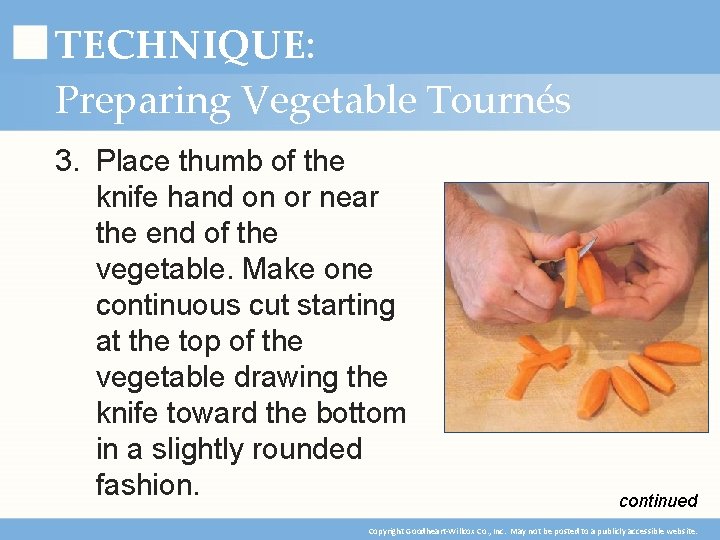
TECHNIQUE: Preparing Vegetable Tournés 3. Place thumb of the knife hand on or near the end of the vegetable. Make one continuous cut starting at the top of the vegetable drawing the knife toward the bottom in a slightly rounded fashion. continued Copyright Goodheart-Willcox Co. , Inc. May not be posted to a publicly accessible website.
TECHNIQUE: Preparing Vegetable Tournés 4. Turn vegetable 1/7 th revolution and make another cut. Right-handed cooks turn the vegetable counterclockwise, while left-handed cooks turn the vegetable clockwise. Finished tourné should have seven equal sides. Copyright Goodheart-Willcox Co. , Inc. May not be posted to a publicly accessible website.
Objective • Implement the proper technique when using a slicer or serrated bread knife. Copyright Goodheart-Willcox Co. , Inc. May not be posted to a publicly accessible website.
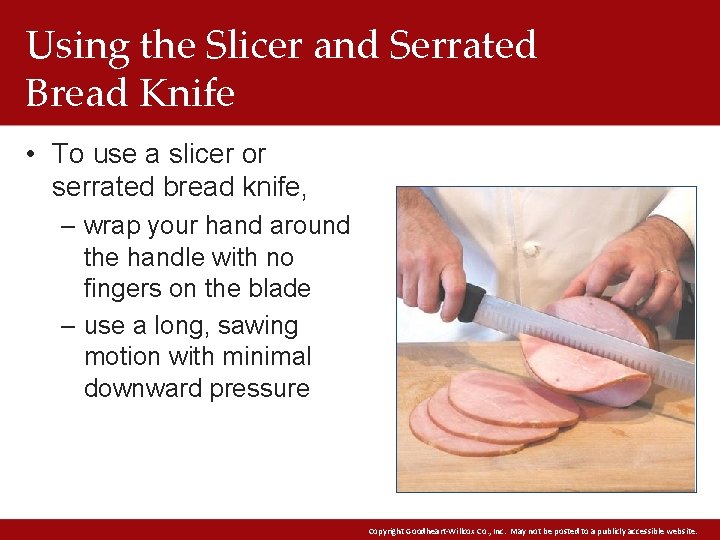
Using the Slicer and Serrated Bread Knife • To use a slicer or serrated bread knife, – wrap your hand around the handle with no fingers on the blade – use a long, sawing motion with minimal downward pressure Copyright Goodheart-Willcox Co. , Inc. May not be posted to a publicly accessible website.
Review • Describe the procedures for preparing a workstation for knife work – Clean and sanitize cutting board; place damp towel between cutting board and worktable to prevent board from shifting; adjust height of worktable or cutting board, if necessary; select appropriate knife; use correct stance continued Copyright Goodheart-Willcox Co. , Inc. May not be posted to a publicly accessible website.
Review • Explain the proper technique for cutting with a chef’s knife – When cutting, fingertips of the guiding hand are curled under for safety and accuracy – Guiding hand guides the knife as it makes uniform cuts using a smooth, forward and downward motion continued Copyright Goodheart-Willcox Co. , Inc. May not be posted to a publicly accessible website.
Review • What types of knife cuts are made with the chef’s knife? – Slices, sticks, dices, mince continued Copyright Goodheart-Willcox Co. , Inc. May not be posted to a publicly accessible website.
Review • Describe the proper technique for using a boning knife – All fingers grip handle; all fingers grip handle except for index finger resting on back of blade; or all fingers wrap around handle with blade pointing down – During cutting, the guiding hand maneuvers the food item being cut continued Copyright Goodheart-Willcox Co. , Inc. May not be posted to a publicly accessible website.
Review • What is the paring knife commonly used for? – carving, peeling, trimming, and making tournés continued Copyright Goodheart-Willcox Co. , Inc. May not be posted to a publicly accessible website.
Review • Explain the correct technique for cutting with a slicer or serrated bread knife – Sawing motion with little downward pressure; product should not be smashed Copyright Goodheart-Willcox Co. , Inc. May not be posted to a publicly accessible website.
- Slides: 46