
12 JIT TPS and Lean Operations Power Point

- Slides: 60
12 JIT, TPS, and Lean Operations Power. Point presentation to accompany Heizer and Render Operations Management, Eleventh Edition Principles of Operations Management, Ninth Edition Power. Point slides by Jeff Heyl
Toyota Motor Corporation § Largest vehicle manufacturer in the world with annual sales of over 9 million vehicles § Success due to two techniques, JIT and TPS § Continual problem solving is central to JIT § Eliminating excess inventory makes problems immediately evident
Toyota Motor Corporation § Central to TPS is employee learning and a continuing effort to produce products under ideal conditions § Respect for people is fundamental § Small building but high levels of production § § Subassemblies are transferred to the assembly line on a JIT basis High quality and low assembly time per vehicle
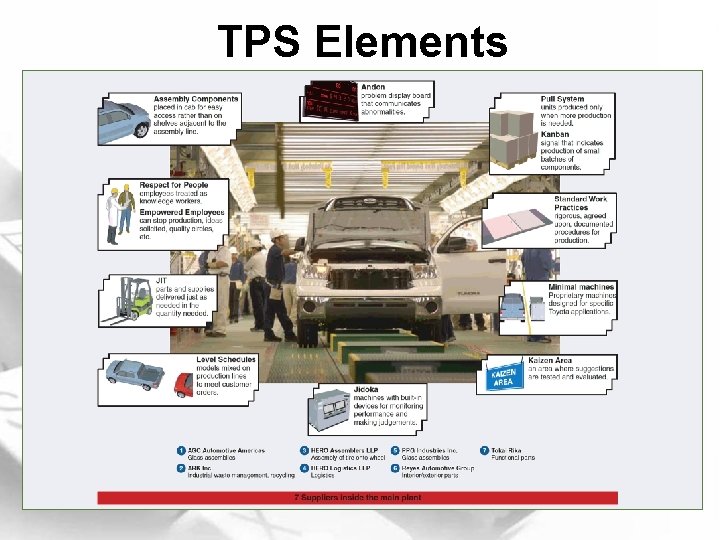
TPS Elements
JIT/TPS/Lean Operations Good production systems require that managers address three issues that are pervasive and fundamental to operations management: eliminate waste, remove variability, and improve throughput
Just-In-Time, TPS, and Lean Operations § JIT focuses on continuous forced problem solving § TPS emphasizes continuous improvement, respect for people, and standard work practices in an assemblyline environment § Lean operations emphasize understanding the customer
Just-In-Time, TPS, and Lean Operations ▶ Tepat waktu (just in time - JIT) adalah pendekatan pemecahan masalah berkesinambungan diwajibkan melalui terobosan dan pengurangan sediaan. ▶ Sistem Produksi Toyota (Toyota Production System TPS) dengan penekanan pada continuous improvement, menghargai sumber daya manusia, dan praktik kerja standar, khususnya disesuaikan dengan lini perakitan. ▶ Operasi ramping (lean operations) menyediakan pelanggan tepat apa yang dibutuhkannya, yaitu memahami Pelanggan.
Eliminate Waste § Waste adalah segala sesuatu yang tidak memberikan nilai tambah, Jika Pelanggan tidak mau membayarnya itu adalah Waste. § Storage, inspection, delay, waiting in queues, and defective products do not add value and are 100% waste
Ohno’s Seven Wastes § Overproduction § Queues § Transportation § Inventory § Motion § Overprocessing § Defective products
Ohno’s Seven Wastes 1. Overproduction (Produksi berlebih): Memproduksi lebih dari yang dipesan pelanggan atau memproduksi lebih awal (sebelum dibutuhkan) adalah waste. Persediaan atau semacamnya adalah waste. 2. Queues (Antrean): Waktu yang tidak dipergunakan untuk apa pun dan menunggu adalah buangan (tidak memberikan nilai tambah). 3. Transportation (Transportasi): Pemindahan material antara pabrik atau antara sentra kerja dan penanganan lebih dari sekali adalah waste.
Ohno’s Seven Wastes 4. Inventory (Persediaan): Bahan mentah yang tidak dibutuhkan, kerja dalam proses (WIP), barang-barang sudah selesai, dan pasokan operasi berlebih tidak memberikan nilai tambahn sehingga merupakan buangan. 5. Motion (Gerakan): Gerakan perlengkapan atau orang yang tidak memberikan nilai tambah adalah buangan. 6. Overprocessing (Proses berlebih): Kerja dilakukan pada produk yang tidak memberikan nilai tambah adalah buangan. 7. Defective products (Produk yang tidak efektif): Barang yang dikembalikan, klaim garansi, pekerjaan ulang, dan sisa-sisa adalah Waste.
Eliminate Waste § Other resources such as energy, water, and air are often wasted § Efficient, sustainable production minimizes inputs, reduces waste § Traditional “housekeeping” has been expanded to the 5 Ss
The 5 Ss Sort/segregate – when in doubt, throw it out Simplify/straighten – methods analysis tools Shine/sweep – clean daily Standardize – remove variations from processes ▶ Sustain/self-discipline – review work and recognize progress ▶ ▶
The 5 Ss ▶ Sort/segregate – when in doubt, throw it out, Letakkan apa yang diperlukan dan keluarkan apa pun yang tidak dibutuhkan dari area kerja ▶ Simplify/straighten – methods analysis tools, Atur dan pergunakan sarana-sarana metode analisis untuk meningkatkan kelancaran aliran pekerjaan dan mengurangi gerakan waste. ▶ Shine/sweep – clean daily, Bersihkan setiap hari; hilangkan segala bentuk kotoran, kontaminasi, dan timbunan yang kacau balau dari area kerja. ▶ Standardize – remove variations from processes, Hilangkan keragaman dalam proses kerja dengan mengembangkan prosedur operasi standar dan daftar periksa. ▶ Sustain/self-discipline – review work and recognize progress, Teliti secara berkala untuk mengenali upaya-upaya dan memotivasi agar continuous improvement.
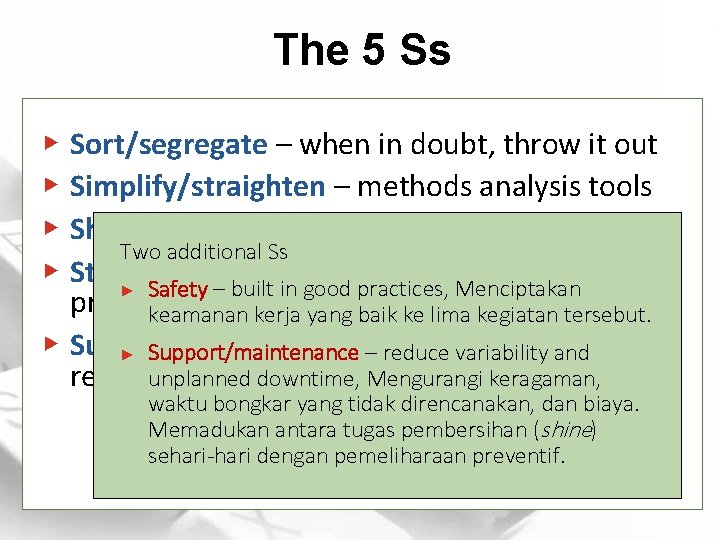
The 5 Ss Sort/segregate – when in doubt, throw it out Simplify/straighten – methods analysis tools Shine/sweep – clean daily Two additional Ss Standardize – remove variations from ► Safety – built in good practices, Menciptakan processes keamanan kerja yang baik ke lima kegiatan tersebut. ▶ Sustain/self-discipline review workand ► Support/maintenance ––reduce variability unplanned downtime, Mengurangi keragaman, recognize progress ▶ ▶ waktu bongkar yang tidak direncanakan, dan biaya. Memadukan antara tugas pembersihan (shine) sehari-hari dengan pemeliharaan preventif.
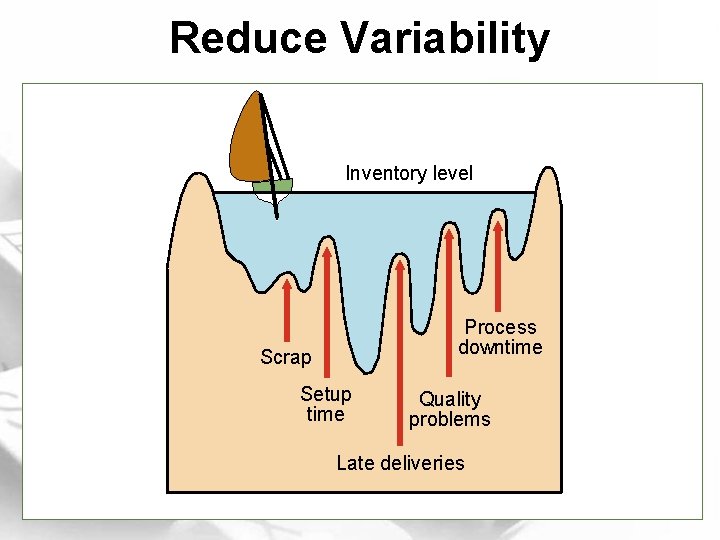
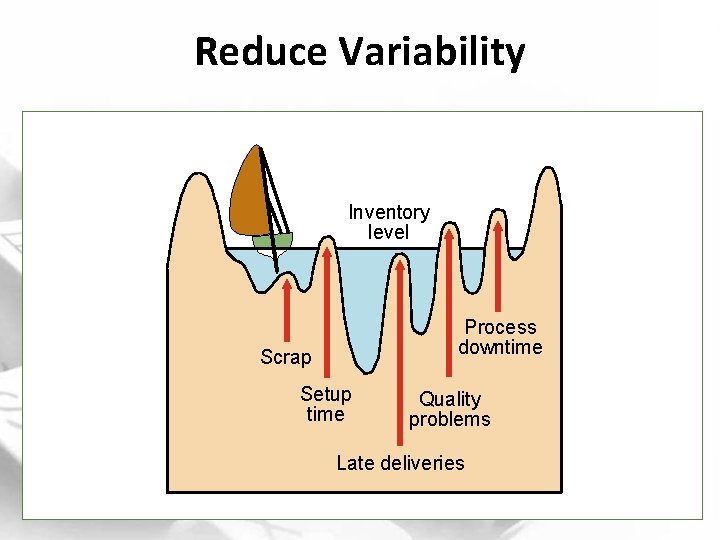
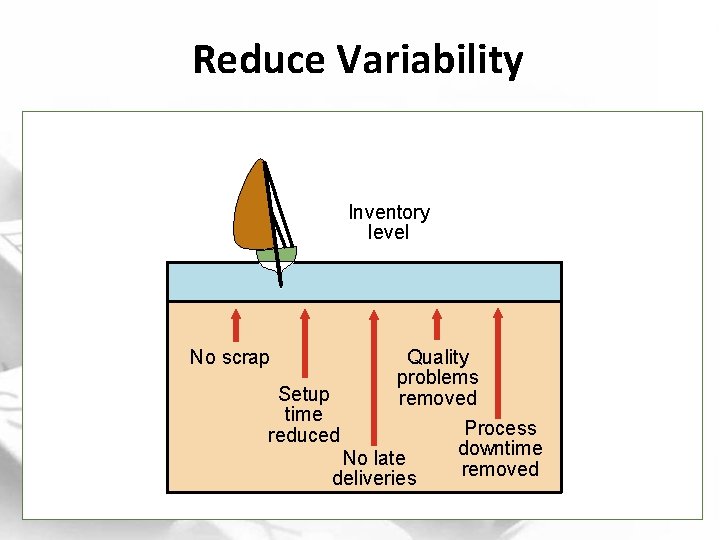
Remove Variability § JIT systems require managers to reduce variability caused by both internal and external factors § Variability is any deviation from the optimum process § Inventory hides variability § Less variability results in less waste
Sources of Variability § Poor production processes resulting in improper quantities, late, or nonconforming units § Unknown customer demands § Incomplete or inaccurate drawings, specifications, or bills of material
Sources of Variability § Poor production processes resulting in improper quantities, late, or nonconforming units § Unknown customer demands § Incomplete or inaccurate drawings, specifications, or bills of material duction re y r o t n e v n i d g n n i a y f T i I t J n h e t d o i B n i s l o o t e v i are effect s of variability cause
Improve Throughput § The time it takes to move an order from receipt to delivery § The time between the arrival of raw materials and the shipping of the finished order is called manufacturing cycle time § A pull system increases throughput
Improve Throughput § By pulling material in small lots, inventory cushions are removed, exposing problems and emphasizing continual improvement § Manufacturing cycle time is reduced § Push systems dump orders on the downstream stations regardless of the need
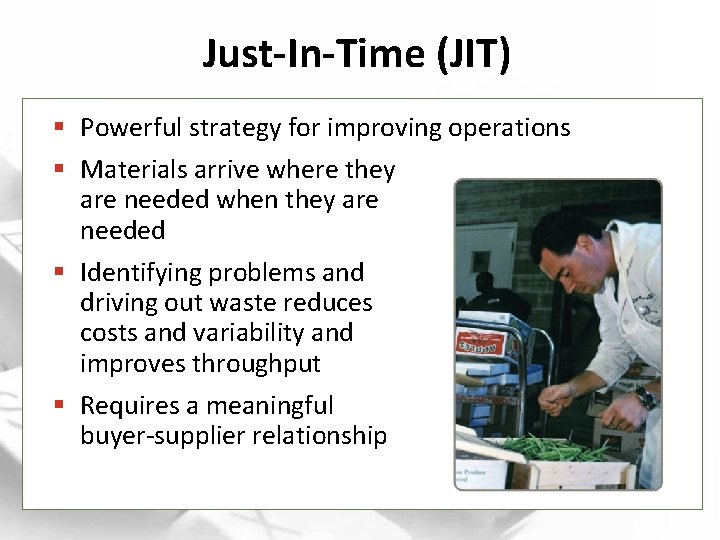
Just-In-Time (JIT) § Powerful strategy for improving operations § Materials arrive where they are needed when they are needed § Identifying problems and driving out waste reduces costs and variability and improves throughput § Requires a meaningful buyer-supplier relationship
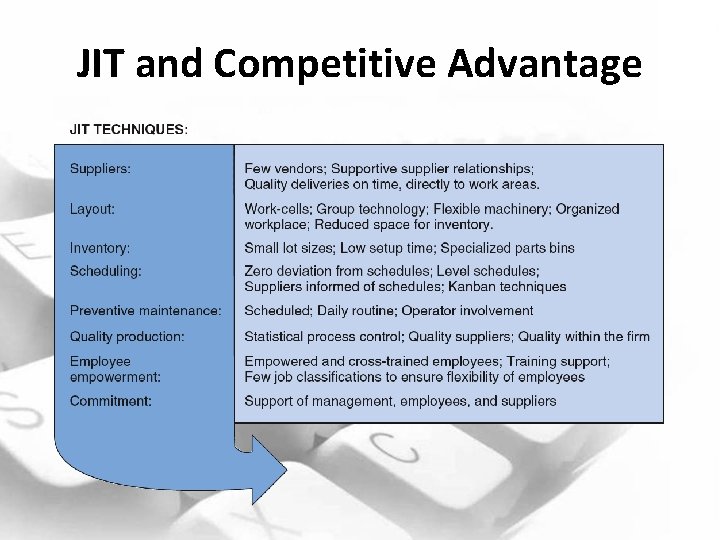
JIT and Competitive Advantage
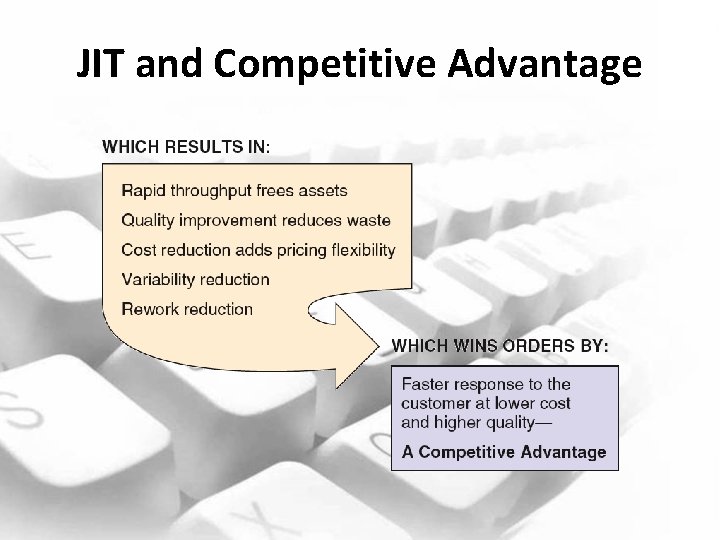
JIT and Competitive Advantage
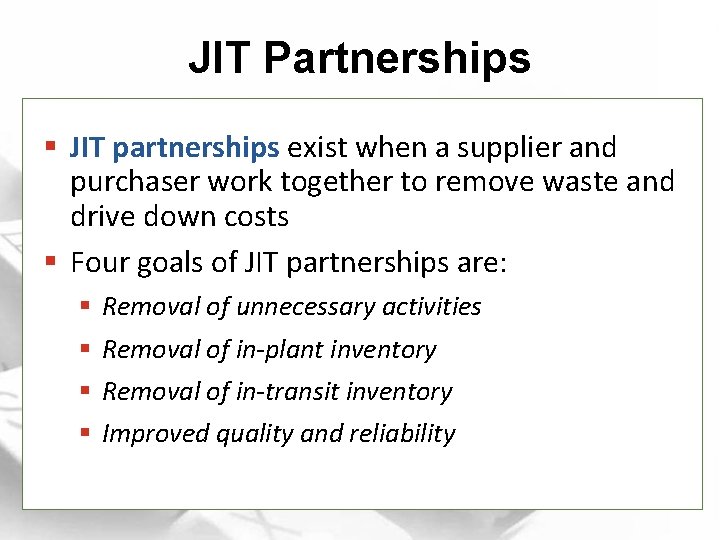
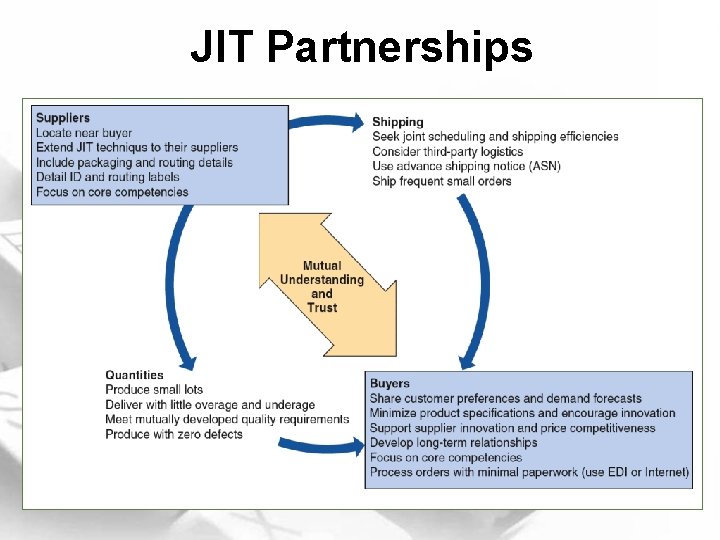
JIT Partnerships § JIT partnerships exist when a supplier and purchaser work together to remove waste and drive down costs § Four goals of JIT partnerships are: § § Removal of unnecessary activities Removal of in-plant inventory Removal of in-transit inventory Improved quality and reliability
JIT Partnerships
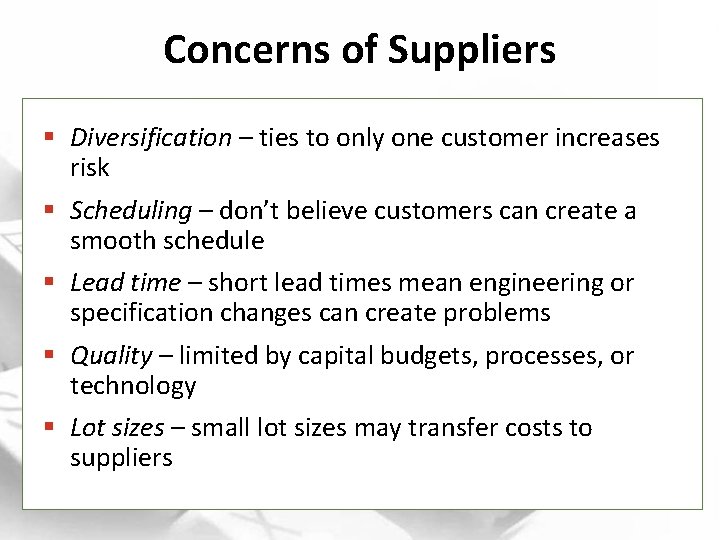
Concerns of Suppliers § Diversification – ties to only one customer increases risk § Scheduling – don’t believe customers can create a smooth schedule § Lead time – short lead times mean engineering or specification changes can create problems § Quality – limited by capital budgets, processes, or technology § Lot sizes – small lot sizes may transfer costs to suppliers
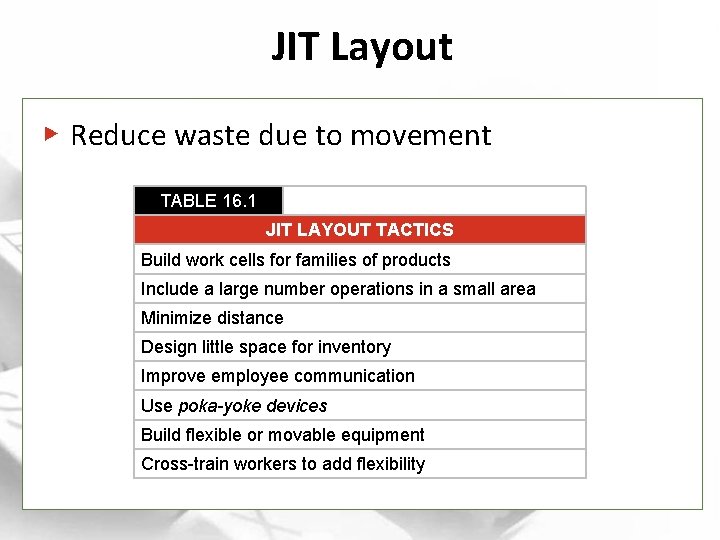
JIT Layout ▶ Reduce waste due to movement TABLE 16. 1 JIT LAYOUT TACTICS Build work cells for families of products Include a large number operations in a small area Minimize distance Design little space for inventory Improve employee communication Use poka yoke devices Build flexible or movable equipment Cross-train workers to add flexibility
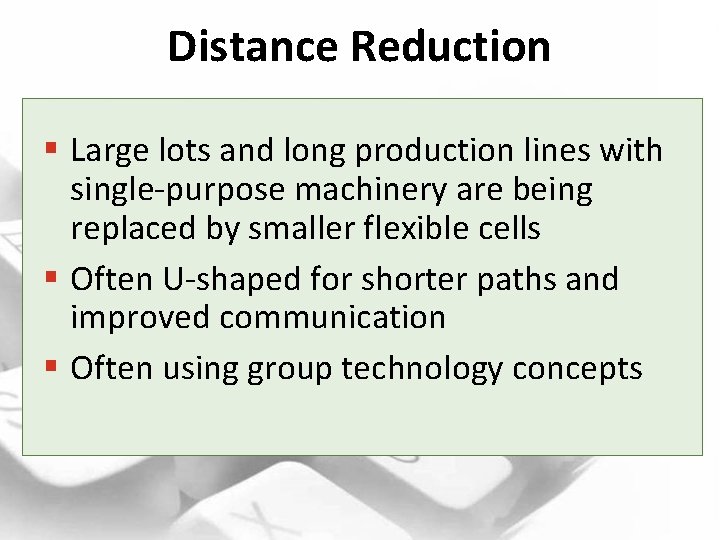
Distance Reduction § Large lots and long production lines with single-purpose machinery are being replaced by smaller flexible cells § Often U-shaped for shorter paths and improved communication § Often using group technology concepts
Increased Flexibility § Cells designed to be rearranged as volume or designs change § Applicable in office environments as well as production settings § Facilitates both product and process improvement
Impact on Employees § Employees may be cross trained for flexibility and efficiency § Improved communications facilitate the passing on of important information about the process § With little or no inventory buffer, getting it right the first time is critical
Reduced Space and Inventory § With reduced space, inventory must be in very small lots § Units are always moving because there is no storage
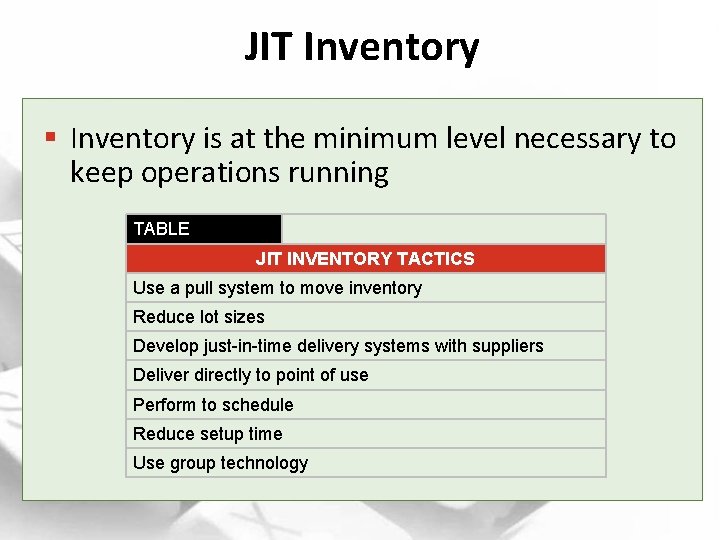
JIT Inventory § Inventory is at the minimum level necessary to keep operations running TABLE JIT INVENTORY TACTICS Use a pull system to move inventory Reduce lot sizes Develop just-in-time delivery systems with suppliers Deliver directly to point of use Perform to schedule Reduce setup time Use group technology
Reduce Variability Inventory level Process downtime Scrap Setup time Quality problems Late deliveries
Reduce Variability Inventory level Process downtime Scrap Setup time Quality problems Late deliveries
Reduce Variability Inventory level No scrap Setup time reduced Quality problems removed No late deliveries Process downtime removed
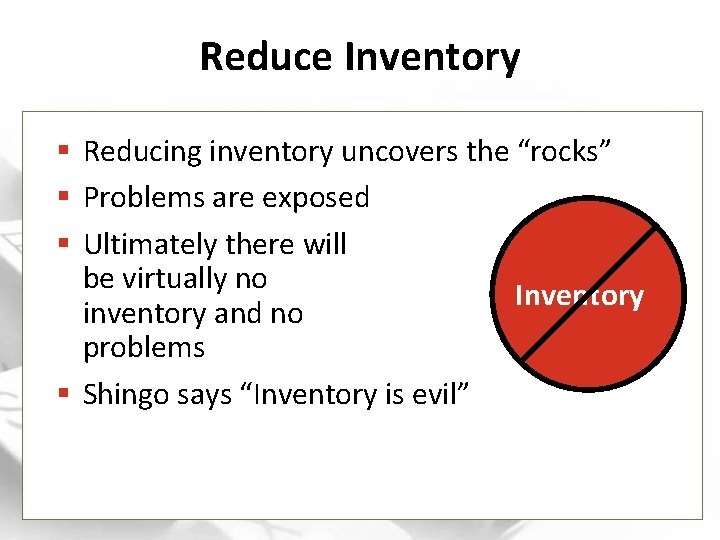
Reduce Inventory § Reducing inventory uncovers the “rocks” § Problems are exposed § Ultimately there will be virtually no Inventory inventory and no problems § Shingo says “Inventory is evil”
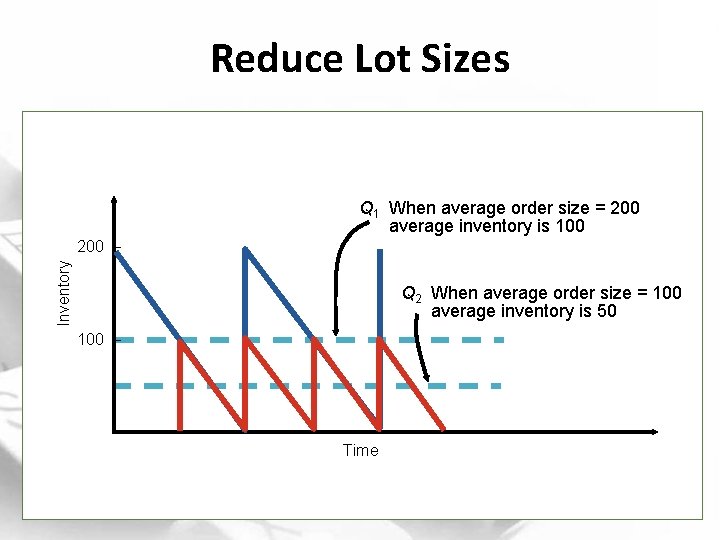
Reduce Lot Sizes Q 1 When average order size = 200 average inventory is 100 Inventory 200 – Q 2 When average order size = 100 average inventory is 50 100 – Time
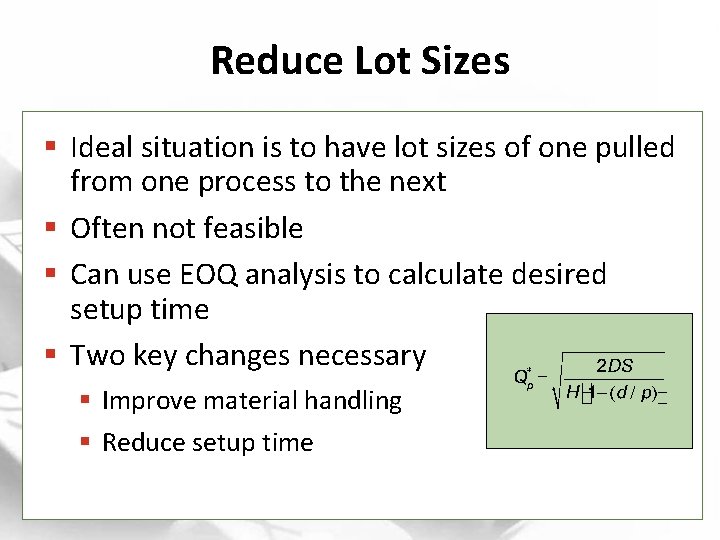
Reduce Lot Sizes § Ideal situation is to have lot sizes of one pulled from one process to the next § Often not feasible § Can use EOQ analysis to calculate desired setup time § Two key changes necessary § Improve material handling § Reduce setup time
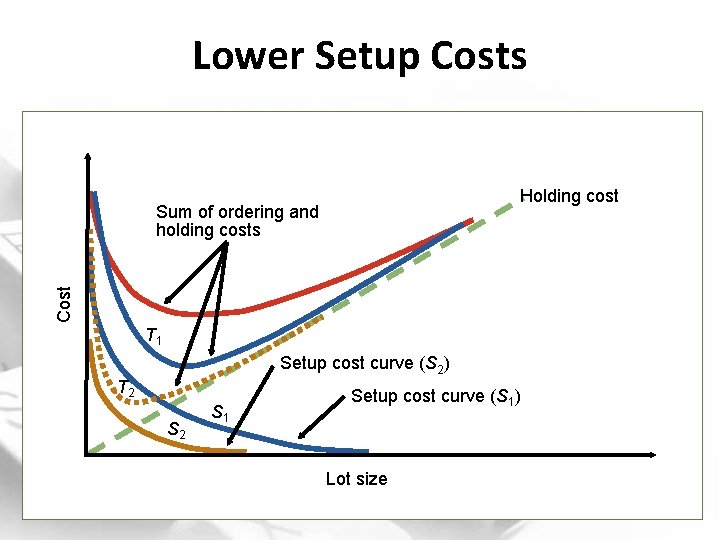
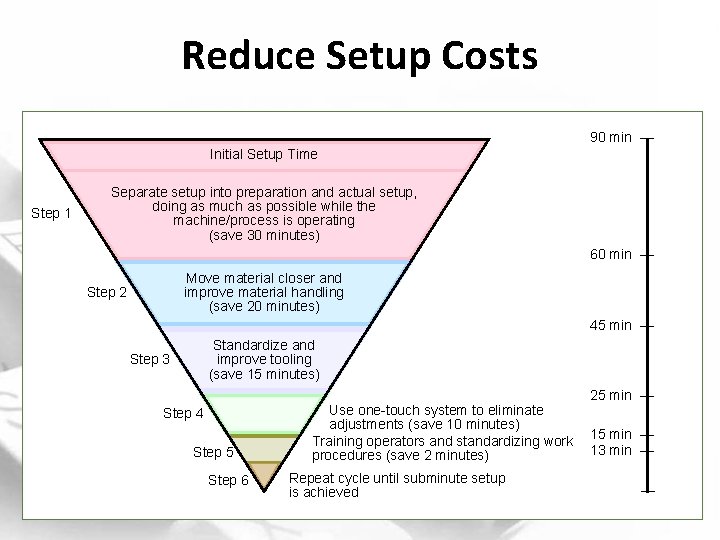
Reduce Setup Costs § High setup costs encourage large lot sizes § Reducing setup costs reduces lot size and reduces average inventory § Setup time can be reduced through preparation prior to shutdown and changeover
Lower Setup Costs Holding cost Cost Sum of ordering and holding costs T 1 Setup cost curve (S 2) T 2 S 1 Setup cost curve (S 1) Lot size
Reduce Setup Costs 90 min — Initial Setup Time Step 1 Separate setup into preparation and actual setup, doing as much as possible while the machine/process is operating (save 30 minutes) 60 min — Move material closer and improve material handling (save 20 minutes) Step 2 45 min — Standardize and improve tooling (save 15 minutes) Step 3 Step 4 Step 5 Step 6 Use one-touch system to eliminate adjustments (save 10 minutes) Training operators and standardizing work procedures (save 2 minutes) Repeat cycle until subminute setup is achieved 25 min — 13 min — —
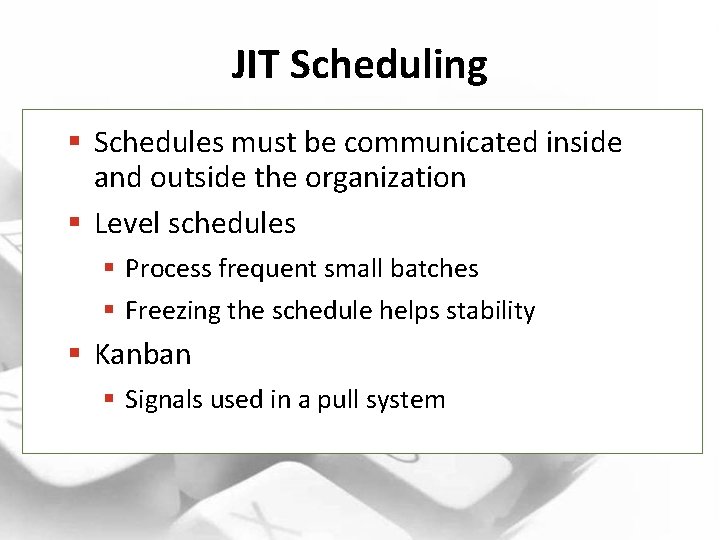
JIT Scheduling § Schedules must be communicated inside and outside the organization § Level schedules § Process frequent small batches § Freezing the schedule helps stability § Kanban § Signals used in a pull system
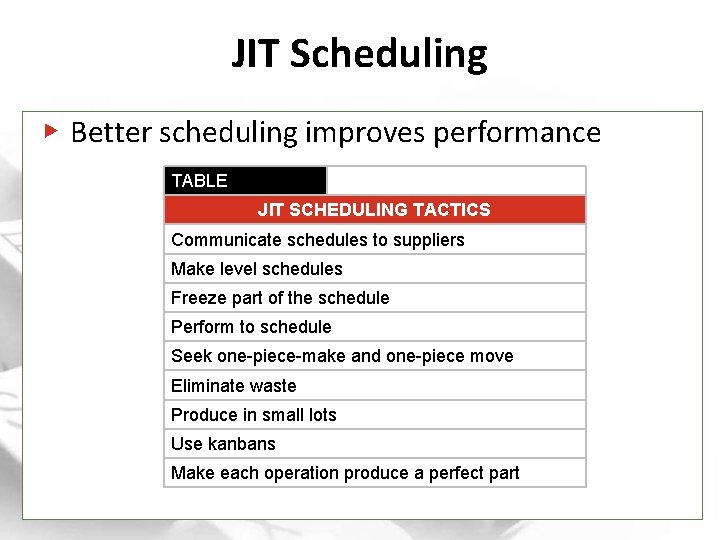
JIT Scheduling ▶ Better scheduling improves performance TABLE JIT SCHEDULING TACTICS Communicate schedules to suppliers Make level schedules Freeze part of the schedule Perform to schedule Seek one-piece-make and one-piece move Eliminate waste Produce in small lots Use kanbans Make each operation produce a perfect part
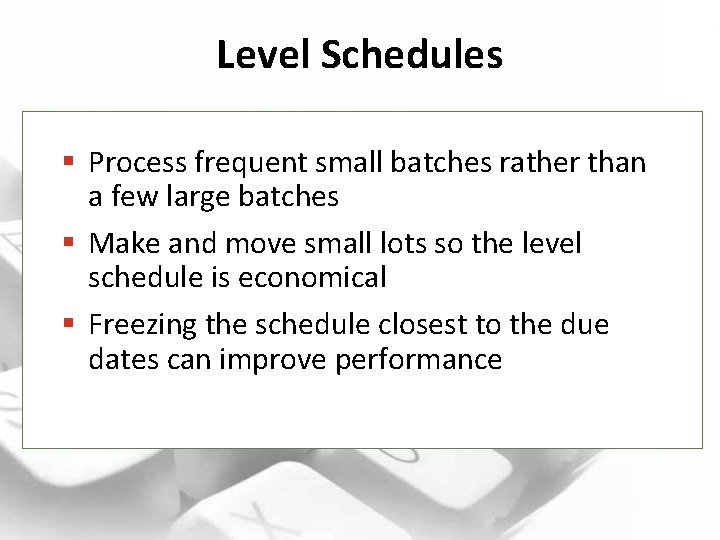
Level Schedules § Process frequent small batches rather than a few large batches § Make and move small lots so the level schedule is economical § Freezing the schedule closest to the due dates can improve performance
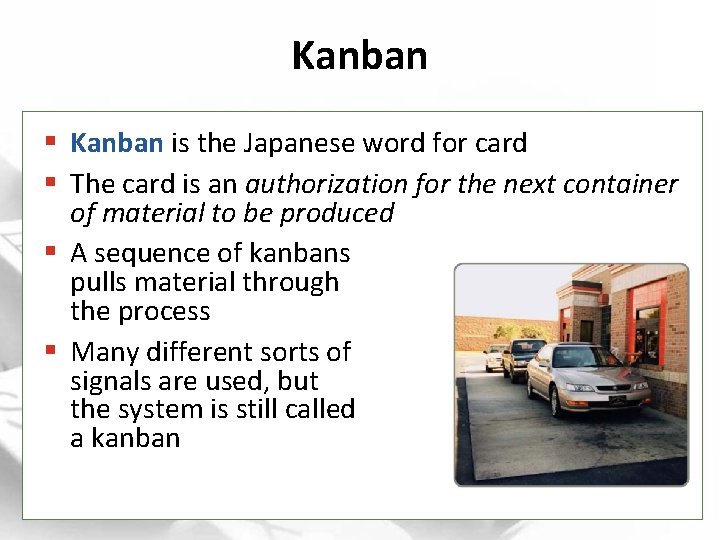
Kanban § Kanban is the Japanese word for card § The card is an authorization for the next container of material to be produced § A sequence of kanbans pulls material through the process § Many different sorts of signals are used, but the system is still called a kanban
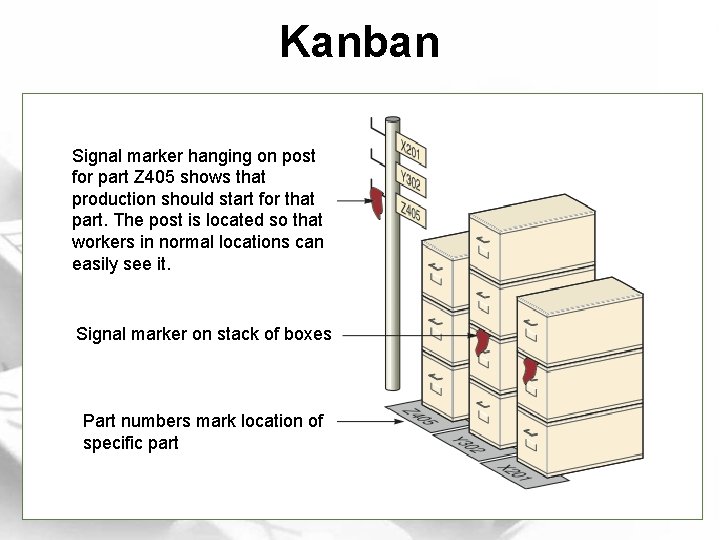
Kanban Signal marker hanging on post for part Z 405 shows that production should start for that part. The post is located so that workers in normal locations can easily see it. Signal marker on stack of boxes Part numbers mark location of specific part
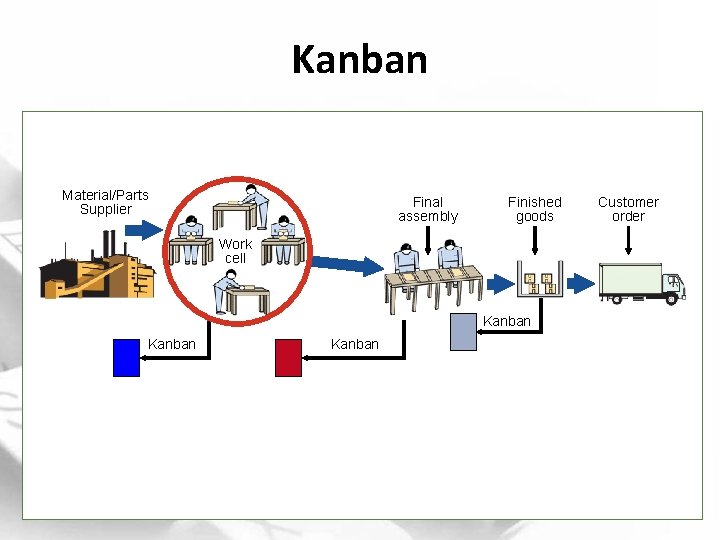
Kanban Material/Parts Supplier Final assembly Finished goods Work cell Kanban Customer order
More Kanban § When the producer and user are not in visual contact, a card can be used; otherwise, a light or flag or empty spot on the floor may be adequate § Usually each card controls a specific quantity or parts although multiple card systems may be used if there are several components or if the lot size is different from the move size
More Kanban § Kanban cards provide a direct control and limit on the amount of work-in-process between cells § If there is an intermediate storage area, a twocard system can be used with one card circulating between the user and storage area and the other between the storage area and the producing area
Advantages of Kanban § Small containers require tight schedules, smooth operations, little variability § Shortages create an immediate impact § Places emphasis on meeting schedules, reducing lead time and setups, and economic material handling § Standardized containers reduce weight, disposal costs, wasted space, and labor
JIT Quality § Strong relationship § JIT cuts the cost of obtaining good quality because JIT exposes poor quality § Because lead times are shorter, quality problems are exposed sooner § Better quality means fewer buffers and allows simpler JIT systems to be used
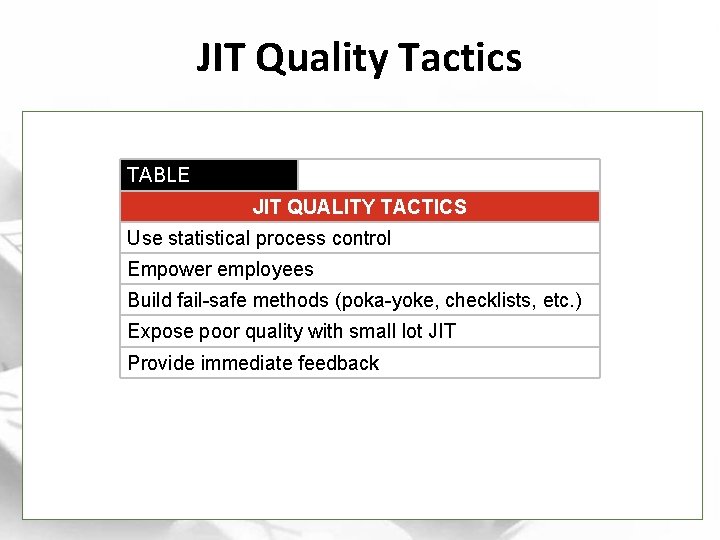
JIT Quality Tactics TABLE JIT QUALITY TACTICS Use statistical process control Empower employees Build fail-safe methods (poka-yoke, checklists, etc. ) Expose poor quality with small lot JIT Provide immediate feedback
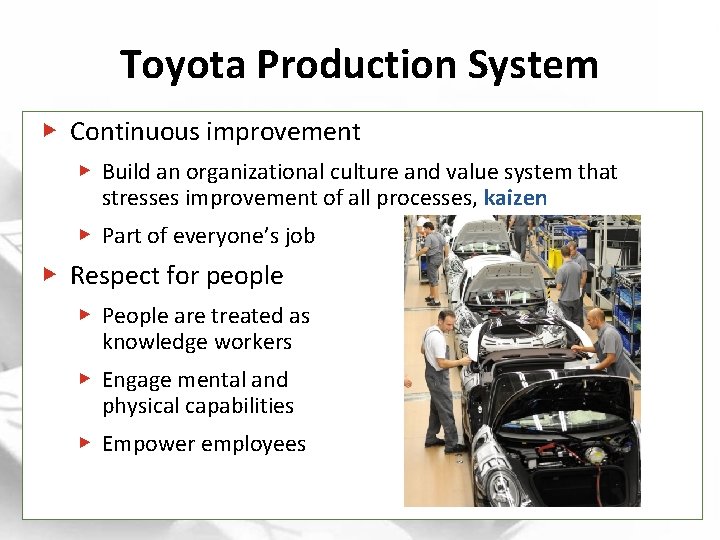
Toyota Production System ▶ Continuous improvement ▶ Build an organizational culture and value system that stresses improvement of all processes, kaizen ▶ Part of everyone’s job ▶ Respect for people ▶ People are treated as knowledge workers ▶ Engage mental and physical capabilities ▶ Empower employees
Toyota Production System § Standard work practice § Work shall be completely specified as to content, sequence, timing, and outcome § Internal and external customer-supplier connection are direct § Product and service flows must be simple and direct § Any improvement must be made in accordance with the scientific method at the lowest possible level of the organization
Lean Operations ▶ Broader than JIT in that it is externally focused on the customer ▶ Starts with understanding what the customer wants ▶ Optimize the entire process from the customer’s perspective
Building a Lean Organization § Transitioning to a lean system can be difficult § Lean systems tend to have the following attributes § Use JIT techniques § Build systems that help employees produce perfect parts § Reduce space requirements
Building a Lean Organization § Lean systems tend to have the following attributes § Develop partnerships with suppliers § Educate suppliers § Eliminate all but value-added activities § Develop employees § Make jobs challenging § Build worker flexibility
Lean Sustainability § Two sides of the same coin § Maximize resource use and economic efficiency § Focus on issues outside the immediate firm § Driving out waste is the common ground
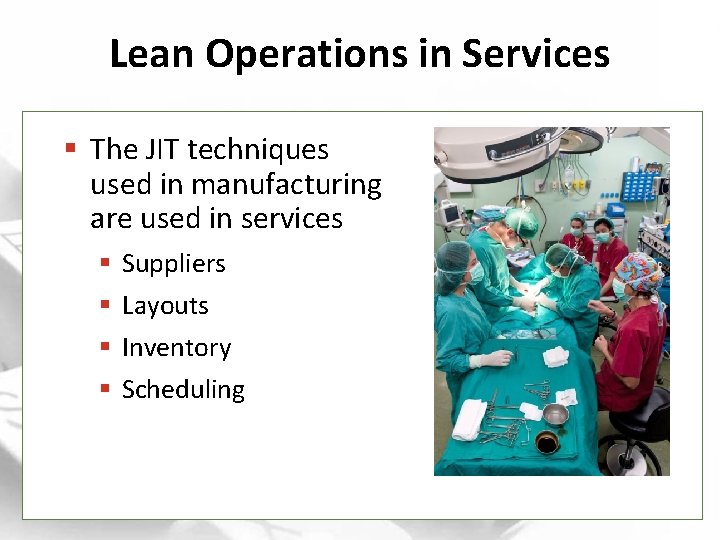
Lean Operations in Services § The JIT techniques used in manufacturing are used in services § § Suppliers Layouts Inventory Scheduling