
12 Implementing Strategy in Companies That Compete in

- Slides: 37
12 Implementing Strategy in Companies That Compete in a Single Industry 1
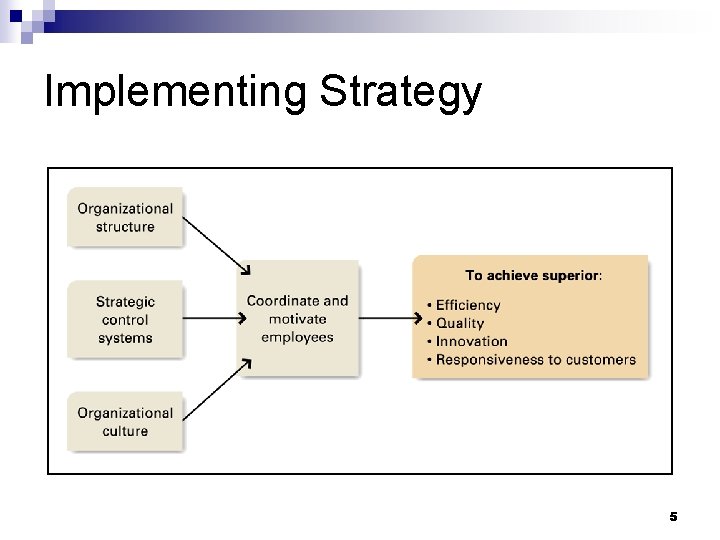
Overview n Strategy implementation ¨ How a company should create, use, and combine organizational structure, control systems, and culture to pursue strategies that lead to a competitive advantage and superior performance 2
Implementing Strategy Through Organizational Structure, Control, and Culture n Organizational structure ¨ Assigns employees to specific value creation tasks and roles and specifies how those are linked to increase efficiency, quality, innovation, and responsiveness to customers ¨ To coordinate and integrate the efforts of all employees 3
Implementing Strategy Through Organizational Structure, Control, and Culture (cont’d) n Control system ¨A set of incentives to motivate employees to increase efficiency, quality, innovation, and responsiveness to customers ¨ Provides feedback on performance so corrective action can be taken n Organizational culture ¨ The collection of values, norms, beliefs, and attitudes shared within an organizations and that control interactions within and outside the organization 4
Implementing Strategy 5
Building Blocks of Organizational Structure n Grouping tasks, functions, and divisions ¨ Organizational structure follows the range and variety of tasks that an organization pursues ¨ Companies group people and tasks into functions and then functions into divisions ¨ Bureaucratic costs 6
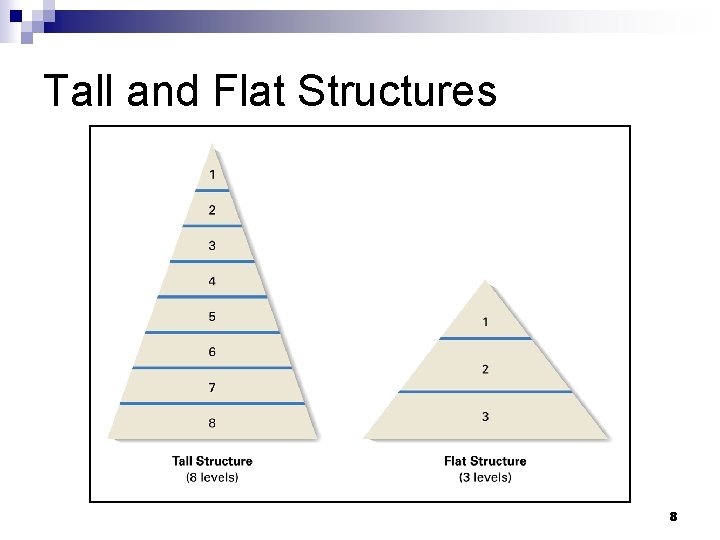
Building Blocks of Organizational Structure (cont’d) n Allocating authority and responsibility ¨ Hierarchy of authority (chain of command) ¨ Span of control (number of subordinates) ¨ Tall and flat organizations ¨ Drawbacks of taller organizations Less flexibility and slower response time n Communication problems n Distortion of commands n Expense n 7
Tall and Flat Structures 8
Allocating Authority and Responsibility (cont’d) ¨ The n n minimum chain of command To combat an organization that is too tall Hand responsibility up and empower those below ¨ Centralization n n or decentralization? Delegating responsibility reduces information overload and enables managers to focus on strategy Empowering lower-level managers increases motivation and accountability Empowering employees requires fewer managers Centralized decisions allow easier coordination of activities Centralization means that decisions fit broad organizational objectives 9
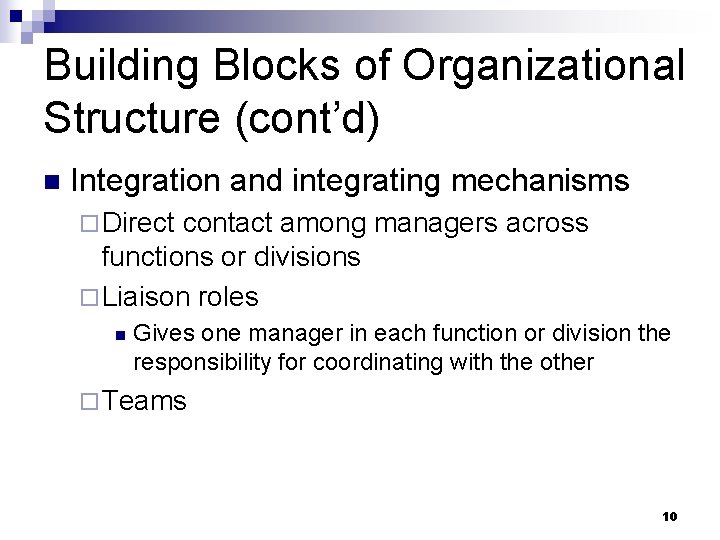
Building Blocks of Organizational Structure (cont’d) n Integration and integrating mechanisms ¨ Direct contact among managers across functions or divisions ¨ Liaison roles n Gives one manager in each function or division the responsibility for coordinating with the other ¨ Teams 10
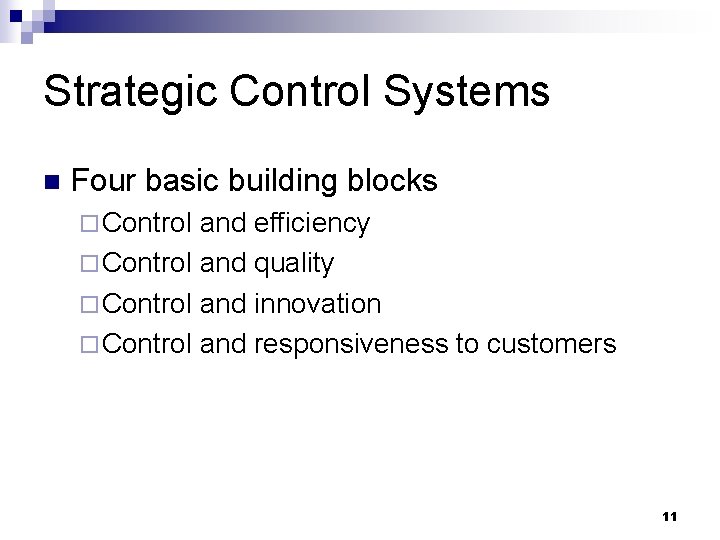
Strategic Control Systems n Four basic building blocks ¨ Control and efficiency ¨ Control and quality ¨ Control and innovation ¨ Control and responsiveness to customers 11
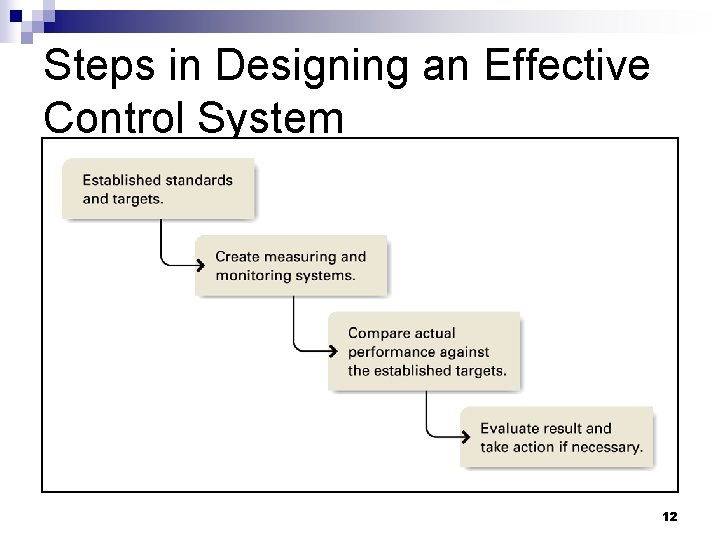
Steps in Designing an Effective Control System 12
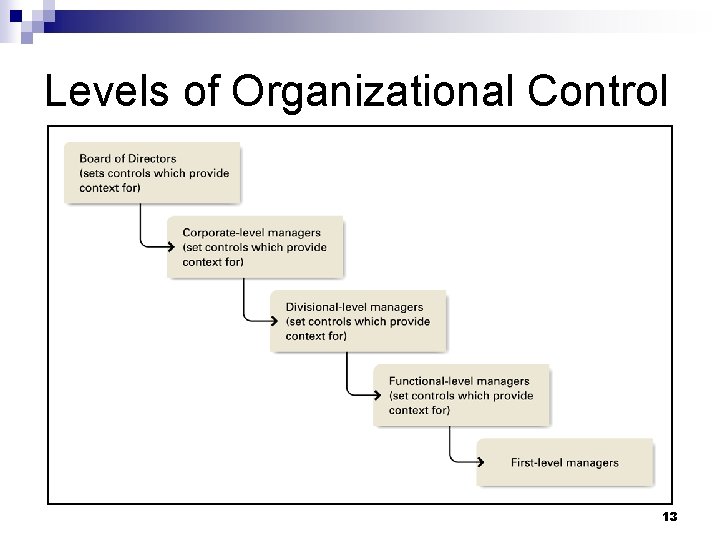
Levels of Organizational Control 13
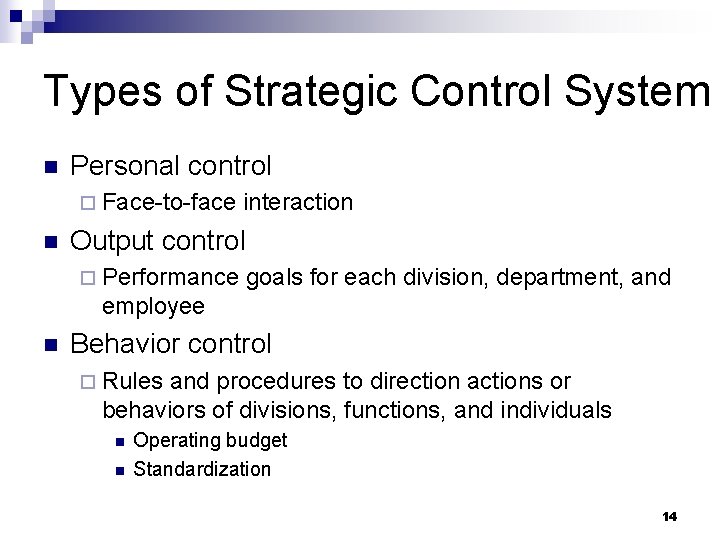
Types of Strategic Control System n Personal control ¨ Face-to-face n interaction Output control ¨ Performance goals for each division, department, and employee n Behavior control ¨ Rules and procedures to direction actions or behaviors of divisions, functions, and individuals n n Operating budget Standardization 14
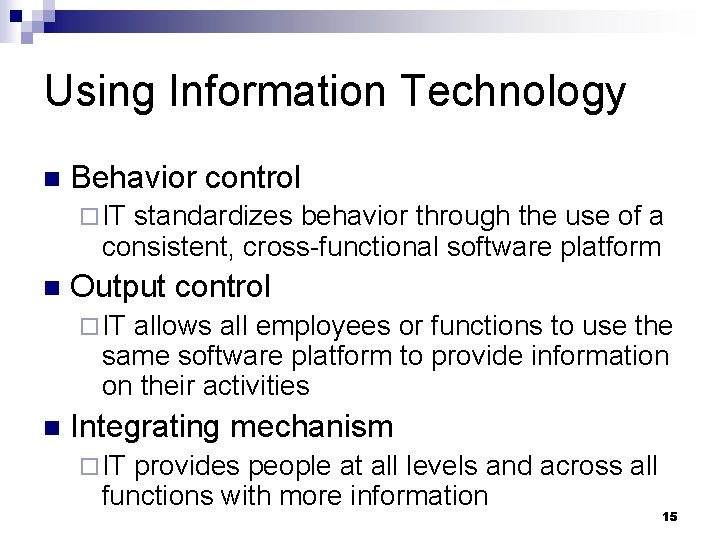
Using Information Technology n Behavior control ¨ IT standardizes behavior through the use of a consistent, cross-functional software platform n Output control ¨ IT allows all employees or functions to use the same software platform to provide information on their activities n Integrating mechanism ¨ IT provides people at all levels and across all functions with more information 15
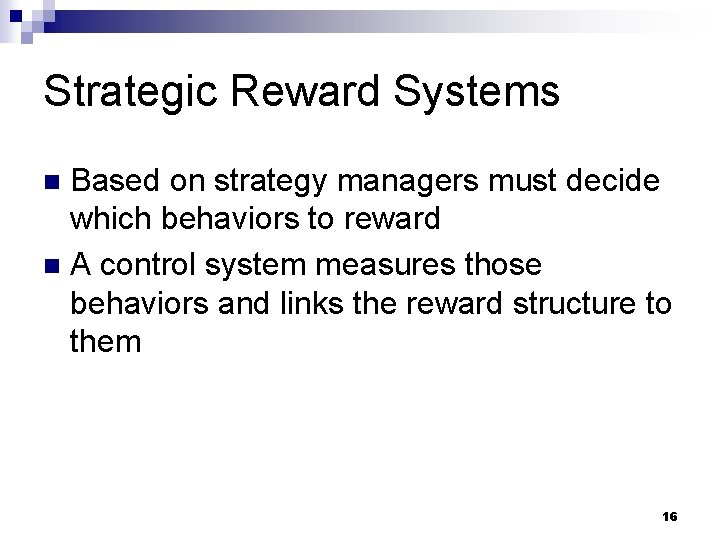
Strategic Reward Systems Based on strategy managers must decide which behaviors to reward n A control system measures those behaviors and links the reward structure to them n 16
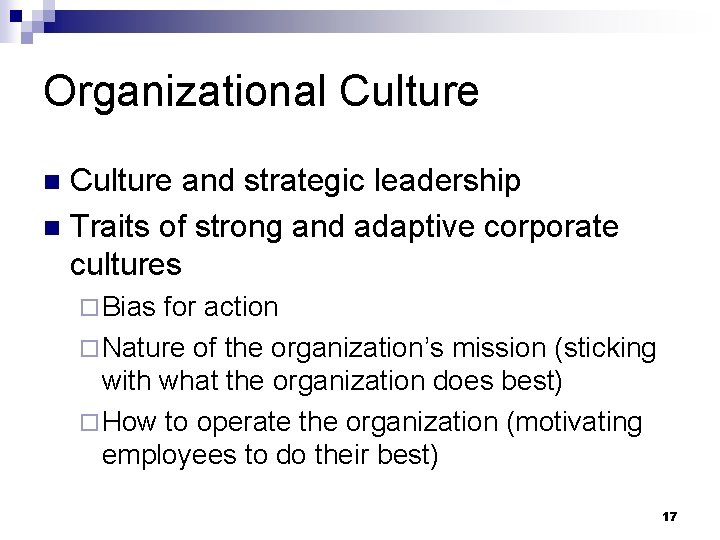
Organizational Culture and strategic leadership n Traits of strong and adaptive corporate cultures n ¨ Bias for action ¨ Nature of the organization’s mission (sticking with what the organization does best) ¨ How to operate the organization (motivating employees to do their best) 17
Building Distinctive Competencies at the Functional Level n Grouping by function: functional structure ¨ Grouping people on the basis of their expertise or because they use the same resources ¨ Advantages People can learn from one another n People can monitor each other n Managers have greater control n With different functional hierarchies, the company can avoid becoming too tall n 18
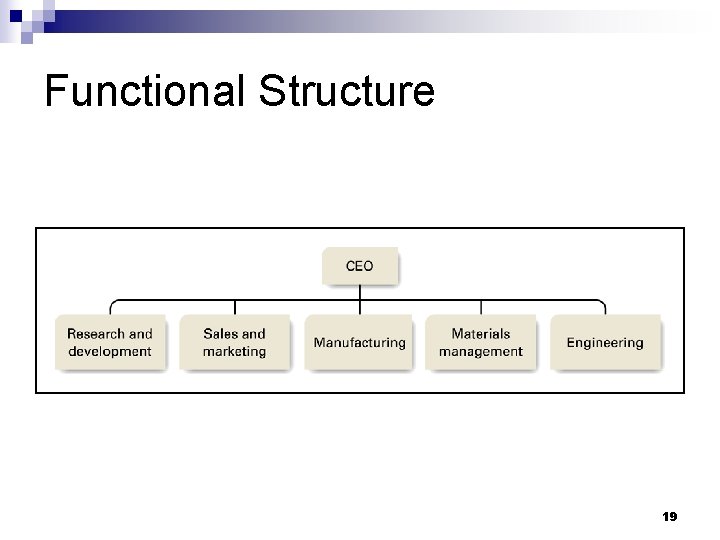
Functional Structure 19
The Functional Level n The role of strategic control ¨ Managers and employees can monitor and improve operating procedures ¨ Easier to apply output control n Developing culture ¨ Managers must implement functional strategy and develop incentive systems to allow each function to succeed ¨ Manufacturing: TQM ¨ R&D: innovation to bring products quickly to market ¨ Sales: output and behavior controls 20
Functional Structure and Bureaucratic Costs Communications problems n Measurement problems n Customer problems n Location problems n Strategic problems n The outsourcing option n 21
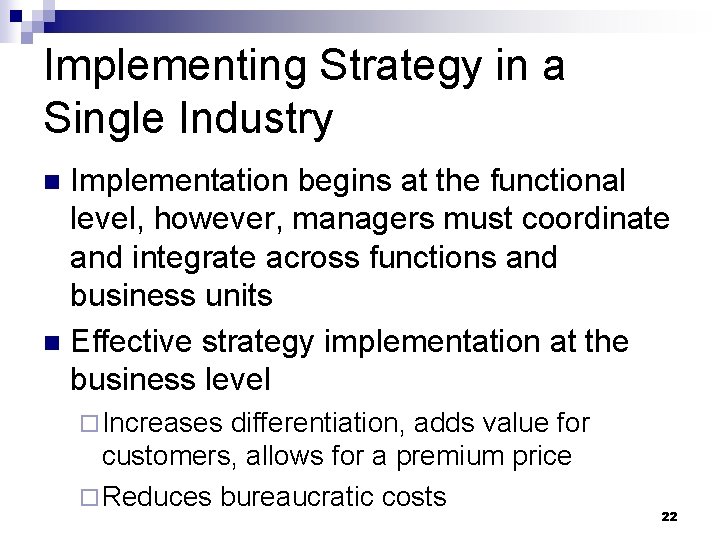
Implementing Strategy in a Single Industry Implementation begins at the functional level, however, managers must coordinate and integrate across functions and business units n Effective strategy implementation at the business level n ¨ Increases differentiation, adds value for customers, allows for a premium price ¨ Reduces bureaucratic costs 22
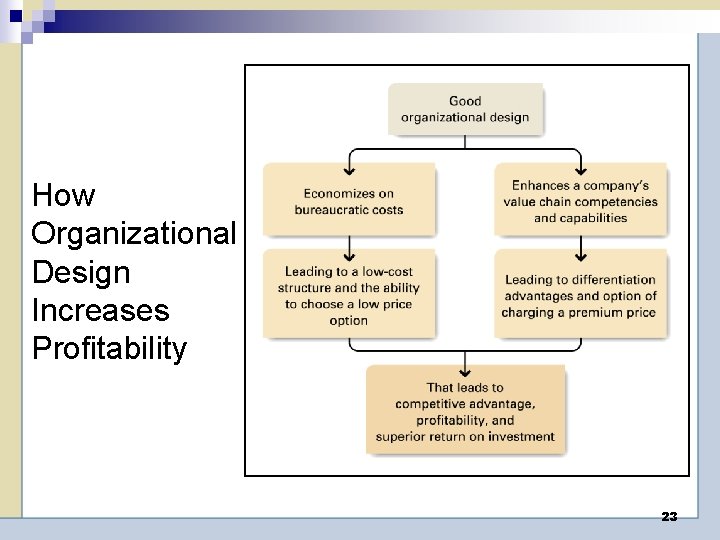
How Organizational Design Increases Profitability 23
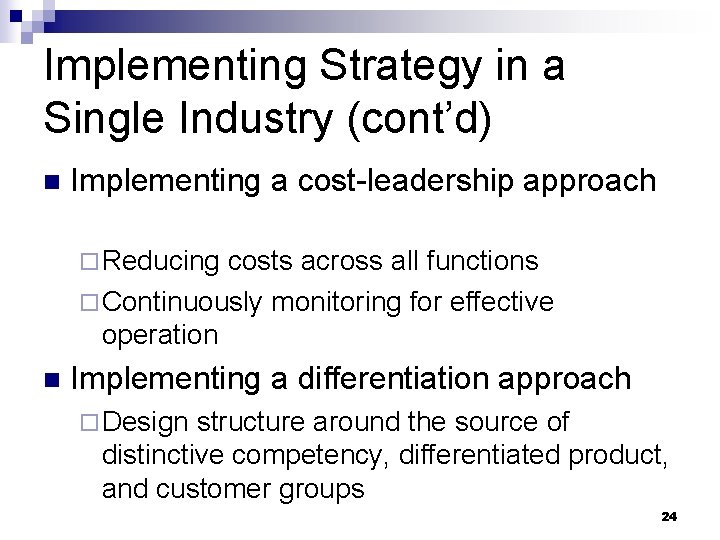
Implementing Strategy in a Single Industry (cont’d) n Implementing a cost-leadership approach ¨ Reducing costs across all functions ¨ Continuously monitoring for effective operation n Implementing a differentiation approach ¨ Design structure around the source of distinctive competency, differentiated product, and customer groups 24
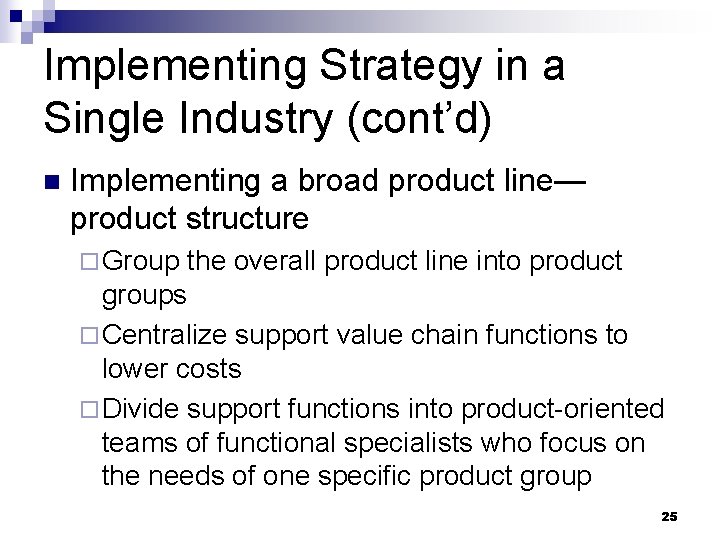
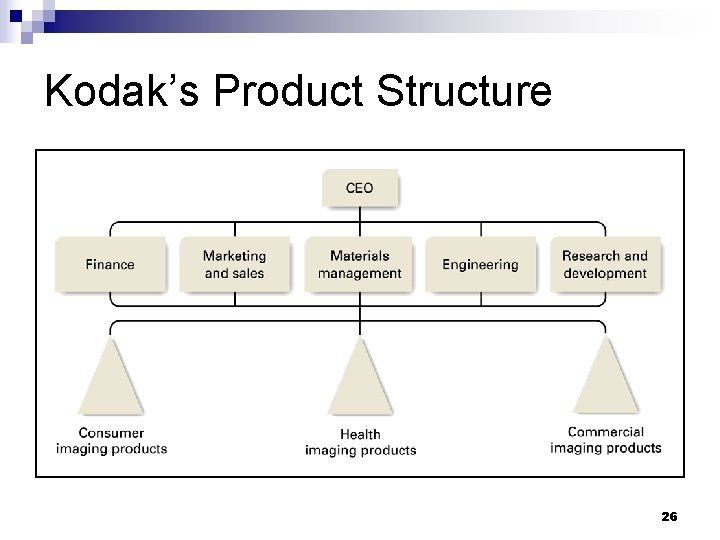
Implementing Strategy in a Single Industry (cont’d) n Implementing a broad product line— product structure ¨ Group the overall product line into product groups ¨ Centralize support value chain functions to lower costs ¨ Divide support functions into product-oriented teams of functional specialists who focus on the needs of one specific product group 25
Kodak’s Product Structure 26
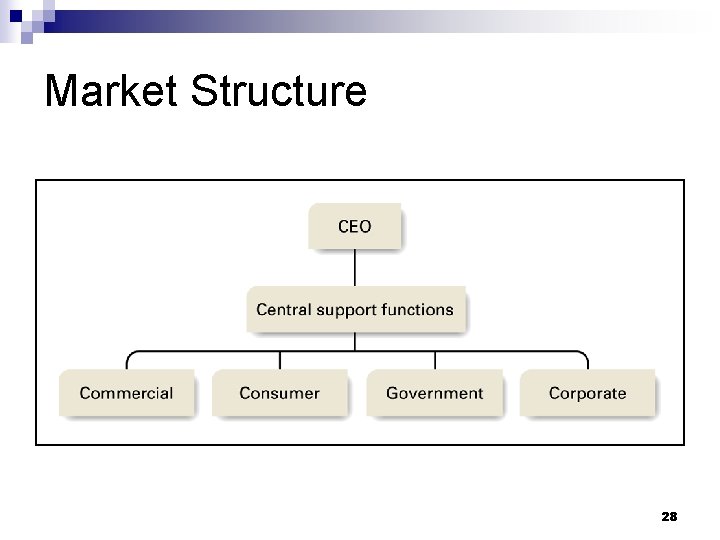
Implementing Strategy in a Single Industry (cont’d) n Increasing responsiveness to customer groups—market structure ¨ Group people and functions by customer or market segments ¨ Different managers are responsible for developing products for each group of customers 27
Market Structure 28
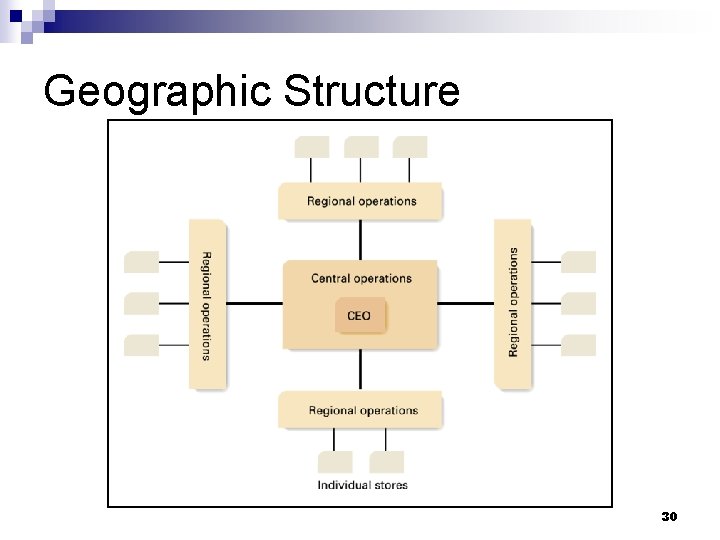
Implementing Strategy in a Single Industry (cont’d) n Expanding nationally—geographic structure ¨ To be responsive to needs of regional customers ¨ To reduce transportation costs 29
Geographic Structure 30
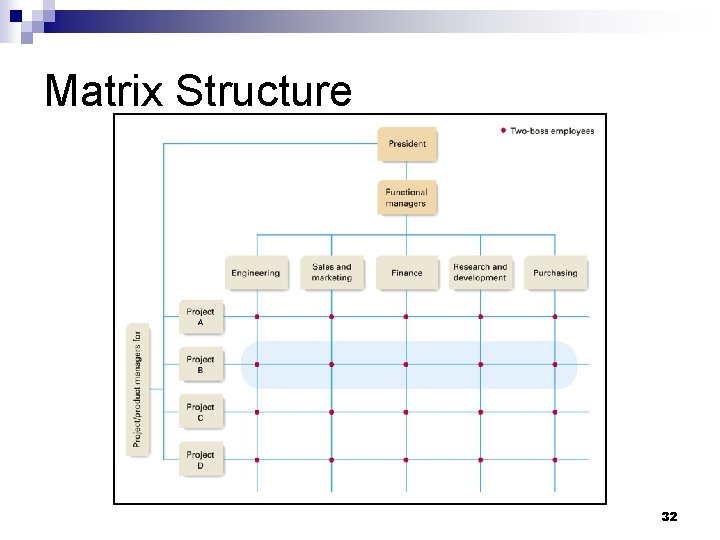
Implementing Strategy in a Single Industry (cont’d) n Competing in fast-changing, high-tech environments—product-team and matrix structures ¨ Matrix structure Value chain activities are grouped by function and by product or project n Flat and decentralized n Promotes innovation and speed n Norms and values based on innovation and product excellence n 31
Matrix Structure 32
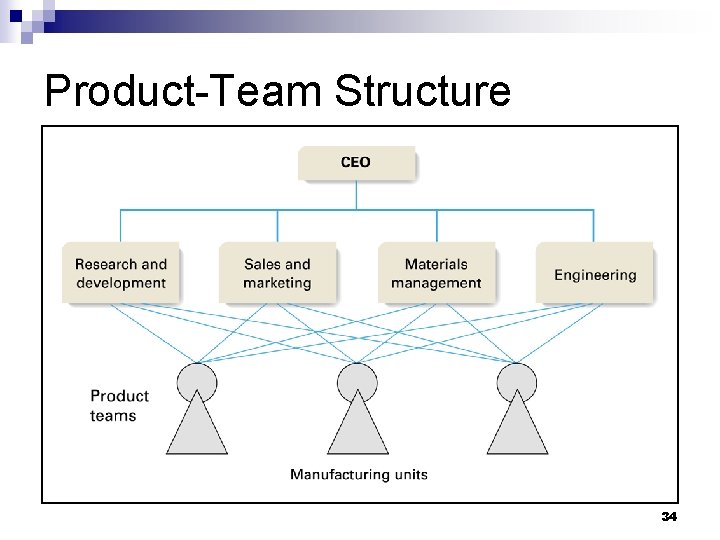
Implementing Strategy in a Single Industry (cont’d) n Competing in fast-changing, high-tech environments—product-team and matrix structures (cont’d) ¨Product-team structure n Tasks divided along product or project lines n Functional specialists are part of permanent cross-functional teams 33
Product-Team Structure 34
Implementing Strategy in a Single Industry (cont’d) n Focusing on a narrow product line ¨ Tends to have higher production costs because output is lower, reducing opportunity for scale economies ¨ Has to develop some form of distinctive competency ¨ Functional structure is appropriate 35
Restructuring and Reengineering n Restructuring involves ¨ Streamlining hierarchy of authority and reducing number of levels ¨ Downsizing the workforce to reduce costs n Reasons ¨ Change in the business environment ¨ Excess capacity ¨ Organization grew too tall and inflexible; bureaucratic costs ¨ To improve competitive advantage and stay on top 36
Restructuring and Reengineering (cont’d) n Reengineering ¨ Fundamental rethinking and radical redesign of business processes to achieve dramatic improvements ¨ Focuses not on functions, but on processes (which cut across functions) 37