
12 Gymnosperms and Angiosperms Gymnosperm Intro and evolution
- Slides: 36
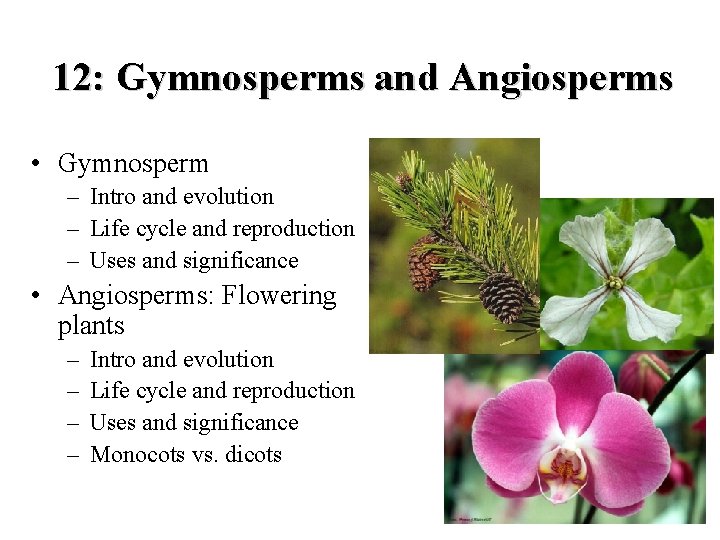
12: Gymnosperms and Angiosperms • Gymnosperm – Intro and evolution – Life cycle and reproduction – Uses and significance • Angiosperms: Flowering plants – – Intro and evolution Life cycle and reproduction Uses and significance Monocots vs. dicots
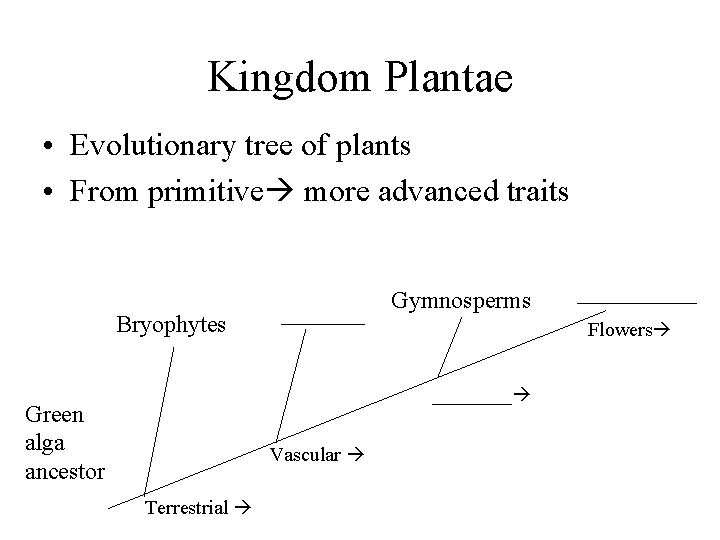
Kingdom Plantae • Evolutionary tree of plants • From primitive more advanced traits Bryophytes _______ Gymnosperms Flowers ____ Green alga ancestor Vascular Terrestrial _____
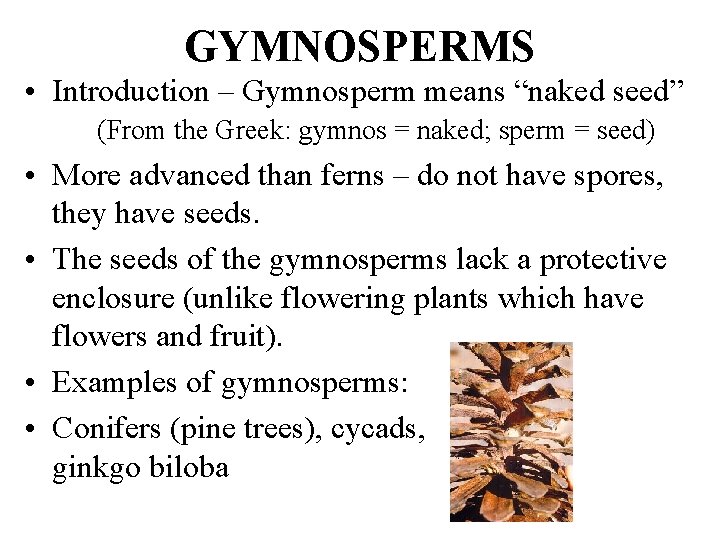
GYMNOSPERMS • Introduction – Gymnosperm means “naked seed” (From the Greek: gymnos = naked; sperm = seed) • More advanced than ferns – do not have spores, they have seeds. • The seeds of the gymnosperms lack a protective enclosure (unlike flowering plants which have flowers and fruit). • Examples of gymnosperms: • Conifers (pine trees), cycads, ginkgo biloba
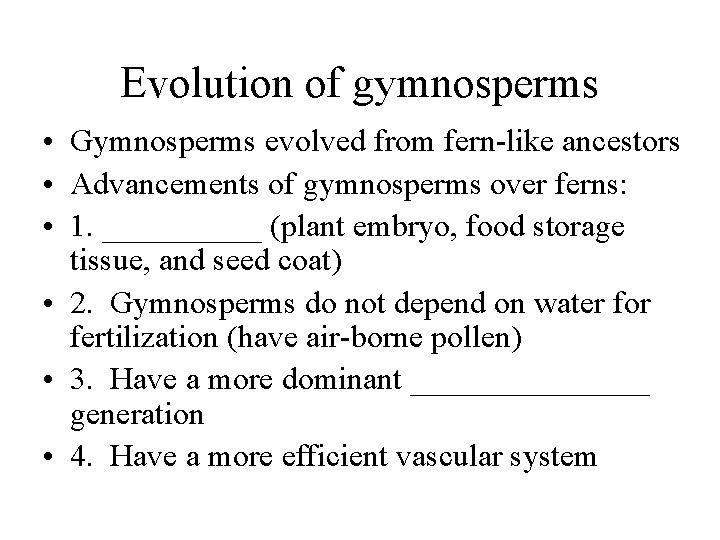
Evolution of gymnosperms • Gymnosperms evolved from fern-like ancestors • Advancements of gymnosperms over ferns: • 1. _____ (plant embryo, food storage tissue, and seed coat) • 2. Gymnosperms do not depend on water for fertilization (have air-borne pollen) • 3. Have a more dominant ________ generation • 4. Have a more efficient vascular system
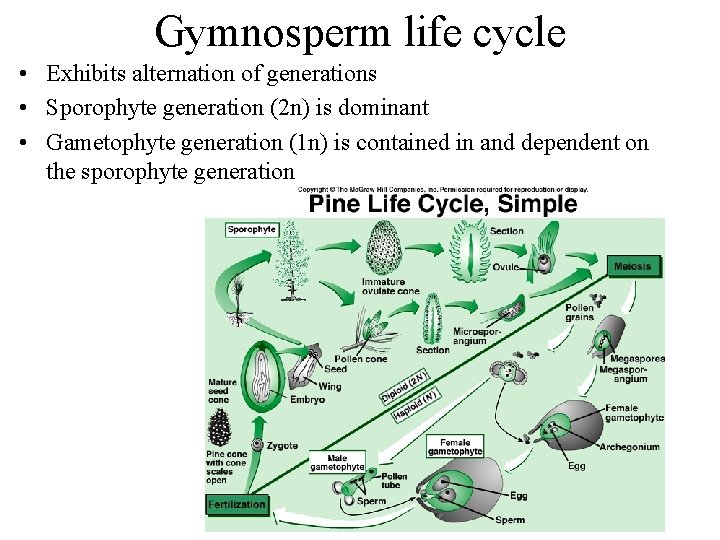
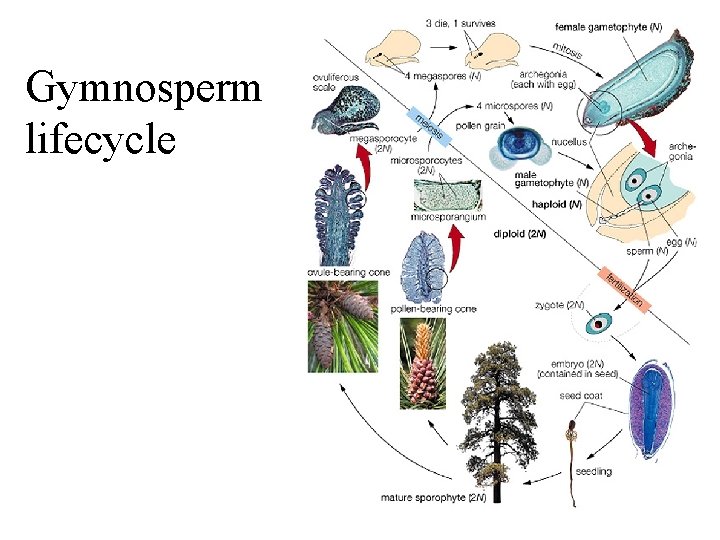
Gymnosperm life cycle • Exhibits alternation of generations • Sporophyte generation (2 n) is dominant • Gametophyte generation (1 n) is contained in and dependent on the sporophyte generation
Gymnosperm lifecycle
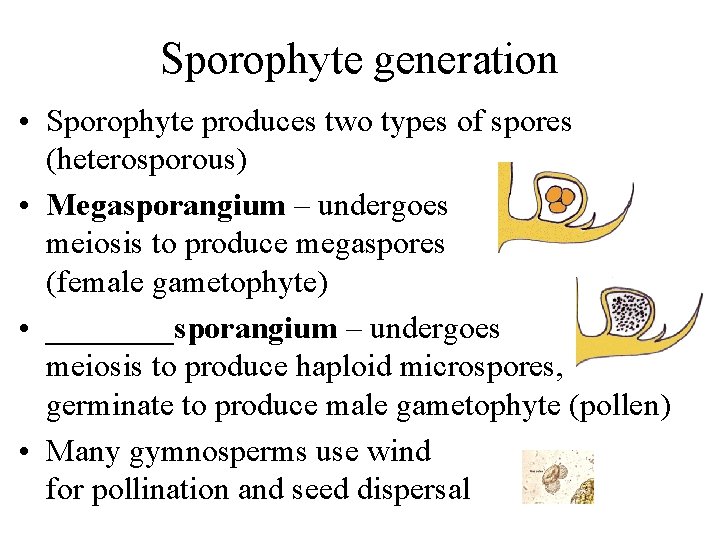
Sporophyte generation • Sporophyte produces two types of spores (heterosporous) • Megasporangium – undergoes meiosis to produce megaspores (female gametophyte) • ____sporangium – undergoes meiosis to produce haploid microspores, germinate to produce male gametophyte (pollen) • Many gymnosperms use wind for pollination and seed dispersal
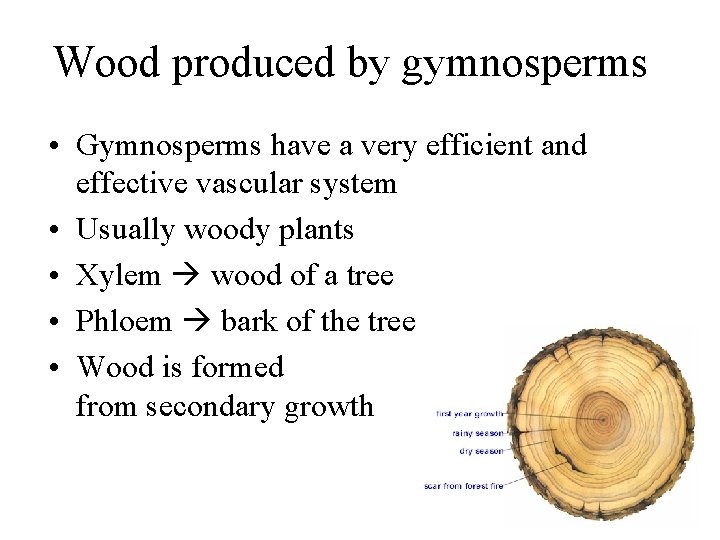
Wood produced by gymnosperms • Gymnosperms have a very efficient and effective vascular system • Usually woody plants • Xylem wood of a tree • Phloem bark of the tree • Wood is formed from secondary growth
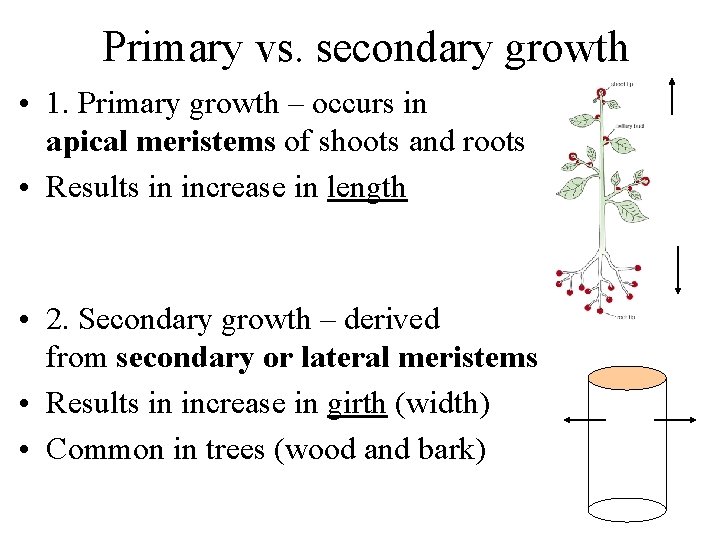
Primary vs. secondary growth • 1. Primary growth – occurs in apical meristems of shoots and roots • Results in increase in length • 2. Secondary growth – derived from secondary or lateral meristems • Results in increase in girth (width) • Common in trees (wood and bark)
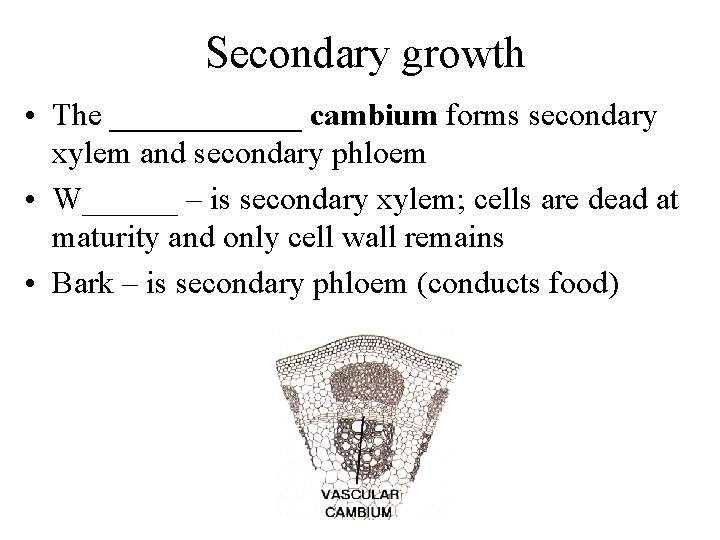
Secondary growth • The ______ cambium forms secondary xylem and secondary phloem • W______ – is secondary xylem; cells are dead at maturity and only cell wall remains • Bark – is secondary phloem (conducts food)
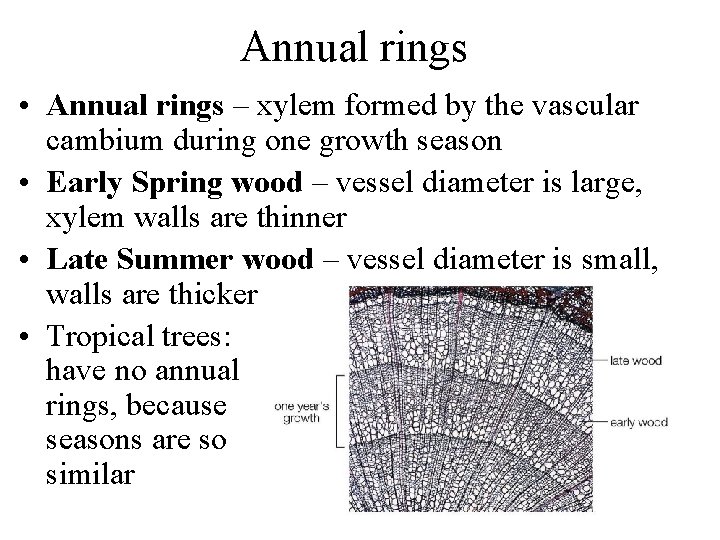
Annual rings • Annual rings – xylem formed by the vascular cambium during one growth season • Early Spring wood – vessel diameter is large, xylem walls are thinner • Late Summer wood – vessel diameter is small, walls are thicker • Tropical trees: have no annual rings, because seasons are so similar
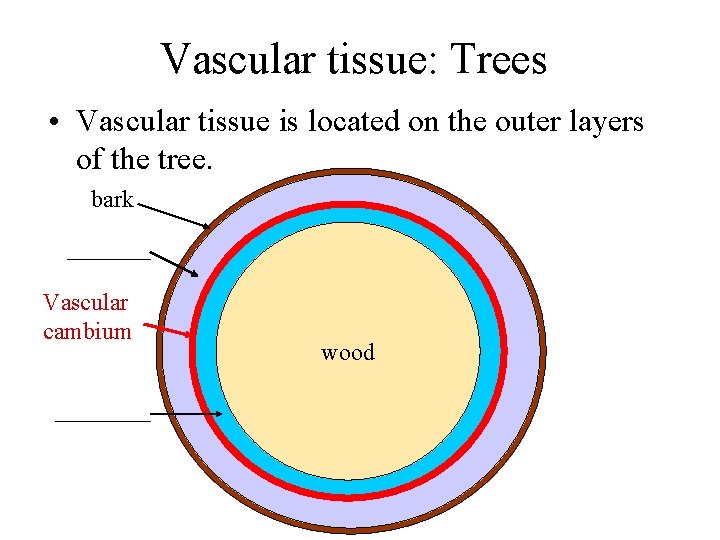
Vascular tissue: Trees • Vascular tissue is located on the outer layers of the tree. bark _______ Vascular cambium ____ wood
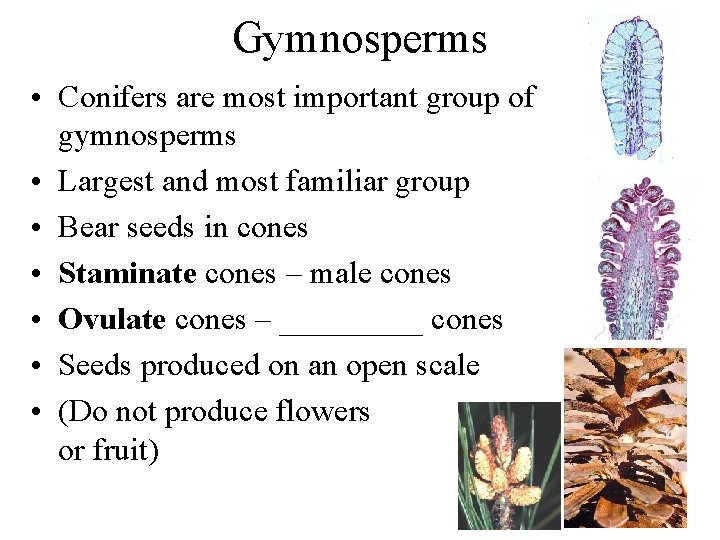
Gymnosperms • Conifers are most important group of gymnosperms • Largest and most familiar group • Bear seeds in cones • Staminate cones – male cones • Ovulate cones – _____ cones • Seeds produced on an open scale • (Do not produce flowers or fruit)
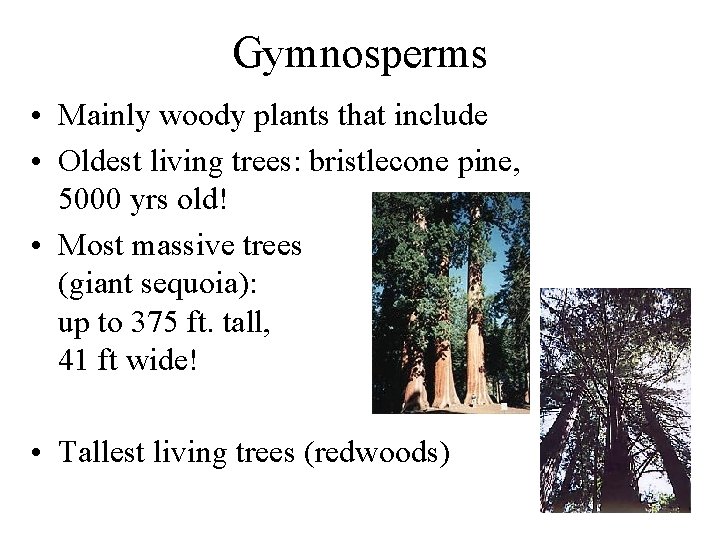
Gymnosperms • Mainly woody plants that include • Oldest living trees: bristlecone pine, 5000 yrs old! • Most massive trees (giant sequoia): up to 375 ft. tall, 41 ft wide! • Tallest living trees (redwoods)
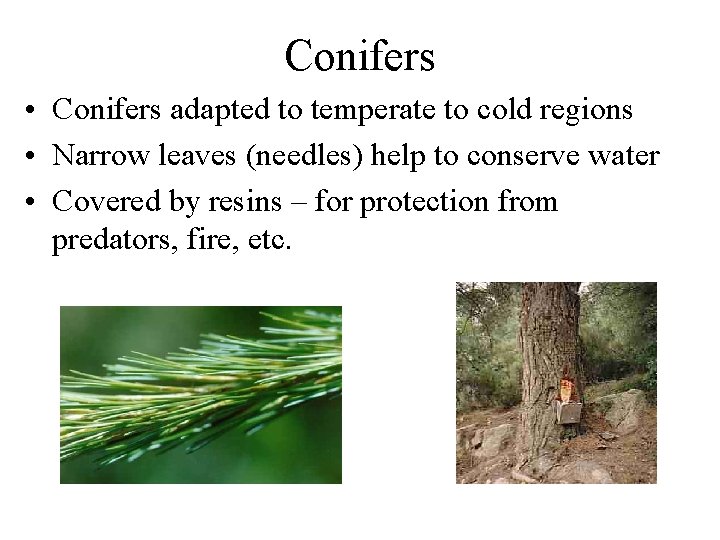
Conifers • Conifers adapted to temperate to cold regions • Narrow leaves (needles) help to conserve water • Covered by resins – for protection from predators, fire, etc.
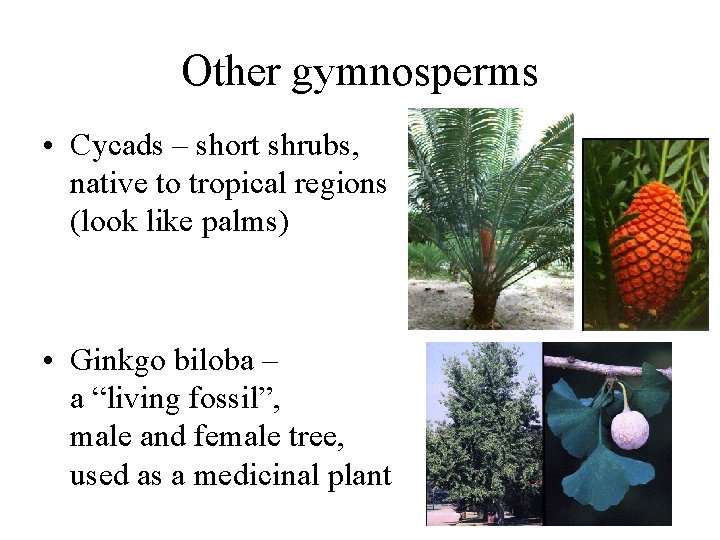
Other gymnosperms • Cycads – short shrubs, native to tropical regions (look like palms) • Ginkgo biloba – a “living fossil”, male and female tree, used as a medicinal plant
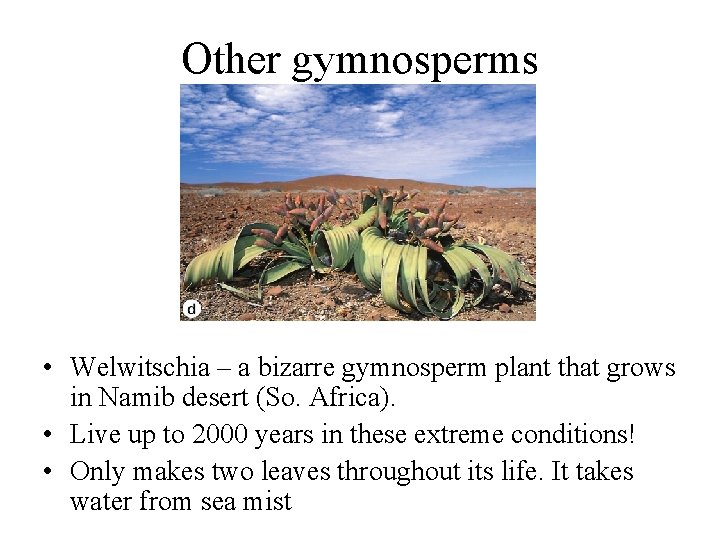
Other gymnosperms • Welwitschia – a bizarre gymnosperm plant that grows in Namib desert (So. Africa). • Live up to 2000 years in these extreme conditions! • Only makes two leaves throughout its life. It takes water from sea mist
Significance of gymnosperms • • • Ecological importance: Provide food and habitat for wildlife Forests prevent soil erosion Reduce greenhouse-effect gasses Economic and commercial importance: Lumber for wood, paper, etc. Resins – wood, furniture, etc. Ornamental plants (trees, landscaping) Food – pine nuts (pesto, etc. )
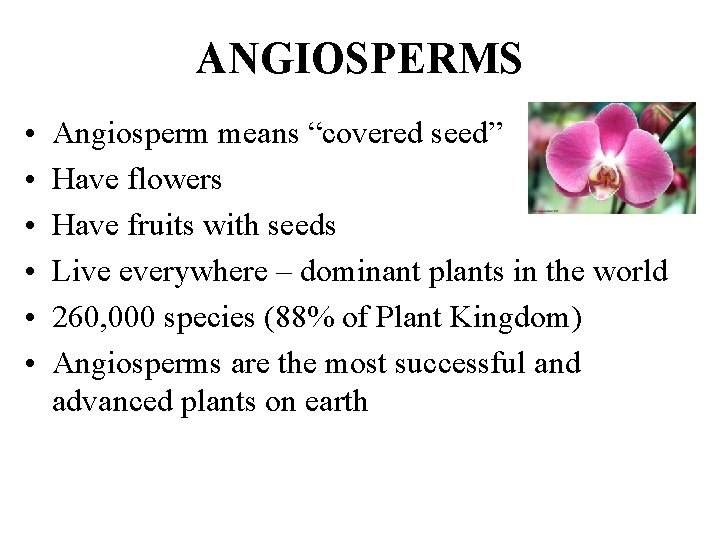
ANGIOSPERMS • • • Angiosperm means “covered seed” Have flowers Have fruits with seeds Live everywhere – dominant plants in the world 260, 000 species (88% of Plant Kingdom) Angiosperms are the most successful and advanced plants on earth
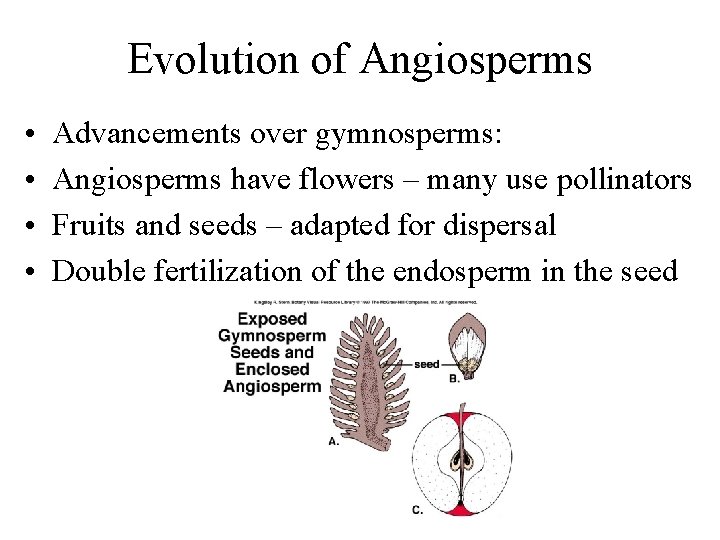
Evolution of Angiosperms • • Advancements over gymnosperms: Angiosperms have flowers – many use pollinators Fruits and seeds – adapted for dispersal Double fertilization of the endosperm in the seed
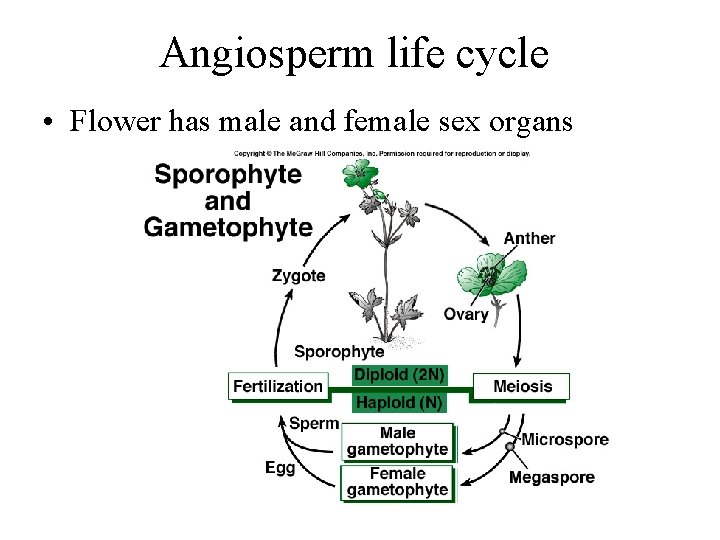
Angiosperm life cycle • Flower has male and female sex organs
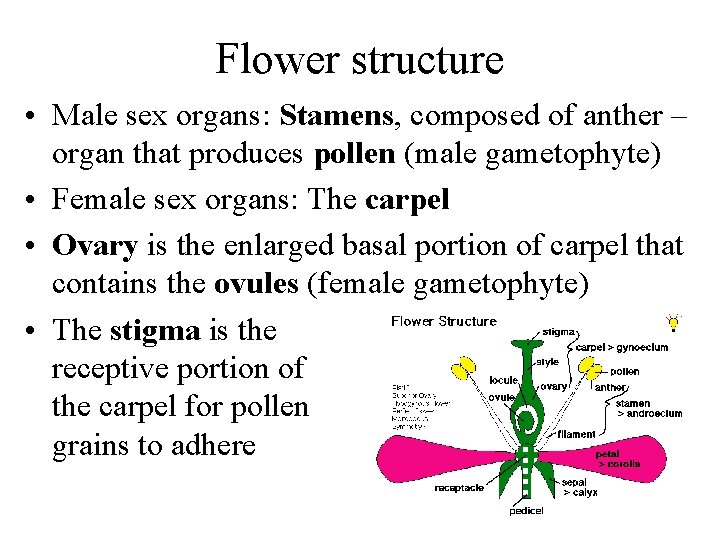
Flower structure • Male sex organs: Stamens, composed of anther – organ that produces pollen (male gametophyte) • Female sex organs: The carpel • Ovary is the enlarged basal portion of carpel that contains the ovules (female gametophyte) • The stigma is the receptive portion of the carpel for pollen grains to adhere
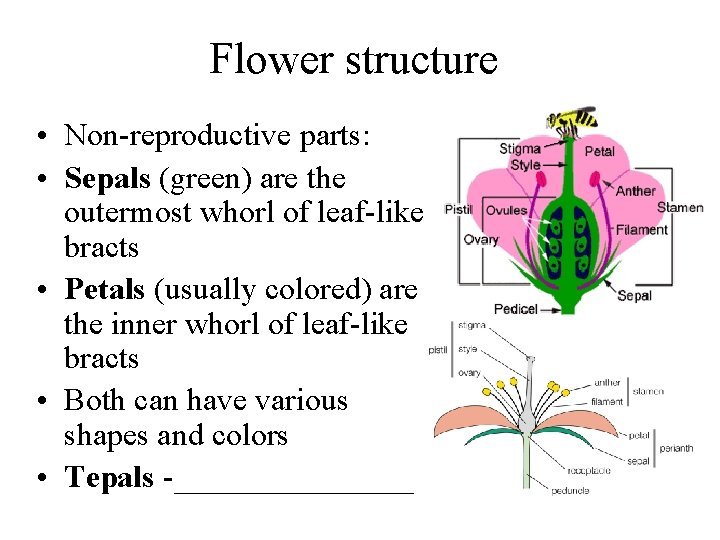
Flower structure • Non-reproductive parts: • Sepals (green) are the outermost whorl of leaf-like bracts • Petals (usually colored) are the inner whorl of leaf-like bracts • Both can have various shapes and colors • Tepals -________
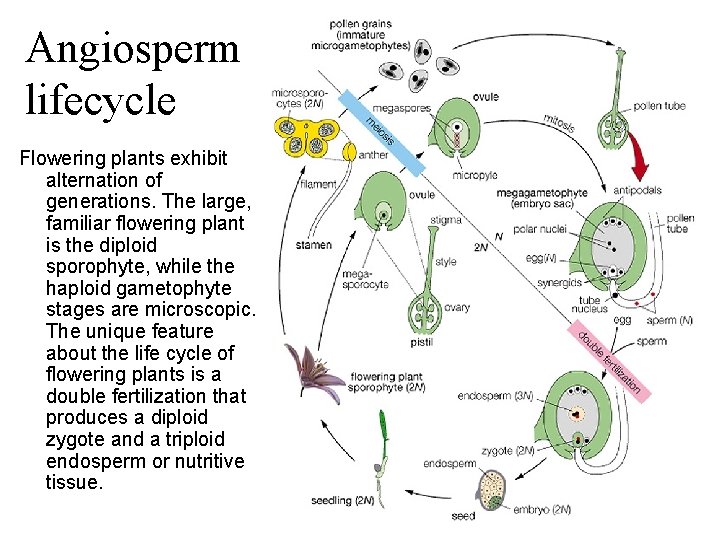
Angiosperm life cycle • Heterosporous: forms two different types of spores (micro- and megaspores; male and female spores) • Male – pollen grains contain tube nucleus and generative cell (2 sperm nuclei) • Female – female gametophyte contains egg and 2 polar nuclei
Angiosperm lifecycle Flowering plants exhibit alternation of generations. The large, familiar flowering plant is the diploid sporophyte, while the haploid gametophyte stages are microscopic. The unique feature about the life cycle of flowering plants is a double fertilization that produces a diploid zygote and a triploid endosperm or nutritive tissue.
Double fertilization • Pollen grain germinates on stigma forming a pollen tube, which grows down style to the ovary • Pollen has 2 haploid sperm nuclei, which travel to the ovary • One sperm nucleus fertilizes the haploid egg forming the 2 n zygote • Another sperm nucleus unites with the 2 polar nuclei, forming the triploid (3 n) endosperm
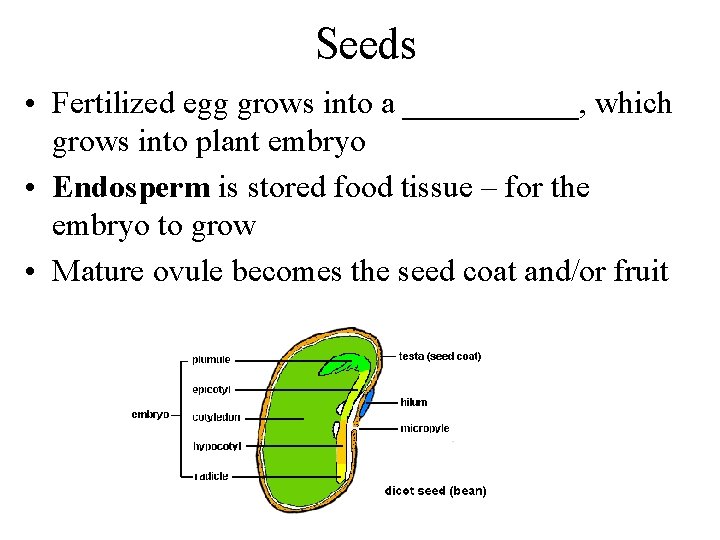
Seeds • Fertilized egg grows into a ______, which grows into plant embryo • Endosperm is stored food tissue – for the embryo to grow • Mature ovule becomes the seed coat and/or fruit
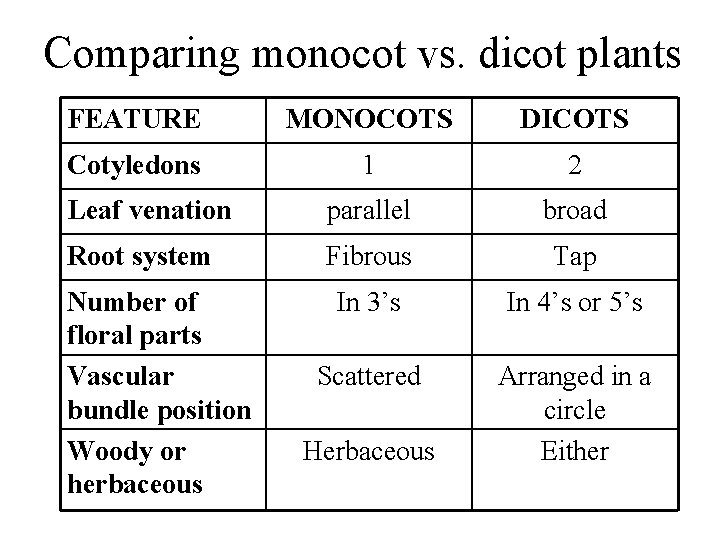
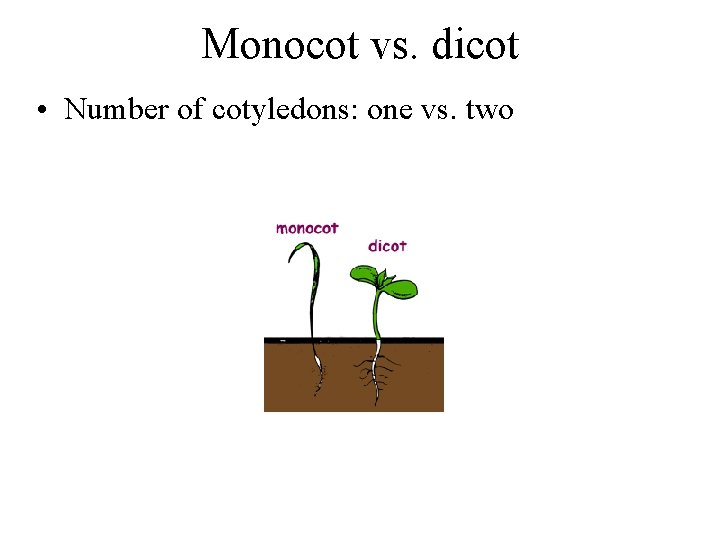
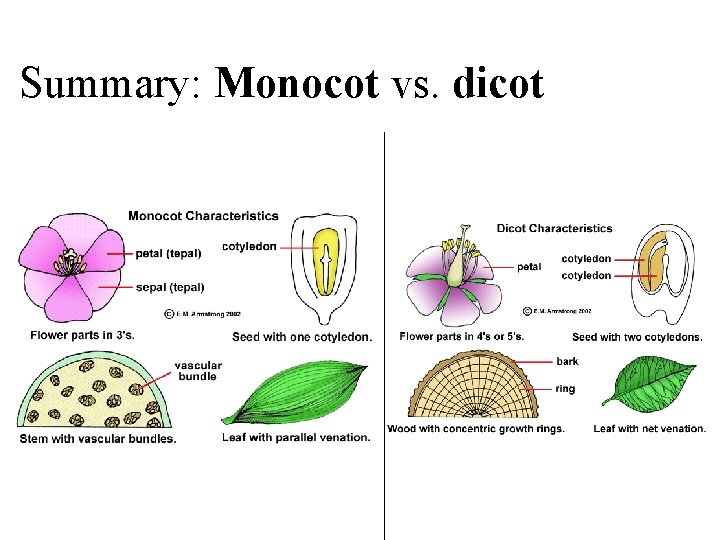
Monocot vs. dicot • Angiosperms are divided into monocots and dicots • As the zygote grows into the embryo, the first leaves of the young sporophyte develop and are called as cotyledons (seed leaves) • Monocots have one cotyledon (corn, lily, etc). • Dicots have two cotyledons (bean, oak, etc).
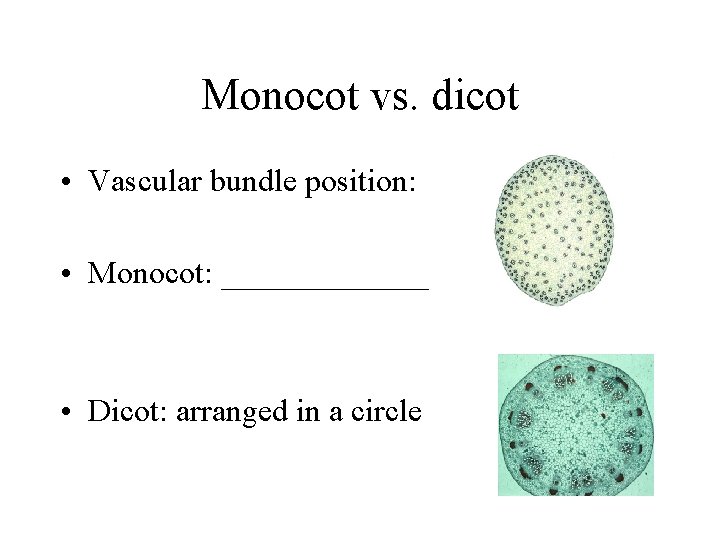
Comparing monocot vs. dicot plants FEATURE MONOCOTS DICOTS Cotyledons 1 2 Leaf venation parallel broad Root system Fibrous Tap In 3’s In 4’s or 5’s Scattered Arranged in a circle Either Number of floral parts Vascular bundle position Woody or herbaceous Herbaceous
Monocot vs. dicot • Number of cotyledons: one vs. two
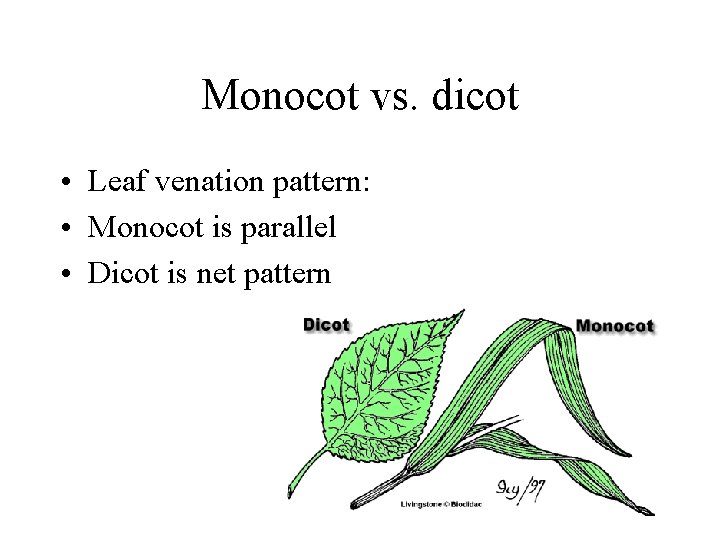
Monocot vs. dicot • Leaf venation pattern: • Monocot is parallel • Dicot is net pattern
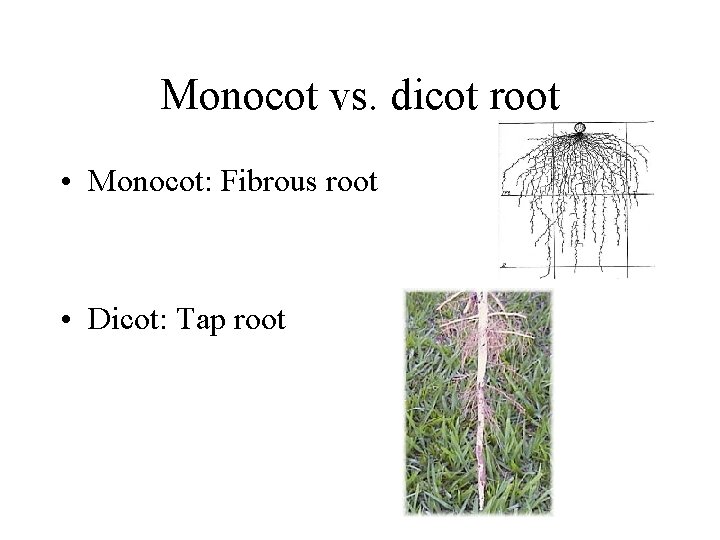
Monocot vs. dicot root • Monocot: Fibrous root • Dicot: Tap root
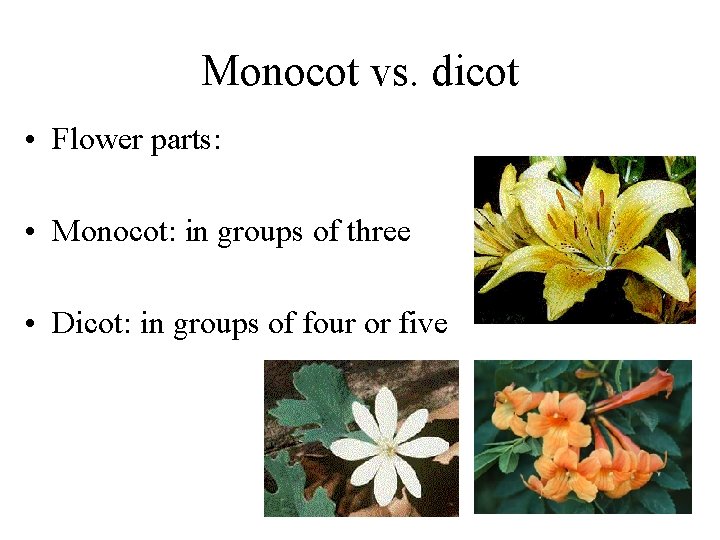
Monocot vs. dicot • Flower parts: • Monocot: in groups of three • Dicot: in groups of four or five
Monocot vs. dicot • Vascular bundle position: • Monocot: _______ • Dicot: arranged in a circle
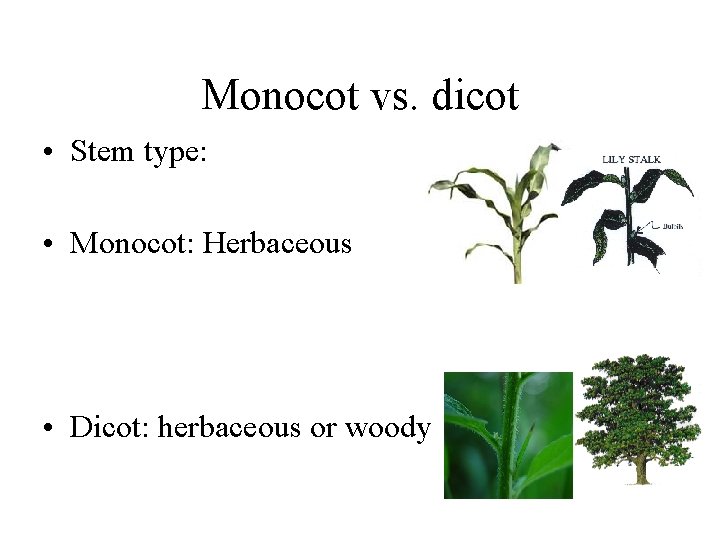
Monocot vs. dicot • Stem type: • Monocot: Herbaceous • Dicot: herbaceous or woody
Summary: Monocot vs. dicot