
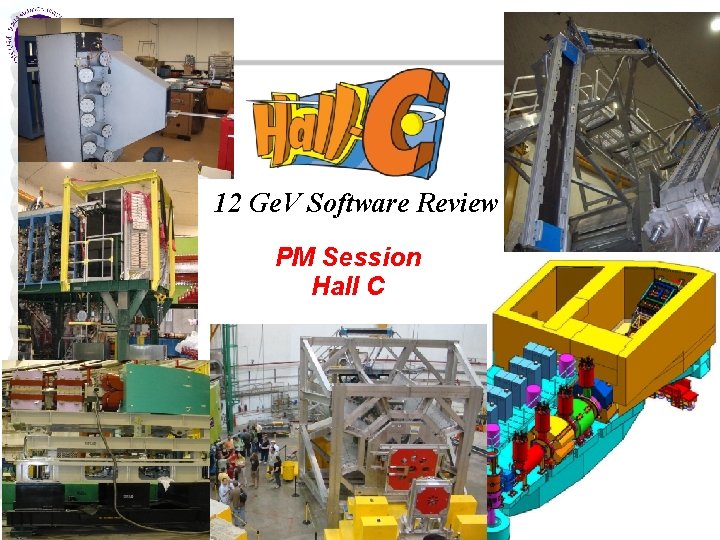
12 Ge V Software Review PM Session Hall
![SIMC Overview [probably backup] Initialization Choose reaction, final state (if appropriate) Disable/enable implementation of](https://slidetodoc.com/presentation_image_h2/0d213bb11894f417979203dcd4a22c64/image-42.jpg "SIMC Overview [probably backup] Initialization Choose reaction, final state (if appropriate) Disable/enable implementation of")
![Overview [probably backup] Acceptance Can apply geometric cuts or spectrometer model. Defaul spec. models](https://slidetodoc.com/presentation_image_h2/0d213bb11894f417979203dcd4a22c64/image-43.jpg "Overview [probably backup] Acceptance Can apply geometric cuts or spectrometer model. Defaul spec. models")
![Beyond single event reconstruction Corrections (beam drift, FR, special[coin/cer block. . . ]) Cuts,](https://slidetodoc.com/presentation_image_h2/0d213bb11894f417979203dcd4a22c64/image-45.jpg "Beyond single event reconstruction Corrections (beam drift, FR, special[coin/cer block. . . ]) Cuts,")
- Slides: 56
12 Ge. V Software Review PM Session Hall C Gabriel Niculescu, Hall C Software Review
hcana engine overview-workflow-calibration-monitoring simc Outline Hall C ROOT/C ++ analyzer (hcana) Hall C Fortran/Cernlib analyzer engine ( ) Analysisalgorithms (tracking, pid, etc. ) Workflow/Calibration/Monitoring Hall C Simulation simc ( ) Summary/Outlook Gabriel Niculescu, Hall C Software Review
hcana engine overview-workflow-calibration-monitoring simc Rationale engine. Hall C software: F 77/Cernlib ~100, 000 Lines of Code C++ is a better match for the skillset of younger collaborators Keep all the solid, documented, and proven analys algorithms from “engine” Gabriel Niculescu, Hall C Software Review
hcana engine overview-workflow-calibration-monitoring simc Approach Keep all analysis algorithms from engine Rewrite in ROOT/C++ Built on top of Hall A’s PODD software …In publicly readable git repository Gabriel Niculescu, Hall C Software Review
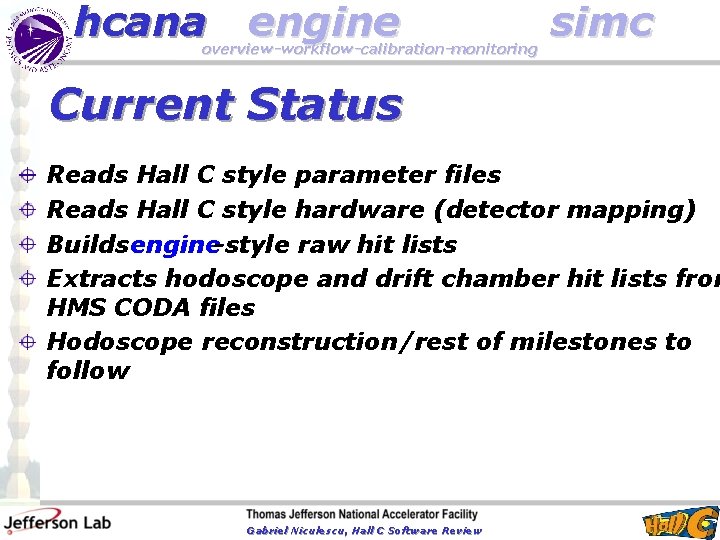
hcana engine overview-workflow-calibration-monitoring simc Current Status Reads Hall C style parameter files Reads Hall C style hardware (detector mapping) Builds engine-style raw hit lists Extracts hodoscope and drift chamber hit lists from HMS CODA files Hodoscope reconstruction/rest of milestones to follow Gabriel Niculescu, Hall C Software Review
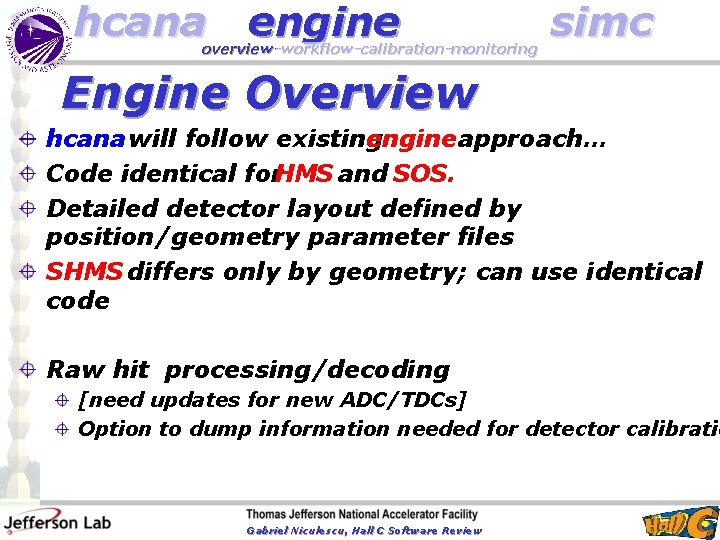
hcana engine overview-workflow-calibration-monitoring simc Engine Overview hcana will follow existing engineapproach… Code identical for. HMS and SOS. Detailed detector layout defined by position/geometry parameter files SHMS differs only by geometry; can use identical code Raw hit processing/decoding [need updates for new ADC/TDCs] Option to dump information needed for detector calibratio Gabriel Niculescu, Hall C Software Review
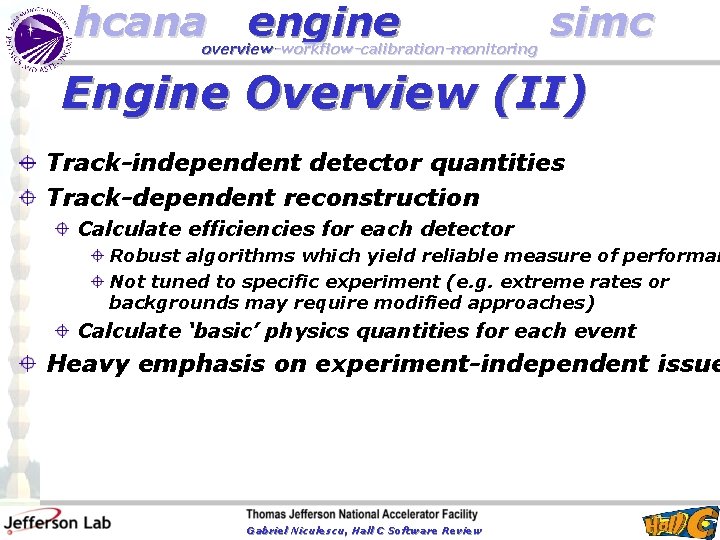
hcana engine overview-workflow-calibration-monitoring simc Engine Overview (II) Track-independent detector quantities Track-dependent reconstruction Calculate efficiencies for each detector Robust algorithms which yield reliable measure of performan Not tuned to specific experiment (e. g. extreme rates or backgrounds may require modified approaches) Calculate ‘basic’ physics quantities for each event Heavy emphasis on experiment-independent issue Gabriel Niculescu, Hall C Software Review
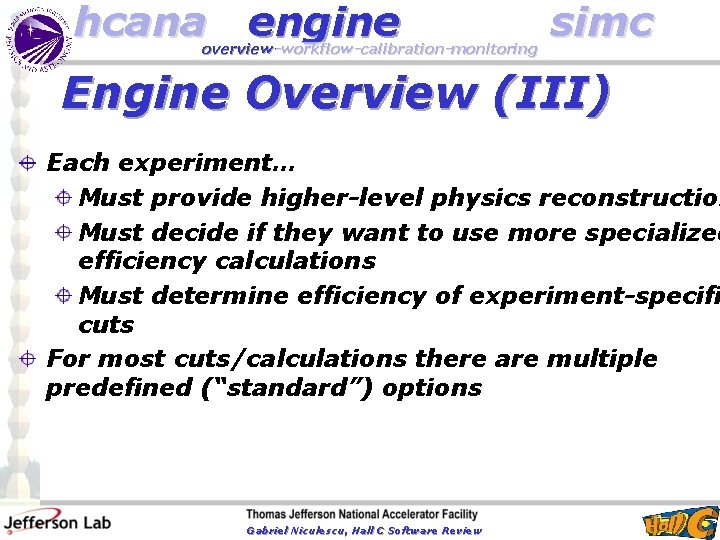
hcana engine overview-workflow-calibration-monitoring simc Engine Overview (III) Each experiment… Must provide higher-level physics reconstruction Must decide if they want to use more specialized efficiency calculations Must determine efficiency of experiment-specifi cuts For most cuts/calculations there are multiple predefined (“standard”) options Gabriel Niculescu, Hall C Software Review
hcana engine overview-workflow-calibration-monitoring simc Analysis Algorithm For each detector: Calibration: Options to dump information for diagnostic/detector calibration Some detectors have built-in calibration optio “Detector reconstruction” Tracking, TOF, npes, shower energy, etc Efficiency Calculation Default efficiency calculation built in Options for experiment-specific calculations Gabriel Niculescu, Hall C Software Review
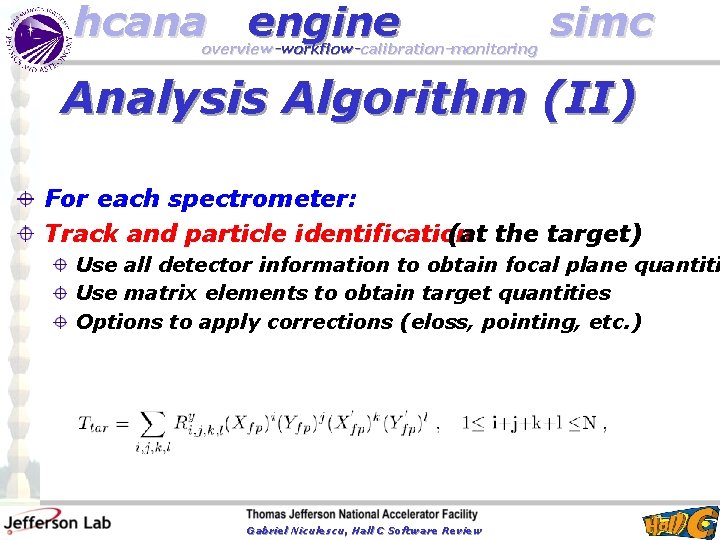
hcana engine overview-workflow-calibration-monitoring simc Analysis Algorithm (II) For each spectrometer: Track and particle identification (at the target) Use all detector information to obtain focal plane quantiti Use matrix elements to obtain target quantities Options to apply corrections (eloss, pointing, etc. ) Gabriel Niculescu, Hall C Software Review
hcana engine overview-workflow-calibration-monitoring simc Analysis Algorithm (III) If a coincidence experiment: Coincidence event reconstruction: Very Experiment-specific! The Fortran code provides subroutines for this (c_reconstruction, c_physics, etc. ). The default code only provides calculation for very basic quantities Historically some/most users just produce a coincidence ntuple and use their own coincidence reconstruction software (. f, . kumac, or both) Gabriel Niculescu, Hall C Software Review
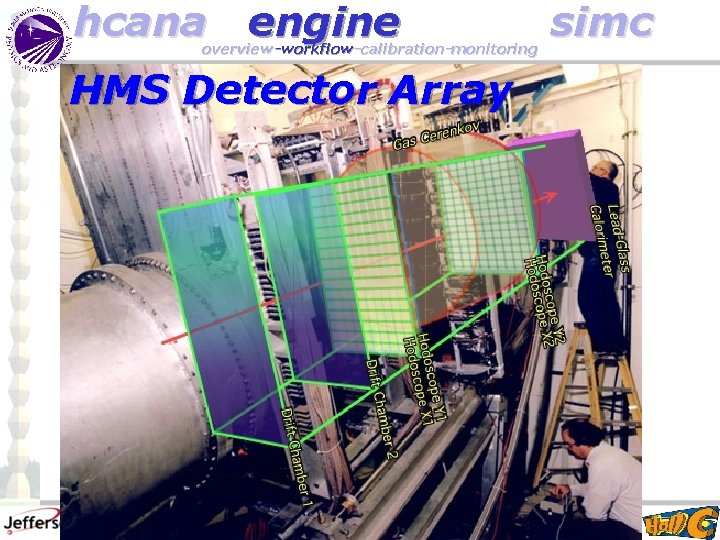
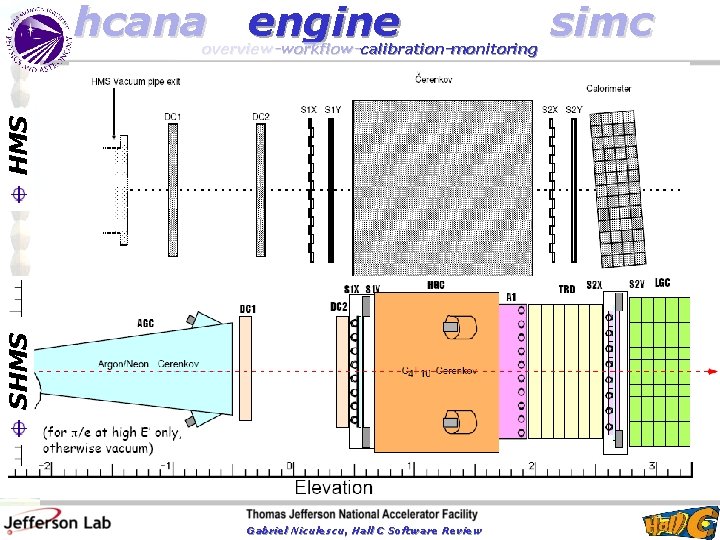
hcana engine overview-workflow-calibration-monitoring HMS Detector Array Gabriel Niculescu, Hall C Software Review simc
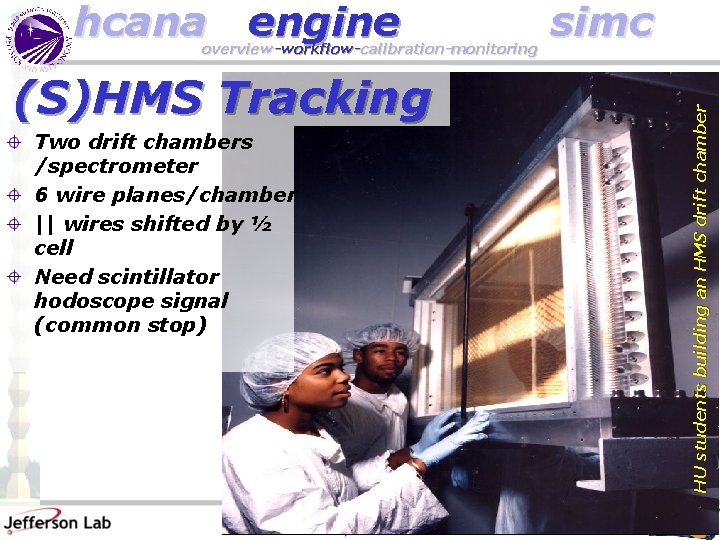
overview-workflow-calibration-monitoring (S)HMS Tracking Two drift chambers /spectrometer 6 wire planes/chamber || wires shifted by ½ cell Need scintillator hodoscope signal (common stop) Gabriel Niculescu, Hall C Software Review simc HU students building an HMS drift chamber hcana engine
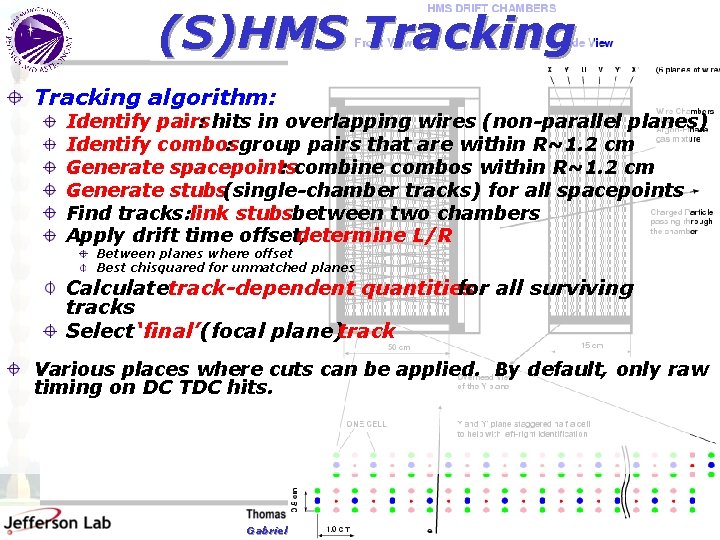
(S)HMS Tracking algorithm: Identify pairs : hits in overlapping wires (non-parallel planes) Identify combos : group pairs that are within R~1. 2 cm Generate spacepoints : combine combos within R~1. 2 cm Generate stubs(single-chamber tracks) for all spacepoints Find tracks: link stubsbetween two chambers Apply drift time offset, determine L/R Between planes where offset Best chisquared for unmatched planes Calculatetrack-dependent quantities for all surviving tracks Select ‘final’(focal plane)track Various places where cuts can be applied. By default, only raw timing on DC TDC hits. Gabriel Niculescu, Hall C Software Review
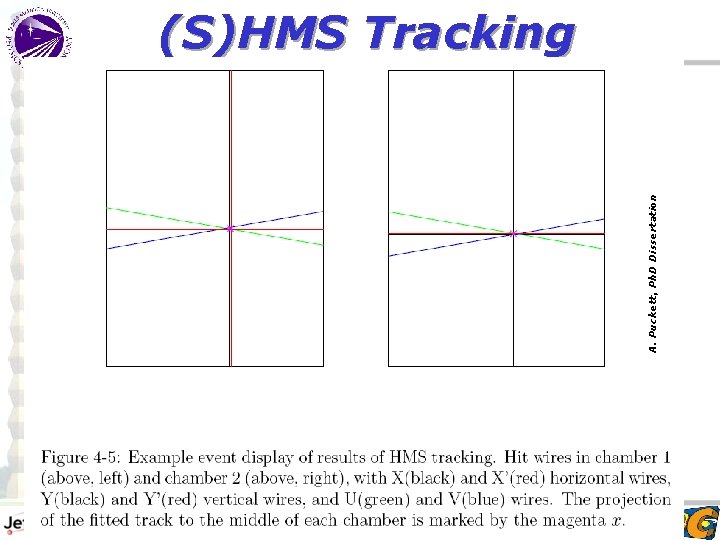
A. Puckett, Ph. D Dissertation (S)HMS Tracking Gabriel Niculescu, Hall C Software Review
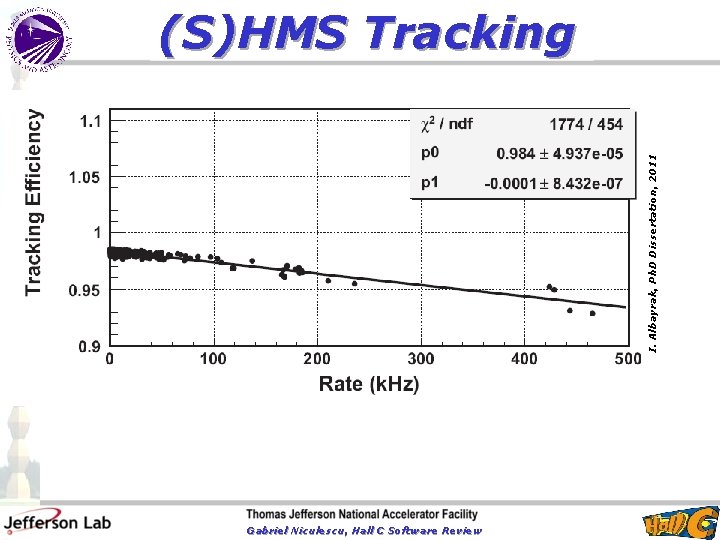
I. Albayrak, Ph. D Dissertation, 2011 (S)HMS Tracking Gabriel Niculescu, Hall C Software Review
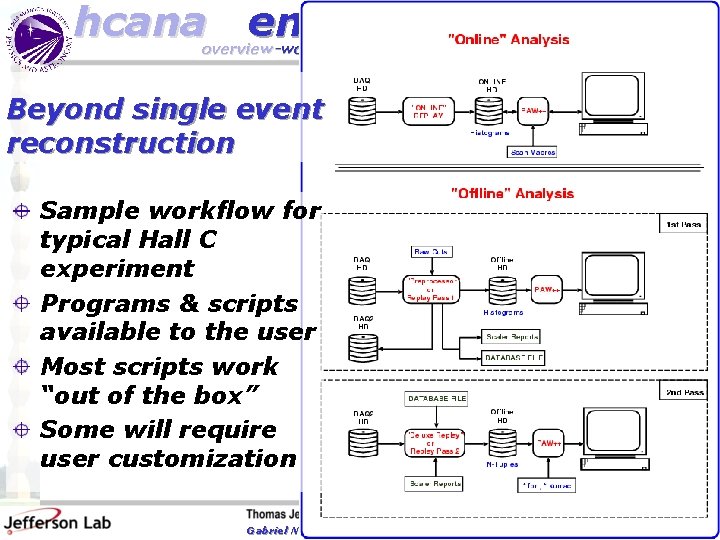
hcana engine overview-workflow-calibration-monitoring Beyond single event reconstruction Sample workflow for typical Hall C experiment Programs & scripts available to the user Most scripts work “out of the box” Some will require user customization Gabriel Niculescu, Hall C Software Review simc
hcana engine SHMS overview-workflow-calibration-monitoring Gabriel Niculescu, Hall C Software Review simc
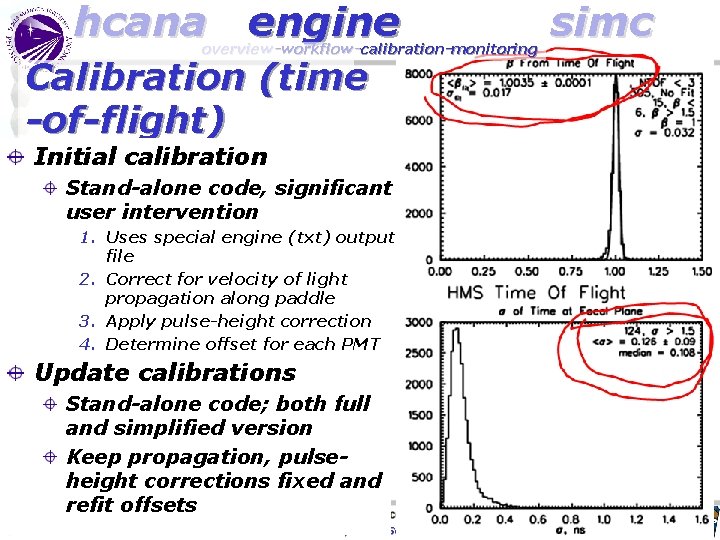
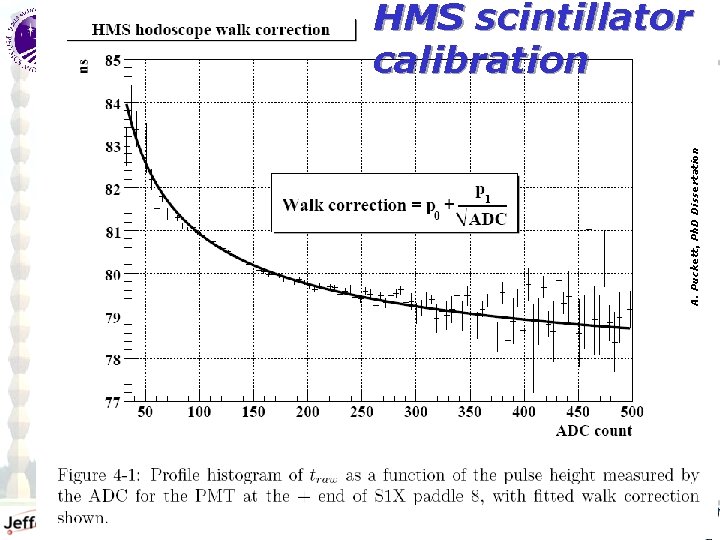
hcana engine overview-workflow-calibration-monitoring Calibration (time -of-flight) Initial calibration Stand-alone code, significant user intervention 1. Uses special engine (txt) output file 2. Correct for velocity of light propagation along paddle 3. Apply pulse-height correction 4. Determine offset for each PMT Update calibrations Stand-alone code; both full and simplified version Keep propagation, pulseheight corrections fixed and refit offsets Gabriel Niculescu, Hall C Software Review simc
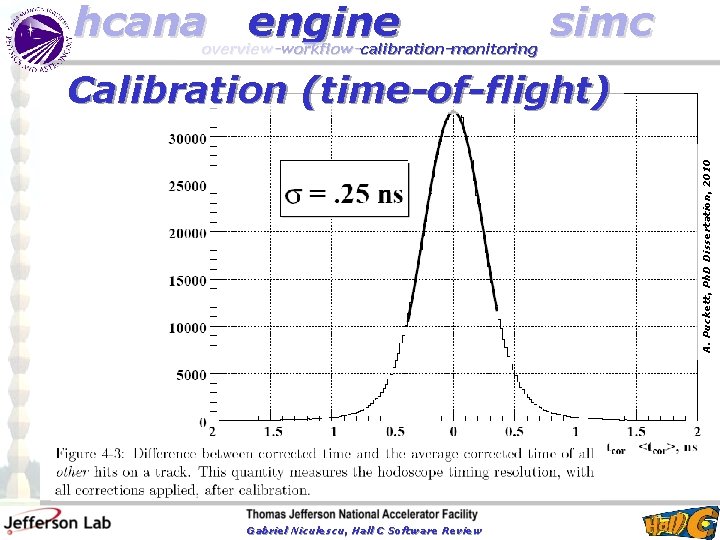
hcana engine overview-workflow-calibration-monitoring simc A. Puckett, Ph. D Dissertation, 2010 Calibration (time-of-flight) Gabriel Niculescu, Hall C Software Review
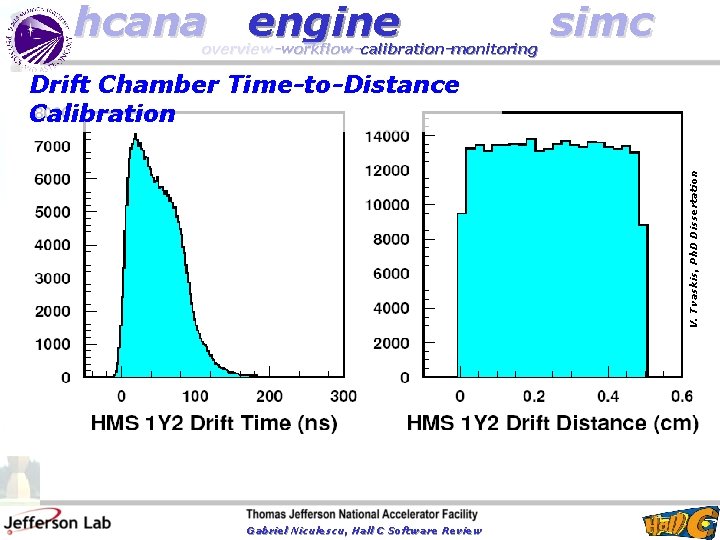
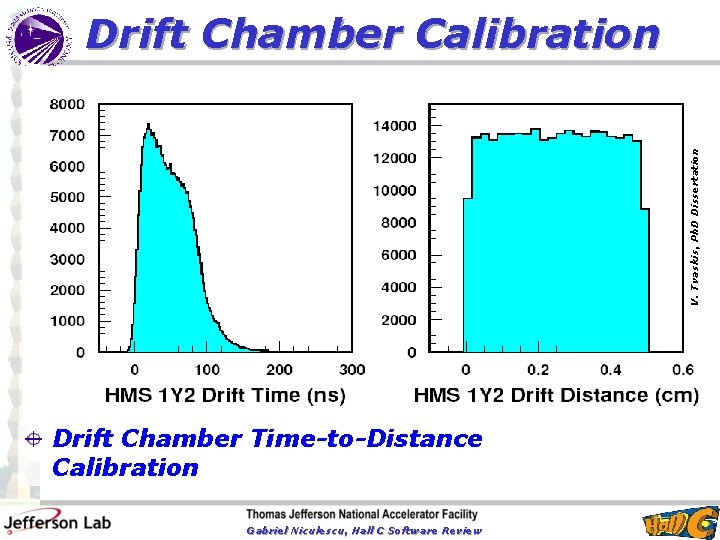
hcana engine overview-workflow-calibration-monitoring simc V. Tvaskis, Ph. D Dissertation Drift Chamber Time-to-Distance Calibration Gabriel Niculescu, Hall C Software Review
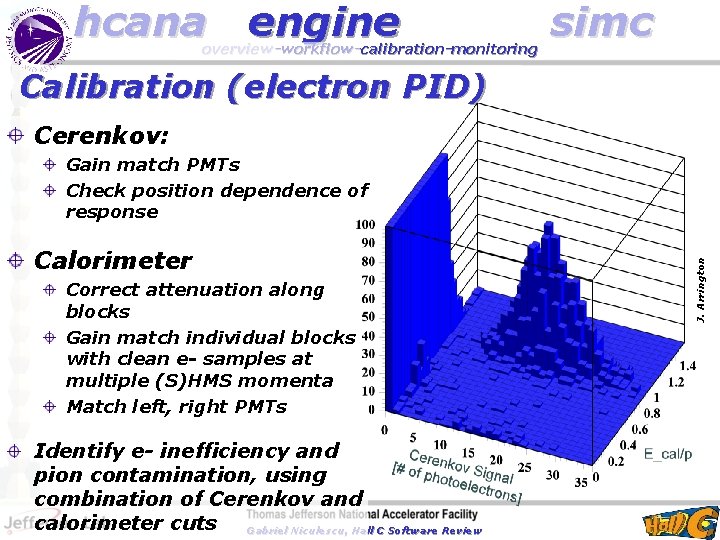
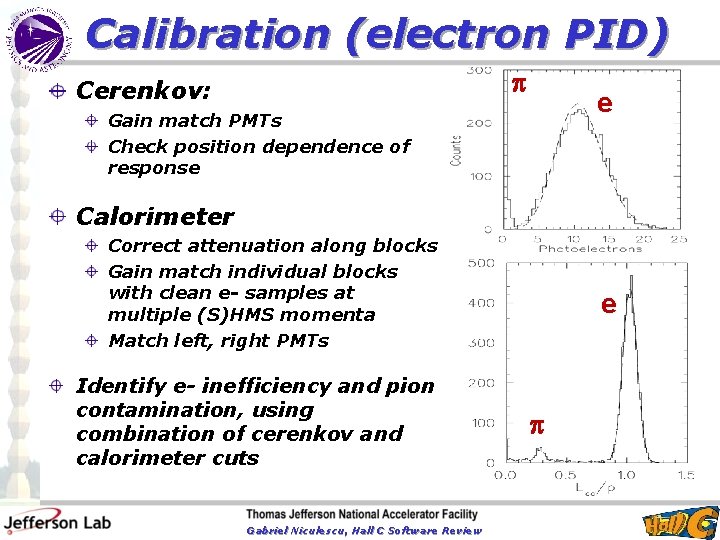
hcana engine overview-workflow-calibration-monitoring simc Calibration (electron PID) Cerenkov: Calorimeter Correct attenuation along blocks Gain match individual blocks with clean e- samples at multiple (S)HMS momenta Match left, right PMTs Identify e- inefficiency and pion contamination, using combination of Cerenkov and calorimeter cuts Gabriel Niculescu, Hall C Software Review J. Arrington Gain match PMTs Check position dependence of response
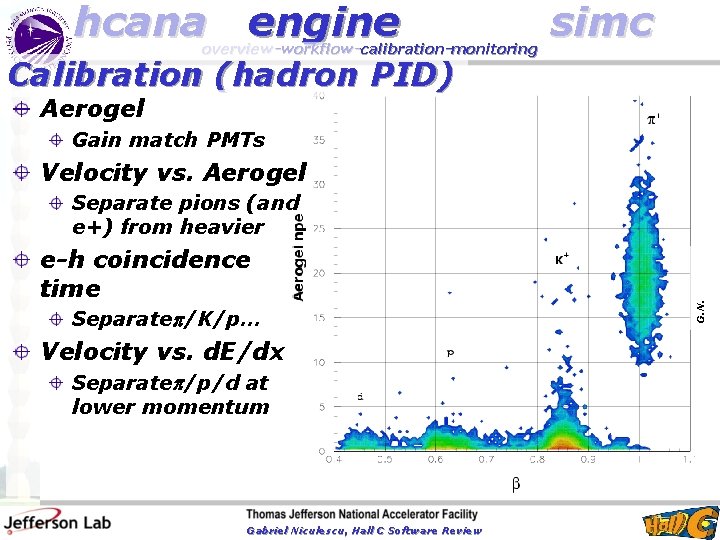
hcana engine overview-workflow-calibration-monitoring simc Calibration (hadron PID) Aerogel Gain match PMTs Velocity vs. Aerogel e-h coincidence time Separatep/K/p… Velocity vs. d. E/dx Separatep/p/d at lower momentum Gabriel Niculescu, Hall C Software Review G. N. Separate pions (and e+) from heavier
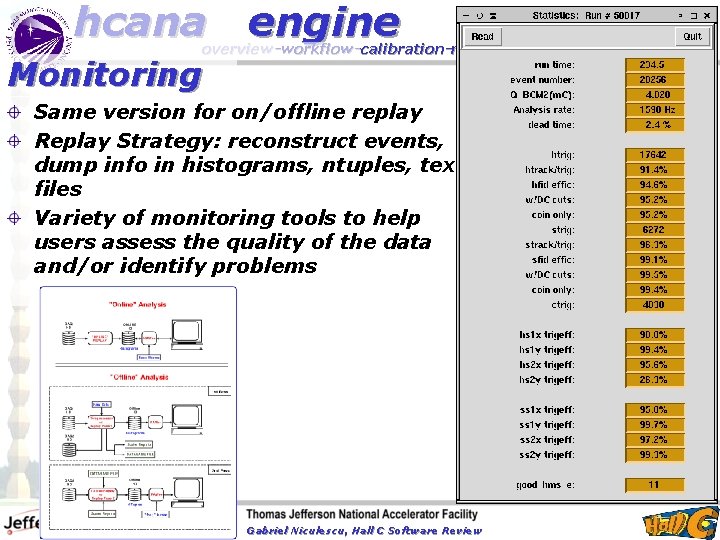
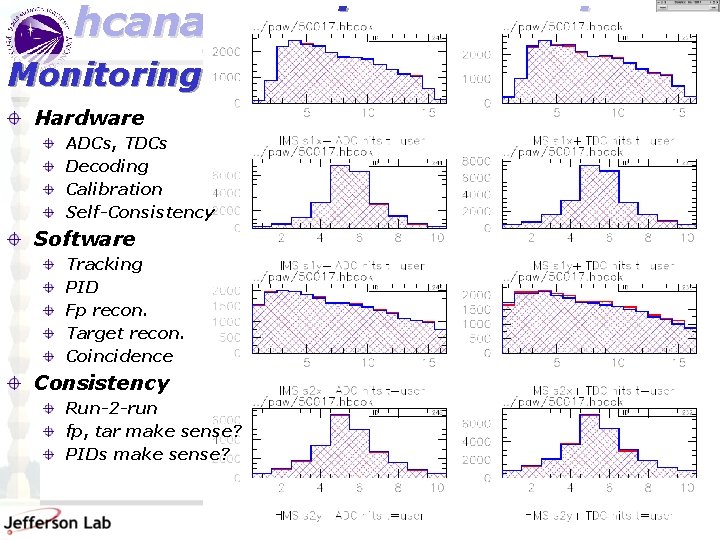
hcana engine overview-workflow-calibration-monitoring Monitoring Same version for on/offline replay Replay Strategy: reconstruct events, dump info in histograms, ntuples, text files Variety of monitoring tools to help users assess the quality of the data and/or identify problems Gabriel Niculescu, Hall C Software Review simc
hcana engine overview-workflow-calibration-monitoring Monitoring Hardware ADCs, TDCs Decoding Calibration Self-Consistency Software Tracking PID Fp recon. Target recon. Coincidence Consistency Run-2 -run fp, tar make sense? PIDs make sense? Gabriel Niculescu, Hall C Software Review simc
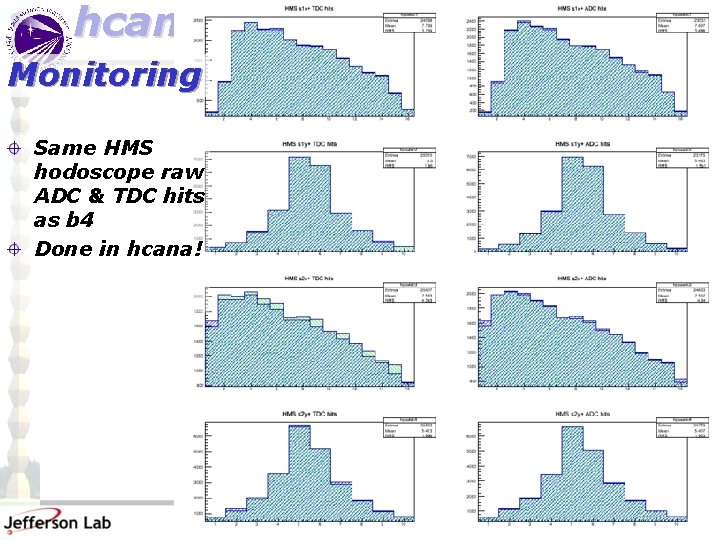
hcana engine overview-workflow-calibration-monitoring Monitoring Same HMS hodoscope raw ADC & TDC hits as b 4 Done in hcana! Gabriel Niculescu, Hall C Software Review simc
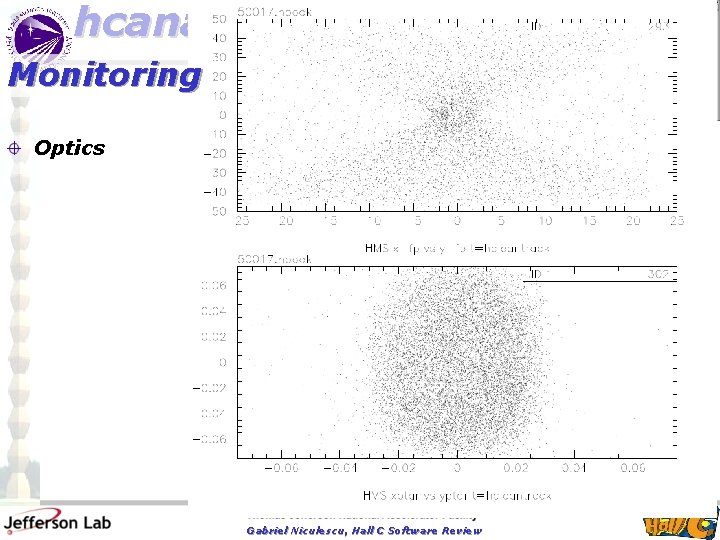
hcana engine overview-workflow-calibration-monitoring Monitoring Optics Gabriel Niculescu, Hall C Software Review simc
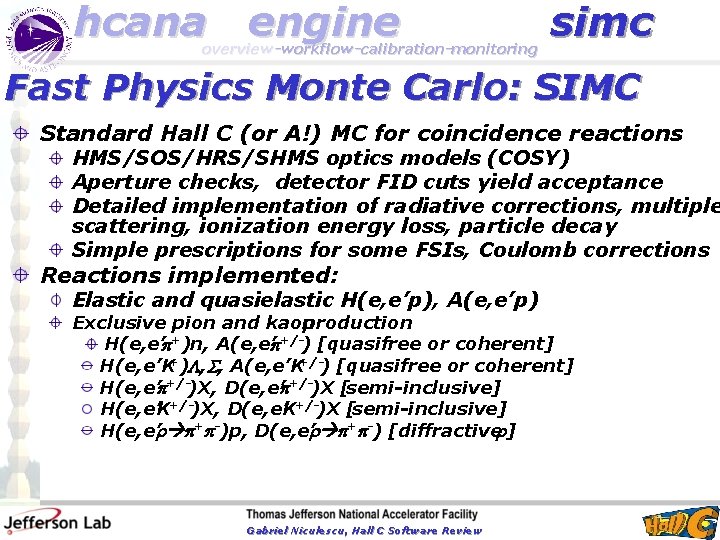
hcana engine overview-workflow-calibration-monitoring simc Fast Physics Monte Carlo: SIMC Standard Hall C (or A!) MC for coincidence reactions HMS/SOS/HRS/SHMS optics models (COSY) Aperture checks, detector FID cuts yield acceptance Detailed implementation of radiative corrections, multiple scattering, ionization energy loss, particle decay Simple prescriptions for some FSIs, Coulomb corrections Reactions implemented: Elastic and quasielastic H(e, e’p), A(e, e’p) Exclusive pion and kaon production H(e, e’p+)n, A(e, e’p+/-) [quasifree or coherent] H(e, e’K+)L, S, A(e, e’K+/-) [quasifree or coherent] H(e, e’p+/-)X, D(e, e’p+/-)X [semi-inclusive] H(e, e’K+/-)X, D(e, e’K+/-)X [semi-inclusive] H(e, e’r p+p-)p, D(e, e’r p+p-) [diffractiver] Gabriel Niculescu, Hall C Software Review
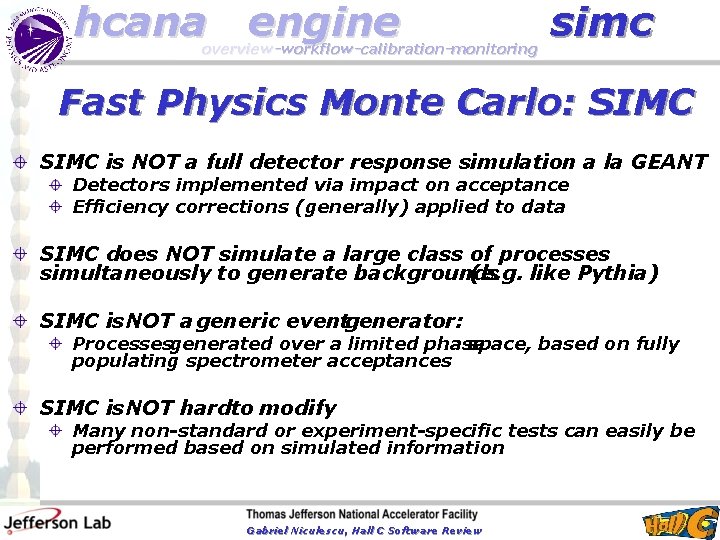
hcana engine overview-workflow-calibration-monitoring simc Fast Physics Monte Carlo: SIMC is NOT a full detector response simulation a la GEANT Detectors implemented via impact on acceptance Efficiency corrections (generally) applied to data SIMC does NOT simulate a large class of processes simultaneously to generate backgrounds (e. g. like Pythia) SIMC is NOT a generic eventgenerator: Processesgenerated over a limited phase space, based on fully populating spectrometer acceptances SIMC is NOT hardto modify Many non-standard or experiment-specific tests can easily be performed based on simulated information Gabriel Niculescu, Hall C Software Review
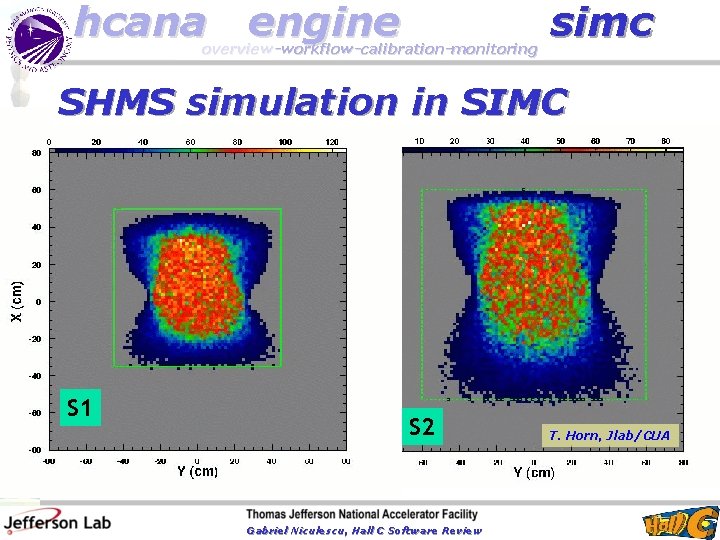
hcana engine overview-workflow-calibration-monitoring simc SHMS simulation in SIMC S 1 S 2 Gabriel Niculescu, Hall C Software Review T. Horn, Jlab/CUA
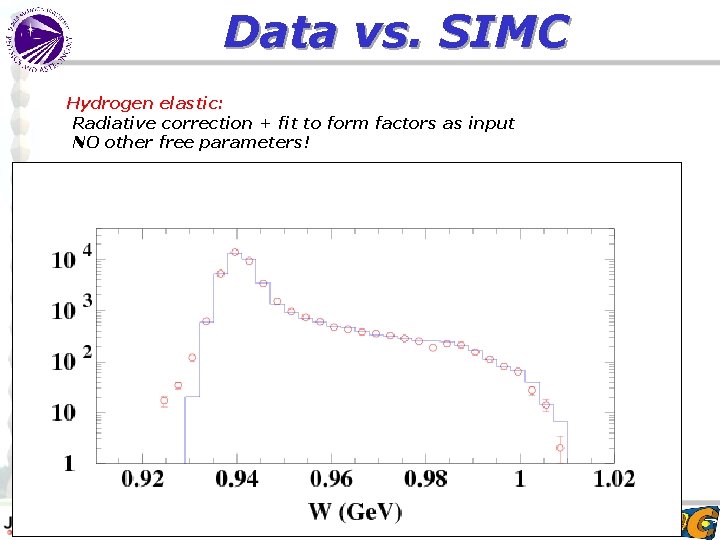
Data vs. SIMC Hydrogen elastic: Radiative correction + fit to form factors as input NO other free parameters! Gabriel Niculescu, Hall C Software Review
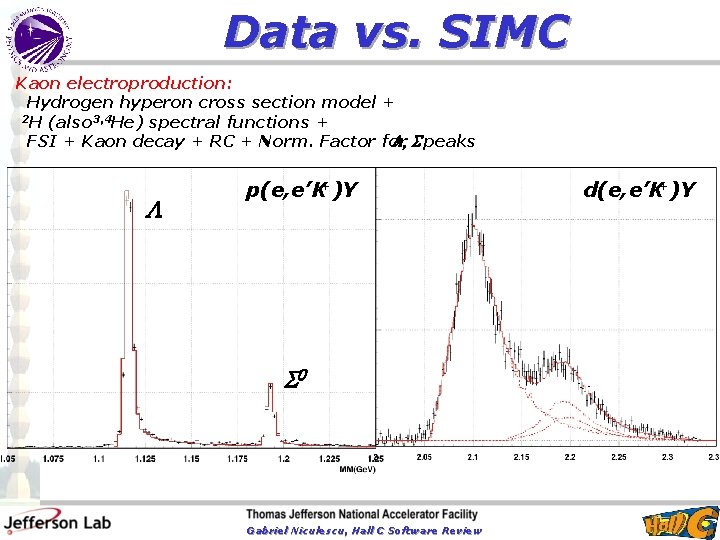
Data vs. SIMC Kaon electroproduction: Hydrogen hyperon cross section model + 2 H (also 3, 4 He) spectral functions + FSI + Kaon decay + RC + Norm. Factor for L, S peaks L p(e, e’K+)Y S 0 Gabriel Niculescu, Hall C Software Review d(e, e’K+)Y
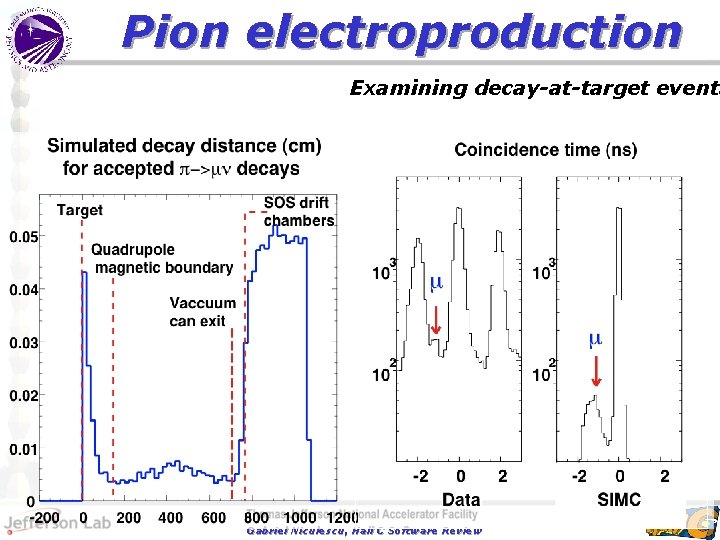
Pion electroproduction Examining decay-at-target events Gabriel Niculescu, Hall C Software Review
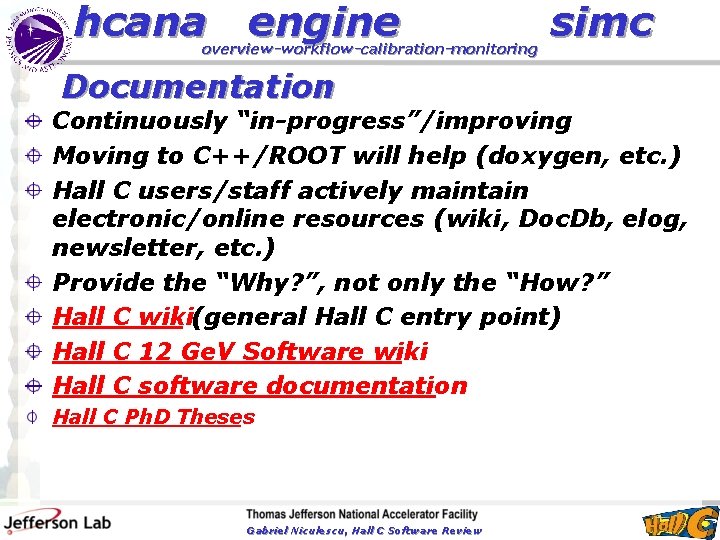
hcana engine overview-workflow-calibration-monitoring Documentation simc Continuously “in-progress”/improving Moving to C++/ROOT will help (doxygen, etc. ) Hall C users/staff actively maintain electronic/online resources (wiki, Doc. Db, elog, newsletter, etc. ) Provide the “Why? ”, not only the “How? ” Hall C wiki(general Hall C entry point) Hall C 12 Ge. V Software wiki Hall C software documentation Hall C Ph. D Theses Gabriel Niculescu, Hall C Software Review
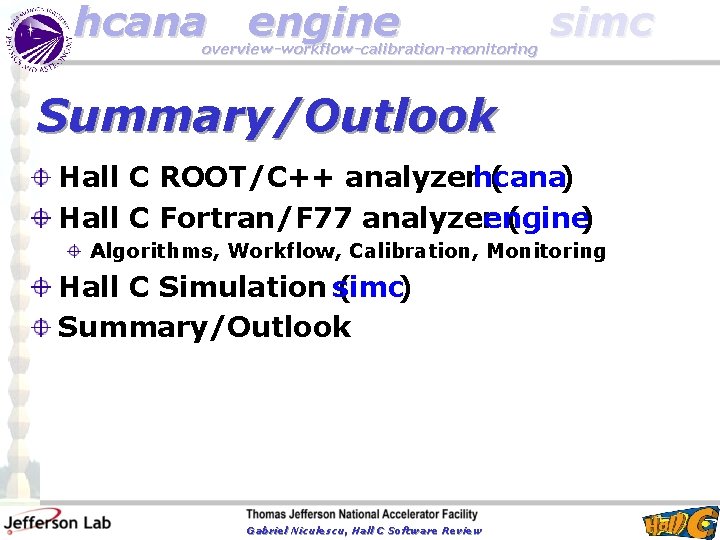
hcana engine overview-workflow-calibration-monitoring simc Summary/Outlook Hall C ROOT/C++ analyzerhcana ( ) Hall C Fortran/F 77 analyzerengine ( ) Algorithms, Workflow, Calibration, Monitoring Hall C Simulation simc ( ) Summary/Outlook Gabriel Niculescu, Hall C Software Review
Back-up from here on Gabriel Niculescu, Hall C Software Review
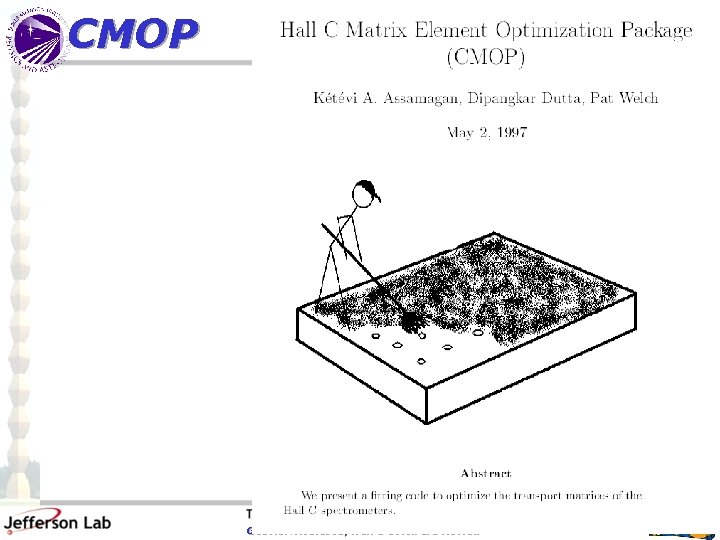
CMOP Gabriel Niculescu, Hall C Software Review
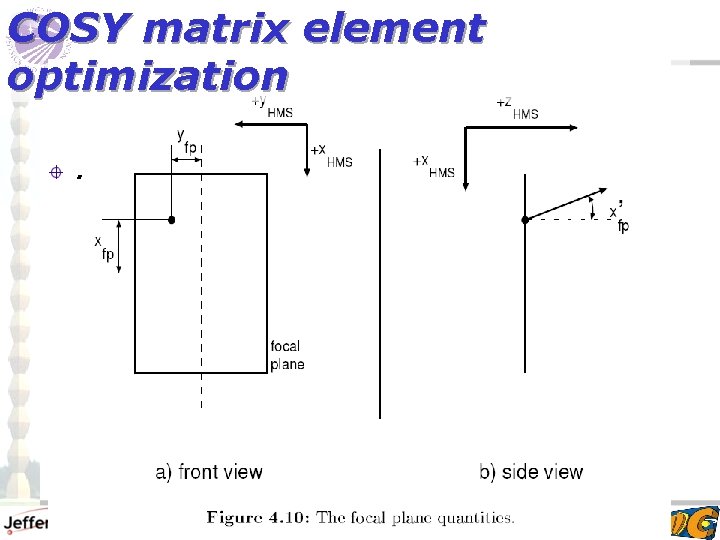
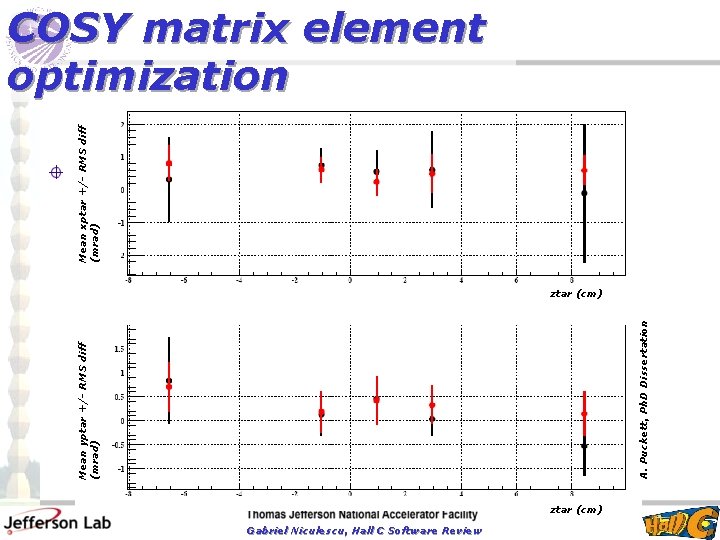
COSY matrix element optimization. Gabriel Niculescu, Hall C Software Review
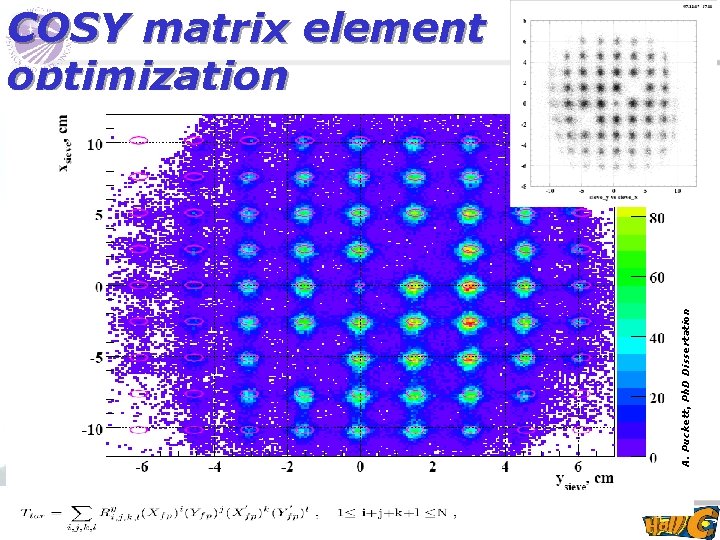
COSY matrix element optimization A. Puckett, Ph. D Dissertation . Gabriel Niculescu, Hall C Software Review
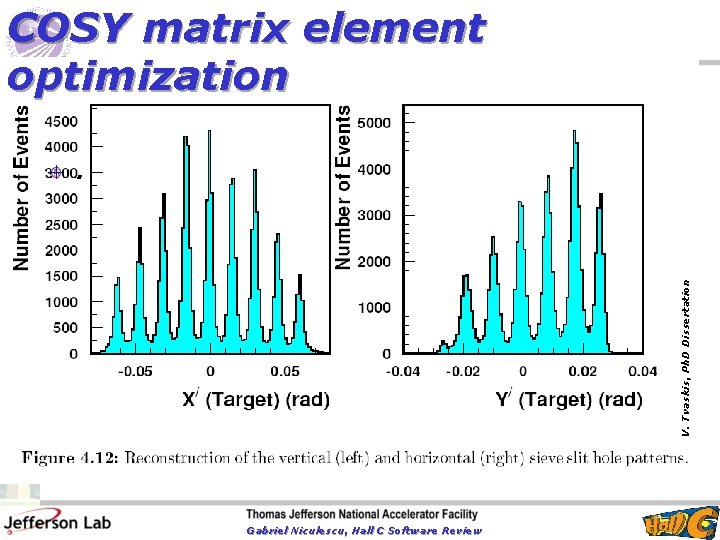
COSY matrix element optimization V. Tvaskis, Ph. D Dissertation . Gabriel Niculescu, Hall C Software Review
Mean xptar +/- RMS diff (mrad) COSY matrix element optimization. Mean yptar +/- RMS diff (mrad) A. Puckett, Ph. D Dissertation ztar (cm) Gabriel Niculescu, Hall C Software Review
SIMC Overview [probably backup] Initialization Choose reaction, final state (if appropriate) Disable/enable implementation of (or correction for) raster, eloss … Event generation Select vertex based on target size, position, raster size, beam spot size Determine energy, angle generation that will populate 100% of the acceptance (accounting for radiation, energ loss, …) Physics Processes Event-by-event multiple scattering, radiative corrections particle decay, coulomb corrections Gabriel Niculescu, Hall C Software Review
Overview [probably backup] Acceptance Can apply geometric cuts or spectrometer model. Defaul spec. models include target/spec. offsets, model of magnetic elements, apertures at front, back, middle of magnets, collimators, detector active area Event Reconstruction Tracks are fitted in the focal plane and reconstructed to the target. Apply average energy loss, fast raster corrections (consistent with data analysis). Calculate physics quantities for Ntuple. Gabriel Niculescu, Hall C Software Review
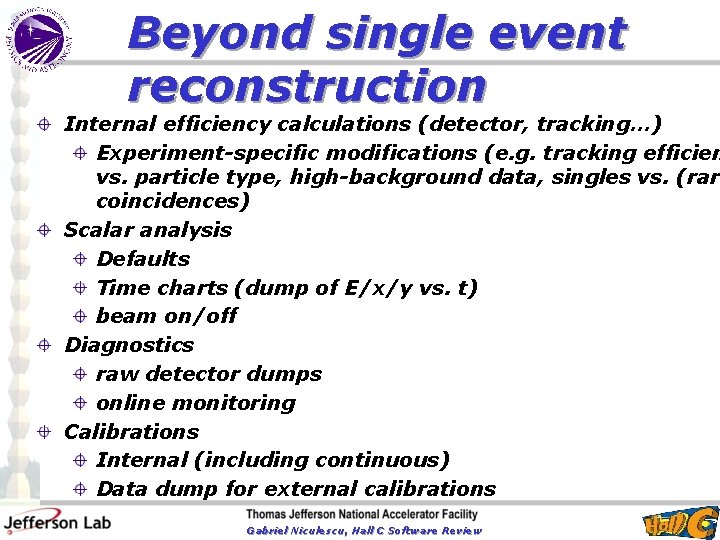
Beyond single event reconstruction Internal efficiency calculations (detector, tracking…) Experiment-specific modifications (e. g. tracking efficien vs. particle type, high-background data, singles vs. (rar coincidences) Scalar analysis Defaults Time charts (dump of E/x/y vs. t) beam on/off Diagnostics raw detector dumps online monitoring Calibrations Internal (including continuous) Data dump for external calibrations Gabriel Niculescu, Hall C Software Review
Beyond single event reconstruction Corrections (beam drift, FR, special[coin/cer block. . . ]) Cuts, normalized yields in arbitrary bins. Simulation: ratio method, include all ‘physics’ event-byevent, apply global corrections (mean eloss) as in analyzer At present, Engine has robust default estimates for efficiencies, calibrations, etc… with options for specific conditions (or user-provided experiment-specific changes) New framework : may want multiple (or selectable) versions to allow simpler selection of optimized approach. Fortunat this capability already exists in PODD. Gabriel Niculescu, Hall C Software Review
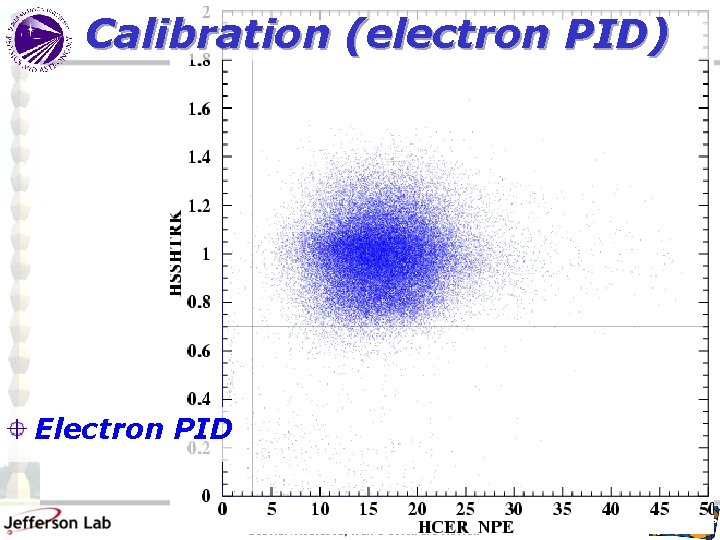
Calibration (electron PID) Electron PID Gabriel Niculescu, Hall C Software Review
Calibration (electron PID) p Cerenkov: e Gain match PMTs Check position dependence of response Calorimeter Correct attenuation along blocks Gain match individual blocks with clean e- samples at multiple (S)HMS momenta Match left, right PMTs Identify e- inefficiency and pion contamination, using combination of cerenkov and calorimeter cuts Gabriel Niculescu, Hall C Software Review e p
V. Tvaskis, Ph. D Dissertation Drift Chamber Calibration Drift Chamber Time-to-Distance Calibration Gabriel Niculescu, Hall C Software Review
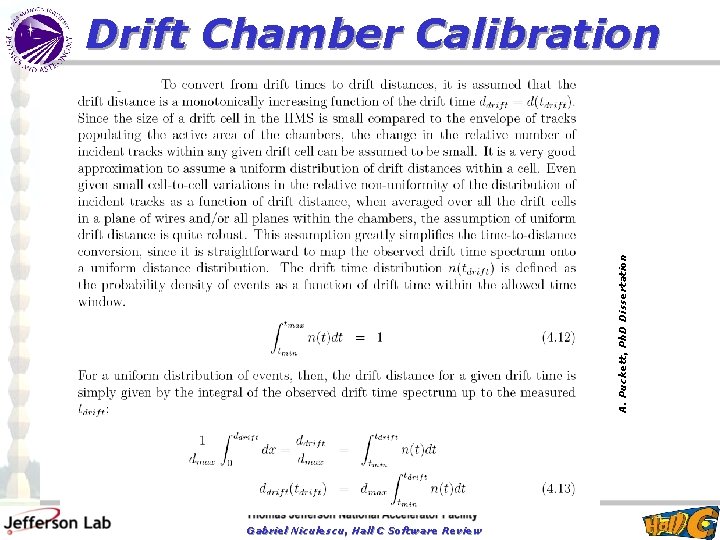
A. Puckett, Ph. D Dissertation Drift Chamber Calibration Gabriel Niculescu, Hall C Software Review
A. Puckett, Ph. D Dissertation HMS scintillator calibration Gabriel Niculescu, Hall C Software Review
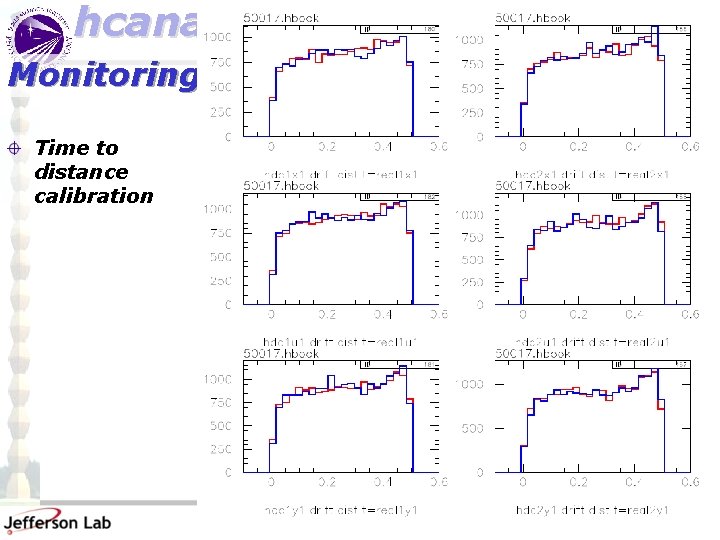
hcana engine overview-workflow-calibration-monitoring Monitoring Time to distance calibration Gabriel Niculescu, Hall C Software Review simc
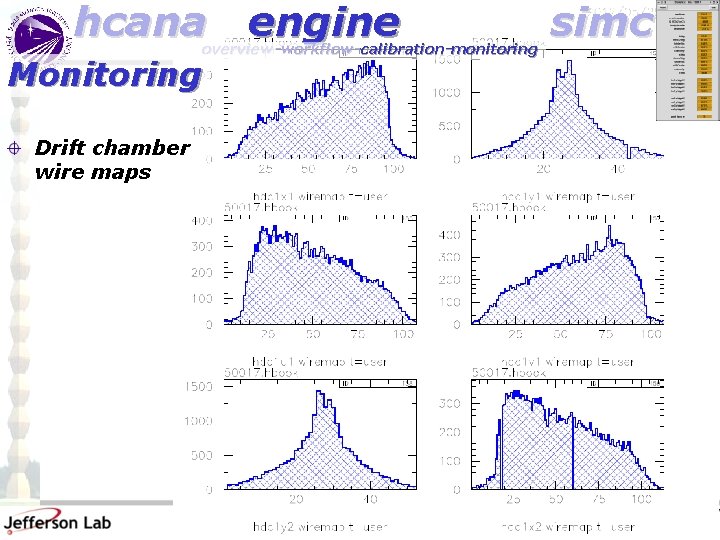
hcana engine overview-workflow-calibration-monitoring Monitoring Drift chamber wire maps Gabriel Niculescu, Hall C Software Review simc
hcana engine overview-workflow-calibration-monitoring simc GIT “Git is afree and open source distributed version control system designed to handle everything from small to very large projects with speed and efficiency. Git is easy to learnand has atiny footprint with lightning fast performance. It outclasses SCM tools like Subversion, CVS, Perforce, and Clear. Case with features like cheap local branching, convenientstaging areas , and multiple workflows. “ http: //git-scm. com/ Gabriel Niculescu, Hall C Software Review
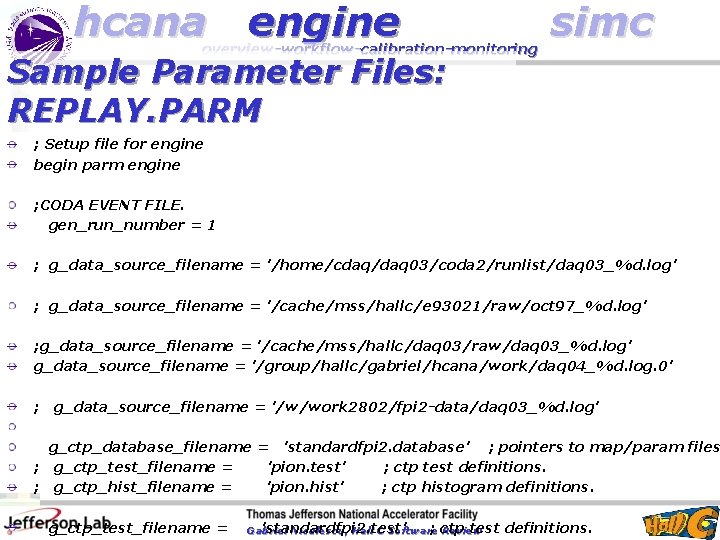
hcana engine overview-workflow-calibration-monitoring simc Sample Parameter Files: REPLAY. PARM ; Setup file for engine begin parm engine ; CODA EVENT FILE. gen_run_number = 1 ; g_data_source_filename = '/home/cdaq/daq 03/coda 2/runlist/daq 03_%d. log' ; g_data_source_filename = '/cache/mss/hallc/e 93021/raw/oct 97_%d. log' ; g_data_source_filename = '/cache/mss/hallc/daq 03/raw/daq 03_%d. log' g_data_source_filename = '/group/hallc/gabriel/hcana/work/daq 04_%d. log. 0' ; g_data_source_filename = '/w/work 2802/fpi 2 -data/daq 03_%d. log' g_ctp_database_filename = 'standardfpi 2. database' ; pointers to map/param files ; g_ctp_test_filename = 'pion. test' ; ctp test definitions. ; g_ctp_hist_filename = 'pion. hist' ; ctp histogram definitions. g_ctp_test_filename = 'standardfpi 2. test' ; ctp test Gabriel Niculescu, Hall C Software Review definitions.
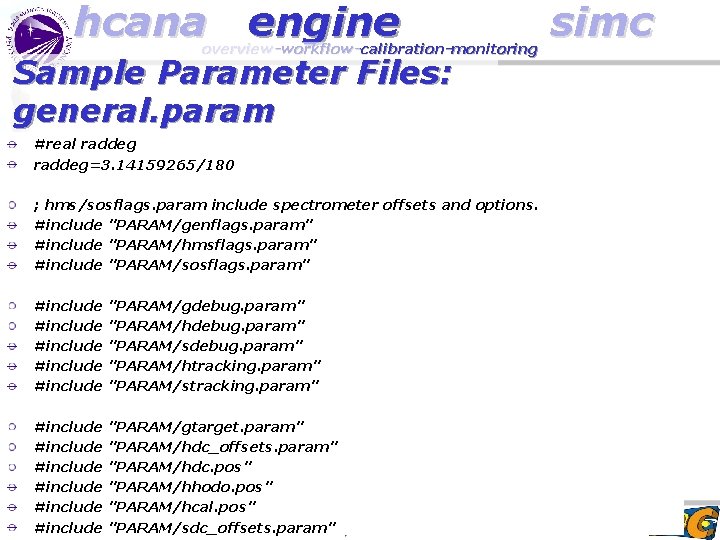
hcana engine overview-workflow-calibration-monitoring Sample Parameter Files: general. param #real raddeg=3. 14159265/180 ; hms/sosflags. param include spectrometer offsets and options. #include "PARAM/genflags. param" #include "PARAM/hmsflags. param" #include "PARAM/sosflags. param" #include #include "PARAM/gdebug. param" "PARAM/hdebug. param" "PARAM/sdebug. param" "PARAM/htracking. param" "PARAM/stracking. param" #include #include "PARAM/gtarget. param" "PARAM/hdc_offsets. param" "PARAM/hdc. pos" "PARAM/hhodo. pos" "PARAM/hcal. pos" "PARAM/sdc_offsets. param" Gabriel Niculescu, Hall C Software Review simc
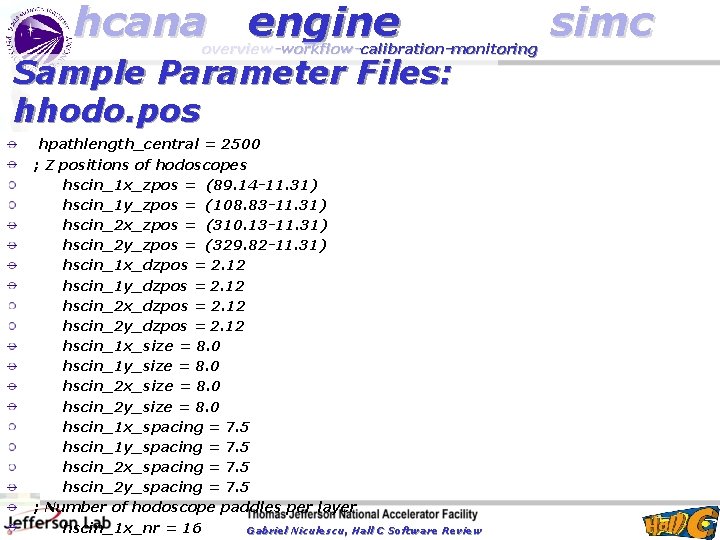
hcana engine overview-workflow-calibration-monitoring Sample Parameter Files: hhodo. pos hpathlength_central = 2500 ; Z positions of hodoscopes hscin_1 x_zpos = (89. 14 -11. 31) hscin_1 y_zpos = (108. 83 -11. 31) hscin_2 x_zpos = (310. 13 -11. 31) hscin_2 y_zpos = (329. 82 -11. 31) hscin_1 x_dzpos = 2. 12 hscin_1 y_dzpos = 2. 12 hscin_2 x_dzpos = 2. 12 hscin_2 y_dzpos = 2. 12 hscin_1 x_size = 8. 0 hscin_1 y_size = 8. 0 hscin_2 x_size = 8. 0 hscin_2 y_size = 8. 0 hscin_1 x_spacing = 7. 5 hscin_1 y_spacing = 7. 5 hscin_2 x_spacing = 7. 5 hscin_2 y_spacing = 7. 5 ; Number of hodoscope paddles per layer hscin_1 x_nr = 16 Gabriel Niculescu, Hall C Software Review simc