
12 Choosing Mitigation Policies It is our choices
- Slides: 18
12: Choosing Mitigation Policies "It is our choices that show what we truly are, far more than our abilities. ” J. K. Rowling, Harry Potter and The Chamber of Secrets, 1999
https: //www. youtube. com/watch? v=WGwiz 80 Ea. Ts
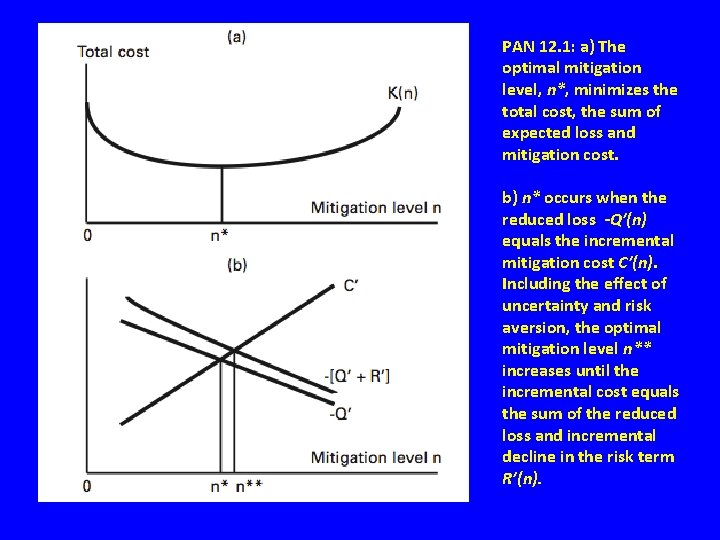
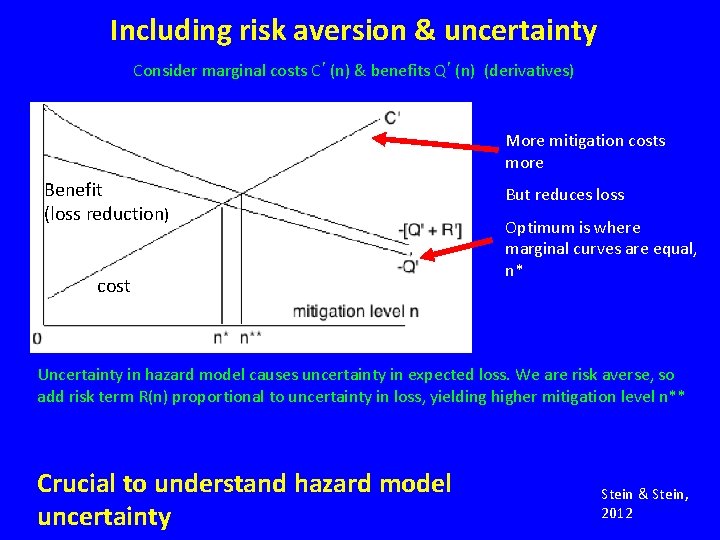
PAN 12. 1: a) The optimal mitigation level, n*, minimizes the total cost, the sum of expected loss and mitigation cost. b) n* occurs when the reduced loss -Q’(n) equals the incremental mitigation cost C’(n). Including the effect of uncertainty and risk aversion, the optimal mitigation level n** increases until the incremental cost equals the sum of the reduced loss and incremental decline in the risk term R’(n).
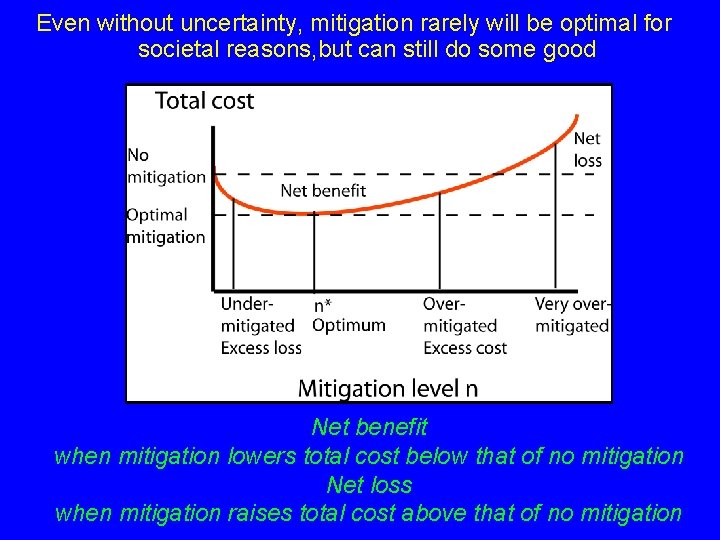
Even without uncertainty, mitigation rarely will be optimal for societal reasons, but can still do some good Net benefit when mitigation lowers total cost below that of no mitigation Net loss when mitigation raises total cost above that of no mitigation
Including risk aversion & uncertainty Consider marginal costs C’(n) & benefits Q’(n) (derivatives) More mitigation costs more Benefit (loss reduction) cost But reduces loss Optimum is where marginal curves are equal, n* Uncertainty in hazard model causes uncertainty in expected loss. We are risk averse, so add risk term R(n) proportional to uncertainty in loss, yielding higher mitigation level n** Crucial to understand hazard model uncertainty Stein & Stein, 2012
Lecture 12 6
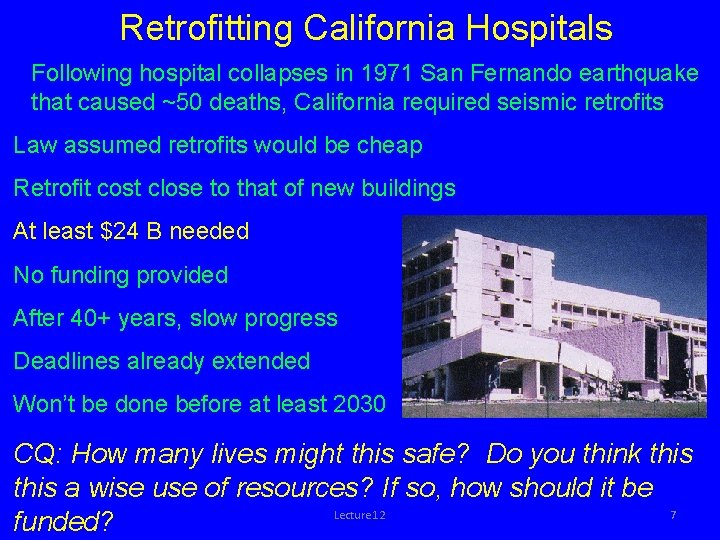
Retrofitting California Hospitals Following hospital collapses in 1971 San Fernando earthquake that caused ~50 deaths, California required seismic retrofits Law assumed retrofits would be cheap Retrofit cost close to that of new buildings At least $24 B needed No funding provided After 40+ years, slow progress Deadlines already extended Won’t be done before at least 2030 CQ: How many lives might this safe? Do you think this a wise use of resources? If so, how should it be Lecture 12 7 funded?
COST-BENEFIT ISSUES IN HAZARD MITIGATION “There's no free lunch” Resources used for one goal aren’t available for another This is easy to see in the public sector, where there are direct tradeoffs. Funds spent strengthening schools aren’t available to hire teachers, upgrading hospitals may mean covering fewer uninsured (~$1 K/yr), stronger bridges may result in hiring fewer police and fire fighters (~$50 K/yr), etc. . .
COST-BENEFIT ISSUES IN HAZARD MITIGATION “There's no such thing as other people's money” Costs are ultimately borne by society as a whole Imposing costs on the private sector affects everyone via reduced economic activity (firms don't build or build elsewhere), job loss (or reduced growth), and the resulting reduction in tax revenue and thus social services.
“The direct costs of federal environmental, health, and safety regulations are probably on the order of $200 billion annually, or about the size of all federal domestic, nondefense discretionary spending. The benefits of those regulations are even less certain. Evidence suggests that some recent regulations would pass a benefit-cost test while others would not. ” Hahn, R. , and R. E. Litan, An Analysis of the Second Government Draft Report on the Costs and Benefits of Federal Regulations, AEIBrookings Joint Center, Washington, DC, 1998.
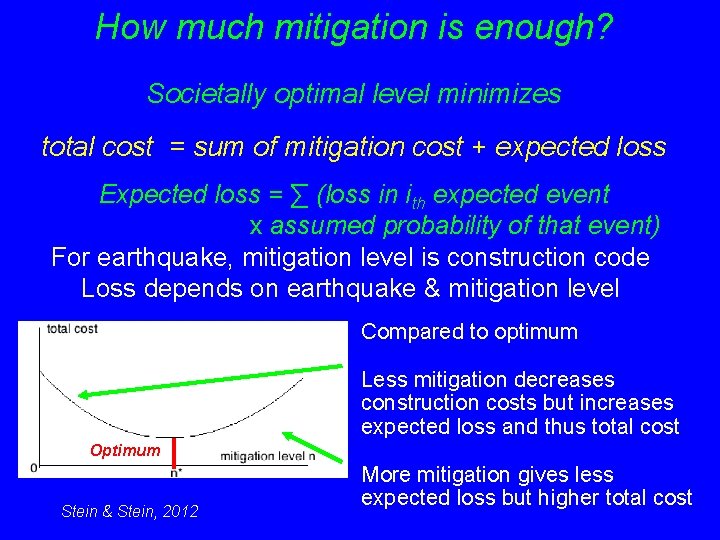
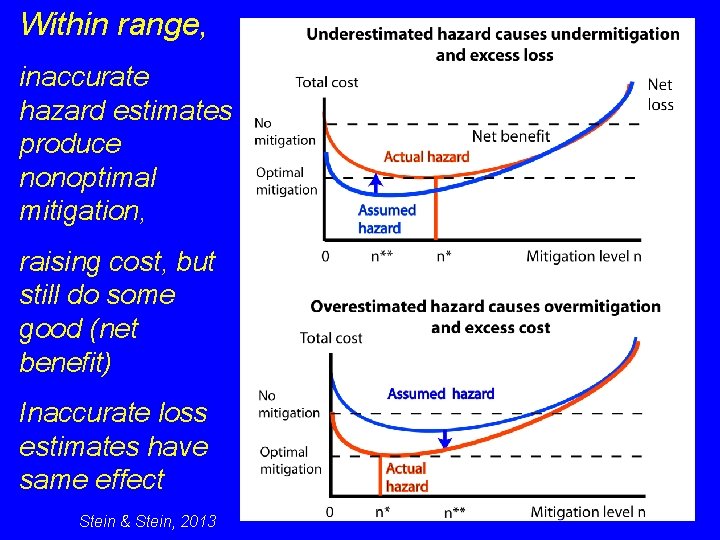
How much mitigation is enough? Societally optimal level minimizes total cost = sum of mitigation cost + expected loss Expected loss = ∑ (loss in ith expected event x assumed probability of that event) For earthquake, mitigation level is construction code Loss depends on earthquake & mitigation level Compared to optimum Less mitigation decreases construction costs but increases expected loss and thus total cost Optimum Stein & Stein, 2012 More mitigation gives less expected loss but higher total cost
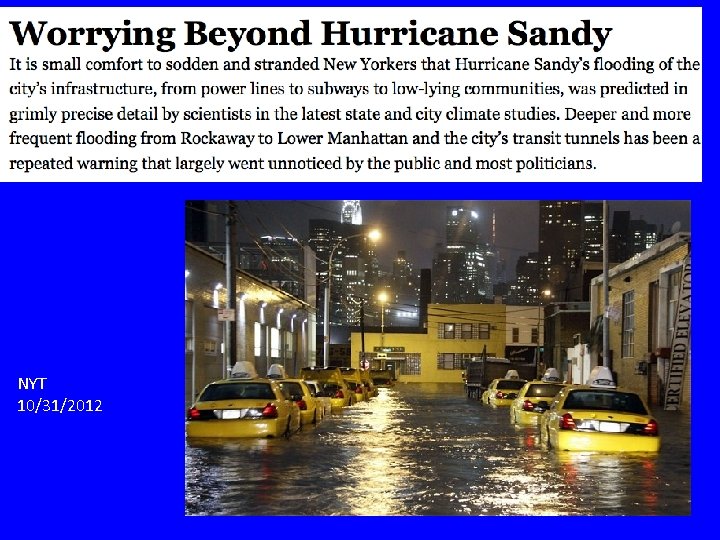
NYT 10/31/2012
CQ: Given the damage to New York City by the storm surge from Hurricane Sandy, possible options range from continuing to do little, through intermediate strategies like providing doors to keep water out of vulnerable tunnels, to building barriers to keep the surge out of rivers. Progressively more extensive mitigation measures cost more, but are expected to produce increasing reduction of losses in future hurricanes. How would you develop a strategy to choose between the various proposed options? How would you include the anticipated but uncertain effects of global warming? Lecture 12 14
Within range, inaccurate hazard estimates produce nonoptimal mitigation, raising cost, but still do some good (net benefit) Inaccurate loss estimates have same effect Stein & Stein, 2013
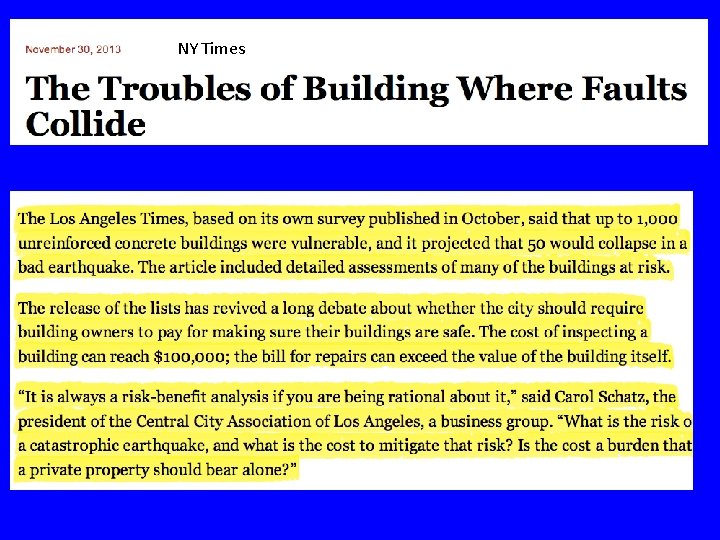
NY Times
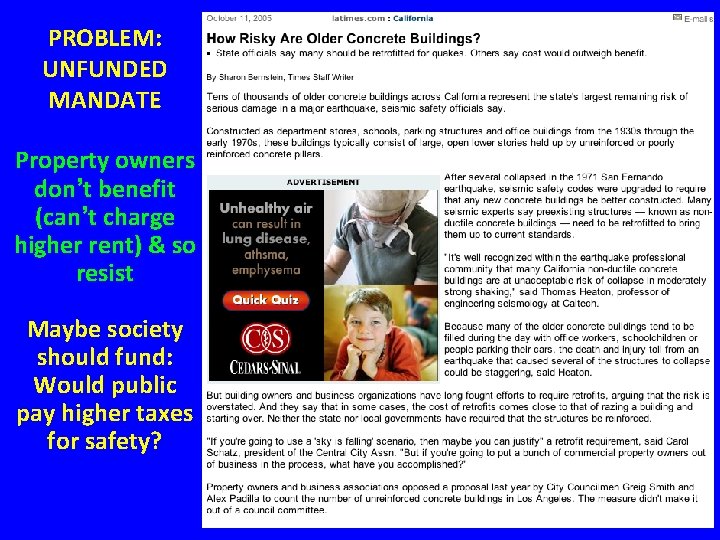
PROBLEM: UNFUNDED MANDATE Property owners don’t benefit (can’t charge higher rent) & so resist Maybe society should fund: Would public pay higher taxes for safety?
CQ: If you were a student in Los Angeles, how much more would you pay in rent each month to live in an earthquake-safe building?