
12 Chapter Robbins Judge Organizational Behavior 14 th
12 Chapter Robbins & Judge Organizational Behavior 14 th Edition Leadership Kelli J. Schutte William Jewell College Copyright © 2011 Pearson Education, Inc. publishing as Prentice Hall 12 -0
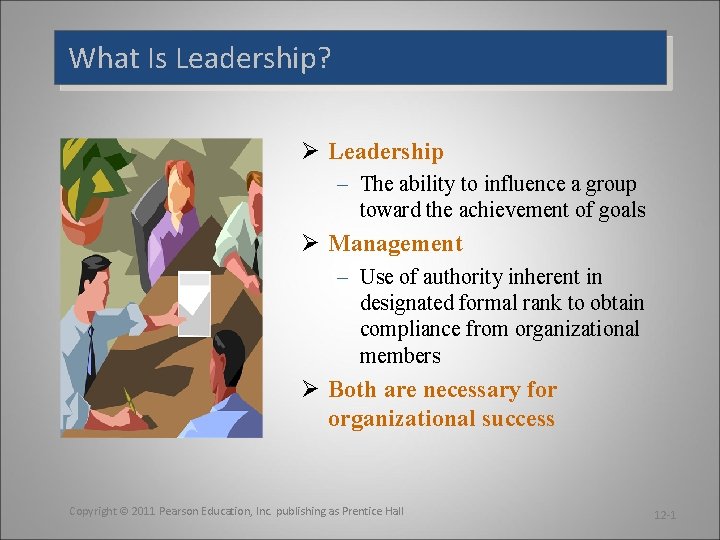
What Is Leadership? Ø Leadership – The ability to influence a group toward the achievement of goals Ø Management – Use of authority inherent in designated formal rank to obtain compliance from organizational members Ø Both are necessary for organizational success Copyright © 2011 Pearson Education, Inc. publishing as Prentice Hall 12 -1
Trait Theories of Leadership Ø Theories that consider personality, social, physical, or intellectual traits to differentiate leaders from nonleaders Ø Not very useful until matched with the Big Five Personality Framework Ø Essential Leadership Traits – – Extroversion Conscientiousness Openness Emotional Intelligence (Qualified) Ø Traits can predict leadership, but they are better at predicting leader emergence than effectiveness. Copyright © 2011 Pearson Education, Inc. publishing as Prentice Hall 12 -2
Behavioral Theories of Leadership Ø Theories proposing that specific behaviors differentiate leaders from nonleaders Ø Differences between theories of leadership: – Trait theory: leadership is inherent, so we must identify the leader based on his or her traits – Behavioral theory: leadership is a skill set and can be taught to anyone, so we must identify the proper behaviors to teach potential leaders Copyright © 2011 Pearson Education, Inc. publishing as Prentice Hall 12 -3
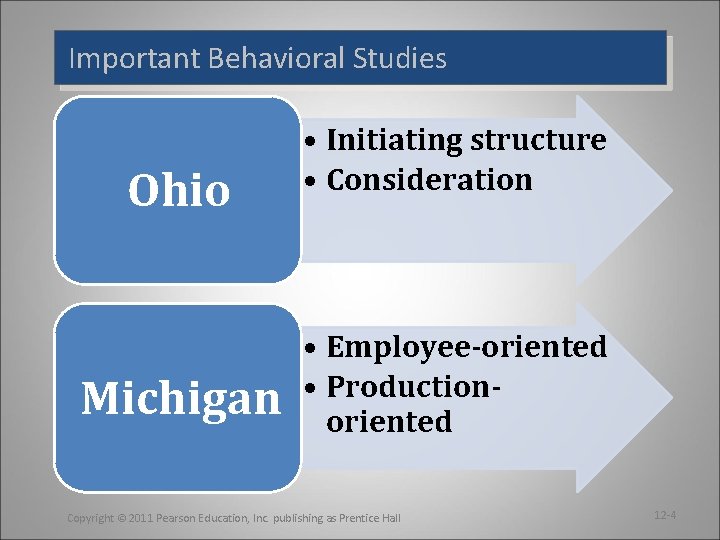
Important Behavioral Studies Ohio Michigan • Initiating structure • Consideration • Employee-oriented • Productionoriented Copyright © 2011 Pearson Education, Inc. publishing as Prentice Hall 12 -4
Contingency Theories Ø While trait and behavior theories do help us understand leadership, an important component is missing: the environment in which the leader exists Ø Contingency Theory adds this additional aspect to our understanding leadership effectiveness studies Ø Three key theories: – Fiedler’s Model – Hersey and Blanchard’s Situational Leadership Theory – Path-Goal Theory Copyright © 2011 Pearson Education, Inc. publishing as Prentice Hall 12 -5
Fiedler Model Ø Effective group performance depends on the proper match between leadership style and the degree to which the situation gives the leader control. – Assumes that leadership style (based on orientation revealed in LPC questionnaire) is fixed Ø Considers Three Situational Factors: – Leader-member relations: degree of confidence and trust in the leader – Task structure: degree of structure in the jobs – Position power: leader’s ability to hire, fire, and reward Ø For effective leadership: must change to a leader who fits the situation or change the situational variables to fit the current leader Copyright © 2011 Pearson Education, Inc. publishing as Prentice Hall 12 -6
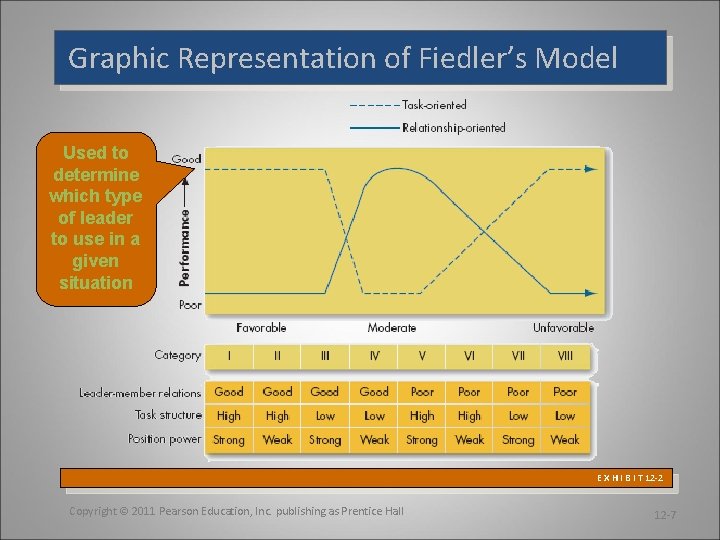
Graphic Representation of Fiedler’s Model Used to determine which type of leader to use in a given situation E X H I B I T 12 -2 Copyright © 2011 Pearson Education, Inc. publishing as Prentice Hall 12 -7
Assessment of Fiedler’s Model Ø Positives: – Considerable evidence supports the model, especially if the original eight situations are grouped into three Ø Problems: – The logic behind the LPC scale is not well understood – LPC scores are not stable – Contingency variables are complex and hard to determine Copyright © 2011 Pearson Education, Inc. publishing as Prentice Hall 12 -8
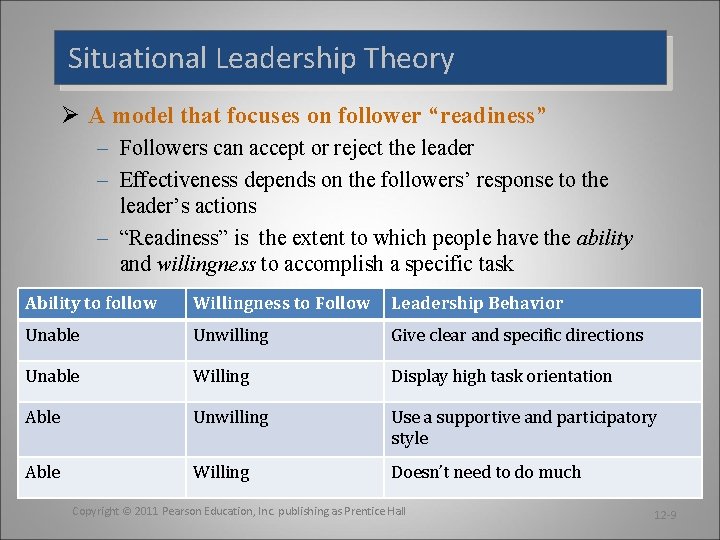
Situational Leadership Theory Ø A model that focuses on follower “readiness” – Followers can accept or reject the leader – Effectiveness depends on the followers’ response to the leader’s actions – “Readiness” is the extent to which people have the ability and willingness to accomplish a specific task Ability to follow Willingness to Follow Leadership Behavior Unable Unwilling Give clear and specific directions Unable Willing Display high task orientation Able Unwilling Use a supportive and participatory style Able Willing Doesn’t need to do much Copyright © 2011 Pearson Education, Inc. publishing as Prentice Hall 12 -9
House’s Path-Goal Theory Ø Builds from the Ohio State studies and the expectancy theory of motivation Ø Theory: – Leaders provide followers with information, support, and resources to help them achieve their goals – Leaders help clarify the “path” to the worker’s goals – Leaders can display multiple leadership types Ø Four types of leaders: – – Directive: focuses on the work to be done Supportive: focuses on the well-being of the worker Participative: consults with employees in decision making Achievement-Oriented: sets challenging goals Copyright © 2011 Pearson Education, Inc. publishing as Prentice Hall 12 -10
Vroom and Yetton’s Leader-Participation Model Ø How a leader makes decisions is as important as what is decided Ø Premise: Situational variables interact with leadership attributes to impact the behavior of the leader. – Leader behaviors must adjust to the way tasks are structured in the organization. – This is a normative model that tells leaders how participative to be in their decision making of a decision tree • Five leadership styles • Twelve contingency variables E X H I B I T 12 -5 Copyright © 2011 Pearson Education, Inc. publishing as Prentice Hall 12 -11
Leader-Member Exchange (LMX) Theory In Groups • Members are similar to leader • In the leader’s inner circle of communication • Receives more time and attention from leader • Gives greater responsibility and rewards Copyright © 2011 Pearson Education, Inc. publishing as Prentice Hall Out Groups • Managed by formal rules and policies • Receive less of the leader’s attention / fewer exchanges • More likely to retaliate against the organization 12 -12
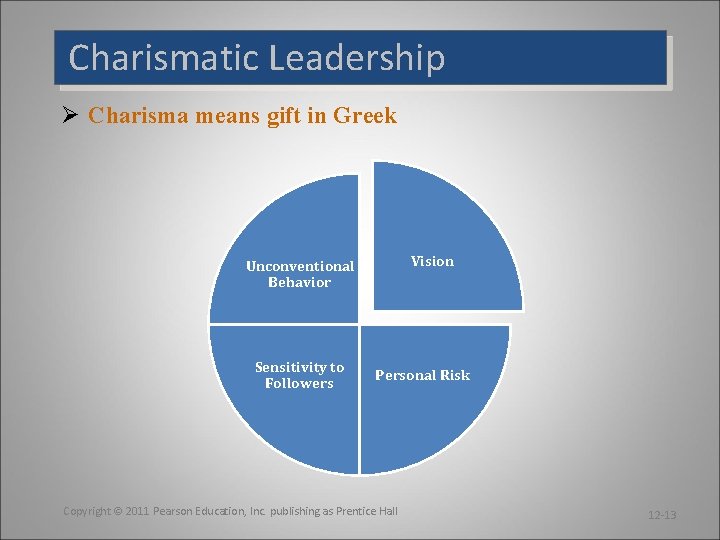
Charismatic Leadership Ø Charisma means gift in Greek Vision Unconventional Behavior Sensitivity to Followers Personal Risk Copyright © 2011 Pearson Education, Inc. publishing as Prentice Hall 12 -13
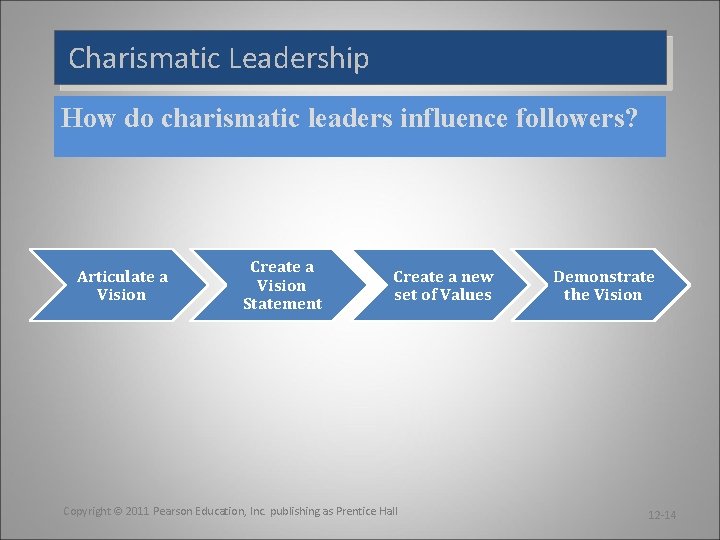
Charismatic Leadership How do charismatic leaders influence followers? Articulate a Vision Create a Vision Statement Create a new set of Values Copyright © 2011 Pearson Education, Inc. publishing as Prentice Hall Demonstrate the Vision 12 -14
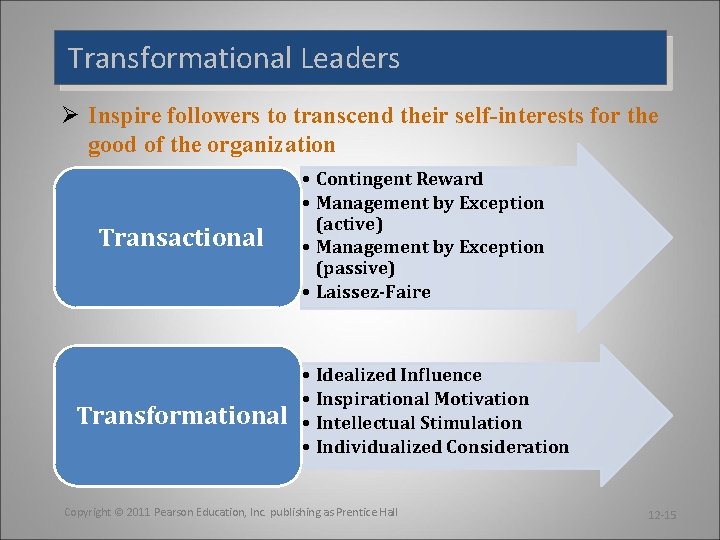
Transformational Leaders Ø Inspire followers to transcend their self-interests for the good of the organization Transactional Transformational • Contingent Reward • Management by Exception (active) • Management by Exception (passive) • Laissez-Faire • Idealized Influence • Inspirational Motivation • Intellectual Stimulation • Individualized Consideration Copyright © 2011 Pearson Education, Inc. publishing as Prentice Hall 12 -15
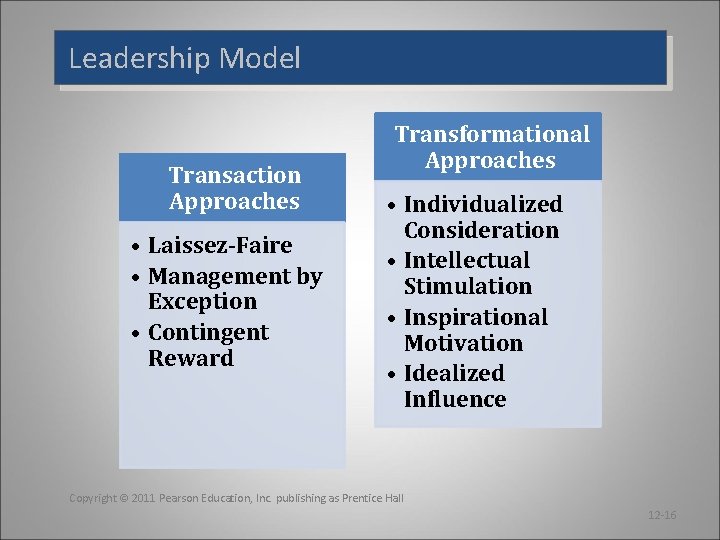
Leadership Model Transaction Approaches • Laissez-Faire • Management by Exception • Contingent Reward Transformational Approaches • Individualized Consideration • Intellectual Stimulation • Inspirational Motivation • Idealized Influence Copyright © 2011 Pearson Education, Inc. publishing as Prentice Hall 12 -16
Authentic Leaders • Authentic leaders know who they are, what they believe in and value, and act upon those values and beliefs. Ethics and Leadership • Leadership is not free from values. When we assess leadership, we must assess not just the goals themselves but also the means by which those goals are achieved. Copyright © 2011 Pearson Education, Inc. publishing as Prentice Hall 12 -17
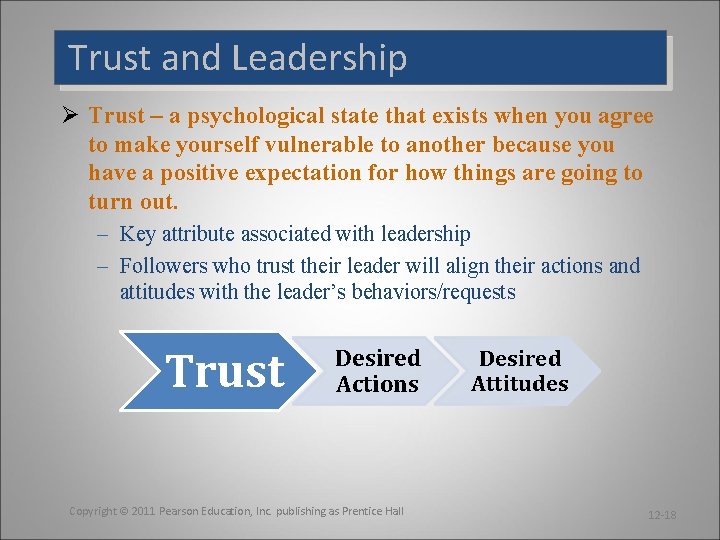
Trust and Leadership Ø Trust – a psychological state that exists when you agree to make yourself vulnerable to another because you have a positive expectation for how things are going to turn out. – Key attribute associated with leadership – Followers who trust their leader will align their actions and attitudes with the leader’s behaviors/requests Trust Desired Actions Copyright © 2011 Pearson Education, Inc. publishing as Prentice Hall Desired Attitudes 12 -18
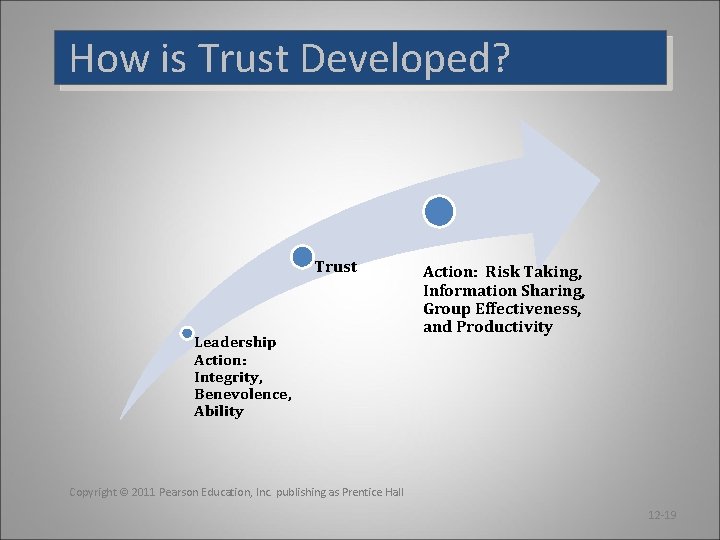
How is Trust Developed? Trust Leadership Action: Integrity, Benevolence, Ability Action: Risk Taking, Information Sharing, Group Effectiveness, and Productivity Copyright © 2011 Pearson Education, Inc. publishing as Prentice Hall 12 -19
- Slides: 20