
12 B Taking chances VOCABULARY UNUSUAL ACTIVITIES GRAMMAR
12 B Taking chances VOCABULARY: UNUSUAL ACTIVITIES GRAMMAR: SECONDITIONAL REVIEW: REPORTED SPEECH
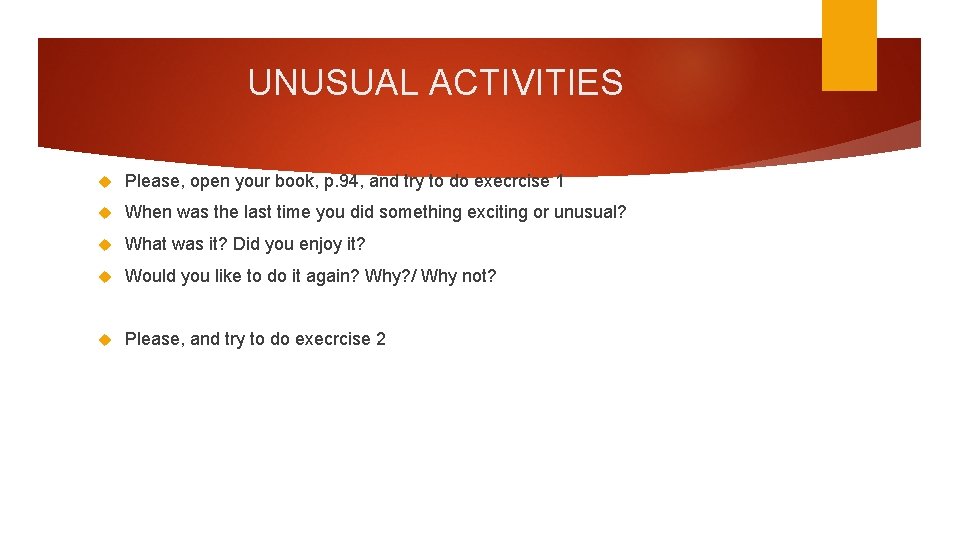
UNUSUAL ACTIVITIES Please, open your book, p. 94, and try to do execrcise 1 When was the last time you did something exciting or unusual? What was it? Did you enjoy it? Would you like to do it again? Why? / Why not? Please, and try to do execrcise 2
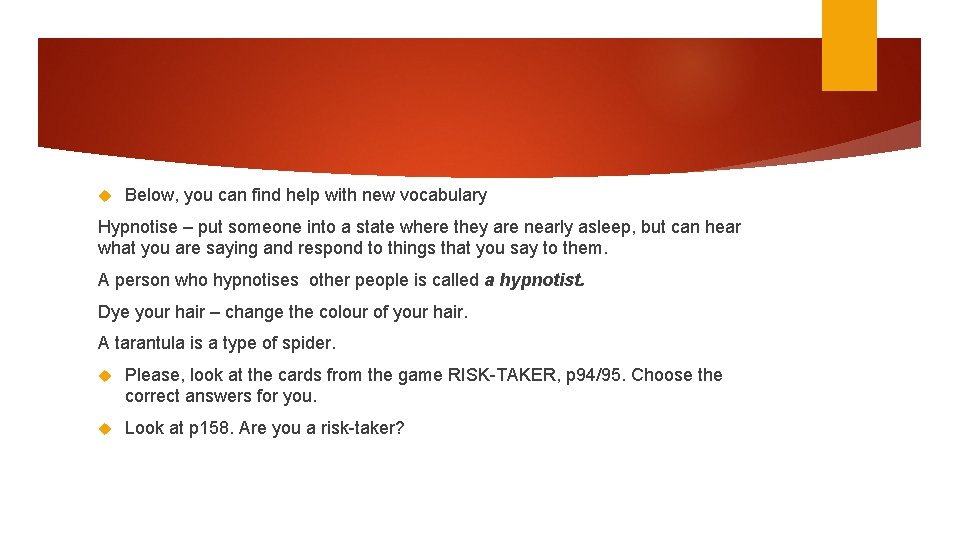
Below, you can find help with new vocabulary Hypnotise – put someone into a state where they are nearly asleep, but can hear what you are saying and respond to things that you say to them. A person who hypnotises other people is called a hypnotist. Dye your hair – change the colour of your hair. A tarantula is a type of spider. Please, look at the cards from the game RISK-TAKER, p 94/95. Choose the correct answers for you. Look at p 158. Are you a risk-taker?
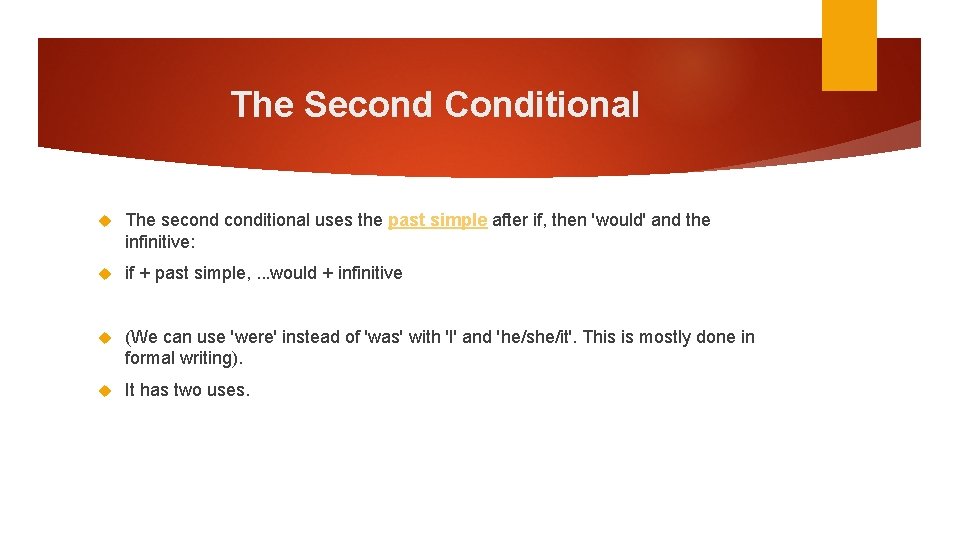
The Second Conditional The seconditional uses the past simple after if, then 'would' and the infinitive: if + past simple, . . . would + infinitive (We can use 'were' instead of 'was' with 'I' and 'he/she/it'. This is mostly done in formal writing). It has two uses.
First, we can use it to talk about things in the future that are probably not going to be true. Maybe I'm imagining some dream for example. If I won the lottery, I would buy a big house. (I probably won't win the lottery) If I met the Queen of England, I would say hello. She would travel all over the world if she were rich. She would pass the exam if she ever studied. (She never studies, so this won't happen)
Second, we can use it to talk about something in the present which is impossible, because it's not true. Is that clear? Have a look at the examples: If I had his number, I would call him. (I don't have his number now, so it's impossible for me to call him). If I were you, I wouldn't go out with that man.
How is this different from the first conditional? This kind of conditional sentence is different from the first conditional because this is a lot more unlikely. For example (seconditional): If I had enough money I would buy a house with twenty bedrooms and a swimming pool (I'm probably not going to have this much money, it's just a dream, not very real) But (first conditional): If I have enough money, I'll buy some new shoes (It's much more likely that I'll have enough money to buy some shoes)
To practise how to make the seconditional, please visit https: //www. perfect-english-grammar. com/second-conditional-exercise-1. html Please, do exercise 7, p 95. Answers: 2. had; ’d like to 3. could; ’d be 5. had; ’d buy 6. could; ’d change 4. wasn’t/weren’t; ’d be

Thank you for your attention! # hope to see you soon Lecturer Ivana Milačić ivana. milacic@udg. edu. me
- Slides: 9