
12 Accounting for Foreign Currency Transactions and Hedging
- Slides: 48
12 Accounting for Foreign Currency Transactions and Hedging Foreign Exchange Risk Advanced Accounting, Fifth Edition Slide 12 -1
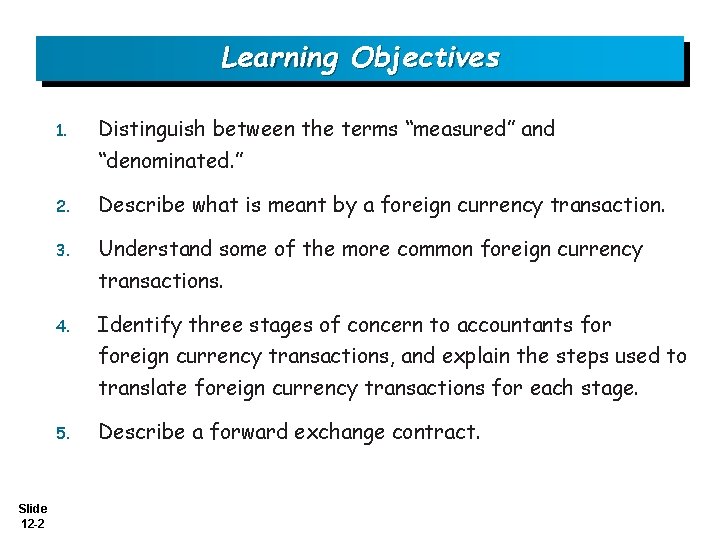
Learning Objectives 1. Distinguish between the terms “measured” and “denominated. ” 2. Describe what is meant by a foreign currency transaction. 3. Understand some of the more common foreign currency transactions. 4. Identify three stages of concern to accountants foreign currency transactions, and explain the steps used to translate foreign currency transactions for each stage. 5. Slide 12 -2 Describe a forward exchange contract.
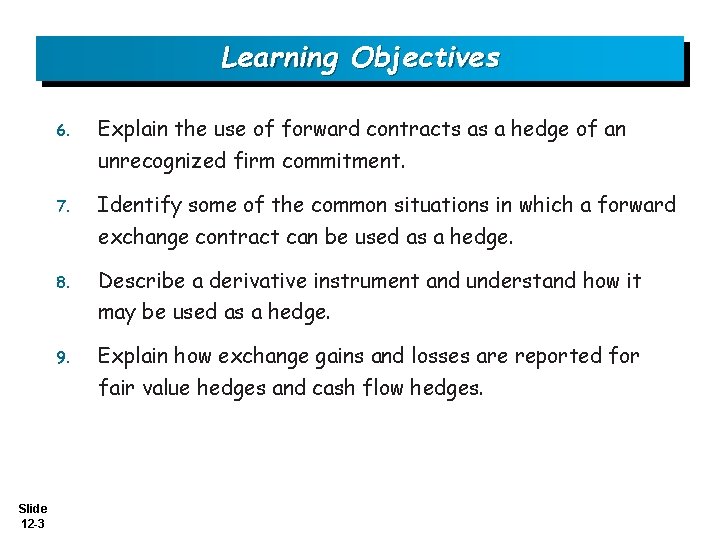
Learning Objectives 6. Explain the use of forward contracts as a hedge of an unrecognized firm commitment. 7. Identify some of the common situations in which a forward exchange contract can be used as a hedge. 8. Describe a derivative instrument and understand how it may be used as a hedge. 9. Explain how exchange gains and losses are reported for fair value hedges and cash flow hedges. Slide 12 -3
Foreign Currency Transactions Many U. S. companies engage in international activities such as: Exporting or importing goods, Establishing a foreign branch, or Holding an equity investment in a foreign company. Slide 12 -4
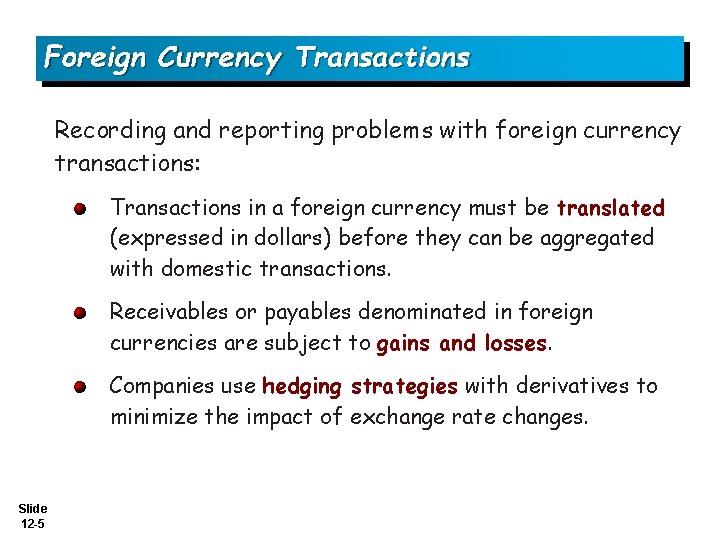
Foreign Currency Transactions Recording and reporting problems with foreign currency transactions: Transactions in a foreign currency must be translated (expressed in dollars) before they can be aggregated with domestic transactions. Receivables or payables denominated in foreign currencies are subject to gains and losses. Companies use hedging strategies with derivatives to minimize the impact of exchange rate changes. Slide 12 -5
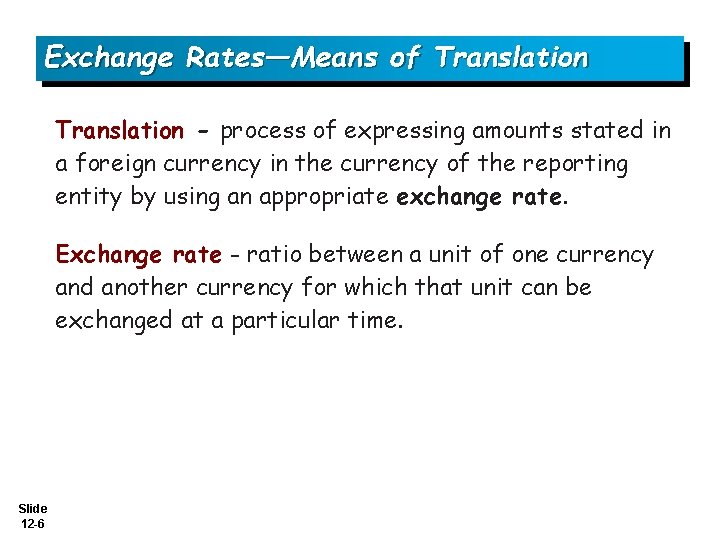
Exchange Rates—Means of Translation - process of expressing amounts stated in a foreign currency in the currency of the reporting entity by using an appropriate exchange rate. Exchange rate - ratio between a unit of one currency and another currency for which that unit can be exchanged at a particular time. Slide 12 -6
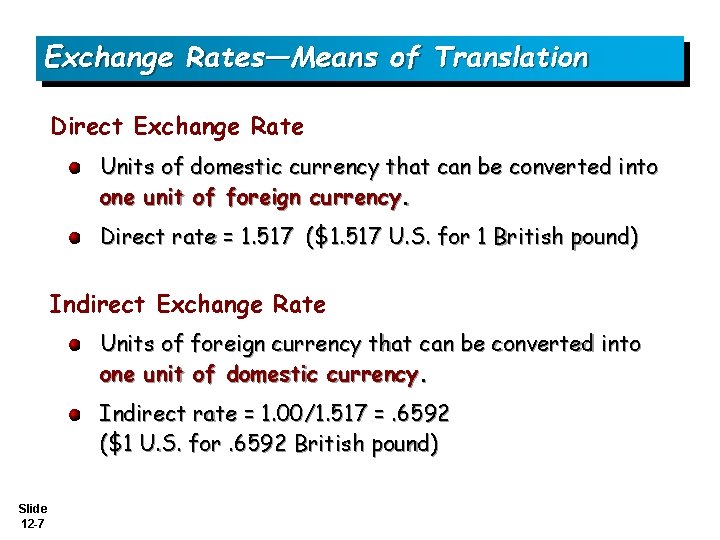
Exchange Rates—Means of Translation Direct Exchange Rate Units of domestic currency that can be converted into one unit of foreign currency. Direct rate = 1. 517 ($1. 517 U. S. for 1 British pound) Indirect Exchange Rate Units of foreign currency that can be converted into one unit of domestic currency. Indirect rate = 1. 00/1. 517 =. 6592 ($1 U. S. for. 6592 British pound) Slide 12 -7
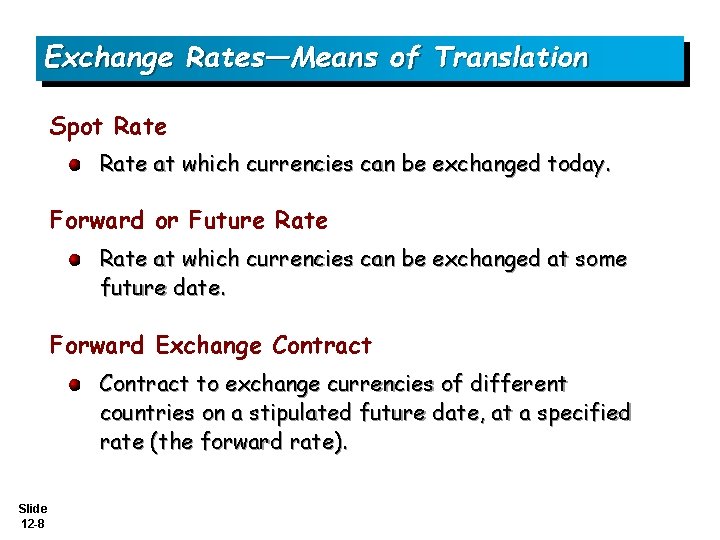
Exchange Rates—Means of Translation Spot Rate at which currencies can be exchanged today. Forward or Future Rate at which currencies can be exchanged at some future date. Forward Exchange Contract to exchange currencies of different countries on a stipulated future date, at a specified rate (the forward rate). Slide 12 -8
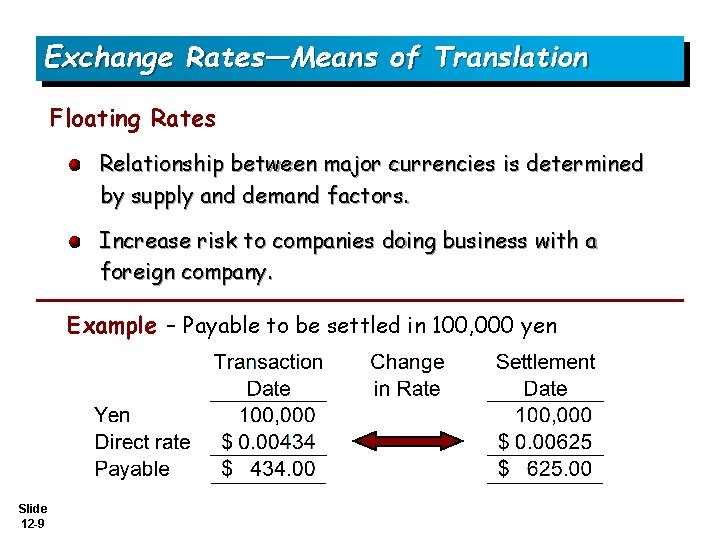
Exchange Rates—Means of Translation Floating Rates Relationship between major currencies is determined by supply and demand factors. Increase risk to companies doing business with a foreign company. Example – Payable to be settled in 100, 000 yen Slide 12 -9
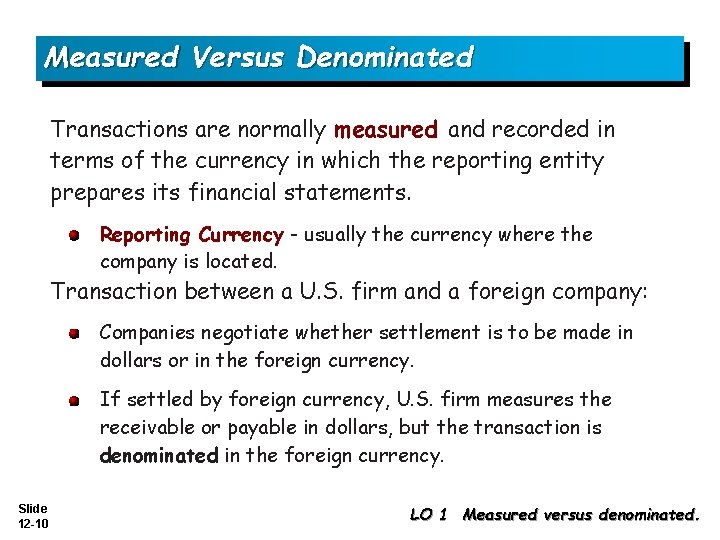
Measured Versus Denominated Transactions are normally measured and recorded in terms of the currency in which the reporting entity prepares its financial statements. Reporting Currency - usually the currency where the company is located. Transaction between a U. S. firm and a foreign company: Companies negotiate whether settlement is to be made in dollars or in the foreign currency. If settled by foreign currency, U. S. firm measures the receivable or payable in dollars, but the transaction is denominated in the foreign currency. Slide 12 -10 LO 1 Measured versus denominated.
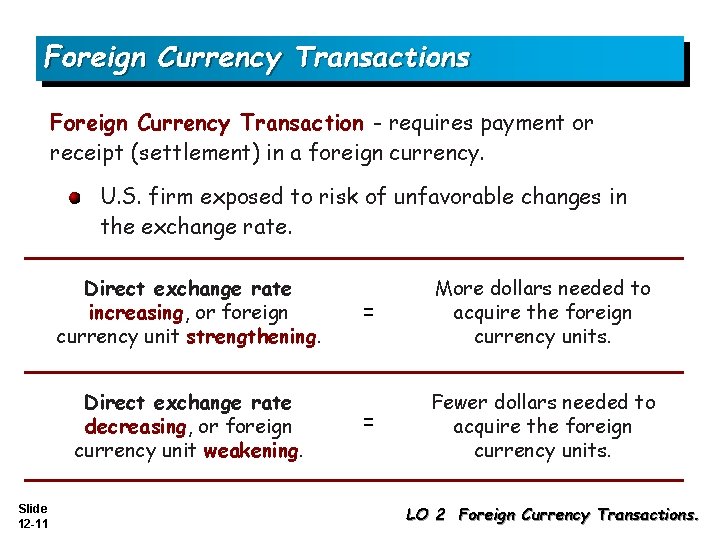
Foreign Currency Transactions Foreign Currency Transaction - requires payment or receipt (settlement) in a foreign currency. U. S. firm exposed to risk of unfavorable changes in the exchange rate. Direct exchange rate increasing, or foreign currency unit strengthening. Direct exchange rate decreasing, or foreign currency unit weakening. Slide 12 -11 = More dollars needed to acquire the foreign currency units. = Fewer dollars needed to acquire the foreign currency units. LO 2 Foreign Currency Transactions.
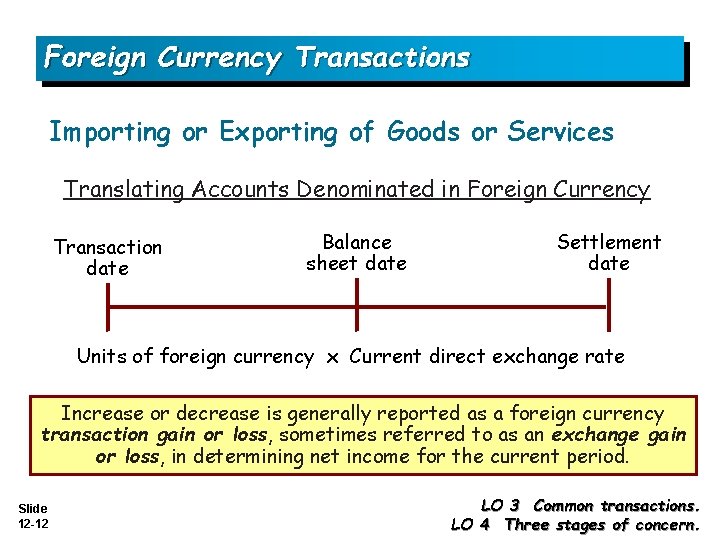
Foreign Currency Transactions Importing or Exporting of Goods or Services Translating Accounts Denominated in Foreign Currency Transaction date Balance sheet date Settlement date Units of foreign currency x Current direct exchange rate Increase or decrease is generally reported as a foreign currency transaction gain or loss, sometimes referred to as an exchange gain or loss, in determining net income for the current period. Slide 12 -12 LO 3 Common transactions. LO 4 Three stages of concern.
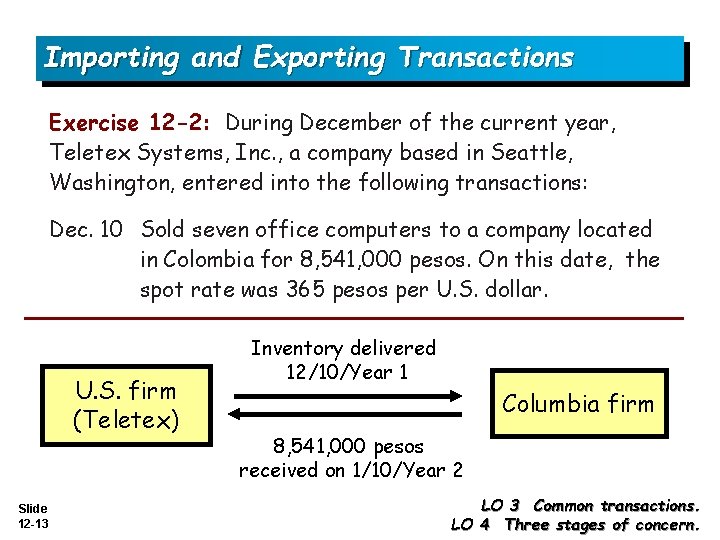
Importing and Exporting Transactions Exercise 12 -2: During December of the current year, Teletex Systems, Inc. , a company based in Seattle, Washington, entered into the following transactions: Dec. 10 Sold seven office computers to a company located in Colombia for 8, 541, 000 pesos. On this date, the spot rate was 365 pesos per U. S. dollar. U. S. firm (Teletex) Slide 12 -13 Inventory delivered 12/10/Year 1 Columbia firm 8, 541, 000 pesos received on 1/10/Year 2 LO 3 Common transactions. LO 4 Three stages of concern.
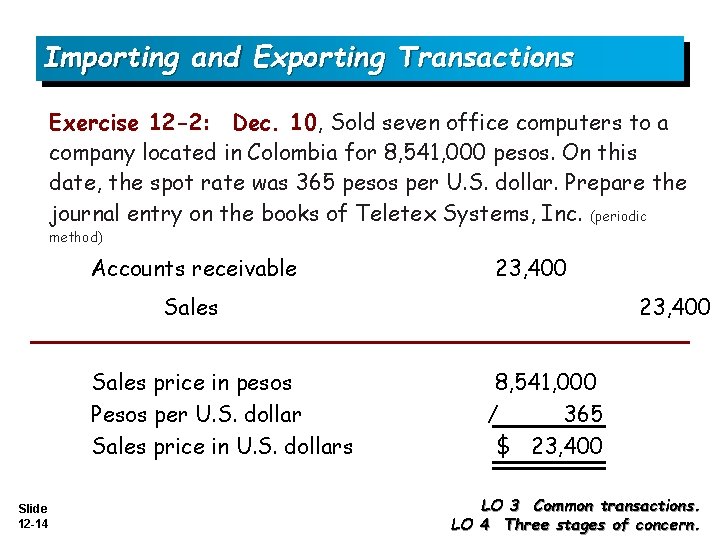
Importing and Exporting Transactions Exercise 12 -2: Dec. 10, Sold seven office computers to a company located in Colombia for 8, 541, 000 pesos. On this date, the spot rate was 365 pesos per U. S. dollar. Prepare the journal entry on the books of Teletex Systems, Inc. (periodic method) Accounts receivable 23, 400 Sales price in pesos Pesos per U. S. dollar Sales price in U. S. dollars Slide 12 -14 23, 400 8, 541, 000 / 365 $ 23, 400 LO 3 Common transactions. LO 4 Three stages of concern.
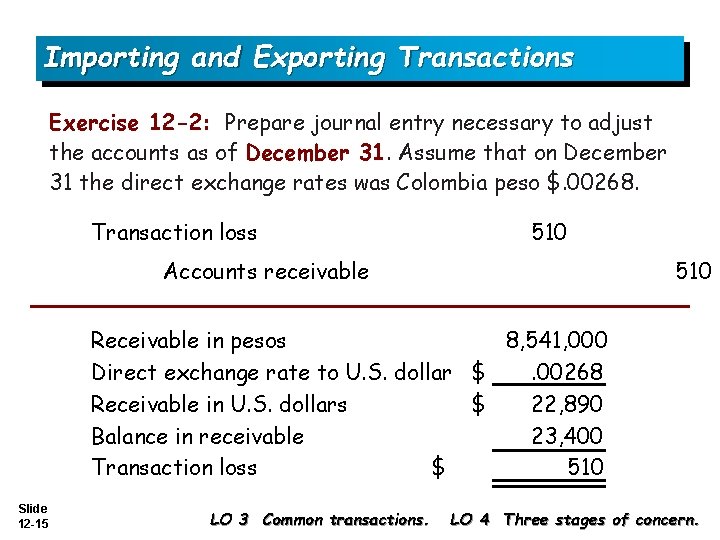
Importing and Exporting Transactions Exercise 12 -2: Prepare journal entry necessary to adjust the accounts as of December 31. Assume that on December 31 the direct exchange rates was Colombia peso $. 00268. Transaction loss 510 Accounts receivable 510 Receivable in pesos 8, 541, 000 Direct exchange rate to U. S. dollar $. 00268 Receivable in U. S. dollars $ 22, 890 Balance in receivable 23, 400 Transaction loss $ 510 Slide 12 -15 LO 3 Common transactions. LO 4 Three stages of concern.
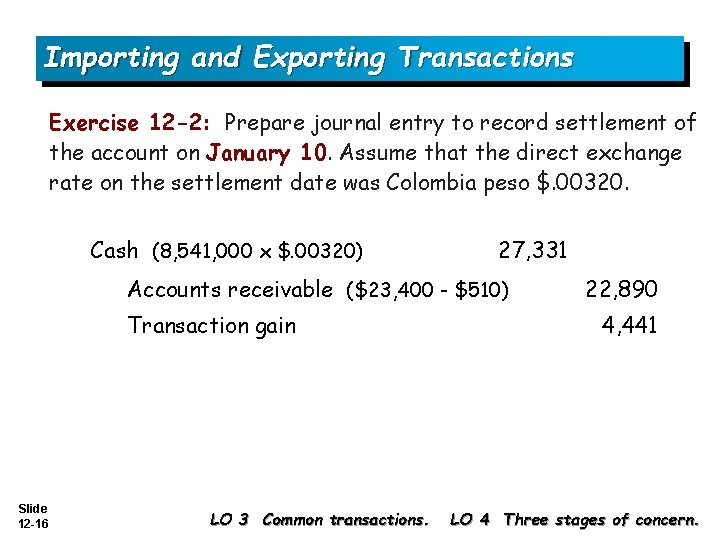
Importing and Exporting Transactions Exercise 12 -2: Prepare journal entry to record settlement of the account on January 10. Assume that the direct exchange rate on the settlement date was Colombia peso $. 00320. Cash (8, 541, 000 x $. 00320) 27, 331 Accounts receivable ($23, 400 - $510) Transaction gain Slide 12 -16 LO 3 Common transactions. 22, 890 4, 441 LO 4 Three stages of concern.
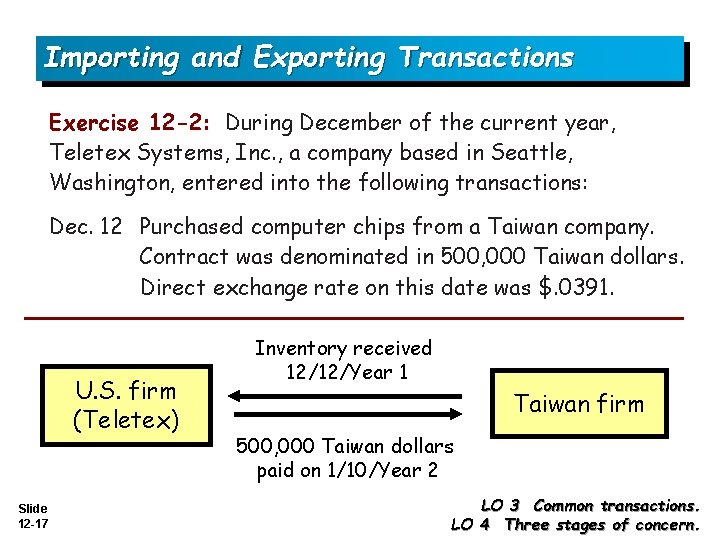
Importing and Exporting Transactions Exercise 12 -2: During December of the current year, Teletex Systems, Inc. , a company based in Seattle, Washington, entered into the following transactions: Dec. 12 Purchased computer chips from a Taiwan company. Contract was denominated in 500, 000 Taiwan dollars. Direct exchange rate on this date was $. 0391. U. S. firm (Teletex) Slide 12 -17 Inventory received 12/12/Year 1 Taiwan firm 500, 000 Taiwan dollars paid on 1/10/Year 2 LO 3 Common transactions. LO 4 Three stages of concern.
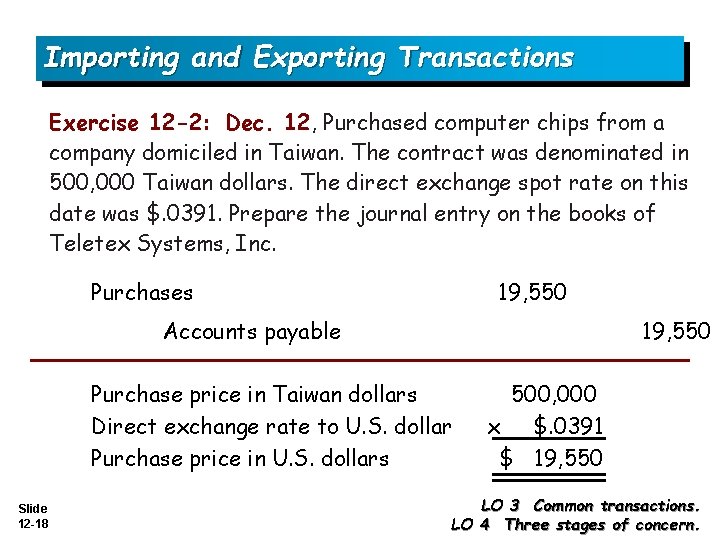
Importing and Exporting Transactions Exercise 12 -2: Dec. 12, Purchased computer chips from a company domiciled in Taiwan. The contract was denominated in 500, 000 Taiwan dollars. The direct exchange spot rate on this date was $. 0391. Prepare the journal entry on the books of Teletex Systems, Inc. Purchases 19, 550 Accounts payable 19, 550 Purchase price in Taiwan dollars Direct exchange rate to U. S. dollar Purchase price in U. S. dollars Slide 12 -18 500, 000 x $. 0391 $ 19, 550 LO 3 Common transactions. LO 4 Three stages of concern.
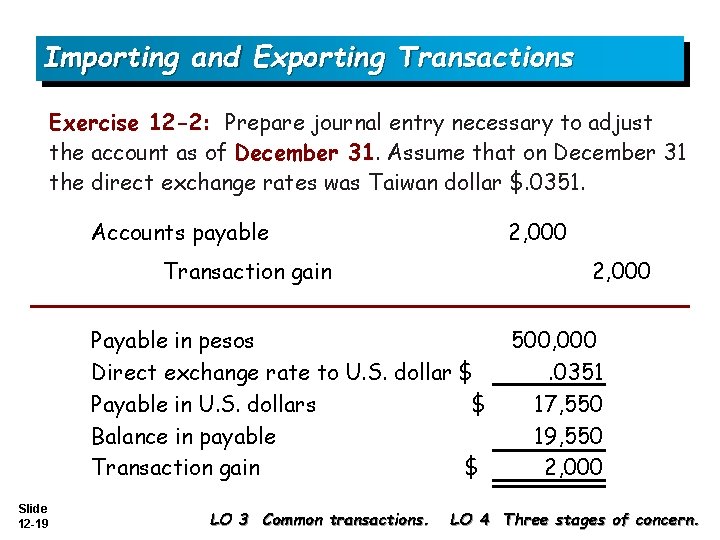
Importing and Exporting Transactions Exercise 12 -2: Prepare journal entry necessary to adjust the account as of December 31. Assume that on December 31 the direct exchange rates was Taiwan dollar $. 0351. Accounts payable 2, 000 Transaction gain 2, 000 Payable in pesos Direct exchange rate to U. S. dollar $ Payable in U. S. dollars $ Balance in payable Transaction gain $ Slide 12 -19 LO 3 Common transactions. 500, 000. 0351 17, 550 19, 550 2, 000 LO 4 Three stages of concern.
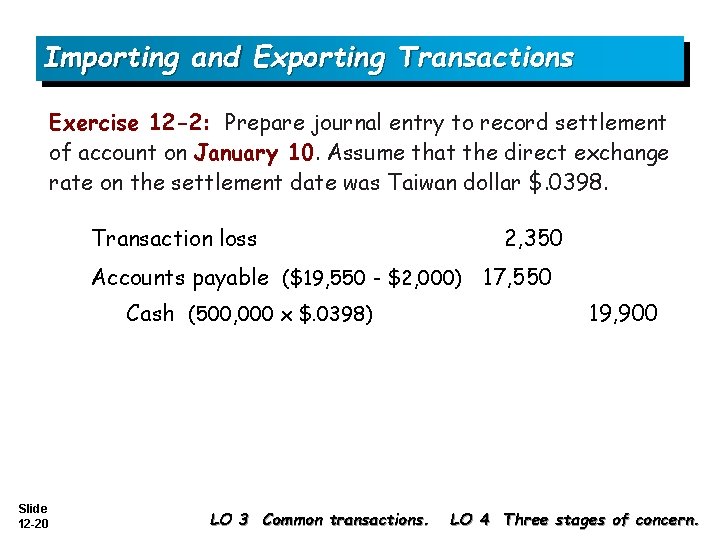
Importing and Exporting Transactions Exercise 12 -2: Prepare journal entry to record settlement of account on January 10. Assume that the direct exchange rate on the settlement date was Taiwan dollar $. 0398. Transaction loss 2, 350 Accounts payable ($19, 550 - $2, 000) 17, 550 Cash (500, 000 x $. 0398) Slide 12 -20 LO 3 Common transactions. 19, 900 LO 4 Three stages of concern.
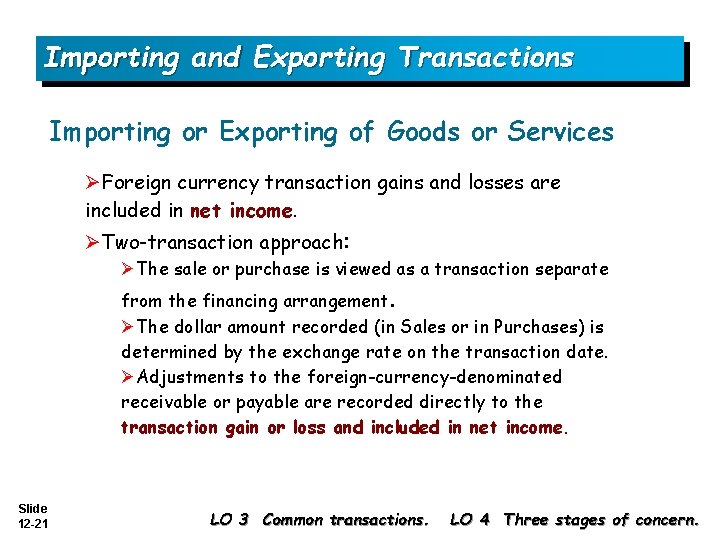
Importing and Exporting Transactions Importing or Exporting of Goods or Services ØForeign currency transaction gains and losses are included in net income. ØTwo-transaction approach: ØThe sale or purchase is viewed as a transaction separate from the financing arrangement. ØThe dollar amount recorded (in Sales or in Purchases) is determined by the exchange rate on the transaction date. ØAdjustments to the foreign-currency-denominated receivable or payable are recorded directly to the transaction gain or loss and included in net income. Slide 12 -21 LO 3 Common transactions. LO 4 Three stages of concern.
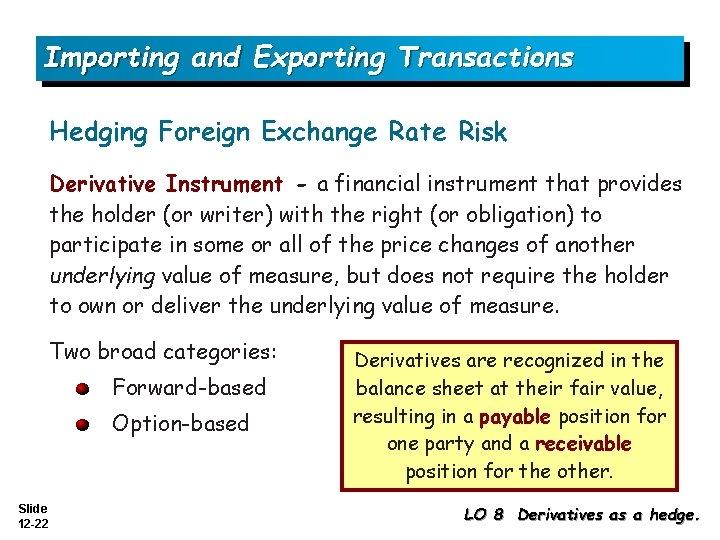
Importing and Exporting Transactions Hedging Foreign Exchange Rate Risk Derivative Instrument - a financial instrument that provides the holder (or writer) with the right (or obligation) to participate in some or all of the price changes of another underlying value of measure, but does not require the holder to own or deliver the underlying value of measure. Two broad categories: Forward-based Option-based Slide 12 -22 Derivatives are recognized in the balance sheet at their fair value, resulting in a payable position for one party and a receivable position for the other. LO 8 Derivatives as a hedge.
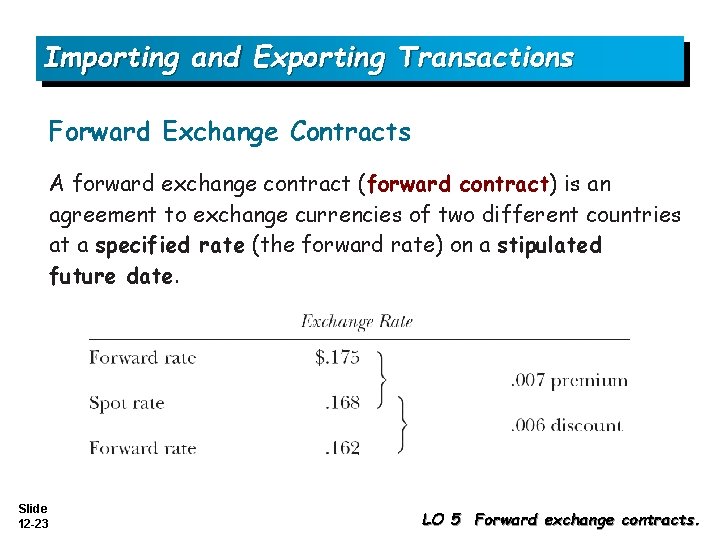
Importing and Exporting Transactions Forward Exchange Contracts A forward exchange contract (forward contract) is an agreement to exchange currencies of two different countries at a specified rate (the forward rate) on a stipulated future date. Slide 12 -23 LO 5 Forward exchange contracts.
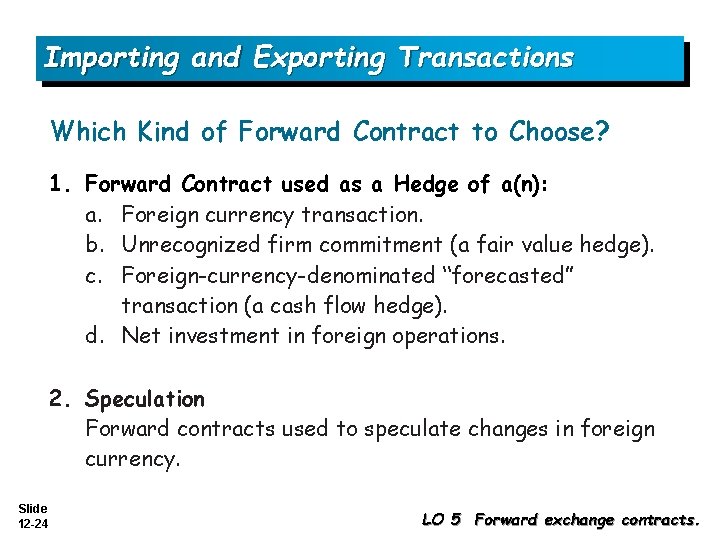
Importing and Exporting Transactions Which Kind of Forward Contract to Choose? 1. Forward Contract used as a Hedge of a(n): a. Foreign currency transaction. b. Unrecognized firm commitment (a fair value hedge). c. Foreign-currency-denominated “forecasted” transaction (a cash flow hedge). d. Net investment in foreign operations. 2. Speculation Forward contracts used to speculate changes in foreign currency. Slide 12 -24 LO 5 Forward exchange contracts.
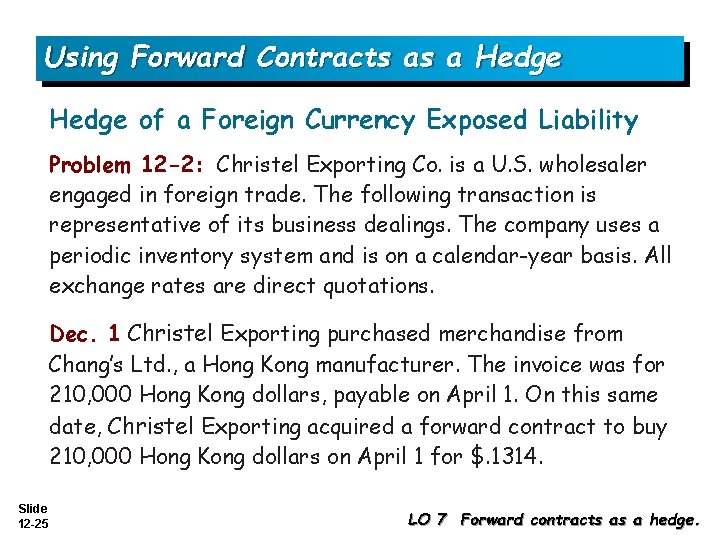
Using Forward Contracts as a Hedge of a Foreign Currency Exposed Liability Problem 12 -2: Christel Exporting Co. is a U. S. wholesaler engaged in foreign trade. The following transaction is representative of its business dealings. The company uses a periodic inventory system and is on a calendar-year basis. All exchange rates are direct quotations. Dec. 1 Christel Exporting purchased merchandise from Chang’s Ltd. , a Hong Kong manufacturer. The invoice was for 210, 000 Hong Kong dollars, payable on April 1. On this same date, Christel Exporting acquired a forward contract to buy 210, 000 Hong Kong dollars on April 1 for $. 1314. Slide 12 -25 LO 7 Forward contracts as a hedge.
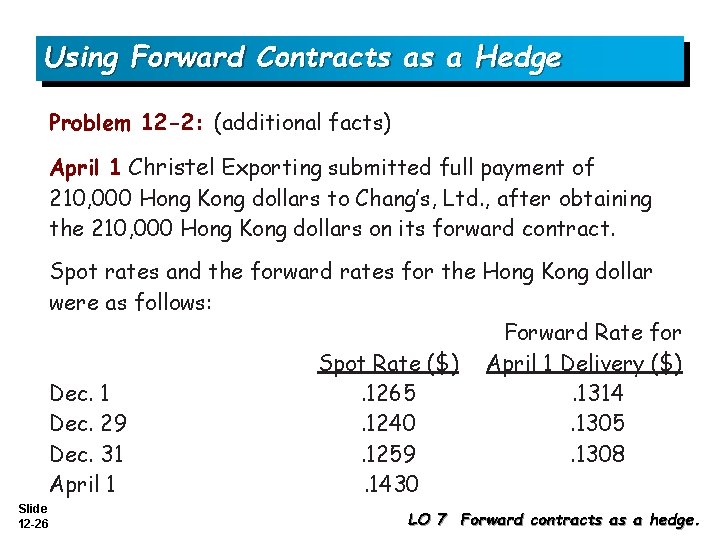
Using Forward Contracts as a Hedge Problem 12 -2: (additional facts) April 1 Christel Exporting submitted full payment of 210, 000 Hong Kong dollars to Chang’s, Ltd. , after obtaining the 210, 000 Hong Kong dollars on its forward contract. Spot rates and the forward rates for the Hong Kong dollar were as follows: Forward Rate for Spot Rate ($) April 1 Delivery ($) Dec. 1. 1265. 1314 Dec. 29. 1240. 1305 Dec. 31. 1259. 1308 April 1. 1430 Slide 12 -26 LO 7 Forward contracts as a hedge.
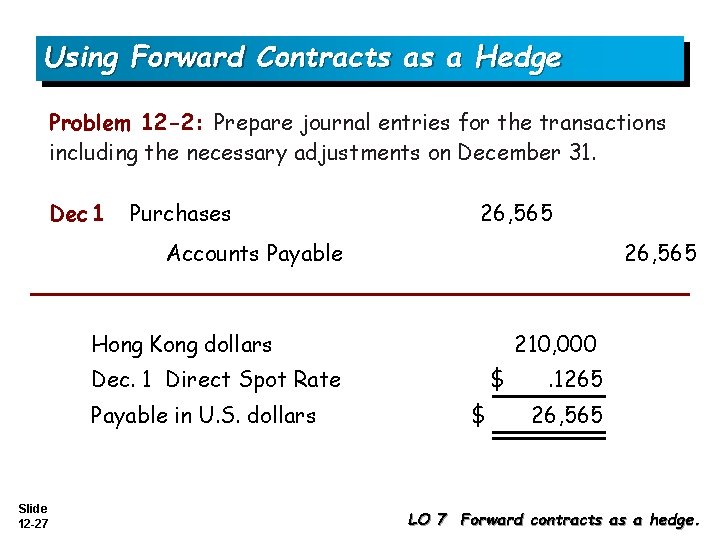
Using Forward Contracts as a Hedge Problem 12 -2: Prepare journal entries for the transactions including the necessary adjustments on December 31. Dec 1 Purchases 26, 565 Accounts Payable 26, 565 Hong Kong dollars 210, 000 Dec. 1 Direct Spot Rate Payable in U. S. dollars Slide 12 -27 $ $ . 1265 26, 565 LO 7 Forward contracts as a hedge.
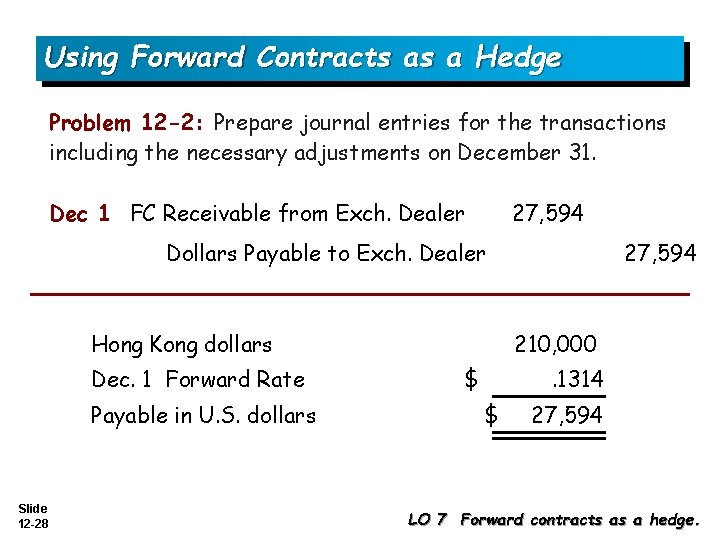
Using Forward Contracts as a Hedge Problem 12 -2: Prepare journal entries for the transactions including the necessary adjustments on December 31. Dec 1 FC Receivable from Exch. Dealer 27, 594 Dollars Payable to Exch. Dealer Hong Kong dollars Dec. 1 Forward Rate Payable in U. S. dollars Slide 12 -28 27, 594 210, 000 $ . 1314 $ 27, 594 LO 7 Forward contracts as a hedge.
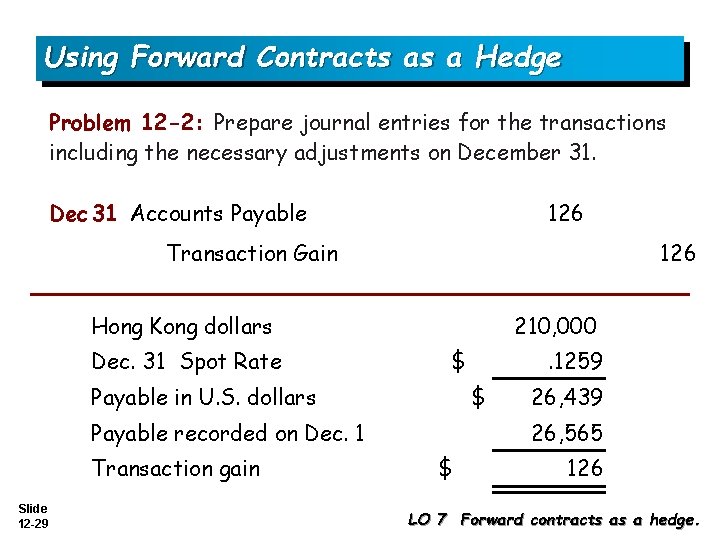
Using Forward Contracts as a Hedge Problem 12 -2: Prepare journal entries for the transactions including the necessary adjustments on December 31. Dec 31 Accounts Payable 126 Transaction Gain 126 Hong Kong dollars Dec. 31 Spot Rate 210, 000 $ Payable in U. S. dollars $ Payable recorded on Dec. 1 Transaction gain Slide 12 -29 . 1259 26, 439 26, 565 $ 126 LO 7 Forward contracts as a hedge.
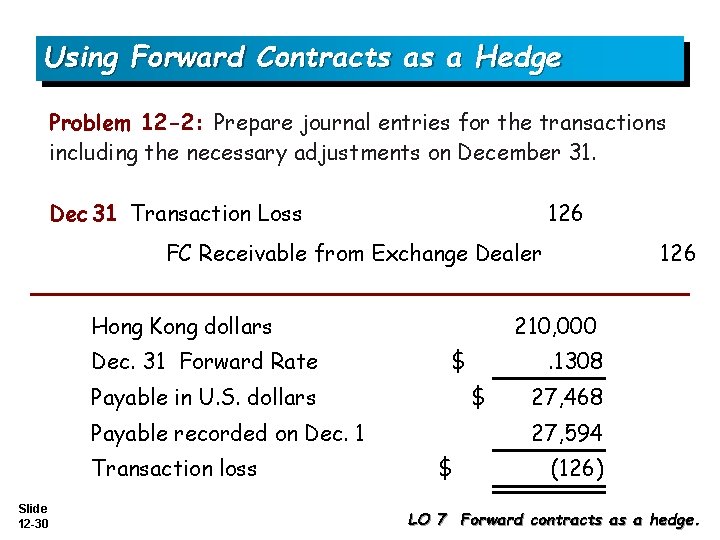
Using Forward Contracts as a Hedge Problem 12 -2: Prepare journal entries for the transactions including the necessary adjustments on December 31. Dec 31 Transaction Loss 126 FC Receivable from Exchange Dealer Hong Kong dollars Dec. 31 Forward Rate 210, 000 $ Payable in U. S. dollars Slide 12 -30 . 1308 $ Payable recorded on Dec. 1 Transaction loss 126 27, 468 27, 594 $ (126) LO 7 Forward contracts as a hedge.
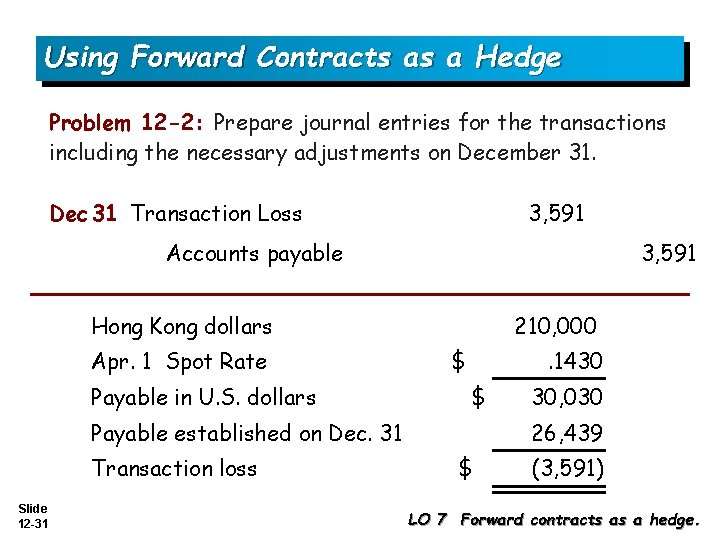
Using Forward Contracts as a Hedge Problem 12 -2: Prepare journal entries for the transactions including the necessary adjustments on December 31. Dec 31 Transaction Loss 3, 591 Accounts payable 3, 591 Hong Kong dollars Apr. 1 Spot Rate Payable in U. S. dollars 210, 000 $ . 1430 $ Payable established on Dec. 31 Transaction loss Slide 12 -31 30, 030 26, 439 $ (3, 591) LO 7 Forward contracts as a hedge.
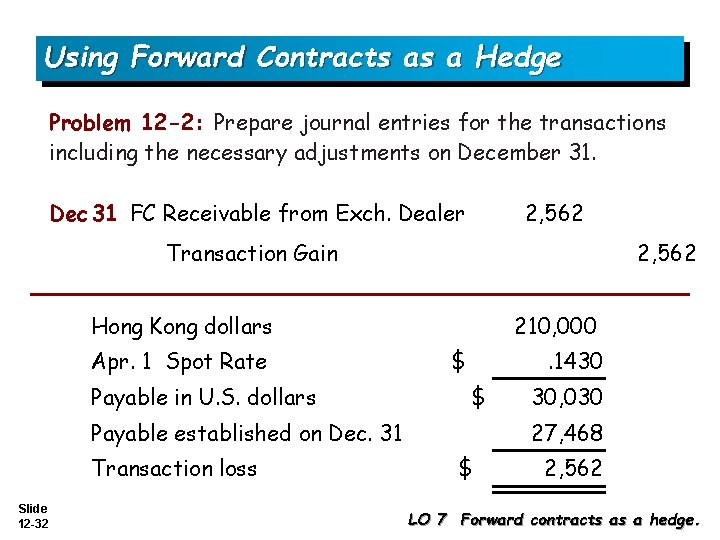
Using Forward Contracts as a Hedge Problem 12 -2: Prepare journal entries for the transactions including the necessary adjustments on December 31. Dec 31 FC Receivable from Exch. Dealer 2, 562 Transaction Gain 2, 562 Hong Kong dollars Apr. 1 Spot Rate Payable in U. S. dollars 210, 000 $ . 1430 $ Payable established on Dec. 31 Transaction loss Slide 12 -32 30, 030 27, 468 $ 2, 562 LO 7 Forward contracts as a hedge.
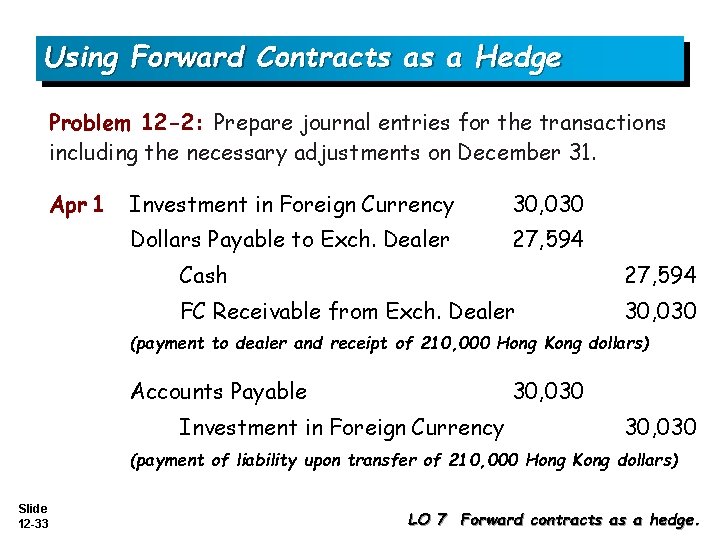
Using Forward Contracts as a Hedge Problem 12 -2: Prepare journal entries for the transactions including the necessary adjustments on December 31. Apr 1 Investment in Foreign Currency 30, 030 Dollars Payable to Exch. Dealer 27, 594 Cash 27, 594 FC Receivable from Exch. Dealer 30, 030 (payment to dealer and receipt of 210, 000 Hong Kong dollars) Accounts Payable 30, 030 Investment in Foreign Currency 30, 030 (payment of liability upon transfer of 210, 000 Hong Kong dollars) Slide 12 -33 LO 7 Forward contracts as a hedge.
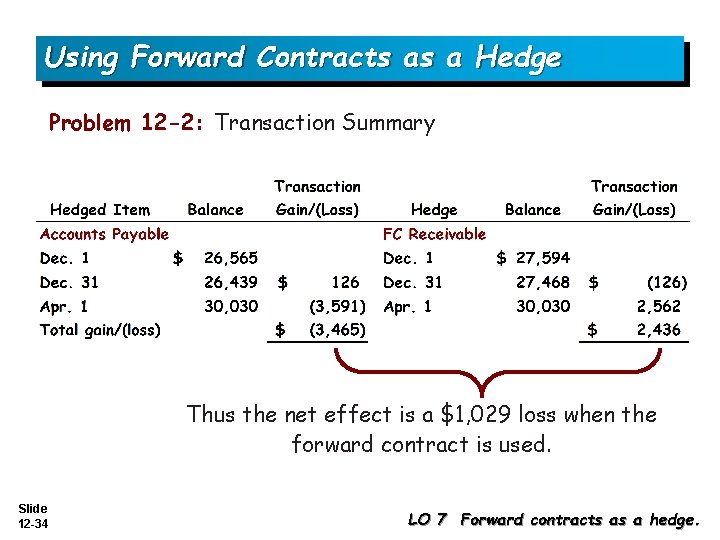
Using Forward Contracts as a Hedge Problem 12 -2: Transaction Summary Thus the net effect is a $1, 029 loss when the forward contract is used. Slide 12 -34 LO 7 Forward contracts as a hedge.
Using Forward Contracts as a Hedge of a Foreign Currency Exposed Asset Accounting for a forward contract entered into as a hedge of an exposed receivable position is similar to an exposed liability position. Because the U. S. firm will be receiving foreign currency in settlement of the exposed receivable balance, it will enter into a forward contract to sell foreign currency for U. S. dollars. Slide 12 -35 LO 7 Forward contracts as a hedge.
Using Forward Contracts as a Hedge Fair Value Hedge—Hedging an Unrecognized Foreign Currency Commitment Ø A U. S. firm, at a date earlier than the transaction date, may make a commitment to a foreign company to buy or sell goods at a price established in foreign currency. Ø Changes in the exchange rate between the commitment date and transaction date would be reflected in the cost or sales price of the asset. Ø The U. S. firm may enter a forward contract to hedge its commitment. Slide 12 -36 LO 7 Forward contracts as a hedge.
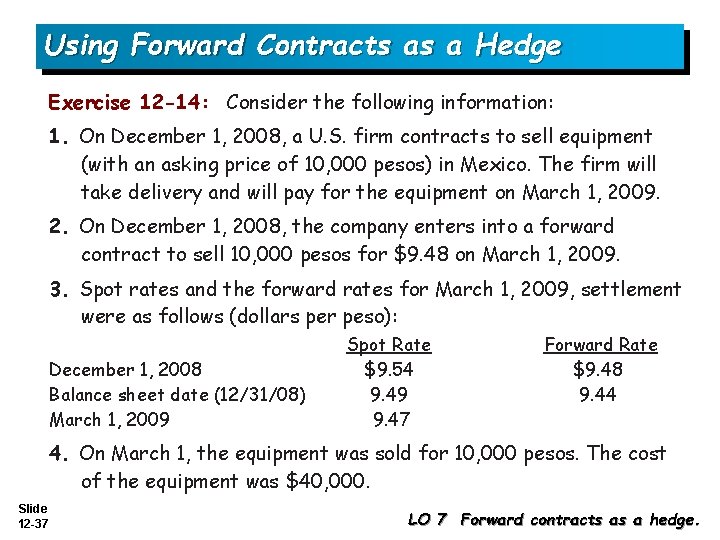
Using Forward Contracts as a Hedge Exercise 12 -14: Consider the following information: 1. On December 1, 2008, a U. S. firm contracts to sell equipment (with an asking price of 10, 000 pesos) in Mexico. The firm will take delivery and will pay for the equipment on March 1, 2009. 2. On December 1, 2008, the company enters into a forward contract to sell 10, 000 pesos for $9. 48 on March 1, 2009. 3. Spot rates and the forward rates for March 1, 2009, settlement were as follows (dollars per peso): December 1, 2008 Balance sheet date (12/31/08) March 1, 2009 Spot Rate $9. 54 9. 49 9. 47 Forward Rate $9. 48 9. 44 4. On March 1, the equipment was sold for 10, 000 pesos. The cost of the equipment was $40, 000. Slide 12 -37 LO 7 Forward contracts as a hedge.
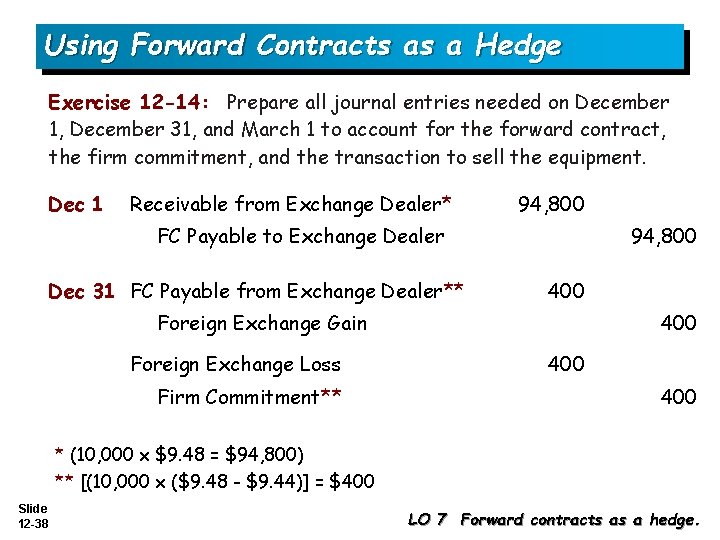
Using Forward Contracts as a Hedge Exercise 12 -14: Prepare all journal entries needed on December 1, December 31, and March 1 to account for the forward contract, the firm commitment, and the transaction to sell the equipment. Dec 1 Receivable from Exchange Dealer* 94, 800 FC Payable to Exchange Dealer Dec 31 FC Payable from Exchange Dealer** 94, 800 400 Foreign Exchange Gain Foreign Exchange Loss Firm Commitment** 400 400 * (10, 000 x $9. 48 = $94, 800) ** [(10, 000 x ($9. 48 - $9. 44)] = $400 Slide 12 -38 LO 7 Forward contracts as a hedge.
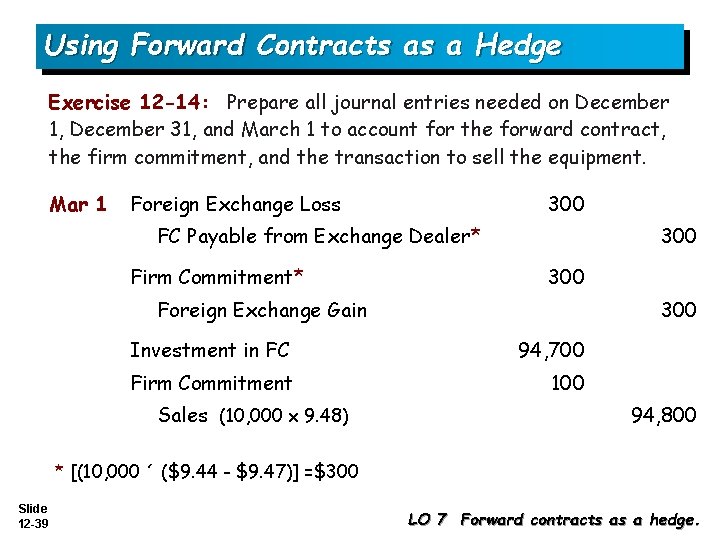
Using Forward Contracts as a Hedge Exercise 12 -14: Prepare all journal entries needed on December 1, December 31, and March 1 to account for the forward contract, the firm commitment, and the transaction to sell the equipment. Mar 1 Foreign Exchange Loss 300 FC Payable from Exchange Dealer* Firm Commitment* 300 Foreign Exchange Gain 300 Investment in FC 94, 700 Firm Commitment 100 Sales (10, 000 x 9. 48) 94, 800 * [(10, 000 ´ ($9. 44 - $9. 47)] =$300 Slide 12 -39 LO 7 Forward contracts as a hedge.
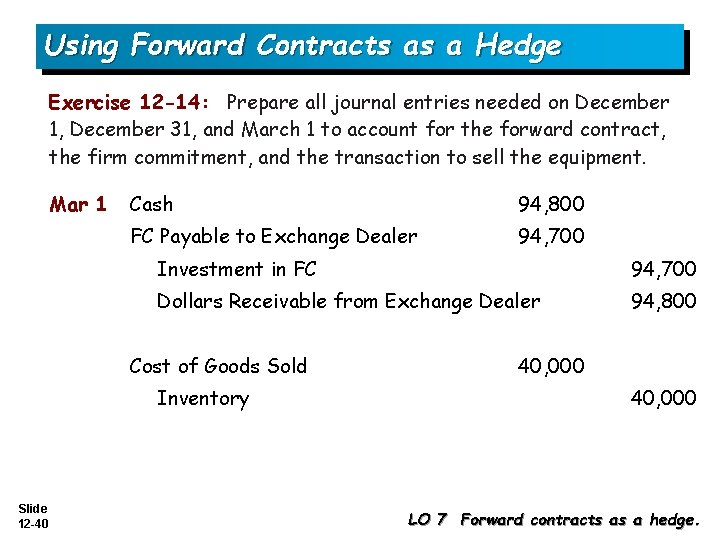
Using Forward Contracts as a Hedge Exercise 12 -14: Prepare all journal entries needed on December 1, December 31, and March 1 to account for the forward contract, the firm commitment, and the transaction to sell the equipment. Mar 1 Cash 94, 800 FC Payable to Exchange Dealer 94, 700 Investment in FC 94, 700 Dollars Receivable from Exchange Dealer 94, 800 Cost of Goods Sold Inventory Slide 12 -40 40, 000 LO 7 Forward contracts as a hedge.
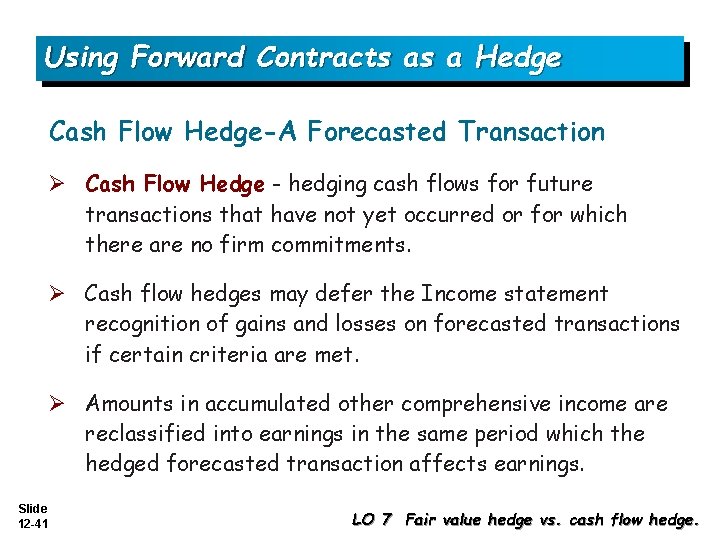
Using Forward Contracts as a Hedge Cash Flow Hedge-A Forecasted Transaction Ø Cash Flow Hedge - hedging cash flows for future transactions that have not yet occurred or for which there are no firm commitments. Ø Cash flow hedges may defer the Income statement recognition of gains and losses on forecasted transactions if certain criteria are met. Ø Amounts in accumulated other comprehensive income are reclassified into earnings in the same period which the hedged forecasted transaction affects earnings. Slide 12 -41 LO 7 Fair value hedge vs. cash flow hedge.
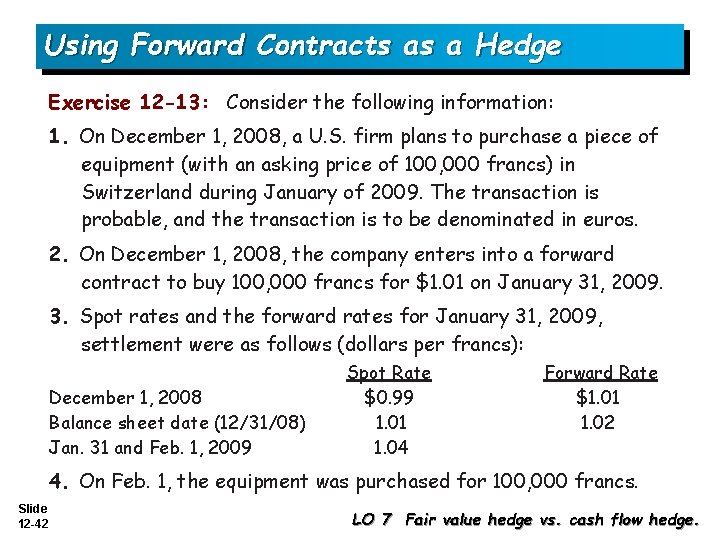
Using Forward Contracts as a Hedge Exercise 12 -13: Consider the following information: 1. On December 1, 2008, a U. S. firm plans to purchase a piece of equipment (with an asking price of 100, 000 francs) in Switzerland during January of 2009. The transaction is probable, and the transaction is to be denominated in euros. 2. On December 1, 2008, the company enters into a forward contract to buy 100, 000 francs for $1. 01 on January 31, 2009. 3. Spot rates and the forward rates for January 31, 2009, settlement were as follows (dollars per francs): December 1, 2008 Balance sheet date (12/31/08) Jan. 31 and Feb. 1, 2009 Spot Rate $0. 99 1. 01 1. 04 Forward Rate $1. 01 1. 02 4. On Feb. 1, the equipment was purchased for 100, 000 francs. Slide 12 -42 LO 7 Fair value hedge vs. cash flow hedge.
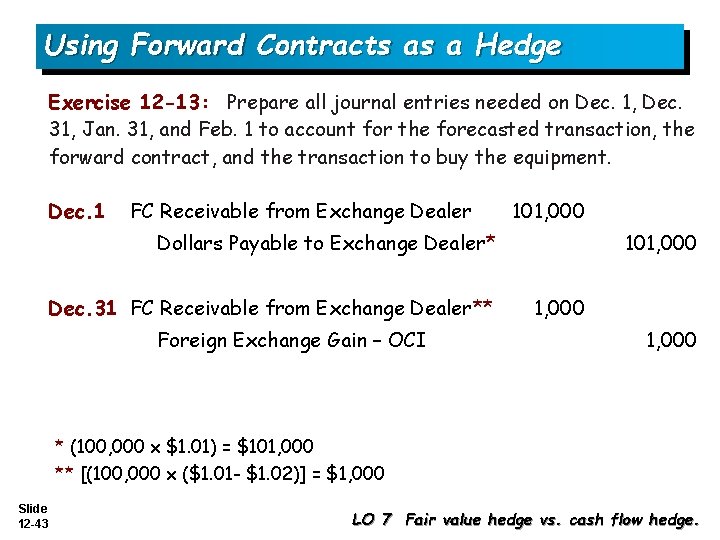
Using Forward Contracts as a Hedge Exercise 12 -13: Prepare all journal entries needed on Dec. 1, Dec. 31, Jan. 31, and Feb. 1 to account for the forecasted transaction, the forward contract, and the transaction to buy the equipment. Dec. 1 FC Receivable from Exchange Dealer 101, 000 Dollars Payable to Exchange Dealer* Dec. 31 FC Receivable from Exchange Dealer** Foreign Exchange Gain – OCI 101, 000 * (100, 000 x $1. 01) = $101, 000 ** [(100, 000 x ($1. 01 - $1. 02)] = $1, 000 Slide 12 -43 LO 7 Fair value hedge vs. cash flow hedge.
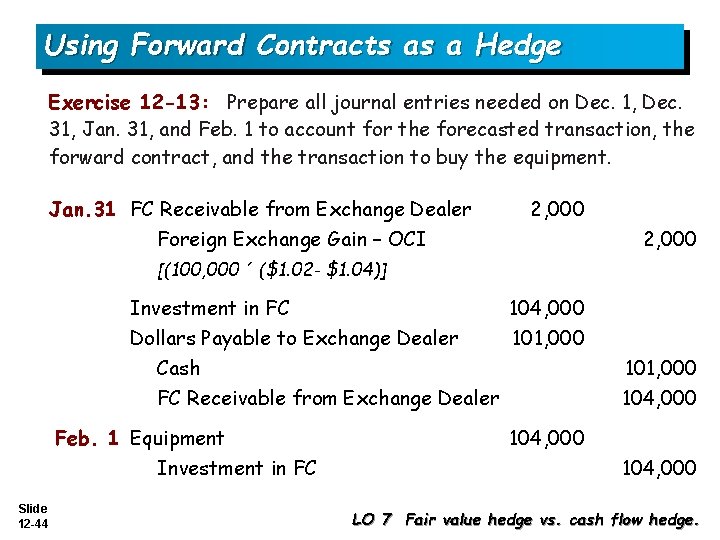
Using Forward Contracts as a Hedge Exercise 12 -13: Prepare all journal entries needed on Dec. 1, Dec. 31, Jan. 31, and Feb. 1 to account for the forecasted transaction, the forward contract, and the transaction to buy the equipment. Jan. 31 FC Receivable from Exchange Dealer Foreign Exchange Gain – OCI 2, 000 [(100, 000 ´ ($1. 02 - $1. 04)] Investment in FC 104, 000 Dollars Payable to Exchange Dealer 101, 000 Cash FC Receivable from Exchange Dealer Feb. 1 Equipment Investment in FC Slide 12 -44 101, 000 104, 000 LO 7 Fair value hedge vs. cash flow hedge.
Using Forward Contracts as a Hedge Economic Hedge of a Net Investment in a Foreign Entity Ø A U. S. firm may enter into a foreign currency transaction or a nonderivative financial instrument in an effort to minimize or offset the effects of currency fluctuations on an equity investment in a foreign company. Ø The gain or loss on the hedging instrument is reported in the same manner as the translation adjustment, that is, reported in the cumulative translation adjustment section under comprehensive income. FASB ASC paragraph 81535 -35 -1 Slide 12 -45 LO 7 Fair value hedge vs. cash flow hedge.
Using Forward Contracts as a Hedge Forward Contracts Acquired to Speculate in the Movement of Foreign Currencies A forward contract may be acquired for speculative purposes in anticipation of realizing a gain. Disclosure Requirements of the Various Hedges FASB ASC Section 815 -20 -50 specifies certain minimal disclosures for derivative instruments and nonderivative instruments designated as qualifying hedging instruments. Slide 12 -46 LO 7 Fair value hedge vs. cash flow hedge. LO 3 Common transactions.
Using Forward Contracts as a Hedge Using Options to Hedge Foreign Currency Changes Ø Options, give the holder the advantage of right but not the obligation to buy or sell the currency. Ø If the exchange rate changes in a negative manner, the firm can simply let the option lapse without a loss. Slide 12 -47 LO 8 Derivatives used as a hedge.
Copyright © 2011 John Wiley & Sons, Inc. All rights reserved. Reproduction or translation of this work beyond that permitted in Section 117 of the 1976 United States Copyright Act without the express written permission of the copyright owner is unlawful. Request for further information should be addressed to the Permissions Department, John Wiley & Sons, Inc. The purchaser may make back-up copies for his/her own use only and not for distribution or resale. The Publisher assumes no responsibility for errors, omissions, or damages, caused by the use of these programs or from the use of the information contained herein. Slide 12 -48