
12 7 Exploring Similar Solids Hubarth Geometry Two
12. 7 Exploring Similar Solids Hubarth Geometry
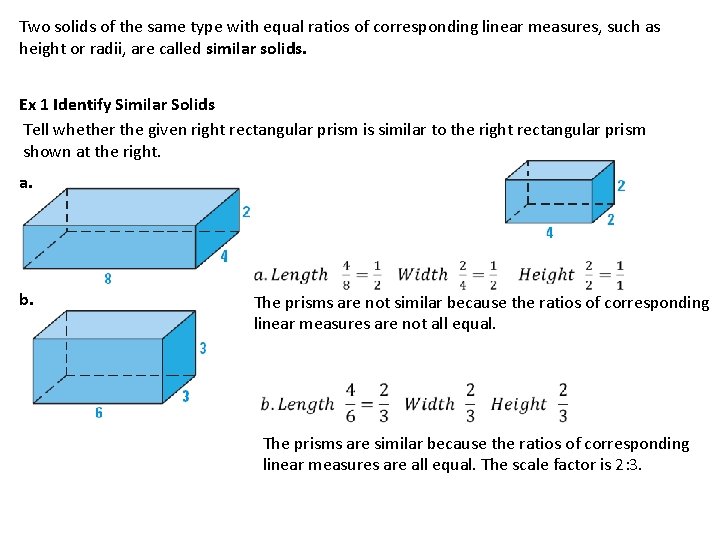
Two solids of the same type with equal ratios of corresponding linear measures, such as height or radii, are called similar solids. Ex 1 Identify Similar Solids Tell whether the given right rectangular prism is similar to the right rectangular prism shown at the right. a. b. The prisms are not similar because the ratios of corresponding linear measures are not all equal. The prisms are similar because the ratios of corresponding linear measures are all equal. The scale factor is 2: 3.

Ex 2 Use the Scale Factor of Similar Solids The cans shown are similar with a scale factor of 87: 100. Find the surface area and volume of the larger can. Surface area of II 51. 84 Surface area of II = = a 2 b 2 872 1002 Volume of I = Volume of II Surface area of II ≈ 68. 49 28. 27 Volume of II = Volume of II ≈ 42. 93 a 3 b 3 873 1003
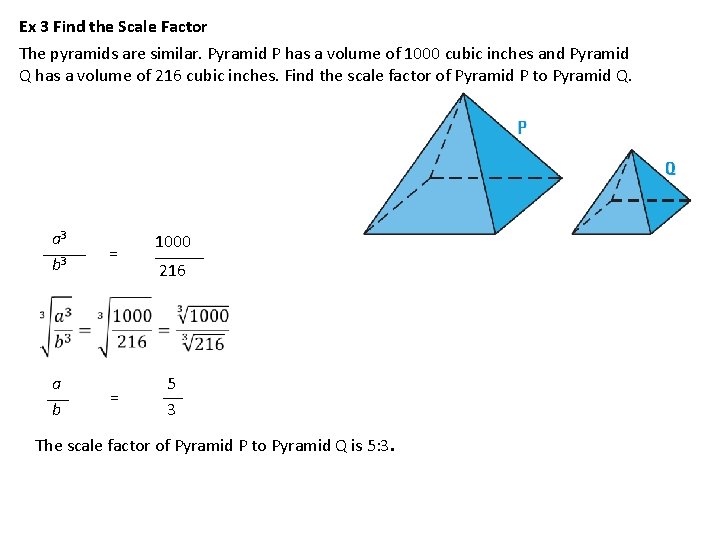
Ex 3 Find the Scale Factor The pyramids are similar. Pyramid P has a volume of 1000 cubic inches and Pyramid Q has a volume of 216 cubic inches. Find the scale factor of Pyramid P to Pyramid Q. a 3 b 3 = a b = 1000 216 5 3 The scale factor of Pyramid P to Pyramid Q is 5: 3.
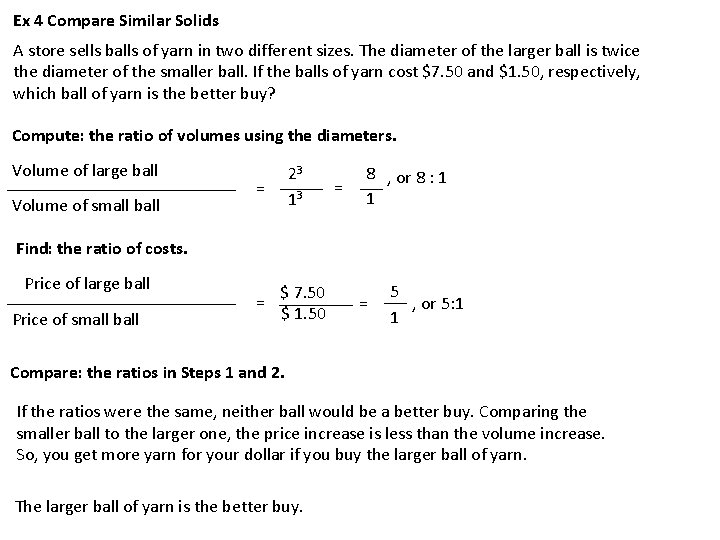
Ex 4 Compare Similar Solids A store sells balls of yarn in two different sizes. The diameter of the larger ball is twice the diameter of the smaller ball. If the balls of yarn cost $7. 50 and $1. 50, respectively, which ball of yarn is the better buy? Compute: the ratio of volumes using the diameters. Volume of large ball Volume of small ball 23 13 = = 8 , or 8 : 1 1 Find: the ratio of costs. Price of large ball Price of small ball = $ 7. 50 $ 1. 50 = 5 , or 5: 1 1 Compare: the ratios in Steps 1 and 2. If the ratios were the same, neither ball would be a better buy. Comparing the smaller ball to the larger one, the price increase is less than the volume increase. So, you get more yarn for your dollar if you buy the larger ball of yarn. The larger ball of yarn is the better buy.
- Slides: 6