
12 540 Principles of the Global Positioning System

12. 540 Principles of the Global Positioning System Lecture 21 Prof. Thomas Herring Room 54 -820 A; 253 -5941 tah@mit. edu http: //geoweb. mit. edu/~tah/12. 540 05/05/201005/01/08 12. 540 Lec 21
Summary • Sources of GPS data and results – Major international organizations involved in GPS – Examine access to GPS data – Examine access to GPS results 05/05/201005/01/08 12. 540 Lec 21 2
GPS Groups/IGS • There are many international and national groups involved in the deployment of GPS. • The international organization is the International GPS Service (IGS) • Started as pilot project by the International Association of Geodesy (IAG) in 1992. • Involves: – Data collection (standards for stations) – Data dissemination (through several archives) – Data analysis (IGS analysis centers) – Analysis improvements (working groups and standards) 05/05/201005/01/08 12. 540 Lec 21 3
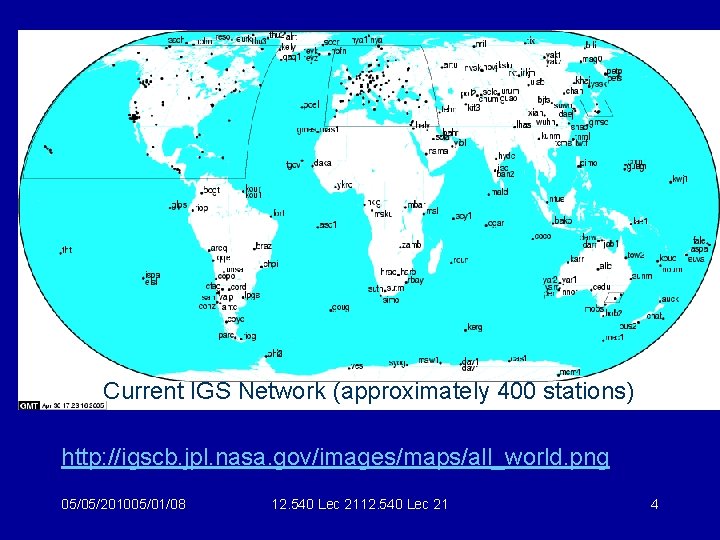
Current IGS Network (approximately 400 stations) http: //igscb. jpl. nasa. gov/images/maps/all_world. png 05/05/201005/01/08 12. 540 Lec 21 4
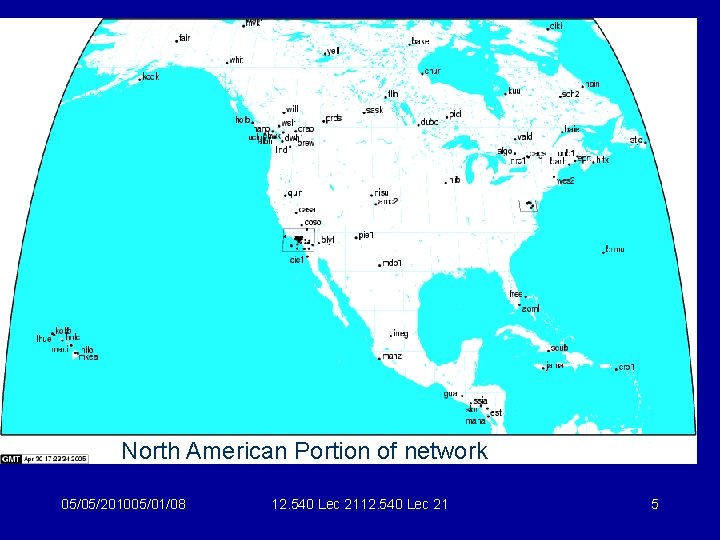
North American Portion of network 05/05/201005/01/08 12. 540 Lec 21 5
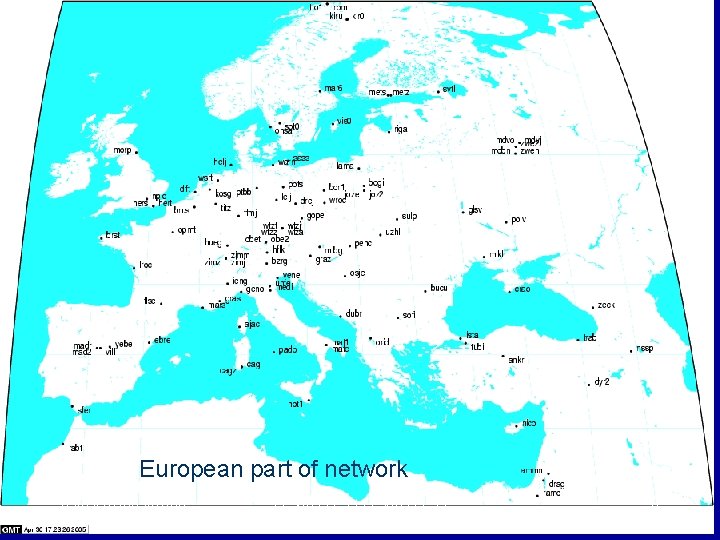
European part of network 05/05/201005/01/08 12. 540 Lec 21 6
IGS • Data for each IGS station is openly available usually within <1 day of collection. Some sites are available hourly. • The central bureau of the IGS is located at: http: //igscb. jpl. nasa. gov/ • Explore site for structure: Web site index gives an overview of page content. 05/05/201005/01/08 12. 540 Lec 21 7
US Groups • There a number of large US groups that run GPS networks. • Largest array is the Southern California Integrated array (SCIGN) with 250 stations http: //www. scign. org/ • Other groups in the Western United States have networks of 20 -50 stations. In all over 400 geophysical class stations in Western US. 05/05/201005/01/08 12. 540 Lec 21 8
Plate Boundary Observatory (PBO) • Installation of 875 new GPS stations across the Pacific-North America plate boundary and a large number of bole-hole strain-meters and 5 long baseline strain-meters. • Project part of NSF funded Earthscope project with contributions from USGS and NASA. • Started in late 2003 and will be completed November 2008. • Web site: http: //pboweb. unavco. org/ 05/05/201005/01/08 12. 540 Lec 21 9
National Geodetic Survey CORS • Main reference frame of the United States. • Continuously Operating Reference Stations (CORS) • http: //www. ngs. noaa. gov/CORS/ • Serves the geodetic control needs of the US. • About 300 GPS sites currently in the network many of them shared with other institutions. 05/05/201005/01/08 12. 540 Lec 21 10
Western US Groups • Networks in the Western United States – Plate Boundary Observatory (PBO) http: //pboweb. unavco. org/ – BARD (Bay Area Regional Network) http: //quake. geo. berkeley. edu/bard/ – PANGA (Pacific Northwest Geodetic Array) http: //www. panga. cwu. edu/ http: //www. geophys. washington. edu/GPS/gps. html – WCDA Western Canada Deformation Array http: //www. pgc. nrcan. gc. ca/geodyn/wcda. htm – BARGEN (Basin and Range Geodetic Network) http: //cfa-www. harvard. edu/space_geodesy/BARGEN/ – For list of arrays see: http: //sopac. ucsd. edu/cgi-bin/db. Show. Array. Sites. Map. cgi • Explore these web sites. 05/05/201005/01/08 12. 540 Lec 21 11
Availability of processed GPS data • Many of the network groups put analyzed results on their web pages as well as access to data. • IGS also sponsors 8 global analysis groups (funding comes from other sources). • SCIGN uses three analysis groups: http: //sideshow. jpl. nasa. gov/mbh/series. html http: //sopac. ucsd. edu/cgibin/db. Show. Array. Sites. Map. cgi? array=SCIGN http: //reason. scign. org http: //pasadena. wr. usgs. gov/scign/Analysis/ 05/05/201005/01/08 12. 540 Lec 21 12
Other important groups • University Navstar Consortium (UNAVCO) facility and corporation http: //www. unavco. org • Unavco is installing the Plate Boundary Observatory (PBO). • Supports a variety of applications of GPS. Initially tectonic deformation but now Antarctic Research and low-precision GIS applications • Supports US Universities in installing GPS through out the world for geophysical studies. 05/05/201005/01/08 12. 540 Lec 21 13
Summary • Data from thousands of GPS stations are collected and processed each data • Largest single array is in Japan (>1400 stations) with PBO following closely (1100) • GPS developments are like the internet development: Many active contributors but often quality is debatable. 05/05/201005/01/08 12. 540 Lec 21 14
- Slides: 14