
12 5 Stationary and progressive waves Meldes experiment

- Slides: 11
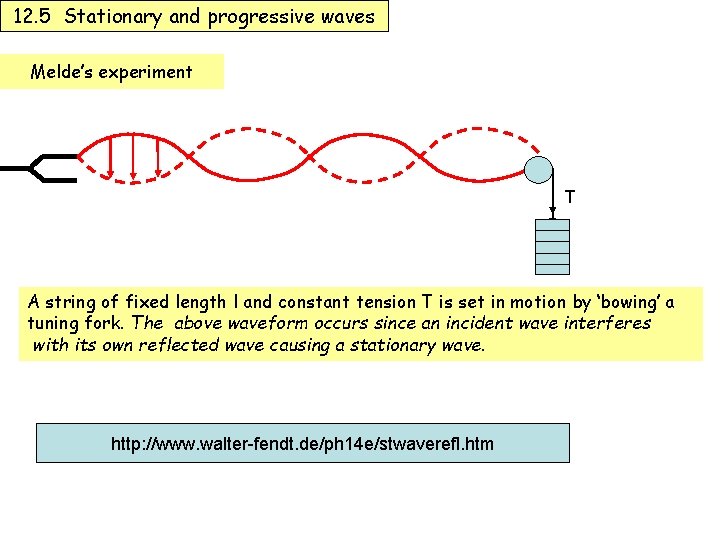
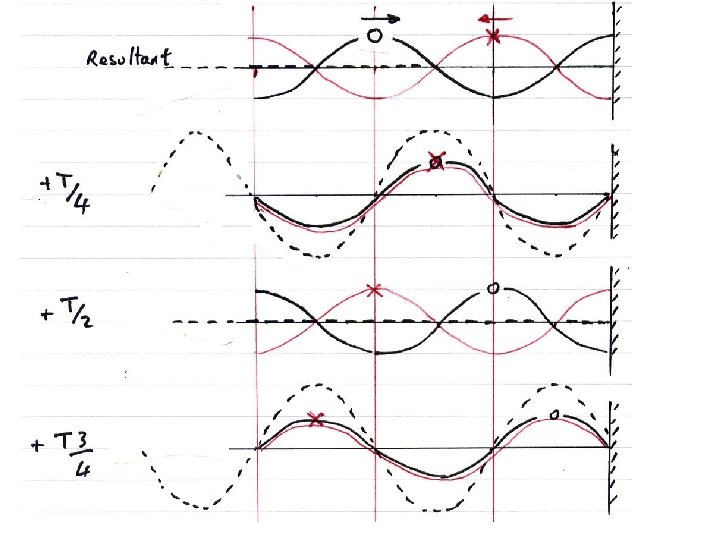
12. 5 Stationary and progressive waves Melde’s experiment T A string of fixed length l and constant tension T is set in motion by ‘bowing’ a tuning fork. The above waveform occurs since an incident wave interferes with its own reflected wave causing a stationary wave. http: //www. walter-fendt. de/ph 14 e/stwaverefl. htm
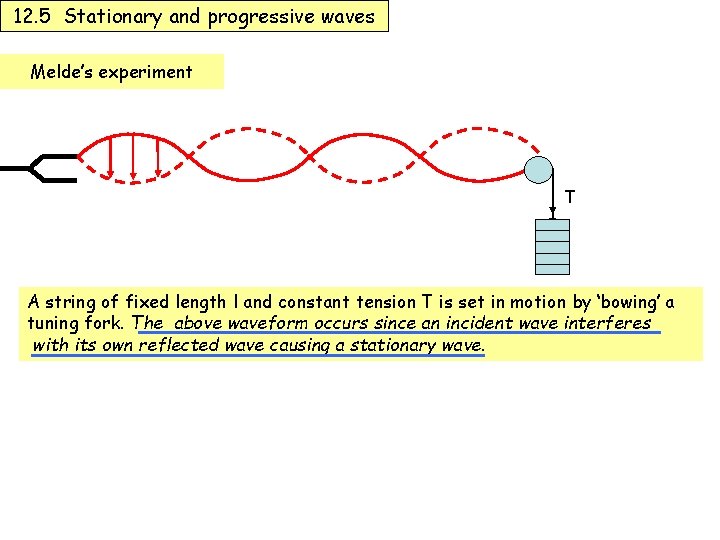
12. 5 Stationary and progressive waves Melde’s experiment T A string of fixed length l and constant tension T is set in motion by ‘bowing’ a tuning fork. The above waveform occurs since an incident wave interferes with its own reflected wave causing a stationary wave.
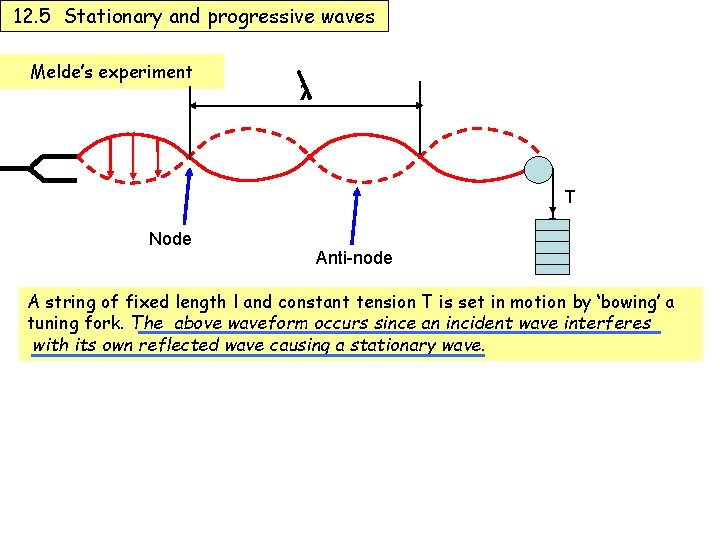
12. 5 Stationary and progressive waves Melde’s experiment λ T Node Anti-node A string of fixed length l and constant tension T is set in motion by ‘bowing’ a tuning fork. The above waveform occurs since an incident wave interferes with its own reflected wave causing a stationary wave.
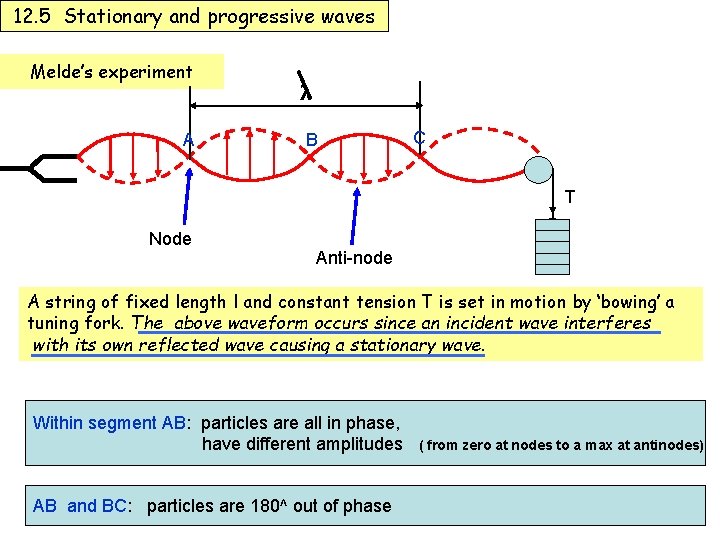
12. 5 Stationary and progressive waves Melde’s experiment A λ B C T Node Anti-node A string of fixed length l and constant tension T is set in motion by ‘bowing’ a tuning fork. The above waveform occurs since an incident wave interferes with its own reflected wave causing a stationary wave. Within segment AB: particles are all in phase, have different amplitudes AB and BC: particles are 180^ out of phase ( from zero at nodes to a max at antinodes)
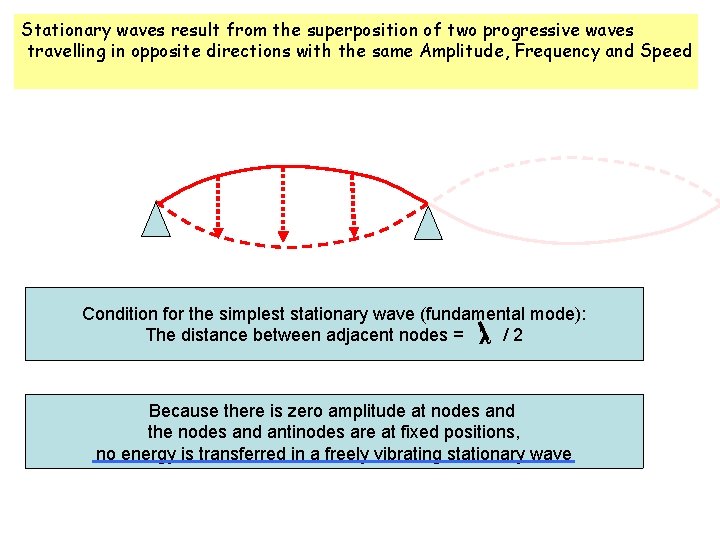
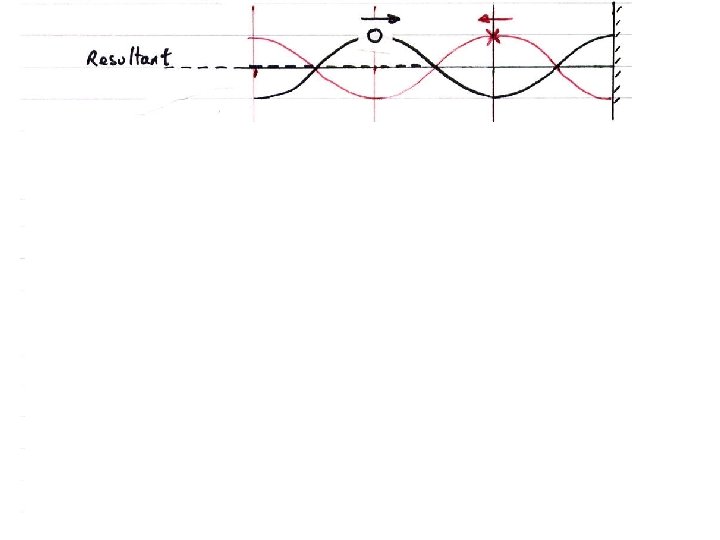
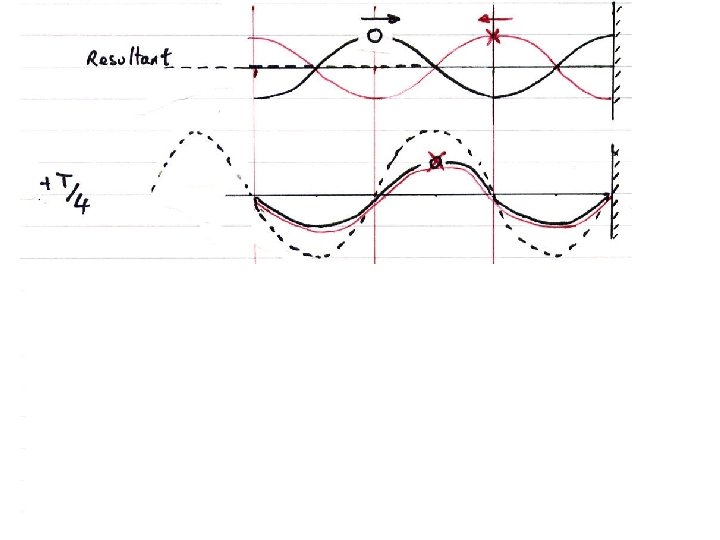
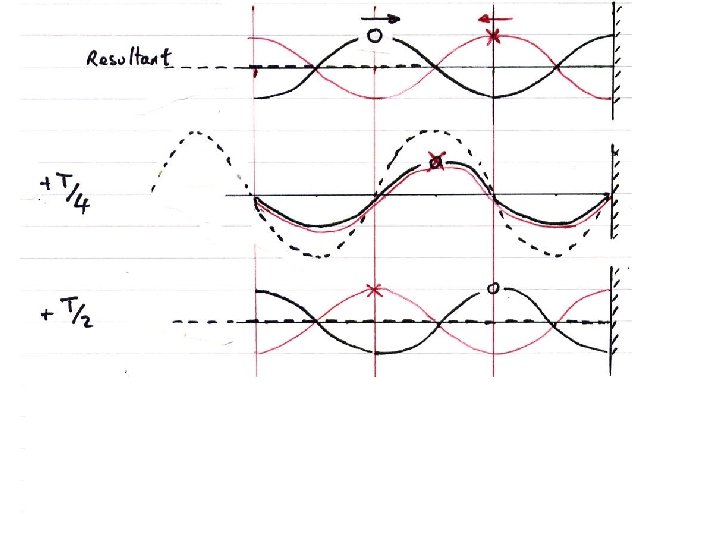
Stationary waves result from the superposition of two progressive waves travelling in opposite directions with the same Amplitude, Frequency and Speed Condition for the simplest stationary wave (fundamental mode): The distance between adjacent nodes = λ / 2 Because there is zero amplitude at nodes and the nodes and antinodes are at fixed positions, no energy is transferred in a freely vibrating stationary wave
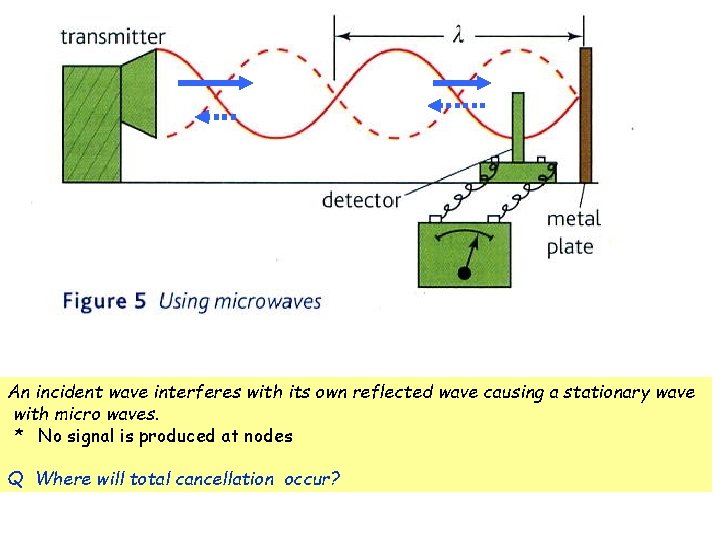
An incident wave interferes with its own reflected wave causing a stationary wave with micro waves. * No signal is produced at nodes Q Where will total cancellation occur?