
12 5 Enlightenment Thinkers The Enlightenment TARGET SWBAT

12. 5 Enlightenment Thinkers The Enlightenment TARGET: SWBAT: Explain & describe the Age of Enlightenment and how it influenced government. Objective 1 -Describe how the Scientific Method was applied to human behavior. Objective 2 -Identify 2 qualities that the philosophes praised and promoted for government. Objective 3 - List & describe 4 Enlightenment philosophes.
12. 5 The Enlightenment Journal: What is the purpose of government?
12. 5 DAILY QUIZ

Enlightenment: Age of Reason • Scientific Revolution-the human mind can understand the secrets of the physical universe. • Scientific Revolution used intellectual powers to discover natural laws. • Thinkers of the Enlightenment sought, through reasoning, to discover the natural laws that governed the affairs of human beings & society. • They criticized the existence of an absolute monarchy & the established church and proposed reforms designed to eliminate abuses & promote individual freedom. • The Enlightenment thinkers are known collectively as the philosphes. • They were more known as critics of the old regime & developed new ideas about government, economics, and religion and worked to improve human conditions to reform society.

Sources of Enlight. Thought • In mid-1600’s, as direct outgrowth of Sci. Revol, European thinkers began to apply scientific principles to the study of society and were inspired by goals of understanding the laws of nature. • Believed humans/society also functioned under natural laws • They believed reason was the key to human progress & scientific methods could be used to solve social problems. • Renaissance & Reformation also influenced the Enlightenment – ideas of individualism & secular thought (Renaissance) and habit of questioning authority (Reformation) • Skeptical of “received knowledge” – wanted to find truths for themselves (Descartes) • From classical Greece & Rome – idea that people should have a say in govt.
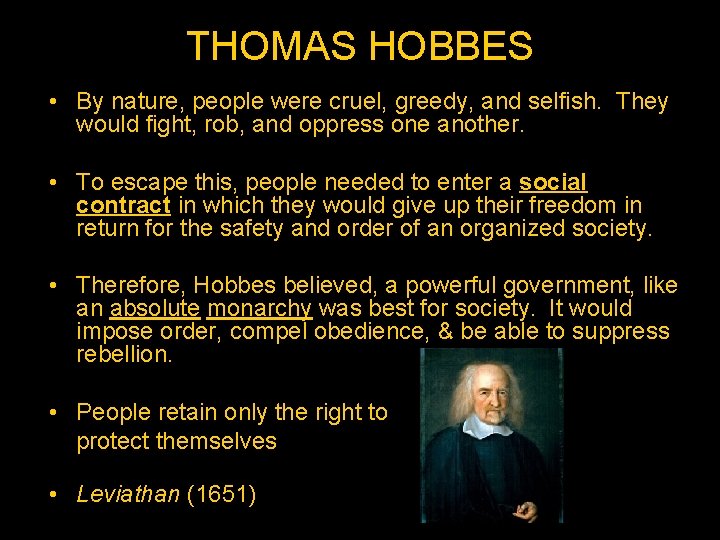
THOMAS HOBBES • By nature, people were cruel, greedy, and selfish. They would fight, rob, and oppress one another. • To escape this, people needed to enter a social contract in which they would give up their freedom in return for the safety and order of an organized society. • Therefore, Hobbes believed, a powerful government, like an absolute monarchy was best for society. It would impose order, compel obedience, & be able to suppress rebellion. • People retain only the right to protect themselves • Leviathan (1651)
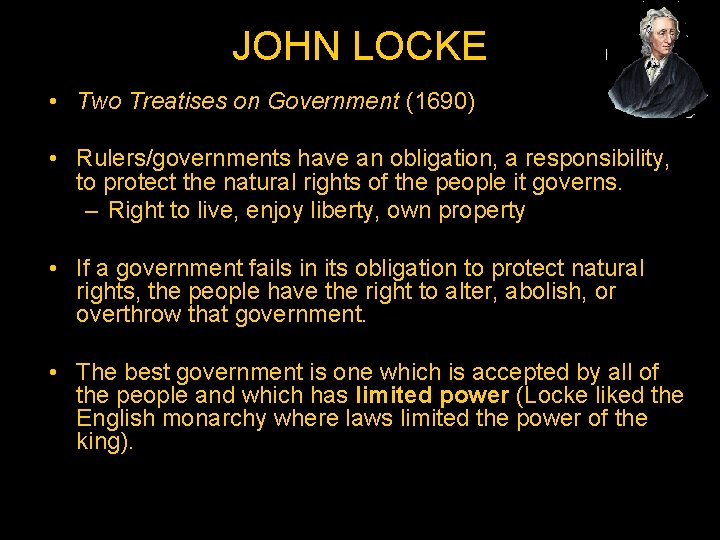
JOHN LOCKE • Two Treatises on Government (1690) • Rulers/governments have an obligation, a responsibility, to protect the natural rights of the people it governs. – Right to live, enjoy liberty, own property • If a government fails in its obligation to protect natural rights, the people have the right to alter, abolish, or overthrow that government. • The best government is one which is accepted by all of the people and which has limited power (Locke liked the English monarchy where laws limited the power of the king).
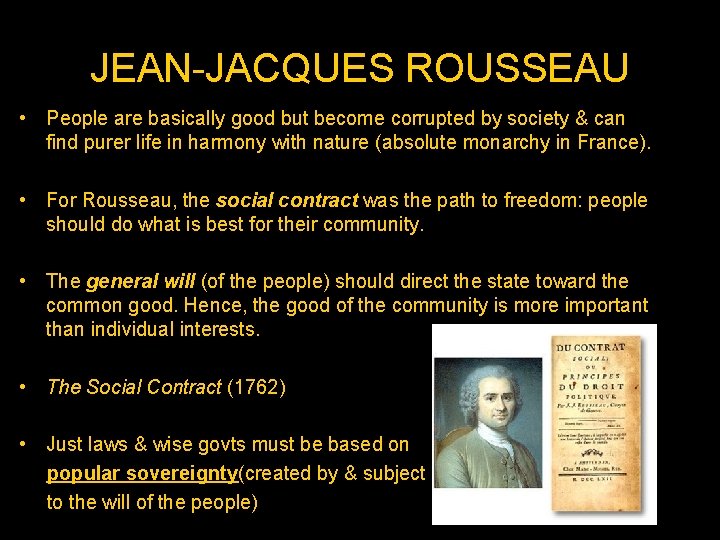
JEAN-JACQUES ROUSSEAU • People are basically good but become corrupted by society & can find purer life in harmony with nature (absolute monarchy in France). • For Rousseau, the social contract was the path to freedom: people should do what is best for their community. • The general will (of the people) should direct the state toward the common good. Hence, the good of the community is more important than individual interests. • The Social Contract (1762) • Just laws & wise govts must be based on popular sovereignty(created by & subject to the will of the people)
MONTESQUIEU • He strongly criticized absolute monarchy and was a voice for democracy. • Separation of Powers - the best way to protect liberty was to divide the powers of government into three branches: legislative, executive, and judicial. • Checks and Balances – each branch of government should check (limit) the power of the other two branches. Thus, power would be balanced (even) and no one branch would be too powerful. • Montesquieu studied the history of governments and cultures all over the world. • The Spirit of the Laws (1748) - tried to describe perfect govt.
VOLTAIRE • Candide • Advocated freedom of thought, speech, politics, and religion. • Fought against intolerance, injustice, inequality, ignorance, and superstition. • Attacked idle aristocrats, corrupt government officials, religious prejudice, and the slave trade. • He often had to express his views indirectly through fictional characters because he lived in an absolute monarchy in France.

DENIS DIDEROT • This philosophe worked 25 years to produce (edit) a 28 volume Encyclopedia – the first one. • The Encyclopedia was not just a collection of articles on human knowledge, it was intended to change the way people thought. Montesquieu, Voltaire, and others wrote articles. • About 20, 000 copies were printed between 1751 and 1789 despite efforts to ban the Encyclopedia.
MARY WOLLSTONECRAFT • Vindication of the Rights of Women (1792) • She argued that women had not been included in the Enlightenment slogan “free and equal. ” Women had been excluded from the social contract. • Her arguments were often met with scorn, even from some ‘enlightened’ men.
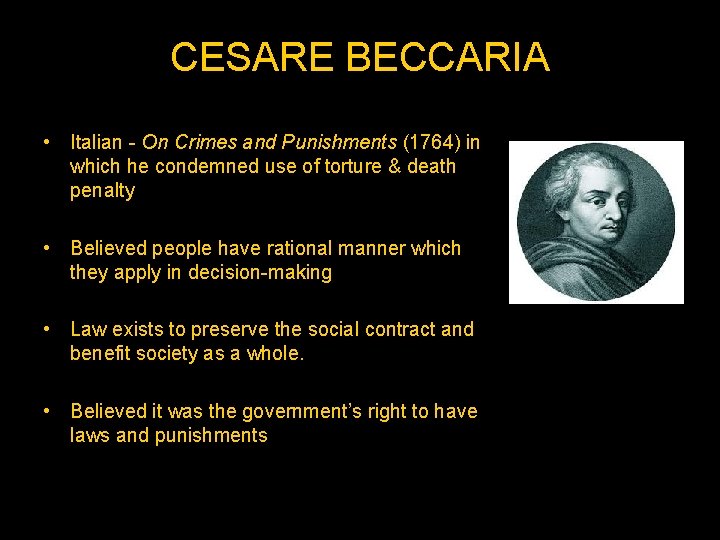
CESARE BECCARIA • Italian - On Crimes and Punishments (1764) in which he condemned use of torture & death penalty • Believed people have rational manner which they apply in decision-making • Law exists to preserve the social contract and benefit society as a whole. • Believed it was the government’s right to have laws and punishments
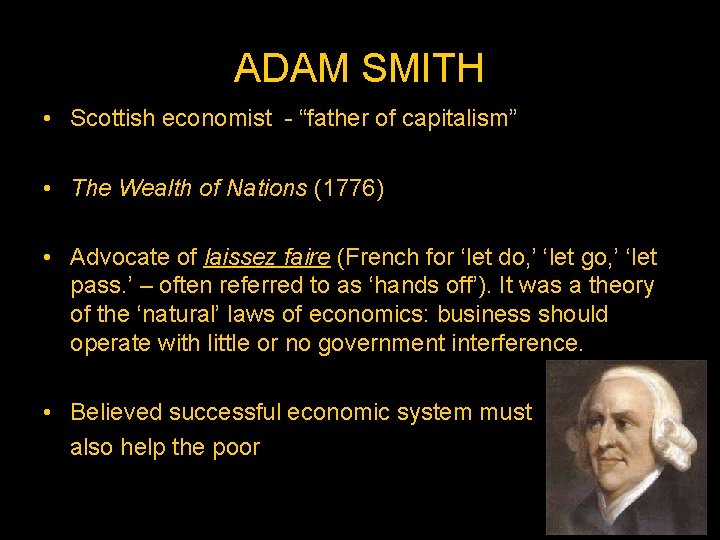
ADAM SMITH • Scottish economist - “father of capitalism” • The Wealth of Nations (1776) • Advocate of laissez faire (French for ‘let do, ’ ‘let go, ’ ‘let pass. ’ – often referred to as ‘hands off’). It was a theory of the ‘natural’ laws of economics: business should operate with little or no government interference. • Believed successful economic system must also help the poor
IMPACT OF THE ENLIGHTENMENT • Encouraged new ways of thinking among some political leaders • Gave rise to new political ideals that spread through Europe and the Americas • Encouraged American & French Revolutions & independence movements in Latin America in the early 1800’s • Promoted optimistic faith in the future – believed society could be understood and improved & that progress was inevitable • Encouraged trend toward secular attitudes in society • Emphasized reason over religion in search for knowledge • Promoted principles of religious toleration & respect for the individual
Quotes-Who said? “Without government our lives would be nasty, brutish, and short!” Thomas Hobbes!!!
Quotes-Who said? “Man is born free, and everywhere he is in chains. ” JEAN-JACQUES ROUSSEAU
Quotes-Who said? “Strengthen the female mind by enlarging it, and there will be an end to blind obedience. ” • Mary Wollstonecraft
Quotes-Who said? “We are born with rights because they are a part of nature, of our very existence – they come from God. ” John Locke!!!!!
Quotes-Who said? “To become truly great, one has to stand with people, not above them. ” MONTESQUIEU
Quotes-Who said? “I disapprove of what you say, but I will defend to the death your right to say it. ” Voltaire
Quotes-Who said? Man will never be free until the last king is strangled with the entrails of the last priest. DENIS DIDEROT
12. 5 OBJ REVIEW The Enlightenment TARGET: SWBAT: Explain & describe the Age of Enlightenment and how it influenced government. Objective 1 -Describe how the Scientific Method was applied to human behavior. Objective 2 -Identify 2 qualities that the philosophes praised and promoted for government. Objective 3 - List & describe 4 Enlightenment philosophes. Objective Review: • 4 to 5 sentences per objective • Create a topic sentence/thesis statement • 3 supportive detail sentences
- Slides: 23