
12 4 Properties of Alkanes The different uses
- Slides: 13
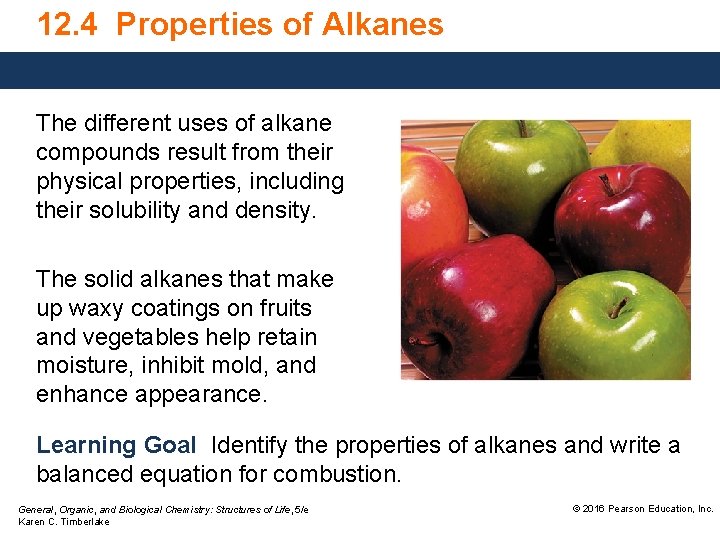
12. 4 Properties of Alkanes The different uses of alkane compounds result from their physical properties, including their solubility and density. The solid alkanes that make up waxy coatings on fruits and vegetables help retain moisture, inhibit mold, and enhance appearance. Learning Goal Identify the properties of alkanes and write a balanced equation for combustion. General, Organic, and Biological Chemistry: Structures of Life, 5/e Karen C. Timberlake © 2016 Pearson Education, Inc.
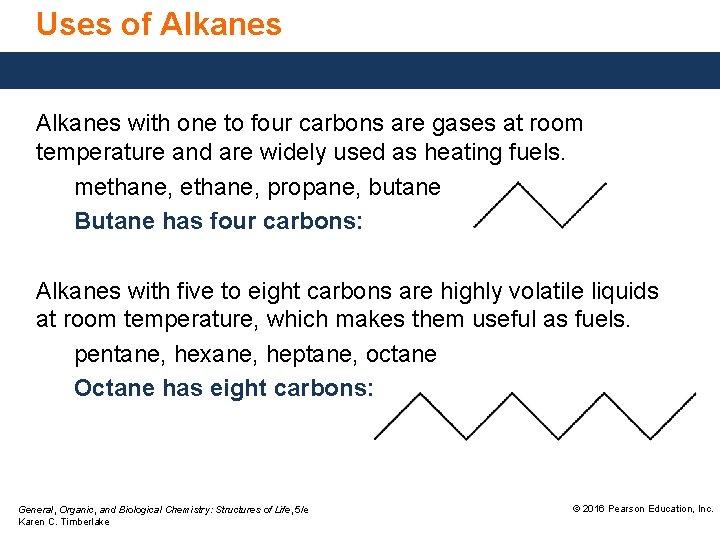
Uses of Alkanes with one to four carbons are gases at room temperature and are widely used as heating fuels. methane, propane, butane Butane has four carbons: Alkanes with five to eight carbons are highly volatile liquids at room temperature, which makes them useful as fuels. pentane, hexane, heptane, octane Octane has eight carbons: General, Organic, and Biological Chemistry: Structures of Life, 5/e Karen C. Timberlake © 2016 Pearson Education, Inc.
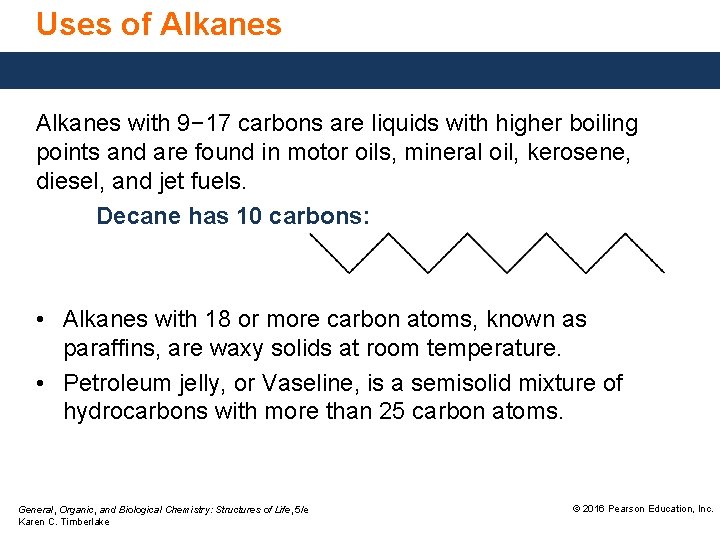
Uses of Alkanes with 9− 17 carbons are liquids with higher boiling points and are found in motor oils, mineral oil, kerosene, diesel, and jet fuels. Decane has 10 carbons: • Alkanes with 18 or more carbon atoms, known as paraffins, are waxy solids at room temperature. • Petroleum jelly, or Vaseline, is a semisolid mixture of hydrocarbons with more than 25 carbon atoms. General, Organic, and Biological Chemistry: Structures of Life, 5/e Karen C. Timberlake © 2016 Pearson Education, Inc.
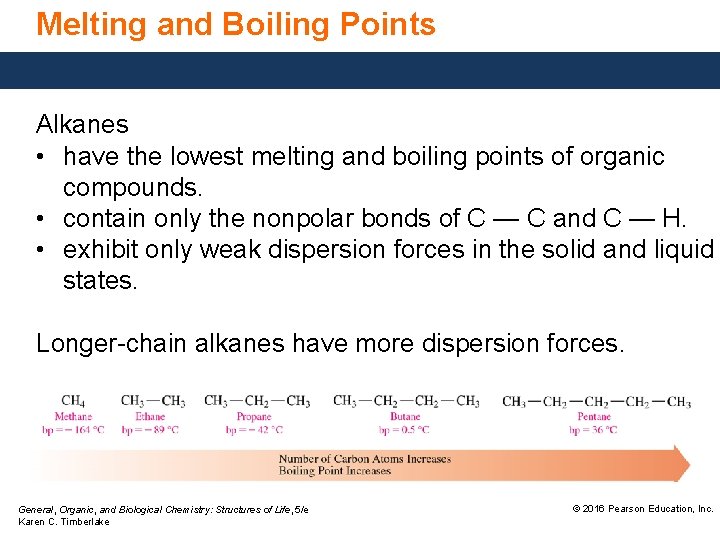
Melting and Boiling Points Alkanes • have the lowest melting and boiling points of organic compounds. • contain only the nonpolar bonds of C — C and C — H. • exhibit only weak dispersion forces in the solid and liquid states. Longer-chain alkanes have more dispersion forces. General, Organic, and Biological Chemistry: Structures of Life, 5/e Karen C. Timberlake © 2016 Pearson Education, Inc.
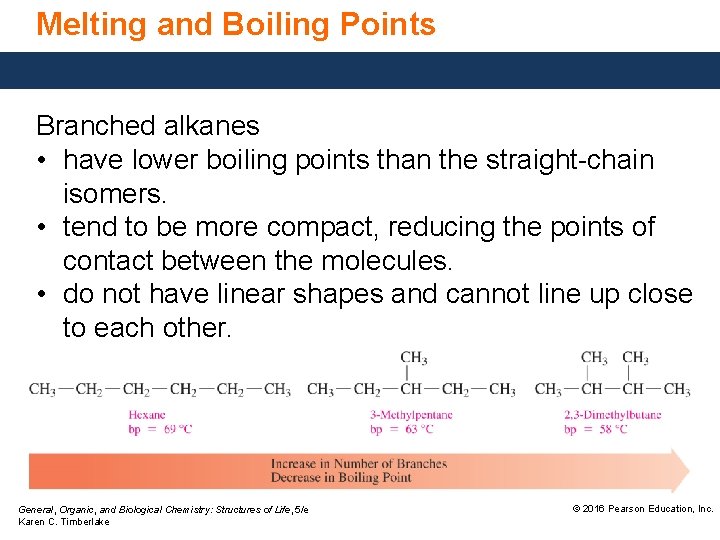
Melting and Boiling Points Branched alkanes • have lower boiling points than the straight-chain isomers. • tend to be more compact, reducing the points of contact between the molecules. • do not have linear shapes and cannot line up close to each other. General, Organic, and Biological Chemistry: Structures of Life, 5/e Karen C. Timberlake © 2016 Pearson Education, Inc.
Melting and Boiling Points Cycloalkanes • have higher boiling points than the straight-chain alkanes with the same number of carbon atoms. • have limited rotation of carbon bonds; they maintain their rigid structure and can be stacked closely together, which gives them many points of contact and attractions to each other. General, Organic, and Biological Chemistry: Structures of Life, 5/e Karen C. Timberlake © 2016 Pearson Education, Inc.
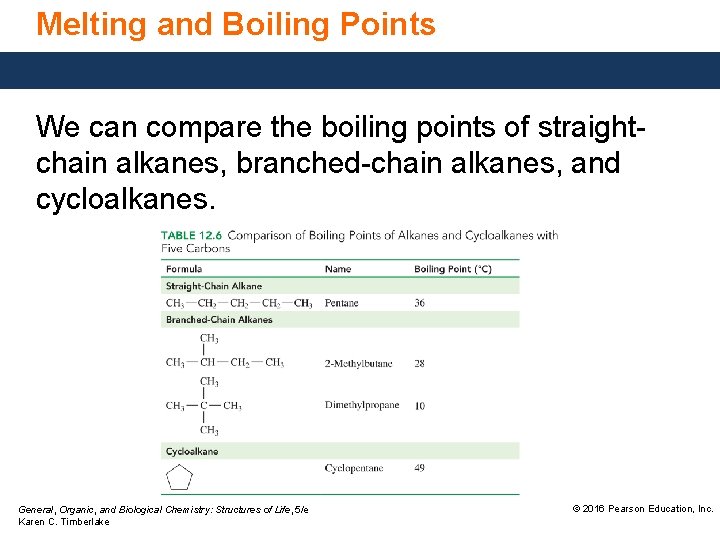
Melting and Boiling Points We can compare the boiling points of straightchain alkanes, branched-chain alkanes, and cycloalkanes. General, Organic, and Biological Chemistry: Structures of Life, 5/e Karen C. Timberlake © 2016 Pearson Education, Inc.
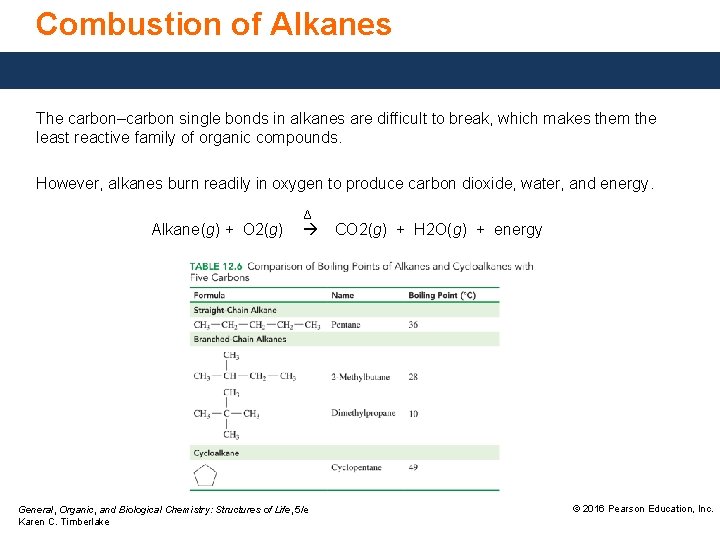
Combustion of Alkanes The carbon–carbon single bonds in alkanes are difficult to break, which makes them the least reactive family of organic compounds. However, alkanes burn readily in oxygen to produce carbon dioxide, water, and energy. Alkane(g) + O 2(g) Δ General, Organic, and Biological Chemistry: Structures of Life, 5/e Karen C. Timberlake CO 2(g) + H 2 O(g) + energy © 2016 Pearson Education, Inc.
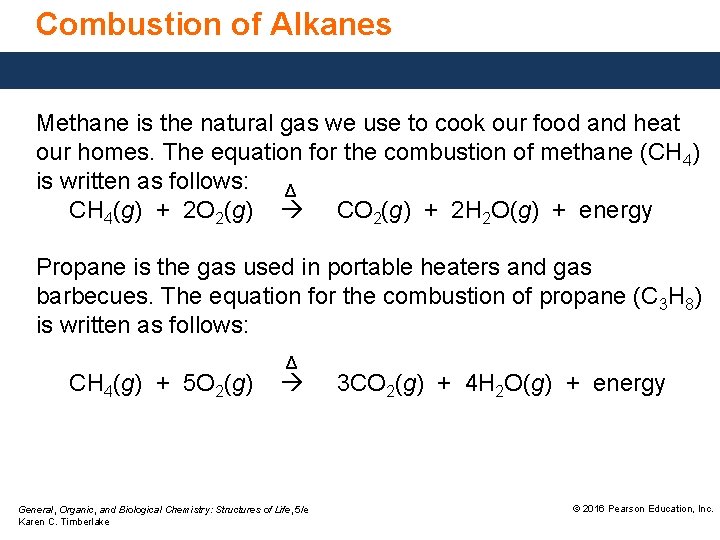
Combustion of Alkanes Methane is the natural gas we use to cook our food and heat our homes. The equation for the combustion of methane (CH 4) is written as follows: Δ CH 4(g) + 2 O 2(g) CO 2(g) + 2 H 2 O(g) + energy Propane is the gas used in portable heaters and gas barbecues. The equation for the combustion of propane (C 3 H 8) is written as follows: CH 4(g) + 5 O 2(g) Δ General, Organic, and Biological Chemistry: Structures of Life, 5/e Karen C. Timberlake 3 CO 2(g) + 4 H 2 O(g) + energy © 2016 Pearson Education, Inc.
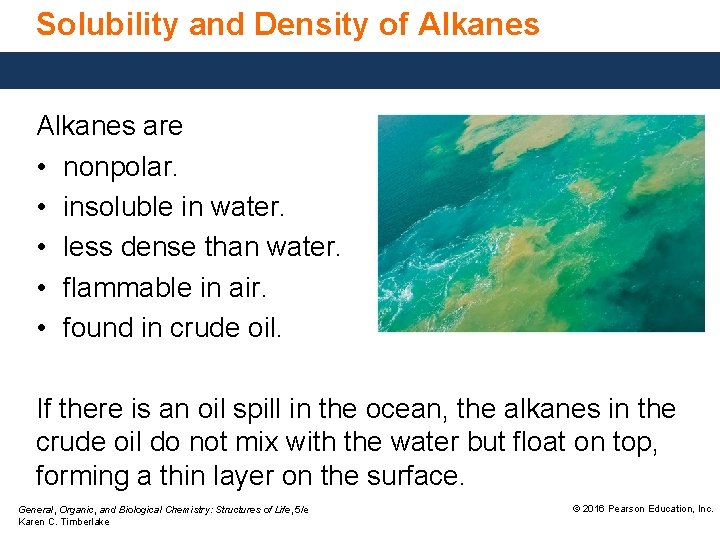
Solubility and Density of Alkanes are • nonpolar. • insoluble in water. • less dense than water. • flammable in air. • found in crude oil. If there is an oil spill in the ocean, the alkanes in the crude oil do not mix with the water but float on top, forming a thin layer on the surface. General, Organic, and Biological Chemistry: Structures of Life, 5/e Karen C. Timberlake © 2016 Pearson Education, Inc.
Oil Spills In April 2010, an explosion on an oil-drilling rig in the Gulf of Mexico caused the largest oil spill in U. S. history, spilling at its maximum about 10 million liters per day. Cleaning up an oil spill includes the following processes: • mechanical—a boom may be placed around the oil so that boats called skimmers can scoop it up and place it in tanks. • chemical—a substance that attracts oil is used to pick up the oil, which is then scraped off into recovery tanks. • microbiological—certain bacteria that ingest oil are used to break oil down into less harmful products. General, Organic, and Biological Chemistry: Structures of Life, 5/e Karen C. Timberlake © 2016 Pearson Education, Inc.
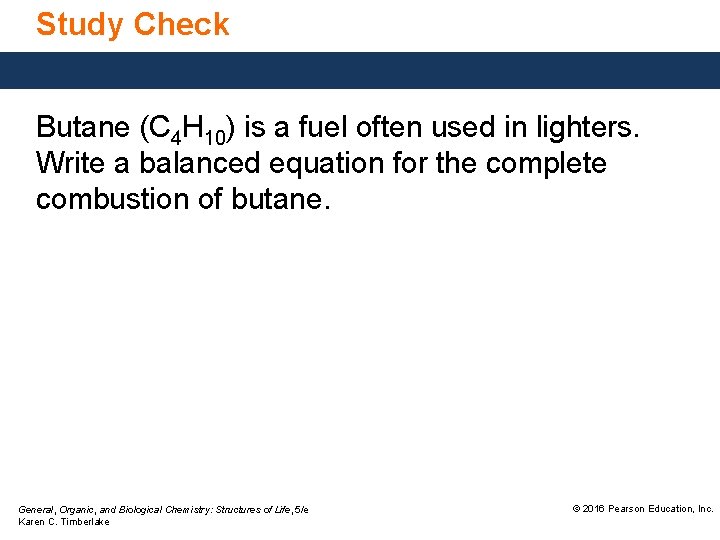
Study Check Butane (C 4 H 10) is a fuel often used in lighters. Write a balanced equation for the complete combustion of butane. General, Organic, and Biological Chemistry: Structures of Life, 5/e Karen C. Timberlake © 2016 Pearson Education, Inc.
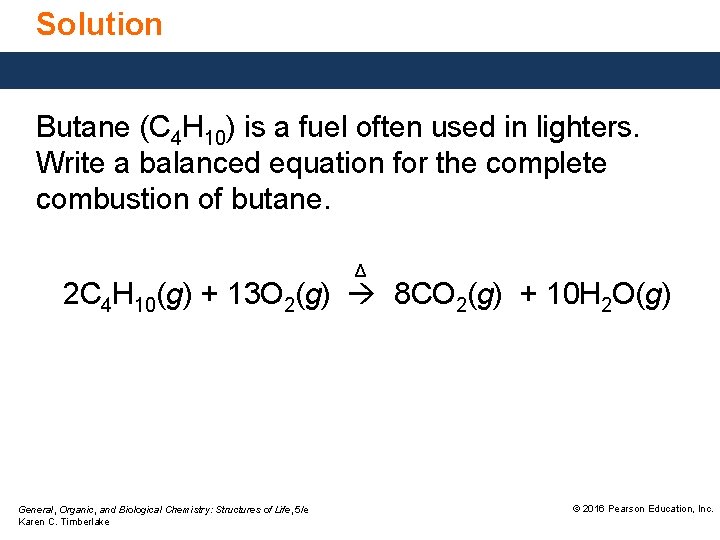
Solution Butane (C 4 H 10) is a fuel often used in lighters. Write a balanced equation for the complete combustion of butane. Δ 2 C 4 H 10(g) + 13 O 2(g) 8 CO 2(g) + 10 H 2 O(g) General, Organic, and Biological Chemistry: Structures of Life, 5/e Karen C. Timberlake © 2016 Pearson Education, Inc.