
12 4 12 5 Solution Equilibrium and Factors
12. 4 -12. 5 Solution Equilibrium and Factors affecting Solubility – Expressing Solution Concentration
Solution Equilibrium and Factors Affecting Solubility • Solution Equilibrium • When a solid solute is placed into a liquid solvent, the solid begins to dissolve into the solvent • But, as it dissolves, the solution becomes gradually more and more concentrated • Once the solution becomes more concentrated, some of the solute can recrystallize • When the rate of dissolution is equal to the rate of recrystallization, dynamic equilibrium has been reached (like the dynamic equilibrium between phase changes talked about in the last chapter) • When a solution has reached this dynamic equilibrium, it is called a saturated solution • If you add solute it will not dissolve • If the solution does not have enough solute to reach the dynamic equilibrium, it is called an unsaturated solution • If you add solute it will dissolve (until the dynamic equilibrium is reached).

Supersaturated Solutions • This occurs when the solution contains more than the amount of solute necessary for dynamic equilibrium • These solutions are unstable, excess solute will often precipitate out • But, sometimes they can exist for an extended time period, but when a piece of the solute is added, all of the excess solute will precipitate.

The Temperature Dependence of the Solubility of Solids • The solubility of solids in water often increases with increased temperature • To purify a solid, an excess of the solid can be dissolved in water at a higher temperature, and then the temperature can be lowered, leading to the solution becoming supersaturated, the excess solid precipitates out of the solution • If it cools slowly, crystals form, their structure tends to reject impurities, leaving a ‘purer’ solid
Factors Affecting the Solubility of Gases in Water • As temperature rises, the solubility of gases in liquids decreases, (that is why bubbles of gases are released before water boils) • This is why warm soda bubbles more than cold soda, and why fish are more lethargic when the water is warm (lower oxygen) e c i t c A solution is saturated in both nitrogen gas and potassium bromide at 75 degrees Celsius. When a r P the solution is cooled to room temperature, what is most likely to happen? 1. Some nitrogen gas will bubble out of the solution 2. Some potassium bromide will precipitate out of the solution 3. Some nitrogen gas will bubble out of the solution and some potassium bromide will precipitate out of the solution 4. Nothing
The Effect of Pressure on Solubility of Gases in Water • The higher the pressure of a gas above the liquid is, the more soluble it is • In soda, the high pressure of gaseous CO 2 results in much of the CO 2 gas remaining in the solution. When the can is opened, the pressure decreases, allowing CO 2 to bubble out • When the solution and the gaseous CO 2 are in a sealed container, dynamic equilibrium occurs because the CO 2 entering the solution equals the CO 2 that is leaving (into the space above) • But, when the volume for the gaseous CO 2 is decreased, the pressure of the CO 2 increases, making more of the gaseous CO 2 enter the solution, until that equilibrium is attained again.
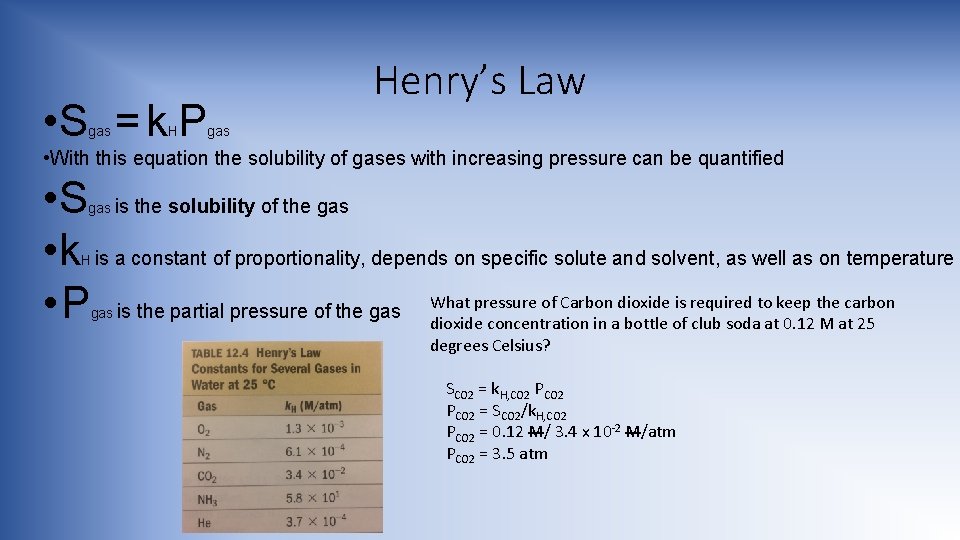
• S = k P gas H Henry’s Law gas • With this equation the solubility of gases with increasing pressure can be quantified • S is the solubility of the gas • k is a constant of proportionality, depends on specific solute and solvent, as well as on temperature • P is the partial pressure of the gas What pressure of Carbon dioxide is required to keep the carbon dioxide concentration in a bottle of club soda at 0. 12 M at 25 gas H gas degrees Celsius? SCO 2 = k. H, CO 2 PCO 2 = SCO 2/k. H, CO 2 PCO 2 = 0. 12 M/ 3. 4 x 10 -2 M/atm PCO 2 = 3. 5 atm
Expressing Solution Concentration • Dilute Solute – contains small quantities of solute relative to the amount of solvent • Concentrated Solute – contains large quantities of solute relative to the amount of solvent • Solution concentration can be reported through • • • Molarity Molality Parts by Mass Parts by Volume Mole Fraction Mole Percent
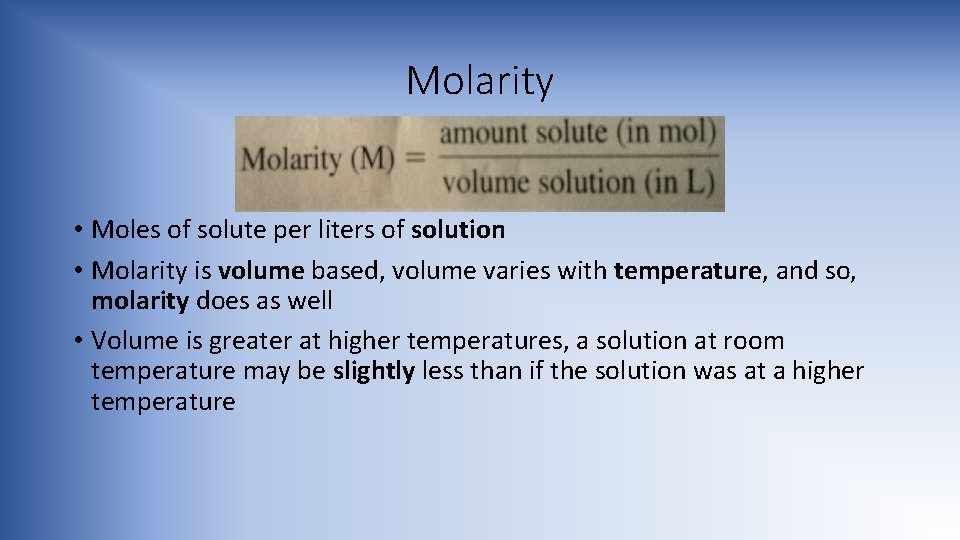
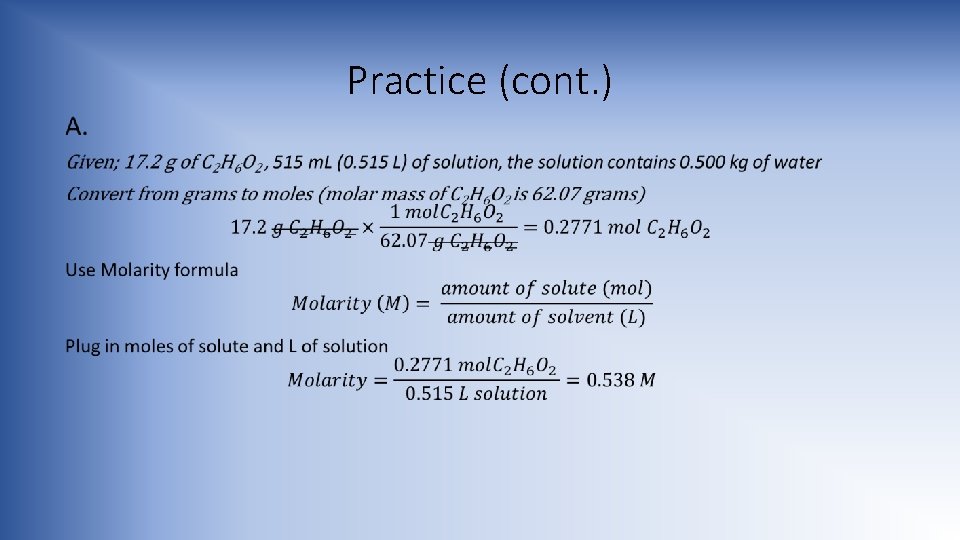
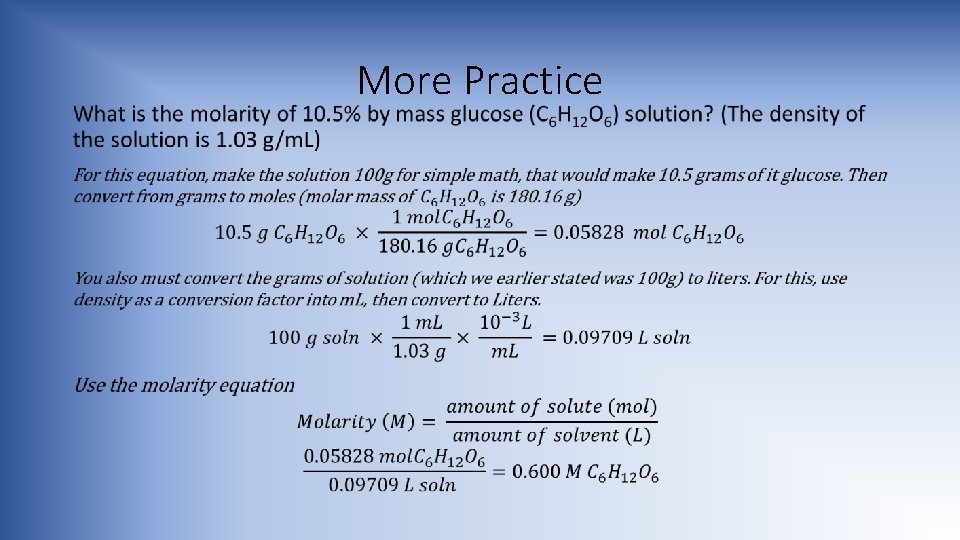
Molarity • Moles of solute per liters of solution • Molarity is volume based, volume varies with temperature, and so, molarity does as well • Volume is greater at higher temperatures, a solution at room temperature may be slightly less than if the solution was at a higher temperature
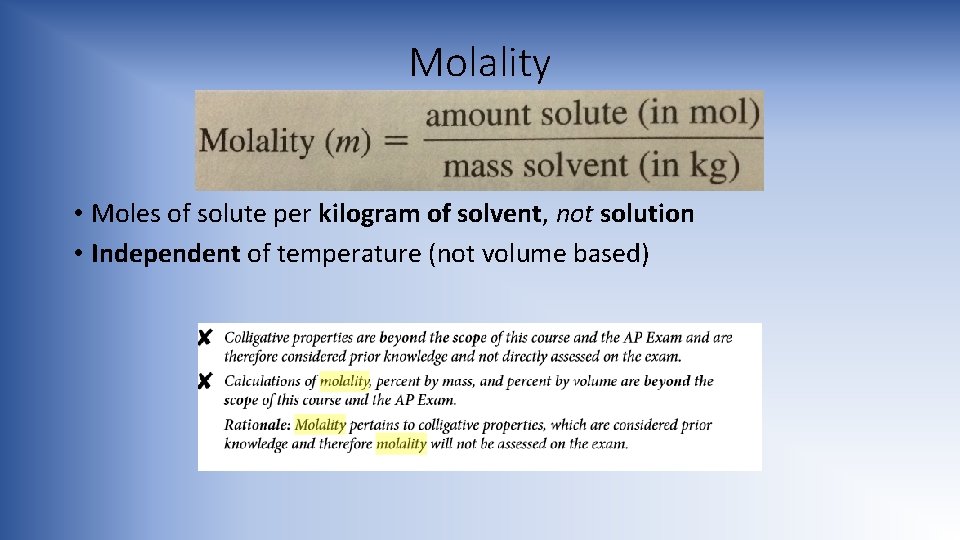
Molality • Moles of solute per kilogram of solvent, not solution • Independent of temperature (not volume based)
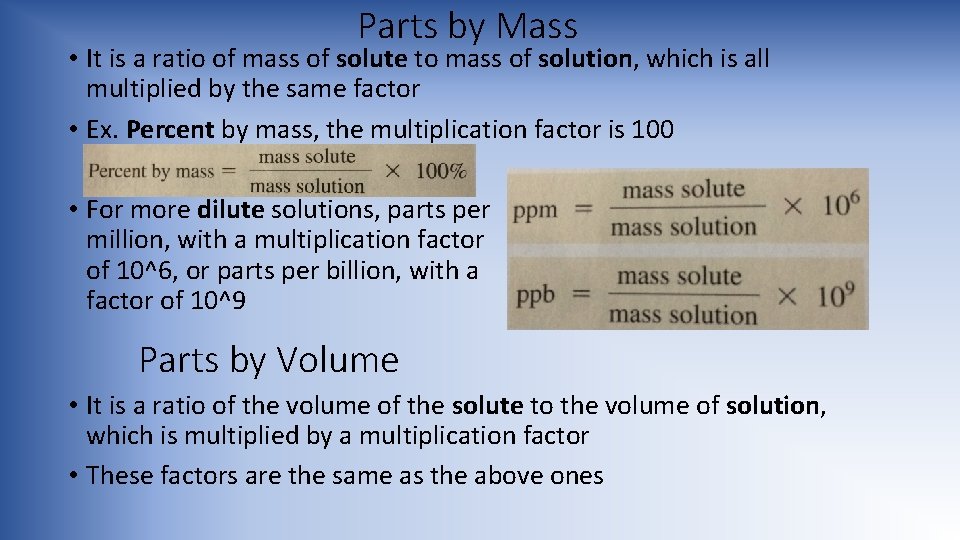
Parts by Mass • It is a ratio of mass of solute to mass of solution, which is all multiplied by the same factor • Ex. Percent by mass, the multiplication factor is 100 • For more dilute solutions, parts per million, with a multiplication factor of 10^6, or parts per billion, with a factor of 10^9 Parts by Volume • It is a ratio of the volume of the solute to the volume of solution, which is multiplied by a multiplication factor • These factors are the same as the above ones
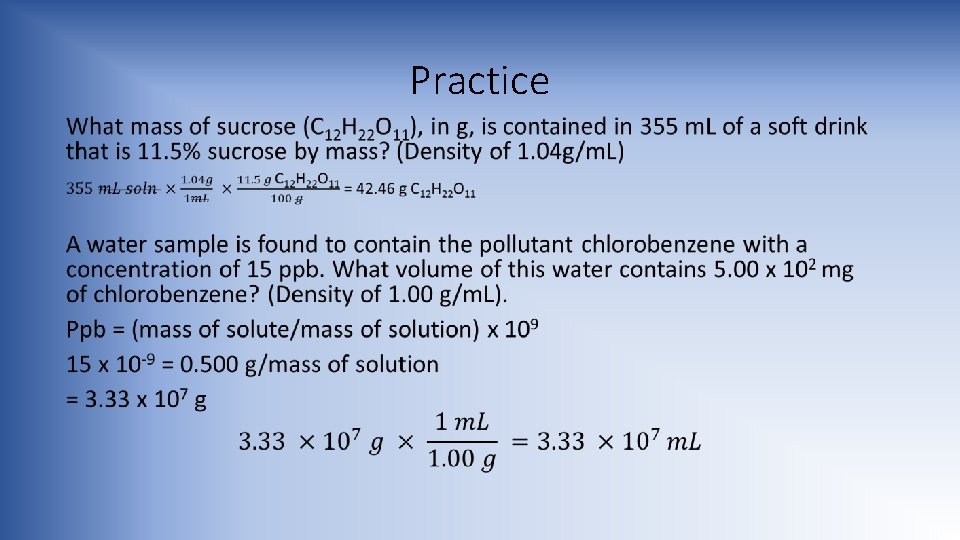
Practice •
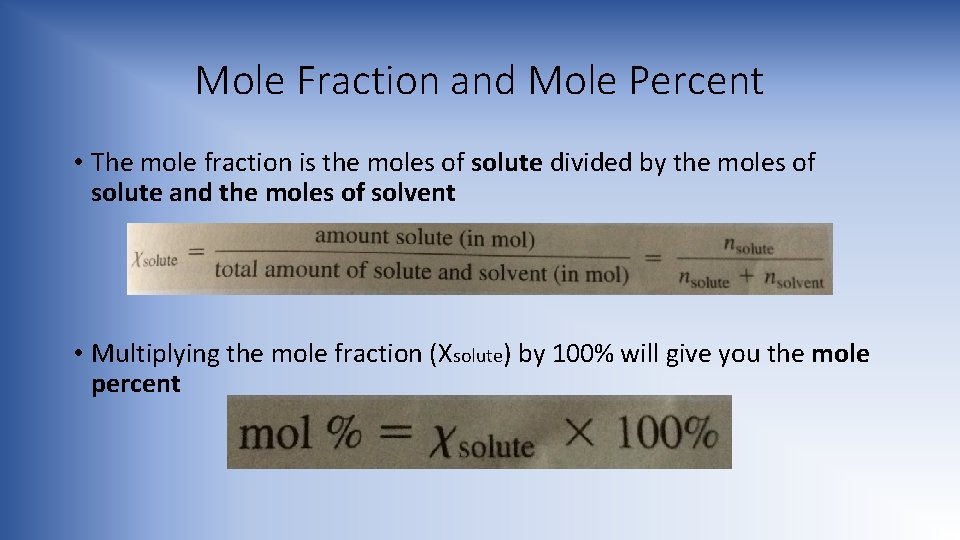
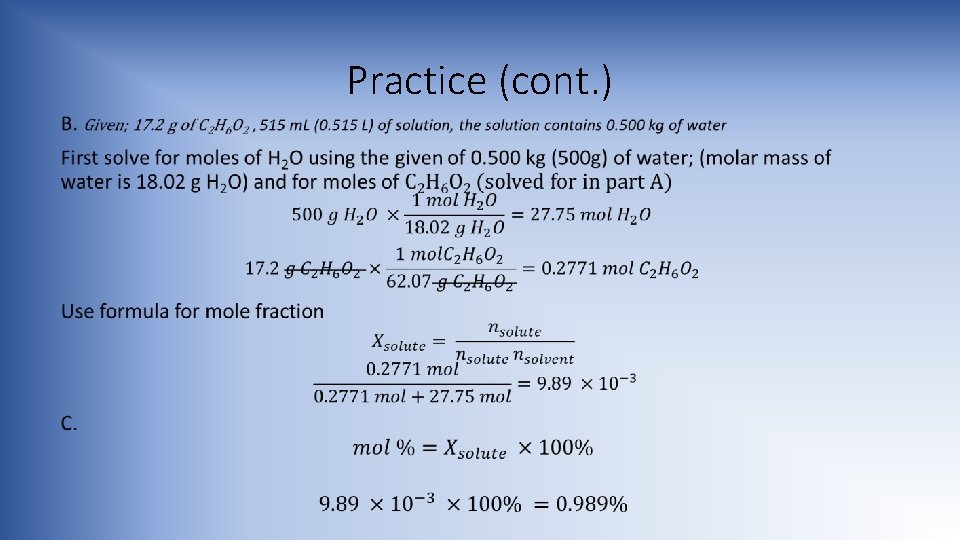
Mole Fraction and Mole Percent • The mole fraction is the moles of solute divided by the moles of solute and the moles of solvent • Multiplying the mole fraction (Xsolute) by 100% will give you the mole percent
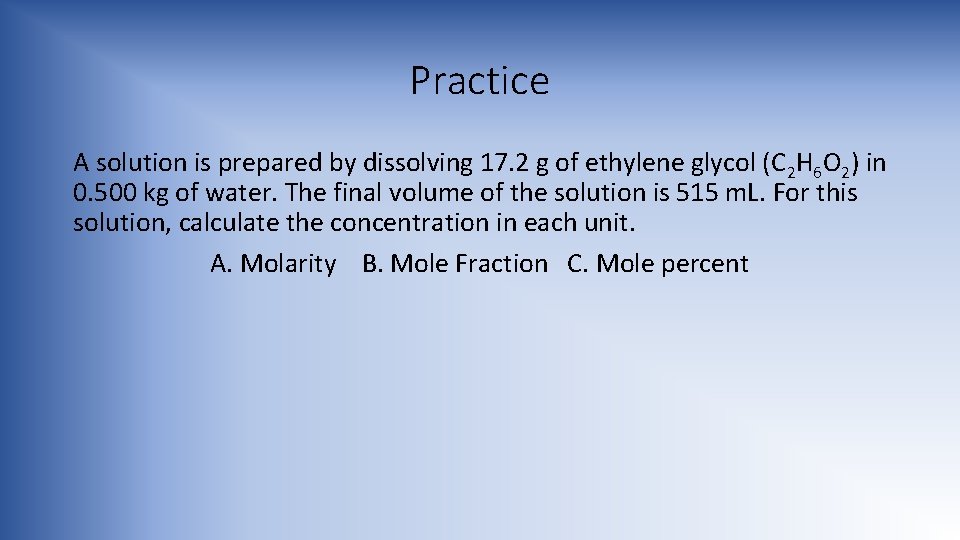
Practice A solution is prepared by dissolving 17. 2 g of ethylene glycol (C 2 H 6 O 2) in 0. 500 kg of water. The final volume of the solution is 515 m. L. For this solution, calculate the concentration in each unit. A. Molarity B. Mole Fraction C. Mole percent
Practice (cont. ) •
Practice (cont. ) •
• More Practice
- Slides: 17