
12 3 Properties of vision The human eye
- Slides: 20
12. 3 Properties of vision • The human eye • Visual defects and their corrections • Visual angle © Manhattan Press (H. K. ) Ltd. 1
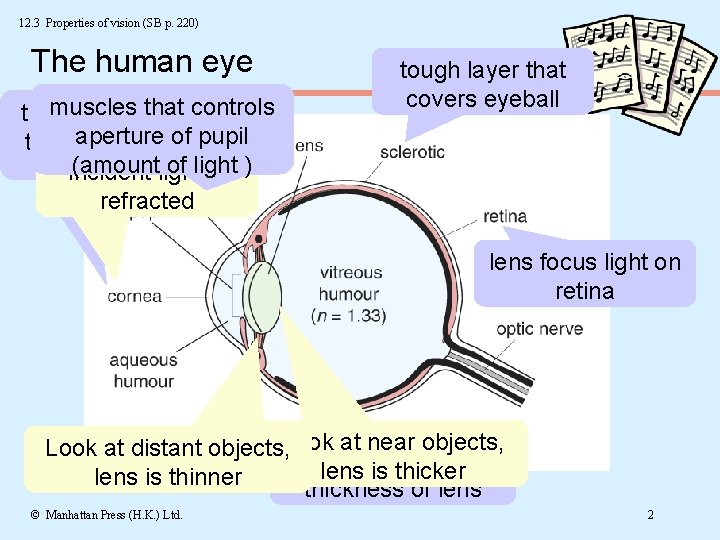
12. 3 Properties of vision (SB p. 220) The human eye muscles that transparent layercontrols aperture of pupil that covers front (amount of light portion of eye incident light is ) refracted tough layer that covers eyeball lens focus light on retina at near objects, Look at distant objects, Look muscle that controls lens is thicker lens is thinner thickness of lens © Manhattan Press (H. K. ) Ltd. 2
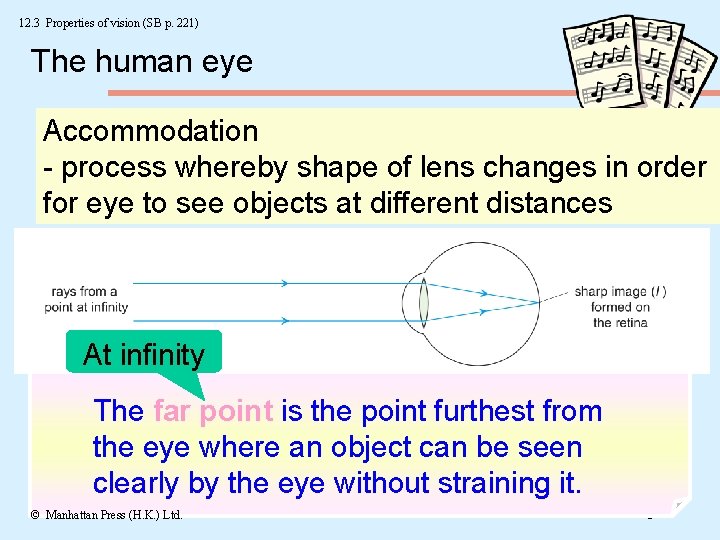
12. 3 Properties of vision (SB p. 221) The human eye Accommodation - process whereby shape of lens changes in order for eye to see objects at different distances At infinity The far point is the point furthest from the eye where an object can be seen clearly by the eye without straining it. © Manhattan Press (H. K. ) Ltd. 3
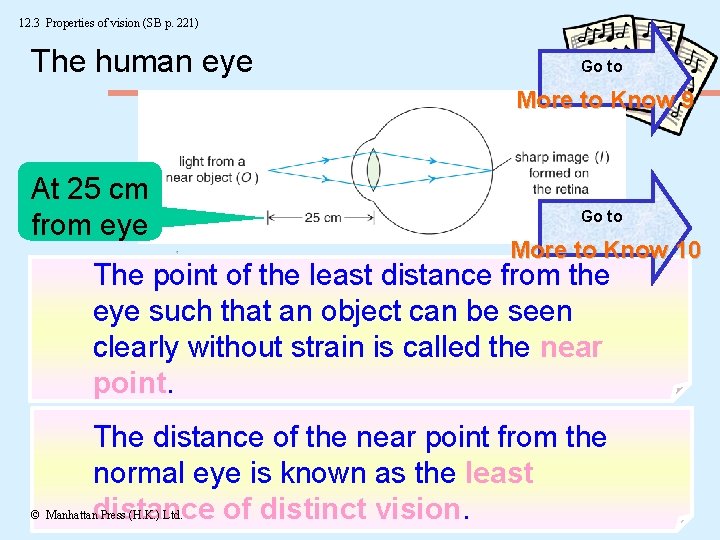
12. 3 Properties of vision (SB p. 221) The human eye Go to More to Know 9 At 25 cm from eye Go to More to Know 10 The point of the least distance from the eye such that an object can be seen clearly without strain is called the near point. The distance of the near point from the normal eye is known as the least distance of distinct vision. © Manhattan Press (H. K. ) Ltd. 4
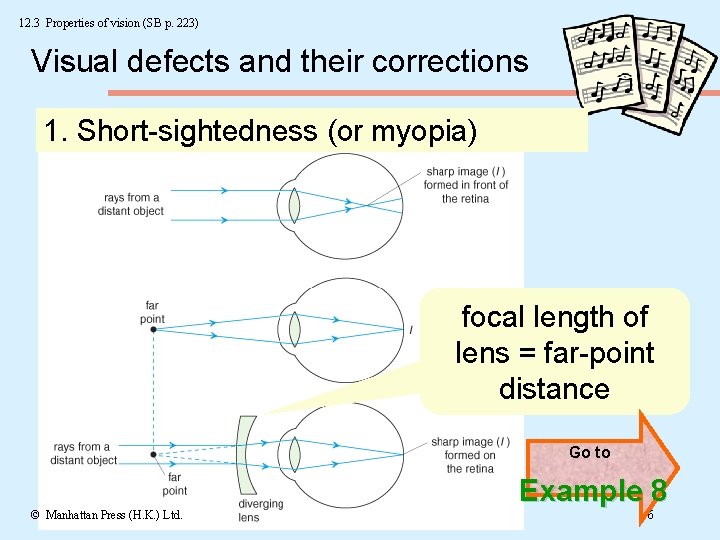
12. 3 Properties of vision (SB p. 223) Visual defects and their corrections 1. Short-sightedness (or myopia) A short-sighted person cannot see distant objects clearly. © Manhattan Press (H. K. ) Ltd. 5
12. 3 Properties of vision (SB p. 223) Visual defects and their corrections 1. Short-sightedness (or myopia) focal length of lens = far-point distance Go to Example 8 © Manhattan Press (H. K. ) Ltd. 6
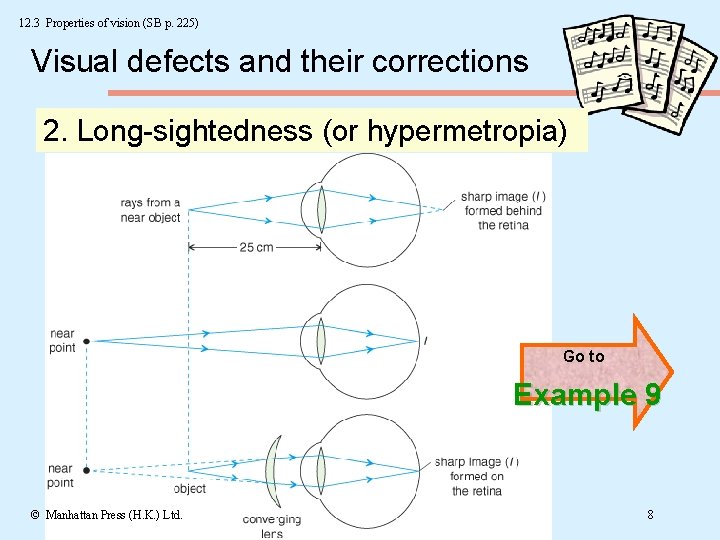
12. 3 Properties of vision (SB p. 225) Visual defects and their corrections 2. Long-sightedness (or hypermetropia) A long-sighted person can only see distant objects clearly. © Manhattan Press (H. K. ) Ltd. 7
12. 3 Properties of vision (SB p. 225) Visual defects and their corrections 2. Long-sightedness (or hypermetropia) Go to Example 9 © Manhattan Press (H. K. ) Ltd. 8
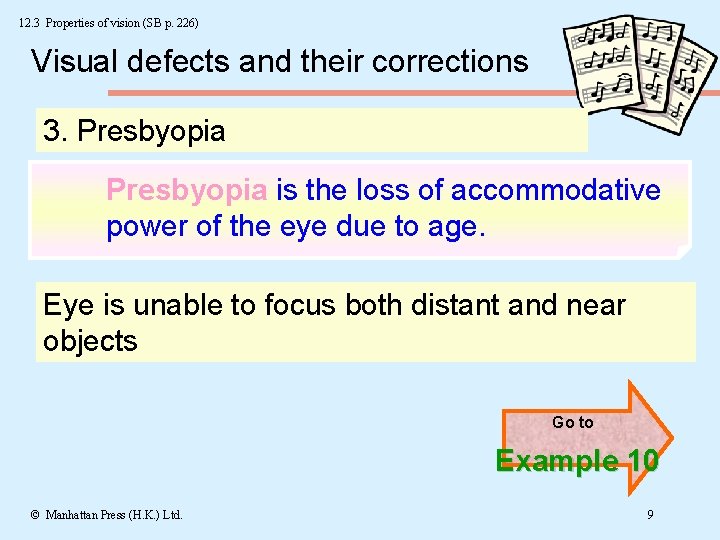
12. 3 Properties of vision (SB p. 226) Visual defects and their corrections 3. Presbyopia is the loss of accommodative power of the eye due to age. Eye is unable to focus both distant and near objects Go to Example 10 © Manhattan Press (H. K. ) Ltd. 9
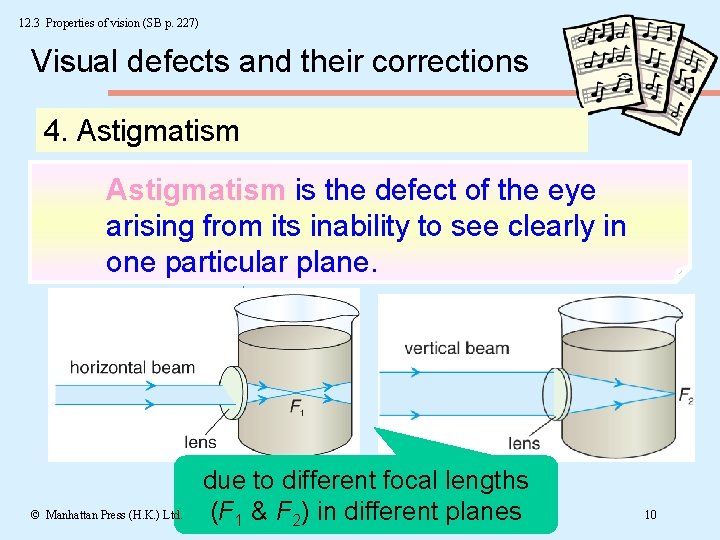
12. 3 Properties of vision (SB p. 227) Visual defects and their corrections 4. Astigmatism is the defect of the eye arising from its inability to see clearly in one particular plane. © Manhattan Press (H. K. ) Ltd. due to different focal lengths (F 1 & F 2) in different planes 10
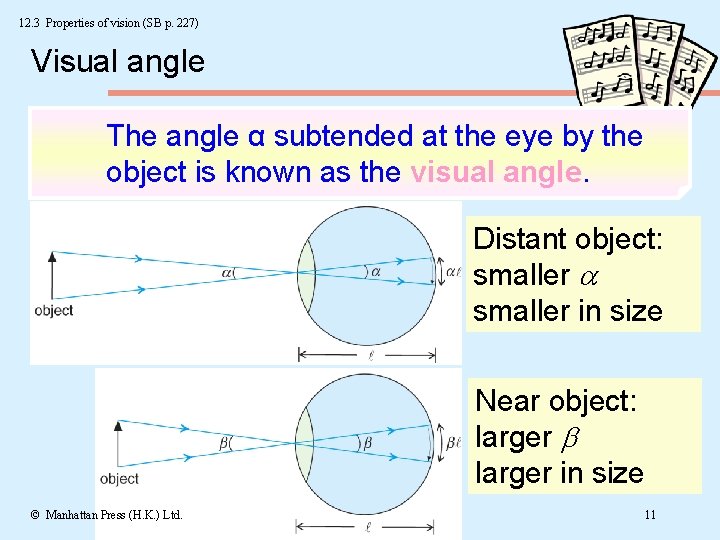
12. 3 Properties of vision (SB p. 227) Visual angle The angle α subtended at the eye by the object is known as the visual angle. Distant object: smaller in size Near object: larger in size © Manhattan Press (H. K. ) Ltd. 11
End © Manhattan Press (H. K. ) Ltd. 12
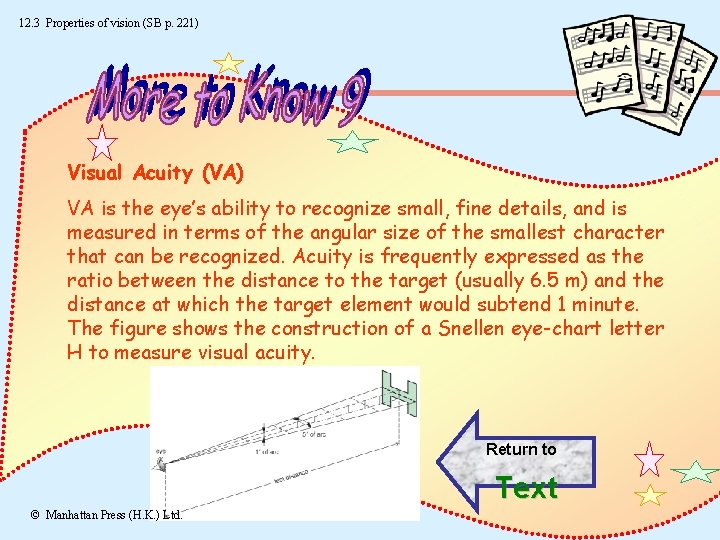
12. 3 Properties of vision (SB p. 221) Visual Acuity (VA) VA is the eye’s ability to recognize small, fine details, and is measured in terms of the angular size of the smallest character that can be recognized. Acuity is frequently expressed as the ratio between the distance to the target (usually 6. 5 m) and the distance at which the target element would subtend 1 minute. The figure shows the construction of a Snellen eye-chart letter H to measure visual acuity. Return to Text © Manhattan Press (H. K. ) Ltd. 13
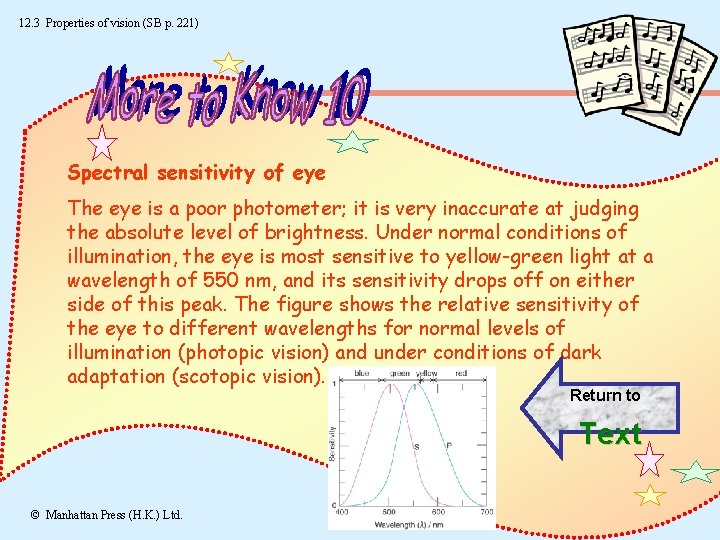
12. 3 Properties of vision (SB p. 221) Spectral sensitivity of eye The eye is a poor photometer; it is very inaccurate at judging the absolute level of brightness. Under normal conditions of illumination, the eye is most sensitive to yellow-green light at a wavelength of 550 nm, and its sensitivity drops off on either side of this peak. The figure shows the relative sensitivity of the eye to different wavelengths for normal levels of illumination (photopic vision) and under conditions of dark adaptation (scotopic vision). Return to Text © Manhattan Press (H. K. ) Ltd. 14
12. 3 Properties of vision (SB p. 224) Q: The far point and the near point of a shortsighted person are 200 cm and 15 cm respectively from the eye. (a) Which type of lens placed 2. 0 cm from the eye would enable him to see an object at infinity clearly? (b) Where would the near point be when he uses spectacles of the focal length calculated? Solution © Manhattan Press (H. K. ) Ltd. 15
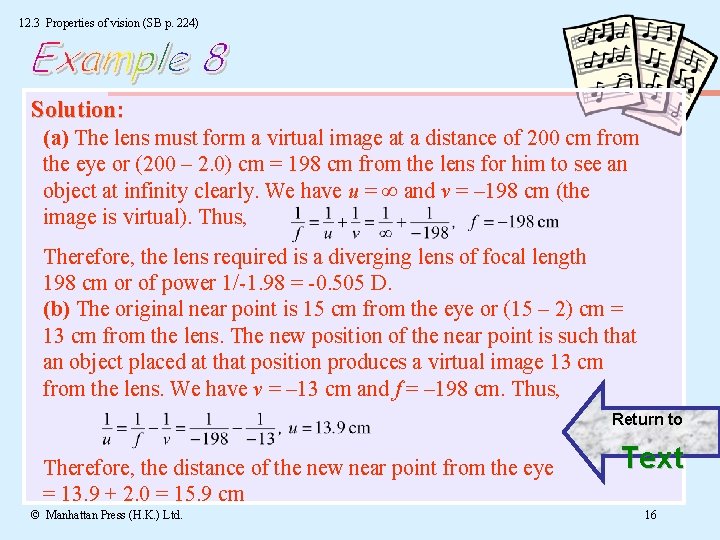
12. 3 Properties of vision (SB p. 224) Solution: (a) The lens must form a virtual image at a distance of 200 cm from the eye or (200 – 2. 0) cm = 198 cm from the lens for him to see an object at infinity clearly. We have u = ∞ and v = – 198 cm (the image is virtual). Thus, Therefore, the lens required is a diverging lens of focal length 198 cm or of power 1/-1. 98 = -0. 505 D. (b) The original near point is 15 cm from the eye or (15 – 2) cm = 13 cm from the lens. The new position of the near point is such that an object placed at that position produces a virtual image 13 cm from the lens. We have v = – 13 cm and f = – 198 cm. Thus, Return to Therefore, the distance of the new near point from the eye = 13. 9 + 2. 0 = 15. 9 cm © Manhattan Press (H. K. ) Ltd. Text 16
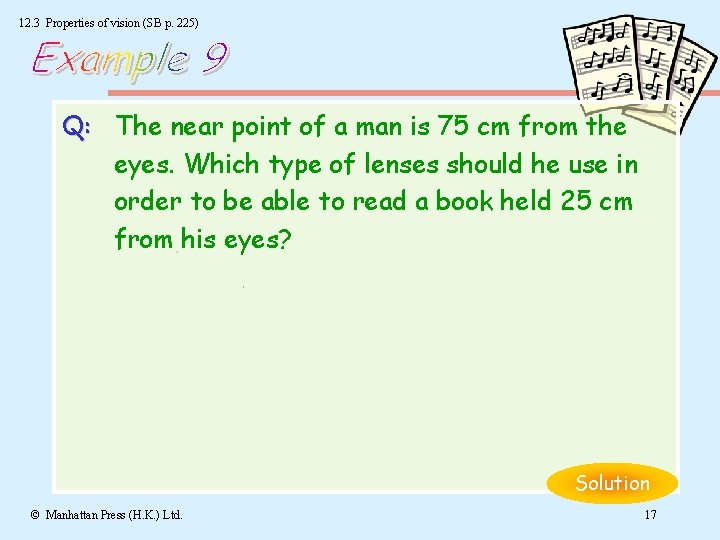
12. 3 Properties of vision (SB p. 225) Q: The near point of a man is 75 cm from the eyes. Which type of lenses should he use in order to be able to read a book held 25 cm from his eyes? Solution © Manhattan Press (H. K. ) Ltd. 17
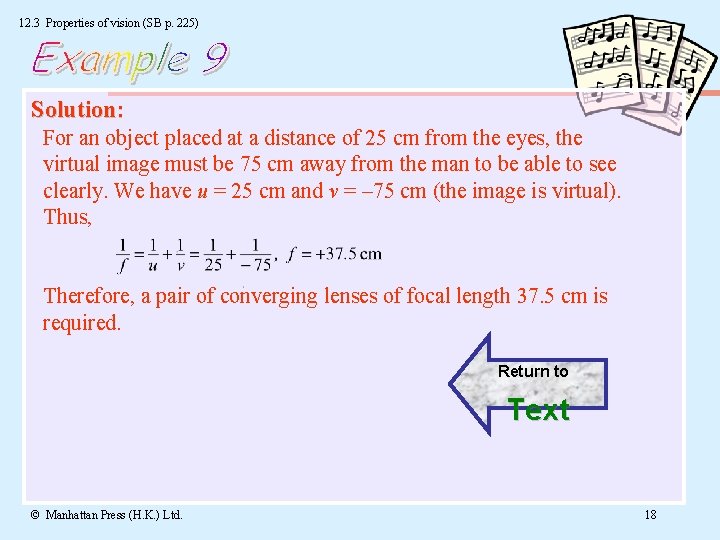
12. 3 Properties of vision (SB p. 225) Solution: For an object placed at a distance of 25 cm from the eyes, the virtual image must be 75 cm away from the man to be able to see clearly. We have u = 25 cm and v = – 75 cm (the image is virtual). Thus, Therefore, a pair of converging lenses of focal length 37. 5 cm is required. Return to Text © Manhattan Press (H. K. ) Ltd. 18
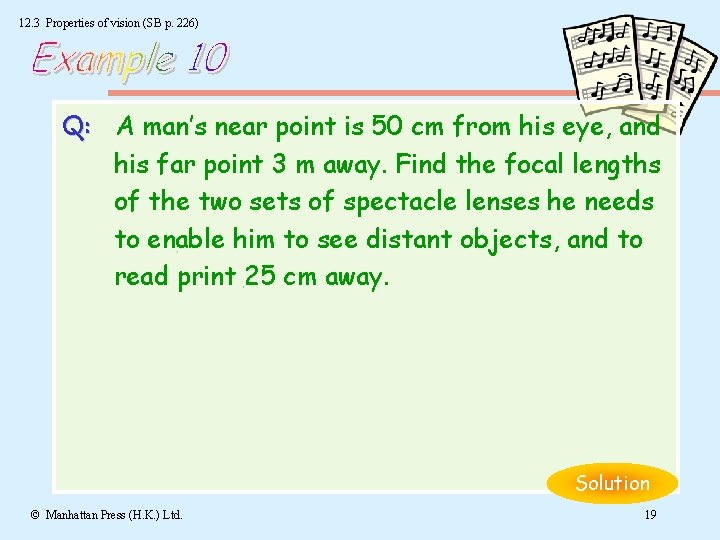
12. 3 Properties of vision (SB p. 226) Q: A man’s near point is 50 cm from his eye, and his far point 3 m away. Find the focal lengths of the two sets of spectacle lenses he needs to enable him to see distant objects, and to read print 25 cm away. Solution © Manhattan Press (H. K. ) Ltd. 19
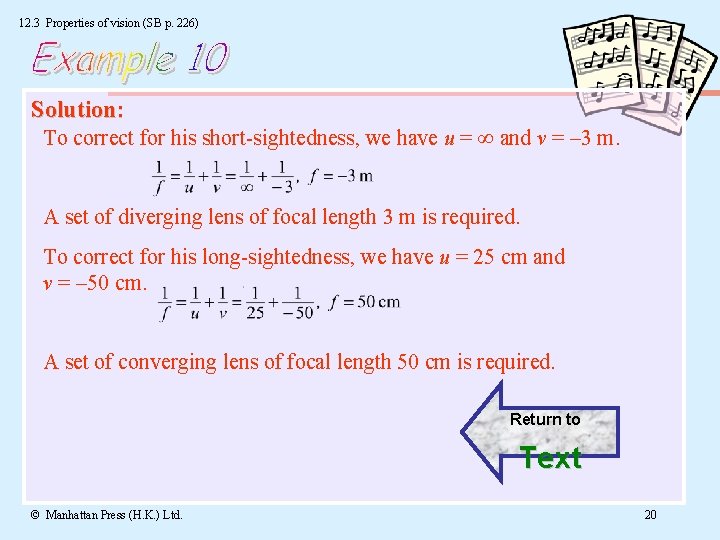
12. 3 Properties of vision (SB p. 226) Solution: To correct for his short-sightedness, we have u = ∞ and v = – 3 m. A set of diverging lens of focal length 3 m is required. To correct for his long-sightedness, we have u = 25 cm and v = – 50 cm. A set of converging lens of focal length 50 cm is required. Return to Text © Manhattan Press (H. K. ) Ltd. 20