
12 3 Lens Technologies and the Human Eye



- Slides: 18
12. 3 Lens Technologies and the Human Eye
Learning Goals • Learn how the human eye works and the common problems with our eyes • Learn about various lens technologies
Video: The Human Eye
The Human Eye
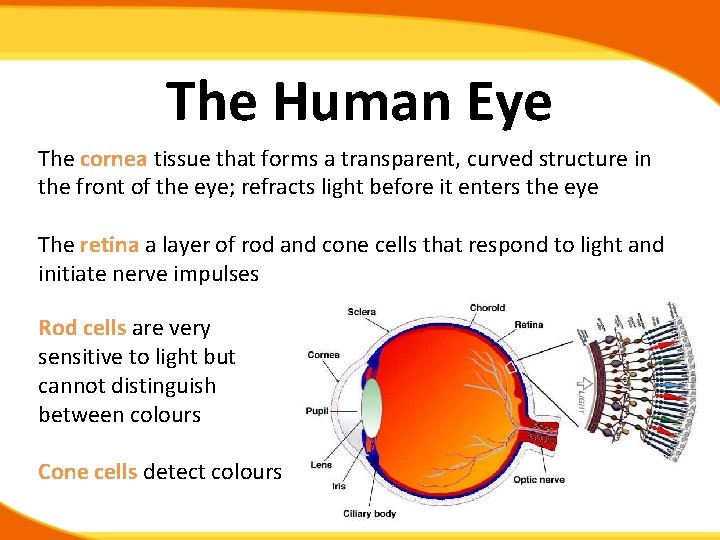
The Human Eye Lens: ability to refract light and allow the eye to focus Ciliary Muscle: changes the shape of the lens Iris: coloured part of the eye made of muscle fibres that contract and expand to open and close the pupil. Pupil: the part of the eye that light passes through Optical Nerve: connects the eye to the brain
The Human Eye The cornea tissue that forms a transparent, curved structure in the front of the eye; refracts light before it enters the eye The retina a layer of rod and cone cells that respond to light and initiate nerve impulses Rod cells are very sensitive to light but cannot distinguish between colours Cone cells detect colours
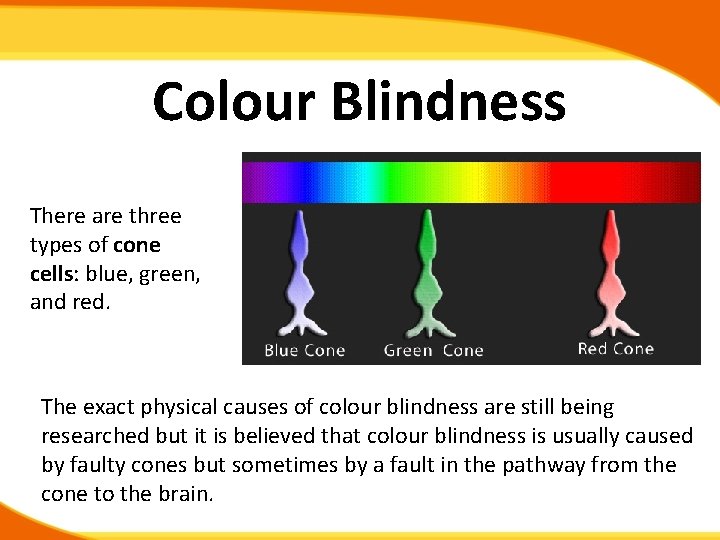
Colour Blindness There are three types of cone cells: blue, green, and red. The exact physical causes of colour blindness are still being researched but it is believed that colour blindness is usually caused by faulty cones but sometimes by a fault in the pathway from the cone to the brain.
Recall from your study of lenses that when an object is moved, the image also moves. In the eye, however, the distance between the retina and the lens is always the same. So how do we still see clear images at different distances?
The Human Eye
Video: Vision Problems
4 Common Vision Problems: 1. Myopia 2. Hyperopia 3. Presbyopia 4. Astigmatism
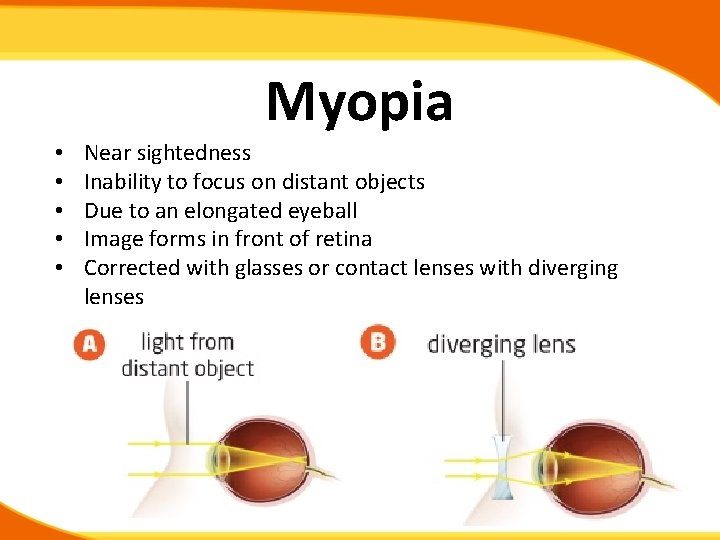
Myopia • • • Near sightedness Inability to focus on distant objects Due to an elongated eyeball Image forms in front of retina Corrected with glasses or contact lenses with diverging lenses
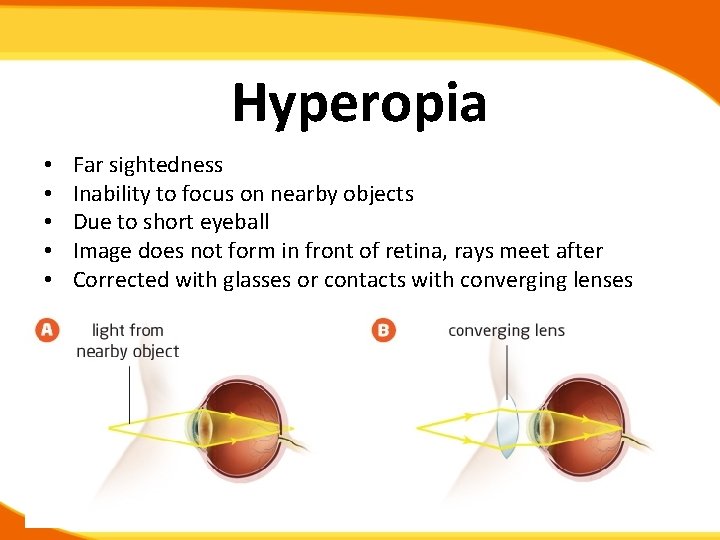
Hyperopia • • • Far sightedness Inability to focus on nearby objects Due to short eyeball Image does not form in front of retina, rays meet after Corrected with glasses or contacts with converging lenses
Video: Myopia and Hyperopia
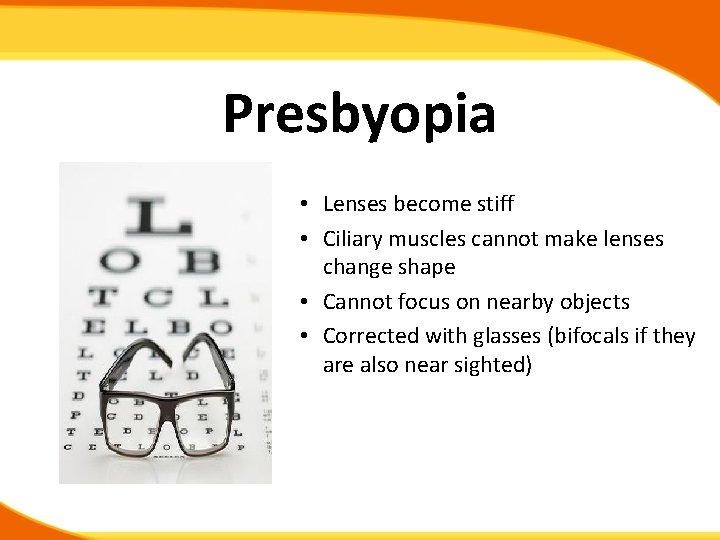
Presbyopia • Lenses become stiff • Ciliary muscles cannot make lenses change shape • Cannot focus on nearby objects • Corrected with glasses (bifocals if they are also near sighted)
Astigmatism • Blurred/distorted vision • Due to incorrectly, oval shaped cornea
Video: Laser Eye Surgery https: //www. youtube. com/watch? v=0 V 4 I 2 xzw. Gd 4 https: //www. youtube. com/watch? v=KDg. ZZh. ARLs. Q
Homework • Read 12. 3 • Chapter 12 Review Questions: pg 518 # 8, 10, 12, 13, 18