
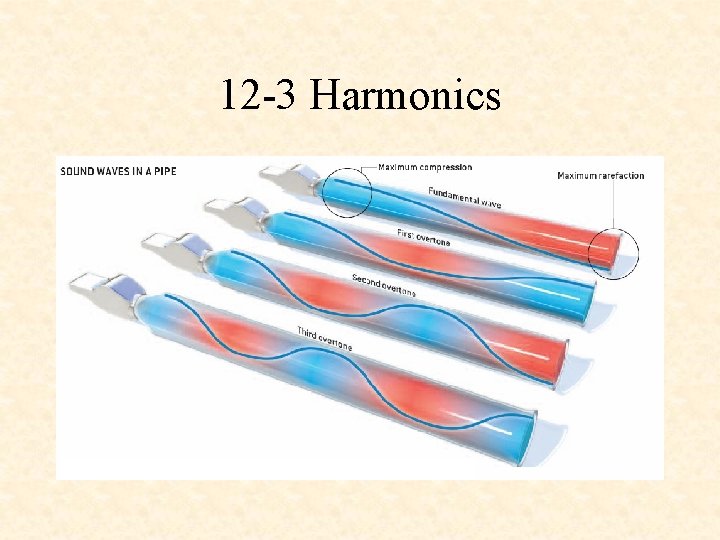
12 3 Harmonics Harmonics a set of natural
- Slides: 13
12 -3 Harmonics
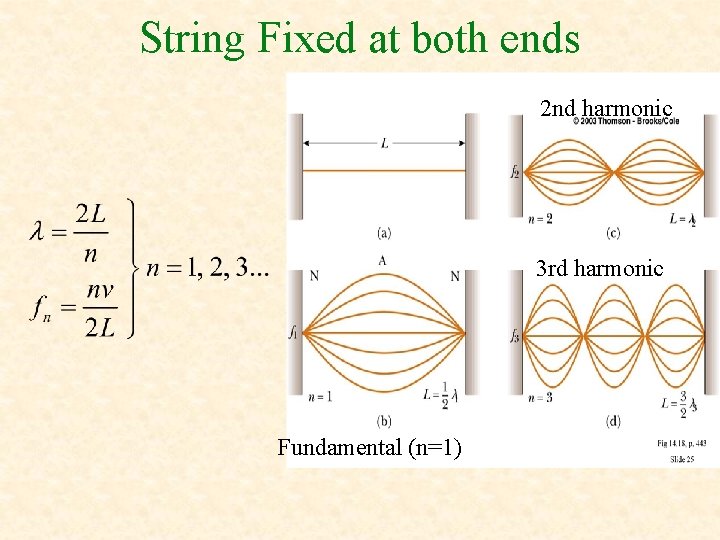
• Harmonics: a set of natural frequencies which are related by being integer multiples of the natural (lowest or fundamental) frequency.
String Fixed at both ends 2 nd harmonic 3 rd harmonic Fundamental (n=1)
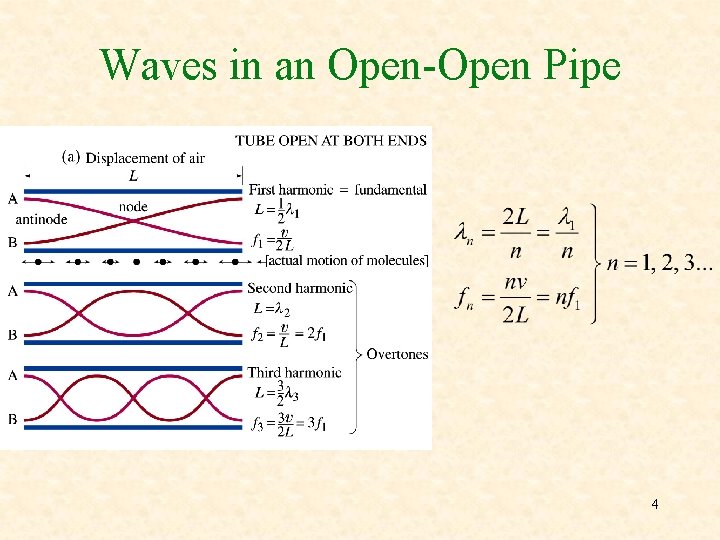
Waves in an Open-Open Pipe 4
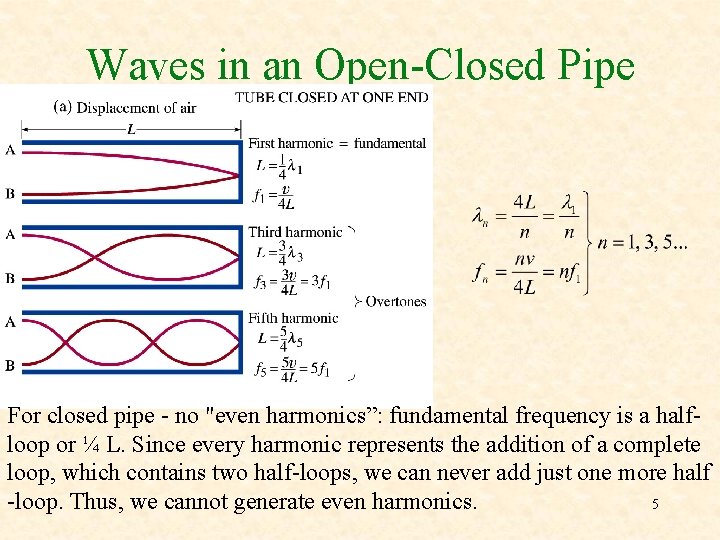
Waves in an Open-Closed Pipe For closed pipe - no "even harmonics”: fundamental frequency is a halfloop or ¼ L. Since every harmonic represents the addition of a complete loop, which contains two half-loops, we can never add just one more half 5 -loop. Thus, we cannot generate even harmonics.
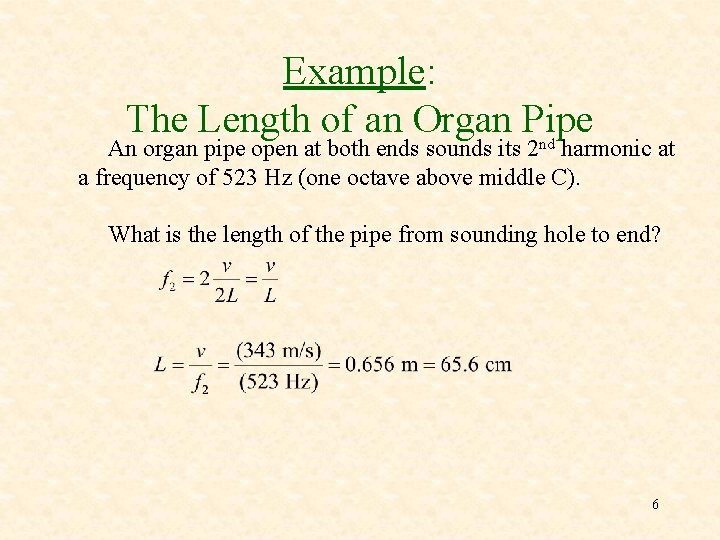
Example: The Length of an Organ Pipe An organ pipe open at both ends sounds its 2 nd harmonic at a frequency of 523 Hz (one octave above middle C). What is the length of the pipe from sounding hole to end? 6
Complex (Real) Sound Waves • Harmonics account for the quality of sound or timbre. • Most sounds that we hear are not pure tones (single frequency ) • But are superpositions of many frequencies with various amplitudes • For example, when a note (tone, frequency) is played on a musical instrument, we actually hear all of the harmonics (f 1, f 2, f 3, …), but usually the amplitudes are decreased for the higher harmonics • This is what gives each instrument it’s unique sound
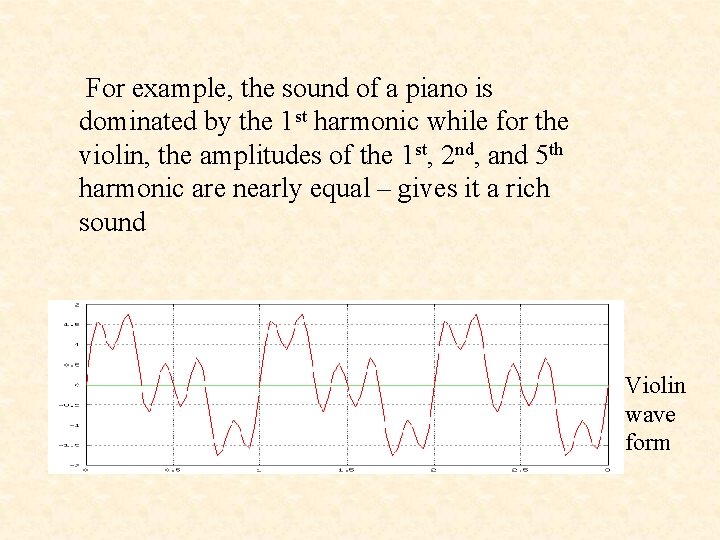
For example, the sound of a piano is dominated by the 1 st harmonic while for the violin, the amplitudes of the 1 st, 2 nd, and 5 th harmonic are nearly equal – gives it a rich sound Violin wave form
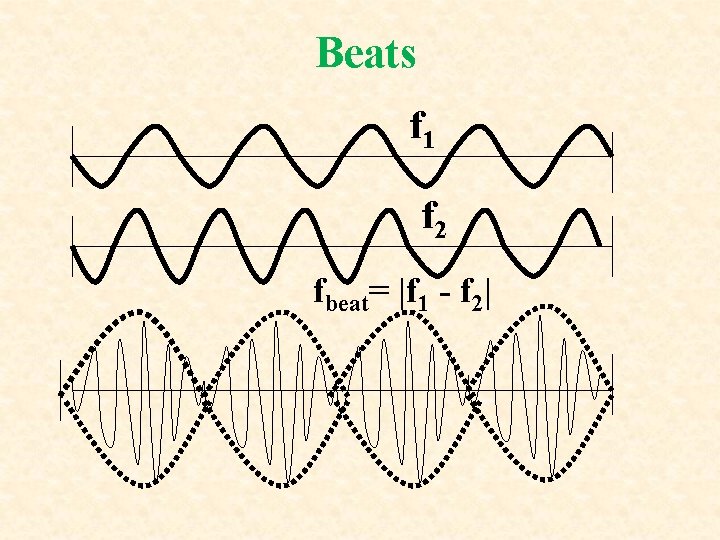
Beats • Interference from two waves with slightly different frequency. • Alternating loud and faint sound can be heard. This periodic variation in loudness is called beats. • Beats are useful for tuning instruments.
Beats f 1 f 2 fbeat= |f 1 - f 2|
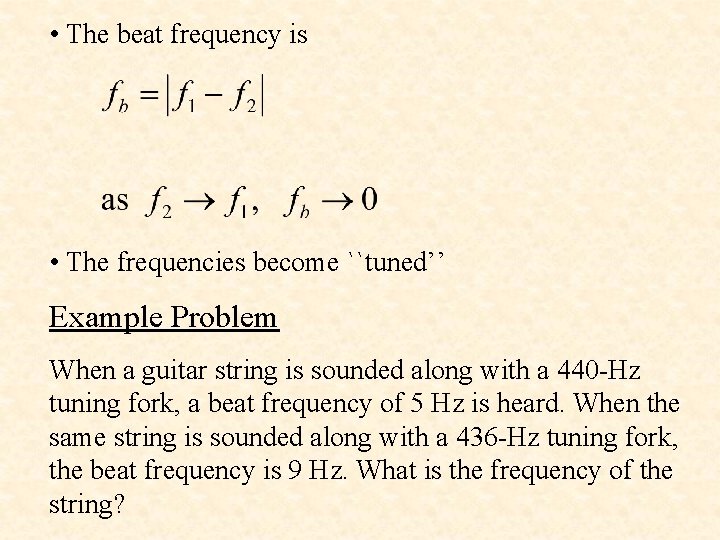
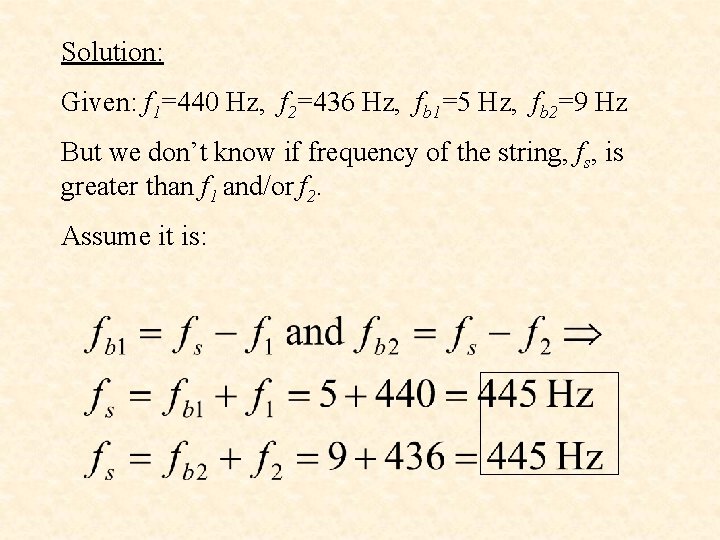
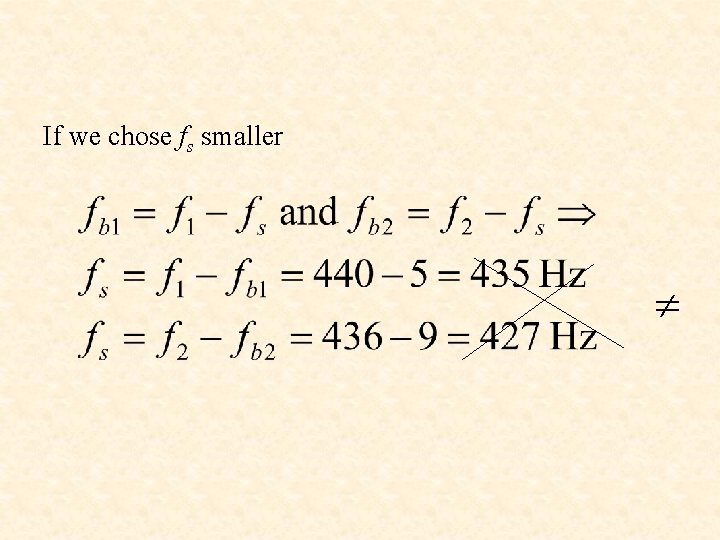
• The beat frequency is • The frequencies become ``tuned’’ Example Problem When a guitar string is sounded along with a 440 -Hz tuning fork, a beat frequency of 5 Hz is heard. When the same string is sounded along with a 436 -Hz tuning fork, the beat frequency is 9 Hz. What is the frequency of the string?
Solution: Given: f 1=440 Hz, f 2=436 Hz, fb 1=5 Hz, fb 2=9 Hz But we don’t know if frequency of the string, fs, is greater than f 1 and/or f 2. Assume it is:
If we chose fs smaller