
12 2 Chromosomes and DNA Replication 12 2

- Slides: 11
12 -2 Chromosomes and DNA Replication 12– 2 Chromosomes and DNA Replication Copyright Pearson Prentice Hall
DNA and Chromosomes Eukaryotic DNA is located in the cell nucleus inside chromosomes. The number of chromosomes varies in each species. Copyright Pearson Prentice Hall
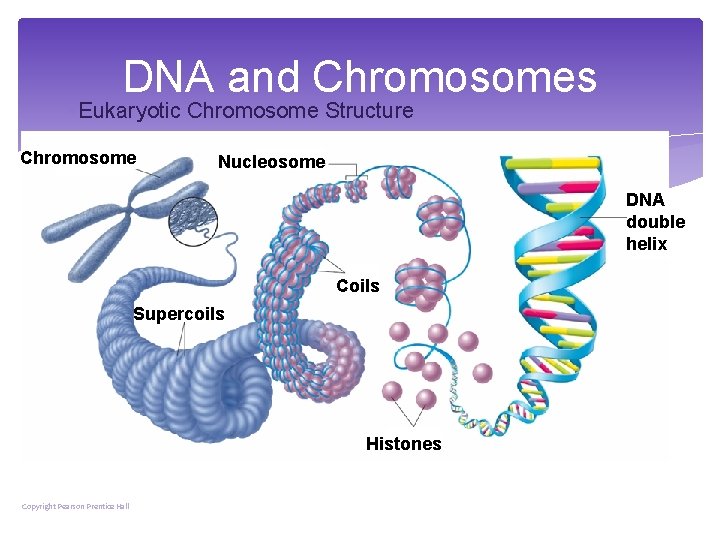
DNA and Chromosomes Chromosome Structure Eukaryotic chromosomes contain DNA and protein, tightly packed together to form chromatin. Chromatin consists of DNA tightly coiled around proteins called histones. DNA and histone molecules form nucleosomes. Nucleosomes pack together, forming a thick fiber. Copyright Pearson Prentice Hall
DNA and Chromosomes Eukaryotic Chromosome Structure Chromosome Nucleosome DNA double helix Coils Supercoils Histones Copyright Pearson Prentice Hall
DNA Replication Each strand of the DNA double helix has all the information needed to reconstruct the other half by the mechanism of base pairing. Copyright Pearson Prentice Hall
DNA Replication The sites where separation and replication occur are called replication forks. Copyright Pearson Prentice Hall
DNA Replication Duplicating DNA Before a cell divides, it duplicates its DNA in a process called replication. Replication ensures that each resulting cell will have a complete set of DNA. Copyright Pearson Prentice Hall
DNA Replication During DNA replication, the DNA molecule separates into two strands, then produces 2 new complementary strands following the rules of base pairing. Each strand of the double helix of DNA serves as a template for the new strand. Copyright Pearson Prentice Hall
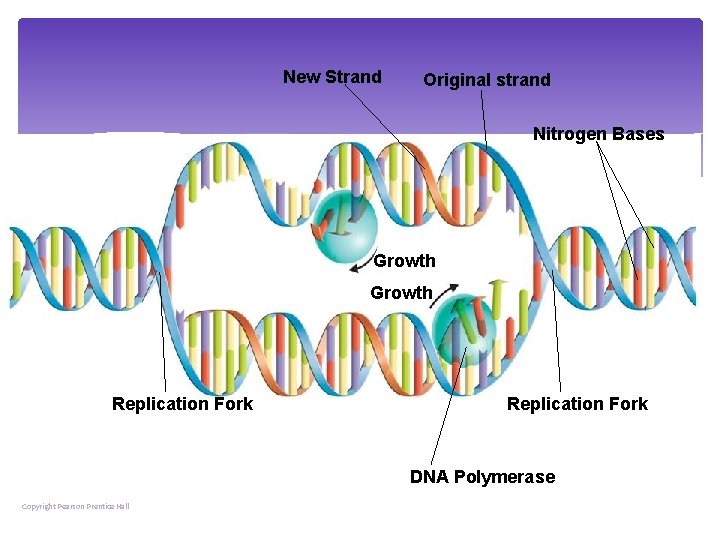
New Strand Original strand Nitrogen Bases Growth Replication Fork DNA Polymerase Copyright Pearson Prentice Hall
DNA Replication How Replication Occurs DNA replication is carried out by enzymes that “unzip” a molecule of DNA. Hydrogen bonds between base pairs are broken and the two strands of DNA unwind. Copyright Pearson Prentice Hall
DNA Replication The principal enzyme involved in DNA replication is DNA polymerase joins individual nucleotides to produce a DNA molecule and then “proofreads” each new DNA strand. Copyright Pearson Prentice Hall