
12 2 Chemical Calculations Chapter 12 Stoichiometry 12
- Slides: 60
12. 2 Chemical Calculations > Chapter 12 Stoichiometry 12. 1 The Arithmetic of Equations 12. 2 Chemical Calculations 12. 3 Limiting Reagent and Percent Yield 1 Copyright © Pearson Education, Inc. , or its affiliates. All Rights Reserved.
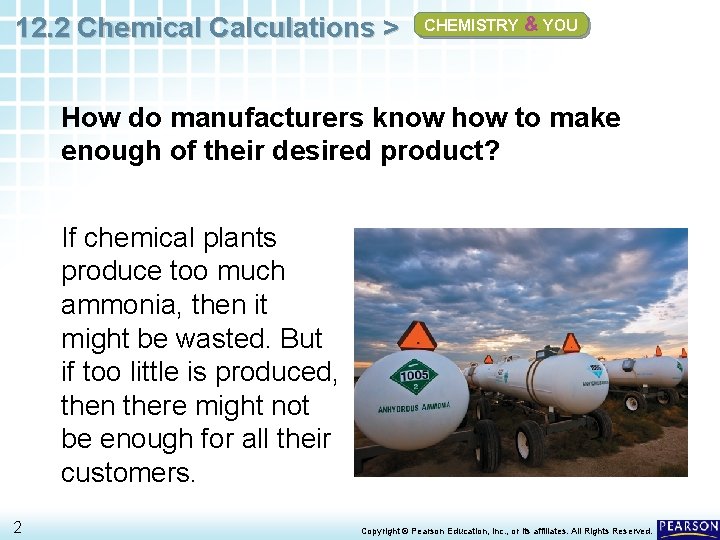
12. 2 Chemical Calculations > CHEMISTRY & YOU How do manufacturers know how to make enough of their desired product? If chemical plants produce too much ammonia, then it might be wasted. But if too little is produced, then there might not be enough for all their customers. 2 Copyright © Pearson Education, Inc. , or its affiliates. All Rights Reserved.
12. 2 Chemical Calculations > Writing and Using Mole Ratios How are mole ratios used in chemical calculations? 3 Copyright © Pearson Education, Inc. , or its affiliates. All Rights Reserved.
12. 2 Chemical Calculations > Writing and Using Mole Ratios A mole ratio is a conversion factor derived from the coefficients of a balanced chemical equation interpreted in terms of moles. 4 Copyright © Pearson Education, Inc. , or its affiliates. All Rights Reserved.
12. 2 Chemical Calculations > Writing and Using Mole Ratios In chemical calculations, mole ratios are used to convert between a given number of moles of a reactant or product to moles of a different reactant or product. 5 Copyright © Pearson Education, Inc. , or its affiliates. All Rights Reserved.
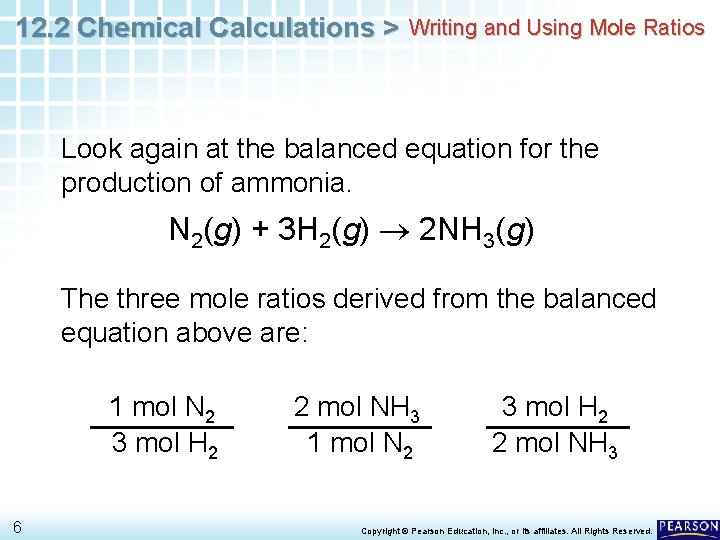
12. 2 Chemical Calculations > Writing and Using Mole Ratios Look again at the balanced equation for the production of ammonia. N 2(g) + 3 H 2(g) 2 NH 3(g) The three mole ratios derived from the balanced equation above are: 1 mol N 2 3 mol H 2 6 2 mol NH 3 1 mol N 2 3 mol H 2 2 mol NH 3 Copyright © Pearson Education, Inc. , or its affiliates. All Rights Reserved.
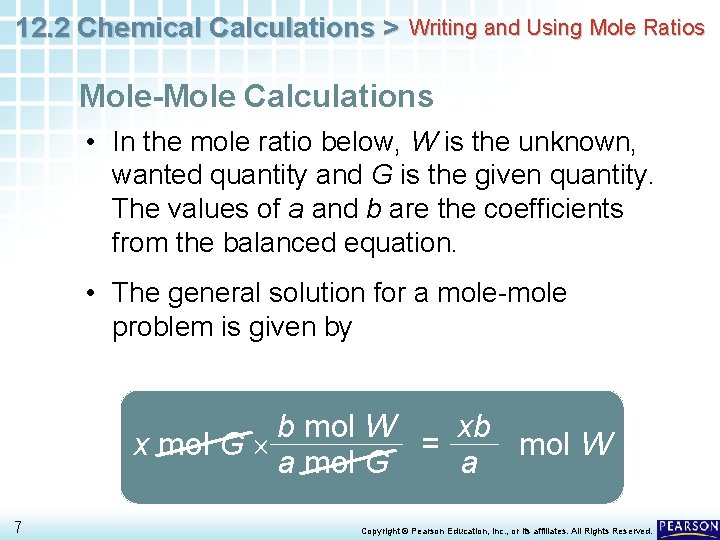
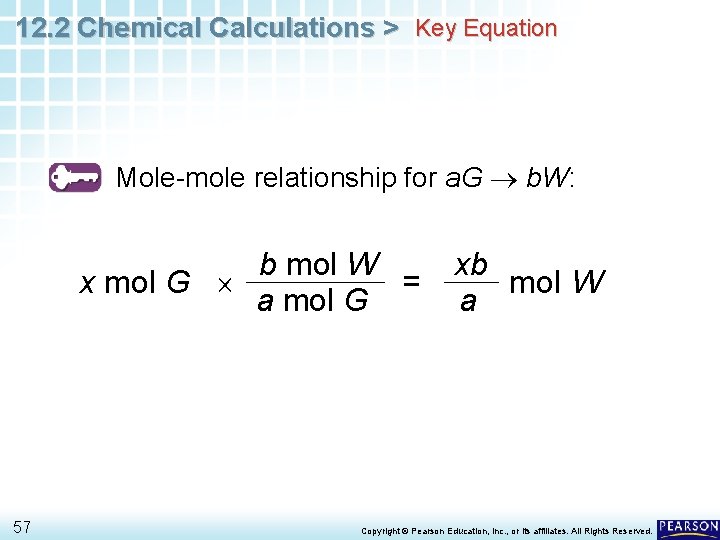
12. 2 Chemical Calculations > Writing and Using Mole Ratios Mole-Mole Calculations • In the mole ratio below, W is the unknown, wanted quantity and G is the given quantity. The values of a and b are the coefficients from the balanced equation. • The general solution for a mole-mole problem is given by b mol W xb x mol G = mol W a mol G a 7 Copyright © Pearson Education, Inc. , or its affiliates. All Rights Reserved.
12. 2 Chemical Calculations > Sample Problem 12. 3 Calculating Moles of a Product How many moles of NH 3 are produced when 0. 60 mol of nitrogen reacts with hydrogen? 8 Copyright © Pearson Education, Inc. , or its affiliates. All Rights Reserved.
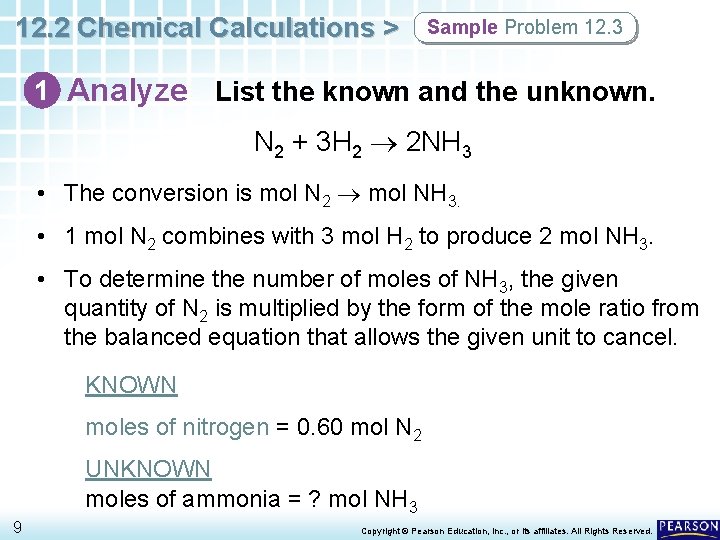
12. 2 Chemical Calculations > Sample Problem 12. 3 1 Analyze List the known and the unknown. N 2 + 3 H 2 2 NH 3 • The conversion is mol N 2 mol NH 3. • 1 mol N 2 combines with 3 mol H 2 to produce 2 mol NH 3. • To determine the number of moles of NH 3, the given quantity of N 2 is multiplied by the form of the mole ratio from the balanced equation that allows the given unit to cancel. KNOWN moles of nitrogen = 0. 60 mol N 2 UNKNOWN moles of ammonia = ? mol NH 3 9 Copyright © Pearson Education, Inc. , or its affiliates. All Rights Reserved.
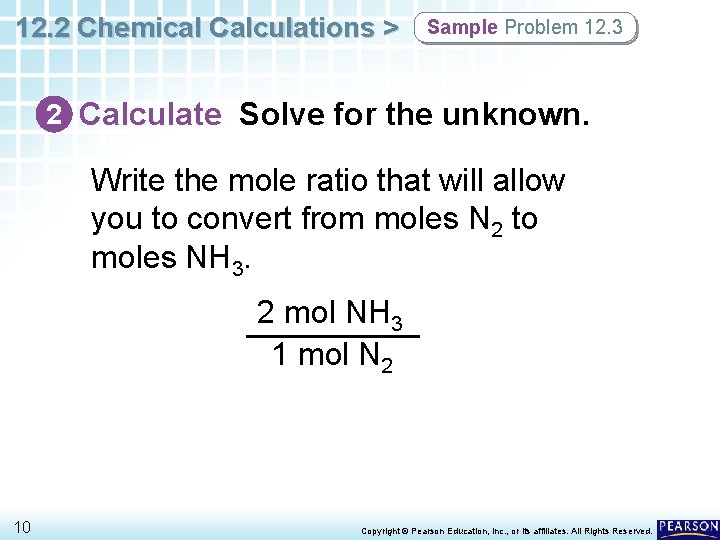
12. 2 Chemical Calculations > Sample Problem 12. 3 2 Calculate Solve for the unknown. Write the mole ratio that will allow you to convert from moles N 2 to moles NH 3. 2 mol NH 3 1 mol N 2 10 Copyright © Pearson Education, Inc. , or its affiliates. All Rights Reserved.
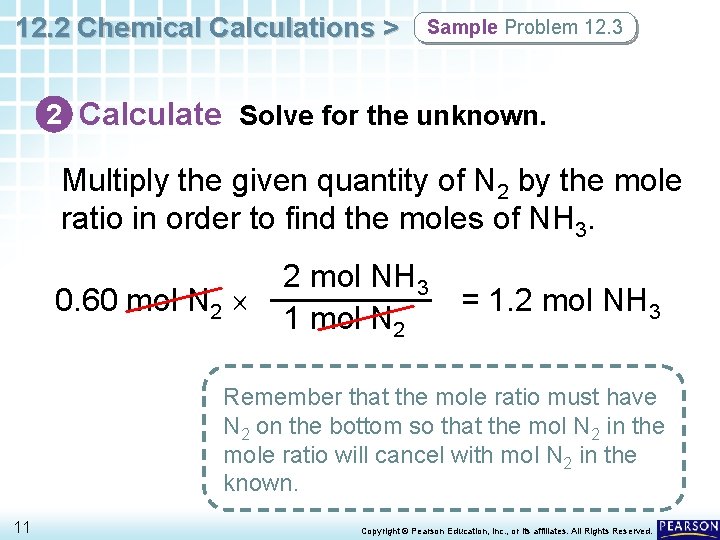
12. 2 Chemical Calculations > Sample Problem 12. 3 2 Calculate Solve for the unknown. Multiply the given quantity of N 2 by the mole ratio in order to find the moles of NH 3. 0. 60 mol N 2 2 mol NH 3 1 mol N 2 = 1. 2 mol NH 3 Remember that the mole ratio must have N 2 on the bottom so that the mol N 2 in the mole ratio will cancel with mol N 2 in the known. 11 Copyright © Pearson Education, Inc. , or its affiliates. All Rights Reserved.
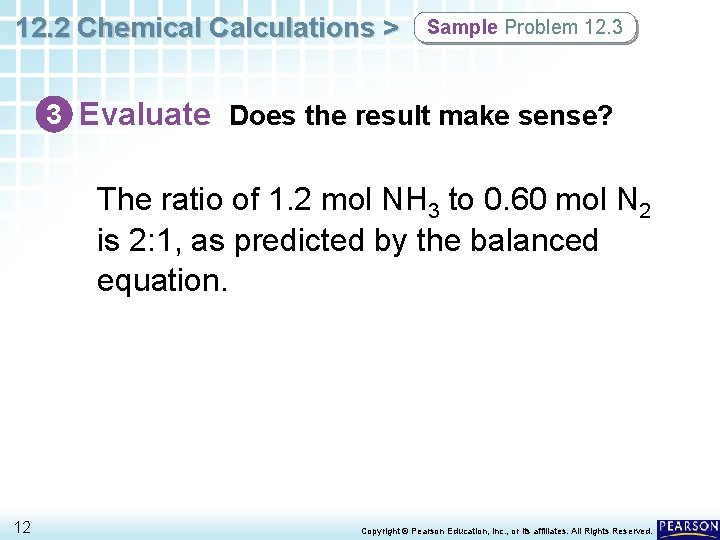
12. 2 Chemical Calculations > Sample Problem 12. 3 3 Evaluate Does the result make sense? The ratio of 1. 2 mol NH 3 to 0. 60 mol N 2 is 2: 1, as predicted by the balanced equation. 12 Copyright © Pearson Education, Inc. , or its affiliates. All Rights Reserved.
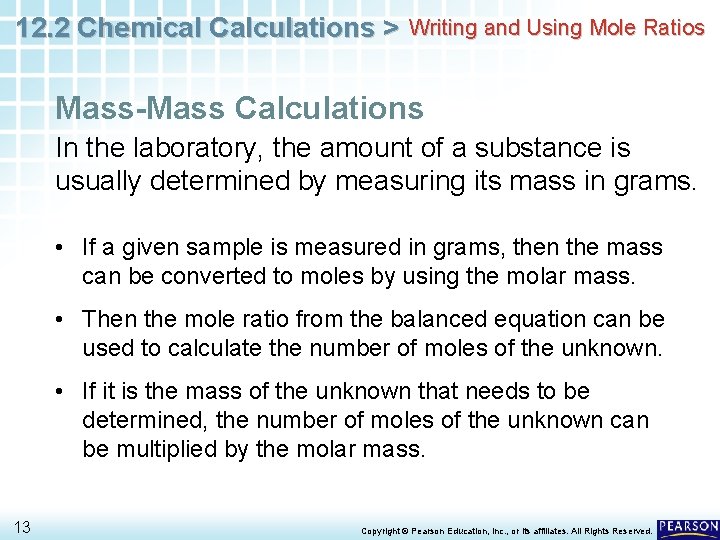
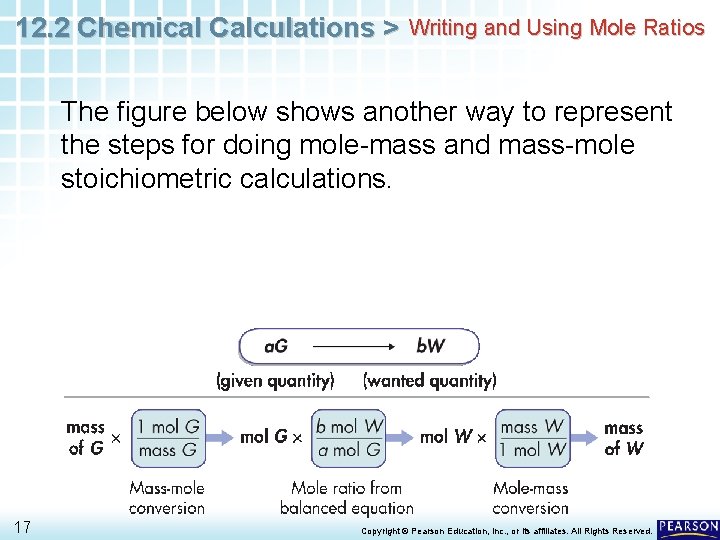
12. 2 Chemical Calculations > Writing and Using Mole Ratios Mass-Mass Calculations In the laboratory, the amount of a substance is usually determined by measuring its mass in grams. • If a given sample is measured in grams, then the mass can be converted to moles by using the molar mass. • Then the mole ratio from the balanced equation can be used to calculate the number of moles of the unknown. • If it is the mass of the unknown that needs to be determined, the number of moles of the unknown can be multiplied by the molar mass. 13 Copyright © Pearson Education, Inc. , or its affiliates. All Rights Reserved.
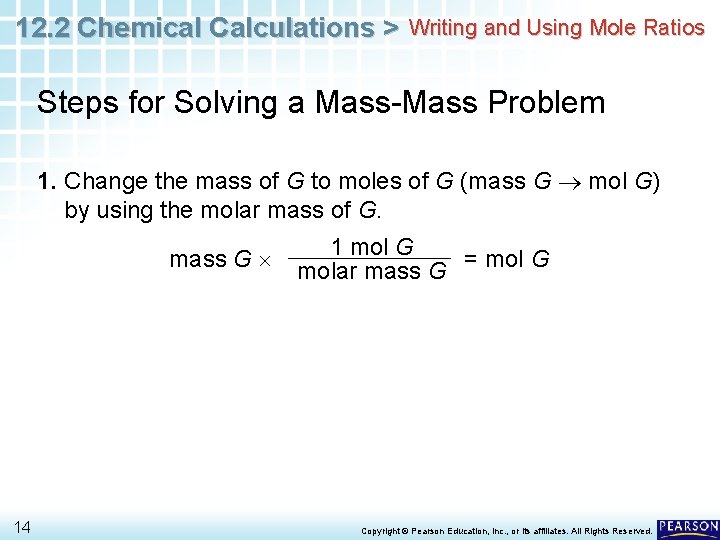
12. 2 Chemical Calculations > Writing and Using Mole Ratios Steps for Solving a Mass-Mass Problem 1. Change the mass of G to moles of G (mass G mol G) by using the molar mass of G. mass G 14 1 mol G molar mass G = mol G Copyright © Pearson Education, Inc. , or its affiliates. All Rights Reserved.
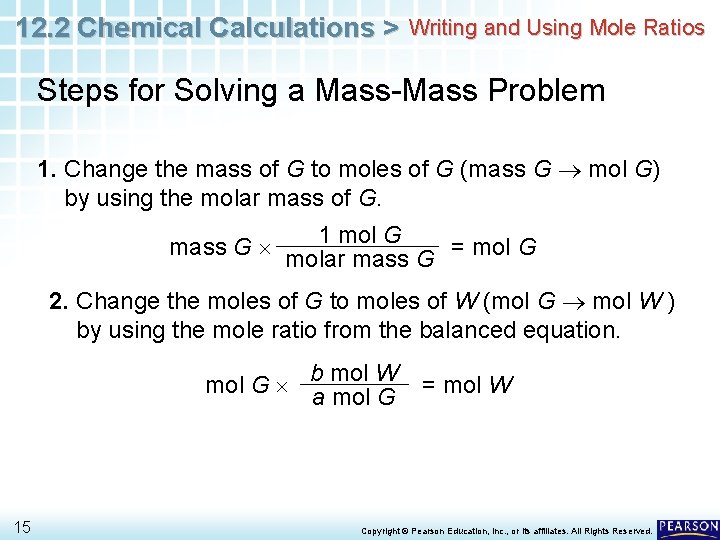
12. 2 Chemical Calculations > Writing and Using Mole Ratios Steps for Solving a Mass-Mass Problem 1. Change the mass of G to moles of G (mass G mol G) by using the molar mass of G. mass G 1 mol G = mol G molar mass G 2. Change the moles of G to moles of W (mol G mol W ) by using the mole ratio from the balanced equation. b mol W mol G a mol G 15 = mol W Copyright © Pearson Education, Inc. , or its affiliates. All Rights Reserved.
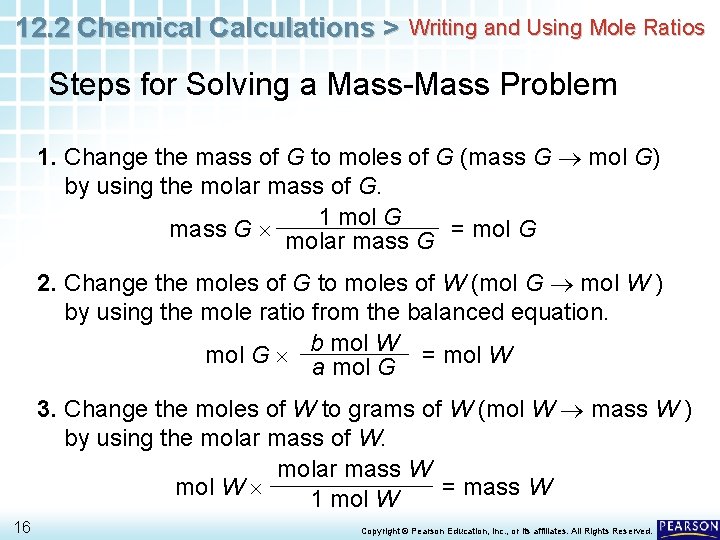
12. 2 Chemical Calculations > Writing and Using Mole Ratios Steps for Solving a Mass-Mass Problem 1. Change the mass of G to moles of G (mass G mol G) by using the molar mass of G. 1 mol G mass G = mol G molar mass G 2. Change the moles of G to moles of W (mol G mol W ) by using the mole ratio from the balanced equation. b mol W mol G a mol G = mol W 3. Change the moles of W to grams of W (mol W mass W ) by using the molar mass of W. molar mass W mol W = mass W 1 mol W 16 Copyright © Pearson Education, Inc. , or its affiliates. All Rights Reserved.
12. 2 Chemical Calculations > Writing and Using Mole Ratios The figure below shows another way to represent the steps for doing mole-mass and mass-mole stoichiometric calculations. 17 Copyright © Pearson Education, Inc. , or its affiliates. All Rights Reserved.
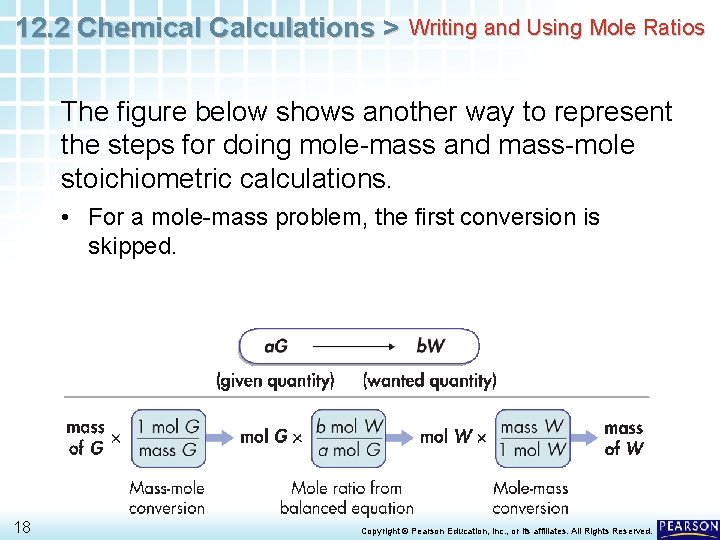
12. 2 Chemical Calculations > Writing and Using Mole Ratios The figure below shows another way to represent the steps for doing mole-mass and mass-mole stoichiometric calculations. • For a mole-mass problem, the first conversion is skipped. 18 Copyright © Pearson Education, Inc. , or its affiliates. All Rights Reserved.
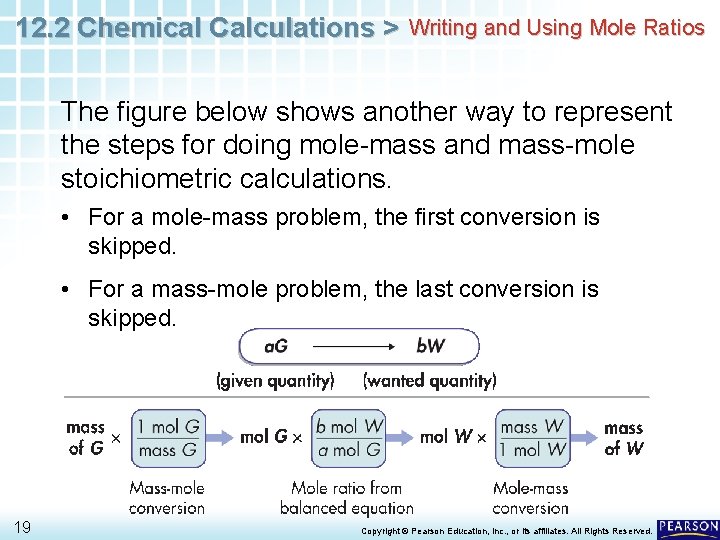
12. 2 Chemical Calculations > Writing and Using Mole Ratios The figure below shows another way to represent the steps for doing mole-mass and mass-mole stoichiometric calculations. • For a mole-mass problem, the first conversion is skipped. • For a mass-mole problem, the last conversion is skipped. 19 Copyright © Pearson Education, Inc. , or its affiliates. All Rights Reserved.
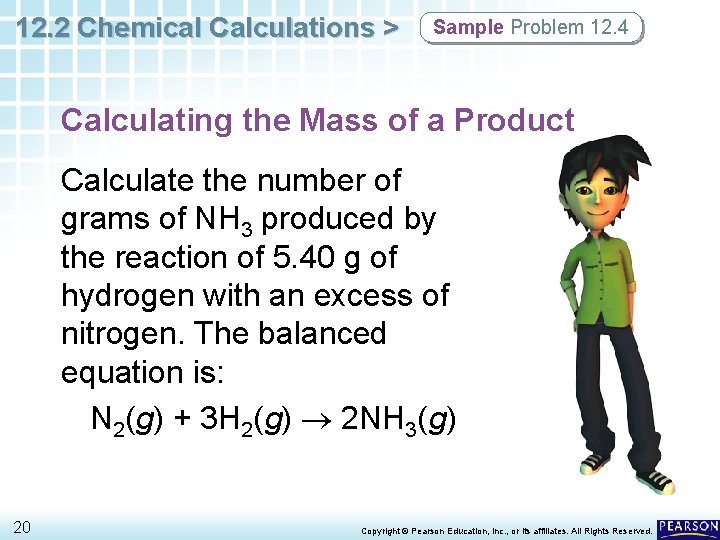
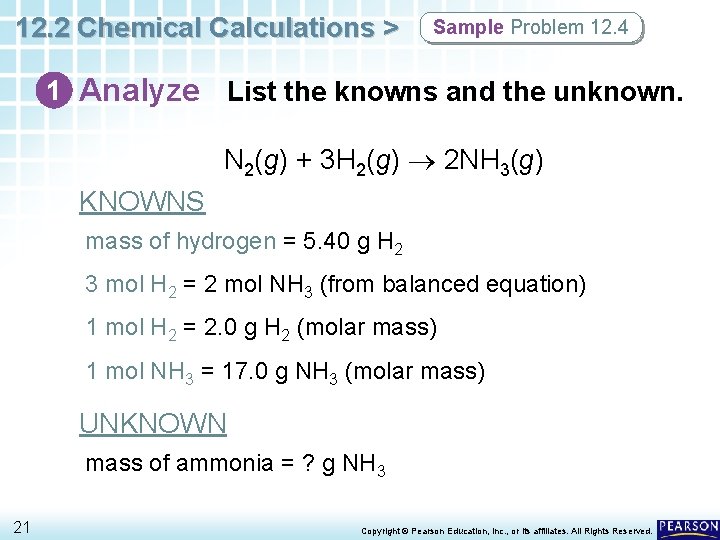
12. 2 Chemical Calculations > Sample Problem 12. 4 Calculating the Mass of a Product Calculate the number of grams of NH 3 produced by the reaction of 5. 40 g of hydrogen with an excess of nitrogen. The balanced equation is: N 2(g) + 3 H 2(g) 2 NH 3(g) 20 Copyright © Pearson Education, Inc. , or its affiliates. All Rights Reserved.
12. 2 Chemical Calculations > Sample Problem 12. 4 1 Analyze List the knowns and the unknown. N 2(g) + 3 H 2(g) 2 NH 3(g) KNOWNS mass of hydrogen = 5. 40 g H 2 3 mol H 2 = 2 mol NH 3 (from balanced equation) 1 mol H 2 = 2. 0 g H 2 (molar mass) 1 mol NH 3 = 17. 0 g NH 3 (molar mass) UNKNOWN mass of ammonia = ? g NH 3 21 Copyright © Pearson Education, Inc. , or its affiliates. All Rights Reserved.
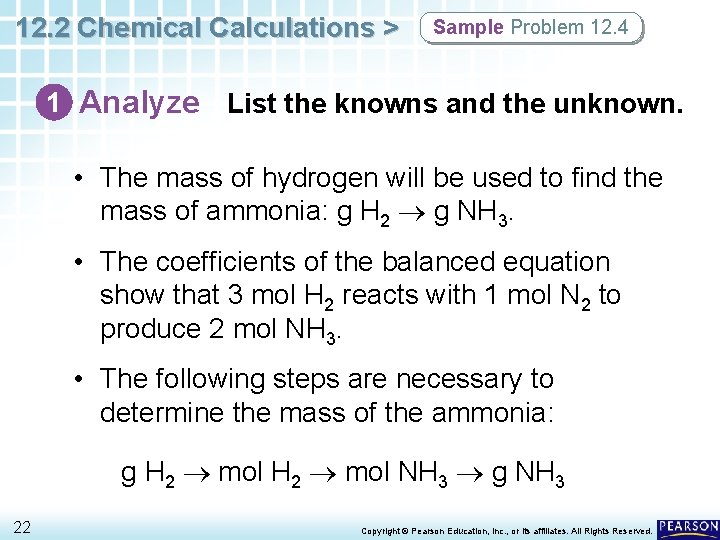
12. 2 Chemical Calculations > Sample Problem 12. 4 1 Analyze List the knowns and the unknown. • The mass of hydrogen will be used to find the mass of ammonia: g H 2 g NH 3. • The coefficients of the balanced equation show that 3 mol H 2 reacts with 1 mol N 2 to produce 2 mol NH 3. • The following steps are necessary to determine the mass of the ammonia: g H 2 mol NH 3 g NH 3 22 Copyright © Pearson Education, Inc. , or its affiliates. All Rights Reserved.
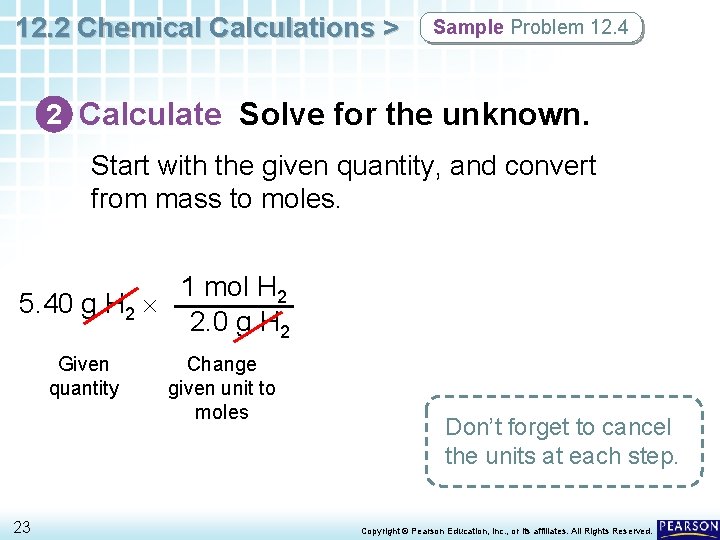
12. 2 Chemical Calculations > Sample Problem 12. 4 2 Calculate Solve for the unknown. Start with the given quantity, and convert from mass to moles. 1 mol H 2 5. 40 g H 2 2. 0 g H 2 Given quantity 23 Change given unit to moles Don’t forget to cancel the units at each step. Copyright © Pearson Education, Inc. , or its affiliates. All Rights Reserved.
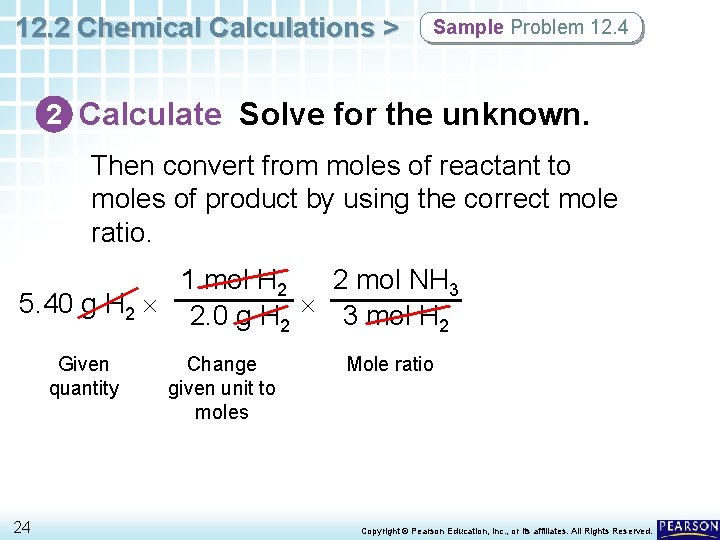
12. 2 Chemical Calculations > Sample Problem 12. 4 2 Calculate Solve for the unknown. Then convert from moles of reactant to moles of product by using the correct mole ratio. 1 mol H 2 2 mol NH 3 5. 40 g H 2 2. 0 g H 3 mol H 2 2 Given quantity 24 Change given unit to moles Mole ratio Copyright © Pearson Education, Inc. , or its affiliates. All Rights Reserved.
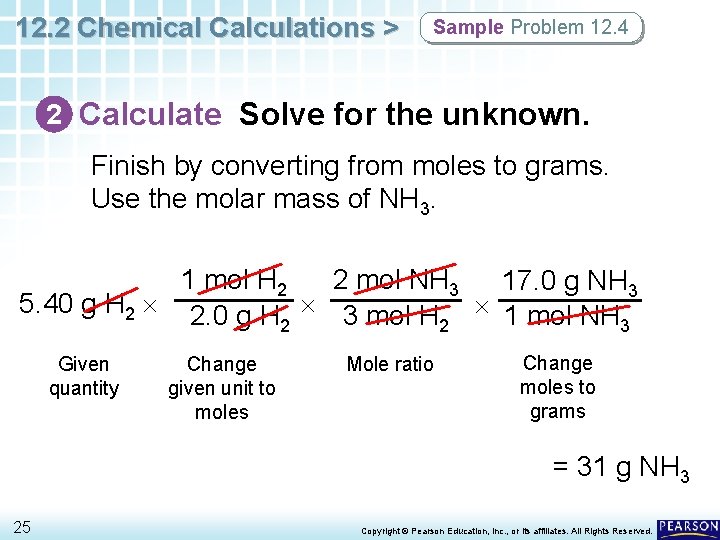
12. 2 Chemical Calculations > Sample Problem 12. 4 2 Calculate Solve for the unknown. Finish by converting from moles to grams. Use the molar mass of NH 3. 1 mol H 2 2 mol NH 3 17. 0 g NH 3 5. 40 g H 2 2. 0 g H 3 mol H 1 mol NH 2 2 3 Given quantity Change given unit to moles Mole ratio Change moles to grams = 31 g NH 3 25 Copyright © Pearson Education, Inc. , or its affiliates. All Rights Reserved.
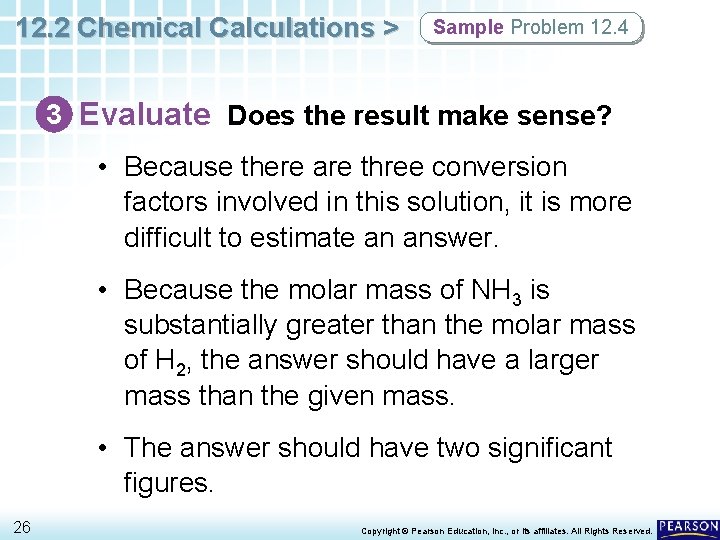
12. 2 Chemical Calculations > Sample Problem 12. 4 3 Evaluate Does the result make sense? • Because there are three conversion factors involved in this solution, it is more difficult to estimate an answer. • Because the molar mass of NH 3 is substantially greater than the molar mass of H 2, the answer should have a larger mass than the given mass. • The answer should have two significant figures. 26 Copyright © Pearson Education, Inc. , or its affiliates. All Rights Reserved.
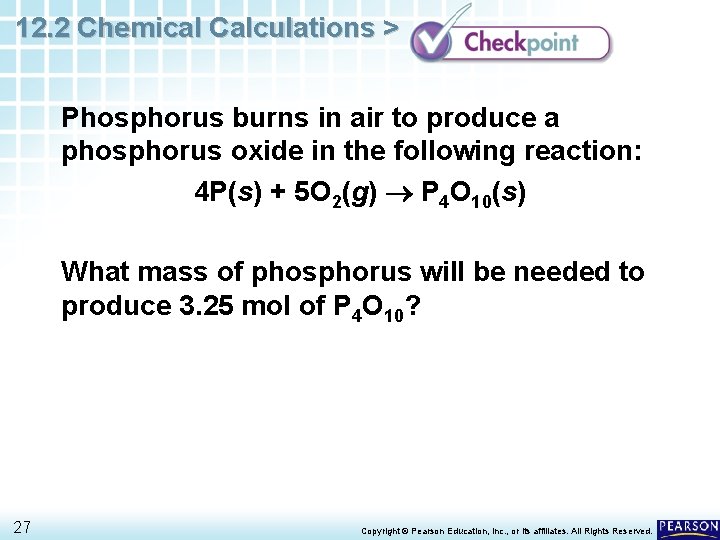
12. 2 Chemical Calculations > Phosphorus burns in air to produce a phosphorus oxide in the following reaction: 4 P(s) + 5 O 2(g) P 4 O 10(s) What mass of phosphorus will be needed to produce 3. 25 mol of P 4 O 10? 27 Copyright © Pearson Education, Inc. , or its affiliates. All Rights Reserved.
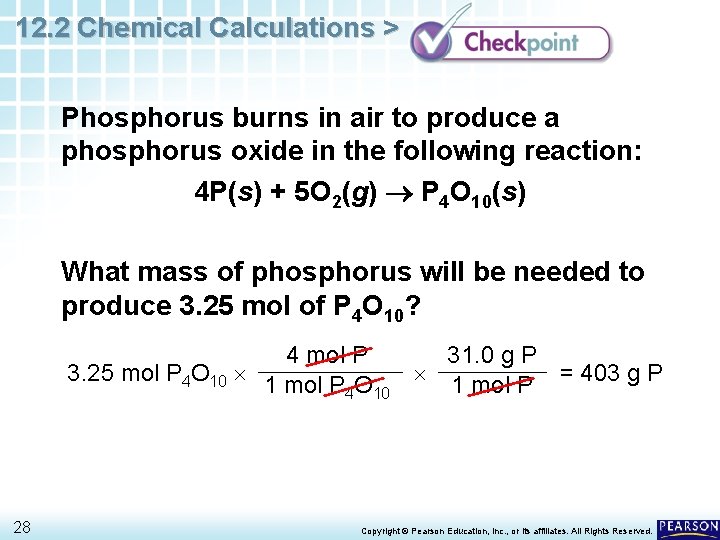
12. 2 Chemical Calculations > Phosphorus burns in air to produce a phosphorus oxide in the following reaction: 4 P(s) + 5 O 2(g) P 4 O 10(s) What mass of phosphorus will be needed to produce 3. 25 mol of P 4 O 10? 4 mol P 31. 0 g P 3. 25 mol P 4 O 10 1 mol P O = 403 g P 1 mol P 4 10 28 Copyright © Pearson Education, Inc. , or its affiliates. All Rights Reserved.
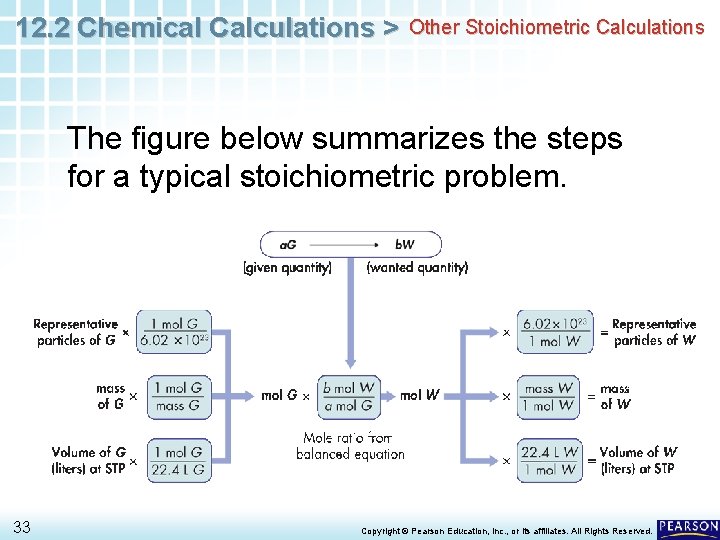
12. 2 Chemical Calculations > Other Stoichiometric Calculations What is the general procedure for solving a stoichiometric problem? 29 Copyright © Pearson Education, Inc. , or its affiliates. All Rights Reserved.
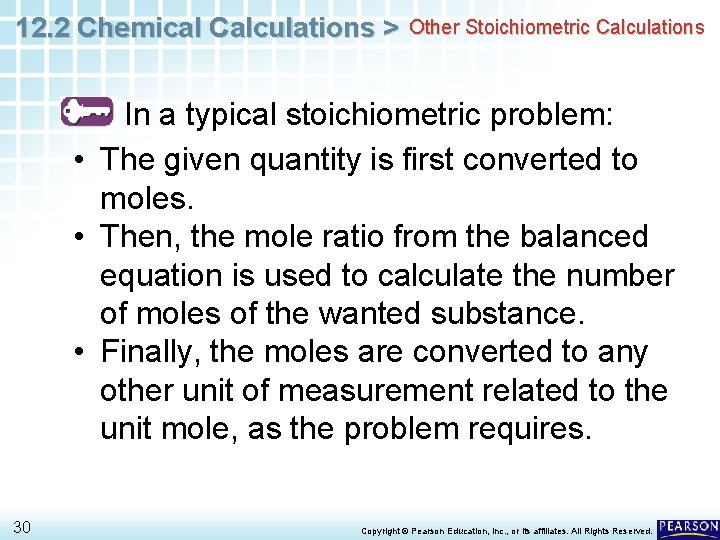
12. 2 Chemical Calculations > Other Stoichiometric Calculations In a typical stoichiometric problem: • The given quantity is first converted to moles. • Then, the mole ratio from the balanced equation is used to calculate the number of moles of the wanted substance. • Finally, the moles are converted to any other unit of measurement related to the unit mole, as the problem requires. 30 Copyright © Pearson Education, Inc. , or its affiliates. All Rights Reserved.
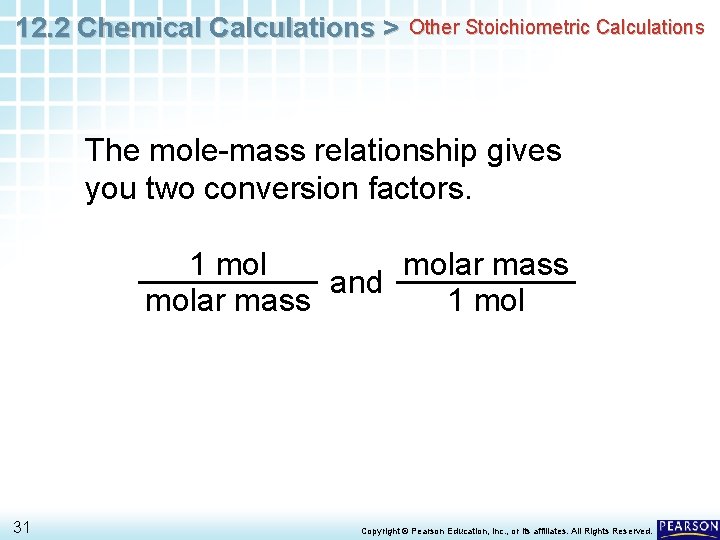
12. 2 Chemical Calculations > Other Stoichiometric Calculations The mole-mass relationship gives you two conversion factors. 1 molar mass and molar mass 1 mol 31 Copyright © Pearson Education, Inc. , or its affiliates. All Rights Reserved.
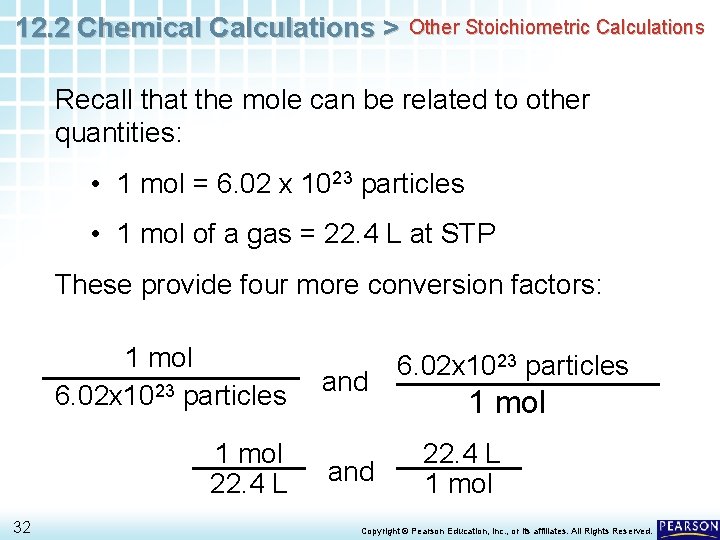
12. 2 Chemical Calculations > Other Stoichiometric Calculations Recall that the mole can be related to other quantities: • 1 mol = 6. 02 x 1023 particles • 1 mol of a gas = 22. 4 L at STP These provide four more conversion factors: 1 mol 6. 02 x 1023 particles 1 mol 22. 4 L 32 and 6. 02 x 1023 particles 1 mol 22. 4 L 1 mol Copyright © Pearson Education, Inc. , or its affiliates. All Rights Reserved.
12. 2 Chemical Calculations > Other Stoichiometric Calculations The figure below summarizes the steps for a typical stoichiometric problem. 33 Copyright © Pearson Education, Inc. , or its affiliates. All Rights Reserved.
12. 2 Chemical Calculations > CHEMISTRY & YOU How do you think air bag manufacturers know how to get the right amount of air in an inflated air bag? 34 Copyright © Pearson Education, Inc. , or its affiliates. All Rights Reserved.
12. 2 Chemical Calculations > CHEMISTRY & YOU How do you think air bag manufacturers know how to get the right amount of air in an inflated air bag? They take the volume of air needed to inflate the bag and convert it to number of moles (assuming STP). Then, they use the mole ratio from a balanced chemical equation to calculate the number of moles of reactants needed. This could be converted to any other unit of measurement related to the unit mole. 35 Copyright © Pearson Education, Inc. , or its affiliates. All Rights Reserved.
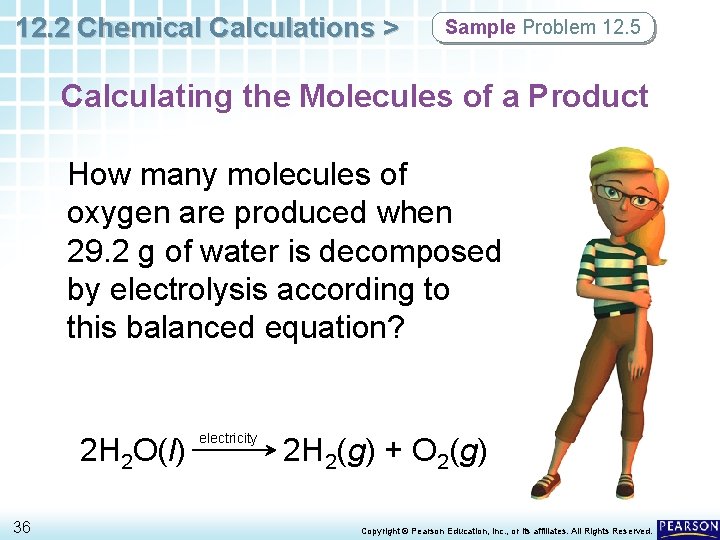
12. 2 Chemical Calculations > Sample Problem 12. 5 Calculating the Molecules of a Product How many molecules of oxygen are produced when 29. 2 g of water is decomposed by electrolysis according to this balanced equation? 2 H 2 O(l) 36 electricity 2 H 2(g) + O 2(g) Copyright © Pearson Education, Inc. , or its affiliates. All Rights Reserved.
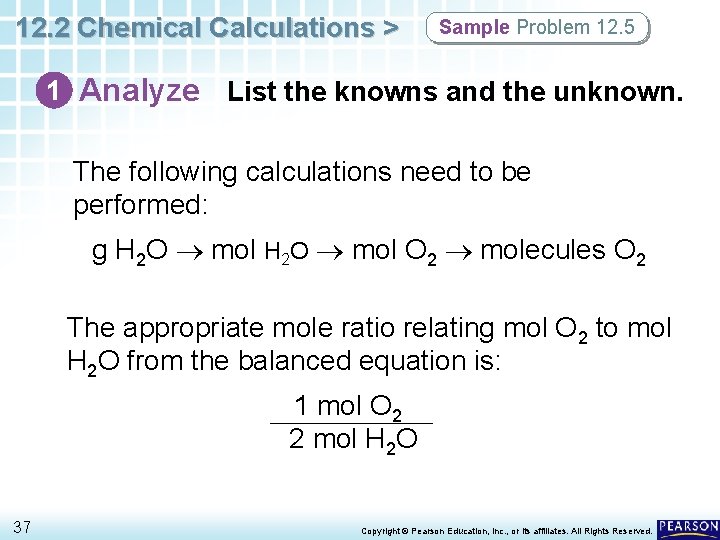
12. 2 Chemical Calculations > Sample Problem 12. 5 1 Analyze List the knowns and the unknown. The following calculations need to be performed: g H 2 O mol O 2 molecules O 2 The appropriate mole ratio relating mol O 2 to mol H 2 O from the balanced equation is: 1 mol O 2 2 mol H 2 O 37 Copyright © Pearson Education, Inc. , or its affiliates. All Rights Reserved.
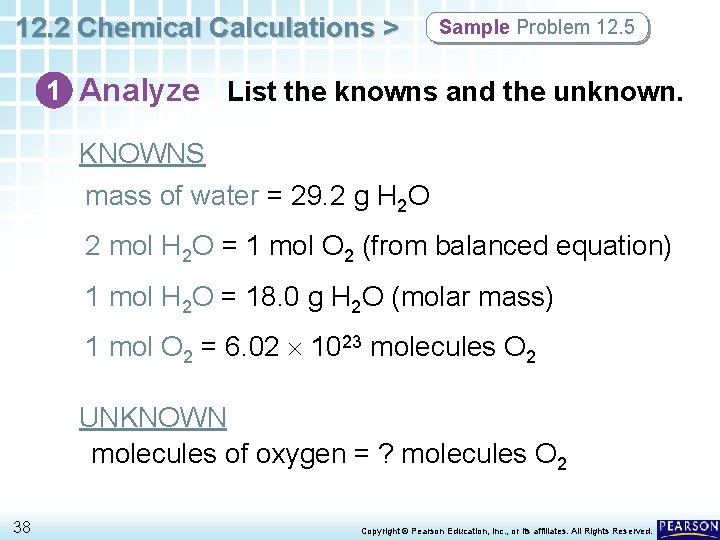
12. 2 Chemical Calculations > Sample Problem 12. 5 1 Analyze List the knowns and the unknown. KNOWNS mass of water = 29. 2 g H 2 O 2 mol H 2 O = 1 mol O 2 (from balanced equation) 1 mol H 2 O = 18. 0 g H 2 O (molar mass) 1 mol O 2 = 6. 02 1023 molecules O 2 UNKNOWN molecules of oxygen = ? molecules O 2 38 Copyright © Pearson Education, Inc. , or its affiliates. All Rights Reserved.
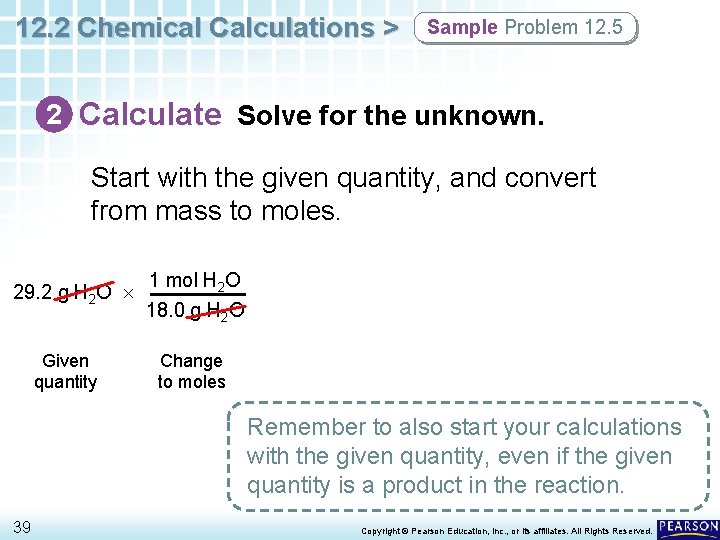
12. 2 Chemical Calculations > Sample Problem 12. 5 2 Calculate Solve for the unknown. Start with the given quantity, and convert from mass to moles. 29. 2 g H 2 O Given quantity 1 mol H 2 O 18. 0 g H 2 O Change to moles Remember to also start your calculations with the given quantity, even if the given quantity is a product in the reaction. 39 Copyright © Pearson Education, Inc. , or its affiliates. All Rights Reserved.
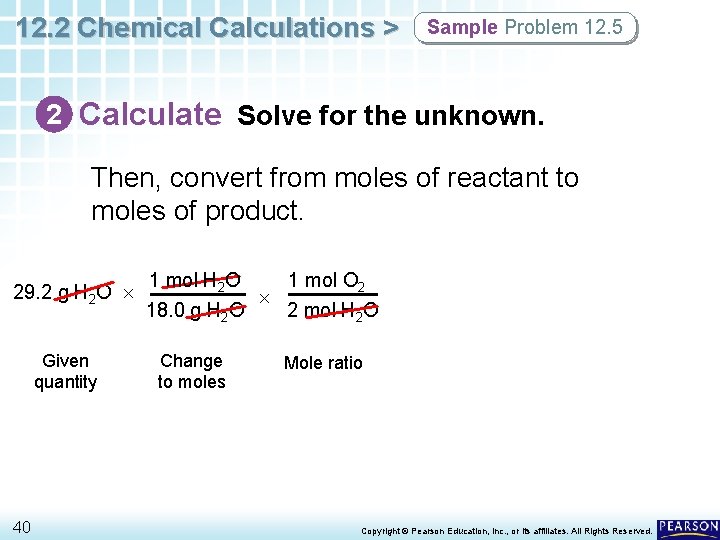
12. 2 Chemical Calculations > Sample Problem 12. 5 2 Calculate Solve for the unknown. Then, convert from moles of reactant to moles of product. 29. 2 g H 2 O Given quantity 40 1 mol H 2 O 1 mol O 2 18. 0 g H 2 O 2 mol H 2 O Change to moles Mole ratio Copyright © Pearson Education, Inc. , or its affiliates. All Rights Reserved.
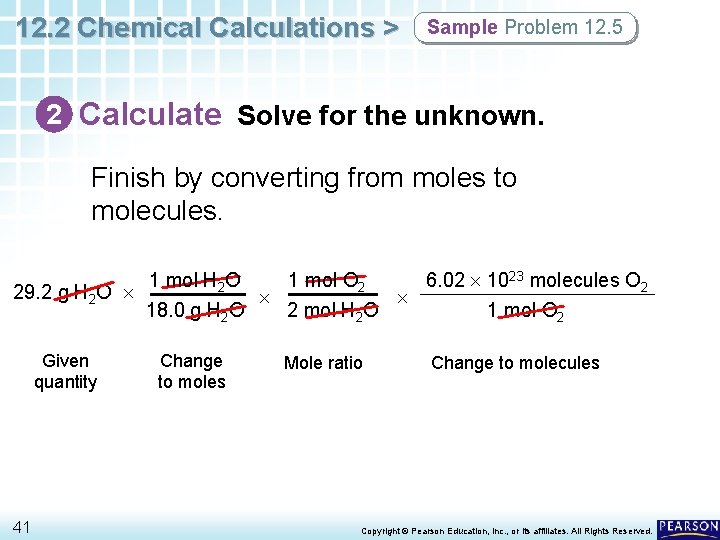
12. 2 Chemical Calculations > Sample Problem 12. 5 2 Calculate Solve for the unknown. Finish by converting from moles to molecules. 1 mol H 2 O 1 mol O 2 6. 02 1023 molecules O 2 29. 2 g H 2 O 18. 0 g H 2 O 2 mol H 2 O 1 mol O 2 Given quantity 41 Change to moles Mole ratio Change to molecules Copyright © Pearson Education, Inc. , or its affiliates. All Rights Reserved.
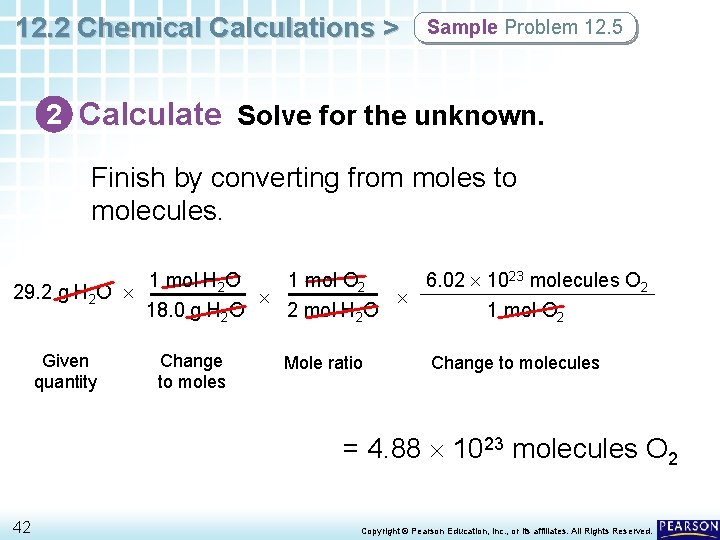
12. 2 Chemical Calculations > Sample Problem 12. 5 2 Calculate Solve for the unknown. Finish by converting from moles to molecules. 1 mol H 2 O 1 mol O 2 6. 02 1023 molecules O 2 29. 2 g H 2 O 18. 0 g H 2 O 2 mol H 2 O 1 mol O 2 Given quantity Change to moles Mole ratio Change to molecules = 4. 88 1023 molecules O 2 42 Copyright © Pearson Education, Inc. , or its affiliates. All Rights Reserved.
12. 2 Chemical Calculations > Sample Problem 12. 5 3 Evaluate Does the result make sense? • The given mass of water should produce a little less than 1 mol of oxygen, or a little less than Avogadro’s number of molecules. • The answer should have three significant figures. 43 Copyright © Pearson Education, Inc. , or its affiliates. All Rights Reserved.
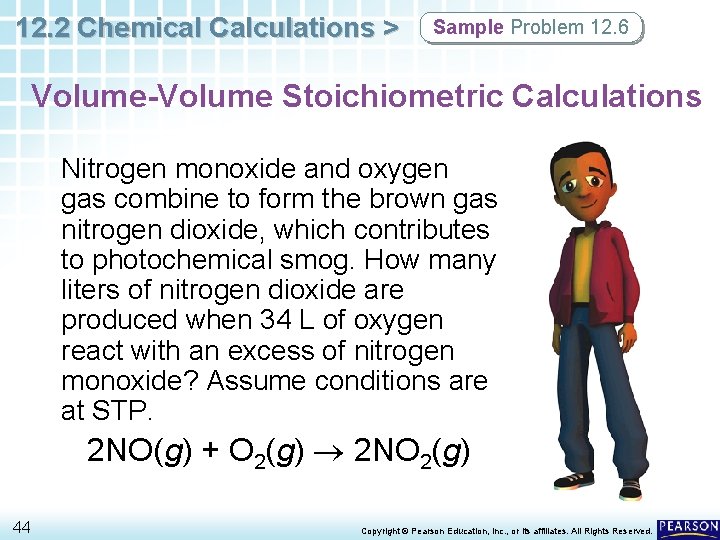
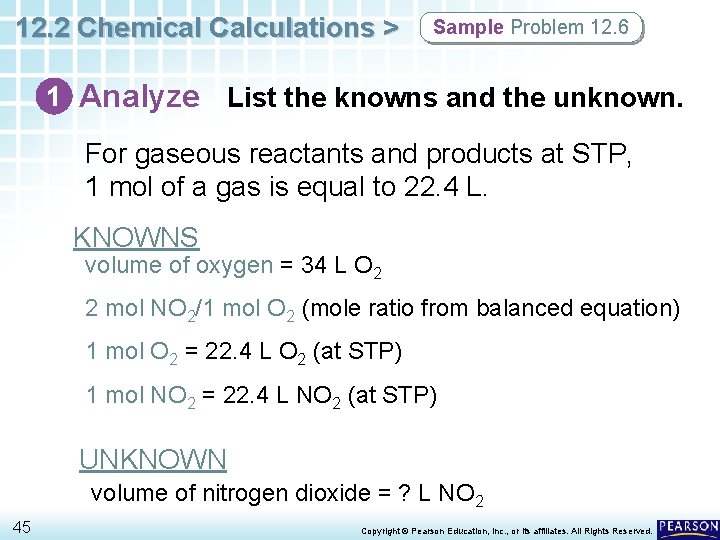
12. 2 Chemical Calculations > Sample Problem 12. 6 Volume-Volume Stoichiometric Calculations Nitrogen monoxide and oxygen gas combine to form the brown gas nitrogen dioxide, which contributes to photochemical smog. How many liters of nitrogen dioxide are produced when 34 L of oxygen react with an excess of nitrogen monoxide? Assume conditions are at STP. 2 NO(g) + O 2(g) 2 NO 2(g) 44 Copyright © Pearson Education, Inc. , or its affiliates. All Rights Reserved.
12. 2 Chemical Calculations > Sample Problem 12. 6 1 Analyze List the knowns and the unknown. For gaseous reactants and products at STP, 1 mol of a gas is equal to 22. 4 L. KNOWNS volume of oxygen = 34 L O 2 2 mol NO 2/1 mol O 2 (mole ratio from balanced equation) 1 mol O 2 = 22. 4 L O 2 (at STP) 1 mol NO 2 = 22. 4 L NO 2 (at STP) UNKNOWN volume of nitrogen dioxide = ? L NO 2 45 Copyright © Pearson Education, Inc. , or its affiliates. All Rights Reserved.
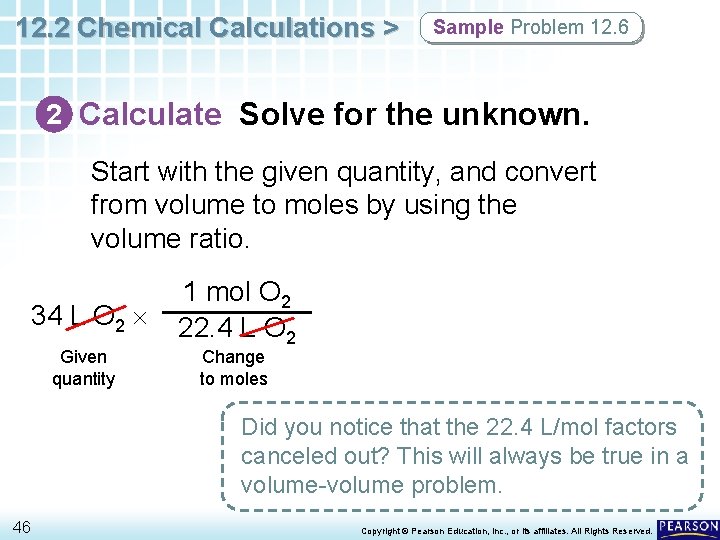
12. 2 Chemical Calculations > Sample Problem 12. 6 2 Calculate Solve for the unknown. Start with the given quantity, and convert from volume to moles by using the volume ratio. 34 L O 2 Given quantity 1 mol O 2 22. 4 L O 2 Change to moles Did you notice that the 22. 4 L/mol factors canceled out? This will always be true in a volume-volume problem. 46 Copyright © Pearson Education, Inc. , or its affiliates. All Rights Reserved.
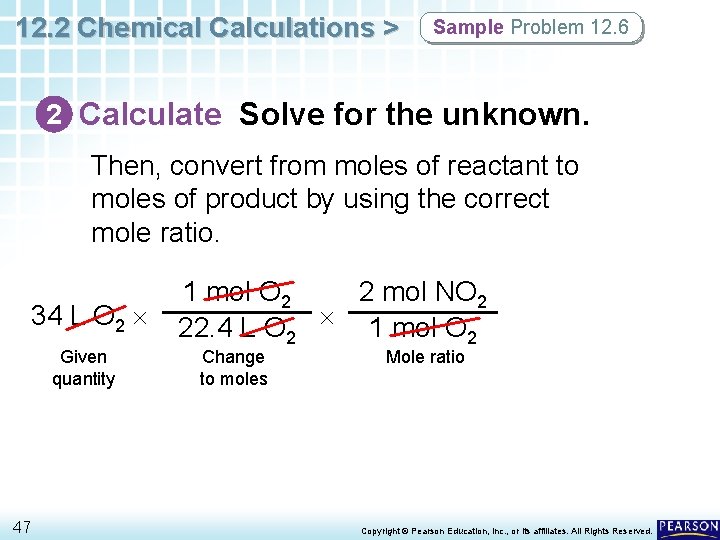
12. 2 Chemical Calculations > Sample Problem 12. 6 2 Calculate Solve for the unknown. Then, convert from moles of reactant to moles of product by using the correct mole ratio. 34 L O 2 Given quantity 47 2 mol NO 2 1 mol O 2 22. 4 L O 2 1 mol O 2 Change to moles Mole ratio Copyright © Pearson Education, Inc. , or its affiliates. All Rights Reserved.
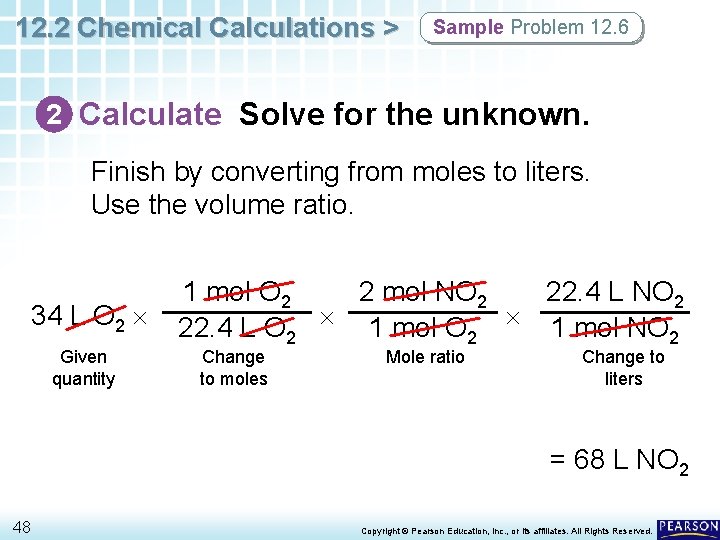
12. 2 Chemical Calculations > Sample Problem 12. 6 2 Calculate Solve for the unknown. Finish by converting from moles to liters. Use the volume ratio. 34 L O 2 Given quantity 2 mol NO 2 22. 4 L NO 2 1 mol O 2 22. 4 L O 2 1 mol NO 2 Change to moles Mole ratio Change to liters = 68 L NO 2 48 Copyright © Pearson Education, Inc. , or its affiliates. All Rights Reserved.
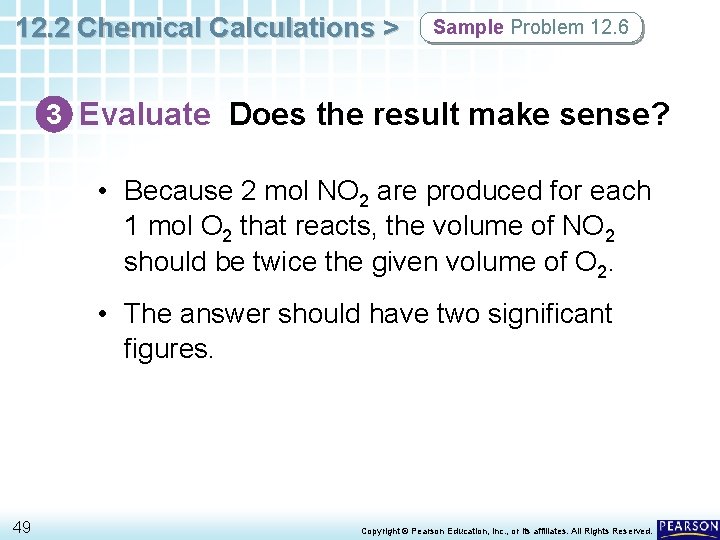
12. 2 Chemical Calculations > Sample Problem 12. 6 3 Evaluate Does the result make sense? • Because 2 mol NO 2 are produced for each 1 mol O 2 that reacts, the volume of NO 2 should be twice the given volume of O 2. • The answer should have two significant figures. 49 Copyright © Pearson Education, Inc. , or its affiliates. All Rights Reserved.
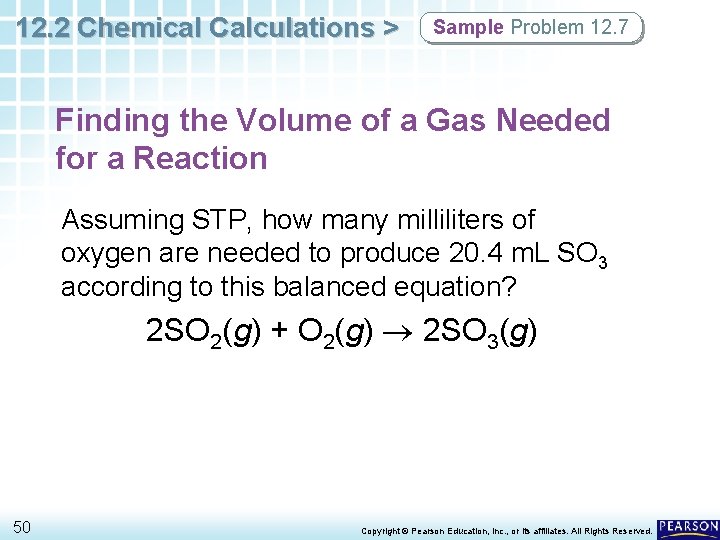
12. 2 Chemical Calculations > Sample Problem 12. 7 Finding the Volume of a Gas Needed for a Reaction Assuming STP, how many milliliters of oxygen are needed to produce 20. 4 m. L SO 3 according to this balanced equation? 2 SO 2(g) + O 2(g) 2 SO 3(g) 50 Copyright © Pearson Education, Inc. , or its affiliates. All Rights Reserved.
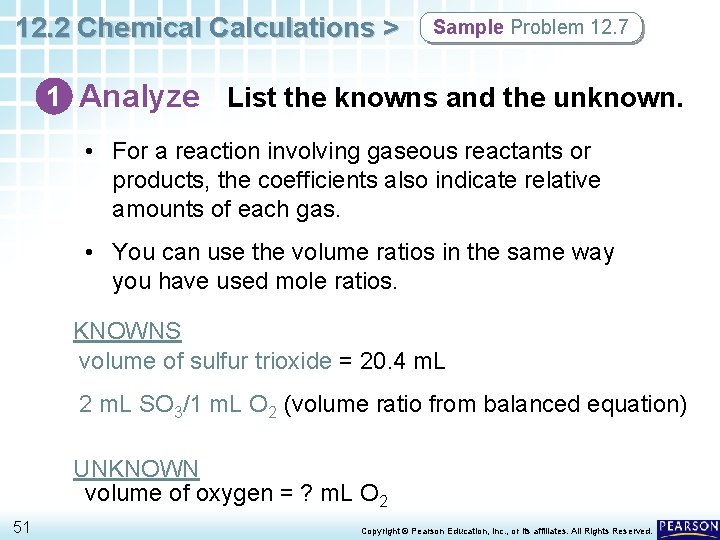
12. 2 Chemical Calculations > Sample Problem 12. 7 1 Analyze List the knowns and the unknown. • For a reaction involving gaseous reactants or products, the coefficients also indicate relative amounts of each gas. • You can use the volume ratios in the same way you have used mole ratios. KNOWNS volume of sulfur trioxide = 20. 4 m. L 2 m. L SO 3/1 m. L O 2 (volume ratio from balanced equation) UNKNOWN volume of oxygen = ? m. L O 2 51 Copyright © Pearson Education, Inc. , or its affiliates. All Rights Reserved.
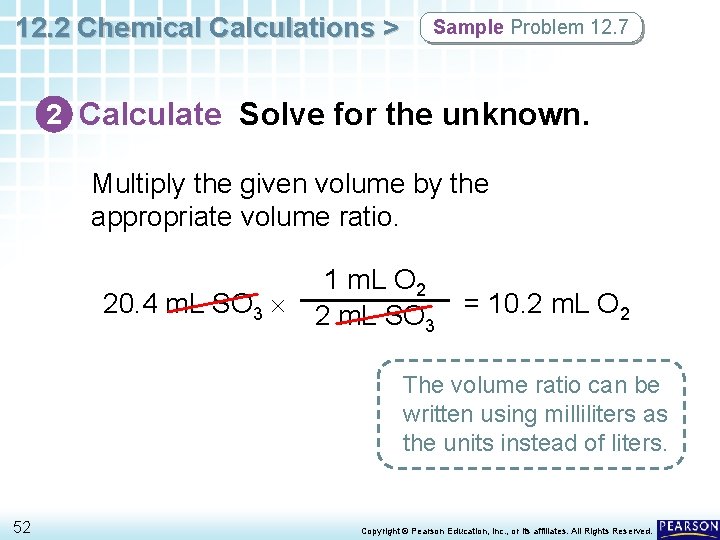
12. 2 Chemical Calculations > Sample Problem 12. 7 2 Calculate Solve for the unknown. Multiply the given volume by the appropriate volume ratio. 20. 4 m. L SO 3 1 m. L O 2 2 m. L SO 3 = 10. 2 m. L O 2 The volume ratio can be written using milliliters as the units instead of liters. 52 Copyright © Pearson Education, Inc. , or its affiliates. All Rights Reserved.
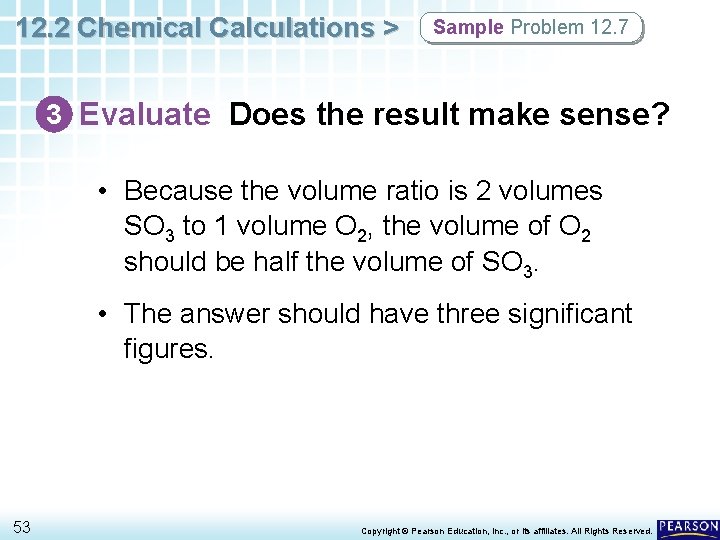
12. 2 Chemical Calculations > Sample Problem 12. 7 3 Evaluate Does the result make sense? • Because the volume ratio is 2 volumes SO 3 to 1 volume O 2, the volume of O 2 should be half the volume of SO 3. • The answer should have three significant figures. 53 Copyright © Pearson Education, Inc. , or its affiliates. All Rights Reserved.
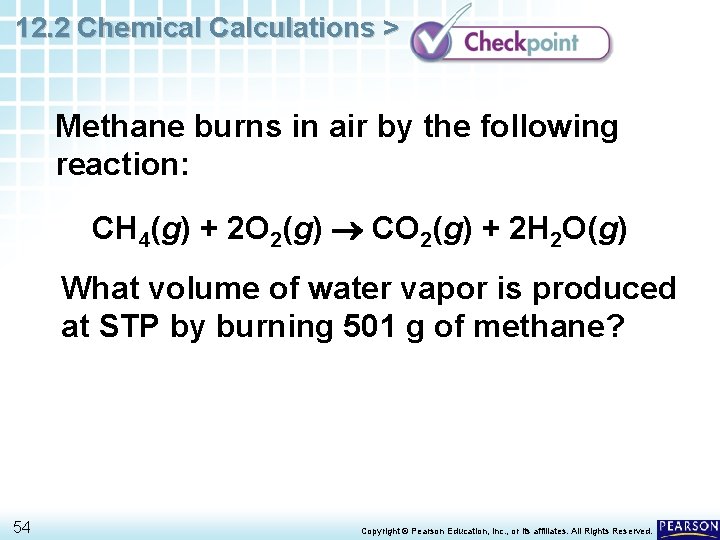
12. 2 Chemical Calculations > Methane burns in air by the following reaction: CH 4(g) + 2 O 2(g) CO 2(g) + 2 H 2 O(g) What volume of water vapor is produced at STP by burning 501 g of methane? 54 Copyright © Pearson Education, Inc. , or its affiliates. All Rights Reserved.
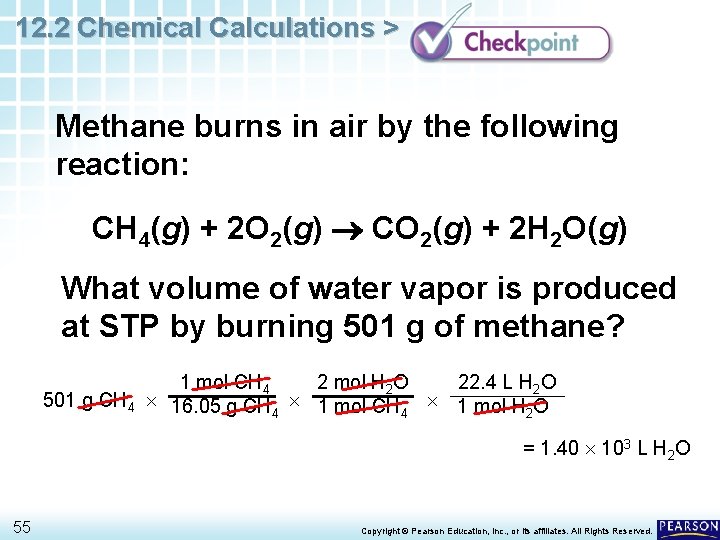
12. 2 Chemical Calculations > Methane burns in air by the following reaction: CH 4(g) + 2 O 2(g) CO 2(g) + 2 H 2 O(g) What volume of water vapor is produced at STP by burning 501 g of methane? 1 mol CH 4 2 mol H 2 O 22. 4 L H 2 O 501 g CH 4 16. 05 g CH 1 mol H O 4 4 2 = 1. 40 103 L H 2 O 55 Copyright © Pearson Education, Inc. , or its affiliates. All Rights Reserved.
12. 2 Chemical Calculations > Key Concepts In chemical calculations, mole ratios are used to convert between moles of reactant and moles of product, between moles of reactants, or between moles of products. In a typical stoichiometric problem, the given quantity is first converted to moles. Then, the mole ratio from the balanced equation is used to calculate the moles of the wanted substance. Finally, the moles are converted to any other unit of measurement related to the unit mole. 56 Copyright © Pearson Education, Inc. , or its affiliates. All Rights Reserved.
12. 2 Chemical Calculations > Key Equation Mole-mole relationship for a. G b. W: b mol W x mol G = a mol G 57 xb mol W a Copyright © Pearson Education, Inc. , or its affiliates. All Rights Reserved.
12. 2 Chemical Calculations > Glossary Terms mole ratio: a conversion factor derived from the coefficients of a balanced chemical equation interpreted in terms of moles 58 Copyright © Pearson Education, Inc. , or its affiliates. All Rights Reserved.
12. 2 Chemical Calculations > BIG IDEA The Mole and Quantifying Matter Mole ratios from the balanced equation are used to calculate the amount of a reactant or product in a chemical reaction from a given amount of one of the reactants or products. 59 Copyright © Pearson Education, Inc. , or its affiliates. All Rights Reserved.
12. 2 Chemical Calculations > END OF 12. 2 60 Copyright © Pearson Education, Inc. , or its affiliates. All Rights Reserved.