
12 2 Business Cycles and Economic Growth Phases
12 -2 Business Cycles and Economic Growth
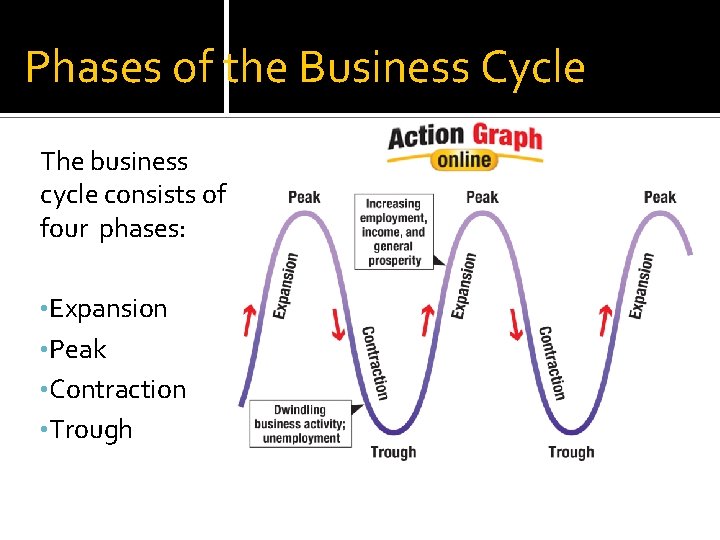
Phases of the Business Cycle The business cycle consists of four phases: • Expansion • Peak • Contraction • Trough
Contraction: Levels of Suckage Recession: bad • declining GDP + rising unemployment • 6 -18 months Depression: worse • an extended recession • high unemployment + declining output Stagflation: worst
What Moves the Business Cycle? 1. Business Investment 2. Interest Rates and Credit 3. Consumer Expectations 4. External Shocks
Business Investment When times are good, businesses aren’t afraid to invest—this increases GDP and keeps the expansion phase growing When firms stop spending/investing, the GDP decreases and the business cycle moves downward
Interest Rate and Credit Businesses and consumers use credit to buy new cars, home, electronics, and vacations. low interest rate= higher GDP Why? Low interest rates cost people less high interest rate= low GDP Why? High interest rates cost people more
Consumer Expectations If people think times are good they spend money and stimulate the economy, thus increasing GDP. If people think times are tough they save and don’t stimulate the economy, thus decreasing GDP
External Shock Unexpected good things help GDP A good harvest increases aggregate supply Discovery of oil or minerals Unexpected bad things hurt GDP An oil shortage increases prices 9/11 Natural disaster destroys a crop
Forecasting the Business Cycle Economists use leading indicators to make predictions: The stock market is a leading indicator. Today, the stock market turns sharply downward before a recession. The Conference Board is also a leading indicator
Business Cycles in American History: The Great Depression Before the 1930 s, it was thought that when an economy declined, it would recover quickly on its own. The Great Depression changed this belief – long-lasting contractions can occur Not until World War II, more than a decade later, did the economy achieve full recovery.
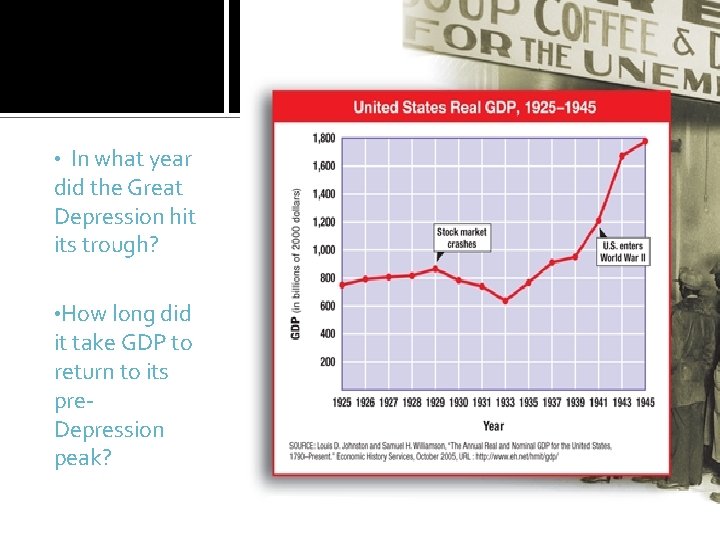
• In what year did the Great Depression hit its trough? • How long did it take GDP to return to its pre. Depression peak?
Later Recessions: OPEC Embargo In the 1970 s, the United States experienced an external shock when the price of gasoline and heating fuels skyrocketed as a result of the OPEC embargo on oil shipped to the United States. The U. S. economy also experienced a recession in the early 1980 s and another brief one in 1991, followed by a period of steady economic growth. The attacks of 9/11 led to another sharp drop in consumer spending in many service industries.
- Slides: 12