
12 1 What Is Ambulatory Monitoring n n
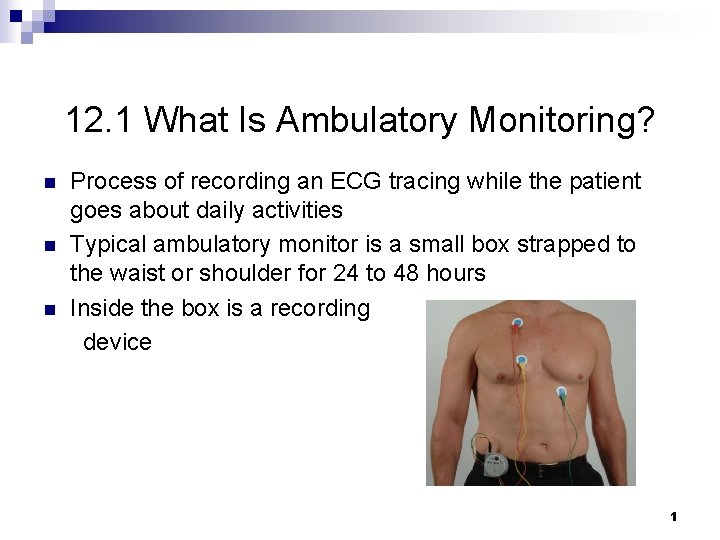
12. 1 What Is Ambulatory Monitoring? n n n Process of recording an ECG tracing while the patient goes about daily activities Typical ambulatory monitor is a small box strapped to the waist or shoulder for 24 to 48 hours Inside the box is a recording device 1
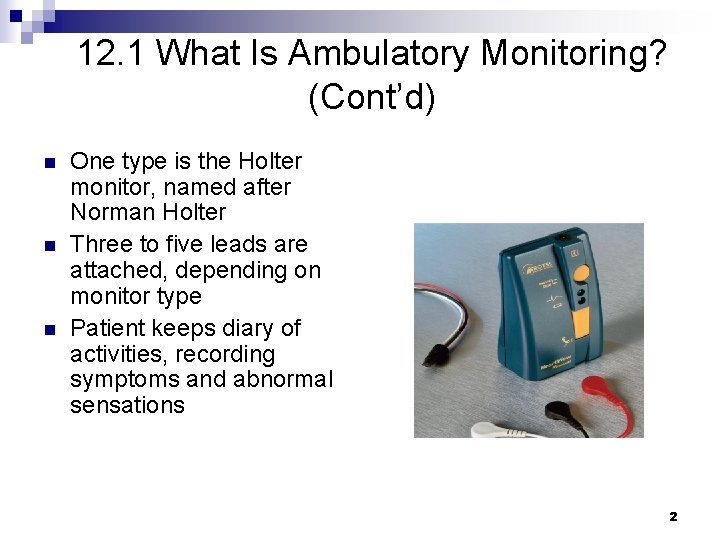
12. 1 What Is Ambulatory Monitoring? (Cont’d) n n n One type is the Holter monitor, named after Norman Holter Three to five leads are attached, depending on monitor type Patient keeps diary of activities, recording symptoms and abnormal sensations 2
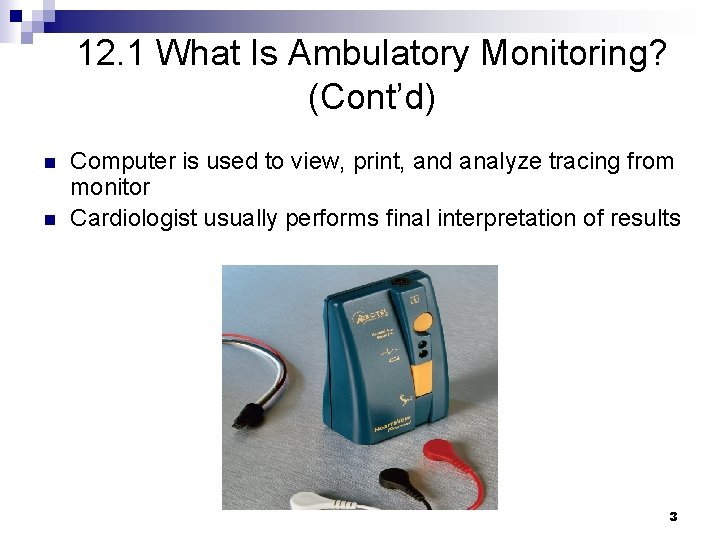
12. 1 What Is Ambulatory Monitoring? (Cont’d) n n Computer is used to view, print, and analyze tracing from monitor Cardiologist usually performs final interpretation of results 3
12. 2 How Is Ambulatory Monitoring Used? n To capture abnormal heart rhythms when symptoms do not occur during 12 -lead or stress ECGs n To monitor effectiveness of cardiac medications n To evaluate pacemaker function n To evaluate the heart after a recent myocardial infarction 4
12. 3 Variations of Ambulatory Monitoring n Continuous monitoring n Intermittent monitoring n Telemetry n Transtelephonic monitoring 5
12. 3 Continuous Monitoring n n n Complete tracing from time unit is applied until removal Patient can activate “event marker” ¨ Traces the exact time symptoms occur Unit is equipped with a clock to correlate tracings with diary entries 6
12. 3 Intermittent Monitoring n Patient activates recording only when symptoms occur n Only shows ECG tracing during the symptom n Can be evaluated more quickly than continuous 7
12. 3 Telemetry Monitoring n Performed inside medical facility n Uses three or five electrodes on chest n Transmits to a central location where multiple patients may be monitored n Patient diary not required 8
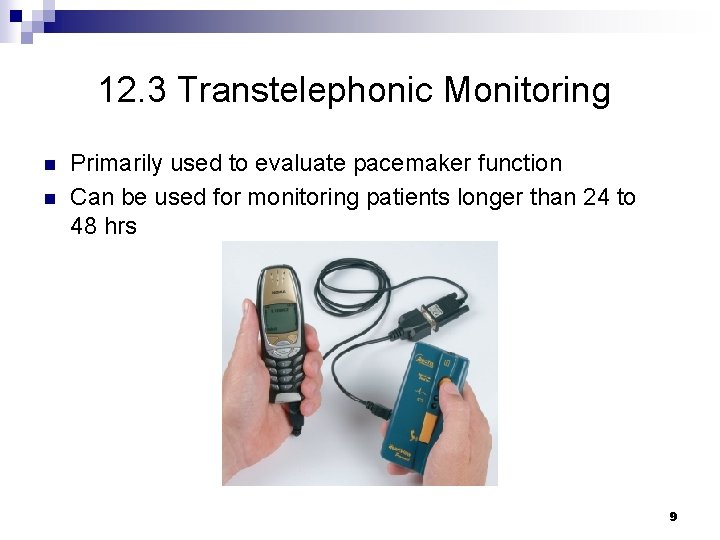
12. 3 Transtelephonic Monitoring n n Primarily used to evaluate pacemaker function Can be used for monitoring patients longer than 24 to 48 hrs 9
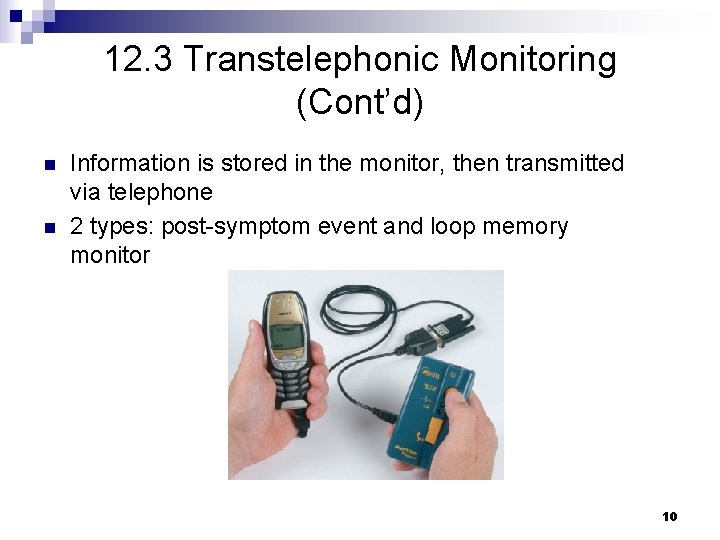
12. 3 Transtelephonic Monitoring (Cont’d) n n Information is stored in the monitor, then transmitted via telephone 2 types: post-symptom event and loop memory monitor 10
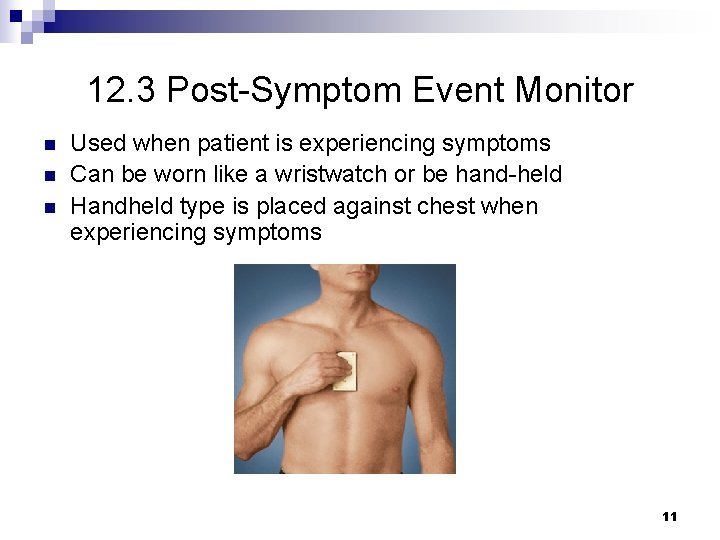
12. 3 Post-Symptom Event Monitor n n n Used when patient is experiencing symptoms Can be worn like a wristwatch or be hand-held Handheld type is placed against chest when experiencing symptoms 11
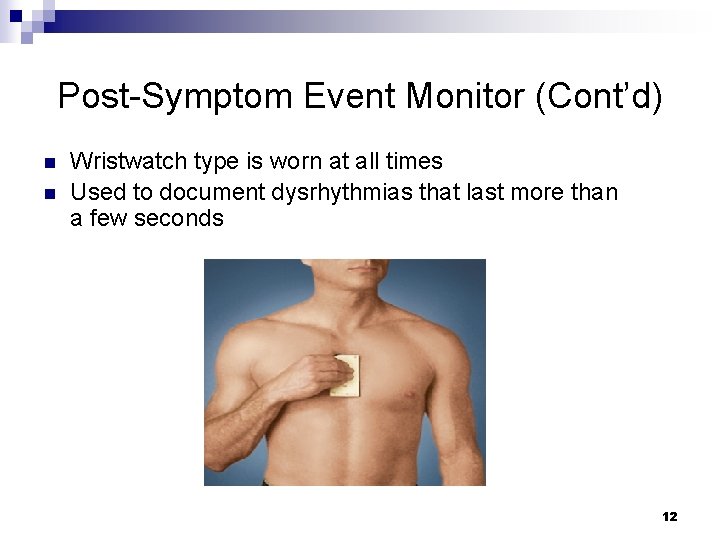
Post-Symptom Event Monitor (Cont’d) n n Wristwatch type is worn at all times Used to document dysrhythmias that last more than a few seconds 12
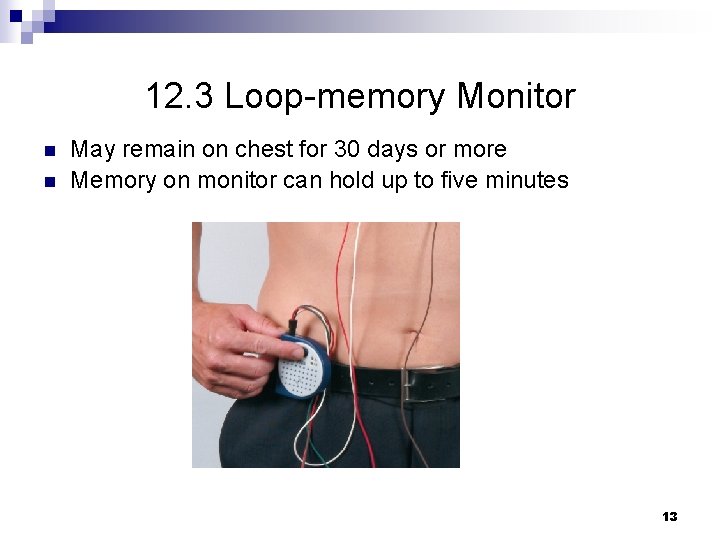
12. 3 Loop-memory Monitor n n May remain on chest for 30 days or more Memory on monitor can hold up to five minutes 13
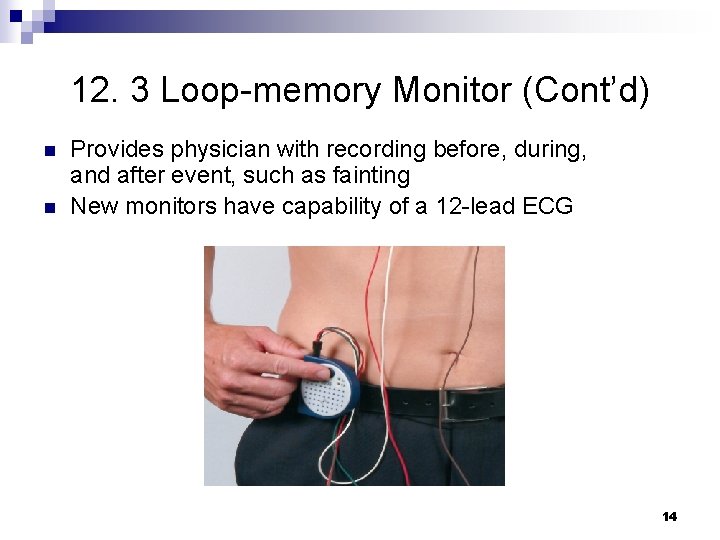
12. 3 Loop-memory Monitor (Cont’d) n n Provides physician with recording before, during, and after event, such as fainting New monitors have capability of a 12 -lead ECG 14

12. 3 Troubleshooting: n Instruct patient to press in center of loose electrode to reapply and to return to facility if electrode falls off n Ambulatory monitors are sensitive and expensive; avoid dropping 15
12. 4 Educating the Patient n Diary ¨A record of events and symptoms that occur while monitor is in place ¨ Used in conjunction with ECG tracing n Have patient repeat diary instructions n Remind patient of any medication changes 16
12. 4 Diary – What Is Recorded All usual and unusual activities, such as: n Urinating, bowel movements n Sexual activity n Walking n Emotional upset n Eating n Sleeping 17

12. 4 Law and Ethics n n It is your responsibility to remind the patient of medication changes prescribed by the physician For questions regarding indications, side effects, and precautions of medications, refer the patient to the licensed practitioner 18
12. 4 What the Patient Should Know During Ambulatory Monitoring n Wear loose fitting clothing for comfort and to reduce artifact n Sponge baths are allowed; no showers or tub baths n When sleeping, make sure tension is not applied to leads 19
12. 4 What the Patient Should Know During Ambulatory Monitoring (Cont’d) n Avoid magnets, metal detectors, high-voltage areas, and electric blankets n Check monitoring equipment for proper functioning n Patient education should be written in the patient’s chart 20
12. 4 Patient Education and Communication n Have patients tell you what they already know about ambulatory monitoring, then explain to them what they don’t know n Explaining the procedure and answering questions should alleviate patient fears 21
12. 5 Ambulatory Monitoring for Children n Consider child’s age and use terms he or she can understand Allow the child to touch the equipment prior to applying it Remember to instruct parent as well 22
12. 6 Before the Procedure: Gather Equipment n Monitor with holder and strap or belt n Batteries and tape or disk n Electrodes (3 or 5) n Lead wires n Alcohol and gauze n Patient diary 23
12. 6 Before the Procedure: Gather Equipment (Cont’d) n Skin preparation materials n Shaving equipment n Tape n Patient education checklist n Manufacturer’s directions for monitor n Pen 24
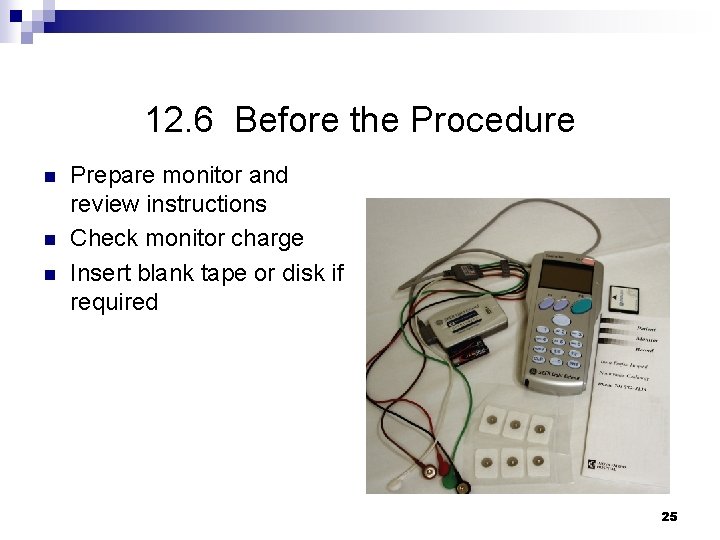
12. 6 Before the Procedure n n n Prepare monitor and review instructions Check monitor charge Insert blank tape or disk if required 25
12. 6 Prepare the Patient n Clothing should be removed from waist up n Provide drape n Have patient sit or lie down and relax n Dry shave electrode sites, if necessary (clip hair for telemetry monitoring) 26
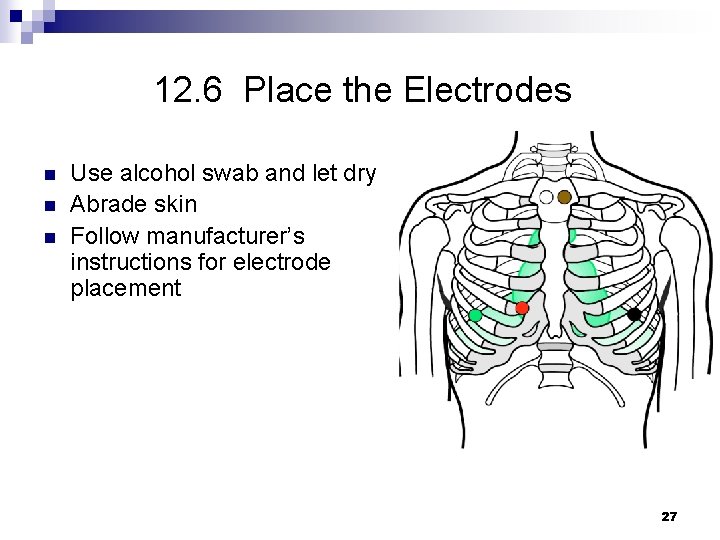
12. 6 Place the Electrodes n n n Use alcohol swab and let dry Abrade skin Follow manufacturer’s instructions for electrode placement 27

12. 6 Elderly or Patients on Certain Medications n Apply less pressure when abrading skin n Avoid abrasive cleansers n Use caution when applying and removing electrodes 28
12. 6 Applying the Monitor n Attach lead wires to electrodes n Arrange lead wires comfortably on patient n Tape each electrode in place n Attach cable to electrocardiograph and run baseline ECG 29
12. 6 Applying the Monitor (Cont’d) n Have patient dress, then attach cable to monitor n Check lead wires and electrodes n Start monitor, have patient make first diary entry n Review all patient instructions 30
12. 6 Applying the Monitor (Cont’d) n When applying an unfamiliar type of monitor, follow manufacturer’s directions n If directions are unavailable, consult supervisor 31
12. 7 Removing the Ambulatory Monitor n n n Review patient’s diary Turn off monitor and detach lead wires Detach lead wires and cable from patient Remove tape and electrodes Clean skin Record removal procedure on patient’s chart 32
12. 7 Reporting Results n Follow manufacturer’s instructions for preparing recording for evaluation n Final interpretation may be done by a physician, usually a cardiologist within your facility, or sent to an outside laboratory 33
12. 7 Reporting Results (Cont’d) n n Ensure cassette or results are properly labeled, including: ¨ Patient’s name ¨ Medical record number ¨ Date ¨ Physician’s name Patient diary must be kept with cassette or results 34
12. 7 Reporting Results (Cont’d) n n Factors affecting accuracy of tracing results: ¨ Improper lead attachment ¨ Incomplete patient diary ¨ Failure of patient to maintain normal routine If results are sent to an outside lab, report can take seven to ten days 35
12. 7 Abnormal Results Abnormal results may indicate: n Electrical conduction defects in heart’s rate and rhythm controlling system n Rhythm abnormalities n Premature atrial or ventricular contractions 36
12. 7 Abnormal Results (Cont’d) n Additional testing that may be required: ¨ Echocardiogram ¨ Coronary angiogram ¨ CT (computerized tomography) scan ¨ MRI (magnetic resonance imaging) ¨ PET (position emission tomography) scan 37
- Slides: 37