
12 1 Strategy the firm Strategy actions that
- Slides: 17
12 -1 Strategy & the firm Strategy: actions that managers must take to attain the goals of the firm Main goal usually to maximize long-term profit , (EPS) Profitability defined by return on sales or return on equity Think strategic, not operational - this is what makes a great CEO Mc. Graw-Hill/Irwin International Business, 5/e © 2005 The Mc. Graw-Hill Companies, Inc. , All Rights Reserved.
12 -2 Value creation Profit determined by : The amount of value customers place on firm’s goods or services (V) Firm’s cost of production (C) Consumer surplus occurs when price charged by a firm on a good or service is less than value placed on it by a customer Firm creates profit by increasing value or lowering cost Two basic strategies to create value and attain competitive advantage according to Porter: Low cost Differentiation strategy Mc. Graw-Hill/Irwin International Business, 5/e © 2005 The Mc. Graw-Hill Companies, Inc. , All Rights Reserved.
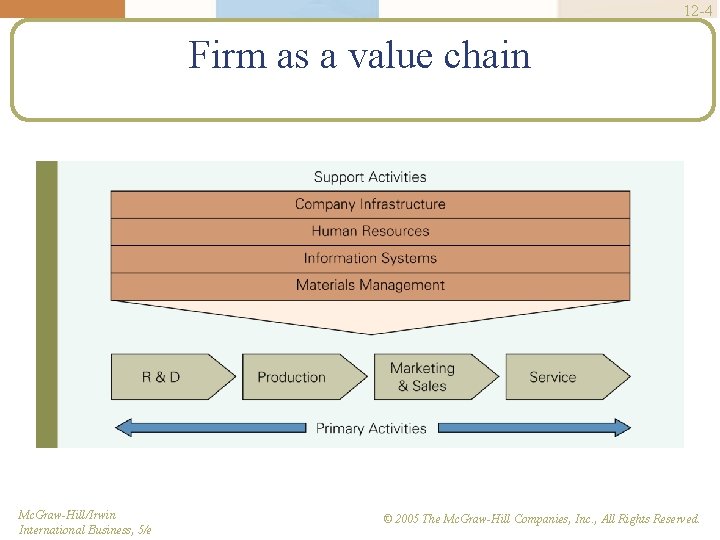
12 -3 Firm as a value chain Where does value come from? Any firm is composed of a series of distinct value creating activities Primary activities Research & development Production Marketing & sales Service Support Activities Materials management or logistics Human resource Information systems, (this includes you accts) Mc. Graw-Hill/Irwin Company infrastructure© 2005 The Mc. Graw-Hill Companies, Inc. , All Rights Reserved. International Business, 5/e
12 -4 Firm as a value chain Mc. Graw-Hill/Irwin International Business, 5/e © 2005 The Mc. Graw-Hill Companies, Inc. , All Rights Reserved.
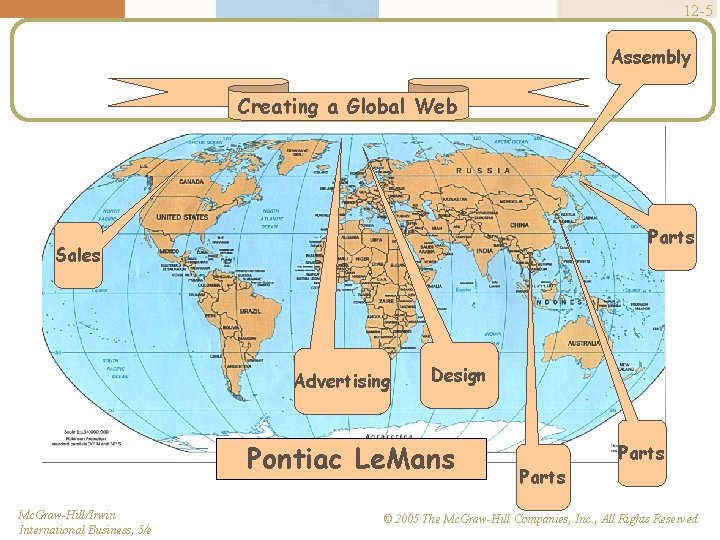
12 -5 Location Economies Assembly Creating a Global Web Parts Sales Advertising Design Pontiac Le. Mans Mc. Graw-Hill/Irwin International Business, 5/e Parts © 2005 The Mc. Graw-Hill Companies, Inc. , All Rights Reserved.
12 -6 Strategy in international business Strategy is concerned with identifying and taking actions that will lower costs of value creation and/or differentiate the firm’s product offering through superior design, quality service, functionality, etc. Meet both of Porters Goals (ie. , low cost & differentiation strategy) Mc. Graw-Hill/Irwin International Business, 5/e © 2005 The Mc. Graw-Hill Companies, Inc. , All Rights Reserved.
12 -7 Advantages of global expansion Location economies Cost economies from experience effects Leveraging core competencies Leveraging subsidiary skills BUT Profitability is constrained by product customization and the “imperative of localization”. Mc. Graw-Hill/Irwin International Business, 5/e © 2005 The Mc. Graw-Hill Companies, Inc. , All Rights Reserved.
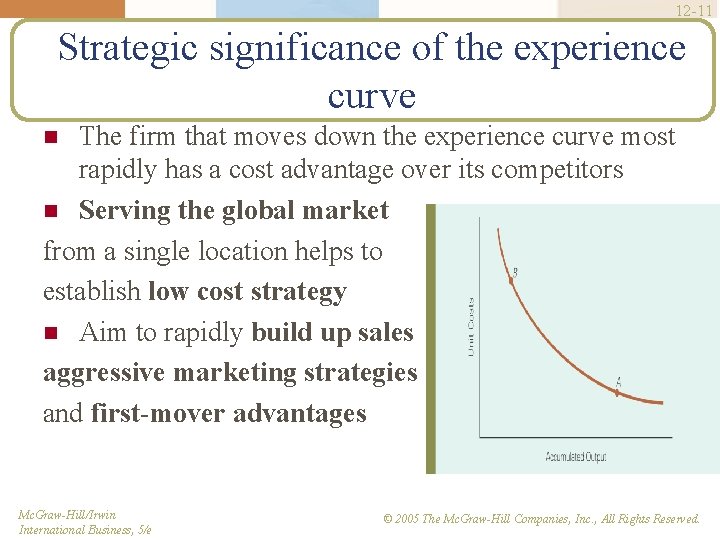
12 -8 Experience effects The systematic reduction in production costs that occurs over the life of a product First observed in aircraft industry where unit costs reduced by 80% each time output was doubled Caused due to Learning effects Economies of scale Mc. Graw-Hill/Irwin International Business, 5/e © 2005 The Mc. Graw-Hill Companies, Inc. , All Rights Reserved.
12 -9 Learning effects Cost savings that come from learning by doing Arises due to increased worker productivity and management efficiency Significant in cases of technologically complex task as there is a lot to be learned Experienced during start-up phase, cease after two or three years Decline after this point comes from economies of scale. Mc. Graw-Hill/Irwin International Business, 5/e © 2005 The Mc. Graw-Hill Companies, Inc. , All Rights Reserved.
12 -10 Economies of scale Refers to reduction in unit cost by producing a large volume of a product Sources: Reduces fixed costs by spreading it over a large volume Ability of large firms to employ increasingly specialized equipment or personnel Mc. Graw-Hill/Irwin International Business, 5/e © 2005 The Mc. Graw-Hill Companies, Inc. , All Rights Reserved.
12 -11 Strategic significance of the experience curve The firm that moves down the experience curve most rapidly has a cost advantage over its competitors Serving the global market from a single location helps to establish low cost strategy Aim to rapidly build up sales aggressive marketing strategies and first-mover advantages Mc. Graw-Hill/Irwin International Business, 5/e © 2005 The Mc. Graw-Hill Companies, Inc. , All Rights Reserved.
12 -12 Pressures for cost reductions Intense in industries of standardized, commodity type product that serve universal needs Major competitors are based in low-cost locations Consumers are powerful and face low switching costs Liberalization of world trade and investment environment Examples Bulk chemicals, petroleum, steel, personal computers Mc. Graw-Hill/Irwin International Business, 5/e © 2005 The Mc. Graw-Hill Companies, Inc. , All Rights Reserved.
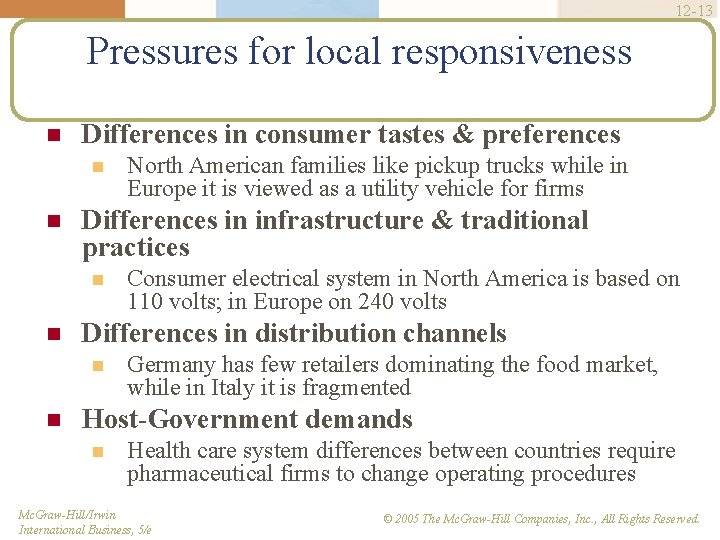
12 -13 Pressures for local responsiveness Differences in consumer tastes & preferences Differences in infrastructure & traditional practices Consumer electrical system in North America is based on 110 volts; in Europe on 240 volts Differences in distribution channels North American families like pickup trucks while in Europe it is viewed as a utility vehicle for firms Germany has few retailers dominating the food market, while in Italy it is fragmented Host-Government demands Health care system differences between countries require pharmaceutical firms to change operating procedures Mc. Graw-Hill/Irwin International Business, 5/e © 2005 The Mc. Graw-Hill Companies, Inc. , All Rights Reserved.
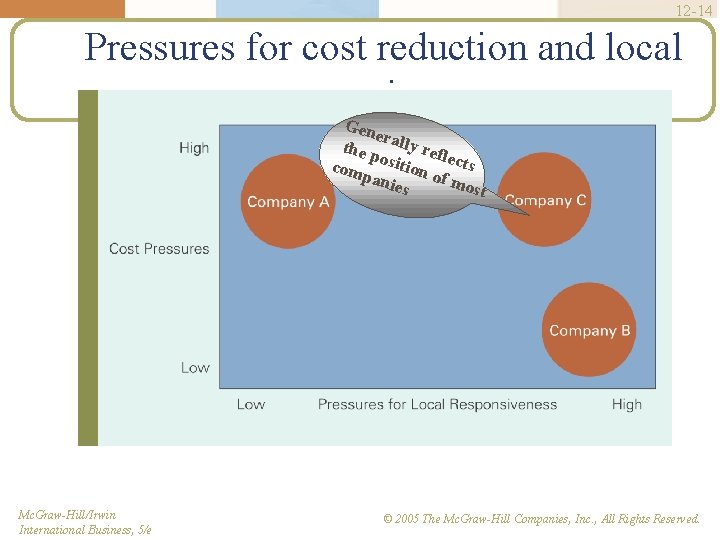
12 -14 Pressures for cost reduction and local responsiveness Gen er the p ally ref l com osition ects pani of m es ost Mc. Graw-Hill/Irwin International Business, 5/e © 2005 The Mc. Graw-Hill Companies, Inc. , All Rights Reserved.
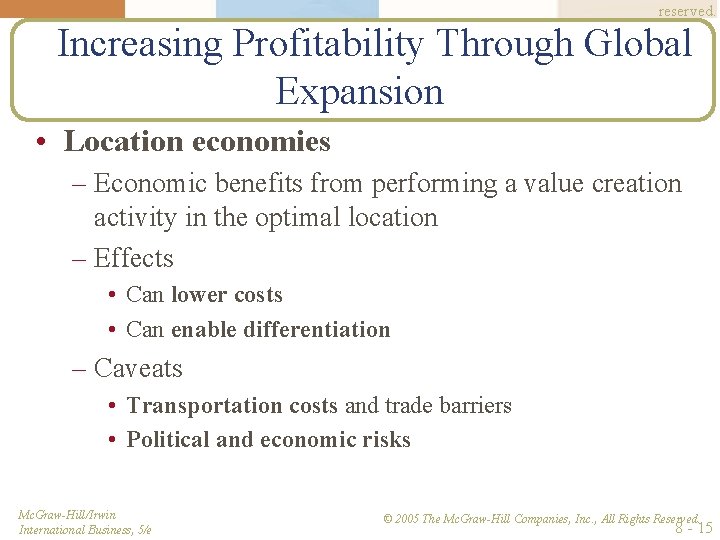
reserved. Increasing Profitability Through Global Expansion • Location economies – Economic benefits from performing a value creation activity in the optimal location – Effects • Can lower costs • Can enable differentiation – Caveats • Transportation costs and trade barriers • Political and economic risks Mc. Graw-Hill/Irwin International Business, 5/e © 2005 The Mc. Graw-Hill Companies, Inc. , All Rights Reserved. 8 - 15
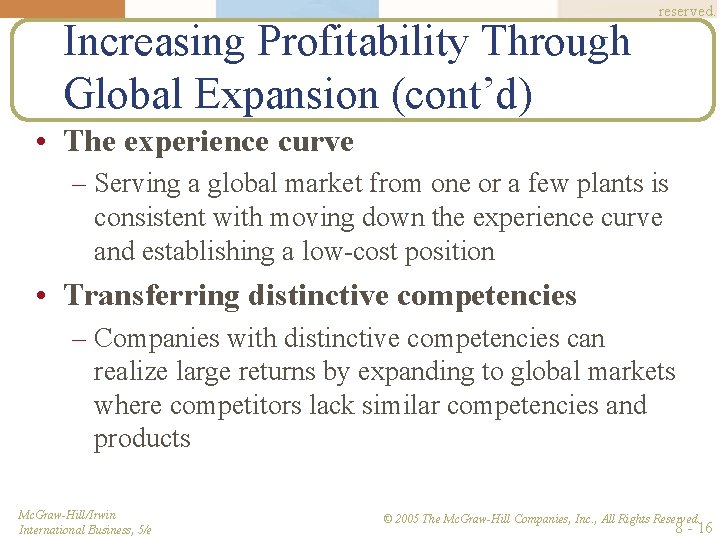
Increasing Profitability Through Global Expansion (cont’d) reserved. • The experience curve – Serving a global market from one or a few plants is consistent with moving down the experience curve and establishing a low-cost position • Transferring distinctive competencies – Companies with distinctive competencies can realize large returns by expanding to global markets where competitors lack similar competencies and products Mc. Graw-Hill/Irwin International Business, 5/e © 2005 The Mc. Graw-Hill Companies, Inc. , All Rights Reserved. 8 - 16
Increasing Profitability Through Global Expansion (cont’d) reserved. • Leveraging the skills of global subsidiaries – Competencies can be created anywhere within a multinational’s global network of operations – Managers must establish an incentive system to encourage local employees to acquire new competencies – Managers must have processes in place to identify valuable new competencies and help transfer them within the company Mc. Graw-Hill/Irwin International Business, 5/e © 2005 The Mc. Graw-Hill Companies, Inc. , All Rights Reserved. 8 - 17