
12 1 Review DNA Structure DNA is a


- Slides: 25
12 -1 Review
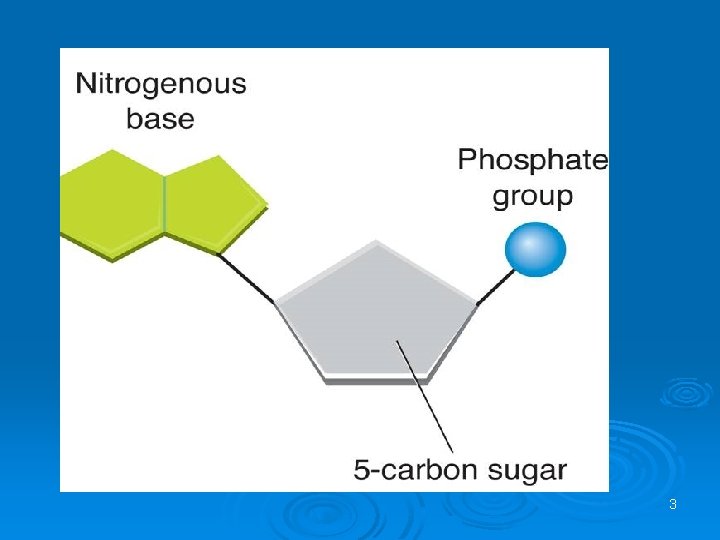
DNA Structure DNA is a nucleic acid. The building blocks of DNA are nucleotides, each composed of: l l l a 5 -carbon sugar called deoxyribose a phosphate group a nitrogenous base • adenine, thymine, cytosine, guanine 2
3
DNA Structure Rosalind Franklin and Maurice Wilkins l performed X-ray diffraction studies to identify the 3 -D structure James Watson and Francis Crick, 1953 l l deduced the structure of DNA using evidence from Chargaff, Franklin, and others proposed a double helix structure 4
DNA Structure The double helix consists of: l l l 2 sugar-phosphate backbones nitrogenous bases toward the interior of the molecule bases form hydrogen bonds with complementary bases on the opposite sugar -phosphate backbone • Cytosine : : Guanine • Adenine : : Thymine 5
Chapter 12 DNA Section 2 Chromosomes and DNA Replication
Objectives Ø Summarize the events of DNA replication Ø Relate the DNA molecule to chromosome structure
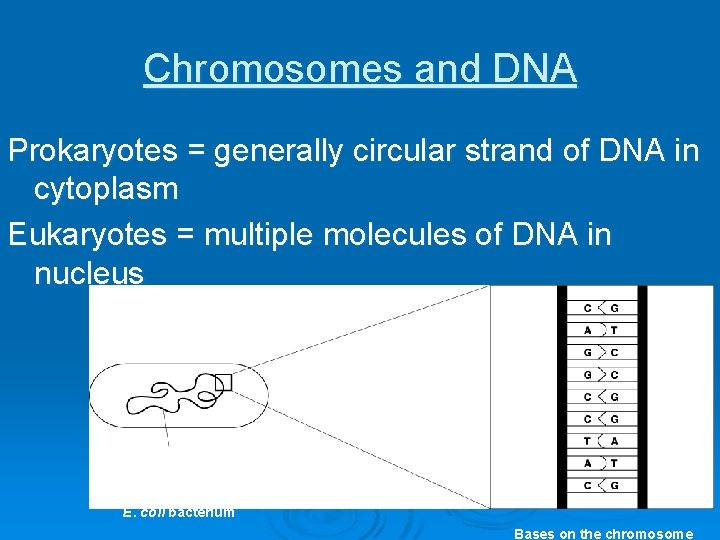
Chromosomes and DNA Prokaryotes = generally circular strand of DNA in cytoplasm Eukaryotes = multiple molecules of DNA in nucleus Chromosome E. coli bacterium Bases on the chromosome
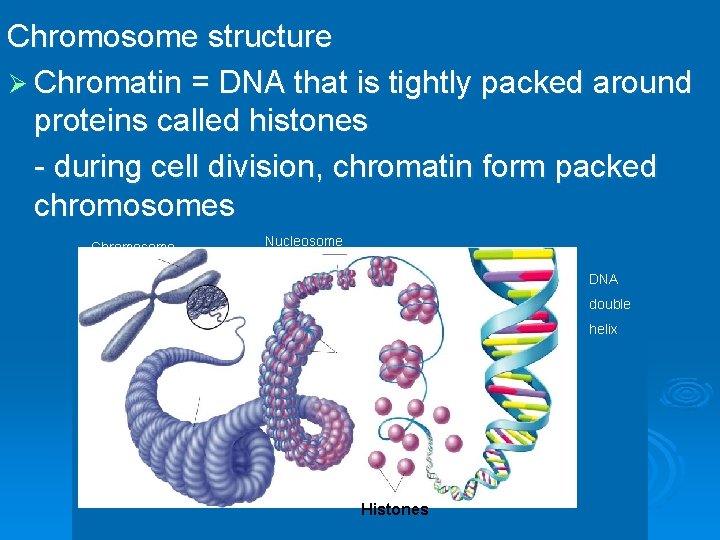
Chromosome structure Ø Chromatin = DNA that is tightly packed around proteins called histones - during cell division, chromatin form packed chromosomes Chromosome Nucleosome DNA double helix Coils Supercoils Histones
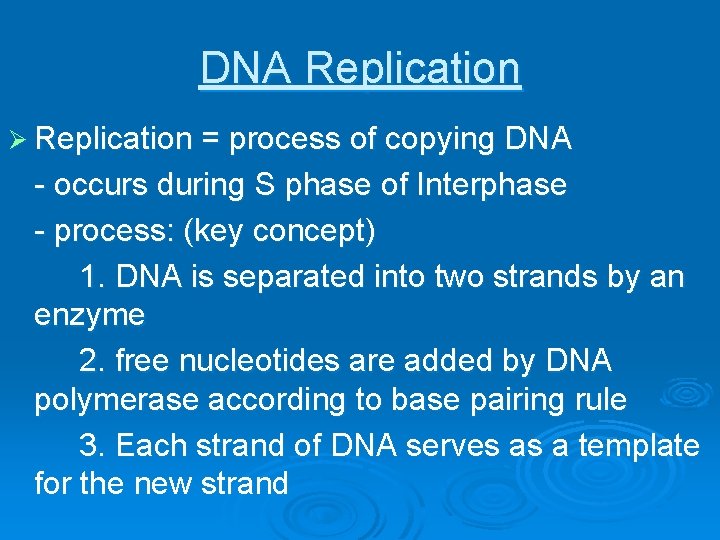
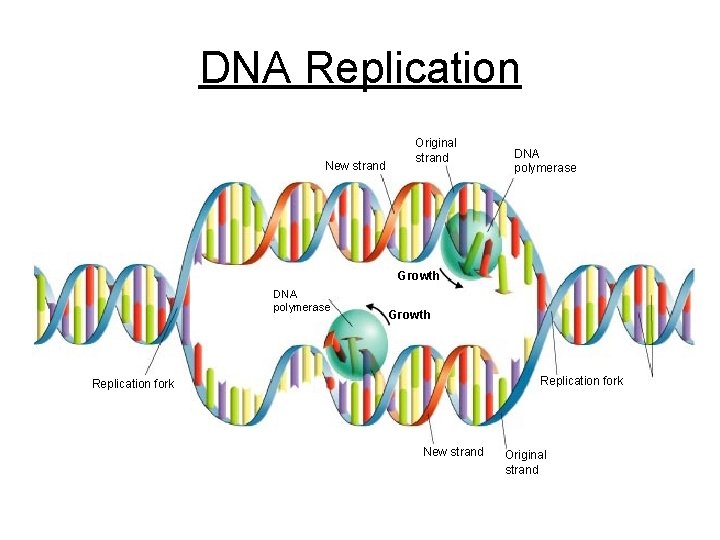
DNA Replication Ø Replication = process of copying DNA - occurs during S phase of Interphase - process: (key concept) 1. DNA is separated into two strands by an enzyme 2. free nucleotides are added by DNA polymerase according to base pairing rule 3. Each strand of DNA serves as a template for the new strand
DNA Replication New strand Original strand DNA polymerase Growth Replication fork Nitrogenous bases Replication fork New strand Original strand
DNA in prokaryotic cells is located in the Ø a. nucleus Ø b. mitochondria Ø c. cytoplasm Ø d. vacuole • ANSWER: C. cytoplasm
DNA PROKARYOTES Ø Is the following sentence true or false? Ø Most prokaryotes contain a single, circular DNA molecule. Ø True
DNA EUKARYOTES Ø Eurkaryotic DNA is generally located in the cell_____ in the form of a number of chromosomes. Ø Nucleus
Is the following sentence true or false? Ø All organisms have the same number of chromosomes. Ø False
What are histones? Histones are proteins around which DNA is tightly coiled.
DNA Replication Ø What occurs during the process of replication? Ø The cell duplicates its DNA in a copying process.
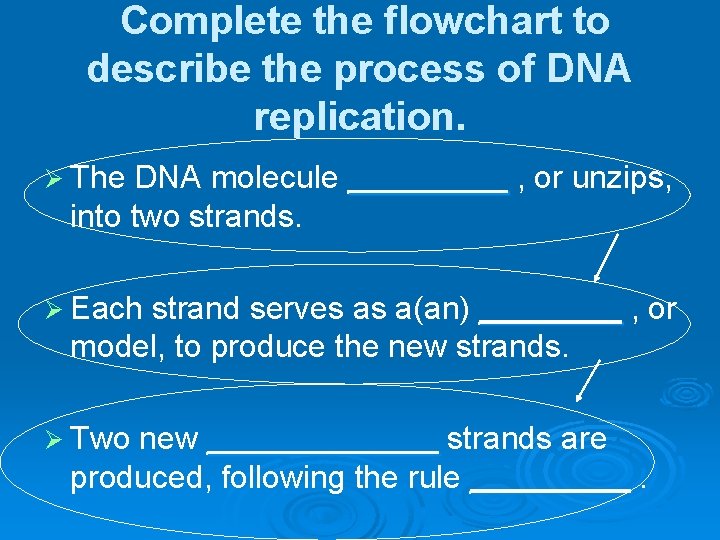
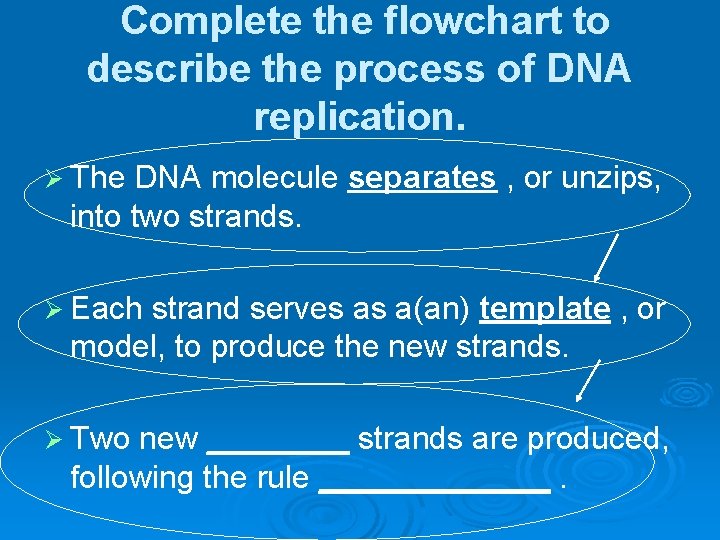
Complete the flowchart to describe the process of DNA replication. Ø The DNA molecule _____ , or unzips, into two strands. Ø Each strand serves as a(an) ____ , or model, to produce the new strands. Ø Two new _______ strands are produced, following the rule _____.
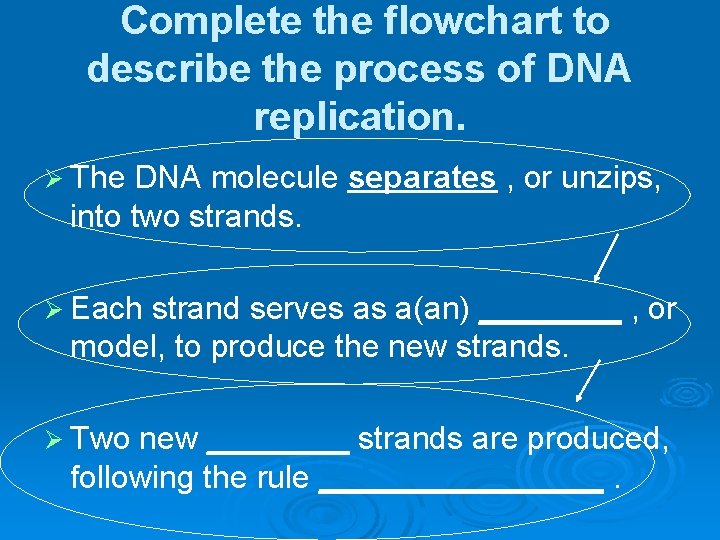
Complete the flowchart to describe the process of DNA replication. Ø The DNA molecule separates , or unzips, into two strands. Ø Each strand serves as a(an) ____ , or model, to produce the new strands. Ø Two new ____ strands are produced, following the rule ________.
Complete the flowchart to describe the process of DNA replication. Ø The DNA molecule separates , or unzips, into two strands. Ø Each strand serves as a(an) template , or model, to produce the new strands. Ø Two new ____ strands are produced, following the rule _______.
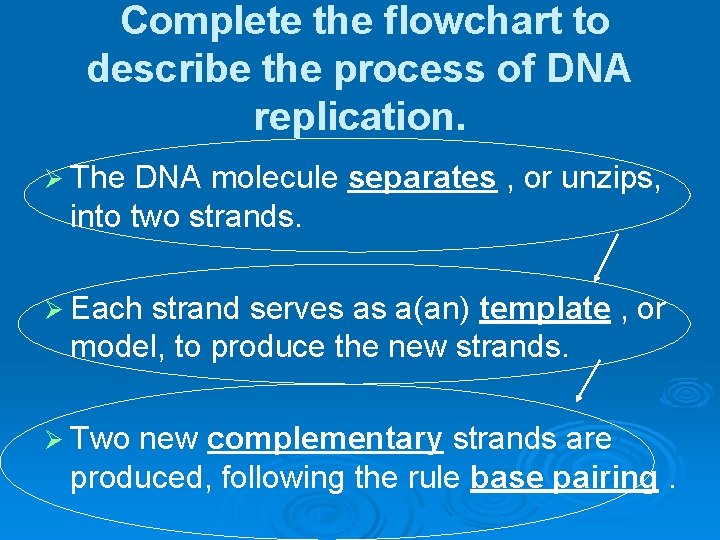
Complete the flowchart to describe the process of DNA replication. Ø The DNA molecule separates , or unzips, into two strands. Ø Each strand serves as a(an) template , or model, to produce the new strands. Ø Two new complementary strands are produced, following the rule base pairing.
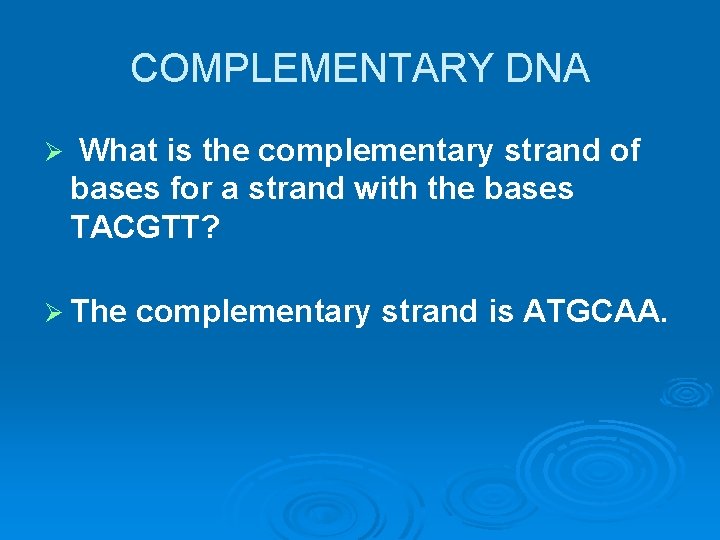
COMPLEMENTARY DNA Ø What is the complementary strand of bases for a strand with the bases TACGTT? Ø The complementary strand is ATGCAA.