
12 1 Exploring Solids Warm Up Lesson Presentation
- Slides: 36
12 -1 Exploring Solids Warm Up Lesson Presentation Lesson Quiz Holt Geometry
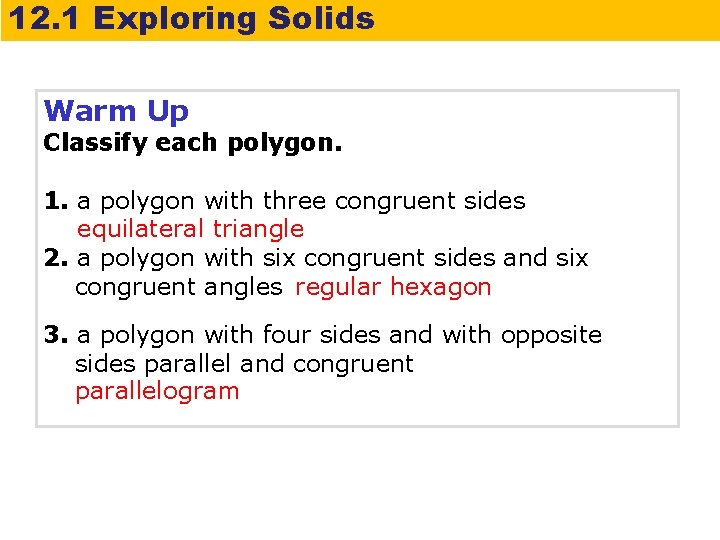
12. 1 Exploring Solids Warm Up Classify each polygon. 1. a polygon with three congruent sides equilateral triangle 2. a polygon with six congruent sides and six congruent angles regular hexagon 3. a polygon with four sides and with opposite sides parallel and congruent parallelogram
12. 1 Exploring Solids Objectives Classify three-dimensional figures according to their properties. Use nets and cross sections to analyze three-dimensional figures.
12. 1 Exploring Solids Vocabulary face edge vertex prism cylinder pyramid cone cube net cross section
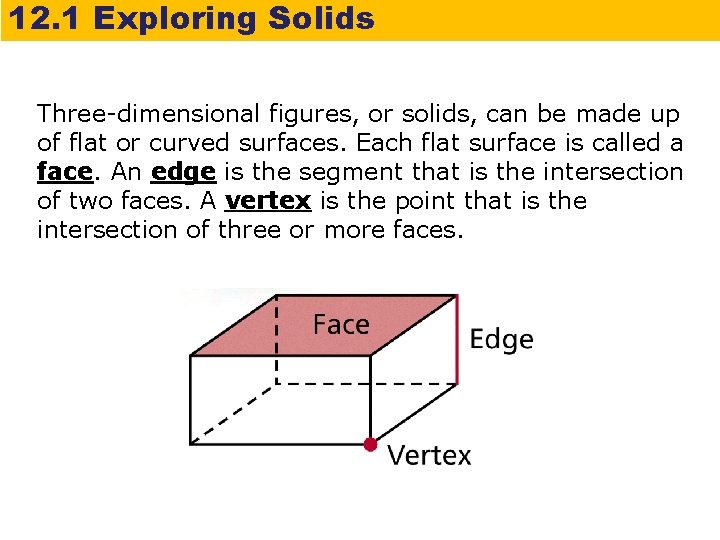
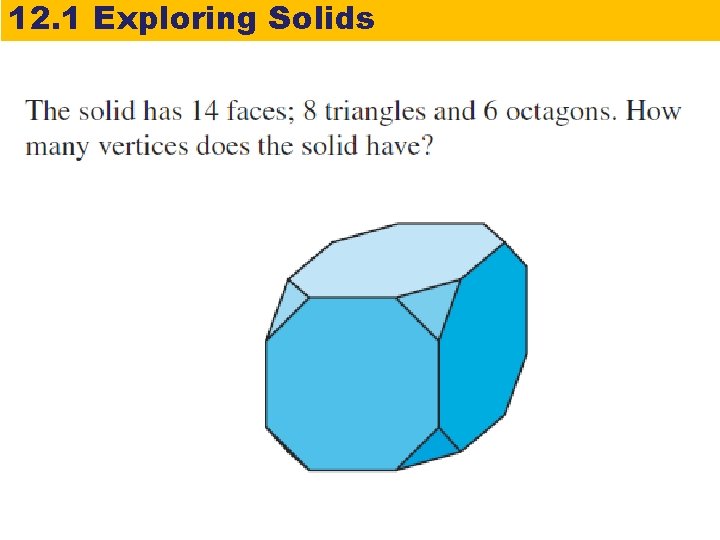
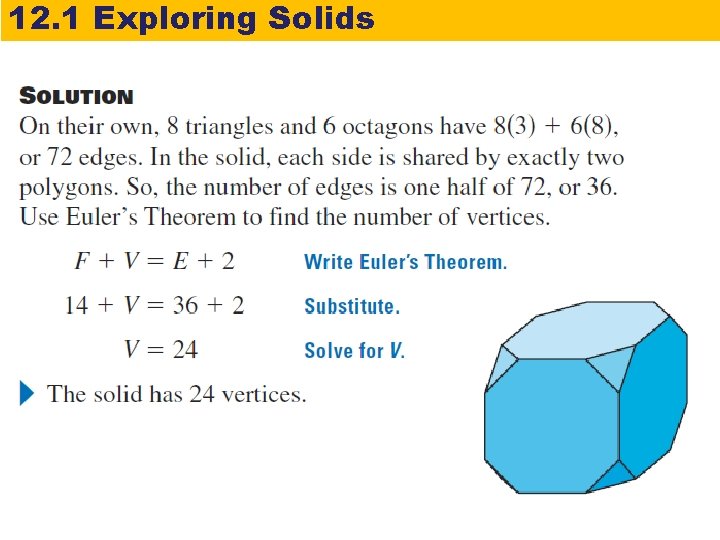
12. 1 Exploring Solids Three-dimensional figures, or solids, can be made up of flat or curved surfaces. Each flat surface is called a face. An edge is the segment that is the intersection of two faces. A vertex is the point that is the intersection of three or more faces.
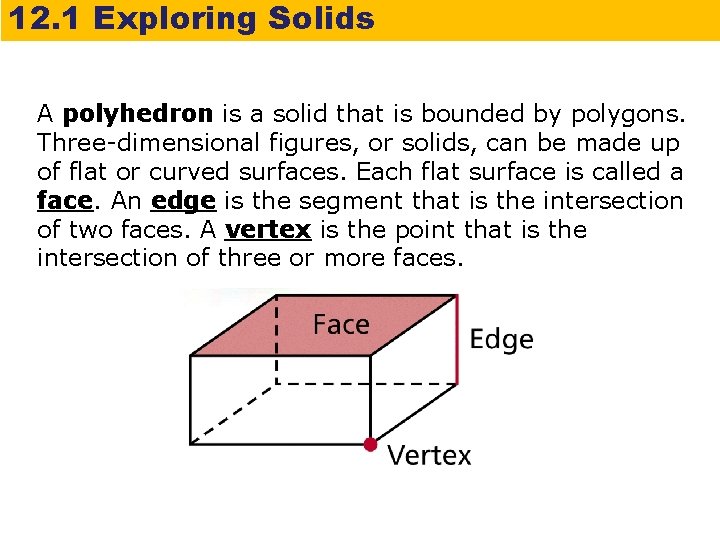
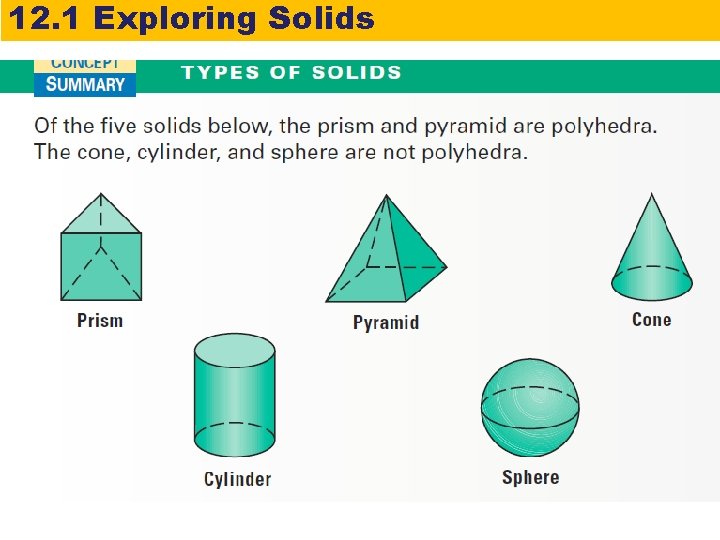
12. 1 Exploring Solids A polyhedron is a solid that is bounded by polygons. Three-dimensional figures, or solids, can be made up of flat or curved surfaces. Each flat surface is called a face. An edge is the segment that is the intersection of two faces. A vertex is the point that is the intersection of three or more faces.
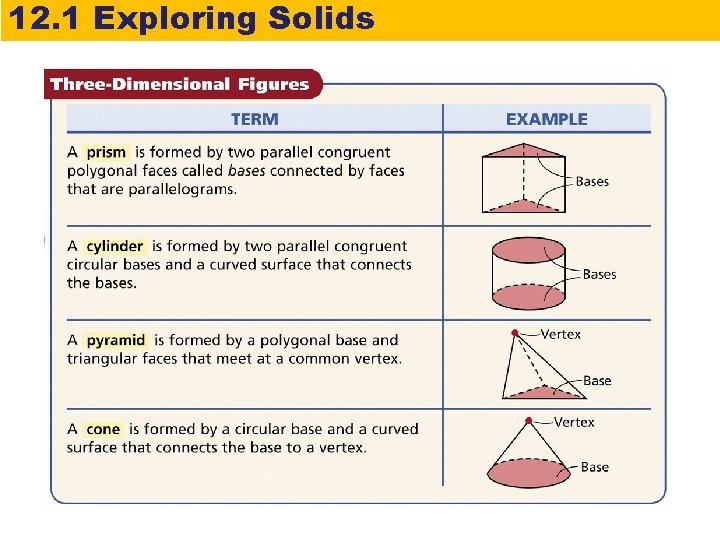
12. 1 Exploring Solids
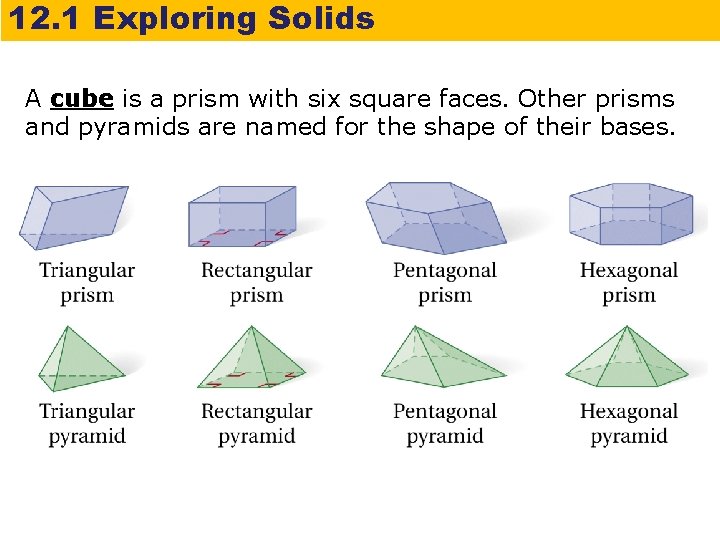
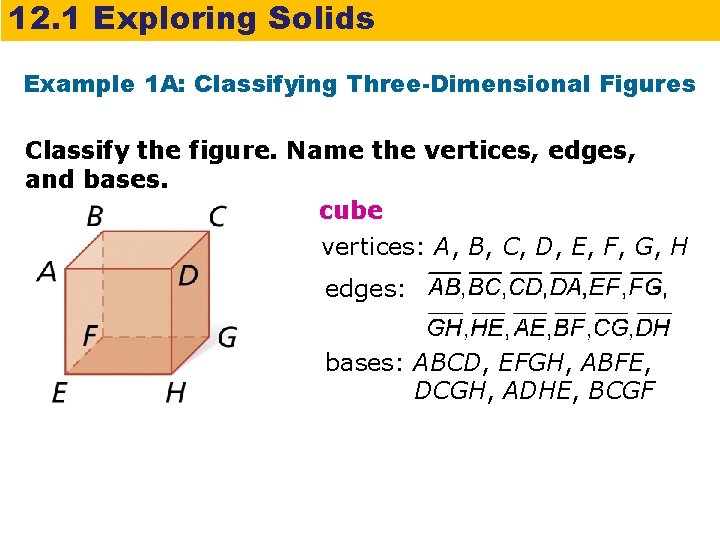
12. 1 Exploring Solids A cube is a prism with six square faces. Other prisms and pyramids are named for the shape of their bases.
12. 1 Exploring Solids Example 1 A: Classifying Three-Dimensional Figures Classify the figure. Name the vertices, edges, and bases. cube vertices: A, B, C, D, E, F, G, H edges: bases: ABCD, EFGH, ABFE, DCGH, ADHE, BCGF
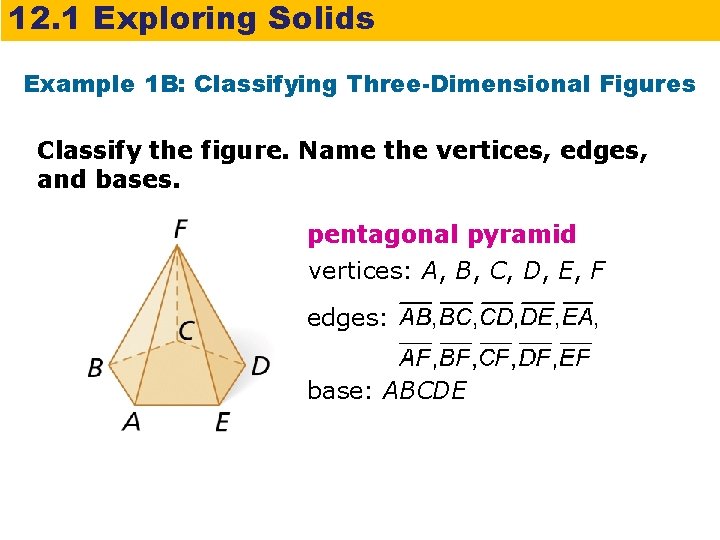
12. 1 Exploring Solids Example 1 B: Classifying Three-Dimensional Figures Classify the figure. Name the vertices, edges, and bases. pentagonal pyramid vertices: A, B, C, D, E, F edges: base: ABCDE
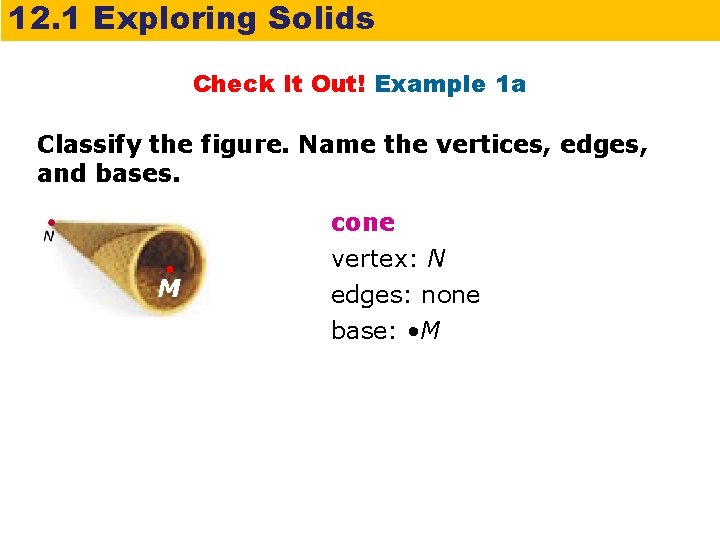
12. 1 Exploring Solids Check It Out! Example 1 a Classify the figure. Name the vertices, edges, and bases. cone vertex: N M edges: none base: • M
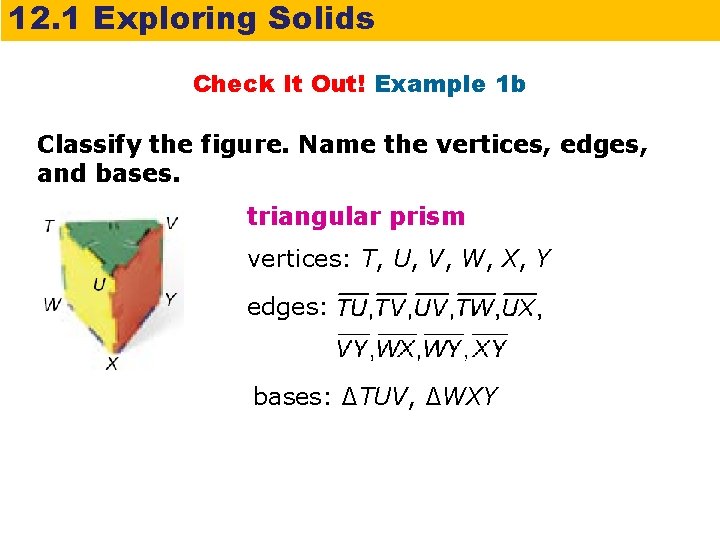
12. 1 Exploring Solids Check It Out! Example 1 b Classify the figure. Name the vertices, edges, and bases. triangular prism vertices: T, U, V, W, X, Y edges: bases: ∆TUV, ∆WXY
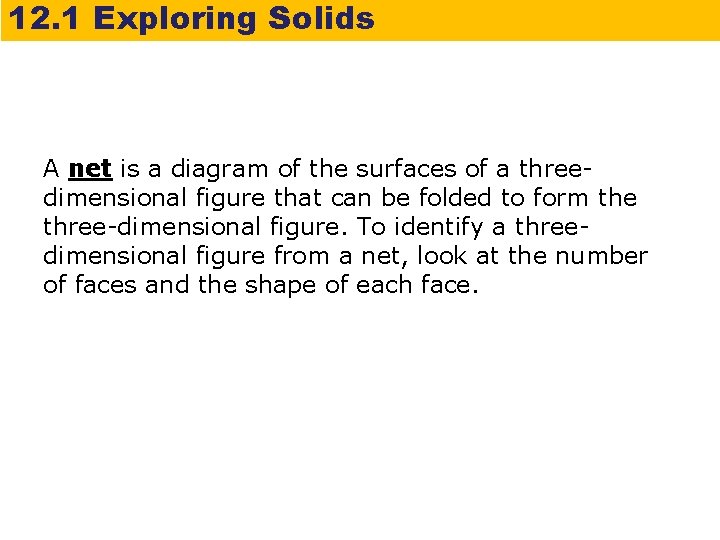
12. 1 Exploring Solids A net is a diagram of the surfaces of a threedimensional figure that can be folded to form the three-dimensional figure. To identify a threedimensional figure from a net, look at the number of faces and the shape of each face.
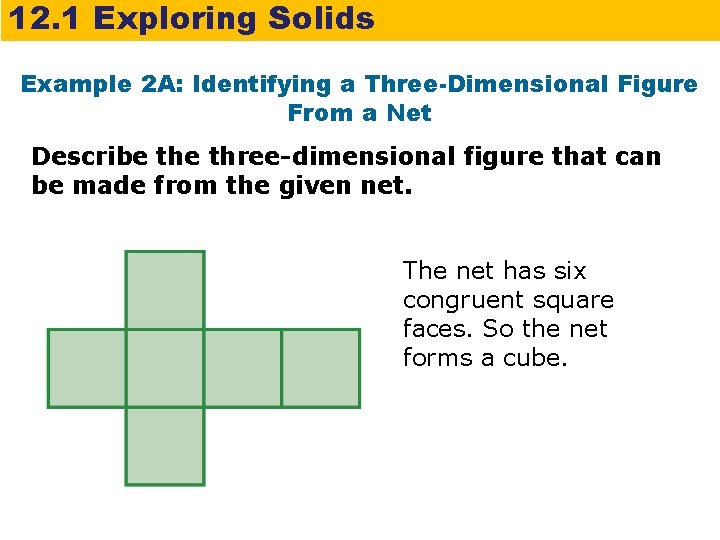
12. 1 Exploring Solids Example 2 A: Identifying a Three-Dimensional Figure From a Net Describe three-dimensional figure that can be made from the given net. The net has six congruent square faces. So the net forms a cube.
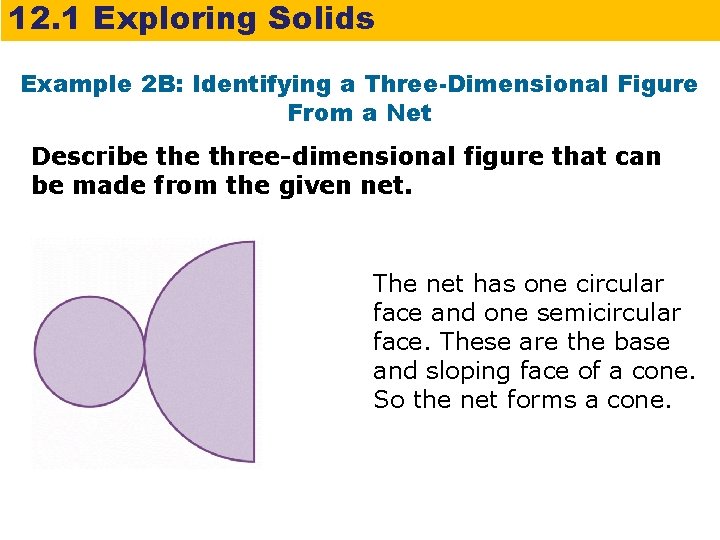
12. 1 Exploring Solids Example 2 B: Identifying a Three-Dimensional Figure From a Net Describe three-dimensional figure that can be made from the given net. The net has one circular face and one semicircular face. These are the base and sloping face of a cone. So the net forms a cone.
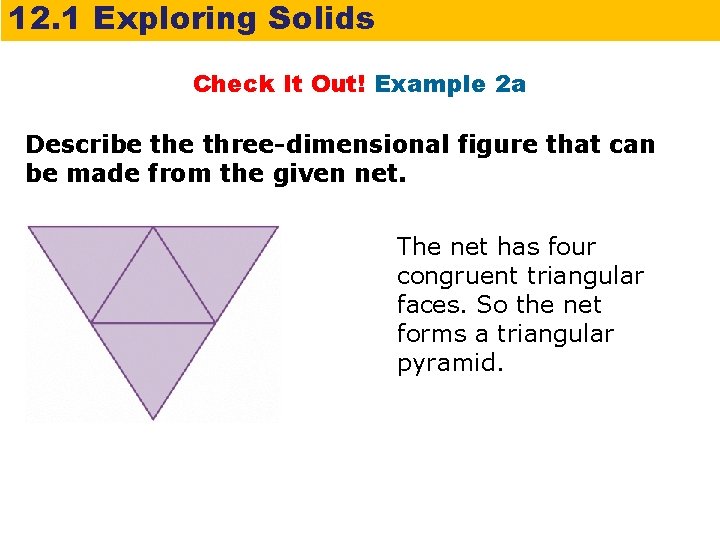
12. 1 Exploring Solids Check It Out! Example 2 a Describe three-dimensional figure that can be made from the given net. The net has four congruent triangular faces. So the net forms a triangular pyramid.
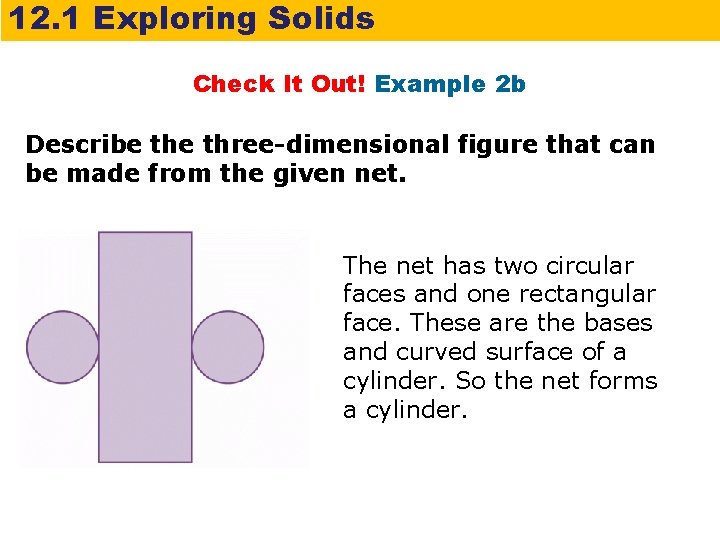
12. 1 Exploring Solids Check It Out! Example 2 b Describe three-dimensional figure that can be made from the given net. The net has two circular faces and one rectangular face. These are the bases and curved surface of a cylinder. So the net forms a cylinder.
12. 1 Exploring Solids
12. 1 Exploring Solids
12. 1 Exploring Solids
12. 1 Exploring Solids
12. 1 Exploring Solids
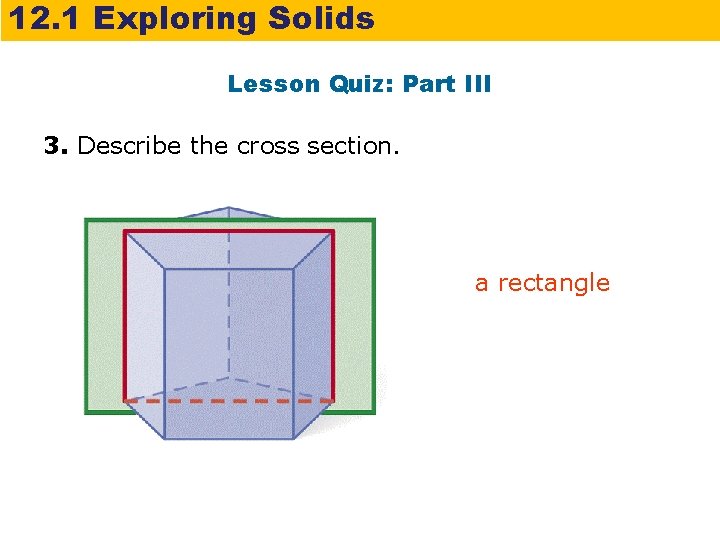
12. 1 Exploring Solids A cross section is the intersection of a threedimensional figure and a plane.
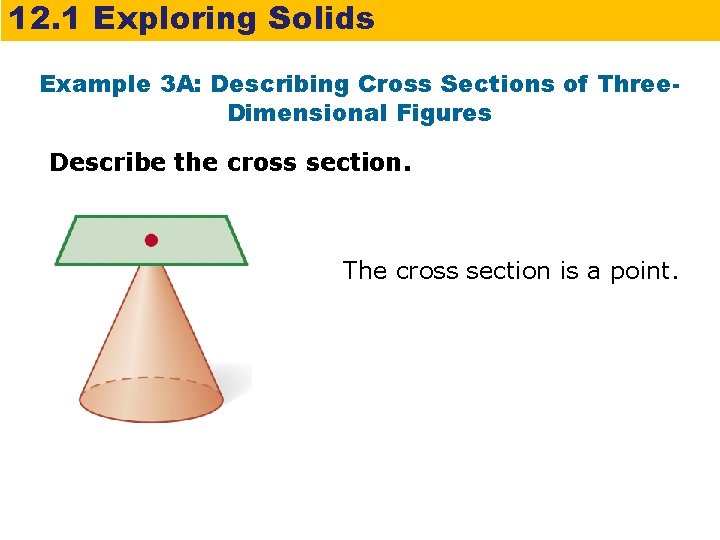
12. 1 Exploring Solids Example 3 A: Describing Cross Sections of Three. Dimensional Figures Describe the cross section. The cross section is a point.
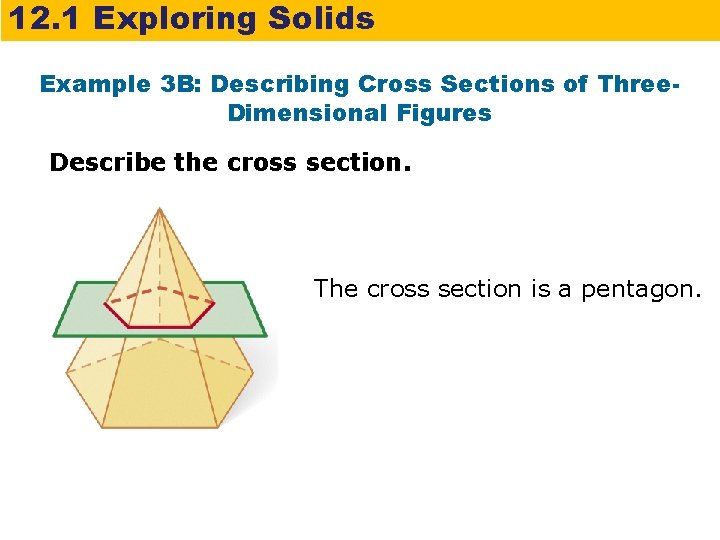
12. 1 Exploring Solids Example 3 B: Describing Cross Sections of Three. Dimensional Figures Describe the cross section. The cross section is a pentagon.
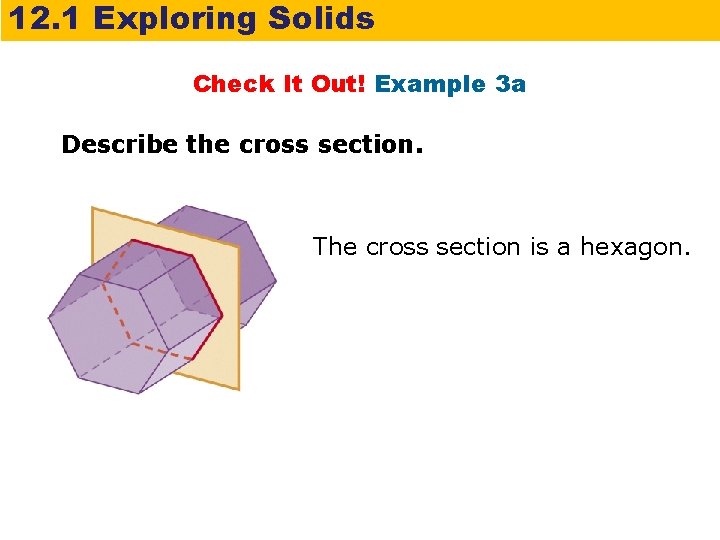
12. 1 Exploring Solids Check It Out! Example 3 a Describe the cross section. The cross section is a hexagon.
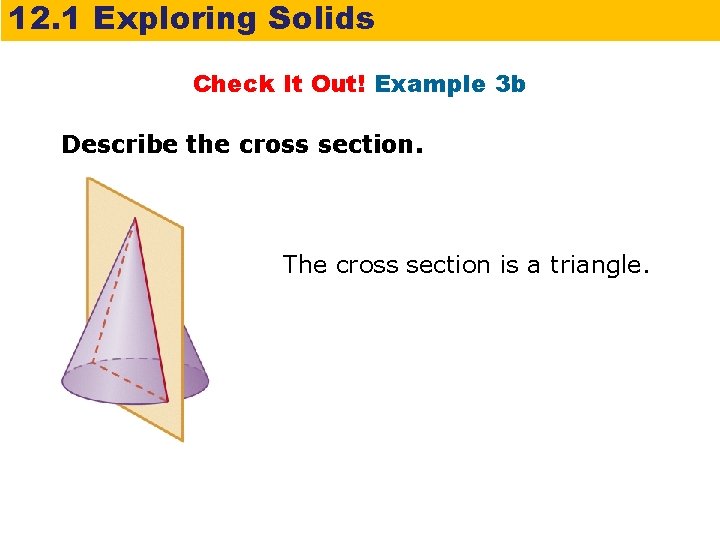
12. 1 Exploring Solids Check It Out! Example 3 b Describe the cross section. The cross section is a triangle.
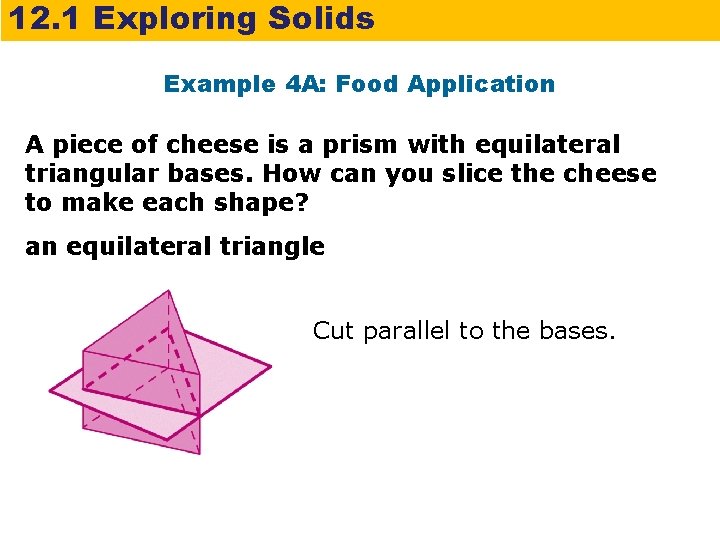
12. 1 Exploring Solids Example 4 A: Food Application A piece of cheese is a prism with equilateral triangular bases. How can you slice the cheese to make each shape? an equilateral triangle Cut parallel to the bases.
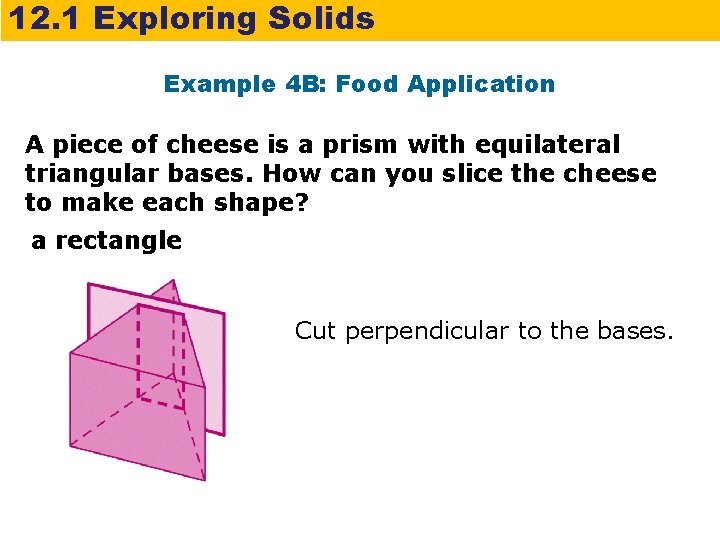
12. 1 Exploring Solids Example 4 B: Food Application A piece of cheese is a prism with equilateral triangular bases. How can you slice the cheese to make each shape? a rectangle Cut perpendicular to the bases.
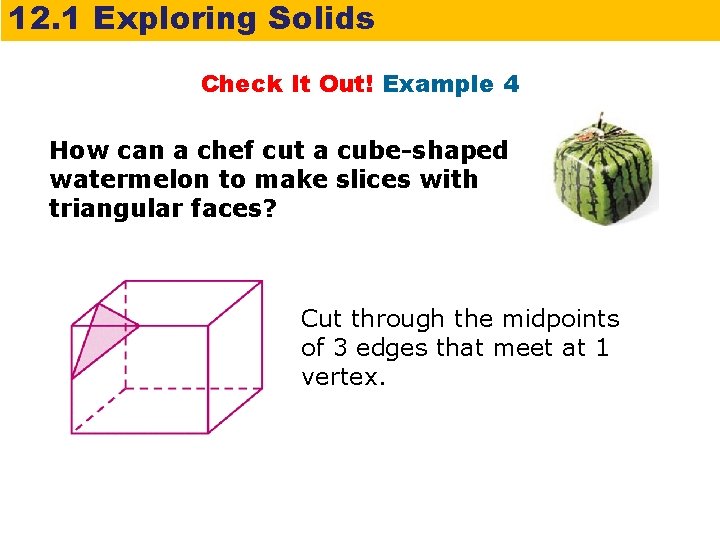
12. 1 Exploring Solids Check It Out! Example 4 How can a chef cut a cube-shaped watermelon to make slices with triangular faces? Cut through the midpoints of 3 edges that meet at 1 vertex.
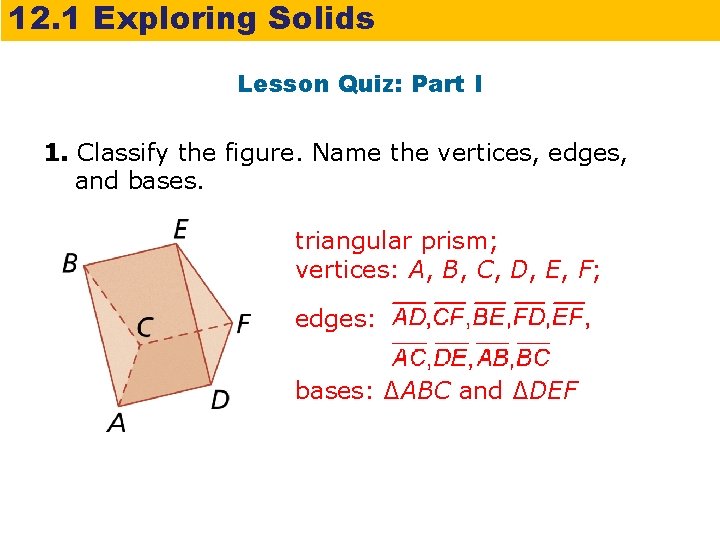
12. 1 Exploring Solids Lesson Quiz: Part I 1. Classify the figure. Name the vertices, edges, and bases. triangular prism; vertices: A, B, C, D, E, F; edges: bases: ∆ABC and ∆DEF
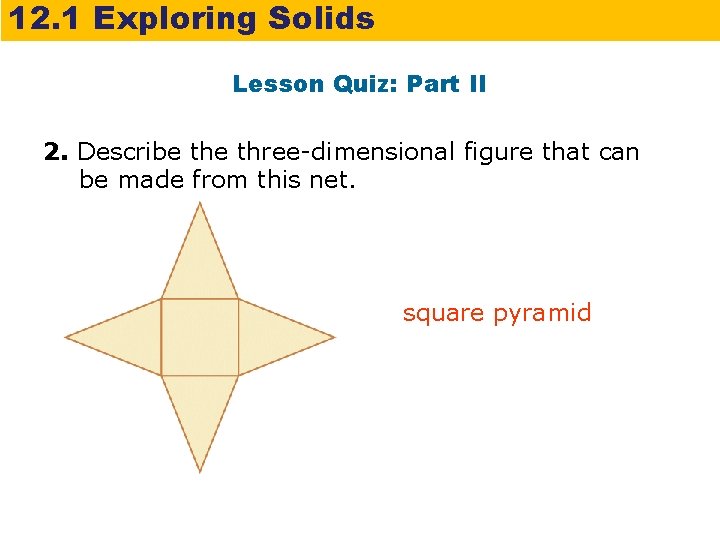
12. 1 Exploring Solids Lesson Quiz: Part II 2. Describe three-dimensional figure that can be made from this net. square pyramid
12. 1 Exploring Solids Lesson Quiz: Part III 3. Describe the cross section. a rectangle
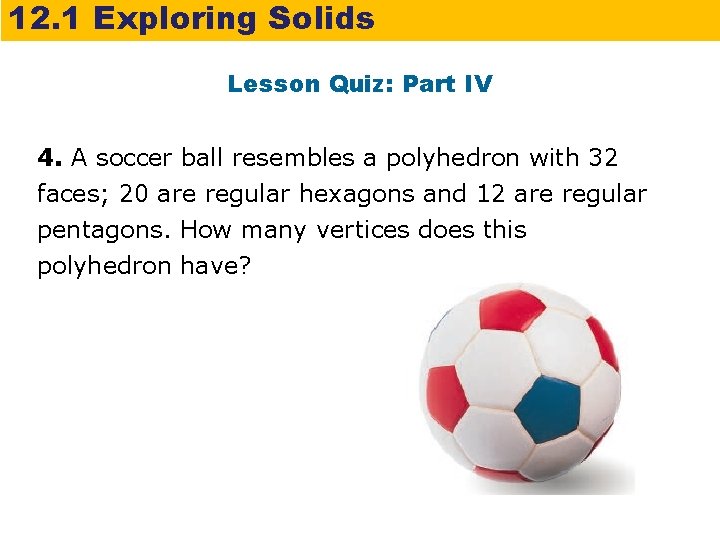
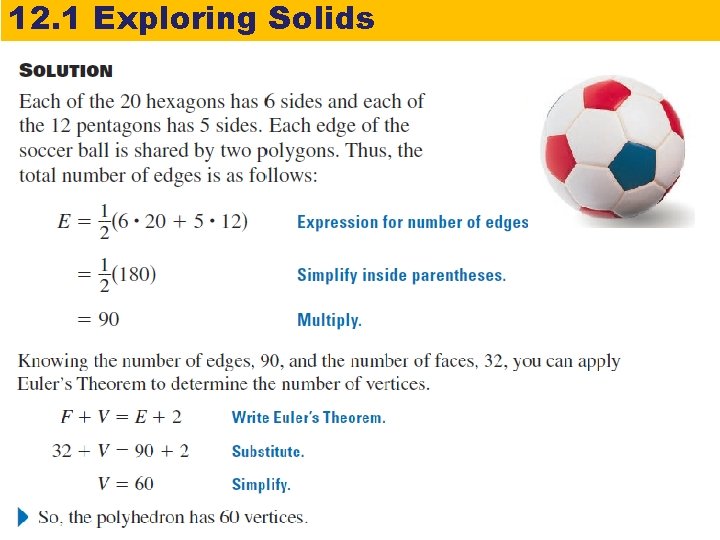
12. 1 Exploring Solids Lesson Quiz: Part IV 4. A soccer ball resembles a polyhedron with 32 faces; 20 are regular hexagons and 12 are regular pentagons. How many vertices does this polyhedron have?
12. 1 Exploring Solids
12. 1 Exploring Solids Videos: Nets of polyhedra https: //www. khanacademy. org/math/cc-sixthgrade-math/cc-6 th-geometry-topic/cc-6 thvolume-surface-area/v/nets-of-polyhedra