
12 1 Aggregate Planning Horizon Aggregate planning Intermediaterange
- Slides: 24
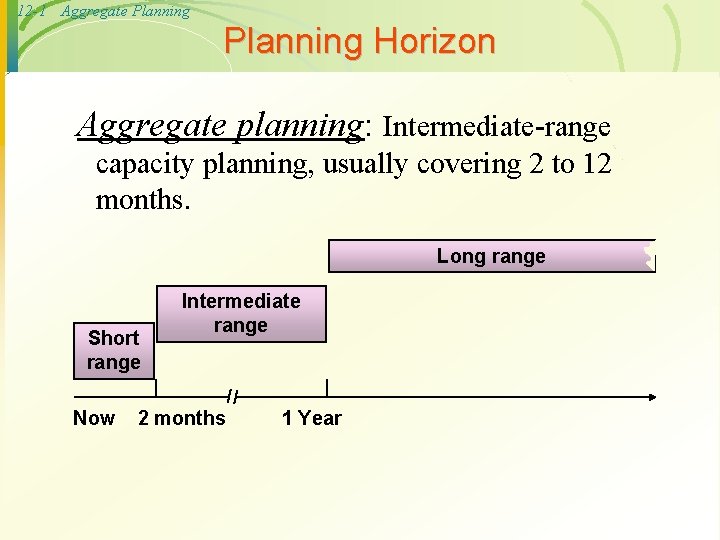
12 -1 Aggregate Planning Horizon Aggregate planning: Intermediate-range capacity planning, usually covering 2 to 12 months. Long range Short range Now Intermediate range 2 months 1 Year
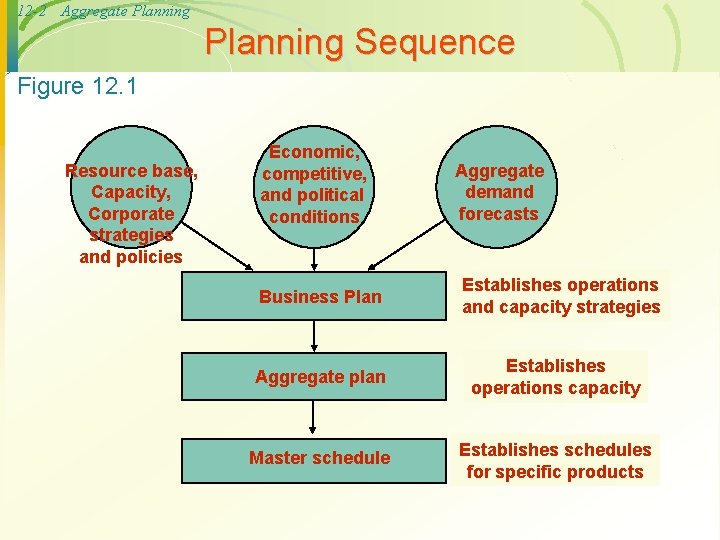
12 -2 Aggregate Planning Sequence Figure 12. 1 Resource base, Capacity, Corporate strategies and policies Economic, competitive, and political conditions Business Plan Aggregate demand forecasts Establishes operations and capacity strategies Aggregate plan Establishes operations capacity Master schedule Establishes schedules for specific products
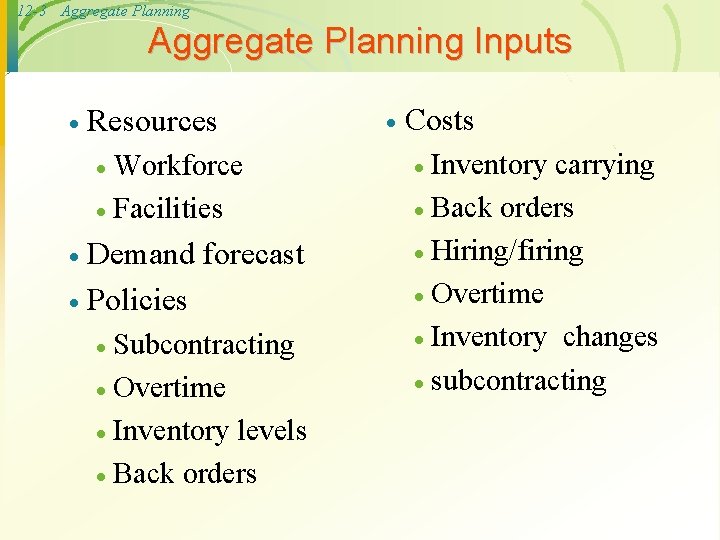
12 -3 Aggregate Planning Inputs · Resources Workforce · Facilities · Demand forecast · Policies · Subcontracting · Overtime · Inventory levels · Back orders · · Costs Inventory carrying · Back orders · Hiring/firing · Overtime · Inventory changes · subcontracting ·
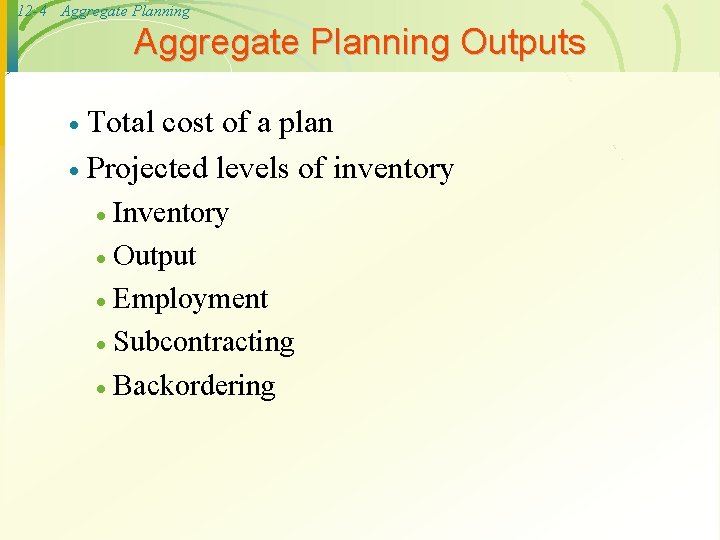
12 -4 Aggregate Planning Outputs Total cost of a plan · Projected levels of inventory · Inventory · Output · Employment · Subcontracting · Backordering ·
12 -5 Aggregate Planning Demand Options · Pricing · Promotion · Back orders · New demand
12 -6 Aggregate Planning Capacity Options Hire and layoff workers · Overtime/slack time · Part-time workers · Inventories · Subcontracting ·
12 -7 Aggregate Planning Strategies · Maintain a level workforce · Maintain a steady output rate · Match demand period by period · Use a combination of decision variables
12 -8 Aggregate Planning Basic Strategies · Level capacity strategy: · · Maintaining a steady rate of regular-time output while meeting variations in demand by a combination of options. Chase demand strategy: · Matching capacity to demand; the planned output for a period is set at the expected demand for that period.
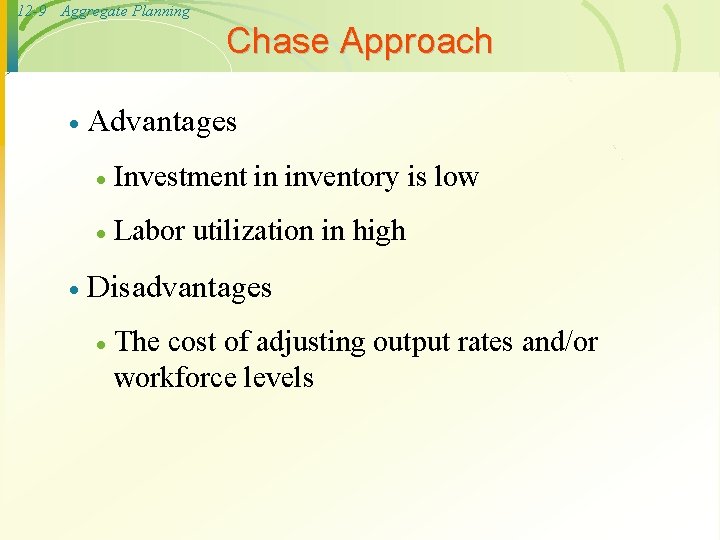
12 -9 Aggregate Planning Chase Approach · · Advantages · Investment in inventory is low · Labor utilization in high Disadvantages · The cost of adjusting output rates and/or workforce levels
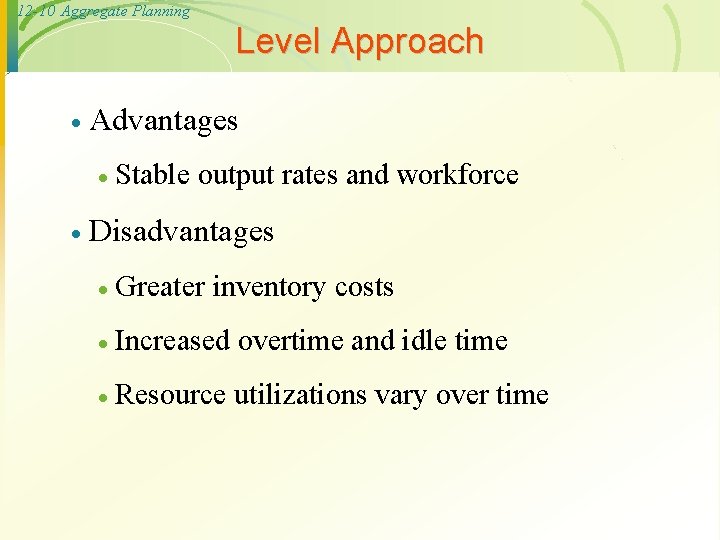
12 -10 Aggregate Planning Level Approach · Advantages · · Stable output rates and workforce Disadvantages · Greater inventory costs · Increased overtime and idle time · Resource utilizations vary over time
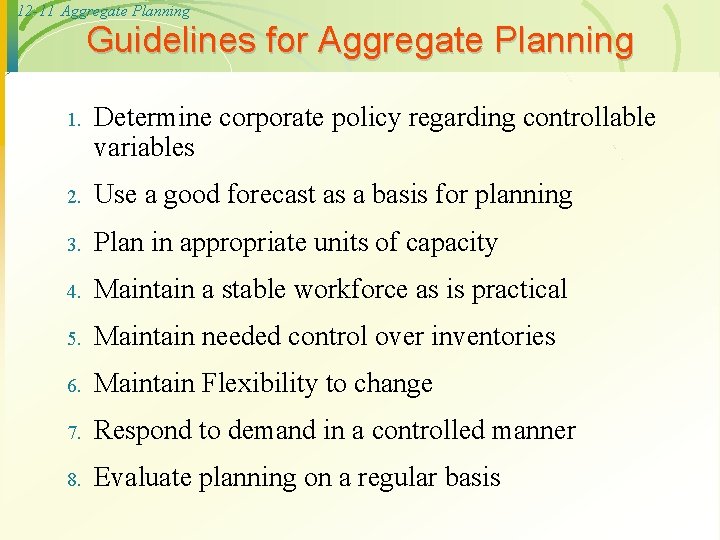
12 -11 Aggregate Planning Guidelines for Aggregate Planning 1. Determine corporate policy regarding controllable variables 2. Use a good forecast as a basis for planning 3. Plan in appropriate units of capacity 4. Maintain a stable workforce as is practical 5. Maintain needed control over inventories 6. Maintain Flexibility to change 7. Respond to demand in a controlled manner 8. Evaluate planning on a regular basis
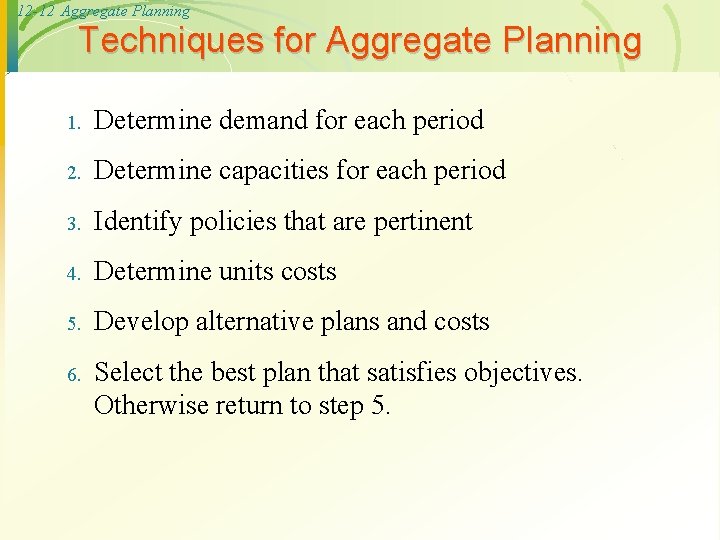
12 -12 Aggregate Planning Techniques for Aggregate Planning 1. Determine demand for each period 2. Determine capacities for each period 3. Identify policies that are pertinent 4. Determine units costs 5. Develop alternative plans and costs 6. Select the best plan that satisfies objectives. Otherwise return to step 5.
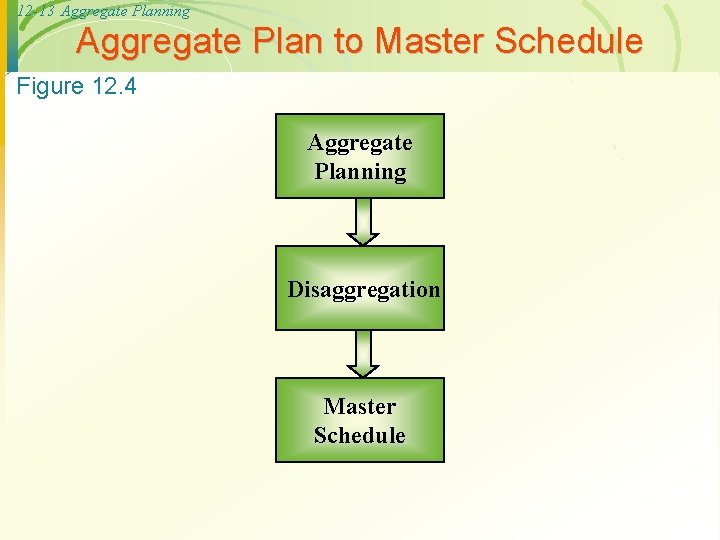
12 -13 Aggregate Planning Aggregate Plan to Master Schedule Figure 12. 4 Aggregate Planning Disaggregation Master Schedule
12 -14 Aggregate Planning Disaggregating the Aggregate Plan · Master schedule: The result of disaggregating an aggregate plan; shows quantity and timing of specific end items for a scheduled horizon. · Rough-cut capacity planning: Approximate balancing of capacity and demand to test the feasibility of a master schedule.
12 -15 Aggregate Planning Master Scheduling · Master schedule Determines quantities needed to meet demand · Interfaces with · · · Marketing Capacity planning Production planning Distribution planning
12 -16 Aggregate Planning Master Scheduler Evaluates impact of new orders · Provides delivery dates for orders · Deals with problems · Production delays · Revising master schedule · Insufficient capacity ·
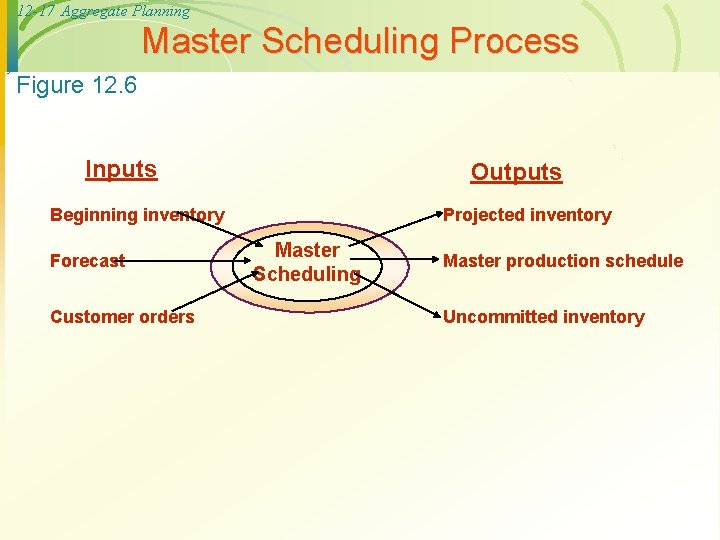
12 -17 Aggregate Planning Master Scheduling Process Figure 12. 6 Inputs Outputs Beginning inventory Forecast Customer orders Projected inventory Master Scheduling Master production schedule Uncommitted inventory
12 -18 Aggregate Planning · · Aggregate Production Plan (APP). Is the process of planning the quantity and timing of output over the intermediate time horizon. It involves adjusting controllable variables to respond to forecast and order fluctuations in a rational manner. Master Scheduling follows APP and breaks the plan down in to specific quantities of individual products to be produced in designated periods. Material Requirement Planning is a computer based information system designed to handle ordering and scheduling of dependent demand inventories.
12 -19 Aggregate Planning · · Bill of Materials (BOM) contains listing of all assemblies, subassemblies, parts and raw materials that are needed to produce one unit of the finished product. Gross requirements (GR) is total expected demand for an item or raw material in a period of time. Scheduled receipts are open orders scheduled to arrive form vendorr or elsewhere in the pipeline. Inventory On hand(IOH) is the amount of inventory that will be on hand at the beginning of each time period.
12 -20 Aggregate Planning Net requirement (NR)is the actual amount needed in each period. ( NR = GR-IOH+SS) · Planned order receipts (PORpts) are the quantity expected to be received by the beginning of the period in which it is shown. · Planned order releases (PORls) is the planned amount to order in each time period; Planned order receipts offset by lead time. ·
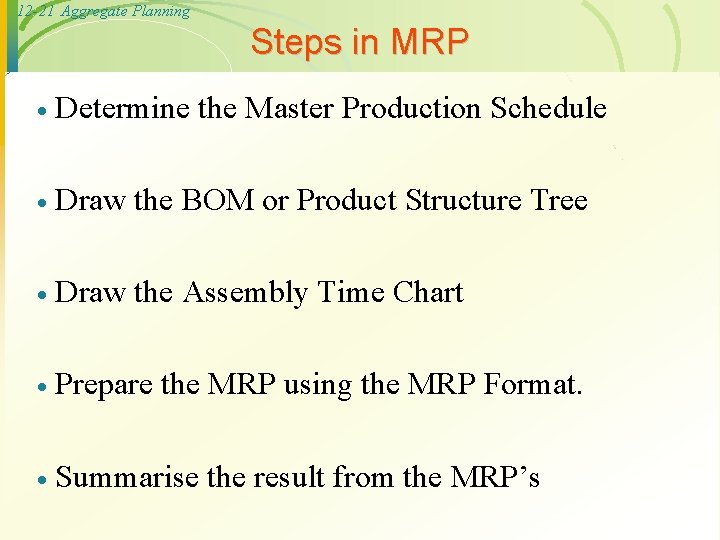
12 -21 Aggregate Planning Steps in MRP · Determine the Master Production Schedule · Draw the BOM or Product Structure Tree · Draw the Assembly Time Chart · Prepare the MRP using the MRP Format. · Summarise the result from the MRP’s
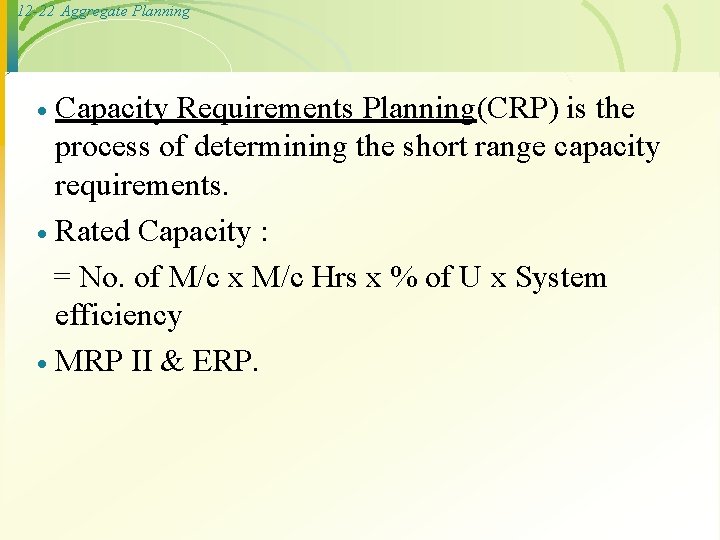
12 -22 Aggregate Planning Capacity Requirements Planning(CRP) is the process of determining the short range capacity requirements. · Rated Capacity : = No. of M/c x M/c Hrs x % of U x System efficiency · MRP II & ERP. ·
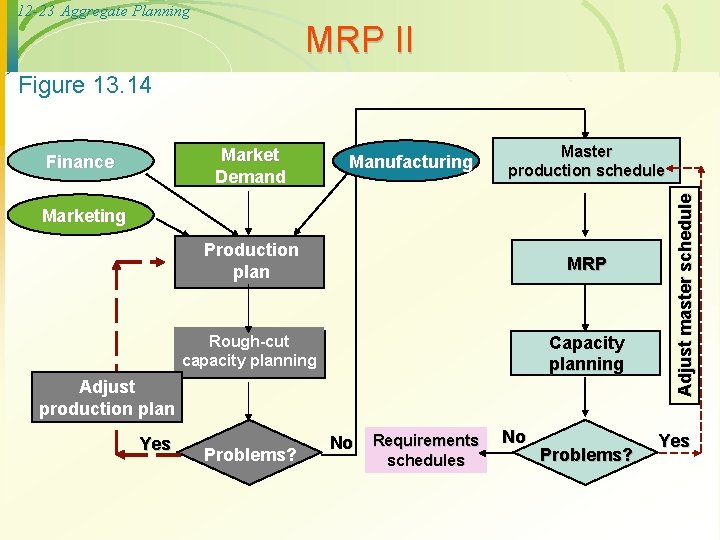
12 -23 Aggregate Planning MRP II Figure 13. 14 Manufacturing Master production schedule Marketing Production plan MRP Rough-cut capacity planning Capacity planning Adjust production plan Yes Problems? No Requirements schedules No Problems? Adjust master schedule Market Demand Finance Yes
12 -24 Aggregate Planning · Lot for Lot – LFL · Lot For Size - LFS