
12 1 Absolute Rulers and Enlightened Despots Essential
12. 1 - Absolute Rulers and Enlightened Despots Essential Question- How much power should government have?
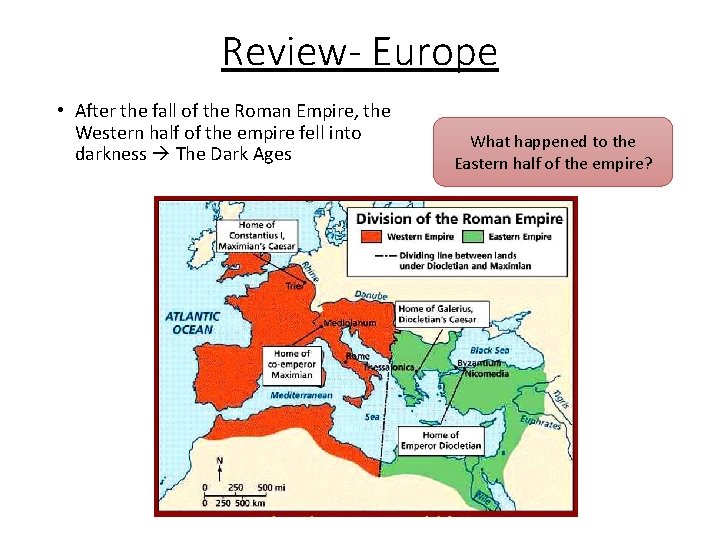
Review- Europe • After the fall of the Roman Empire, the Western half of the empire fell into darkness The Dark Ages What happened to the Eastern half of the empire?
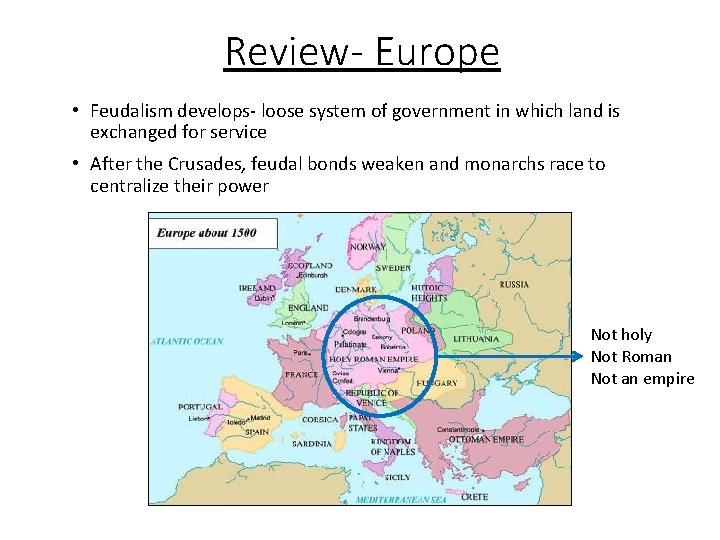
Review- Europe • Feudalism develops- loose system of government in which land is exchanged for service • After the Crusades, feudal bonds weaken and monarchs race to centralize their power Not holy Not Roman Not an empire
The Age of Absolutism • In the 1500 s, rulers of countries like Spain and France set up absolute monarchies • Power passed from generation to generation within families • Often had parliaments or other governing bodies that had no real power- ruler could dissolve them • Embraced the idea of divine right as a way to command absolute obedience from subjects • Saw themselves as God’s representatives on Earth, and acted in his name • Although the Church was more powerful than kings during the Middle Ages, monarchs were now able to regain control of the Church Absolute Monarchysystem of gov’t in which one ruler has complete authority over the gov’t and the lives of people Divine Right- authority to rule comes directly from God
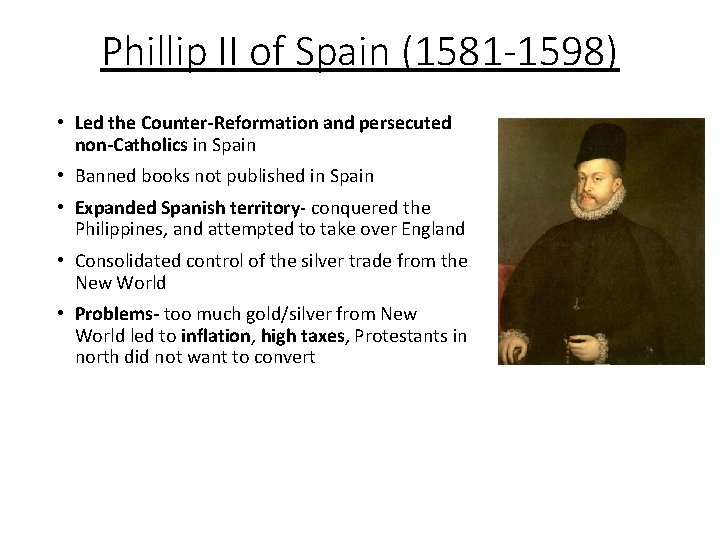
Phillip II of Spain (1581 -1598) • Led the Counter-Reformation and persecuted non-Catholics in Spain • Banned books not published in Spain • Expanded Spanish territory- conquered the Philippines, and attempted to take over England • Consolidated control of the silver trade from the New World • Problems- too much gold/silver from New World led to inflation, high taxes, Protestants in north did not want to convert
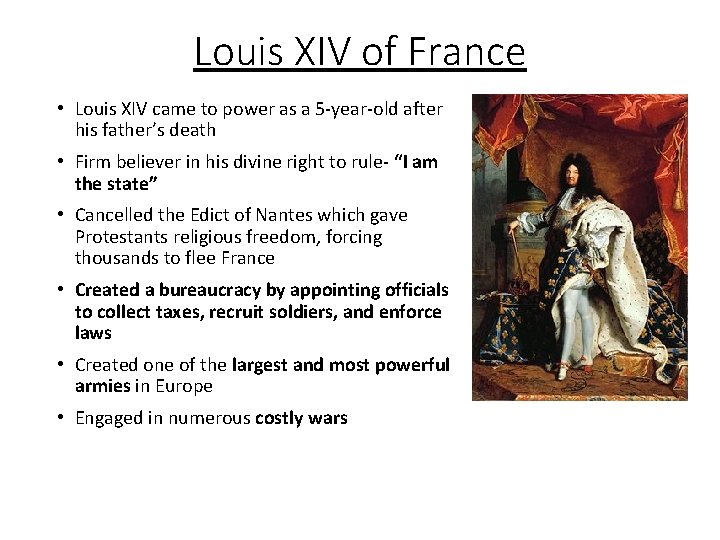
Louis XIV of France • Louis XIV came to power as a 5 -year-old after his father’s death • Firm believer in his divine right to rule- “I am the state” • Cancelled the Edict of Nantes which gave Protestants religious freedom, forcing thousands to flee France • Created a bureaucracy by appointing officials to collect taxes, recruit soldiers, and enforce laws • Created one of the largest and most powerful armies in Europe • Engaged in numerous costly wars
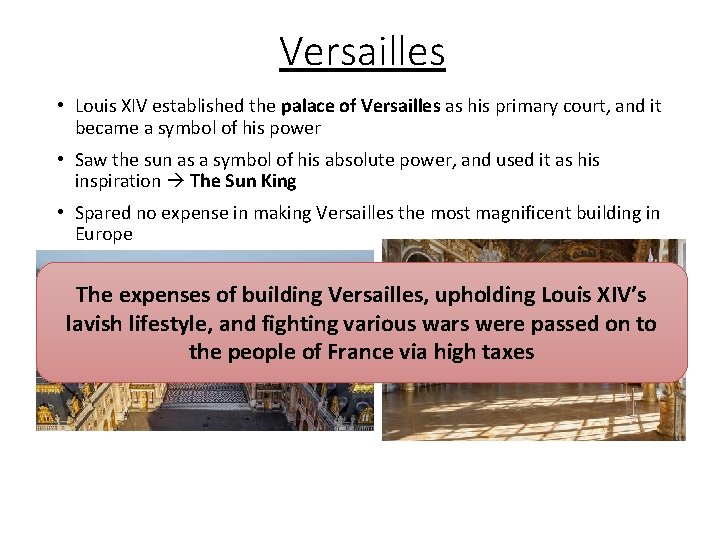
Versailles • Louis XIV established the palace of Versailles as his primary court, and it became a symbol of his power • Saw the sun as a symbol of his absolute power, and used it as his inspiration The Sun King • Spared no expense in making Versailles the most magnificent building in Europe The expenses of building Versailles, upholding Louis XIV’s lavish lifestyle, and fighting various wars were passed on to the people of France via high taxes
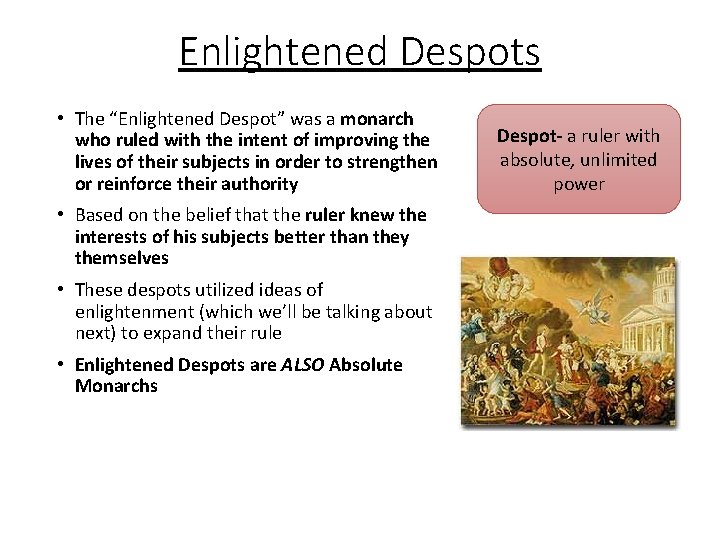
Enlightened Despots • The “Enlightened Despot” was a monarch who ruled with the intent of improving the lives of their subjects in order to strengthen or reinforce their authority • Based on the belief that the ruler knew the interests of his subjects better than they themselves • These despots utilized ideas of enlightenment (which we’ll be talking about next) to expand their rule • Enlightened Despots are ALSO Absolute Monarchs Despot- a ruler with absolute, unlimited power
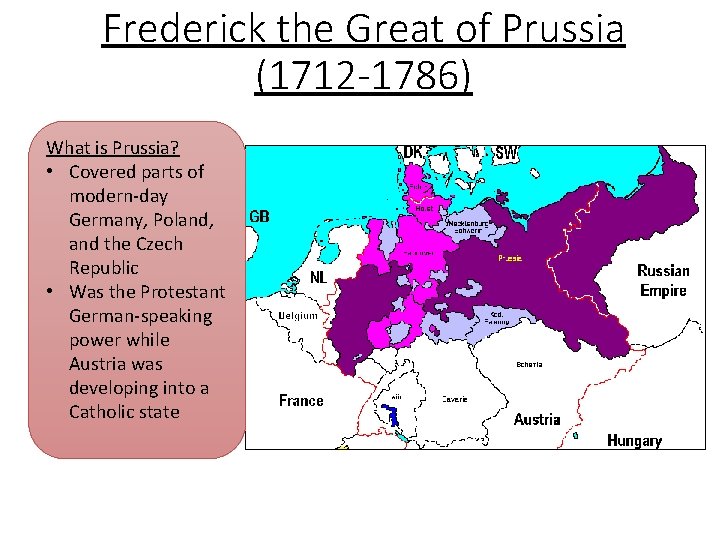
Frederick the Great of Prussia (1712 -1786) What is Prussia? • Frederick the Great was a humanist thinker • Covered parts oflearning, philosophy, and the who embraced modern-day arts Germany, Poland, • Modernized the army, won numerous military and the Czech victories and expanded the nation Republic Beloved by his subjects- built canals, made • • Was the Protestant new land arable, reformed the judicial system German-speaking and opened it to men of all classes, was power while religiously tolerant, allowed complete Austria was freedom of the press and literature developing into a Catholic state
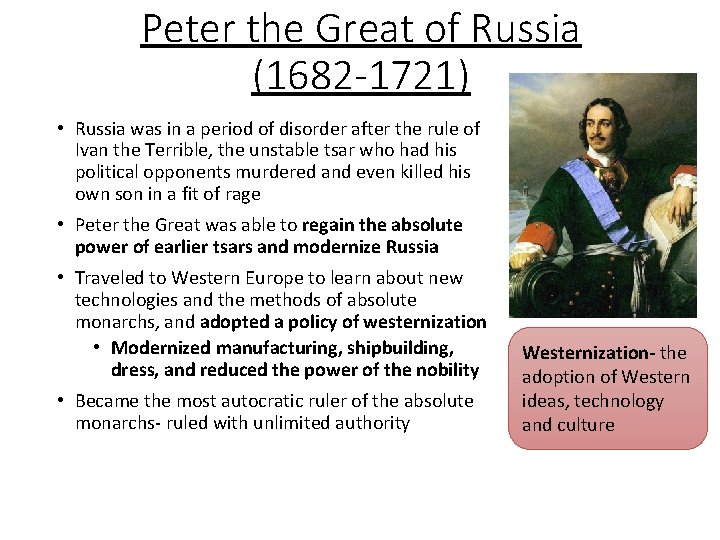
Peter the Great of Russia (1682 -1721) • Russia was in a period of disorder after the rule of Ivan the Terrible, the unstable tsar who had his political opponents murdered and even killed his own son in a fit of rage • Peter the Great was able to regain the absolute power of earlier tsars and modernize Russia • Traveled to Western Europe to learn about new technologies and the methods of absolute monarchs, and adopted a policy of westernization • Modernized manufacturing, shipbuilding, dress, and reduced the power of the nobility • Became the most autocratic ruler of the absolute monarchs- ruled with unlimited authority Westernization- the adoption of Western ideas, technology and culture
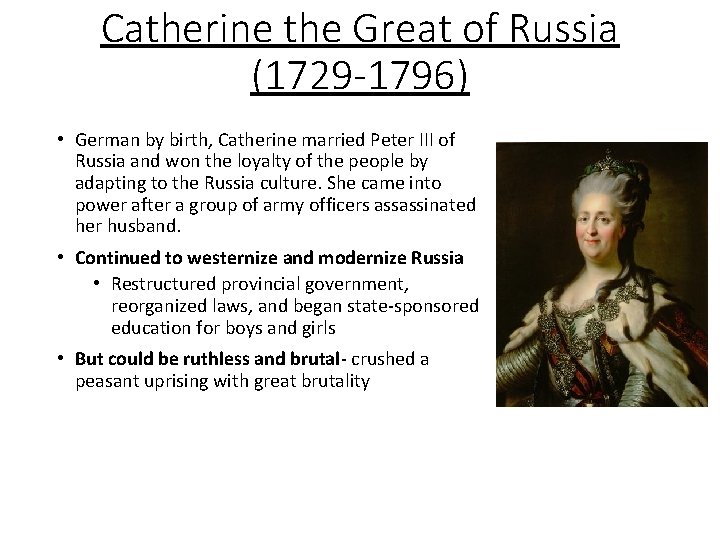
Catherine the Great of Russia (1729 -1796) • German by birth, Catherine married Peter III of Russia and won the loyalty of the people by adapting to the Russia culture. She came into power after a group of army officers assassinated her husband. • Continued to westernize and modernize Russia • Restructured provincial government, reorganized laws, and began state-sponsored education for boys and girls • But could be ruthless and brutal- crushed a peasant uprising with great brutality
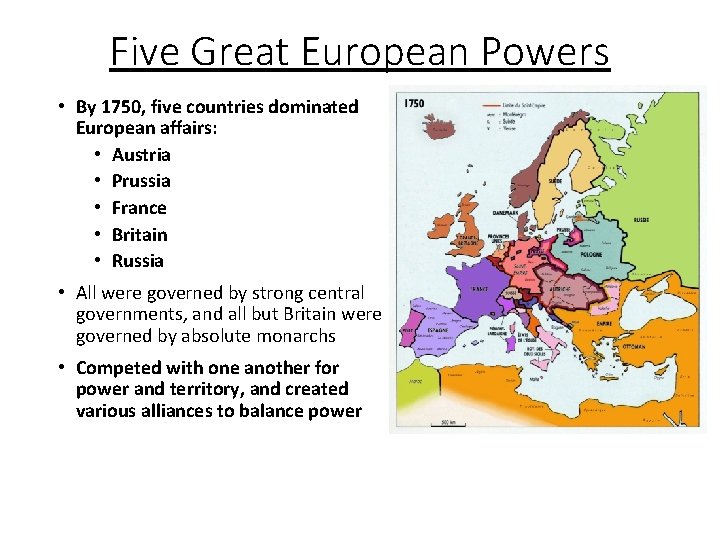
Five Great European Powers • By 1750, five countries dominated European affairs: • Austria • Prussia • France • Britain • Russia • All were governed by strong central governments, and all but Britain were governed by absolute monarchs • Competed with one another for power and territory, and created various alliances to balance power
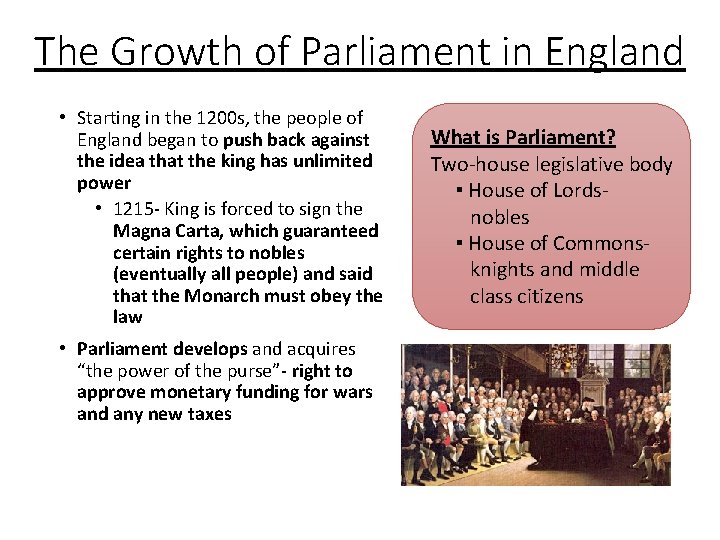
The Growth of Parliament in England • Starting in the 1200 s, the people of England began to push back against the idea that the king has unlimited power • 1215 - King is forced to sign the Magna Carta, which guaranteed certain rights to nobles (eventually all people) and said that the Monarch must obey the law • Parliament develops and acquires “the power of the purse”- right to approve monetary funding for wars and any new taxes What is Parliament? Two-house legislative body ▪ House of Lordsnobles ▪ House of Commonsknights and middle class citizens
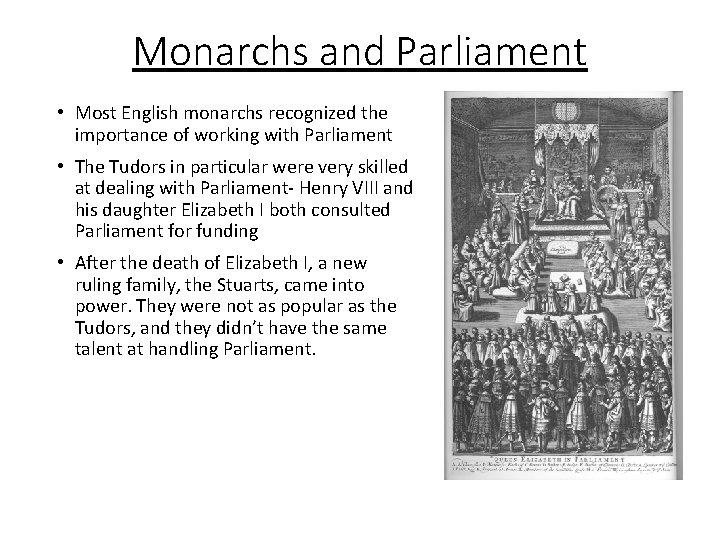
Monarchs and Parliament • Most English monarchs recognized the importance of working with Parliament • The Tudors in particular were very skilled at dealing with Parliament- Henry VIII and his daughter Elizabeth I both consulted Parliament for funding • After the death of Elizabeth I, a new ruling family, the Stuarts, came into power. They were not as popular as the Tudors, and they didn’t have the same talent at handling Parliament.
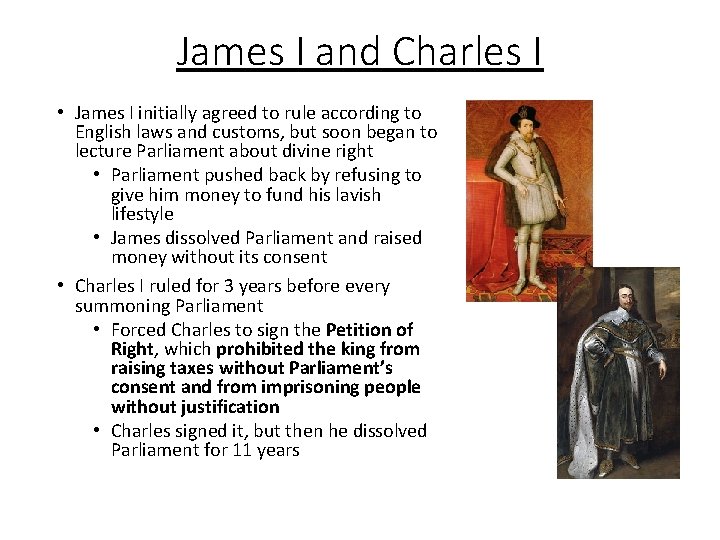
James I and Charles I • James I initially agreed to rule according to English laws and customs, but soon began to lecture Parliament about divine right • Parliament pushed back by refusing to give him money to fund his lavish lifestyle • James dissolved Parliament and raised money without its consent • Charles I ruled for 3 years before every summoning Parliament • Forced Charles to sign the Petition of Right, which prohibited the king from raising taxes without Parliament’s consent and from imprisoning people without justification • Charles signed it, but then he dissolved Parliament for 11 years
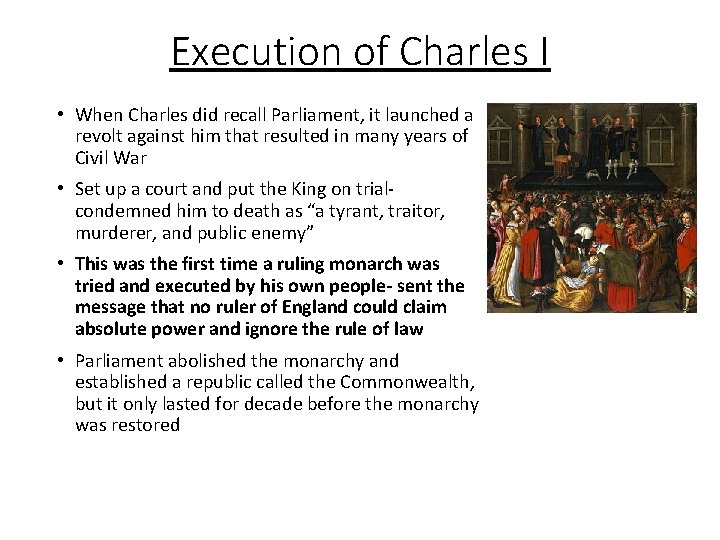
Execution of Charles I • When Charles did recall Parliament, it launched a revolt against him that resulted in many years of Civil War • Set up a court and put the King on trialcondemned him to death as “a tyrant, traitor, murderer, and public enemy” • This was the first time a ruling monarch was tried and executed by his own people- sent the message that no ruler of England could claim absolute power and ignore the rule of law • Parliament abolished the monarchy and established a republic called the Commonwealth, but it only lasted for decade before the monarchy was restored
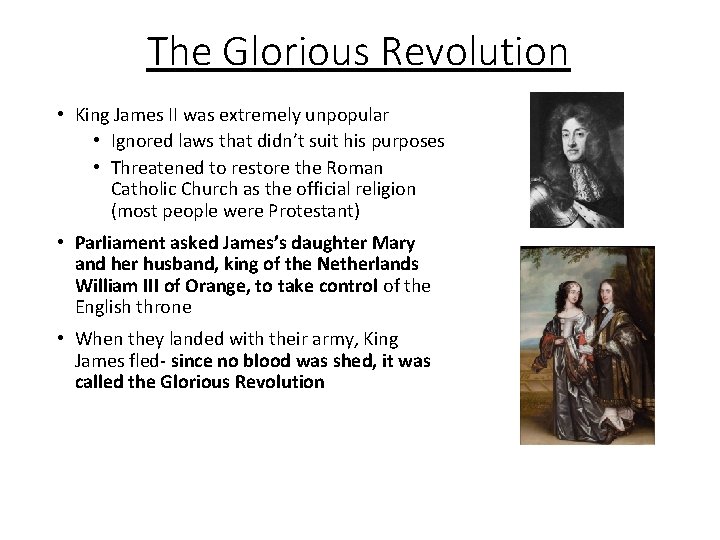
The Glorious Revolution • King James II was extremely unpopular • Ignored laws that didn’t suit his purposes • Threatened to restore the Roman Catholic Church as the official religion (most people were Protestant) • Parliament asked James’s daughter Mary and her husband, king of the Netherlands William III of Orange, to take control of the English throne • When they landed with their army, King James fled- since no blood was shed, it was called the Glorious Revolution
English Bill of Rights • Before they were crowned, William and Mary had to accept several acts passed by Parliament that became known as the English Bill of Rights • Monarch must summon Parliament regularly • Parliament maintained control of spending • Monarch could not suspend laws or interfere in parliamentary debates • Restated citizens’ legal rights- trial by jury, no cruel or unjust punishment, can’t be held in prison without being charged with a crime • This turned England into a limited monarchythough monarchs had a lot of power, they had to obey the law and govern in partnership with Parliament • They were not absolute rulers
- Slides: 18