
118 week 7 Anomie and Strain Theories Anomie
- Slides: 14
118 week 7: Anomie and Strain Theories
Anomie n Emile Durkheim ¡ ¡ ¡ Anomie: normlessness, no rules or norms about behavior. Anomie explains crime between societies (eg. US and Japan) Strain explains crime within societies (eg. Within the US)
Merton – Classic Strain Theory n n 1938 (fairly forgotten until mid 80 s) 2 important concepts: ¡ ¡ n Culturally defined goals Acceptable means to achieve goals There is a disjunction between goals and means, this can cause strain, so people have to adapt to these
Merton – Classic Strain Theory ¡ People are generally moral and optimistic ¡ Strain comes from universalism ¡ Strain applies to everyone, but mostly to the lower classes (why? )
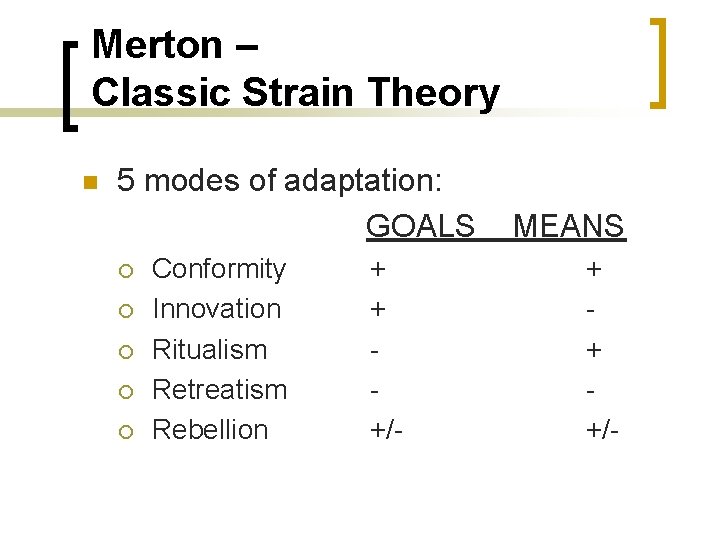
Merton – Classic Strain Theory n 5 modes of adaptation: GOALS ¡ ¡ ¡ Conformity Innovation Ritualism Retreatism Rebellion + + +/- MEANS + + +/-
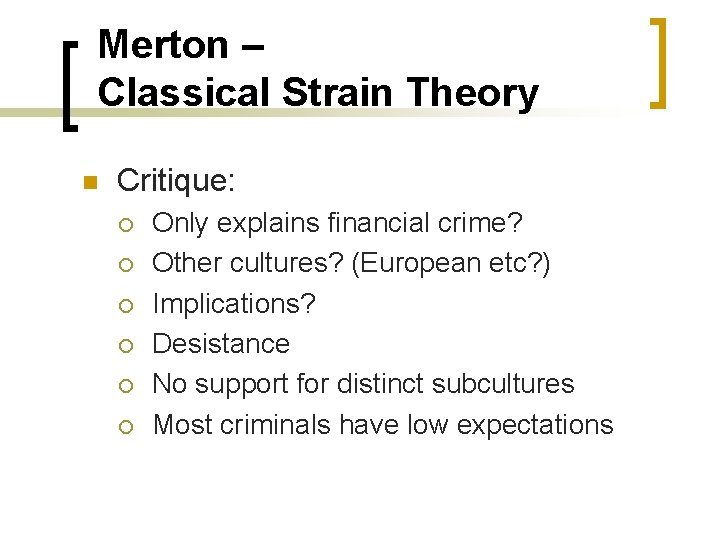
Merton – Classical Strain Theory n Critique: ¡ ¡ ¡ Only explains financial crime? Other cultures? (European etc? ) Implications? Desistance No support for distinct subcultures Most criminals have low expectations
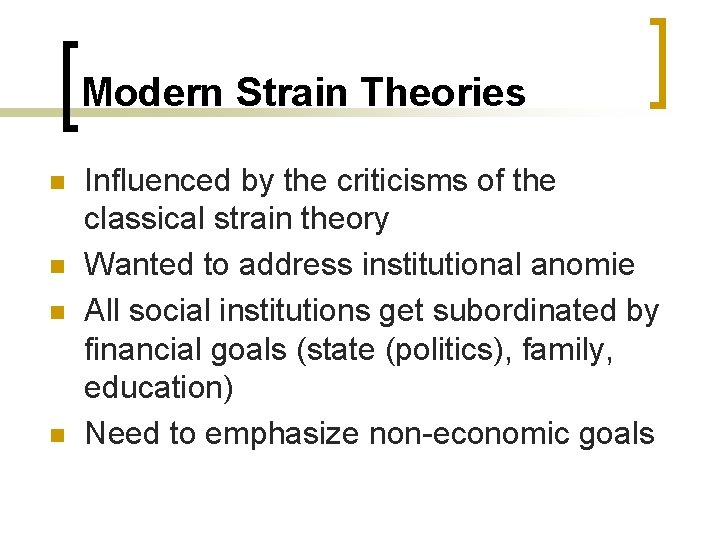
Modern Strain Theories n n Influenced by the criticisms of the classical strain theory Wanted to address institutional anomie All social institutions get subordinated by financial goals (state (politics), family, education) Need to emphasize non-economic goals
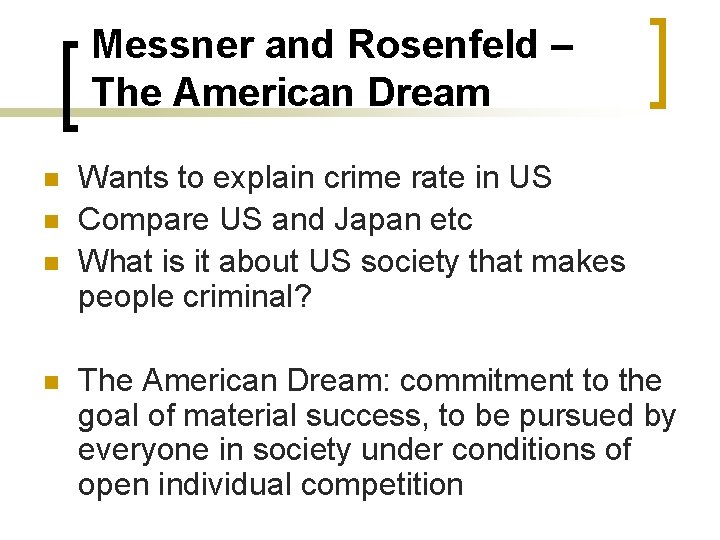
Messner and Rosenfeld – The American Dream n n Wants to explain crime rate in US Compare US and Japan etc What is it about US society that makes people criminal? The American Dream: commitment to the goal of material success, to be pursued by everyone in society under conditions of open individual competition
Messner and Rosenfeld – The American Dream ‘America poises its citizens against one another, with the warning that they must make it on their own. Hence the stress of moving past others, driven by a fear of failing behind. No other nation so rates its residents as winners or losers’
Messner and Rosenfeld – The American Dream n n Money success self worth Big contribution: ¡ ¡ Challenged criminologists to think at the macro level Crime was seen as a product of a widely admired cultural phenomenon Deep historical roots that were not psychological Epitome of free will
Agnew – General Strain Theory n n n Looked at multiple factors as a source of strain Applied strain at an individual level Added an important component… emotions… which one?
Agnew – General Strain Theory n n Negative relationships negative emotions crime Stress and negative relationships come from: ¡ ¡ n Removal of positively valued stimuli Presentation of negative stimuli Anger is the key mechanism in producing crime
Agnew – General Strain Theory n n Adolescents lack the resources to deal with these emotions Coping mechanisms: ¡ ¡ ¡ Cognitive coping Behavioral coping Emotional coping
Gangs Video n n n Old video – what’s changed? How does someone become a gang member? What theory explains this process? Do female gang members require a separate explanation? If so, what? Why is graffiti referred to as the newspaper of the street?