
1115 Ottokee St P O Box 416 Wauseon
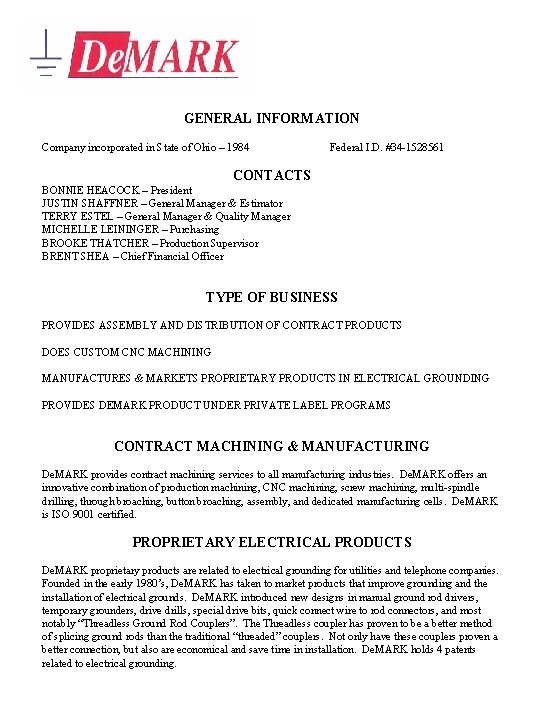
1115 Ottokee St. ● P. O. Box 416 ● Wauseon, OH 43567 Tel. 419 -337 -5866 ● Fax 419 -337 -5089 WEB: www. ejdemark. com ● Email: ground@ejdemark. com ELECTRICAL GROUNDING PRODUCTS . THREADLESS GROUND ROD COUPLERS. “COPPERHEAD” & “SLIDER” GROUND WIRE TO GROUND ROD CONNECTORS . MANUAL GROUND ROD DRIVERS. TEMPORARY GROUNDER FOR TRUCKS AND RESISTANCE TESTING . DRIVE BITS FOR IMPACT HAMMERS TO DRIVE GROUND RODS . DRIVE DRILLS TO HELP DRIVE GROUND RODS . DRIVE POINTS TO HELP DRIVE GROUND RODS . SPECIAL PRODUCTS MADE TO YOUR SPECIFICATIONS THROUGH OUR CONTRACT MACHINING OPERATIONS E&J De. MARK, Inc. dba De. MARK – A company to serve special needs
GENERAL INFORMATION Company incorporated in State of Ohio – 1984 Federal I. D. #34 -1528561 CONTACTS BONNIE HEACOCK – President JUSTIN SHAFFNER – General Manager & Estimator TERRY ESTEL – General Manager & Quality Manager MICHELLE LEININGER – Purchasing BROOKE THATCHER – Production Supervisor BRENT SHEA – Chief Financial Officer TYPE OF BUSINESS PROVIDES ASSEMBLY AND DISTRIBUTION OF CONTRACT PRODUCTS DOES CUSTOM CNC MACHINING MANUFACTURES & MARKETS PROPRIETARY PRODUCTS IN ELECTRICAL GROUNDING PROVIDES DEMARK PRODUCT UNDER PRIVATE LABEL PROGRAMS CONTRACT MACHINING & MANUFACTURING De. MARK provides contract machining services to all manufacturing industries. De. MARK offers an innovative combination of production machining, CNC machining, screw machining, multi-spindle drilling, through broaching, button broaching, assembly, and dedicated manufacturing cells. De. MARK is ISO 9001 certified. PROPRIETARY ELECTRICAL PRODUCTS De. MARK proprietary products are related to electrical grounding for utilities and telephone companies. Founded in the early 1980’s, De. MARK has taken to market products that improve grounding and the installation of electrical grounds. De. MARK introduced new designs in manual ground rod drivers, temporary grounders, drive drills, special drive bits, quick connect wire to rod connectors, and most notably “Threadless Ground Rod Couplers”. The Threadless coupler has proven to be a better method of splicing ground rods than the traditional “threaded” couplers. Not only have these couplers proven a better connection, but also are economical and save time in installation. De. MARK holds 4 patents related to electrical grounding.
De. MARK GROUNDING PRODUCTS OFFER SOMETHING BETTER THREADLESS GROUND ROD COUPLERS These ground rod splices are available to fit all ground rods from. 44” to 1. 00” in any kind of metal – copper clad, galvanized, stainless, steel & etc. GROUND WIRE TO GROUND ROD CONNECTIONS The “COPPERHEAD” & “SLIDER” connectors are easy to install with a minimum amount of time required and without special tools for regular, multiple wire, and “T” connections. They are available for all types of ground . wire and ground rod combinations MANUAL GROUND ROD DRIVERS These unique drivers allow an individual to drive an 8 foot ground rod while standing on the ground with the impact force contained inside the unit. TEMPORARY GROUNDERS This tool can easily be installed in any kind of ground with ease and easily retrieved. It is good for truck grounding as well as doing soil resistivity tests. DRIVE BITS WITH INTEGRITY CHAMBER The drive bit will not damage rod tips while driving ground rods. They are available for all sizes and types of ground rods and for all kinds of impact drivers, breakers, and other such ground rod driving equipment. DRIVE DRILLS & DRIVE POINTS These special parts to put on the ends of ground rods make installation easier and sometimes will allow for deeper driving of ground rods. SPECIAL PRODUCTS & SERVICES De. MARK does contract machining and can provide special products to your specifications. We can design products to meet your needs.
De. MARK COUPLERS ARE BETTER AGAINST COMPETITION Available for all sizes and types of threadless ground rods from. 44” to 1” for copper, zinc, galvanized and stainless. Works on all standard manufacturers’ ground rods regardless of manufacturer. Greater tensile strength. Greater pull out strength. Greater contact area between rod and coupler. Handles more rod variation. Tests over 100% conductivity. AGAINST OTHER TYPES OF SPLICING OR COUPLING OF GROUND RODS Cost effective. Saves time. No cracked or loose connection. Easy to install.
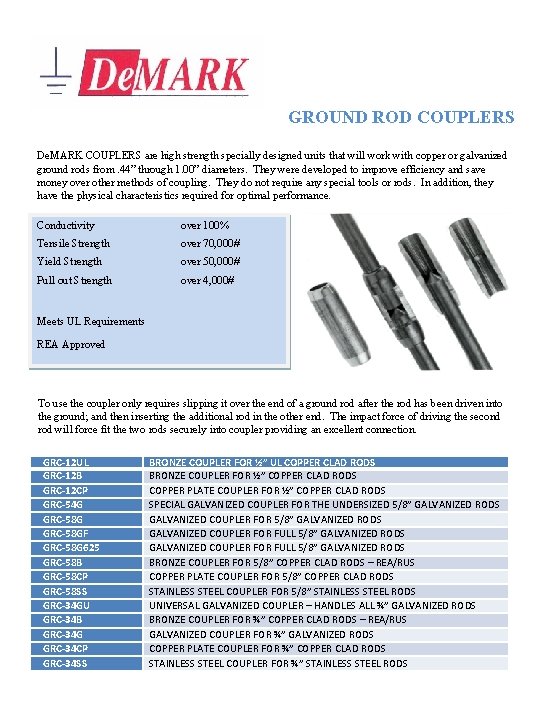
GROUND ROD COUPLERS De. MARK COUPLERS are high strength specially designed units that will work with copper or galvanized ground rods from. 44” through 1. 00” diameters. They were developed to improve efficiency and save money over other methods of coupling. They do not require any special tools or rods. In addition, they have the physical characteristics required for optimal performance. Conductivity over 100% Tensile Strength over 70, 000# Yield Strength over 50, 000# Pull out Strength over 4, 000# Meets UL Requirements REA Approved To use the coupler only requires slipping it over the end of a ground rod after the rod has been driven into the ground; and then inserting the additional rod in the other end. The impact force of driving the second rod will force fit the two rods securely into coupler providing an excellent connection. GRC-12 UL GRC-12 B GRC-12 CP GRC-54 G GRC-58 GF GRC-58 G 625 GRC-58 B GRC-58 CP GRC-58 SS GRC-34 GU GRC-34 B GRC-34 G GRC-34 CP GRC-34 SS BRONZE COUPLER FOR ½” UL COPPER CLAD RODS BRONZE COUPLER FOR ½” COPPER CLAD RODS COPPER PLATE COUPLER FOR ½” COPPER CLAD RODS SPECIAL GALVANIZED COUPLER FOR THE UNDERSIZED 5/8” GALVANIZED RODS GALVANIZED COUPLER FOR FULL 5/8” GALVANIZED RODS BRONZE COUPLER FOR 5/8” COPPER CLAD RODS – REA/RUS COPPER PLATE COUPLER FOR 5/8” COPPER CLAD RODS STAINLESS STEEL COUPLER FOR 5/8” STAINLESS STEEL RODS UNIVERSAL GALVANIZED COUPLER – HANDLES ALL ¾” GALVANIZED RODS BRONZE COUPLER FOR ¾” COPPER CLAD RODS – REA/RUS GALVANIZED COUPLER FOR ¾” GALVANIZED RODS COPPER PLATE COUPLER FOR ¾” COPPER CLAD RODS STAINLESS STEEL COUPLER FOR ¾” STAINLESS STEEL RODS
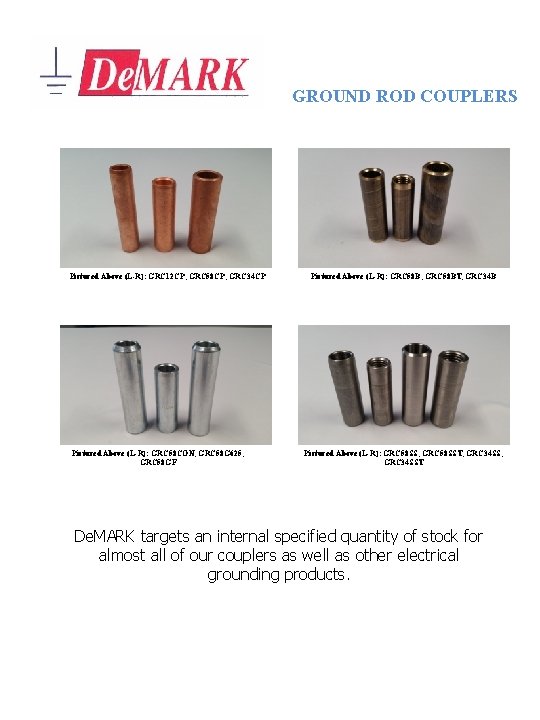
GROUND ROD COUPLERS Pictured Above (L-R): GRC 12 CP, GRC 58 CP, GRC 34 CP Pictured Above (L-R): GRC 58 CON, GRC 58 G 625, GRC 58 GF Pictured Above (L-R): GRC 58 B, GRC 58 BT, GRC 34 B Pictured Above (L-R): GRC 58 SS, GRC 58 SST, GRC 34 SS, GRC 34 SST De. MARK targets an internal specified quantity of stock for almost all of our couplers as well as other electrical grounding products.
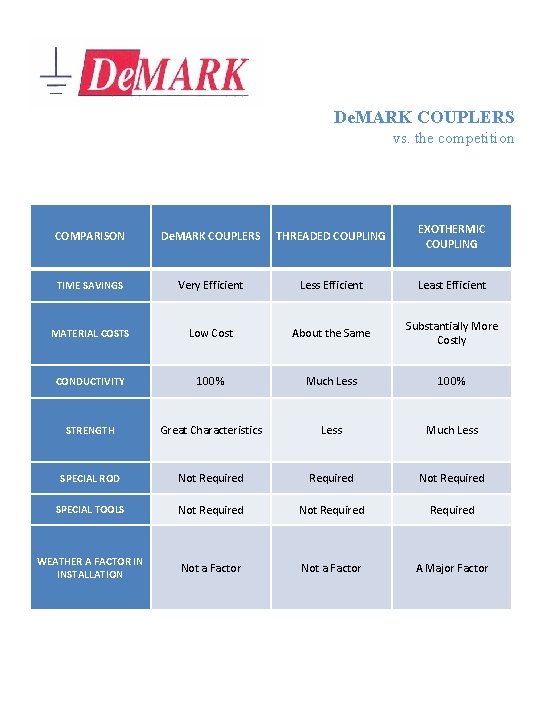
De. MARK COUPLERS vs. the competition COMPARISON De. MARK COUPLERS THREADED COUPLING EXOTHERMIC COUPLING TIME SAVINGS Very Efficient Less Efficient Least Efficient MATERIAL COSTS Low Cost About the Same Substantially More Costly CONDUCTIVITY 100% Much Less 100% STRENGTH Great Characteristics Less Much Less SPECIAL ROD Not Required SPECIAL TOOLS Not Required WEATHER A FACTOR IN INSTALLATION Not a Factor A Major Factor
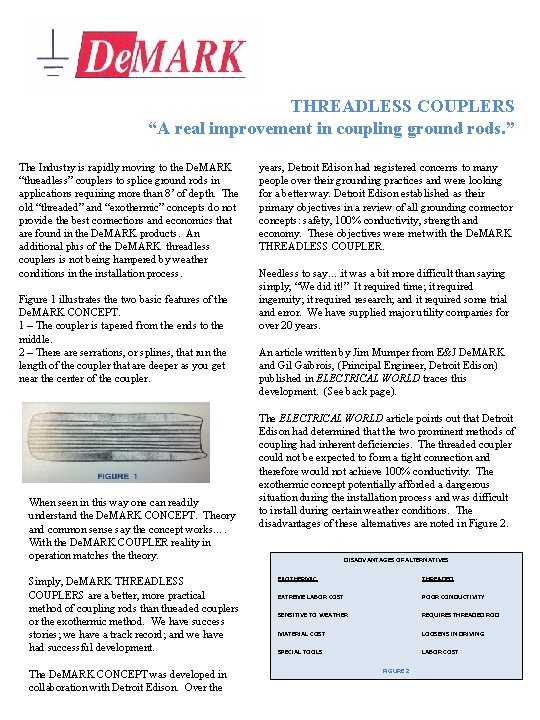
THREADLESS COUPLERS “A real improvement in coupling ground rods. ” The Industry is rapidly moving to the De. MARK “threadless” couplers to splice ground rods in applications requiring more than 8’ of depth. The old “threaded” and “exothermic” concepts do not provide the best connections and economics that are found in the De. MARK products. An additional plus of the De. MARK threadless couplers is not being hampered by weather conditions in the installation process. Figure 1 illustrates the two basic features of the De. MARK CONCEPT. 1 – The coupler is tapered from the ends to the middle. 2 – There are serrations, or splines, that run the length of the coupler that are deeper as you get near the center of the coupler. When seen in this way one can readily understand the De. MARK CONCEPT. Theory and common sense say the concept works…. With the De. MARK COUPLER reality in operation matches theory. Simply, De. MARK THREADLESS COUPLERS are a better, more practical method of coupling rods than threaded couplers or the exothermic method. We have success stories; we have a track record; and we have had successful development. The De. MARK CONCEPT was developed in collaboration with Detroit Edison. Over the years, Detroit Edison had registered concerns to many people over their grounding practices and were looking for a better way. Detroit Edison established as their primary objectives in a review of all grounding connector concepts: safety, 100% conductivity, strength and economy. These objectives were met with the De. MARK THREADLESS COUPLER. Needless to say…. it was a bit more difficult than saying simply, “We did it!” It required time; it required ingenuity; it required research; and it required some trial and error. We have supplied major utility companies for over 20 years. An article written by Jim Mumper from E&J De. MARK and Gil Gaibrois, (Principal Engineer, Detroit Edison) published in ELECTRICAL WORLD traces this development. (See back page). The ELECTRICAL WORLD article points out that Detroit Edison had determined that the two prominent methods of coupling had inherent deficiencies. The threaded coupler could not be expected to form a tight connection and therefore would not achieve 100% conductivity. The exothermic concept potentially afforded a dangerous situation during the installation process and was difficult to install during certain weather conditions. The disadvantages of these alternatives are noted in Figure 2. DISADVANTAGES OF ALTERNATIVES EXOTHERMIC THREADED EXTREME LABOR COST POOR CONDUCTIVITY SENSITIVE TO WEATHER REQUIRES THREADED ROD MATERIAL COST LOOSENS IN DRIVING SPECIAL TOOLS LABOR COST FIGURE 2
THREADLESS COUPLERS The De. MARK coupler has proven to be economical and has performed extremely well. All tests run by utilities have shown the De. MARK couplers to have greater than 100% conductivity. Tests have consistently shown pull out strength in excess of 4000# which translates into a very tight connection. Further, actual field tests have shown that De. MARK requires less time to install than other forms of coupling. The summary of performance standards shown here, (Figure 3) are based on tests confirmed by testing of major utilities. A copy of this test data is available upon request. CONDUCTIVITY OVER 100% TENSILE STRENGTH OVER 60, 000# PULL OUT STRENGTH OVER 4, 000# YIELD STRENGTH OVER 40, 000# FIGURE 3 The key to the success is two fold. As you can see from the cross sectional view of the De. MARK coupler (Figure 1), there are two primary features – the taper and the splines. The amount of taper is critical to insure a tight fit. The splines increase the surface contact area and allow for some variation in rod diameter. Today we are successfully supplying numerous utilities with these couplers covering the full range of rod sizes from. 44” through 1. 00”. Besides Detroit Edison a number of other large and small utilities have approved the use of De. MARK COUPLERS such as Florida Power Corp. , Florida Power and Light, Duke, United Telephone, Virginia Power, Indiana Michigan Power, Central Vermont, Alabama Power, GTE, and Public Service of Indiana. There also numerous companies currently testing De. MARK COUPLERS. There are other threadless couplers on the market today. Two other manufacturers have models for 5/8” copper rods as well as one foreign company (based on metric rods). These units do work in most cases, HOWEVER, they lack the overall advantages of De. MARK COUPLERS. Specifically, they do not have the splines that provide additional surface contact, their taper is not as long, and they are not capable of meeting much variation in rod diameter causing a possible fit problem. As most people in the industry are aware diameter dimensions of ground rods are nominal. Neither a 5/8” copper clad rod or a 5/8” galvanized rod are actually 5/8”. In addition, the specifications for rods allow for variation in diameter size. In the case of galvanized rods it is +/- 1/32”. To be installed properly, are must be taken so as not to cause major distortion of the ground rod end in driving. Some damage, “mushrooming”, is acceptable with De. MARK COUPLERS. The damage to the rod tip must not be so great as to keep the rod from being inserted into the coupler. We have developed solutions to this particular problem of driving rods without damaging the rod tip. The actual answer depends on the difficulty in driving. We have three driving tools that can handle the job. 1. Using the De. MARK GROUND ROD DRIVER (Figure 4) is very effective in simple installations. The inside of the driving chamber is “tapered” and will contain the “mushrooming” effect sufficiently so that the coupler can be fitted over the rod. In addition, the De. MARK GROUND ROD DRIVER can put an eight foot rod into the ground from start to finish without getting on steps, on a boom, or the back of a truck.
COUPLERS AND GROUND ROD DRIVERS 2) For medium hard driving situations where impact equipment is used, our basic driving cap can be utilized that will fit most driving bits on impact equipment. 3) For extremely difficult situations, we have worked with Bruner and Lay to provide our “integrity chamber” in their driving bits. This special tapered design has two advantages: First of all, the impact area in the hole does allow for some mushrooming – but importantly dictates the form of the distortion. Secondly, the taper to the bottom of the driving bit allows for easy removal of the rod. Driving bits can be provided for most any “impact” or “demolition” hammer. There are other means that have been developed by various utilities. One that deserves mention is used in Northern Florida. They drive the initial rod, which is relatively easy, by driving on the De. MARK coupler directly. The second rod is then inserted in the coupler with the point at the top and driving is done directly on the rod tip. The resulting mushrooming does not result in the rod tip being too large to fit into the next coupler. This “point upward” procedure is repeated in succeeding rods. This will not work in tough driving conditions. Depending on the situation and the company, . 44” through 1. 00” rods are being used for grounding in both galvanized and copper clad or copper plated. There is no uniform standardization and what appears to be the best for one company may not fit the needs of another. In some cases local city and state regulations can affect the decision. There does not appear to be a move away from copper clad to galvanized rods. Here it is important to be sure of the specifications of the rod you are acquiring. There are many manufacturers of galvanized rods and in some cases the utility will have to set specs to assure that the rods received will provide the performance required. While utilities do not all have the same standards, they do have a common goal. That is: To improve grounding which obviously has economic “paybacks” due to having fewer problems over time.
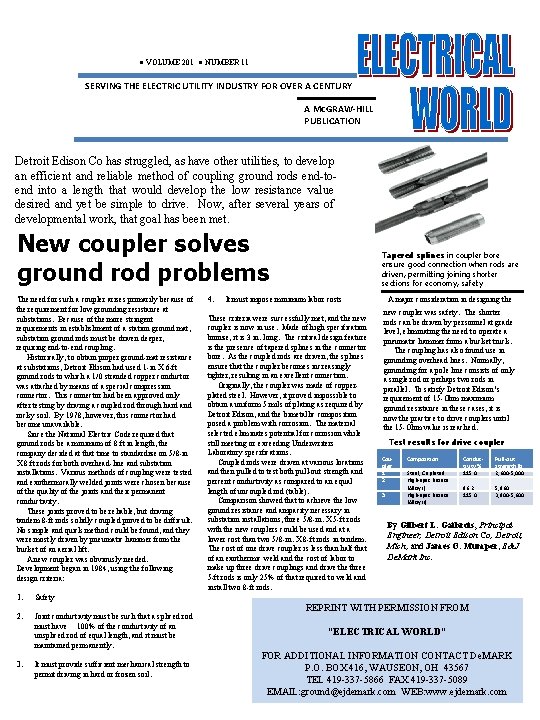
● VOLUME 201 ● NUMBER 11 SERVING THE ELECTRIC UTILITY INDUSTRY FOR OVER A CENTURY A Mc. GRAW-HILL PUBLICATION Detroit Edison Co has struggled, as have other utilities, to develop an efficient and reliable method of coupling ground rods end-toend into a length that would develop the low resistance value desired and yet be simple to drive. Now, after several years of developmental work, that goal has been met. New coupler solves ground rod problems The need for such a coupler arises primarily because of the requirement for low grounding resistance at substations. Because of the more stringent requirements in establishment of a station ground mat, substation ground rods must be driven deeper, requiring end-to-end coupling. Historically, to obtain proper ground-mat resistance at substations, Detroit Edison had used 1 -in X 6 -ft ground rods to which a 1/0 stranded copper conductor was attached by means of a special compression connector. This connector had been approved only after testing by driving a coupled rod through hard and rocky soil. By 1978, however, this connector had become unavailable. Since the National Electric Code required that ground rods be a minimum of 8 ft in length, the company decided at that time to standardize on 5/8 -in X 8 ft rods for both overhead-line and substation installations. Various methods of coupling were tested and exothermically welded joints were chosen because of the quality of the joints and their permanent conductivity. These joints proved to be reliable, but driving tandem 8 -ft rods solidly coupled proved to be difficult. No simple and quick method could be found, and they were mostly driven by pneumatic hammer from the bucket of an aerial lift. A new coupler was obviously needed. Development began in 1984, using the following design criteria: 1. Safety 2. Joint conductivity must be such that a spliced rod must have 100% of the conductivity of an unspliced rod of equal length, and it must be maintained permanently. 3. It must provide sufficient mechanical strength to permit driving in hard or frozen soil. 4. It must impose minimum labor costs These criteria were successfully met, and the new coupler is now in use. Made of high specification bronze, it is 3 in. long. The critical design feature is the presence of tapered splines in the connector bore. As the coupled rods are driven, the splines ensure that the coupler becomes increasingly tighter, resulting in an excellent connection. Originally, the coupler was made of copperplated steel. However, it proved impossible to obtain a uniform 5 mils of plating as required by Detroit Edison, and the bimetallic composition posed a problem with corrosion. The material selected eliminates potential for corrosion while still meeting or exceeding Underwriters Laboratory specifications. Coupled rods were driven at various locations and then pulled to test both pull-out strength and percent conductivity as compared to an equal length of uncoupled rod (table). Comparison showed that to achieve the low ground resistance and ampacity necessary in substation installations, three 5/8 -in. X 5 -ft rods with the new couplers could be used and at a lower cost than two 5/8 -in. X 8 -ft rods in tandem. The cost of one drive coupler is less than half that of an exothermic weld and the cost of labor to make up three drive couplings and drive three 5 -ft rods is only 25% of that required to weld and install two 8 -ft rods. Tapered splines in coupler bore ensure good connection when rods are driven, permitting joining shorter sections for economy, safety A major consideration in designing the new coupler was safety. The shorter rods can be driven by personnel at grade level, eliminating the need to operate a pneumatic hammer from a bucket truck. The coupling has also found use in grounding overhead lines. Normally, grounding for a pole line consists of only a single rod or perhaps two rods in parallel. To satisfy Detroit Edison’s requirement of 15 -Ohm maximum ground resistance in these cases, it is now the practice to drive couplers until the 15 -Ohm value is reached. Test results for drive coupler Coupler 1 2 3 Composition Steel, Cu plated High-spec bronze (Alloy I) High-spec bronze (Alloy II) Conductivity, % 115. 0 96. 2 115. 0 Pull-out strength lb 2, 600 -5, 000 5, 860 3, 800 -5, 600 By Gilbert L. Gaibrois, Principal Engineer, Detroit Edison Co, Detroit, Mich; and James O. Mumper, E&J De. Mark Inc. REPRINT WITH PERMISSION FROM “ELECTRICAL WORLD” FOR ADDITIONAL INFORMATION CONTACT De. MARK P. O. BOX 416, WAUSEON, OH 43567 TEL 419 -337 -5866 FAX 419 -337 -5089 EMAIL: ground@ejdemark. com WEB: www. ejdemark. com
COPPERHEAD® DRIVE ON CONNECTORS AVAILABLE FOR ALL GROUND RODS. CONNECT GROUND WIRE FROM #6 COPPER TO 4/0 – SOLID AND STRANDED HIGH CONTACT SECURE CONNECTION EASY & FAST TO INSTALL NO SPECIAL TOOLS REQUIRED
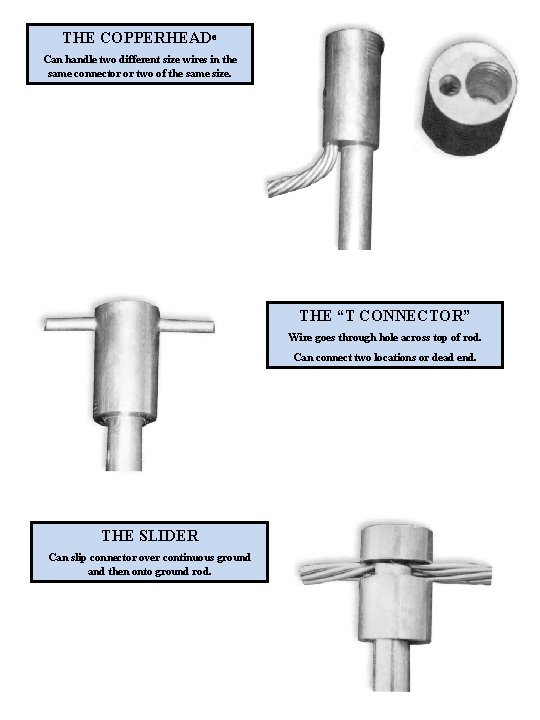
THE COPPERHEAD® Can handle two different size wires in the same connector or two of the same size. THE “T CONNECTOR” Wire goes through hole across top of rod. Can connect two locations or dead end. THE SLIDER Can slip connector over continuous ground and then onto ground rod.
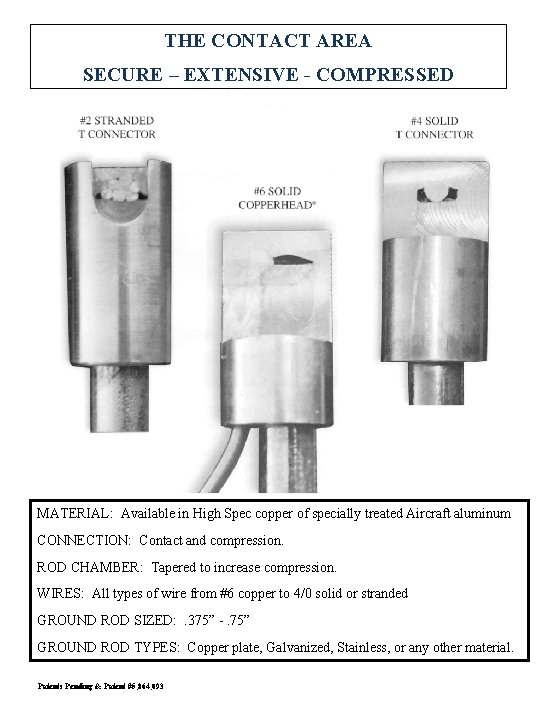
THE CONTACT AREA SECURE – EXTENSIVE - COMPRESSED MATERIAL: Available in High Spec copper of specially treated Aircraft aluminum CONNECTION: Contact and compression. ROD CHAMBER: Tapered to increase compression. WIRES: All types of wire from #6 copper to 4/0 solid or stranded GROUND ROD SIZED: . 375” -. 75” GROUND ROD TYPES: Copper plate, Galvanized, Stainless, or any other material. Patents Pending & Patent #5, 864, 093
Our mission is to provide products that fit a customer’s specific needs in an economical manner. We can often make variations of these products without significant addition cost. Tell us what you need so that we may help solve your problem. De. MARK® GROUNDING PRODUCTS OFFER SOMETHING BETTER Threadless Couplers Manual Ground Rod Drives Ground Rod to Ground Wire Connectors Drive Drills Drive Points Drive Bits Temporary Grounders Stainless Ground Rods De. MARK® THE COMPANY De. MARK was founded in 1984. In addition to grounding products, the Company provides extensive contract machining services through their inhouse turning and milling operations. Customers include automotive, trucking, plumbing, as well as electrical. De. MARK private labels finished products for certain companies in the utility business. De. MARK manufactures and designs all its own products. De. MARK pioneered a number of grounding products including threadless couplers, drive bits with the Integrity Chamber®, Drive-On Copperhead®, “Slider” and “T Connectors” for ground rod to ground wire connections. For more information give us a call or check us out on our website at www. ejdemark. com ©De. MARK January, 1999
THE “COPPERHEAD” CONNECTOR COPPER AND ALUMINUM (Ground Rod to Wire) The design of the De. MARK ground rod connector is unique. This product has significant advantages over other means of connecting ground wire to a ground rod. It utilizes a concept of compression, which helps provide a good ground, by driving the connector that has a tapered hole. (The opening hole is larger than the ground rod diameter and the end of the hole is smaller than the rod. ) The connection is made by first inserting the ground wire into the designated hole of the connector. The connector is then driven on the ground rod with a hammer or sledge hammer. Two or three hits with a 3# field hammer is more than sufficient. The result of this “drive on approach” forces the ground rod to make a strong bond with both the ground wire and the internal walls of the connector. The material is a special high spec “Tellurium” copper that allows for the ease of driving the connector onto the rod and yet has the strength necessary to form a tight and strong connection. There are more and more concerns in the field about adequate ground wire to ground rod connections. We have found that many companies using the inexpensive “acorn” type connector are dissatisfied. They have found for different reasons that the connection is not good or has deteriorated over time. Obviously if the customer who uses an “acorn” type connector knows they have a problem, the De. MARK “COPPERHEAD” CONNECTOR is a viable alternative. The only disadvantage being the expense of the product. At the high end of the market, “EXOTHERMIC” type connection, the “COPPERHEAD” measures up in all ways. It is a good connection; it is priced competitive or less expensive when considering the time element; it is fast and easy. The only special tool it requires is a hammer…. One does not have to worry about weather either. There is no limit to the type of rod or wire that can be used. While the most used ground wires are #4 and #6, we have made these units for several other types of wire up to a #4/0. We have made these units to handle more than one wire at a time and even able to accommodate different wire sizes in the same connector. PATENTED AND PATENT PENDING 2 -99
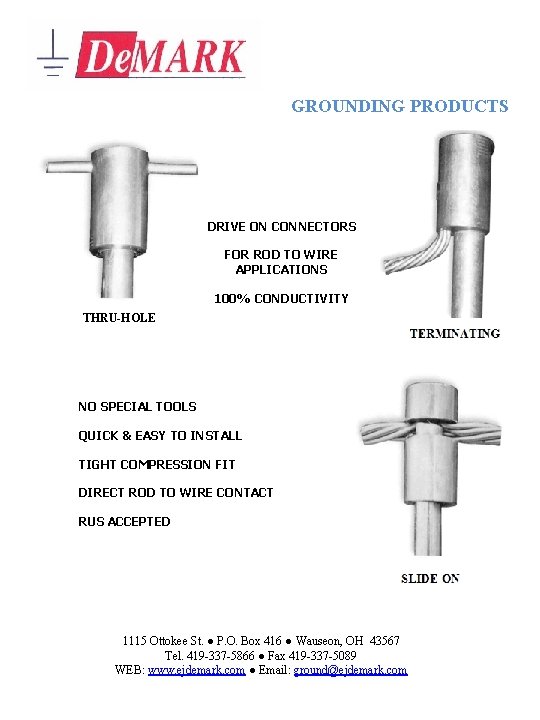
GROUNDING PRODUCTS THRU-HOLE DRIVE ON CONNECTORS FOR ROD TO WIRE APPLICATIONS 100% CONDUCTIVITY NO SPECIAL TOOLS QUICK & EASY TO INSTALL TIGHT COMPRESSION FIT DIRECT ROD TO WIRE CONTACT RUS ACCEPTED 1115 Ottokee St. ● P. O. Box 416 ● Wauseon, OH 43567 Tel. 419 -337 -5866 ● Fax 419 -337 -5089 WEB: www. ejdemark. com ● Email: ground@ejdemark. com
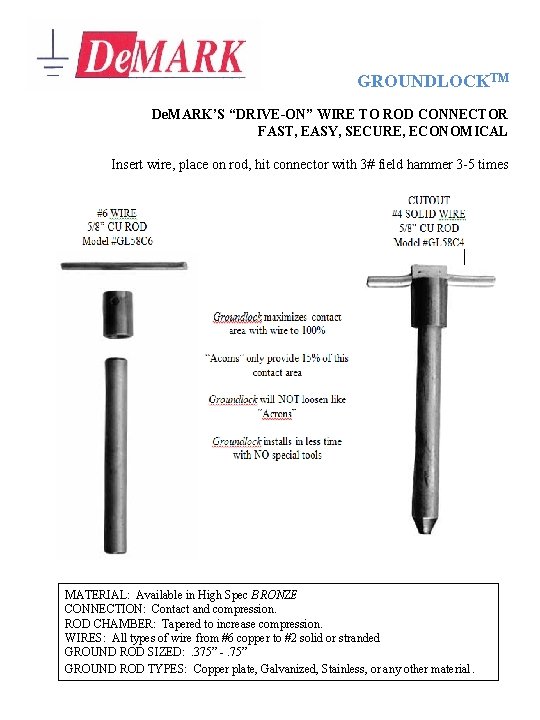
GROUNDLOCKTM De. MARK’S “DRIVE-ON” WIRE TO ROD CONNECTOR FAST, EASY, SECURE, ECONOMICAL Insert wire, place on rod, hit connector with 3# field hammer 3 -5 times MATERIAL: Available in High Spec BRONZE CONNECTION: Contact and compression. ROD CHAMBER: Tapered to increase compression. WIRES: All types of wire from #6 copper to #2 solid or stranded GROUND ROD SIZED: . 375” -. 75” GROUND ROD TYPES: Copper plate, Galvanized, Stainless, or any other material.
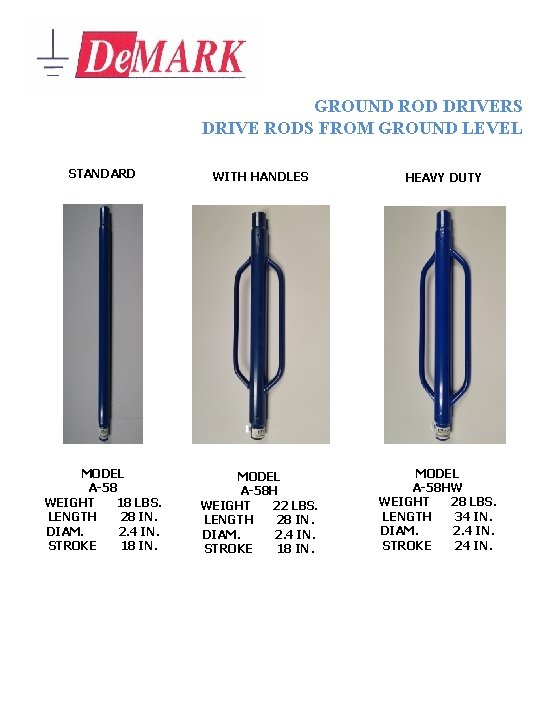
GROUND ROD DRIVERS DRIVE RODS FROM GROUND LEVEL STANDARD WITH HANDLES MODEL A-58 WEIGHT 18 LBS. LENGTH 28 IN. DIAM. 2. 4 IN. STROKE 18 IN. MODEL A-58 H WEIGHT 22 LBS. LENGTH 28 IN. DIAM. 2. 4 IN. STROKE 18 IN. HEAVY DUTY MODEL A-58 HW WEIGHT 28 LBS. LENGTH 34 IN. DIAM. 2. 4 IN. STROKE 24 IN.
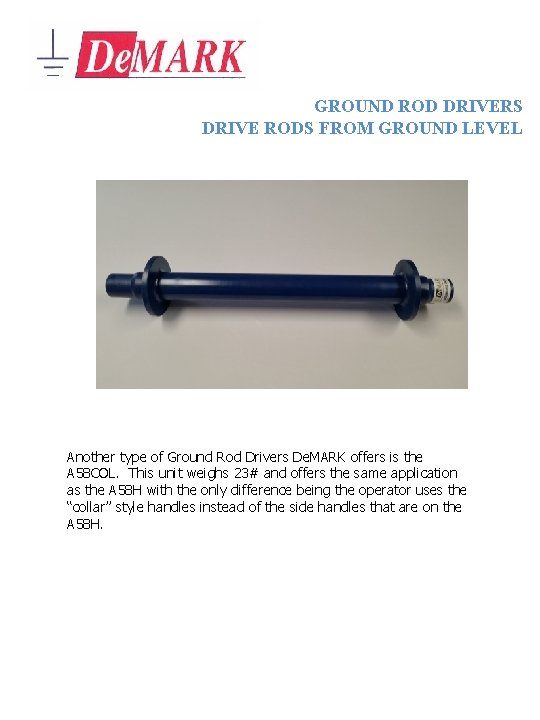
GROUND ROD DRIVERS DRIVE RODS FROM GROUND LEVEL Another type of Ground Rod Drivers De. MARK offers is the A 58 COL. This unit weighs 23# and offers the same application as the A 58 H with the only difference being the operator uses the “collar” style handles instead of the side handles that are on the A 58 H.
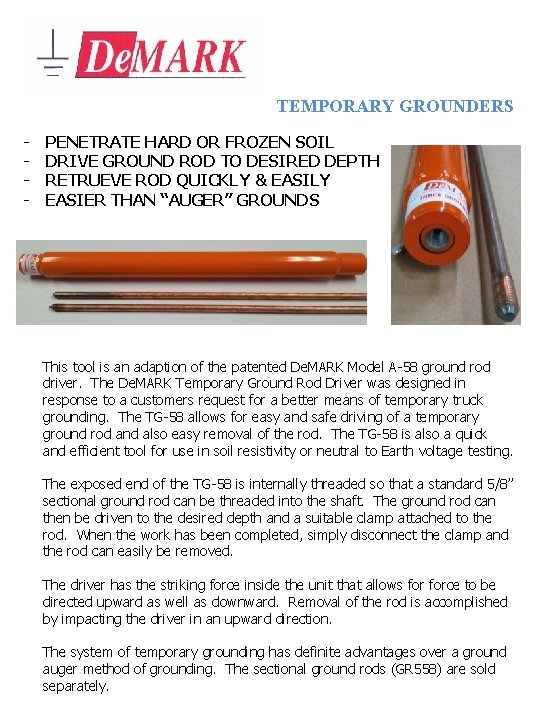
TEMPORARY GROUNDERS - PENETRATE HARD OR FROZEN SOIL DRIVE GROUND ROD TO DESIRED DEPTH RETRUEVE ROD QUICKLY & EASILY EASIER THAN “AUGER” GROUNDS This tool is an adaption of the patented De. MARK Model A-58 ground rod driver. The De. MARK Temporary Ground Rod Driver was designed in response to a customers request for a better means of temporary truck grounding. The TG-58 allows for easy and safe driving of a temporary ground rod and also easy removal of the rod. The TG-58 is also a quick and efficient tool for use in soil resistivity or neutral to Earth voltage testing. The exposed end of the TG-58 is internally threaded so that a standard 5/8” sectional ground rod can be threaded into the shaft. The ground rod can then be driven to the desired depth and a suitable clamp attached to the rod. When the work has been completed, simply disconnect the clamp and the rod can easily be removed. The driver has the striking force inside the unit that allows force to be directed upward as well as downward. Removal of the rod is accomplished by impacting the driver in an upward direction. The system of temporary grounding has definite advantages over a ground auger method of grounding. The sectional ground rods (GR 558) are sold separately.
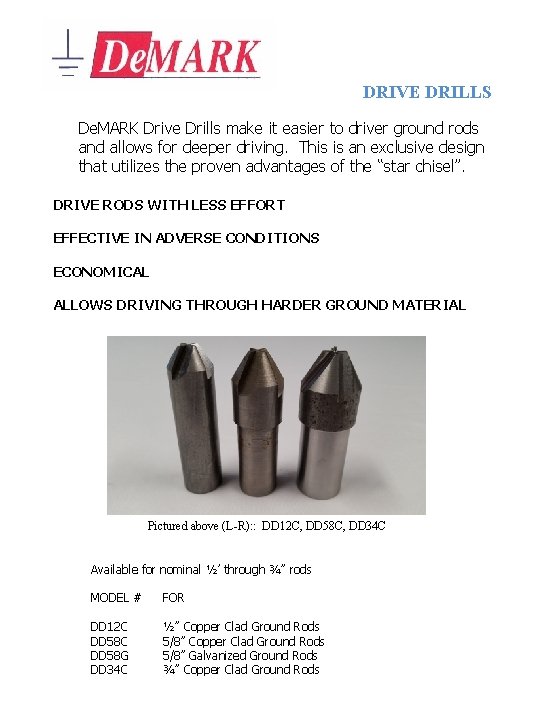
DRIVE DRILLS De. MARK Drive Drills make it easier to driver ground rods and allows for deeper driving. This is an exclusive design that utilizes the proven advantages of the “star chisel”. DRIVE RODS WITH LESS EFFORT EFFECTIVE IN ADVERSE CONDITIONS ECONOMICAL ALLOWS DRIVING THROUGH HARDER GROUND MATERIAL Pictured above (L-R): : DD 12 C, DD 58 C, DD 34 C Available for nominal ½’ through ¾” rods MODEL # FOR DD 12 C DD 58 G DD 34 C ½” Copper Clad Ground Rods 5/8” Galvanized Ground Rods ¾” Copper Clad Ground Rods
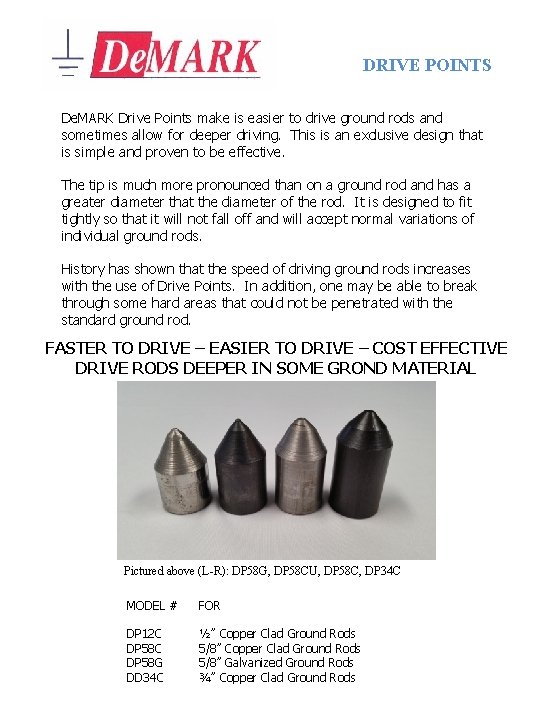
DRIVE POINTS De. MARK Drive Points make is easier to drive ground rods and sometimes allow for deeper driving. This is an exclusive design that is simple and proven to be effective. The tip is much more pronounced than on a ground rod and has a greater diameter that the diameter of the rod. It is designed to fit tightly so that it will not fall off and will accept normal variations of individual ground rods. History has shown that the speed of driving ground rods increases with the use of Drive Points. In addition, one may be able to break through some hard areas that could not be penetrated with the standard ground rod. FASTER TO DRIVE – EASIER TO DRIVE – COST EFFECTIVE DRIVE RODS DEEPER IN SOME GROND MATERIAL Pictured above (L-R): DP 58 G, DP 58 CU, DP 58 C, DP 34 C MODEL # FOR DP 12 C DP 58 G DD 34 C ½” Copper Clad Ground Rods 5/8” Galvanized Ground Rods ¾” Copper Clad Ground Rods
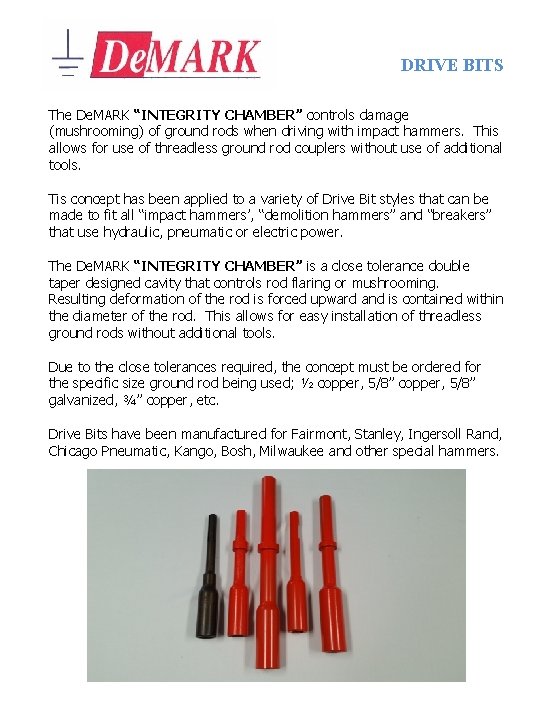
DRIVE BITS The De. MARK “INTEGRITY CHAMBER” controls damage (mushrooming) of ground rods when driving with impact hammers. This allows for use of threadless ground rod couplers without use of additional tools. Tis concept has been applied to a variety of Drive Bit styles that can be made to fit all “impact hammers’, “demolition hammers” and “breakers” that use hydraulic, pneumatic or electric power. The De. MARK “INTEGRITY CHAMBER” is a close tolerance double taper designed cavity that controls rod flaring or mushrooming. Resulting deformation of the rod is forced upward and is contained within the diameter of the rod. This allows for easy installation of threadless ground rods without additional tools. Due to the close tolerances required, the concept must be ordered for the specific size ground rod being used; ½ copper, 5/8” galvanized, ¾” copper, etc. Drive Bits have been manufactured for Fairmont, Stanley, Ingersoll Rand, Chicago Pneumatic, Kango, Bosh, Milwaukee and other special hammers.
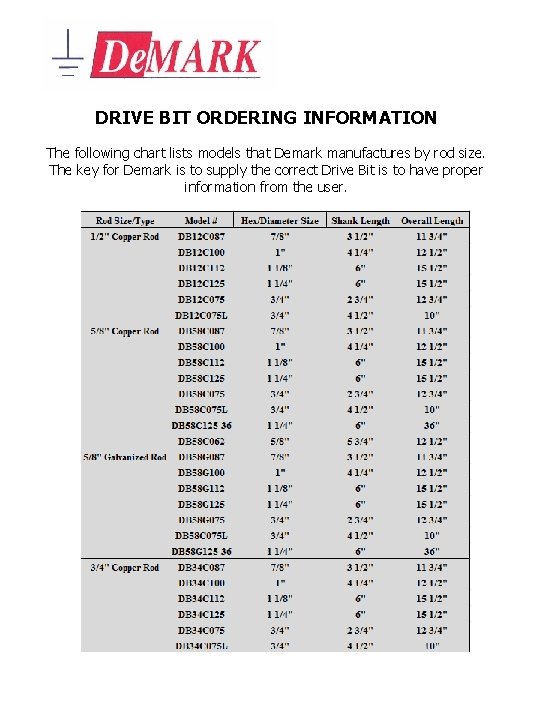
DRIVE BIT ORDERING INFORMATION The following chart lists models that Demark manufactures by rod size. The key for Demark is to supply the correct Drive Bit is to have proper information from the user.
- Slides: 25