
11 Thesis statement offering a concise summary of


- Slides: 29
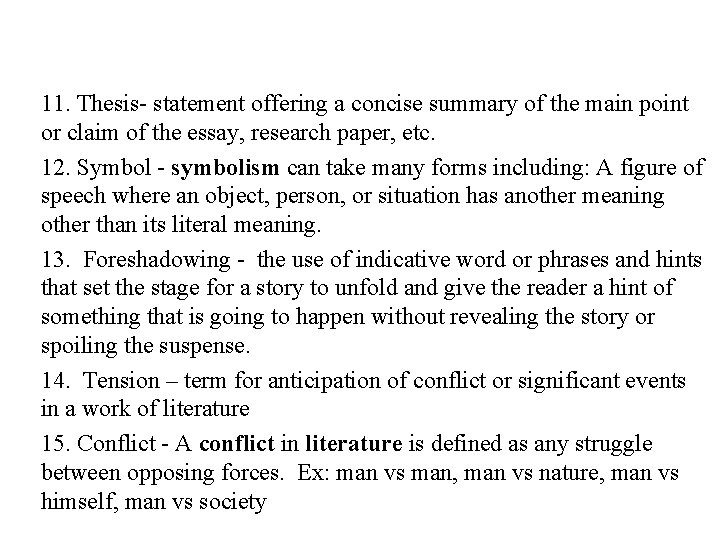
11. Thesis- statement offering a concise summary of the main point or claim of the essay, research paper, etc. 12. Symbol - symbolism can take many forms including: A figure of speech where an object, person, or situation has another meaning other than its literal meaning. 13. Foreshadowing - the use of indicative word or phrases and hints that set the stage for a story to unfold and give the reader a hint of something that is going to happen without revealing the story or spoiling the suspense. 14. Tension – term for anticipation of conflict or significant events in a work of literature 15. Conflict - A conflict in literature is defined as any struggle between opposing forces. Ex: man vs man, man vs nature, man vs himself, man vs society
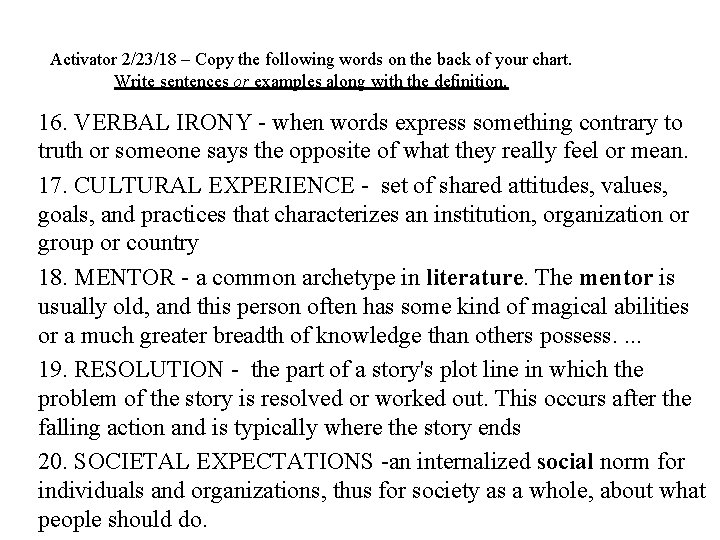
Activator 2/23/18 – Copy the following words on the back of your chart. Write sentences or examples along with the definition. 16. VERBAL IRONY - when words express something contrary to truth or someone says the opposite of what they really feel or mean. 17. CULTURAL EXPERIENCE - set of shared attitudes, values, goals, and practices that characterizes an institution, organization or group or country 18. MENTOR - a common archetype in literature. The mentor is usually old, and this person often has some kind of magical abilities or a much greater breadth of knowledge than others possess. . 19. RESOLUTION - the part of a story's plot line in which the problem of the story is resolved or worked out. This occurs after the falling action and is typically where the story ends 20. SOCIETAL EXPECTATIONS -an internalized social norm for individuals and organizations, thus for society as a whole, about what people should do.
AGENDA • CHARACTER EDUCATION- Diligence • HOMEWORK- Write sentences using all 20 of your vocabulary words. • AGENDA MESSAGE- Tutoring is available Tues before school, Wed after school. Vocabulary Quiz is Tuesday!! • STANDARDS – W 5 develops and strengthens writing W 7 conducts sustained research
Research Writing An Introduction for 7 th Grade
What is a Research Paper? • A research paper is like a report. • Before you write it, you use books, articles, the internet, and other sources to gather information about your topic. • You GATHER information from these sources and use that information in your paper to tell your readers about your topic.
WAIT……WHAT? ? ? • A research paper is actually a WRITTEN piece of WORK IN YOUR OWN WORDS that fully discusses a topic that you have spent time learning about. It is to be in depth and intelligent, with support from credible sources. This paper will be YOUR work, but you have based your knowledge on the credible work of others. • Sounds difficult? It’s not really so bad, actually, it gets pretty easy.
There’s NO NEED to become this……. we will work on this TOGETHER.
Magazine or Newspaper Articles Journals Books Internet Web
Choosing a Topic • Pick a topic – You will receive a list of topics you may choose from. Select your topic 4 choices. • Take time to look at the attached list. Ask questions about unfamiliar topics.
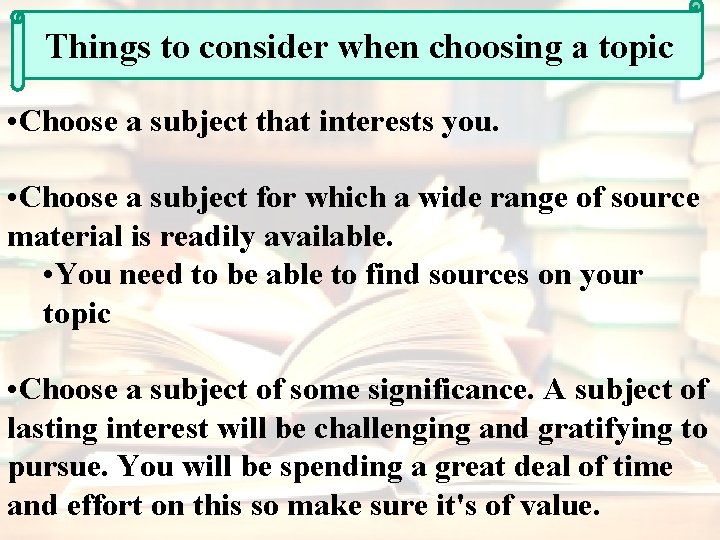
Things to consider when choosing a topic • Choose a subject that interests you. • Choose a subject for which a wide range of source material is readily available. • You need to be able to find sources on your topic • Choose a subject of some significance. A subject of lasting interest will be challenging and gratifying to pursue. You will be spending a great deal of time and effort on this so make sure it's of value.
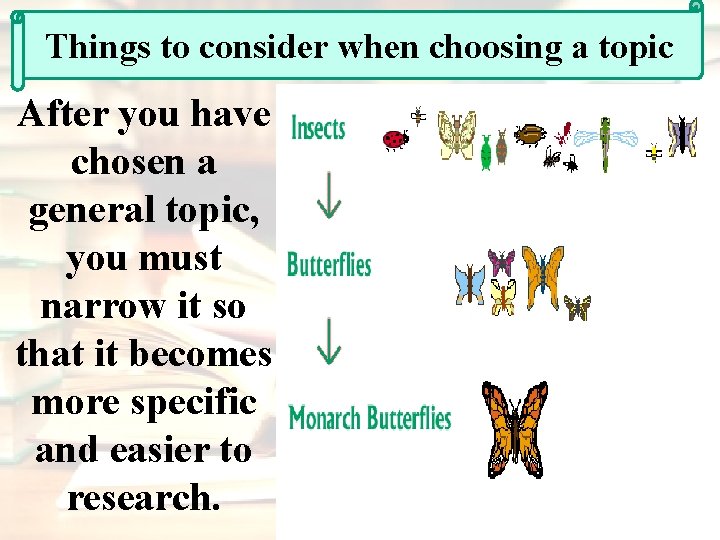
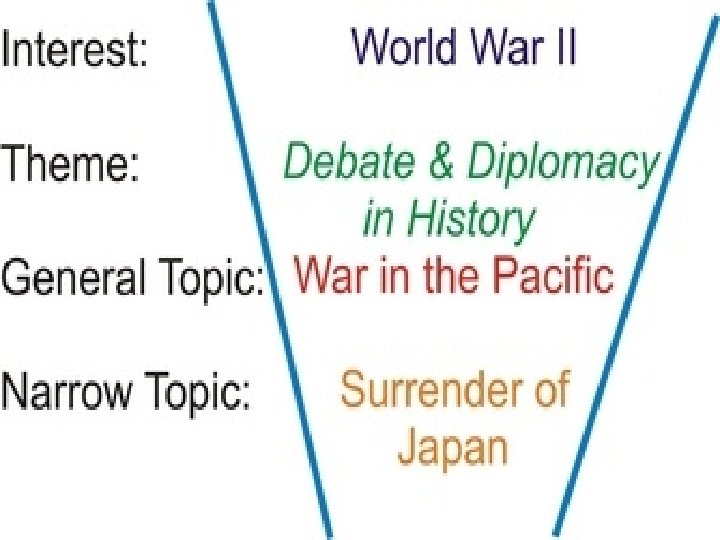
Things to consider when choosing a topic After you have chosen a general topic, you must narrow it so that it becomes more specific and easier to research.
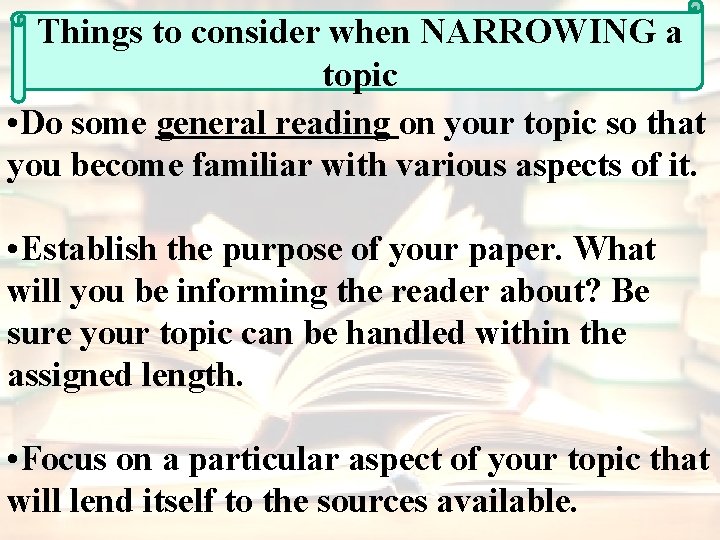
Things to consider when NARROWING a topic • Do some general reading on your topic so that you become familiar with various aspects of it. • Establish the purpose of your paper. What will you be informing the reader about? Be sure your topic can be handled within the assigned length. • Focus on a particular aspect of your topic that will lend itself to the sources available.
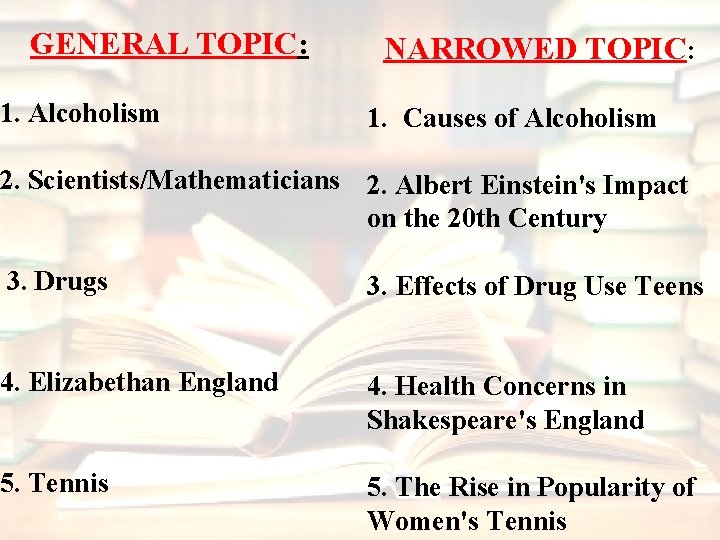
GENERAL TOPIC: 1. Alcoholism NARROWED TOPIC: 1. Causes of Alcoholism 2. Scientists/Mathematicians 2. Albert Einstein's Impact on the 20 th Century 3. Drugs 3. Effects of Drug Use Teens 4. Elizabethan England 4. Health Concerns in Shakespeare's England 5. Tennis 5. The Rise in Popularity of Women's Tennis
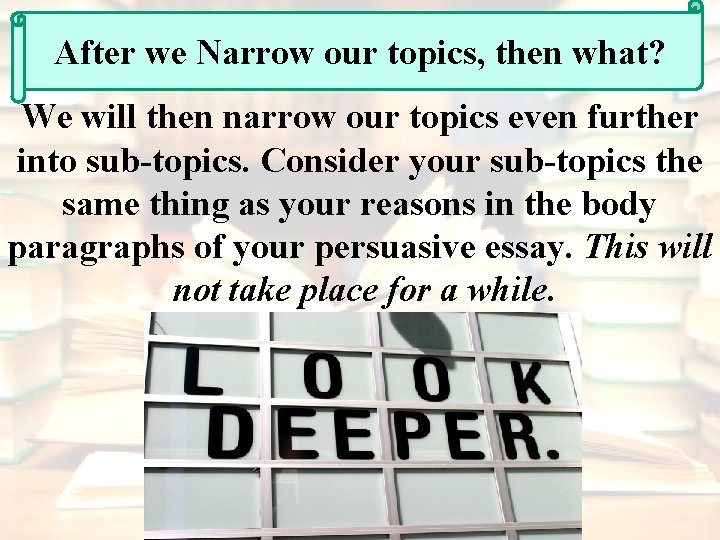
After we Narrow our topics, then what? We will then narrow our topics even further into sub-topics. Consider your sub-topics the same thing as your reasons in the body paragraphs of your persuasive essay. This will not take place for a while.
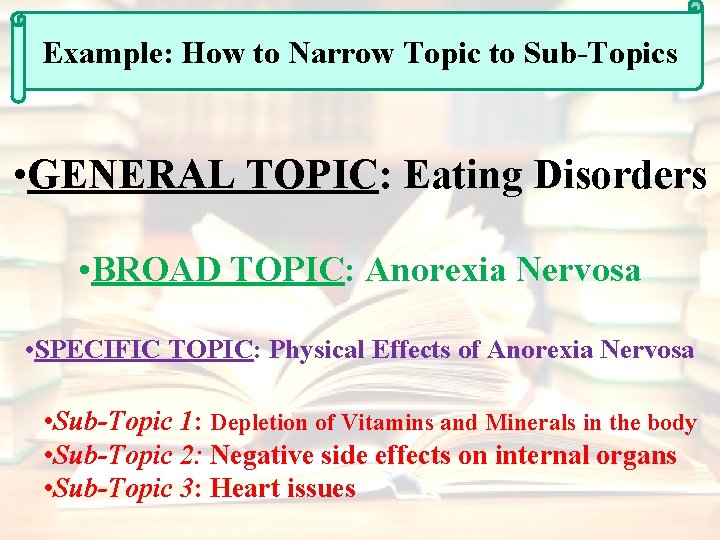
Example: How to Narrow Topic to Sub-Topics • GENERAL TOPIC: Eating Disorders • BROAD TOPIC: Anorexia Nervosa • SPECIFIC TOPIC: Physical Effects of Anorexia Nervosa • Sub-Topic 1: Depletion of Vitamins and Minerals in the body • Sub-Topic 2: Negative side effects on internal organs • Sub-Topic 3: Heart issues
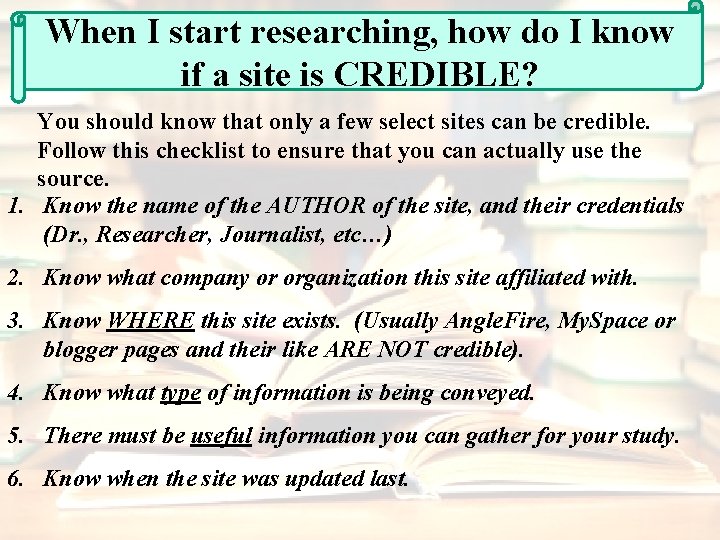
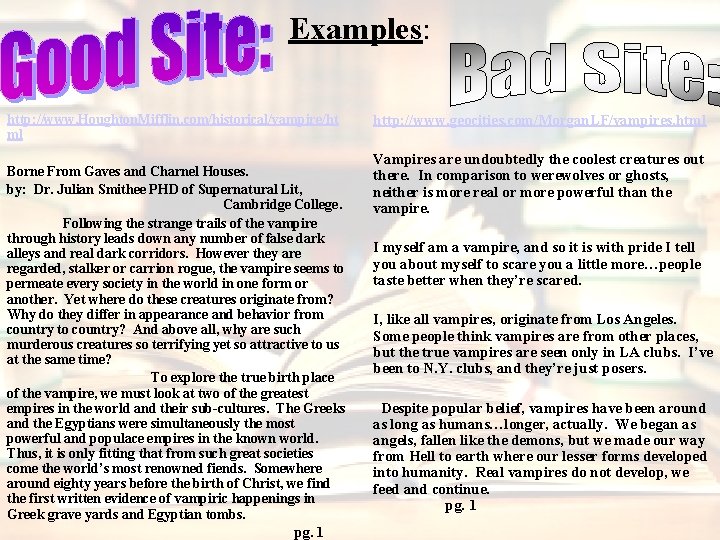
When I start researching, how do I know if a site is CREDIBLE? You should know that only a few select sites can be credible. Follow this checklist to ensure that you can actually use the source. 1. Know the name of the AUTHOR of the site, and their credentials (Dr. , Researcher, Journalist, etc…) 2. Know what company or organization this site affiliated with. 3. Know WHERE this site exists. (Usually Angle. Fire, My. Space or blogger pages and their like ARE NOT credible). 4. Know what type of information is being conveyed. 5. There must be useful information you can gather for your study. 6. Know when the site was updated last.
Examples: http: //www. Houghton. Mifflin. com/historical/vampire/ht ml Borne From Gaves and Charnel Houses. by: Dr. Julian Smithee PHD of Supernatural Lit, Cambridge College. Following the strange trails of the vampire through history leads down any number of false dark alleys and real dark corridors. However they are regarded, stalker or carrion rogue, the vampire seems to permeate every society in the world in one form or another. Yet where do these creatures originate from? Why do they differ in appearance and behavior from country to country? And above all, why are such murderous creatures so terrifying yet so attractive to us at the same time? To explore the true birth place of the vampire, we must look at two of the greatest empires in the world and their sub-cultures. The Greeks and the Egyptians were simultaneously the most powerful and populace empires in the known world. Thus, it is only fitting that from such great societies come the world’s most renowned fiends. Somewhere around eighty years before the birth of Christ, we find the first written evidence of vampiric happenings in Greek grave yards and Egyptian tombs. pg. 1 http: //www. geocities. com/Morgan. LF/vampires. html Vampires are undoubtedly the coolest creatures out there. In comparison to werewolves or ghosts, neither is more real or more powerful than the vampire. I myself am a vampire, and so it is with pride I tell you about myself to scare you a little more…people taste better when they’re scared. I, like all vampires, originate from Los Angeles. Some people think vampires are from other places, but the true vampires are seen only in LA clubs. I’ve been to N. Y. clubs, and they’re just posers. Despite popular belief, vampires have been around as long as humans…longer, actually. We began as angels, fallen like the demons, but we made our way from Hell to earth where our lesser forms developed into humanity. Real vampires do not develop, we feed and continue. pg. 1
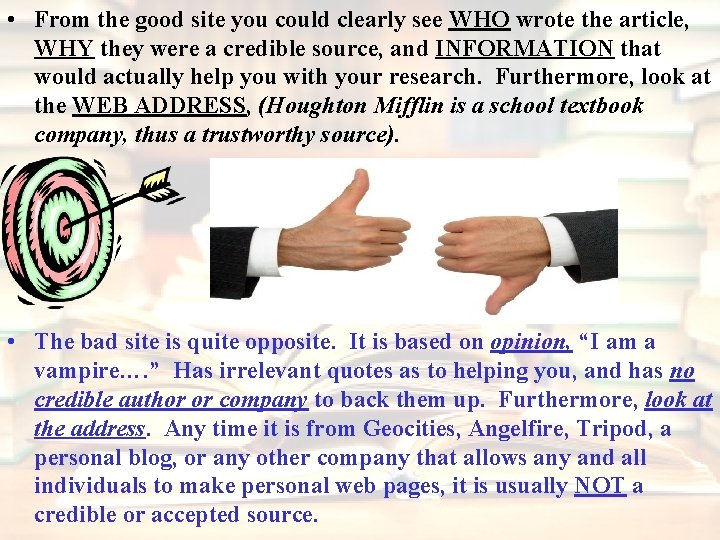
• From the good site you could clearly see WHO wrote the article, WHY they were a credible source, and INFORMATION that would actually help you with your research. Furthermore, look at the WEB ADDRESS, (Houghton Mifflin is a school textbook company, thus a trustworthy source). • The bad site is quite opposite. It is based on opinion, “I am a vampire…. ” Has irrelevant quotes as to helping you, and has no credible author or company to back them up. Furthermore, look at the address. Any time it is from Geocities, Angelfire, Tripod, a personal blog, or any other company that allows any and all individuals to make personal web pages, it is usually NOT a credible or accepted source.
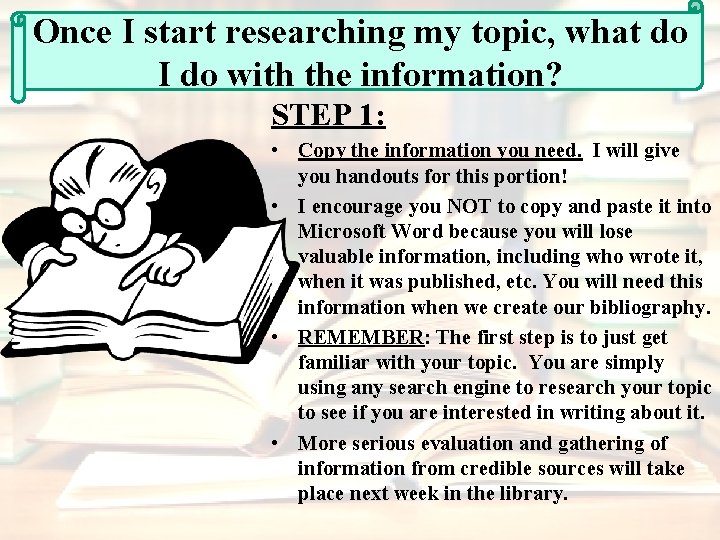
Once I start researching my topic, what do I do with the information? STEP 1: • Copy the information you need. I will give you handouts for this portion! • I encourage you NOT to copy and paste it into Microsoft Word because you will lose valuable information, including who wrote it, when it was published, etc. You will need this information when we create our bibliography. • REMEMBER: The first step is to just get familiar with your topic. You are simply using any search engine to research your topic to see if you are interested in writing about it. • More serious evaluation and gathering of information from credible sources will take place next week in the library.
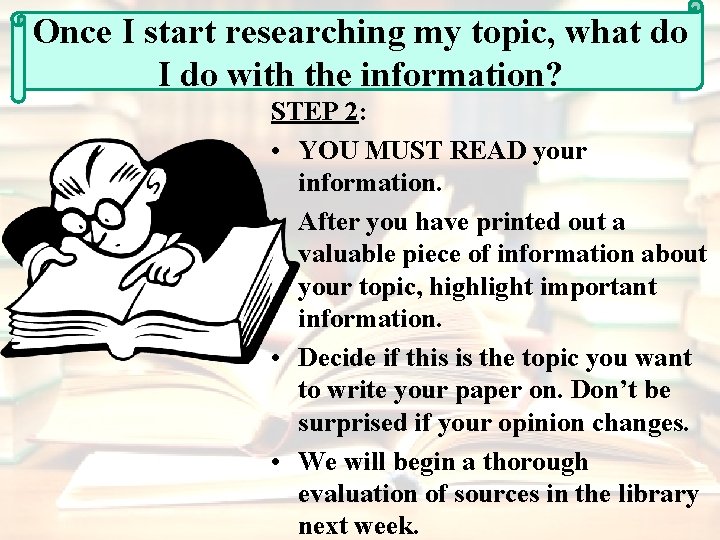
Once I start researching my topic, what do I do with the information? STEP 2: • YOU MUST READ your information. • After you have printed out a valuable piece of information about your topic, highlight important information. • Decide if this is the topic you want to write your paper on. Don’t be surprised if your opinion changes. • We will begin a thorough evaluation of sources in the library next week.
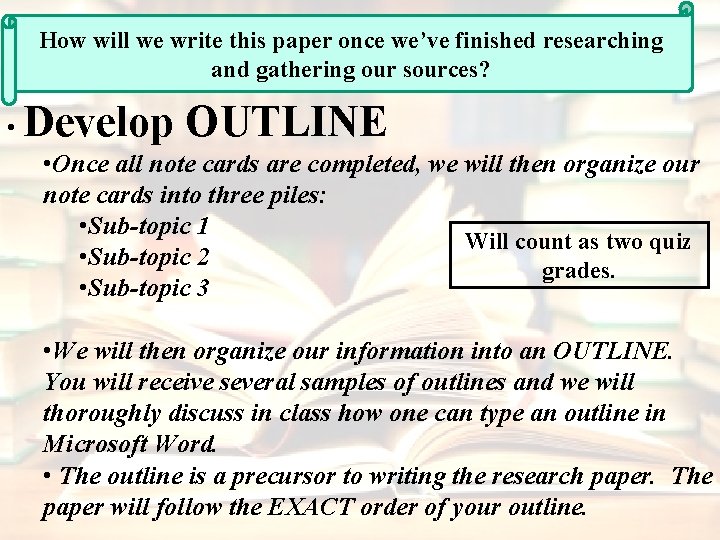
How will we write this paper once we’ve finished researching and gathering our sources? • Develop OUTLINE • Once all note cards are completed, we will then organize our note cards into three piles: • Sub-topic 1 Will count as two quiz • Sub-topic 2 grades. • Sub-topic 3 • We will then organize our information into an OUTLINE. You will receive several samples of outlines and we will thoroughly discuss in class how one can type an outline in Microsoft Word. • The outline is a precursor to writing the research paper. The paper will follow the EXACT order of your outline.
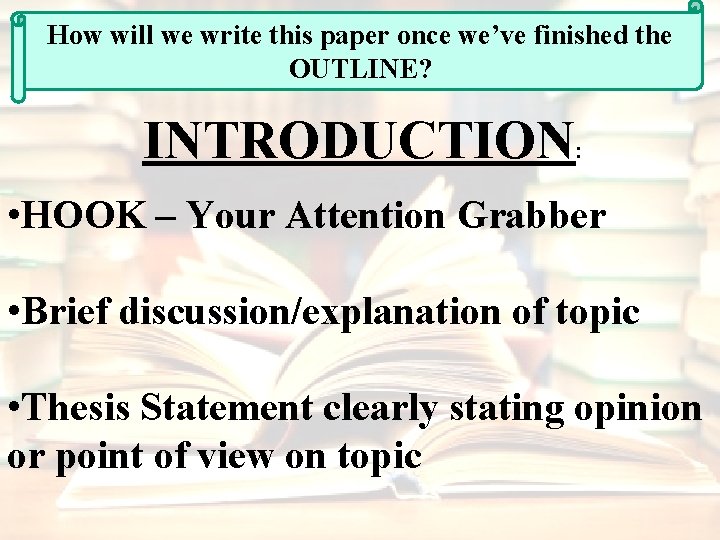
How will we write this paper once we’ve finished the OUTLINE? INTRODUCTION: • HOOK – Your Attention Grabber • Brief discussion/explanation of topic • Thesis Statement clearly stating opinion or point of view on topic
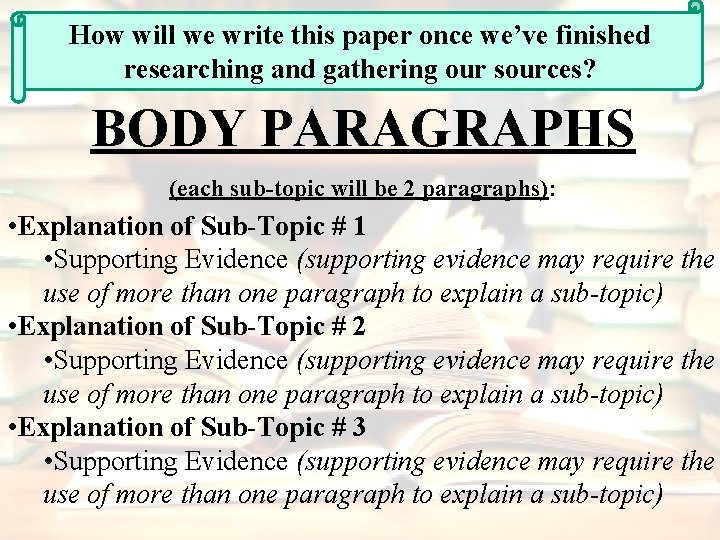
How will we write this paper once we’ve finished researching and gathering our sources? BODY PARAGRAPHS (each sub-topic will be 2 paragraphs): • Explanation of Sub-Topic # 1 • Supporting Evidence (supporting evidence may require the use of more than one paragraph to explain a sub-topic) • Explanation of Sub-Topic # 2 • Supporting Evidence (supporting evidence may require the use of more than one paragraph to explain a sub-topic) • Explanation of Sub-Topic # 3 • Supporting Evidence (supporting evidence may require the use of more than one paragraph to explain a sub-topic)
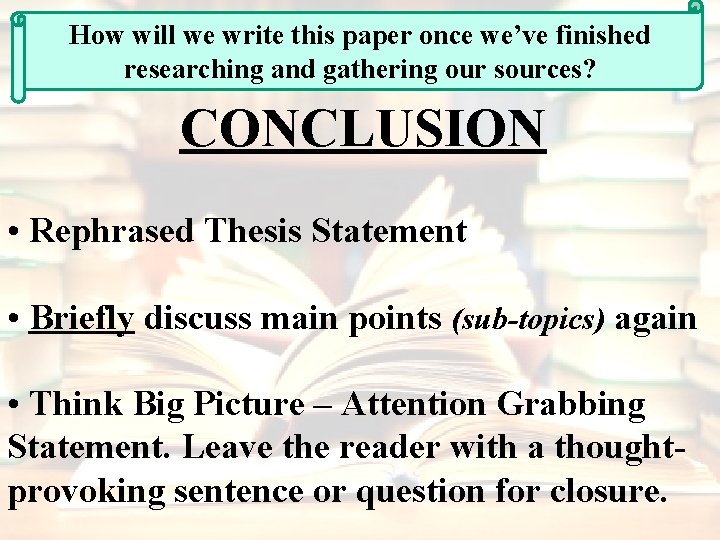
How will we write this paper once we’ve finished researching and gathering our sources? CONCLUSION • Rephrased Thesis Statement • Briefly discuss main points (sub-topics) again • Think Big Picture – Attention Grabbing Statement. Leave the reader with a thoughtprovoking sentence or question for closure.
How will we write this paper once we’ve finished researching and gathering our sources? MLA BIBLIOGRAPHY • This will be done in the library with the help of Mrs. Young and Mrs. Bluneir. *I will help, too. • MLA stands for Modern Language Association. It is a specific format we will follow. This will all be explained to you in class.
• Every step in the research paper process is graded and will contribute to the final product. If you choose to become lazy at any point in the process, it will affect the final product and frustrate you in the end. • Take PRIDE in your work and REMEMBER: it reflects your work ethic and commitment to excellence. Choose a topic you would be interested in reading. And, above all, create something you are proud of altogether.
• Plagiarism is when you take someone else’s works, ideas or words and use them as your own. Whether it is a sentence, a part of a sentence or an entire paper, it will ruin your grade. • It is an academic crime and an ethical offense. Plagiarism is stealing someone’s intellectual property. • If you plagiarize in ANY college class, you are usually expelled from the college, cannot reapply EVER, and the infraction is placed on your permanent record. • Why is it an academic crime? It is an academic crime because you are stealing another person’s ideas. It is illegal and immoral. • If you are thinking about it, don’t chance it. • If you ever need to help summarizing, properly quoting or paraphrasing, see me! It’s better to ask for extra help than take the sneaky route and copy someone else’s writing. I will have more respect for you if you ask for help. We will discuss how to avoid this much more in class.