
11 The Muscular System Power Point Lecture Presentations





- Slides: 26
11 The Muscular System Power. Point® Lecture Presentations prepared by Jason La. Pres Lone Star College—North Harris © 2012 Pearson Education, Inc.
An Introduction to the Muscular System Learning Outcomes 11 -1 Describe the arrangement of fascicles in the various types of muscles, and explain the resulting functional differences. 11 -2 Describe the classes of levers, and explain how they make muscles more efficient. 11 -3 Predict the actions of a muscle on the basis of its origin and insertion, and explain how muscles interact to produce or oppose movements. 11 -4 Explain how the name of a muscle can help identify its location, appearance, or function. 11 -5 Identify the principal axial muscles of the body, plus their origins, insertions, actions, and innervation. 11 -6 Identify the principal appendicular muscles of the body, 11 -7 Identify age-related changes of the muscular system. 11 -8 Explain the functional relationship between the muscular system and other body systems, and explain the role of exercise in producing various responses in other body systems. © 2012 Pearson Education, Inc.
An Introduction to the Muscular System The Muscular System (only the skeletal muscles) Muscle Organization and Function Muscle organization affects power, range, and speed of muscle movement Fascicles (muscle cells (fibers) are organized in bundles (fascicles) Classification of Skeletal Muscles By the way fascicles are organized By relationships of fascicles to tendons Organization of Skeletal Muscle Fibers Four patterns of fascicle organization Parallel Pennate Convergent Circular © 2012 Pearson Education, Inc.
© 2012 Pearson Education, Inc.
11 -1 Fascicle Arrangement Parallel Muscles Fibers parallel to the long axis of muscle For example, biceps brachii Depends on total number of myofibrils Directly relates to cross section of muscle 1 in. 2 (6. 45 cm 2) of cross section develops 50 lb (23 kg) of tension © 2012 Pearson Education, Inc.
11 -1 Fascicle Arrangement Convergent Muscles A broad area converges on attachment site (tendon, aponeurosis, or raphe) Muscle fibers pull in different directions, depending on stimulation For example, pectoralis muscles © 2012 Pearson Education, Inc.
11 -1 Fascicle Arrangement Pennate Muscles Form an angle with the tendon Develop more tension than parallel muscles Unipennate Fibers on one side of tendon For example, extensor digitorum Bipennate Fibers on both sides of tendon For example, rectus femoris Multipennate Tendon branches within muscle For example, deltoid © 2012 Pearson Education, Inc.
11 -1 Fascicle Arrangement Circular Muscles Also called sphincters Open and close to guard entrances of body For example, orbicularis oris muscle of the mouth © 2012 Pearson Education, Inc.
11 -2 Levers Skeletal Motion Skeletal muscles attach to skeleton, produce motion Type of muscle attachment affects power, range, and speed of muscle movement Levers (a rigid piece turning about an axis and used for transmitting and changing force and motion). Mechanically, each bone is a lever (a rigid, moving structure) And each joint a fulcrum (a fixed point) Muscles provide applied force (AF) Required to overcome load (L) © 2012 Pearson Education, Inc.
11 -2 Levers Function of a Lever To change: Direction of an AF Distance and speed of movement produced by an AF Effective strength of an AF The Three Classes of Levers Depend on the relationship between applied force, fulcrum, and resistance 1. First-class lever 2. Second-class lever 3. Third-class lever © 2012 Pearson Education, Inc.
1 Which type of lever prodouces the most force? © 2012 Pearson Education, Inc.
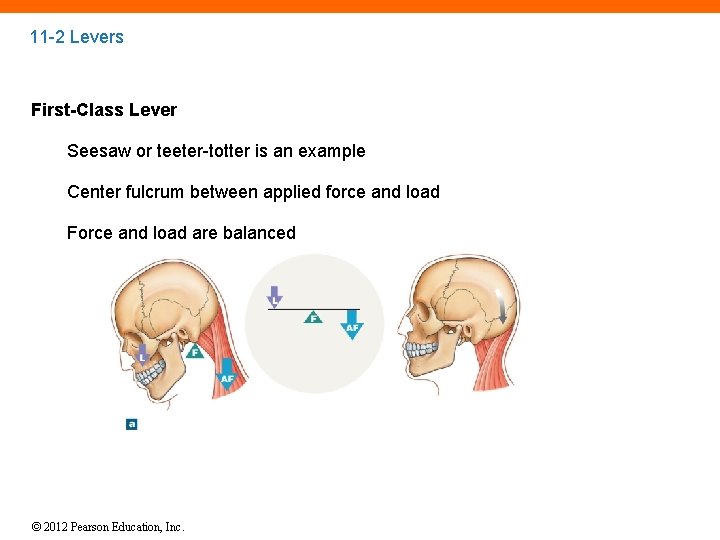
11 -2 Levers First-Class Lever Seesaw or teeter-totter is an example Center fulcrum between applied force and load Force and load are balanced © 2012 Pearson Education, Inc.
11 -2 Levers Second-Class Lever Wheelbarrow is an example Center resistance between applied force and fulcrum A small force moves a large weight © 2012 Pearson Education, Inc.
11 -2 Levers Third-Class Lever Most common levers in the body Center applied force between load and fulcrum Greater force moves smaller load Maximizes speed and distance traveled © 2012 Pearson Education, Inc.
11 -3 Muscle Attachments to Other Tissues Origins and Insertions Muscles have one fixed point of attachment (origin) And one moving point of attachment (insertion) Most muscles originate or insert on the skeleton Origin is usually proximal to insertion Actions Movements produced by muscle contraction Body movements For example, flexion, extension, adduction, etc. Described in terms of bone, joint, or region © 2012 Pearson Education, Inc.
11 -3 Muscle Attachments to Other Tissues Muscle Interactions Muscles work in groups to maximize efficiency Smaller muscles reach maximum tension first, followed by larger, primary muscles Muscle Terminology Based on Function Agonist (or prime mover)—Produces a particular movement Antagonist—Opposes movement of a particular agonist Synergist—Smaller muscle that assists a larger agonist Helps start motion or stabilize origin of agonist (fixator) © 2012 Pearson Education, Inc.
11 -3 Muscle Attachments to Other Tissues Muscle Opposition Agonists and antagonists work in pairs When one contracts, the other stretches Such as flexors–extensors, abductors–adductors, etc. Names of Skeletal Muscles Correct names of muscles include the term muscle Exceptions: Platysma (covers anterior part of neck) Diaphragm (divides thoracic and abdominopelvic cavities) © 2012 Pearson Education, Inc.
Give an example of a muscle names for each of the following characteristics: direction of fibers, shape, action, size, origin and insertion, location, and number of tendons of origin. © 2012 Pearson Education, Inc.
11 -4 Naming Skeletal Muscles Divisions of the Muscular System Axial muscles Position head and spinal column Move rib cage 60% of skeletal muscles Appendicular muscles Support pectoral and pelvic girdles Support limbs 40% of skeletal muscles © 2012 Pearson Education, Inc.
Muscles © 2012 Pearson Education, Inc.
The Axial Muscles The Appendicular Muscles Divisions based on location and function Position and stabilize pectoral Muscles of the head and neck and pelvic girdles Muscles of the vertebral column Move upper and lower limbs Oblique and rectus muscles Two divisions of appendicular Muscles of the pelvic floor muscles Muscles of the shoulders and upper limbs Muscles of the pelvis and lower limbs © 2012 Pearson Education, Inc.
11 -7 Effects of Aging on the Muscular System Effects of Aging Skeletal muscle fibers become smaller in diameter Skeletal muscles become less elastic Develop increasing amounts of fibrous tissue (fibrosis) Decreased tolerance for exercise Decreased ability to recover from muscular injuries © 2012 Pearson Education, Inc.
11 -8 Muscular System Integration Cardiovascular System Delivers oxygen and fuel Removes carbon dioxide and wastes Respiratory System Responds to oxygen demand of muscles Integumentary System Disperses heat from muscle activity Nervous and Endocrine Systems Direct responses of all systems © 2012 Pearson Education, Inc.
BIOL 2401 Abnormal Functioning at the NMJ 1 An electrical signal (nerve impulse) moves along the nerve toward the nerve ending. Stored within the nerve ending are vesicles filled with ACh. 2 The nerve impulse causes the vesicles to release the ACh into the space between the nerve ending and the muscle membrane. 3 ACh diffuses across the space and binds to the receptor sites on the muscle membrane. 4 The ACh stimulates the receptors and causes an electrical signal to develop along the muscle membrane. The ACh then unbinds the receptor site and is immediately destroyed by ACh. E. The free-binding sites are then ready for additional Ach when the nerve is stimulated again. © 2012 Pearson Education, Inc.
BIOL 2401 Match the examples of abnormalfunctioning at the NMJ. Picture 1 Myasthenia gravis Picture 2 Neuromuscular blockade by curare Picture 3 Infection by Clostricium botulinum Picture 4 Infection by Clostridium tetani © 2012 Pearson Education, Inc.
© 2012 Pearson Education, Inc.