
11 Public Goods and Common Resources Power Point
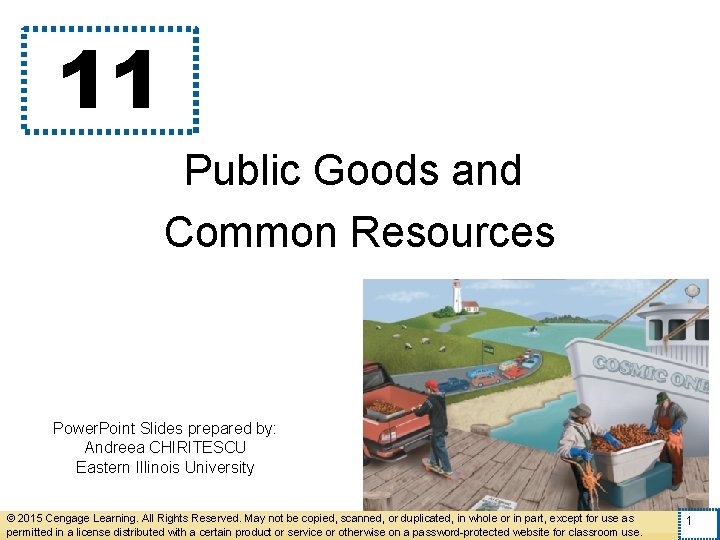
11 Public Goods and Common Resources Power. Point Slides prepared by: Andreea CHIRITESCU Eastern Illinois University © 2015 Cengage Learning. All Rights Reserved. May not be copied, scanned, or duplicated, in whole or in part, except for use as permitted in a license distributed with a certain product or service or otherwise on a password-protected website for classroom use. 1
The Different Kinds of Goods • Excludability – Property of a good whereby a person can be prevented from using it • Rivalry in consumption – Property of a good whereby one person’s use diminishes other people’s use © 2015 Cengage Learning. All Rights Reserved. May not be copied, scanned, or duplicated, in whole or in part, except for use as permitted in a license distributed with a certain product or service or otherwise on a password-protected website for classroom use. 2

The Different Kinds of Goods • Private goods – Excludable & Rival in consumption • Public goods – Not excludable & Not rival in consumption • Common resources – Rival in consumption & Not excludable • Club goods – Excludable & Not rival in consumption – One type of natural monopoly © 2015 Cengage Learning. All Rights Reserved. May not be copied, scanned, or duplicated, in whole or in part, except for use as permitted in a license distributed with a certain product or service or otherwise on a password-protected website for classroom use. 3

Four Types of Goods Figure 1 Goods can be grouped into four categories according to two characteristics: (1) A good is excludable if people can be prevented from using it. (2) A good is rival in consumption if one person’s use of the good diminishes other people’s use of it. This diagram gives examples of goods in each category. © 2015 Cengage Learning. All Rights Reserved. May not be copied, scanned, or duplicated, in whole or in part, except for use as permitted in a license distributed with a certain product or service or otherwise on a password-protected website for classroom use. 4
The Different Kinds of Goods • Public goods and common resources – Not excludable • People cannot be prevented from using them • Available to everyone free of charge – No price attached to it – External effects • Positive externalities (public goods) • Negative externalities (common resources) © 2015 Cengage Learning. All Rights Reserved. May not be copied, scanned, or duplicated, in whole or in part, except for use as permitted in a license distributed with a certain product or service or otherwise on a password-protected website for classroom use. 5
The Different Kinds of Goods • Public goods and common resources – Private decisions about consumption and production • Can lead to an inefficient allocation of resources – Government intervention • Can potentially raise economic well-being © 2015 Cengage Learning. All Rights Reserved. May not be copied, scanned, or duplicated, in whole or in part, except for use as permitted in a license distributed with a certain product or service or otherwise on a password-protected website for classroom use. 6
Public Goods • Free rider – Person who receives the benefit of a good but avoids paying for it • The free-rider problem – Public goods are not excludable – Prevents the private market from supplying the goods © 2015 Cengage Learning. All Rights Reserved. May not be copied, scanned, or duplicated, in whole or in part, except for use as permitted in a license distributed with a certain product or service or otherwise on a password-protected website for classroom use. 7
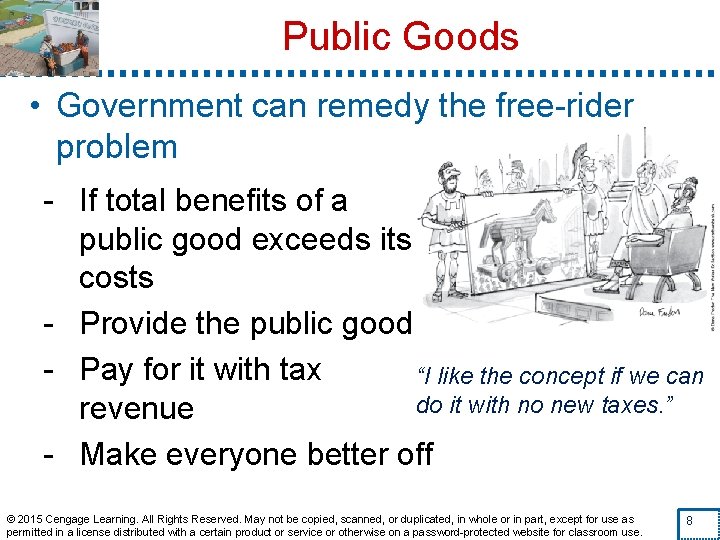
Public Goods • Government can remedy the free-rider problem - If total benefits of a public good exceeds its costs - Provide the public good - Pay for it with tax “I like the concept if we can do it with no new taxes. ” revenue - Make everyone better off © 2015 Cengage Learning. All Rights Reserved. May not be copied, scanned, or duplicated, in whole or in part, except for use as permitted in a license distributed with a certain product or service or otherwise on a password-protected website for classroom use. 8
Public Goods • Some important public goods – National defense • Very expensive public good • $717 billion in 2011 – Basic research • General knowledge • Subsidized by government • The public sector fails to pay for the right amount and the right kinds © 2015 Cengage Learning. All Rights Reserved. May not be copied, scanned, or duplicated, in whole or in part, except for use as permitted in a license distributed with a certain product or service or otherwise on a password-protected website for classroom use. 9
Public Goods • Some important public goods – Antipoverty programs (financed by taxes) • Welfare system (Temporary Assistance for Needy Families program, TANF) – Provides a small income for some poor families • Food stamps (Supplemental Nutrition Assistance Program, SNAP) – Subsidize the purchase of food for those with low incomes • Government housing programs – Make shelter more affordable © 2015 Cengage Learning. All Rights Reserved. May not be copied, scanned, or duplicated, in whole or in part, except for use as permitted in a license distributed with a certain product or service or otherwise on a password-protected website for classroom use. 10
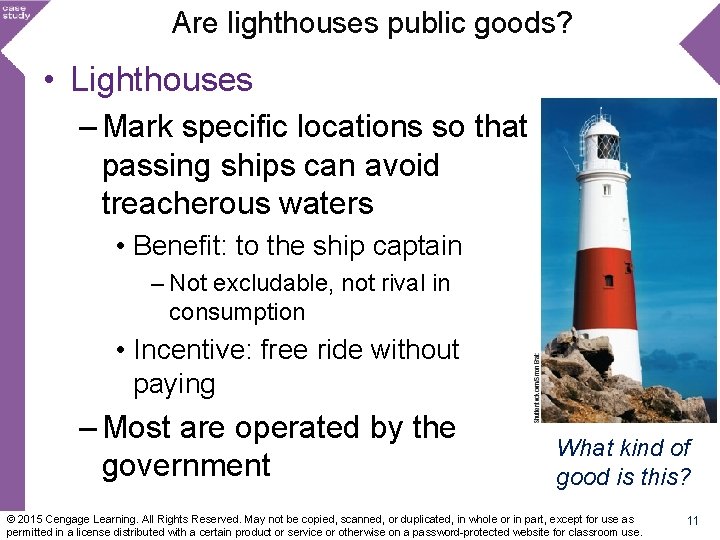
Are lighthouses public goods? • Lighthouses – Mark specific locations so that passing ships can avoid treacherous waters • Benefit: to the ship captain – Not excludable, not rival in consumption • Incentive: free ride without paying – Most are operated by the government What kind of good is this? © 2015 Cengage Learning. All Rights Reserved. May not be copied, scanned, or duplicated, in whole or in part, except for use as permitted in a license distributed with a certain product or service or otherwise on a password-protected website for classroom use. 11
Are lighthouses public goods? • In some cases – Lighthouses are closer to private goods • Coast of England, 19 th century • Lighthouses were privately owned and operated • The owner of the lighthouse charged the owner of the nearby port – If the port owned did not pay, lighthouse owner turned the light off » Ships avoided that port © 2015 Cengage Learning. All Rights Reserved. May not be copied, scanned, or duplicated, in whole or in part, except for use as permitted in a license distributed with a certain product or service or otherwise on a password-protected website for classroom use. 12
Are lighthouses public goods? • Decide whether something is a public good – Determine who the beneficiaries are – Determine whether the beneficiaries can be excluded from using the good • A free-rider problem – When the number of beneficiaries is large – Exclusion of any one of them is impossible © 2015 Cengage Learning. All Rights Reserved. May not be copied, scanned, or duplicated, in whole or in part, except for use as permitted in a license distributed with a certain product or service or otherwise on a password-protected website for classroom use. 13
Public Goods • The difficult job of cost–benefit analysis – Government • Decide what public goods to provide • In what quantities – Cost–benefit analysis • Compare the costs and benefits to society of providing a public good • Doesn’t have any price signals to observe • Government findings – Rough approximations at best © 2015 Cengage Learning. All Rights Reserved. May not be copied, scanned, or duplicated, in whole or in part, except for use as permitted in a license distributed with a certain product or service or otherwise on a password-protected website for classroom use. 14
How much is a life worth? • Cost: $10, 000 for a new traffic light • Benefit: increased safety – Risk of a fatal traffic accident • Drops from 1. 6% to 1. 1 % • Obstacle – Measure costs and benefits in the same units • Put a dollar value on a human life? – Priceless = infinite dollar value © 2015 Cengage Learning. All Rights Reserved. May not be copied, scanned, or duplicated, in whole or in part, except for use as permitted in a license distributed with a certain product or service or otherwise on a password-protected website for classroom use. 15
How much is a life worth? • Implicit dollar value of a human life – Courts: award damages in wrongful-death suits • Total amount of money a person would have earned if he or she had lived • Ignores other opportunity costs of losing one’s life – Risks that people are voluntarily willing to take and how much they must be paid for taking them • Value of human life = $10 million © 2015 Cengage Learning. All Rights Reserved. May not be copied, scanned, or duplicated, in whole or in part, except for use as permitted in a license distributed with a certain product or service or otherwise on a password-protected website for classroom use. 16
How much is a life worth? • Cost-benefit analysis – Traffic light • Reduces risk of fatality by 0. 5 percentage points – Expected benefit = 0. 005 × $10 million = $50, 000 – Cost ($10, 000) < Benefit ($50, 000) – Approve the traffic light © 2015 Cengage Learning. All Rights Reserved. May not be copied, scanned, or duplicated, in whole or in part, except for use as permitted in a license distributed with a certain product or service or otherwise on a password-protected website for classroom use. 17
Common Resources • Common resources – Not excludable – Rival in consumption • The tragedy of the commons – Parable that shows why common resources are used more than desirable • From society’s standpoint – Social and private incentives differ – Arises because of a negative externality © 2015 Cengage Learning. All Rights Reserved. May not be copied, scanned, or duplicated, in whole or in part, except for use as permitted in a license distributed with a certain product or service or otherwise on a password-protected website for classroom use. 18
Common Resources • The tragedy of the commons – Negative externality • One person uses a common resource – Diminishes other people’s enjoyment of it • Common resources tend to be used excessively – Government can solve the problem • Regulation or taxes to reduce consumption of the common resource • Turn the common resource into a private good © 2015 Cengage Learning. All Rights Reserved. May not be copied, scanned, or duplicated, in whole or in part, except for use as permitted in a license distributed with a certain product or service or otherwise on a password-protected website for classroom use. 19
Common Resources • Some important common resources – Clean air and water • Negative externality: pollution • Regulations or corrective taxes – Congested roads • Negative externality: congestion • Corrective tax: charge drivers a tool • Tax on gasoline © 2015 Cengage Learning. All Rights Reserved. May not be copied, scanned, or duplicated, in whole or in part, except for use as permitted in a license distributed with a certain product or service or otherwise on a password-protected website for classroom use. 20
Common Resources • Some important common resources – Fish, whales, and other wildlife • Oceans are the least regulated common resource – Needs international cooperation – Difficult to enforce an agreement • Fishing and hunting licenses • Limits on fishing and hunting seasons • Limits on size of fish • Limits on quantity of animals killed © 2015 Cengage Learning. All Rights Reserved. May not be copied, scanned, or duplicated, in whole or in part, except for use as permitted in a license distributed with a certain product or service or otherwise on a password-protected website for classroom use. 21
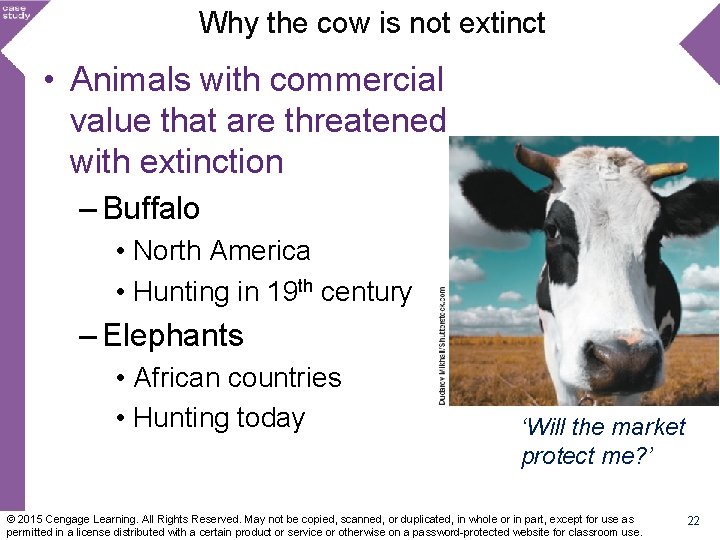
Why the cow is not extinct • Animals with commercial value that are threatened with extinction – Buffalo • North America • Hunting in 19 th century – Elephants • African countries • Hunting today ‘Will the market protect me? ’ © 2015 Cengage Learning. All Rights Reserved. May not be copied, scanned, or duplicated, in whole or in part, except for use as permitted in a license distributed with a certain product or service or otherwise on a password-protected website for classroom use. 22
Why the cow is not extinct • The cow – Commercial value – Species continues to thrive • Cows are a private good – Ranches are privately owned – Rancher - great effort to maintain the cattle population on his ranch • Reaps the benefit © 2015 Cengage Learning. All Rights Reserved. May not be copied, scanned, or duplicated, in whole or in part, except for use as permitted in a license distributed with a certain product or service or otherwise on a password-protected website for classroom use. 23
Why the cow is not extinct • Elephant - common resource – Poachers are numerous • Strong incentive to kill elephants • Government of Kenya, Tanzania, and Uganda – Illegal to kill elephants and sell ivory – Hard to enforce laws – Decreasing population of elephants © 2015 Cengage Learning. All Rights Reserved. May not be copied, scanned, or duplicated, in whole or in part, except for use as permitted in a license distributed with a certain product or service or otherwise on a password-protected website for classroom use. 24
Why the cow is not extinct • Government of Botswana, Malawi, Namibia, and Zimbabwe – Made elephants a private good – People can kill elephants on their own property – Landowners have an incentive to preserve the species – Elephant populations have started to rise © 2015 Cengage Learning. All Rights Reserved. May not be copied, scanned, or duplicated, in whole or in part, except for use as permitted in a license distributed with a certain product or service or otherwise on a password-protected website for classroom use. 25
Importance of Property Rights • Market fails to allocate resources efficiently – Because property rights are not well established – Some item of value does not have an owner with the legal authority to control it © 2015 Cengage Learning. All Rights Reserved. May not be copied, scanned, or duplicated, in whole or in part, except for use as permitted in a license distributed with a certain product or service or otherwise on a password-protected website for classroom use. 26
Importance of Property Rights • The government can potentially solve the problem – Help define property rights and thereby unleash market forces – Regulate private behavior – Use tax revenue to supply a good that the market fails to supply © 2015 Cengage Learning. All Rights Reserved. May not be copied, scanned, or duplicated, in whole or in part, except for use as permitted in a license distributed with a certain product or service or otherwise on a password-protected website for classroom use. 27
- Slides: 27