
11 Polymers 2 130212 Engineering materials Assistant Professor
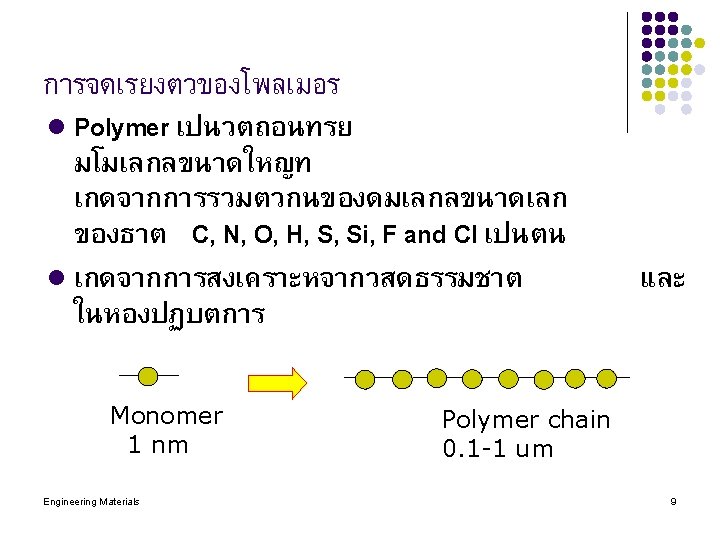


- Slides: 88
บทท 11 โพลเมอร Polymers 2 130212 Engineering materials Assistant Professor Sukangkana Lee Engineering Materials 1
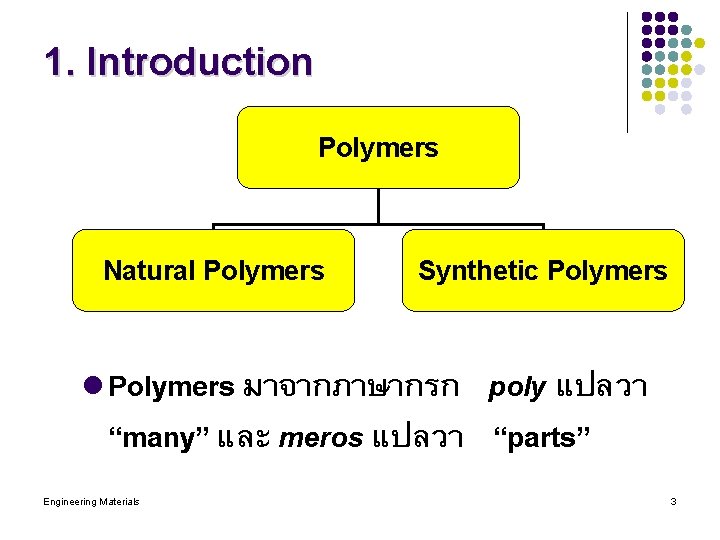
1. Introduction Polymers Natural Polymers Synthetic Polymers l Polymers มาจากภาษากรก poly แปลวา “many” และ meros แปลวา “parts” Engineering Materials 3
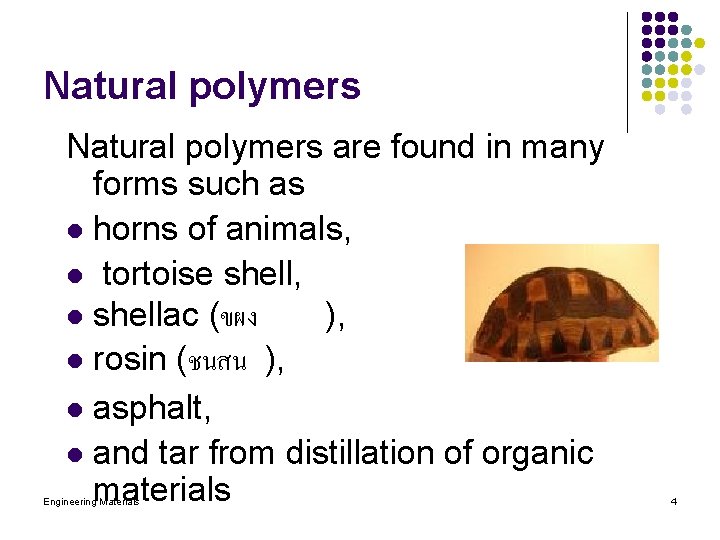
Natural polymers are found in many forms such as l horns of animals, l tortoise shell, l shellac (ขผง ), l rosin (ชนสน ), l asphalt, l and tar from distillation of organic materials Engineering Materials 4
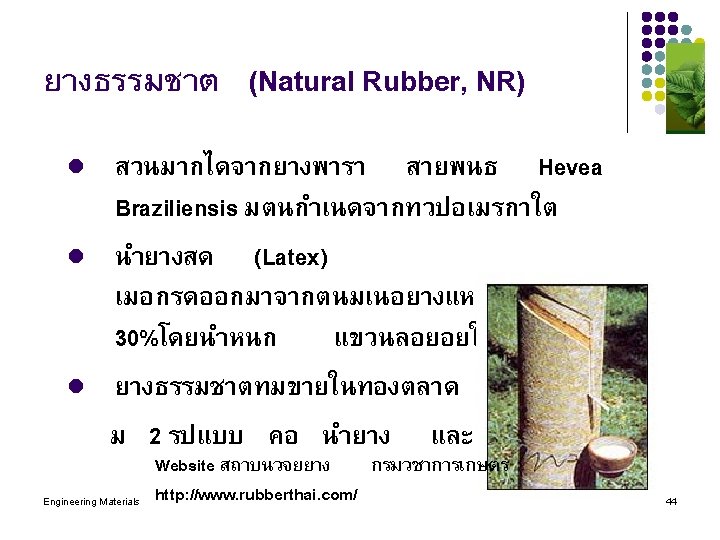
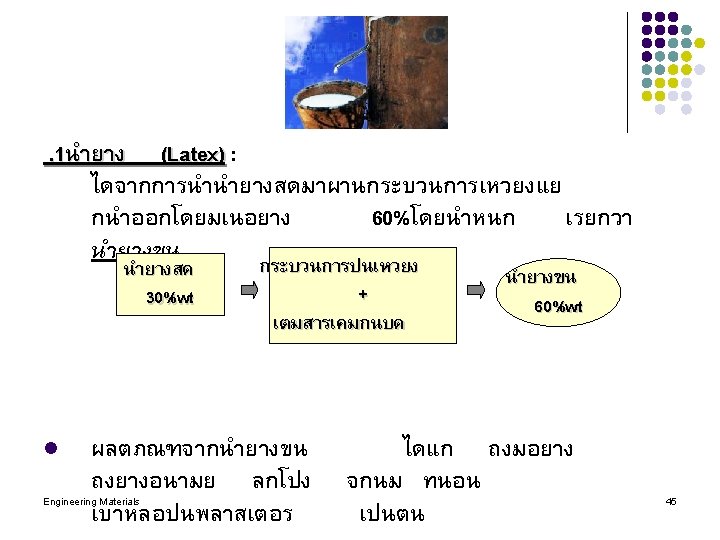
One of the most useful of the natural polymers was rubber, obtained from the sap of the hevea tree (ยางพารา). l Rubber was named by the chemist Joseph Priestley who found that a piece of solidified latex gum was good for rubbing out pencil marks on paper (ยางลบ). l Engineering Materials 5
Synthetic Polymers l l l Natural rubber had only limited use as it became brittle in the cold and melted when warmed. In 1839, Charles Goodyear discovered, through a lucky accident, that by heating the latex with sulfur, the properties were changed making the rubber more flexible and temperature stable. That process became known as vulcanization. Engineering Materials 6
������� online ���������� l http: //www. bpf. co. uk/Plastipedia/Plastic s_History/Default. aspx l Engineering Materials 8
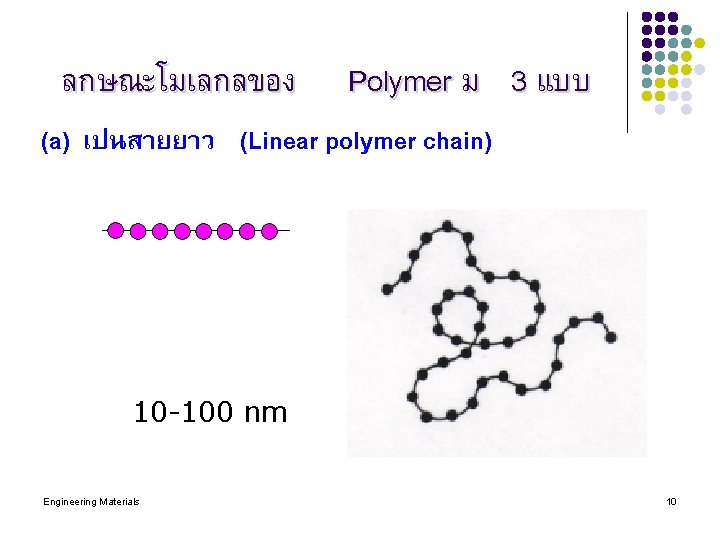
ลกษณะโมเลกลของ Polymer ม 3 แบบ (a) เปนสายยาว (Linear polymer chain) 10 -100 nm Engineering Materials 10
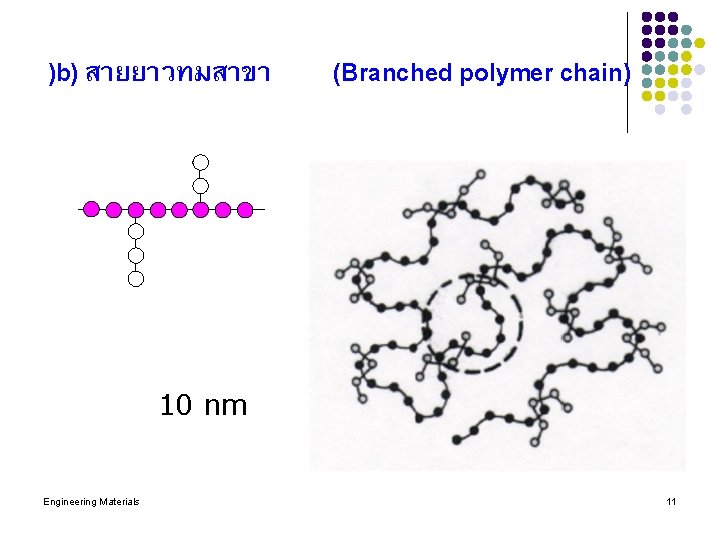
)b) สายยาวทมสาขา (Branched polymer chain) 10 nm Engineering Materials 11
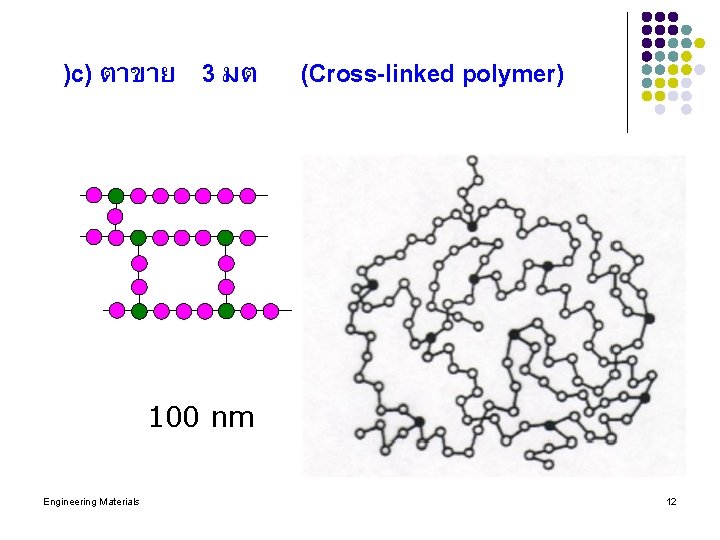
)c) ตาขาย 3 มต (Cross-linked polymer) 100 nm Engineering Materials 12
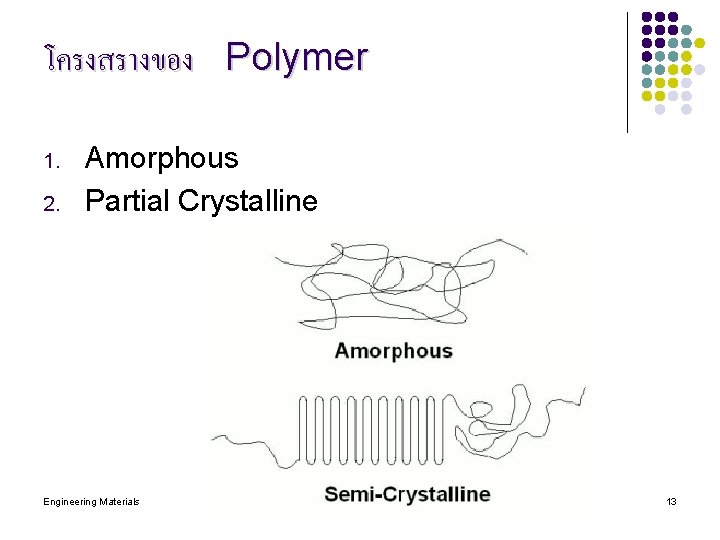
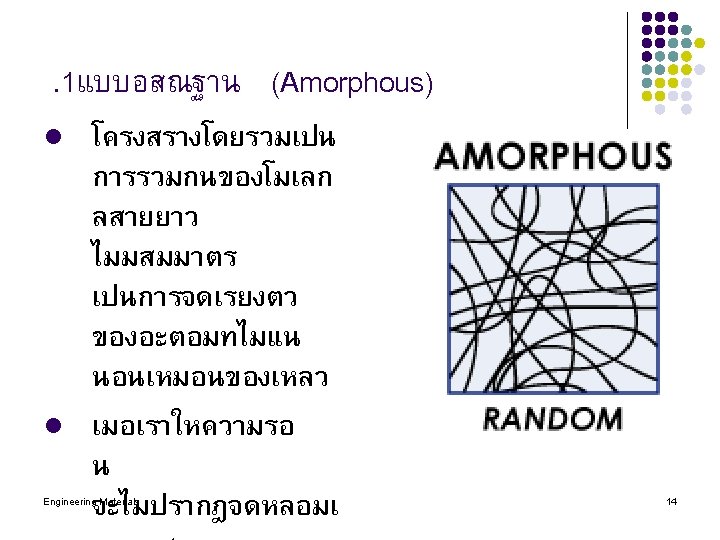
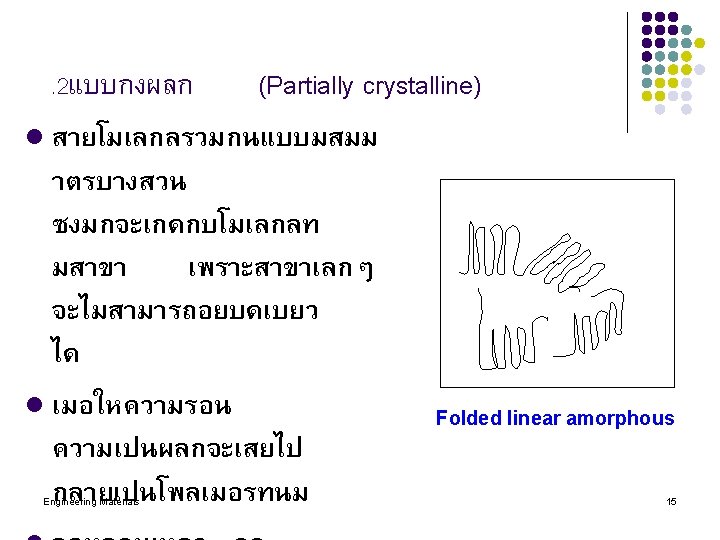
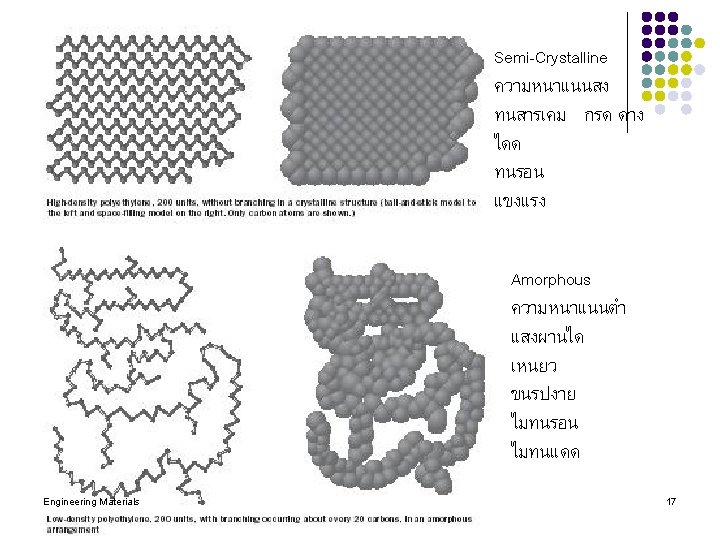
โครงสรางของ Polymer 1. 2. Amorphous Partial Crystalline Engineering Materials 13
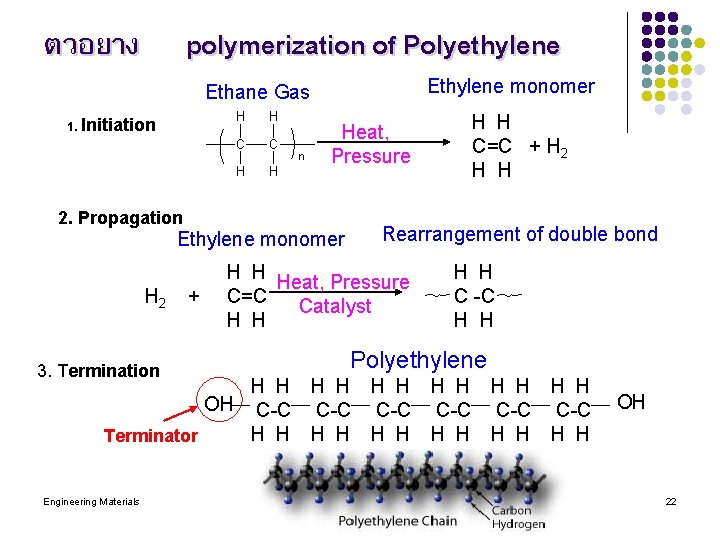
ตวอยาง polymerization of Polyethylene Ethane Gas H H H-C-C-H H H 1. Initiation Ethylene monomer Heat, Pressure 2. Propagation Ethylene monomer H 2 3. Termination + H H C=C + H 2 H H Rearrangement of double bond H H Heat, Pressure C=C Catalyst H H C -C H H Polyethylene H H H OH C-C C-C C-C H H H Terminator Engineering Materials OH 22
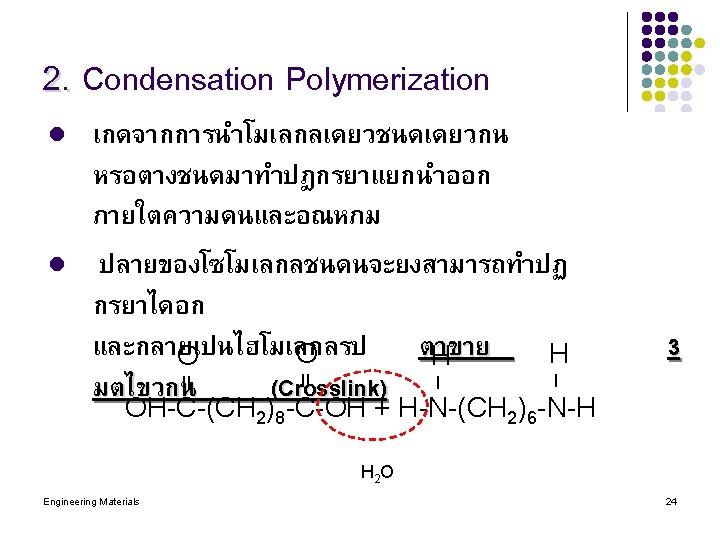
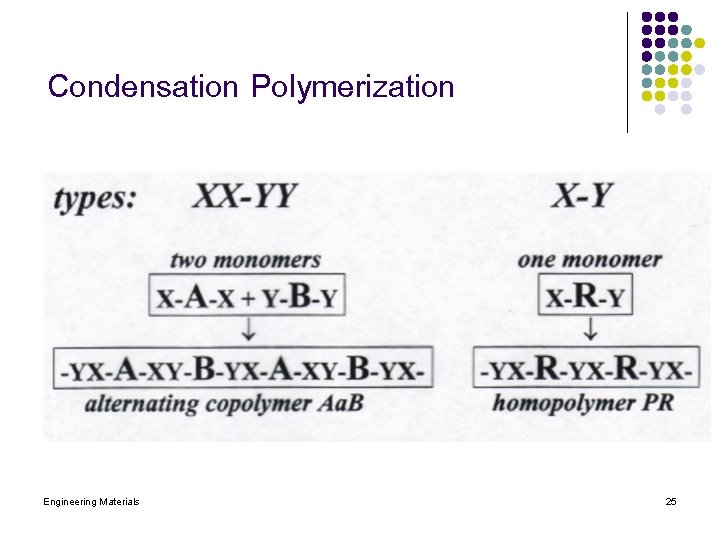
Condensation Polymerization Engineering Materials 25
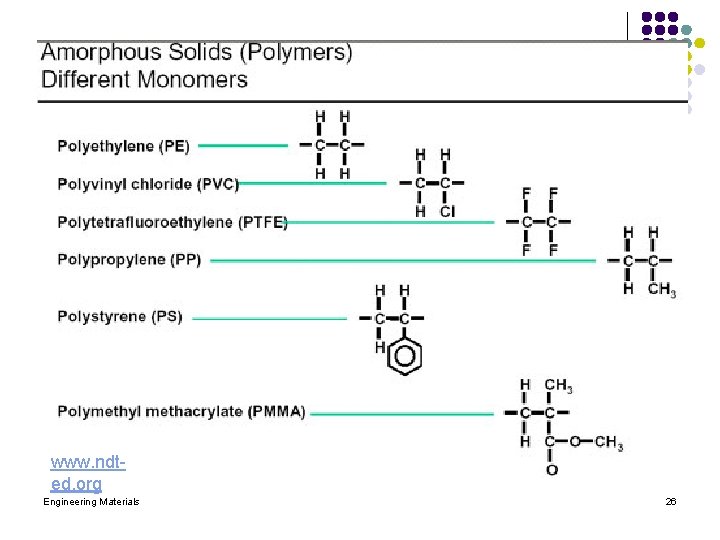
www. ndted. org Engineering Materials 26
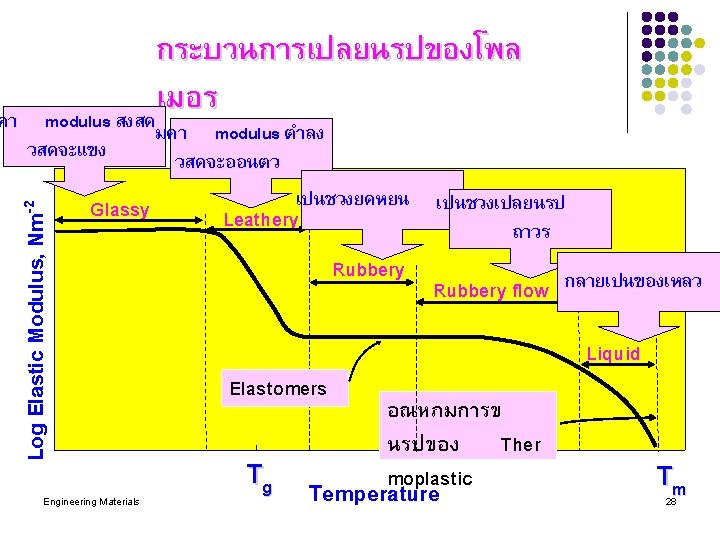
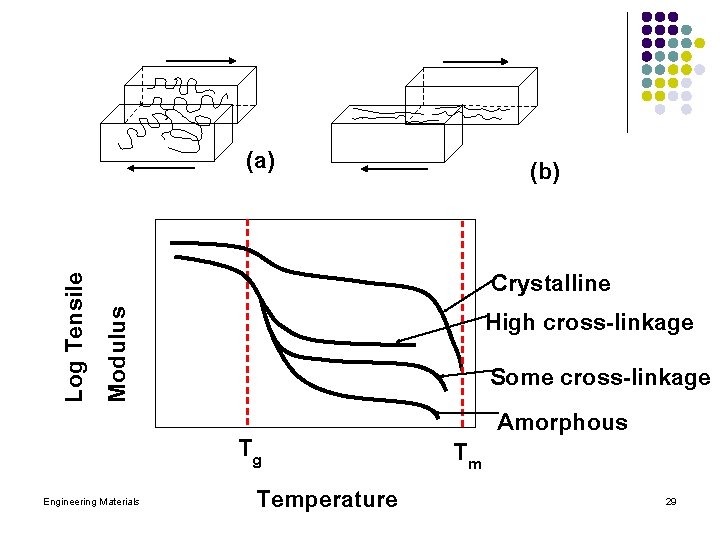
(a) (b) Log Tensile Modulus Crystalline High cross-linkage Engineering Materials Tg Temperature Tm Some cross-linkage Amorphous 29
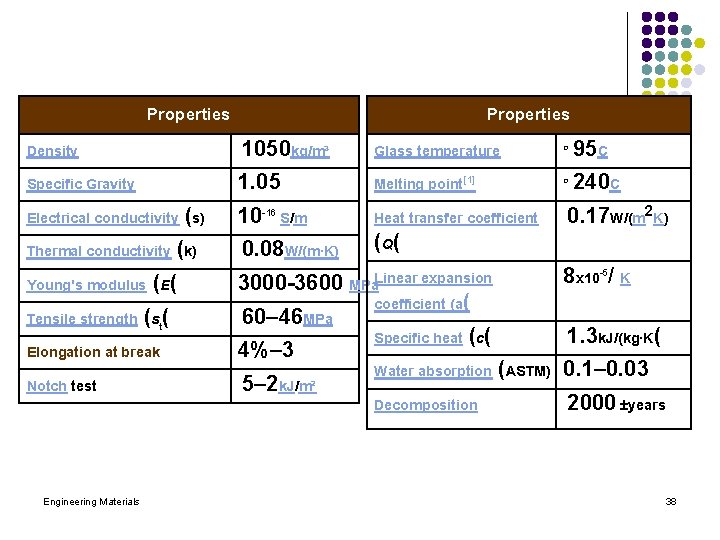
Properties Density 1050 kg/m³ Glass temperature ° 95 C Specific Gravity 1. 05 Melting point[1] ° 240 C Electrical conductivity (s) 10 -16 S/m Thermal conductivity (k) 0. 08 W/(m·K) Heat transfer coefficient 0. 17 W/(m 2 K) (Q( Young's modulus (E( Tensile strength (st( Elongation at break Notch test Engineering Materials 3000 -3600 MPa. Linear expansion coefficient (a( 60– 46 MPa Specific heat (c( 4%– 3 Water absorption (ASTM) 5– 2 k. J/m² Decomposition 8 x 10 -5/ K 1. 3 k. J/(kg·K( 0. 1– 0. 03 2000 ±years 38
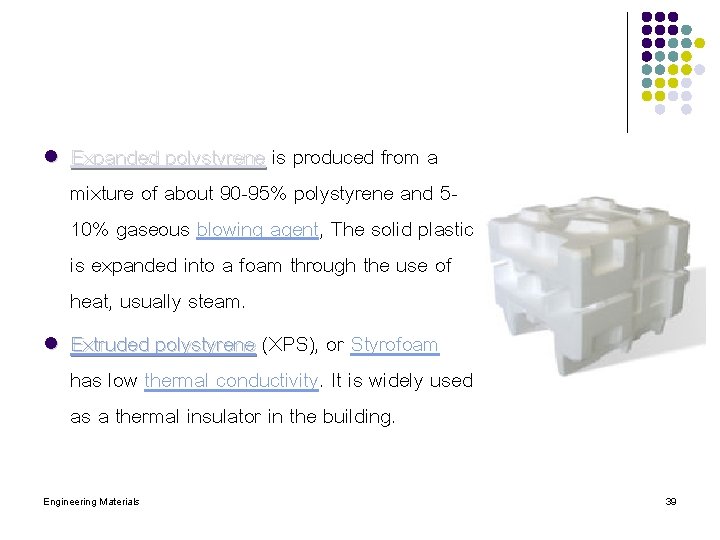
l l Expanded polystyrene is produced from a mixture of about 90 -95% polystyrene and 510% gaseous blowing agent, The solid plastic is expanded into a foam through the use of heat, usually steam. Extruded polystyrene (XPS), or Styrofoam has low thermal conductivity. It is widely used as a thermal insulator in the building. Engineering Materials 39
l http: //www. anubistfx. com/molding. htm Engineering Materials 64
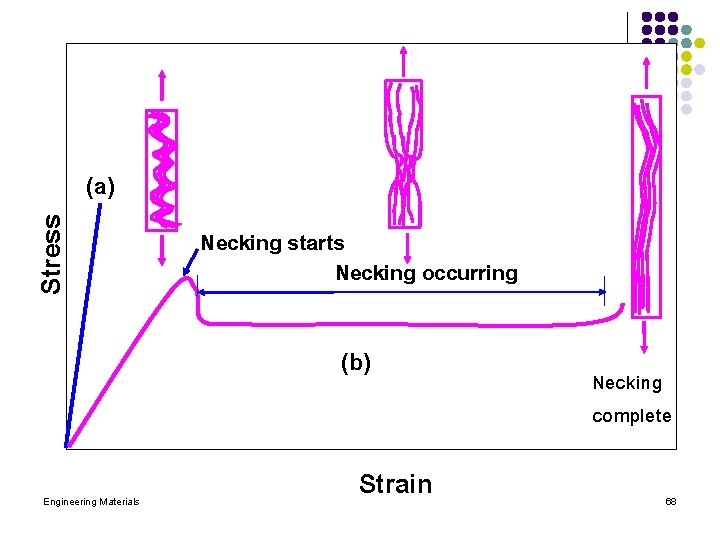
Stress (a) Necking starts Necking occurring (b) Engineering Materials Strain Necking complete 68
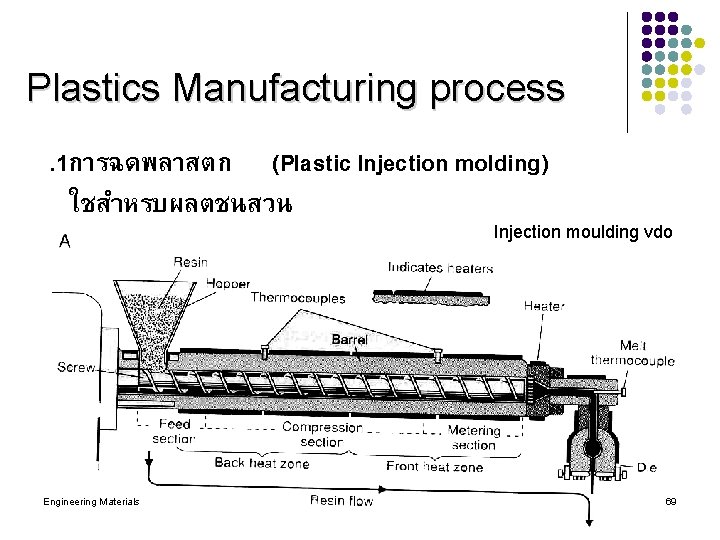
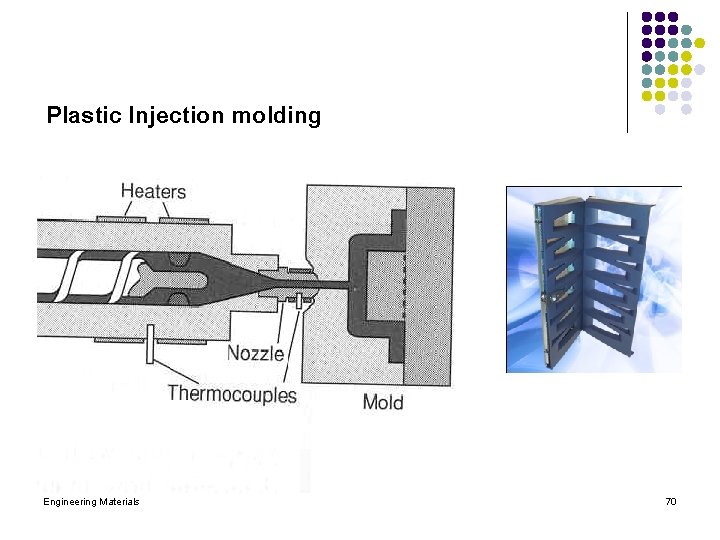
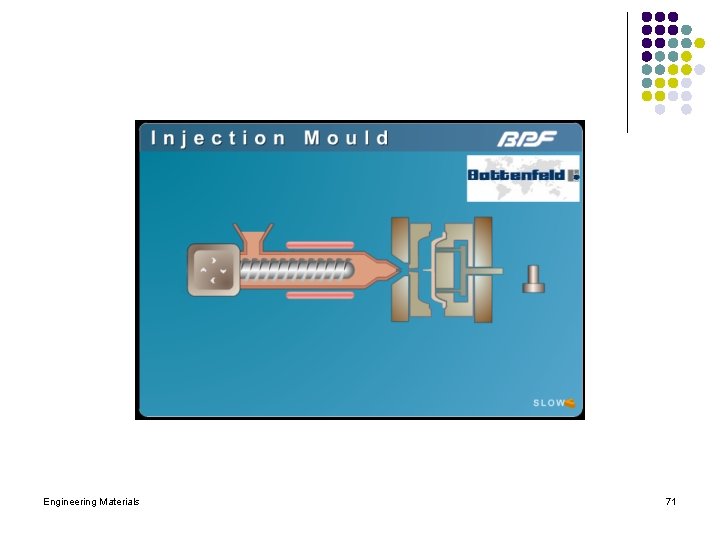
Plastics Manufacturing process . 1การฉดพลาสตก (Plastic Injection molding) ใชสำหรบผลตชนสวน Injection moulding vdo หรอชนงานจากเมดพลาสตก Engineering Materials 69
Plastic Injection molding Engineering Materials 70
Engineering Materials 71
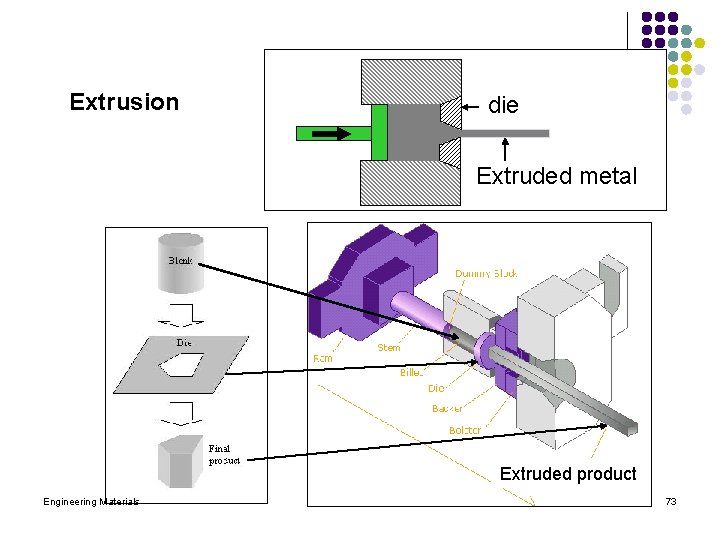
Extrusion die Extruded metal Extruded product Engineering Materials 73
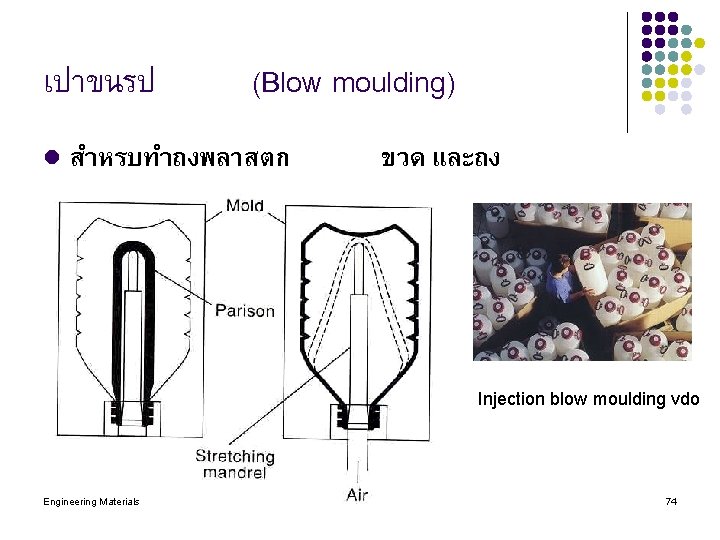
เปาขนรป l (Blow moulding) สำหรบทำถงพลาสตก ขวด และถง Injection blow moulding vdo Engineering Materials 74
Engineering Materials 75
������� online l http: //www. bpf. co. uk/Plastipedia/Processes/D efault. aspx Engineering Materials 76
8. Speciality Polymers 1. High-performance polymers l เปนโพลเมอรทมคณสมบตดหลายๆ อยางรวมกน ซงไดแก high modulus, good temperature resistance and good toughness ซงจะไดจากการทมพนธะหลกทแขงแรง l ไดแก Polyimides (PI) และ Polyester ether ketone (PEEK) ทเปน Semicrystalline polymer มจดหลอมเหลว 330 C l ทงสองชนดเปน Metrix สำหรบ Carbon fiber composites Engineering Materials 77
l 1. 2. 3. 4. ยางแอสฟลทอมลชนมคณสมบต คงรกษาความเหลวทเหมาะสม กบการนำไปใชในงานประเภทตางๆ Asphalt emulsion is in liquid form at ambient temperature and there is no need for heating for all application unlike other types of asphalts. There is no fire hazard since asphalt emulsion has no solvent component. There is no pollution since it does not require heating. Asphalt emulsion has excellent adhesion properties to most types of aggregates. Engineering Materials 83
ขอเสย l เปนอนตรายตอบรรยากาศ เนองจาก the asphalt prime coat needs to be applied in a liquid state, it is blended with gasoline, kerosene or diesel. They evaporates as it cures, releasing volatile organic compounds (VOCs) (สารระเหย) into the atmosphere - contributing to air pollution levels. l ไมควรใชในการปองกนการซมของอางเกบ นำ เพราะอาจทำใหนำมสารปนเปอน Engineering Materials 85