
11 INFINITE SEQUENCES AND SERIES INFINITE SEQUENCES AND





- Slides: 51
11 INFINITE SEQUENCES AND SERIES
INFINITE SEQUENCES AND SERIES 11. 4 The Comparison Tests In this section, we will learn: How to find the value of a series by comparing it with a known series.
COMPARISON TESTS In the comparison tests, the idea is to compare a given series with one that is known to be convergent or divergent.
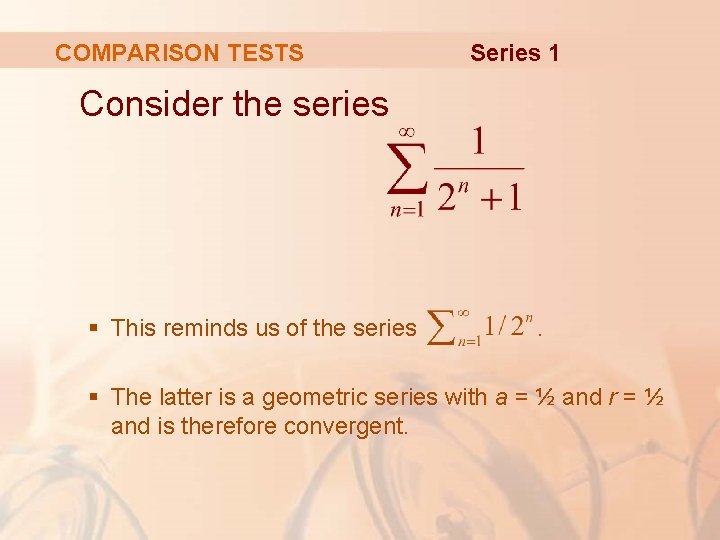
COMPARISON TESTS Series 1 Consider the series § This reminds us of the series . § The latter is a geometric series with a = ½ and r = ½ and is therefore convergent.
COMPARISON TESTS As the series is similar to a convergent series, we have the feeling that it too must be convergent. § Indeed, it is.
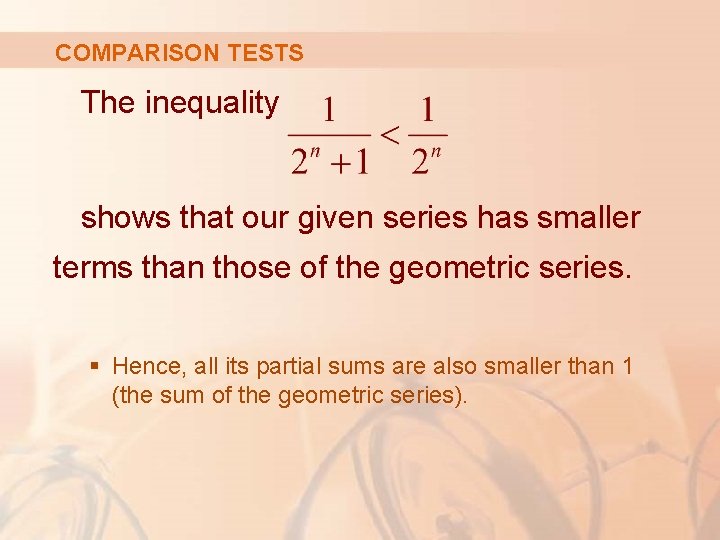
COMPARISON TESTS The inequality shows that our given series has smaller terms than those of the geometric series. § Hence, all its partial sums are also smaller than 1 (the sum of the geometric series).
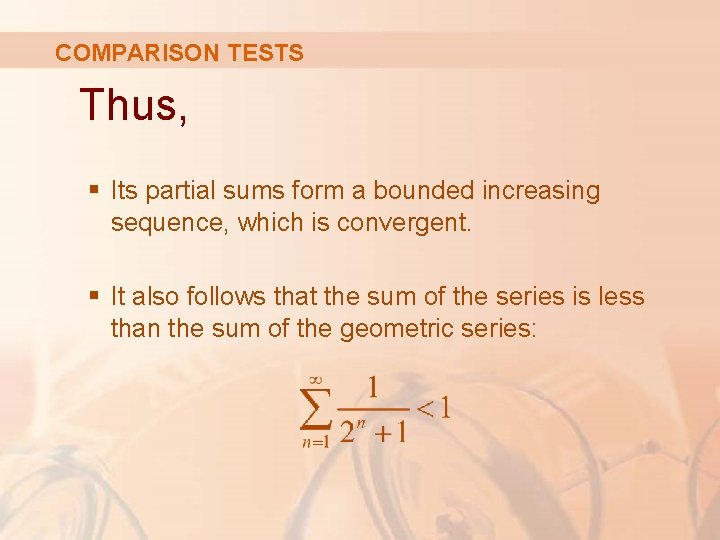
COMPARISON TESTS Thus, § Its partial sums form a bounded increasing sequence, which is convergent. § It also follows that the sum of the series is less than the sum of the geometric series:
COMPARISON TESTS Similar reasoning can be used to prove the following test—which applies only to series whose terms are positive.
COMPARISON TESTS The first part says that, if we have a series whose terms are smaller than those of a known convergent series, then our series is also convergent.
COMPARISON TESTS The second part says that, if we start with a series whose terms are larger than those of a known divergent series, then it too is divergent.
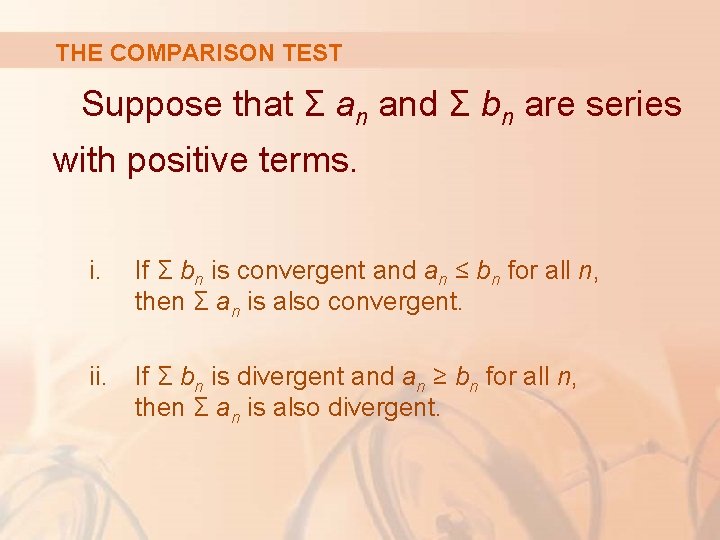
THE COMPARISON TEST Suppose that Σ an and Σ bn are series with positive terms. i. If Σ bn is convergent and an ≤ bn for all n, then Σ an is also convergent. ii. If Σ bn is divergent and an ≥ bn for all n, then Σ an is also divergent.
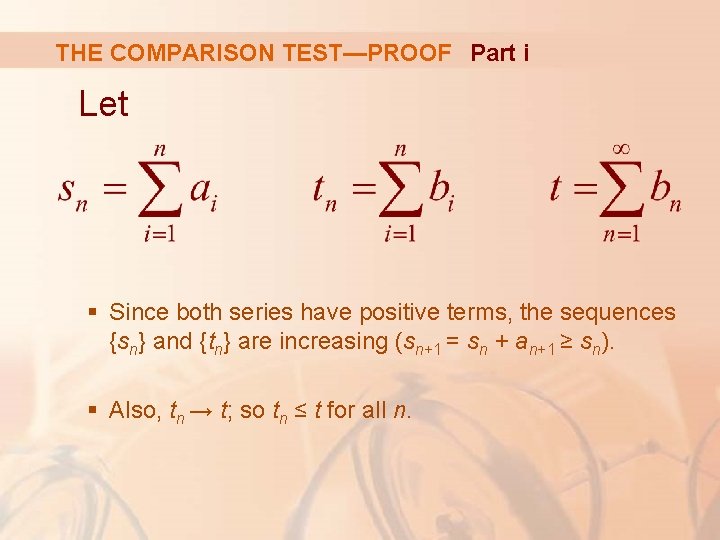
THE COMPARISON TEST—PROOF Part i Let § Since both series have positive terms, the sequences {sn} and {tn} are increasing (sn+1 = sn + an+1 ≥ sn). § Also, tn → t; so tn ≤ t for all n.
THE COMPARISON TEST—PROOF Part i Since ai ≤ bi, we have sn ≤ tn. Hence, sn ≤ t for all n. § This means that {sn} is increasing and bounded above. § So, it converges by the Monotonic Sequence Theorem. § Thus, Σ an converges.
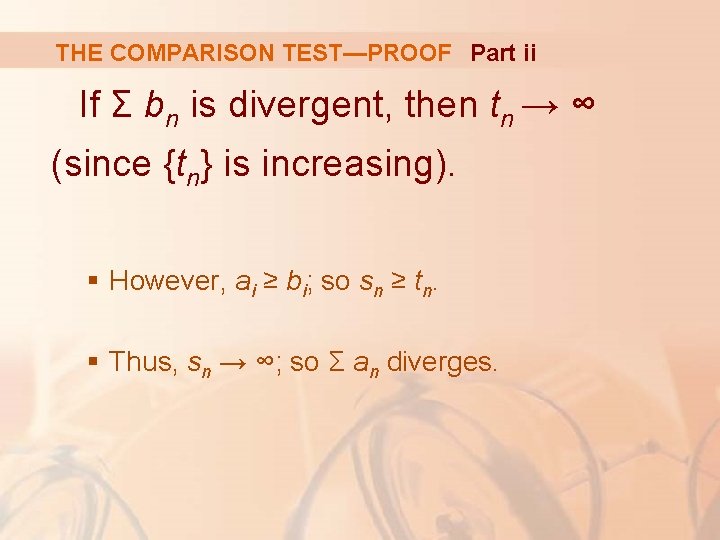
THE COMPARISON TEST—PROOF Part ii If Σ bn is divergent, then tn → ∞ (since {tn} is increasing). § However, ai ≥ bi; so sn ≥ tn. § Thus, sn → ∞; so Σ an diverges.
SEQUENCE VS. SERIES It is important to keep in mind the distinction between a sequence and a series. § A sequence is a list of numbers. § A series is a sum.
SEQUENCE VS. SERIES With every series Σ an, there associated two sequences: 1. The sequence {an} of terms 2. The sequence {sn} of partial sums
COMPARISON TEST In using the Comparison Test, we must, of course, have some known series Σ bn for the purpose of comparison.
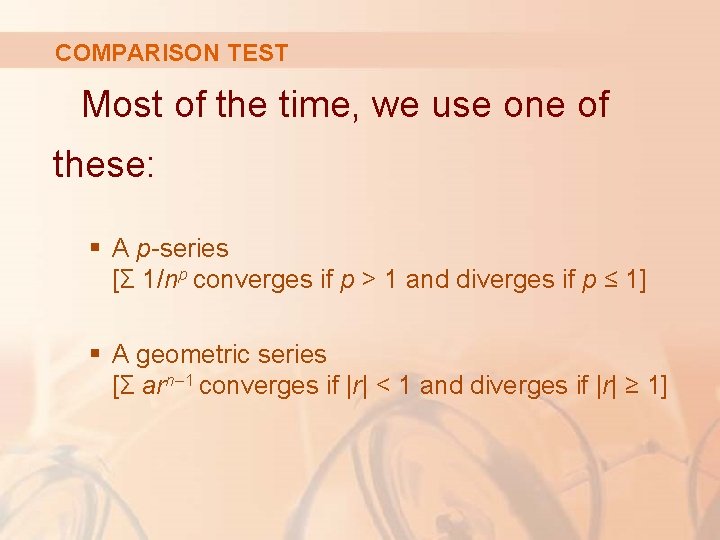
COMPARISON TEST Most of the time, we use one of these: § A p-series [Σ 1/np converges if p > 1 and diverges if p ≤ 1] § A geometric series [Σ arn– 1 converges if |r| < 1 and diverges if |r| ≥ 1]
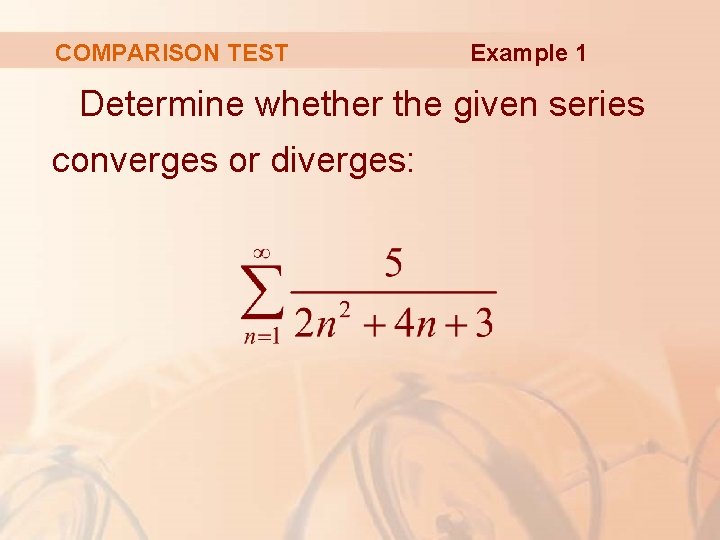
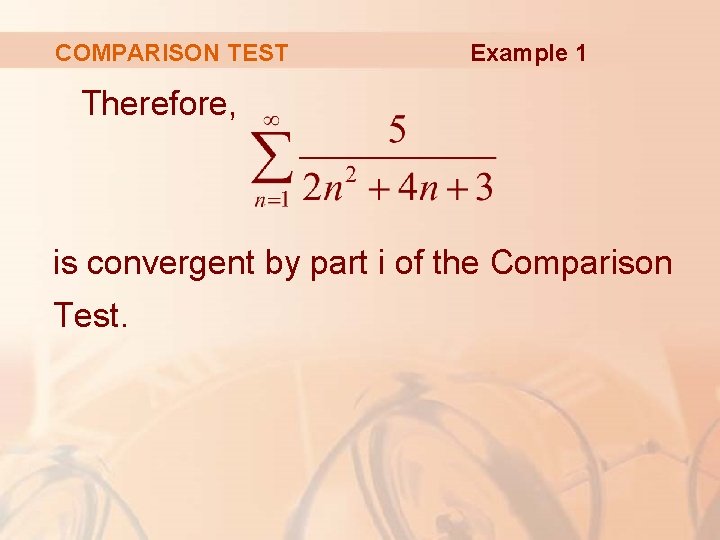
COMPARISON TEST Example 1 Determine whether the given series converges or diverges:
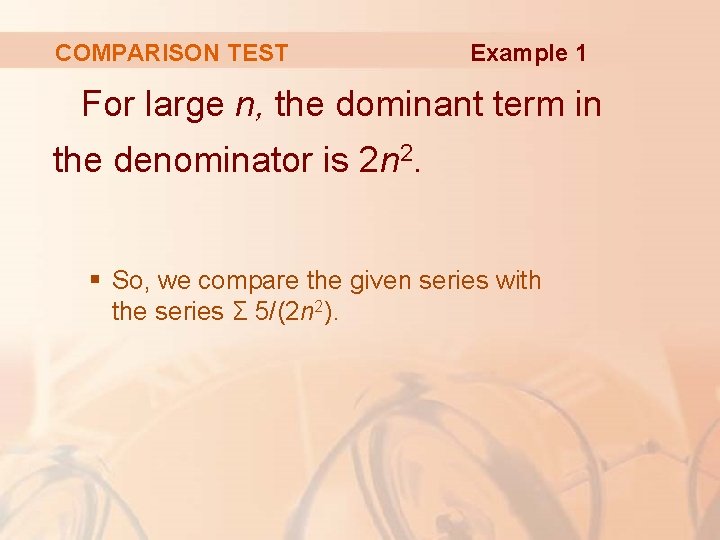
COMPARISON TEST Example 1 For large n, the dominant term in the denominator is 2 n 2. § So, we compare the given series with the series Σ 5/(2 n 2).
COMPARISON TEST Example 1 Observe that since the left side has a bigger denominator. § In the notation of the Comparison Test, an is the left side and bn is the right side.
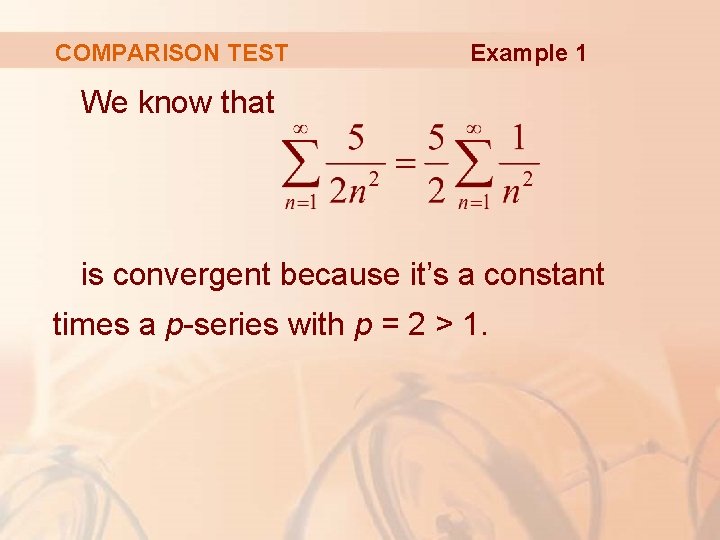
COMPARISON TEST Example 1 We know that is convergent because it’s a constant times a p-series with p = 2 > 1.
COMPARISON TEST Example 1 Therefore, is convergent by part i of the Comparison Test.
NOTE 1 Although the condition an ≤ bn or an ≥ bn in the Comparison Test is given for all n, we need verify only that it holds for n ≥ N, where N is some fixed integer. § This is because the convergence of a series is not affected by a finite number of terms. § This is illustrated in the next example.
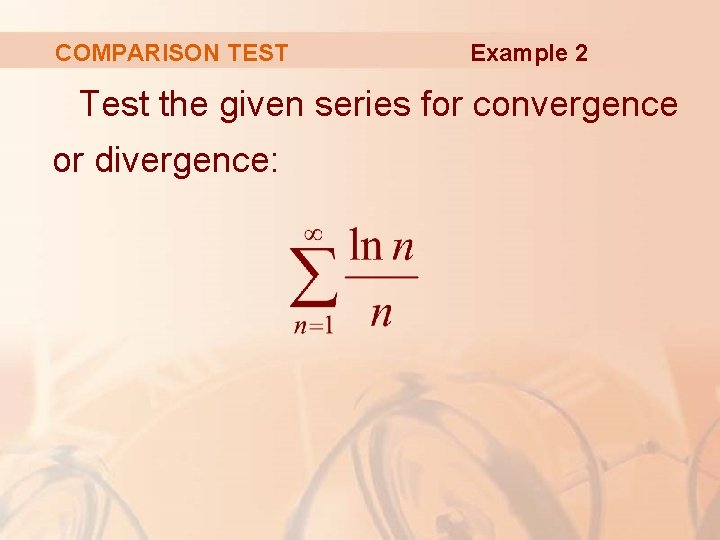
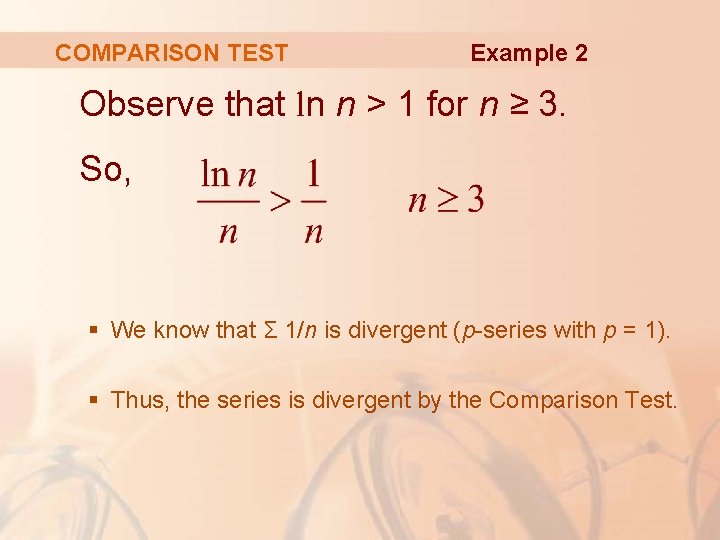
COMPARISON TEST Example 2 Test the given series for convergence or divergence:
COMPARISON TEST Example 2 This series was tested (using the Integral Test) in Example 4 in Section 11. 3 § However, it is also possible to test it by comparing it with the harmonic series.
COMPARISON TEST Example 2 Observe that ln n > 1 for n ≥ 3. So, § We know that Σ 1/n is divergent (p-series with p = 1). § Thus, the series is divergent by the Comparison Test.
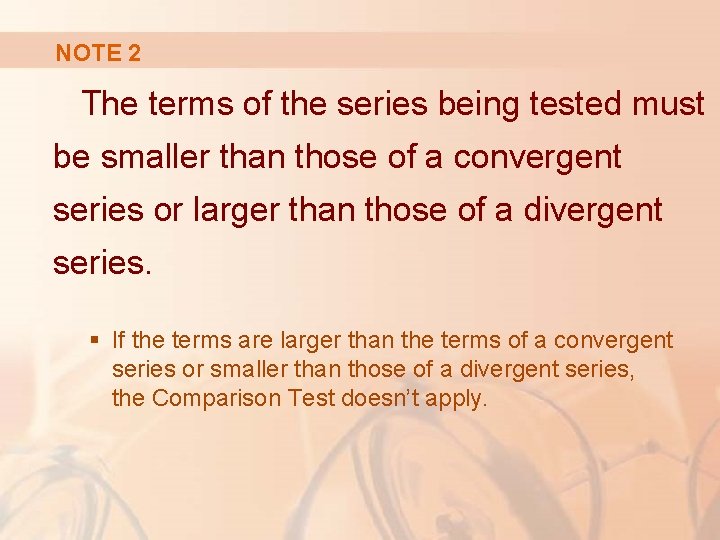
NOTE 2 The terms of the series being tested must be smaller than those of a convergent series or larger than those of a divergent series. § If the terms are larger than the terms of a convergent series or smaller than those of a divergent series, the Comparison Test doesn’t apply.
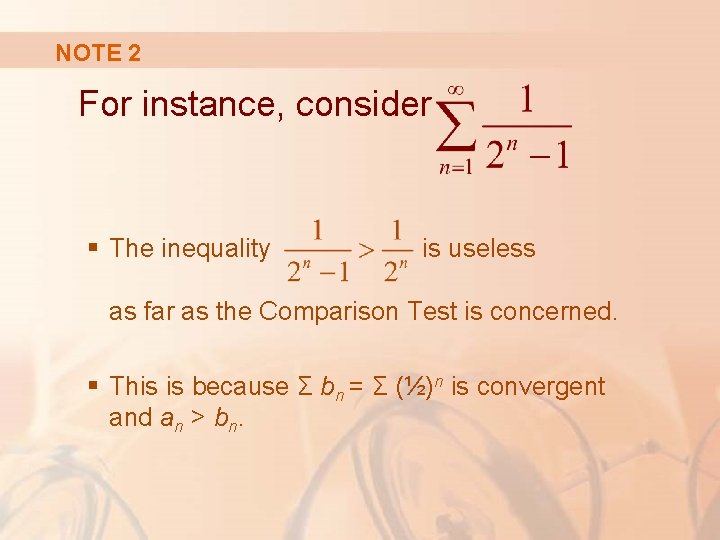
NOTE 2 For instance, consider § The inequality is useless as far as the Comparison Test is concerned. § This is because Σ bn = Σ (½)n is convergent and an > bn.
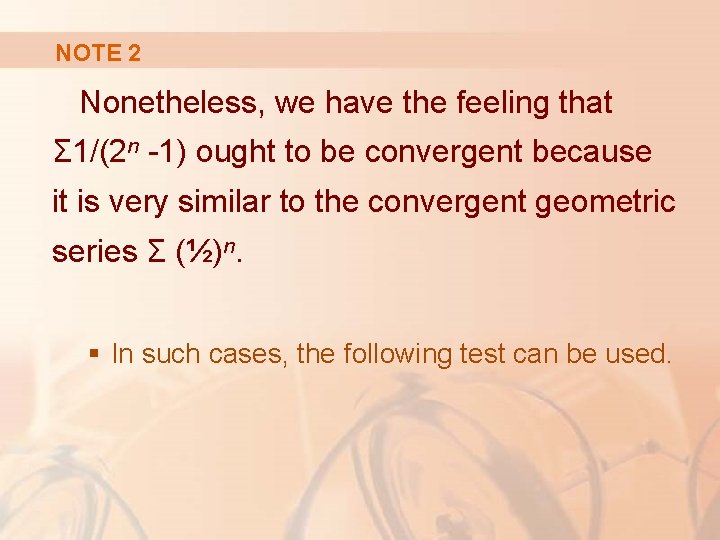
NOTE 2 Nonetheless, we have the feeling that Σ 1/(2 n -1) ought to be convergent because it is very similar to the convergent geometric series Σ (½)n. § In such cases, the following test can be used.
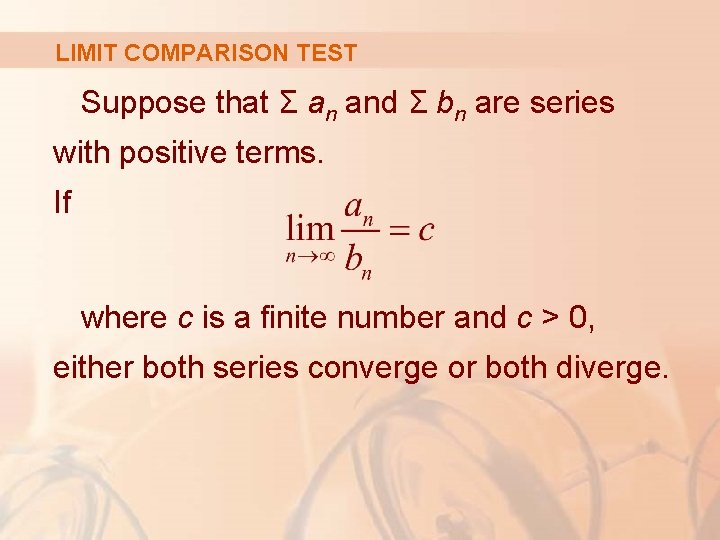
LIMIT COMPARISON TEST Suppose that Σ an and Σ bn are series with positive terms. If where c is a finite number and c > 0, either both series converge or both diverge.
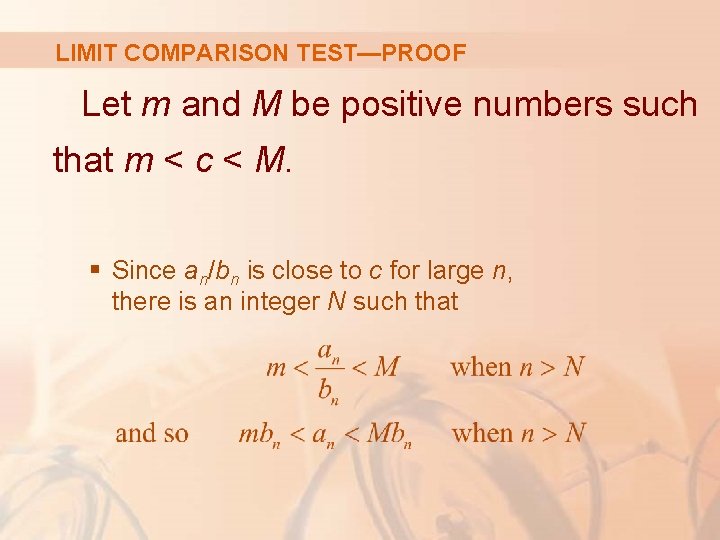
LIMIT COMPARISON TEST—PROOF Let m and M be positive numbers such that m < c < M. § Since an/bn is close to c for large n, there is an integer N such that
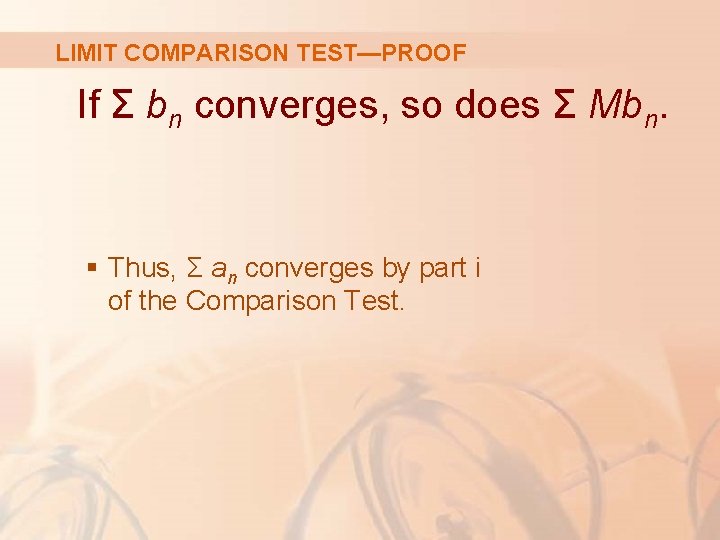
LIMIT COMPARISON TEST—PROOF If Σ bn converges, so does Σ Mbn. § Thus, Σ an converges by part i of the Comparison Test.
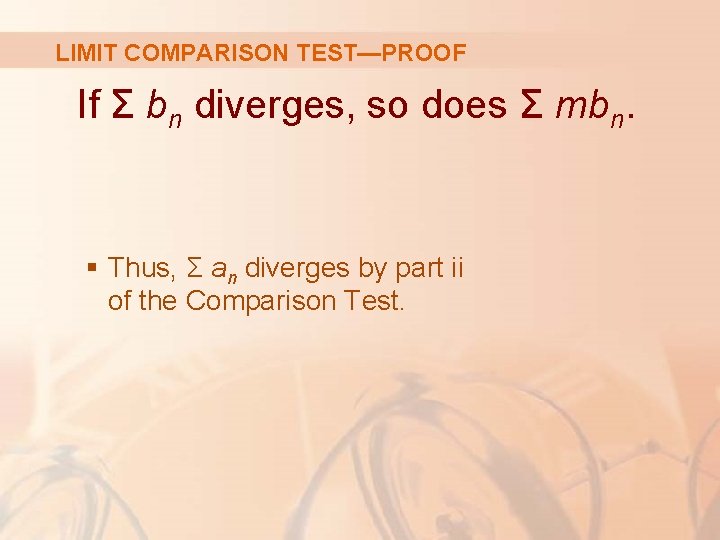
LIMIT COMPARISON TEST—PROOF If Σ bn diverges, so does Σ mbn. § Thus, Σ an diverges by part ii of the Comparison Test.
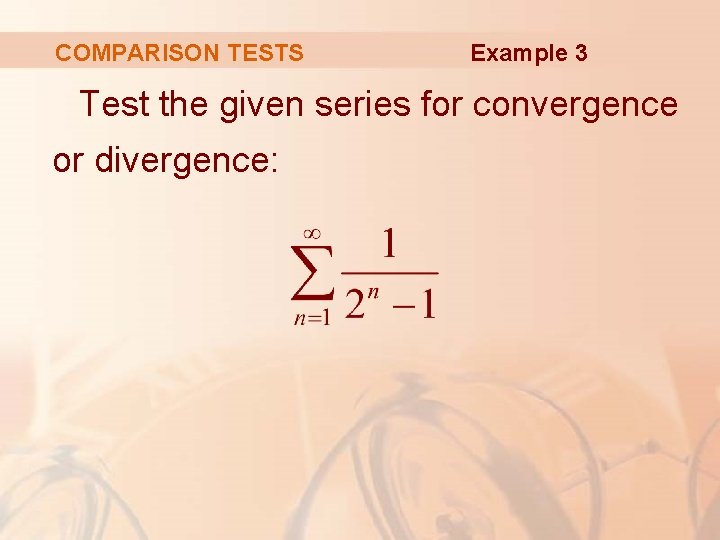
COMPARISON TESTS Example 3 Test the given series for convergence or divergence:
COMPARISON TESTS Example 3 We use the Limit Comparison Test with:
COMPARISON TESTS We obtain: Example 3
COMPARISON TESTS Example 3 This limit exists and Σ 1/2 n is a convergent geometric series. § Thus, the given series converges by the Limit Comparison Test.
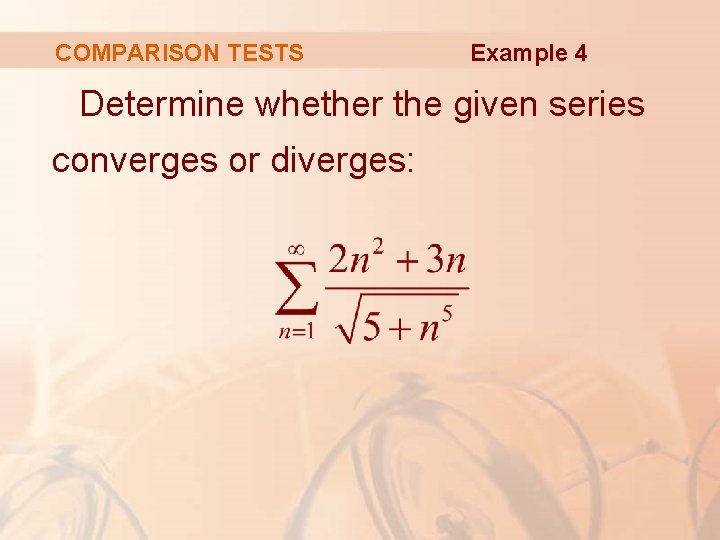
COMPARISON TESTS Example 4 Determine whether the given series converges or diverges:
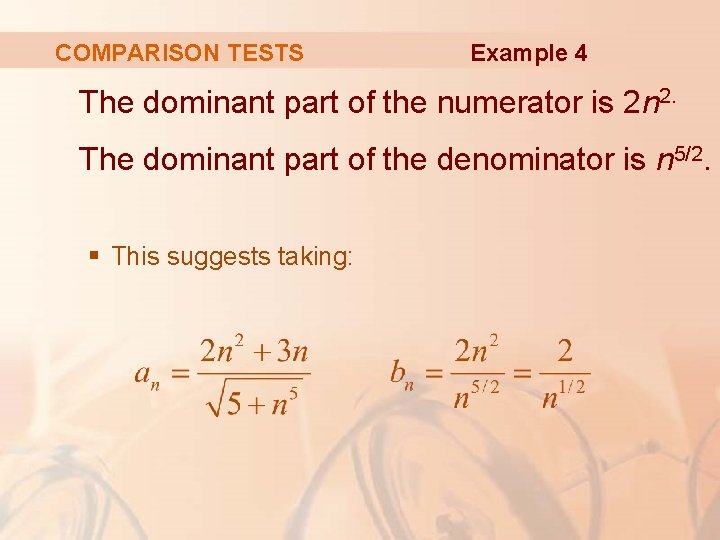
COMPARISON TESTS Example 4 The dominant part of the numerator is 2 n 2. The dominant part of the denominator is n 5/2. § This suggests taking:
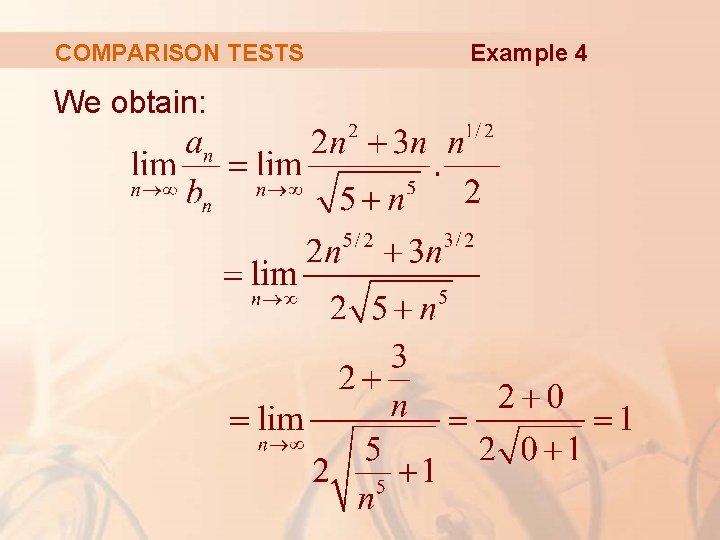
COMPARISON TESTS We obtain: Example 4
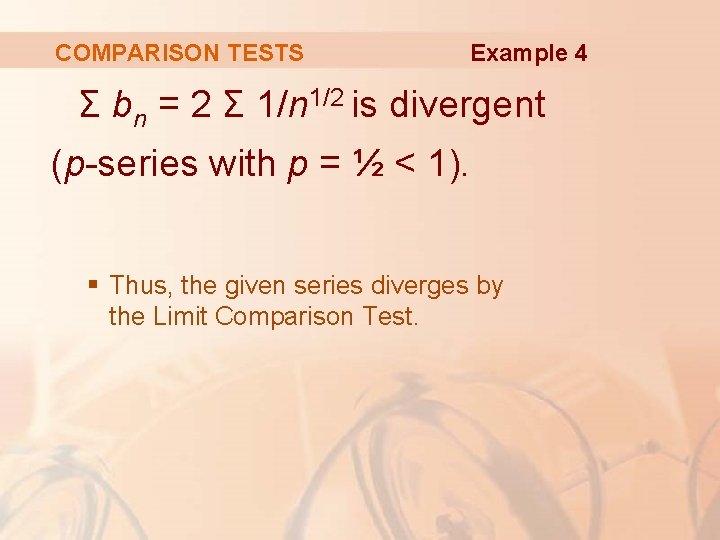
COMPARISON TESTS Example 4 Σ bn = 2 Σ 1/n 1/2 is divergent (p-series with p = ½ < 1). § Thus, the given series diverges by the Limit Comparison Test.
COMPARISON TESTS Notice that, in testing many series, we find a suitable comparison series Σ bn by keeping only the highest powers in the numerator and denominator.
ESTIMATING SUMS We have used the Comparison Test to show that a series Σ an converges by comparison with a series Σ bn. § It follows that we may be able to estimate the sum Σ an by comparing remainders.
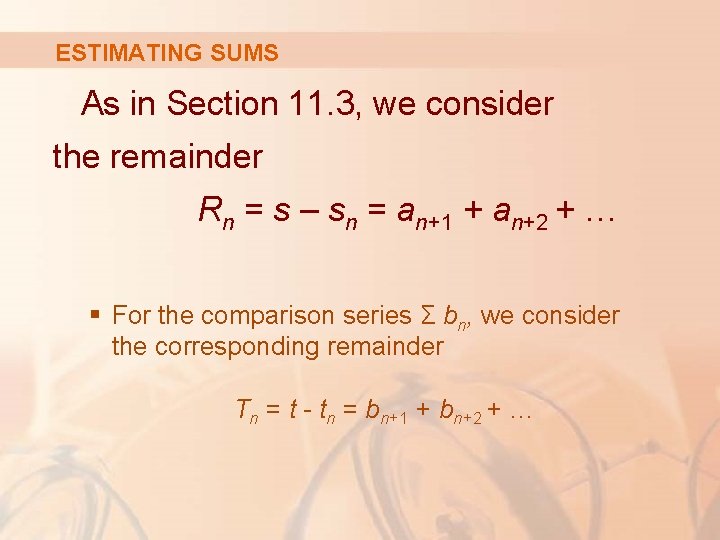
ESTIMATING SUMS As in Section 11. 3, we consider the remainder Rn = s – sn = an+1 + an+2 + … § For the comparison series Σ bn, we consider the corresponding remainder Tn = t - tn = bn+1 + bn+2 + …
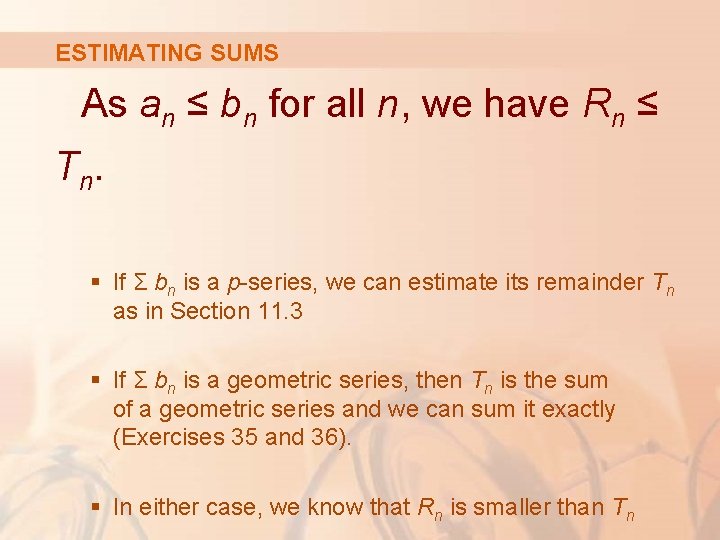
ESTIMATING SUMS As an ≤ bn for all n, we have Rn ≤ T n. § If Σ bn is a p-series, we can estimate its remainder Tn as in Section 11. 3 § If Σ bn is a geometric series, then Tn is the sum of a geometric series and we can sum it exactly (Exercises 35 and 36). § In either case, we know that Rn is smaller than Tn
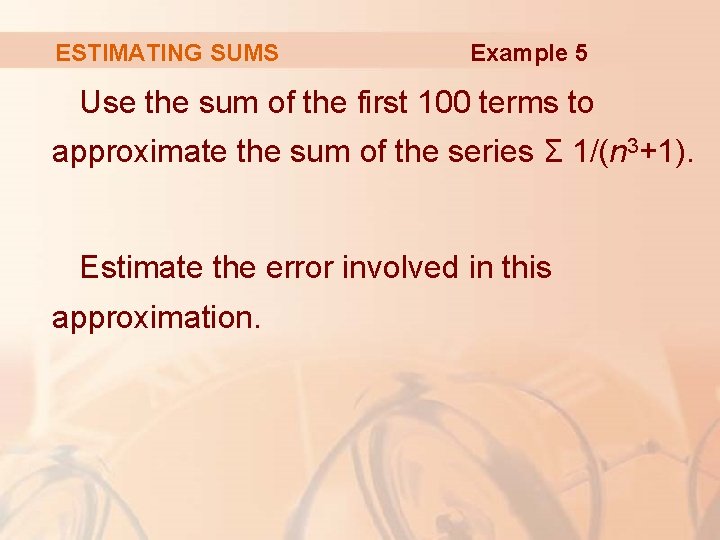
ESTIMATING SUMS Example 5 Use the sum of the first 100 terms to approximate the sum of the series Σ 1/(n 3+1). Estimate the error involved in this approximation.
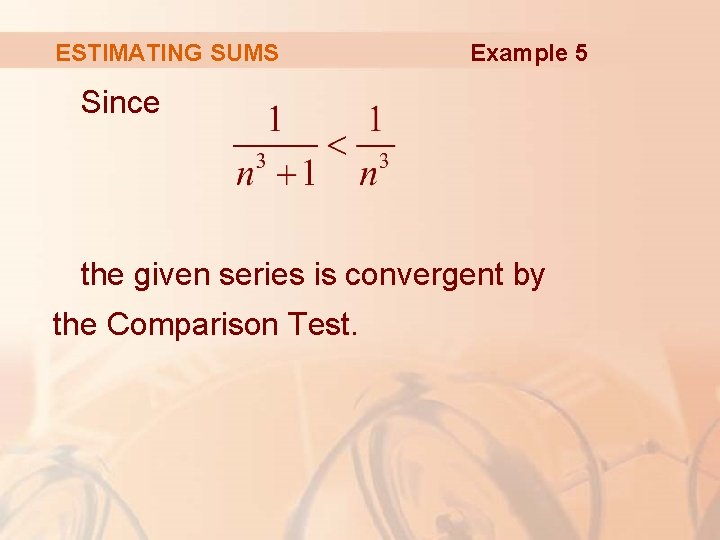
ESTIMATING SUMS Example 5 Since the given series is convergent by the Comparison Test.
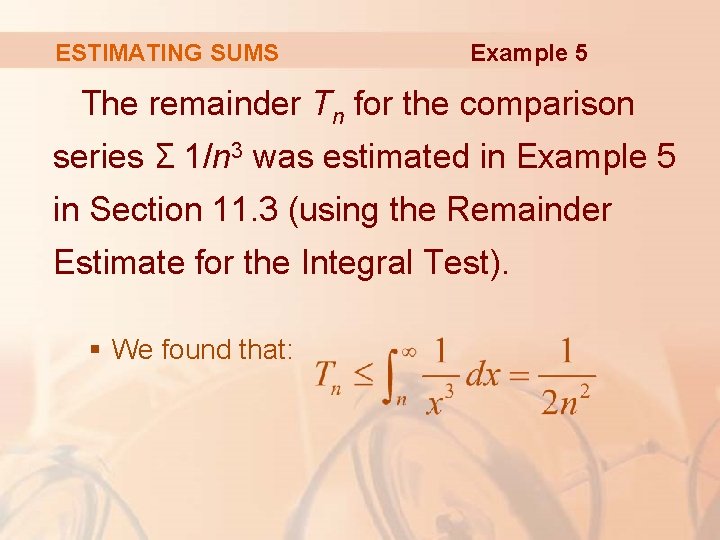
ESTIMATING SUMS Example 5 The remainder Tn for the comparison series Σ 1/n 3 was estimated in Example 5 in Section 11. 3 (using the Remainder Estimate for the Integral Test). § We found that:
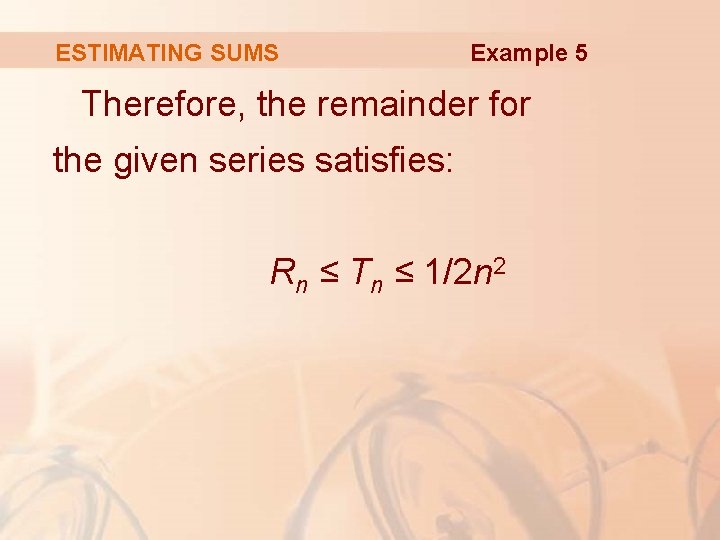
ESTIMATING SUMS Example 5 Therefore, the remainder for the given series satisfies: Rn ≤ Tn ≤ 1/2 n 2
ESTIMATING SUMS Example 5 With n = 100, we have: § With a programmable calculator or a computer, we find that with error less than 0. 00005