
11 G A I N IN G R
- Slides: 16
11 G A I N IN G R E E C T C N P A A LI H P C O M Prepared by Robert Gass & John Seiter COPYRIGHT © 2014 PEARSON EDUCATION INC. , ALL RIGHTS RESERVED 1
CONCEPTUALIZING COMPLIANCE GAINING Compliance gaining is a sub-set of persuasion § Compliance gaining is intentional § The focus is on the outcome—behavioral conformity § Studies concentrate on interpersonal influence (one-onone) § Studies emphasize strategy selection and use COPYRIGHT © 2014 PEARSON EDUCATION INC. , ALL RIGHTS RESERVED 2
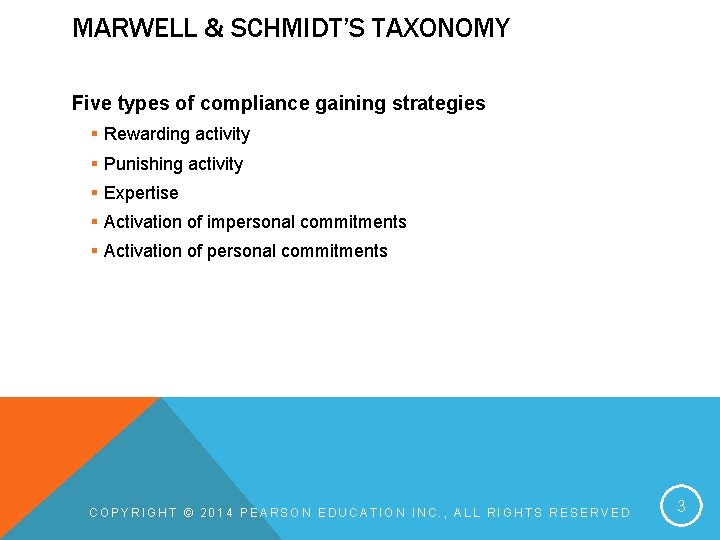
MARWELL & SCHMIDT’S TAXONOMY Five types of compliance gaining strategies § Rewarding activity § Punishing activity § Expertise § Activation of impersonal commitments § Activation of personal commitments COPYRIGHT © 2014 PEARSON EDUCATION INC. , ALL RIGHTS RESERVED 3
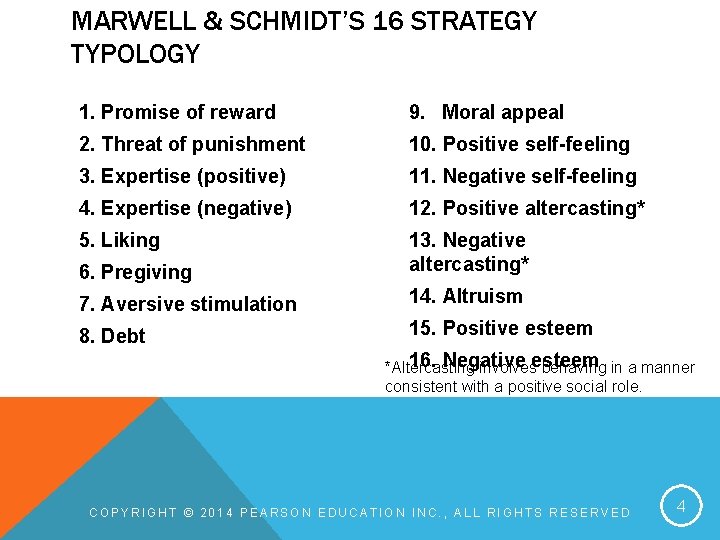
MARWELL & SCHMIDT’S 16 STRATEGY TYPOLOGY 1. Promise of reward 9. Moral appeal 2. Threat of punishment 10. Positive self-feeling 3. Expertise (positive) 11. Negative self-feeling 4. Expertise (negative) 12. Positive altercasting* 5. Liking 6. Pregiving 13. Negative altercasting* 7. Aversive stimulation 14. Altruism 8. Debt 15. Positive esteem 16. Negative *Altercasting involvesesteem behaving in a manner consistent with a positive social role. COPYRIGHT © 2014 PEARSON EDUCATION INC. , ALL RIGHTS RESERVED 4
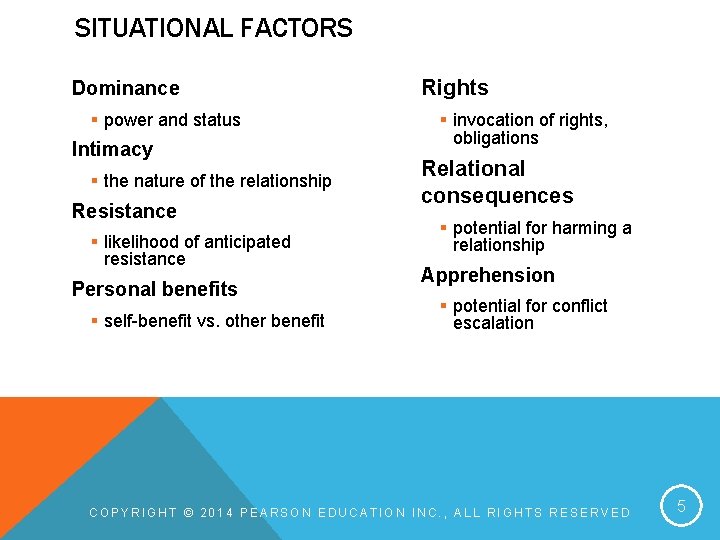
SITUATIONAL FACTORS Dominance § power and status Intimacy § the nature of the relationship Resistance § likelihood of anticipated resistance Personal benefits § self-benefit vs. other benefit Rights § invocation of rights, obligations Relational consequences § potential for harming a relationship Apprehension § potential for conflict escalation COPYRIGHT © 2014 PEARSON EDUCATION INC. , ALL RIGHTS RESERVED 5
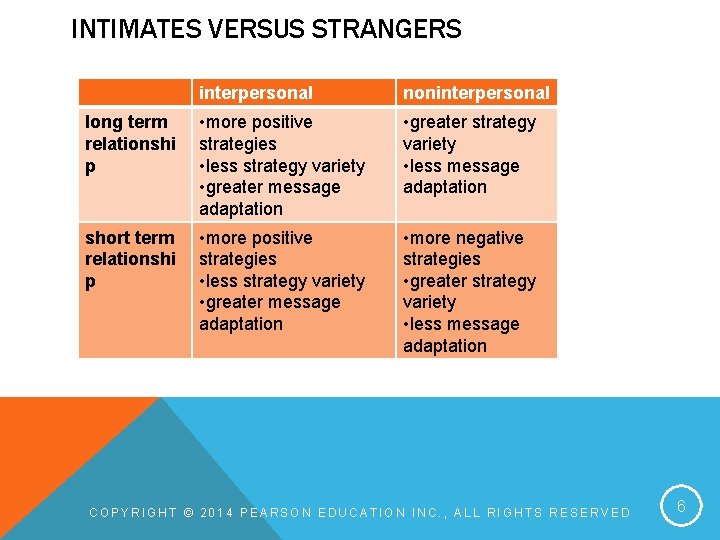
INTIMATES VERSUS STRANGERS interpersonal noninterpersonal long term relationshi p • more positive strategies • less strategy variety • greater message adaptation • greater strategy variety • less message adaptation short term relationshi p • more positive strategies • less strategy variety • greater message adaptation • more negative strategies • greater strategy variety • less message adaptation COPYRIGHT © 2014 PEARSON EDUCATION INC. , ALL RIGHTS RESERVED 6
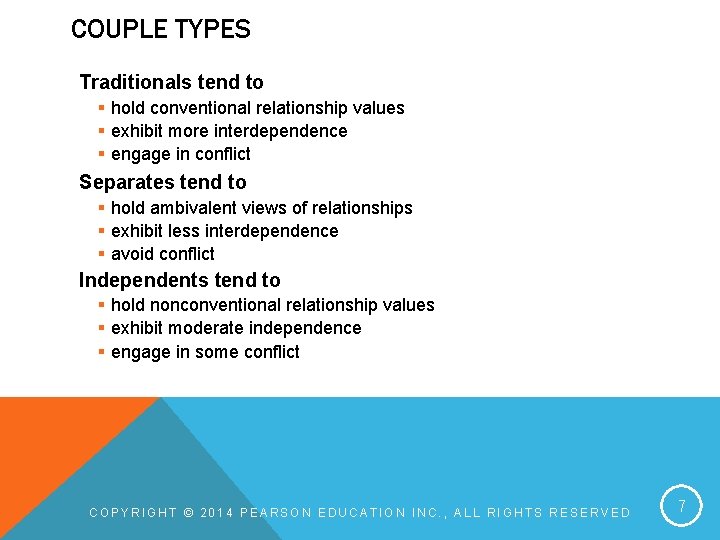
COUPLE TYPES Traditionals tend to § hold conventional relationship values § exhibit more interdependence § engage in conflict Separates tend to § hold ambivalent views of relationships § exhibit less interdependence § avoid conflict Independents tend to § hold nonconventional relationship values § exhibit moderate independence § engage in some conflict COPYRIGHT © 2014 PEARSON EDUCATION INC. , ALL RIGHTS RESERVED 7
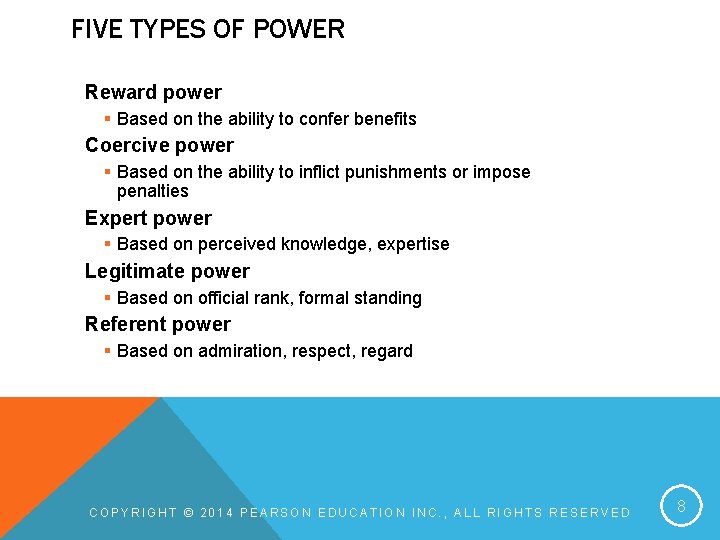
FIVE TYPES OF POWER Reward power § Based on the ability to confer benefits Coercive power § Based on the ability to inflict punishments or impose penalties Expert power § Based on perceived knowledge, expertise Legitimate power § Based on official rank, formal standing Referent power § Based on admiration, respect, regard COPYRIGHT © 2014 PEARSON EDUCATION INC. , ALL RIGHTS RESERVED 8
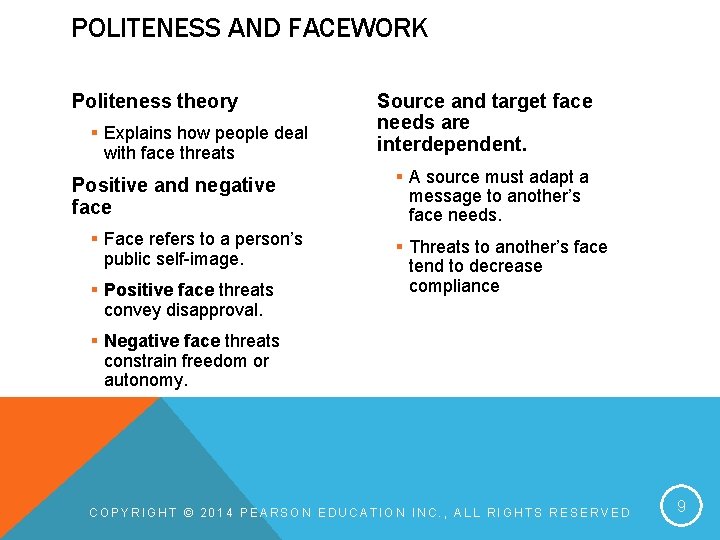
POLITENESS AND FACEWORK Politeness theory § Explains how people deal with face threats Positive and negative face § Face refers to a person’s public self-image. § Positive face threats convey disapproval. Source and target face needs are interdependent. § A source must adapt a message to another’s face needs. § Threats to another’s face tend to decrease compliance § Negative face threats constrain freedom or autonomy. COPYRIGHT © 2014 PEARSON EDUCATION INC. , ALL RIGHTS RESERVED 9
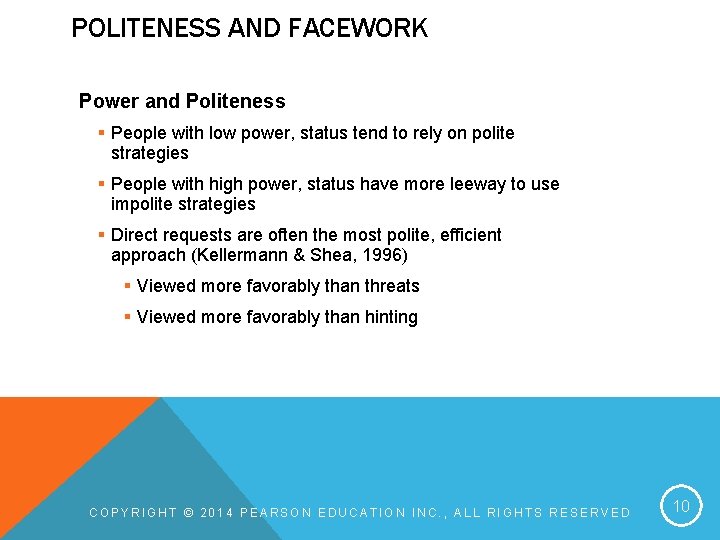
POLITENESS AND FACEWORK Power and Politeness § People with low power, status tend to rely on polite strategies § People with high power, status have more leeway to use impolite strategies § Direct requests are often the most polite, efficient approach (Kellermann & Shea, 1996) § Viewed more favorably than threats § Viewed more favorably than hinting COPYRIGHT © 2014 PEARSON EDUCATION INC. , ALL RIGHTS RESERVED 10
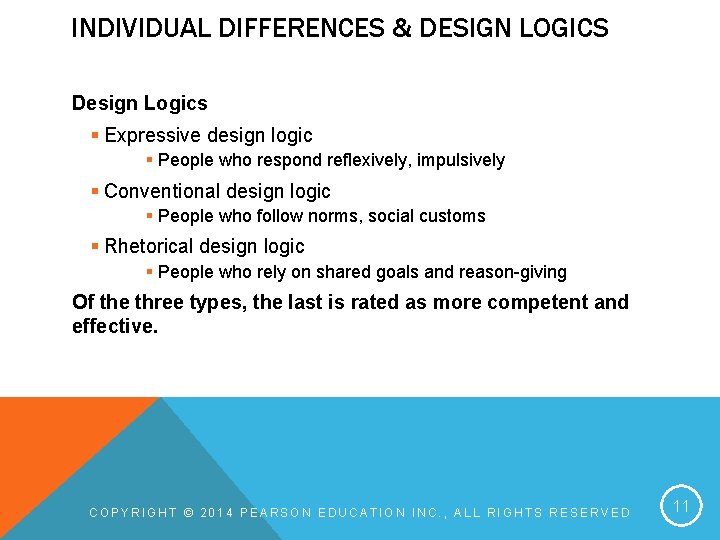
INDIVIDUAL DIFFERENCES & DESIGN LOGICS Design Logics § Expressive design logic § People who respond reflexively, impulsively § Conventional design logic § People who follow norms, social customs § Rhetorical design logic § People who rely on shared goals and reason-giving Of the three types, the last is rated as more competent and effective. COPYRIGHT © 2014 PEARSON EDUCATION INC. , ALL RIGHTS RESERVED 11
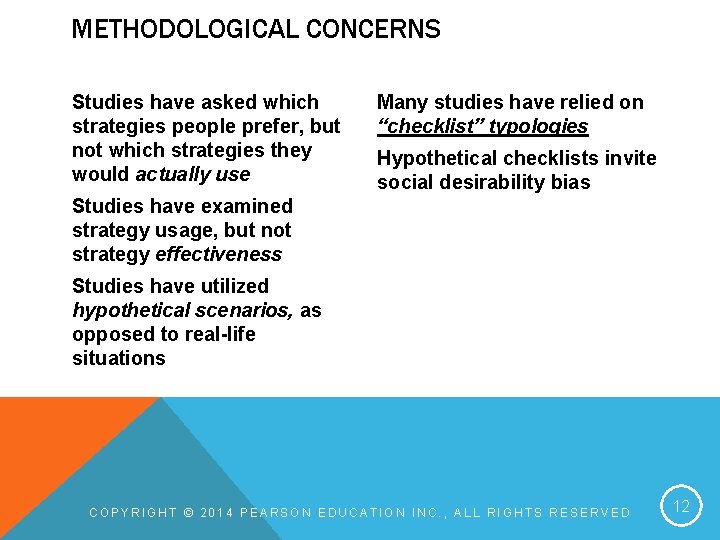
METHODOLOGICAL CONCERNS Studies have asked which strategies people prefer, but not which strategies they would actually use Many studies have relied on “checklist” typologies Hypothetical checklists invite social desirability bias Studies have examined strategy usage, but not strategy effectiveness Studies have utilized hypothetical scenarios, as opposed to real-life situations COPYRIGHT © 2014 PEARSON EDUCATION INC. , ALL RIGHTS RESERVED 12
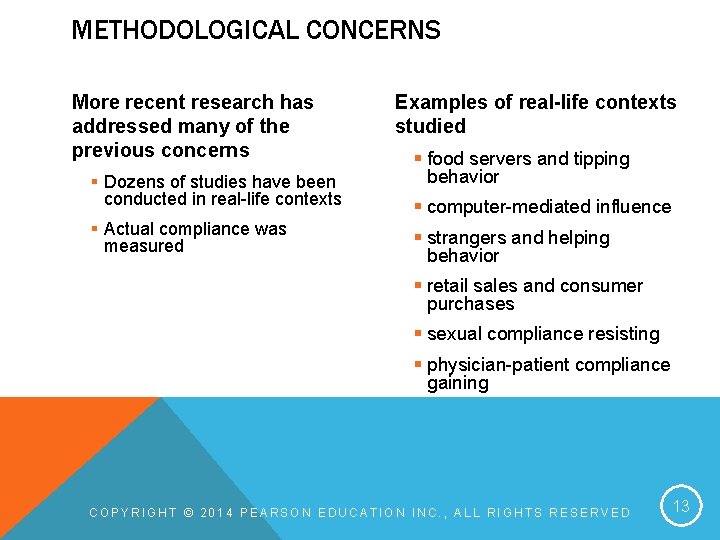
METHODOLOGICAL CONCERNS More recent research has addressed many of the previous concerns § Dozens of studies have been conducted in real-life contexts § Actual compliance was measured Examples of real-life contexts studied § food servers and tipping behavior § computer-mediated influence § strangers and helping behavior § retail sales and consumer purchases § sexual compliance resisting § physician-patient compliance gaining COPYRIGHT © 2014 PEARSON EDUCATION INC. , ALL RIGHTS RESERVED 13
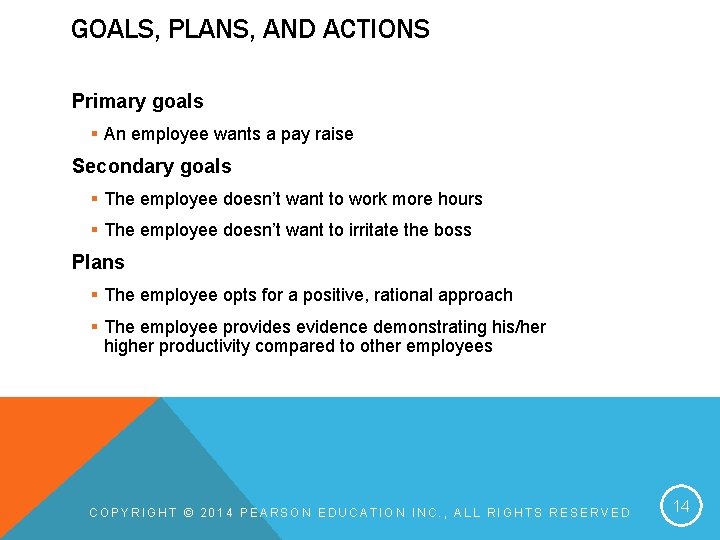
GOALS, PLANS, AND ACTIONS Primary goals § An employee wants a pay raise Secondary goals § The employee doesn’t want to work more hours § The employee doesn’t want to irritate the boss Plans § The employee opts for a positive, rational approach § The employee provides evidence demonstrating his/her higher productivity compared to other employees COPYRIGHT © 2014 PEARSON EDUCATION INC. , ALL RIGHTS RESERVED 14
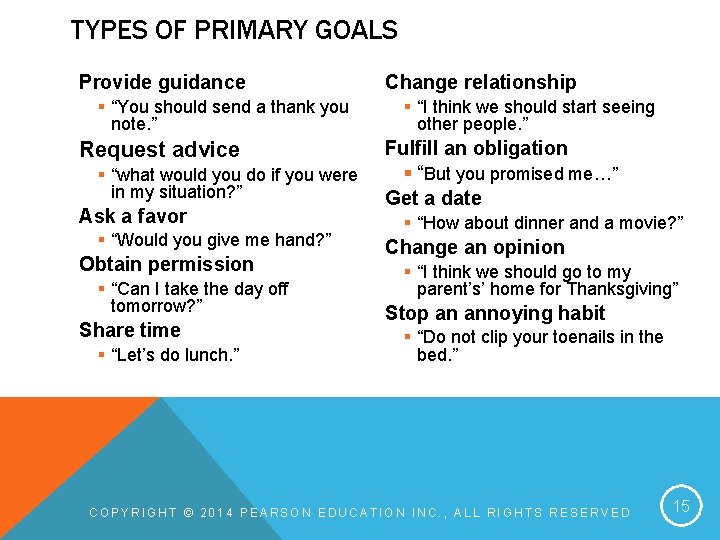
TYPES OF PRIMARY GOALS Provide guidance § “You should send a thank you note. ” Request advice § “what would you do if you were in my situation? ” Ask a favor § “Would you give me hand? ” Obtain permission § “Can I take the day off tomorrow? ” Share time § “Let’s do lunch. ” Change relationship § “I think we should start seeing other people. ” Fulfill an obligation § “But you promised me…” Get a date § “How about dinner and a movie? ” Change an opinion § “I think we should go to my parent’s’ home for Thanksgiving” Stop an annoying habit § “Do not clip your toenails in the bed. ” COPYRIGHT © 2014 PEARSON EDUCATION INC. , ALL RIGHTS RESERVED 15
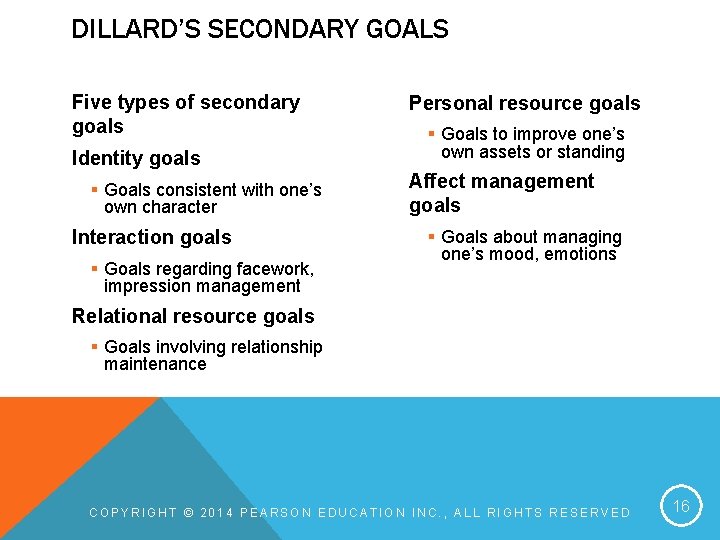
DILLARD’S SECONDARY GOALS Five types of secondary goals Identity goals § Goals consistent with one’s own character Interaction goals § Goals regarding facework, impression management Personal resource goals § Goals to improve one’s own assets or standing Affect management goals § Goals about managing one’s mood, emotions Relational resource goals § Goals involving relationship maintenance COPYRIGHT © 2014 PEARSON EDUCATION INC. , ALL RIGHTS RESERVED 16