
11 Flower Pollination Algorithms XinShe Yang NatureInspired Optimization
- Slides: 15
11 Flower Pollination Algorithms Xin-She Yang, Nature-Inspired Optimization Algorithms, Elsevier, 2014.
• The flower pollination algorithm (FPA) was developed by Xin-She Yang in 2012, inspired by the pollination process of flowering plants. • FPA has been extended to multiobjective optimization with promising results.
11. 1 Introduction • Real-world design problems in engineering and industry are usually multi-objective or multi-criteria. • Common approaches are to provide good approximations to the true Pareto fronts of the problem of interest so that decision makers can rank different options, depending on their preferences or their utilities [1, 5, 15].
• For single objective optimization, the optimal solution can often be a single point in the solution space. • A higher-dimensional problem can have an extremely complex hypersurface as its Pareto front.
11. 2 Flower Pollination Algorithm
11. 2. 1 Characteristics of Flower Pollination • The main purpose of a flower is ultimately reproduction via pollination. • Flower pollination is typically associated with the transfer of pollen, and such transfer is often linked with pollinators such as insects, birds, bats, and other animals. • Pollination can be achieved by self-pollination or cross-pollination.
• Pollination can take two major forms: abiotic and biotic. • Bees and birds may exhibit Lévy flight behavior with jump or fly distance steps obeying a Lévy distribution.
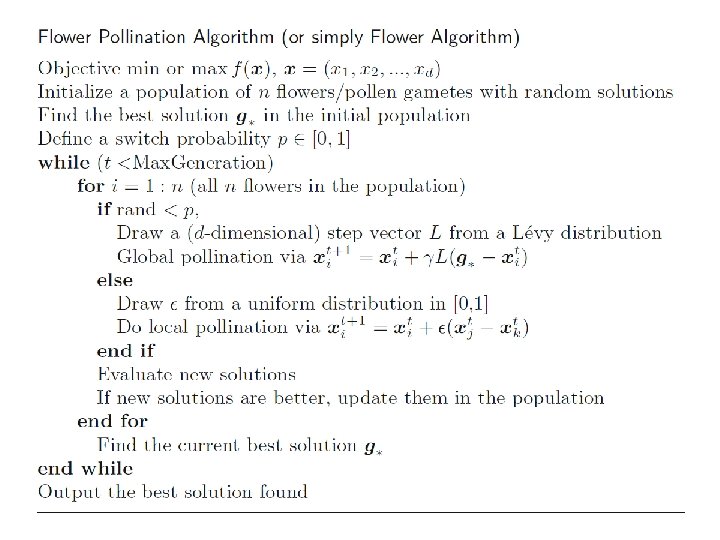
11. 2. 2 Flower Pollination Algorithm • FPA was developed by Xin-She Yang in 2012 [19], inspired by the flow pollination process of flowering plants. • FPA has been extended to multi-objective optimization [20].
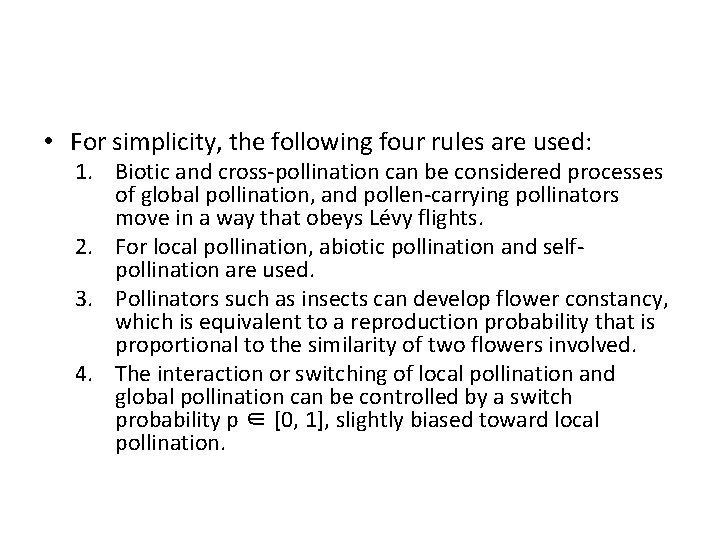
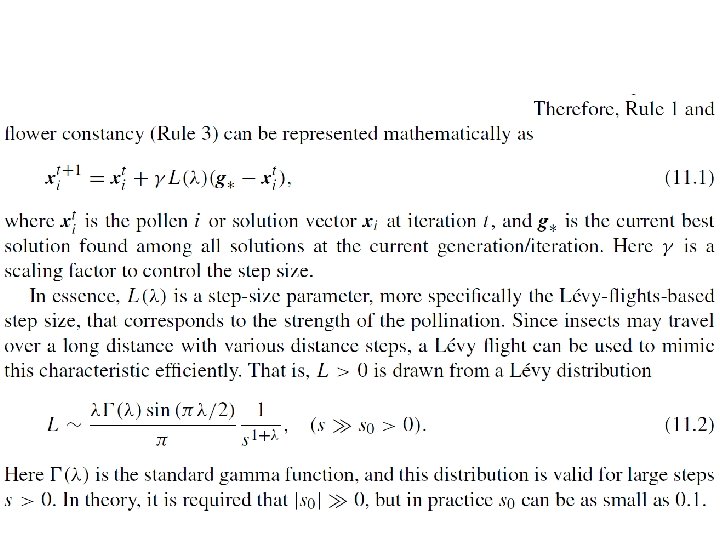
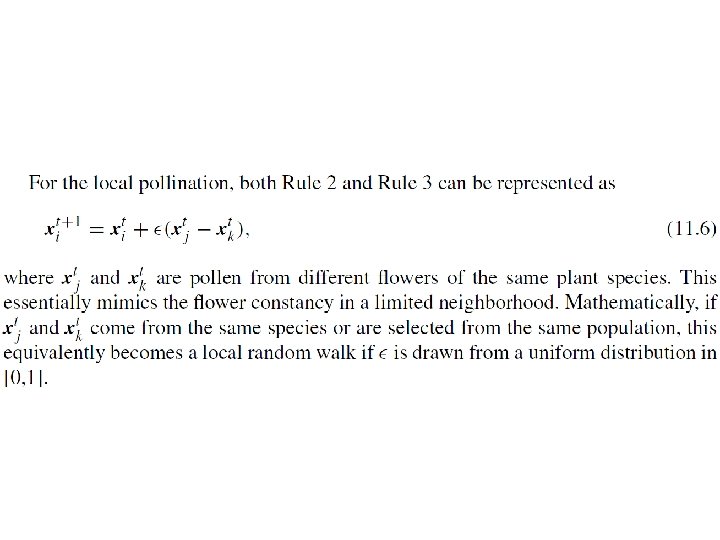
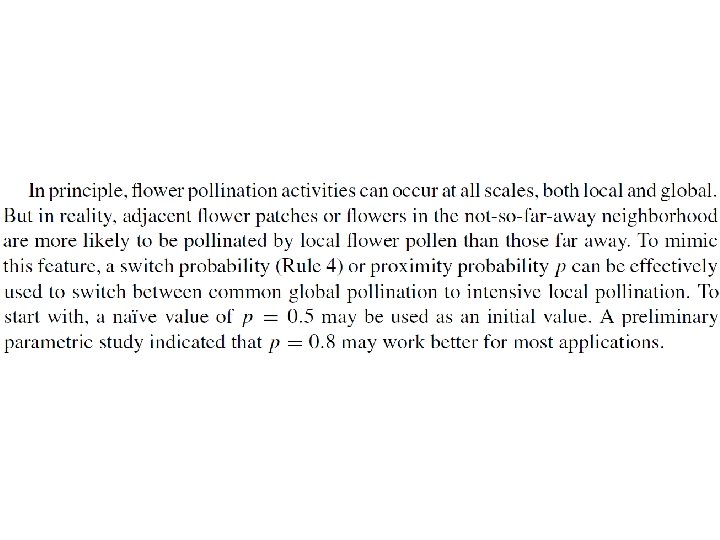
• For simplicity, the following four rules are used: 1. Biotic and cross-pollination can be considered processes of global pollination, and pollen-carrying pollinators move in a way that obeys Lévy flights. 2. For local pollination, abiotic pollination and selfpollination are used. 3. Pollinators such as insects can develop flower constancy, which is equivalent to a reproduction probability that is proportional to the similarity of two flowers involved. 4. The interaction or switching of local pollination and global pollination can be controlled by a switch probability p ∈ [0, 1], slightly biased toward local pollination.