
11 Edition Management Stephen P ROBBINS Mary COULTER

11 Edition Management Stephen P. ROBBINS Mary COULTER Part IV. Leading Chapter Seven Motivating Employees Lecturer: Seng Theara Copyright © 2012, Pearson Education, Inc. , publishing as Prentice Hall 7 -1
Chapter Objectives 1. What Is Motivation? 2. Early Theories of Motivation 3. Contemporary of Motivation Copyright © 2012, Pearson Education, Inc. , publishing as Prentice Hall 7 -2
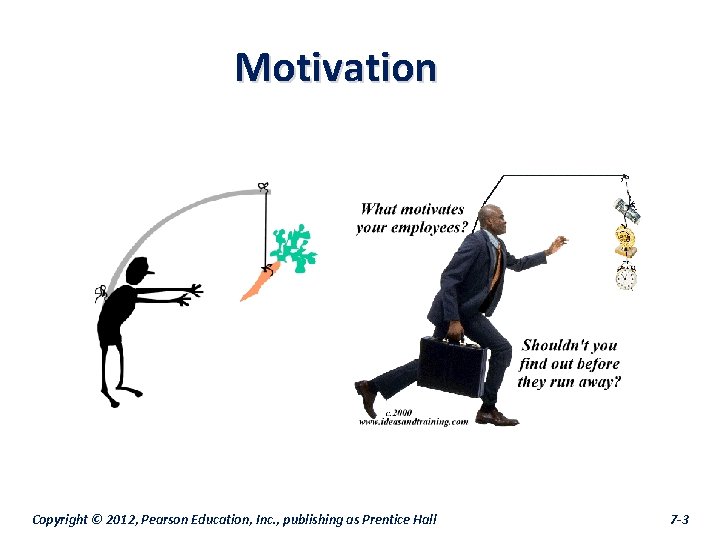
Motivation Copyright © 2012, Pearson Education, Inc. , publishing as Prentice Hall 7 -3
Motivation (Cont’d) • Motivation ü Refers to the process by which a person’s efforts are energized, directed, and sustained toward attaining a goal. Ø Energy– measure of intensity or drive. Ø Direction—toward organizational goals. Ø Persistence — exerting effort to achieve goals. ü Managers must motivate people to Ø Join the organization Ø Remain in the organization Ø Come to work regularly Copyright © 2012, Pearson Education, Inc. , publishing as Prentice Hall 7 -4
Early Theories of Motivation • We begin by looking at four early motivation theories: ü Maslow’s hierarchy of needs ü Mc. Gregor’s theories X and Y ü Herzberg’s two-factor theory ü Mc. Clelland’s three needs theory Copyright © 2012, Pearson Education, Inc. , publishing as Prentice Hall 7 -5
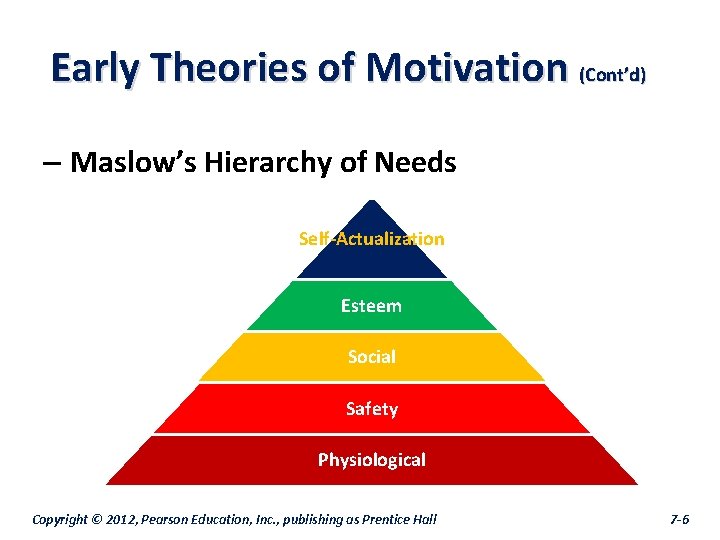
Early Theories of Motivation (Cont’d) – Maslow’s Hierarchy of Needs Self-Actualization Esteem Social Safety Physiological Copyright © 2012, Pearson Education, Inc. , publishing as Prentice Hall 7 -6
Early Theories of Motivation (Cont’d) – Maslow’s Hierarchy of Needs ü Physiological Needs—food, drink, shelter…. ü Safety Needs—Security and protection physical and emotional harm. ü Social Needs—belongingness, acceptance and friendship. ü Esteem Needs—Internal esteem factors such as selfrespect, autonomy and achievement; external esteem factors such as recognition. ü Self-Actualization Needs—Growth, achieving one’s potential and self-fulfillment. Copyright © 2012, Pearson Education, Inc. , publishing as Prentice Hall 7 -7
Early Theories of Motivation (Cont’d) – Mc. Gregor’s Theories X and Y ü Theory X—One is a basically negative view. Ø Little ambition, dislike work, want to avoid responsibility, and need to be closely controlled to work effectively. ü Theory Y—One is a basically positive view. Ø Enjoy work, seek out and accept responsibility, and exercise self-direction Copyright © 2012, Pearson Education, Inc. , publishing as Prentice Hall 7 -8
Early Theories of Motivation (Cont’d) – Herzberg’s Two-Factor Theory ü Job satisfaction and job dissatisfaction are created by different factors. ØHygiene factors—extrinsic (environmental) factors that create job dissatisfaction. ØMotivators—intrinsic (psychological) factors that create job satisfaction. Copyright © 2012, Pearson Education, Inc. , publishing as Prentice Hall 7 -9
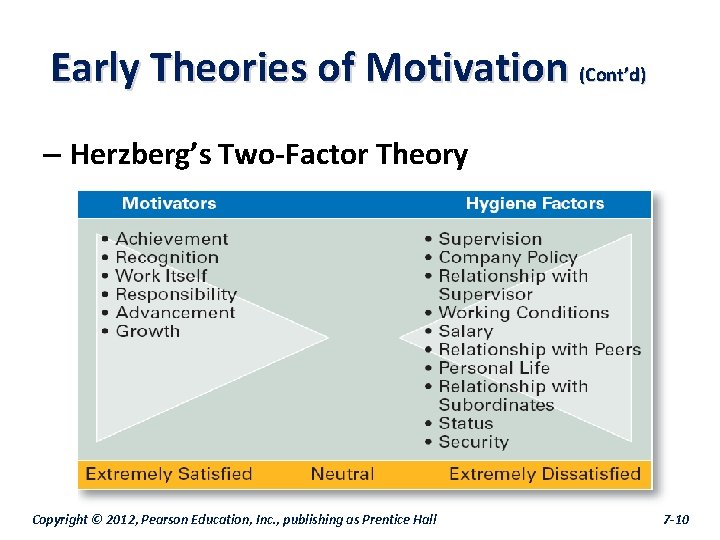
Early Theories of Motivation (Cont’d) – Herzberg’s Two-Factor Theory Copyright © 2012, Pearson Education, Inc. , publishing as Prentice Hall 7 -10
Early Theories of Motivation (Cont’d) – Mc. Clelland’s Three Needs Theory ü There are three major acquired needs that are major motives in work. Ø Need for achievement (n. Ach) – The drive to excel and succeed in relation to a set of standards. Ø Need for power (n. Pow) – The need to influence the behavior of others. Ø Need of affiliation (n. Aff) – The desire for interpersonal relationships Copyright © 2012, Pearson Education, Inc. , publishing as Prentice Hall 7 -11
Contemporary of Motivation • Goal-Setting Theory ü Says that specific goals increase performance and that difficult goals, when accepted, result in higher performance than do easy goals. Ø First, working toward a goal is a major source of job motivation. Ø Next, will employees try harder if they have the opportunity to participate in the setting of goals? Ø Finally, we know that people will do better if they get feedback on how well they’re progressing toward their goals. Copyright © 2012, Pearson Education, Inc. , publishing as Prentice Hall 7 -12
Contemporary of Motivation (Cont’d) • Equity Theory ü Proposes that employees perceive what they get from a job situation (outcomes) in relation to what they put in (inputs) and then compare their inputs-outcomes ratio with the inputs-outcomes ratios of relevant others. • If the ratios are perceived as equal then a state of equity (fairness) exists. • If the ratios are perceived as unequal, inequity exists and the person feels under- or over-rewarded. • When inequities occur, employees will attempt to do something to rebalance the ratios (seek justice). Copyright © 2012, Pearson Education, Inc. , publishing as Prentice Hall 7 -13
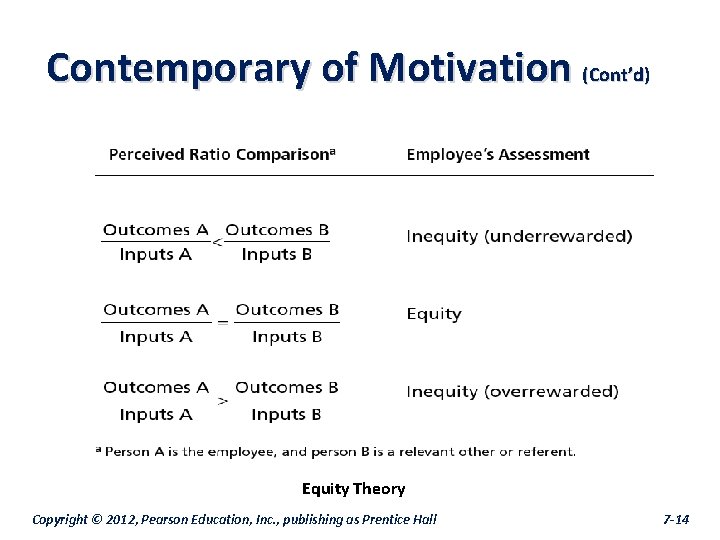
Contemporary of Motivation (Cont’d) Equity Theory Copyright © 2012, Pearson Education, Inc. , publishing as Prentice Hall 7 -14
Contemporary of Motivation (Cont’d) • Equity Theory ü Distributive justice ØThe perceived fairness of the amount and allocation of rewards among individuals (i. e. , who received what). – Influences an employee’s satisfaction. ü Procedural justice ØThe perceived fairness of the process use to determine the distribution of rewards (i. e. , how who received what). – Affects an employee’s organizational commitment. Copyright © 2012, Pearson Education, Inc. , publishing as Prentice Hall 7 -15
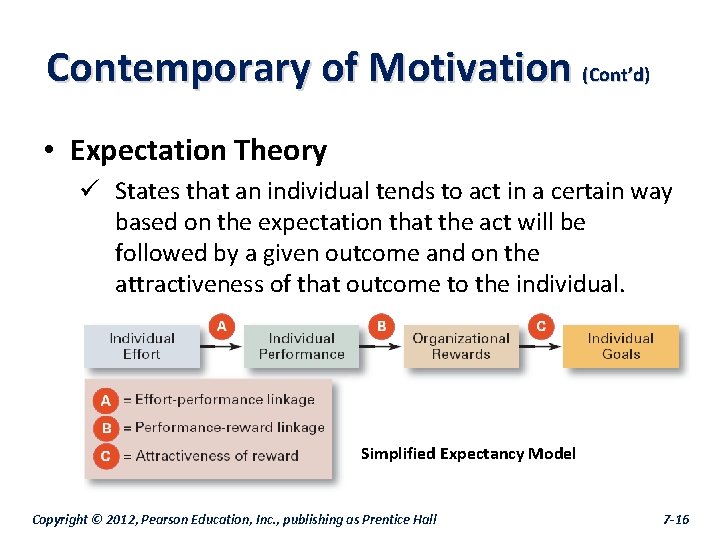
Contemporary of Motivation (Cont’d) • Expectation Theory ü States that an individual tends to act in a certain way based on the expectation that the act will be followed by a given outcome and on the attractiveness of that outcome to the individual. Simplified Expectancy Model Copyright © 2012, Pearson Education, Inc. , publishing as Prentice Hall 7 -16
- Slides: 16