
11 6 Patterns in Evolution through natural selection

- Slides: 9
11. 6 Patterns in Evolution through natural selection is not random. • Natural selection can have direction. • The effects of natural selection add up over time.
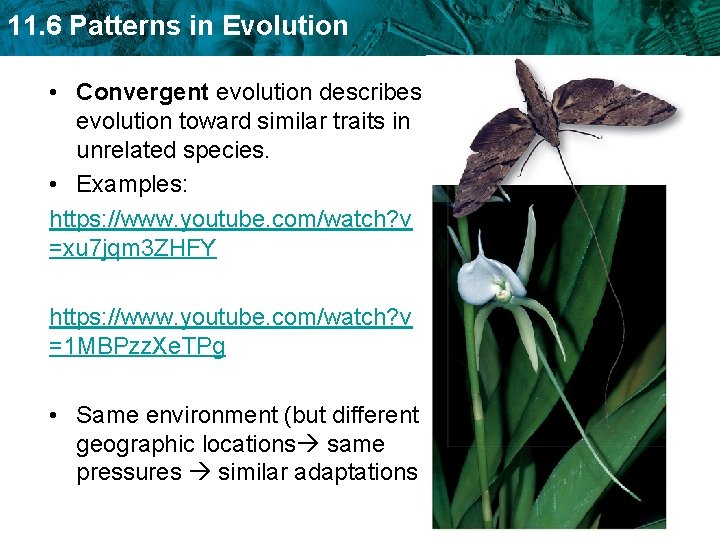
11. 6 Patterns in Evolution • Convergent evolution describes evolution toward similar traits in unrelated species. • Examples: https: //www. youtube. com/watch? v =xu 7 jqm 3 ZHFY https: //www. youtube. com/watch? v =1 MBPzz. Xe. TPg • Same environment (but different geographic locations same pressures similar adaptations
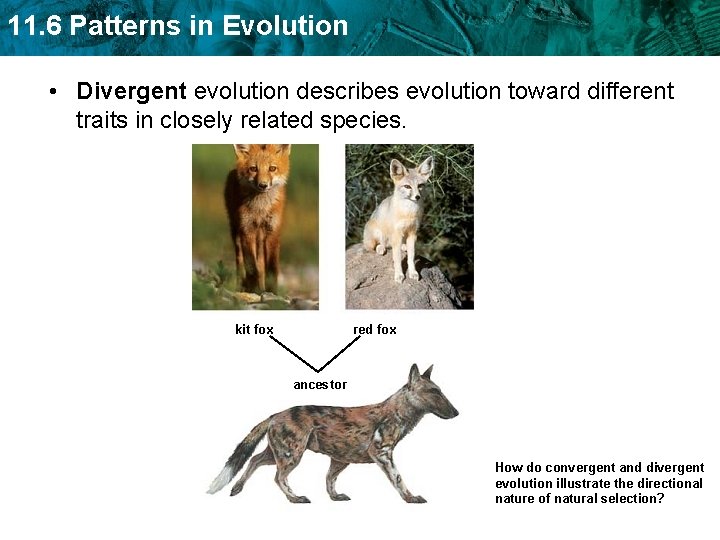
11. 6 Patterns in Evolution • Divergent evolution describes evolution toward different traits in closely related species. kit fox red fox ancestor How do convergent and divergent evolution illustrate the directional nature of natural selection?
11. 6 Patterns in Evolution Species can shape each other over time. • Two or more species can evolve together through coevolution. – evolutionary paths become connected – species evolve in response to changes in each other Example: https: //www. youtube. com/watch? v=9 Cuhq. Qz. BACQ
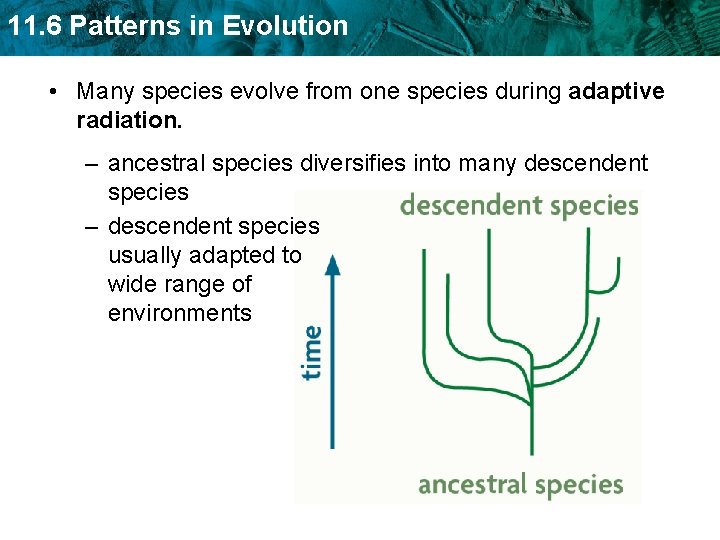
11. 6 Patterns in Evolution • Many species evolve from one species during adaptive radiation. – ancestral species diversifies into many descendent species – descendent species usually adapted to wide range of environments
11. 6 Patterns in Evolution Adaptive Radiation • Speciation from a common ancestor, that results in different forms of the same species filling ecological niches • Example: https: //www. youtube. com/watch? v=mc. M 23 MCCog
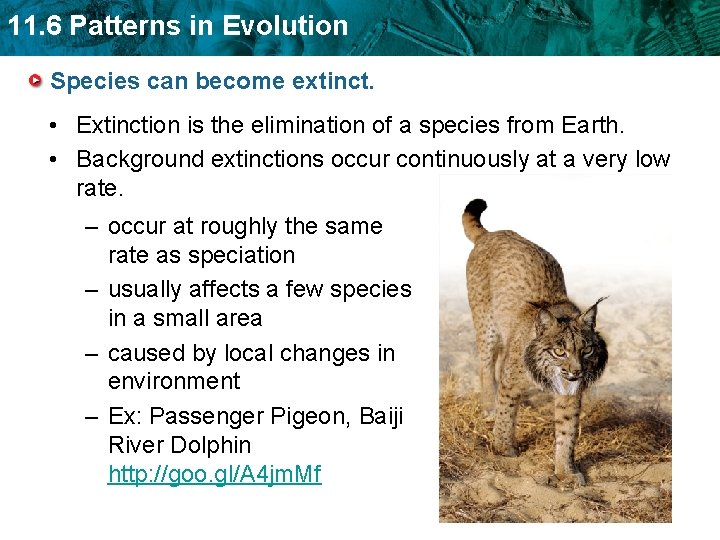
11. 6 Patterns in Evolution Species can become extinct. • Extinction is the elimination of a species from Earth. • Background extinctions occur continuously at a very low rate. – occur at roughly the same rate as speciation – usually affects a few species in a small area – caused by local changes in environment – Ex: Passenger Pigeon, Baiji River Dolphin http: //goo. gl/A 4 jm. Mf
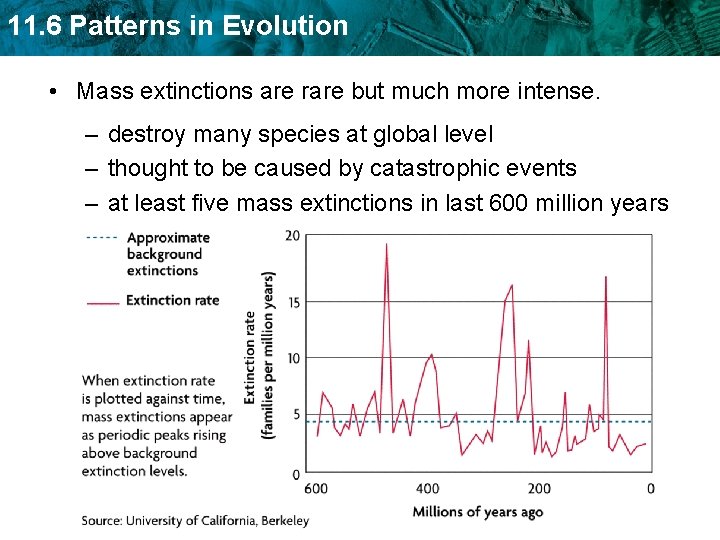
11. 6 Patterns in Evolution • Mass extinctions are rare but much more intense. – destroy many species at global level – thought to be caused by catastrophic events – at least five mass extinctions in last 600 million years
11. 6 Patterns in Evolution Speciation often occurs in patterns. • A pattern of punctuated equilibrium exists in the fossil record. – theory proposed by Eldredge and Gould in 1972 – episodes of speciation occur suddenly in geologic time – followed by long periods of little evolutionary change – revised Darwin’s idea that species arose through gradual transformations • Gradualism is still accepted as a means of evolution