
11 4 Two Way Tables Find and interpret
11. 4 Two Way Tables
§ Find and interpret marginal frequencies § Make two way tables What We Will Learn § Find relative and conditional relative frequencies § Use two way tables to recognize association in data
§ Two way table: frequency table that displays data collected from one source that belong to two different categories § Joint frequency: each entry in the two way table § Marginal frequencies: sums of the rows and columns in a two way table Needed Vocab § Joint relative frequencies: ratio of a frequency that is not in the total row of the total column to the total number of values § Marginal relative frequency: sum of the joint relative frequencies in a row or column § Conditional relative frequency: ration of a joint relative frequency to the marginal relative frequency
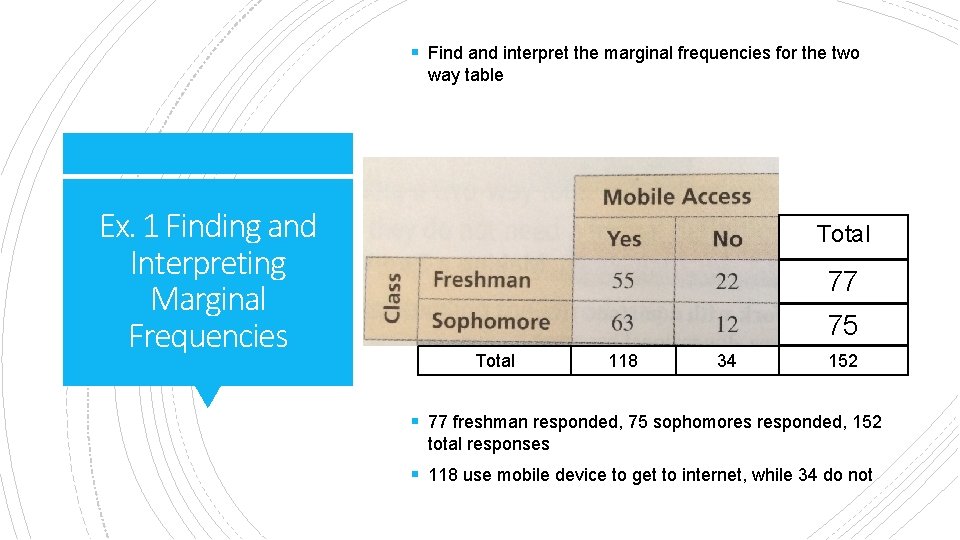
§ Find and interpret the marginal frequencies for the two way table Ex. 1 Finding and Interpreting Marginal Frequencies Total 77 75 Total 118 34 152 § 77 freshman responded, 75 sophomores responded, 152 total responses § 118 use mobile device to get to internet, while 34 do not
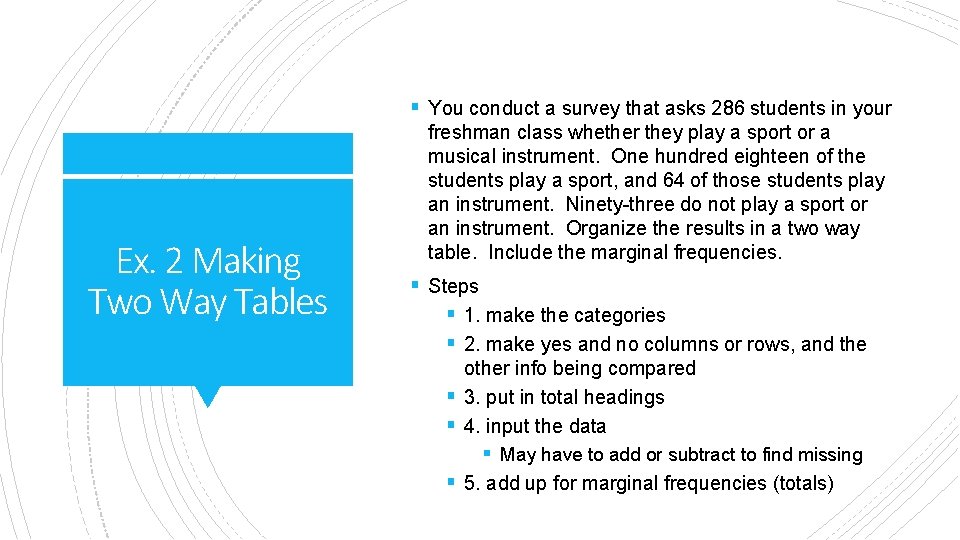
§ You conduct a survey that asks 286 students in your Ex. 2 Making Two Way Tables freshman class whether they play a sport or a musical instrument. One hundred eighteen of the students play a sport, and 64 of those students play an instrument. Ninety-three do not play a sport or an instrument. Organize the results in a two way table. Include the marginal frequencies. § Steps § 1. make the categories § 2. make yes and no columns or rows, and the other info being compared § 3. put in total headings § 4. input the data § May have to add or subtract to find missing § 5. add up for marginal frequencies (totals)
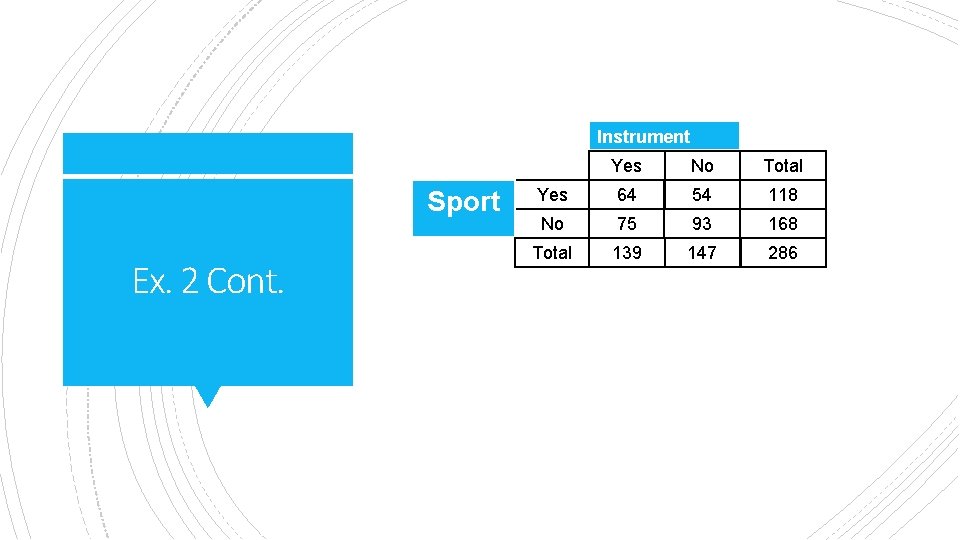
Instrument Sport Ex. 2 Cont. Yes No Total Yes 64 54 118 No 75 93 168 Total 139 147 286
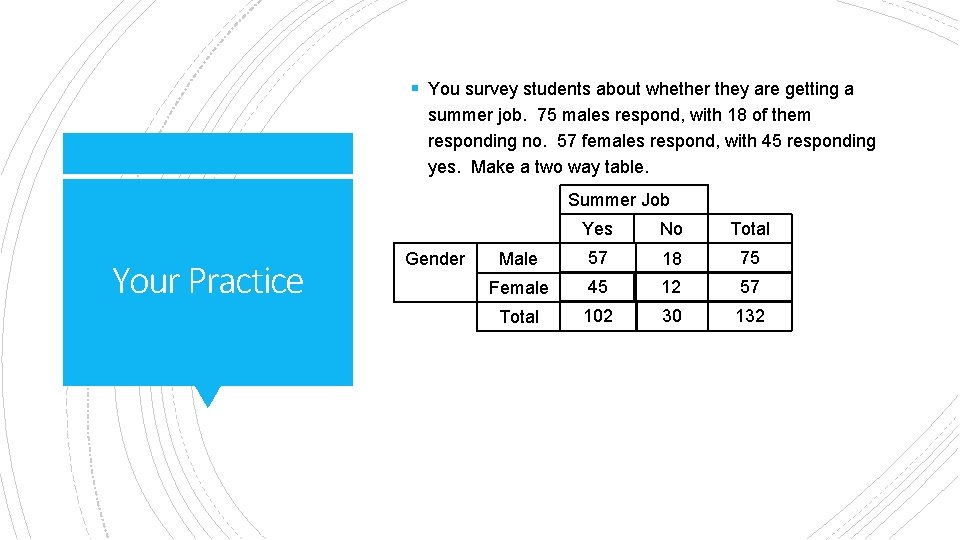
§ You survey students about whether they are getting a summer job. 75 males respond, with 18 of them responding no. 57 females respond, with 45 responding yes. Make a two way table. Summer Job Your Practice Gender Yes No Total Male 57 18 75 Female 45 12 57 Total 102 30 132
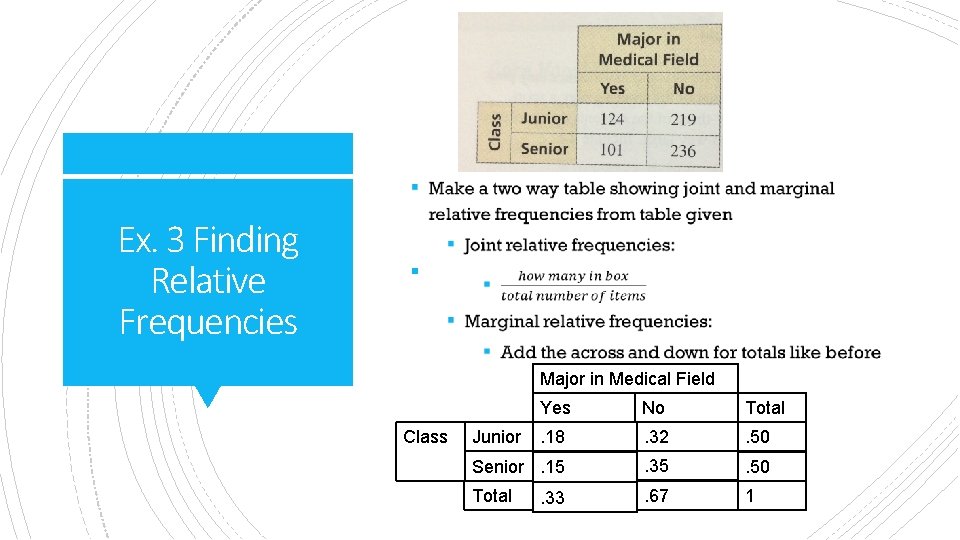
Ex. 3 Finding Relative Frequencies § Major in Medical Field Class Yes No Total . 18 . 32 . 50 Senior. 15 . 35 . 50 Total . 67 1 Junior . 33
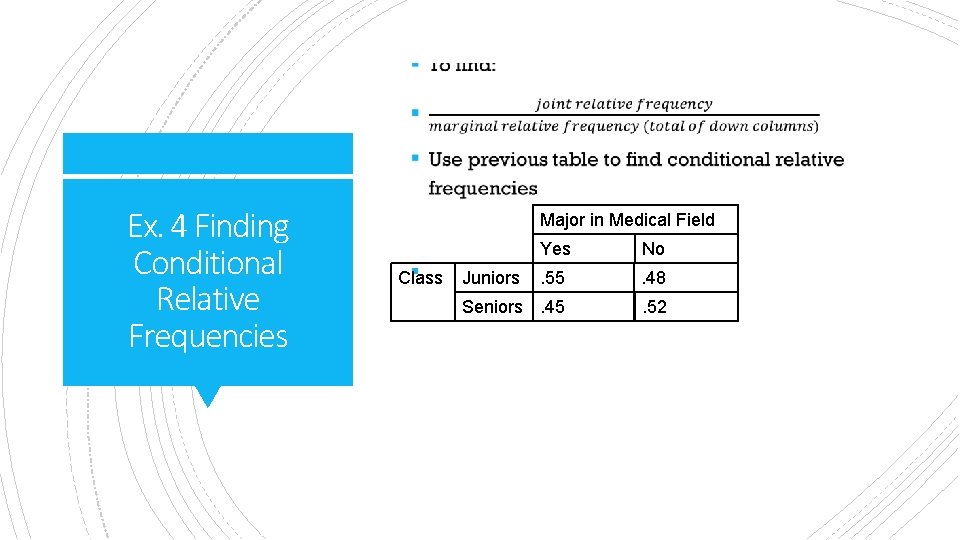
Ex. 4 Finding Conditional Relative Frequencies Major in Medical Field § Class Yes No . 55 . 48 Seniors. 45 . 52 Juniors
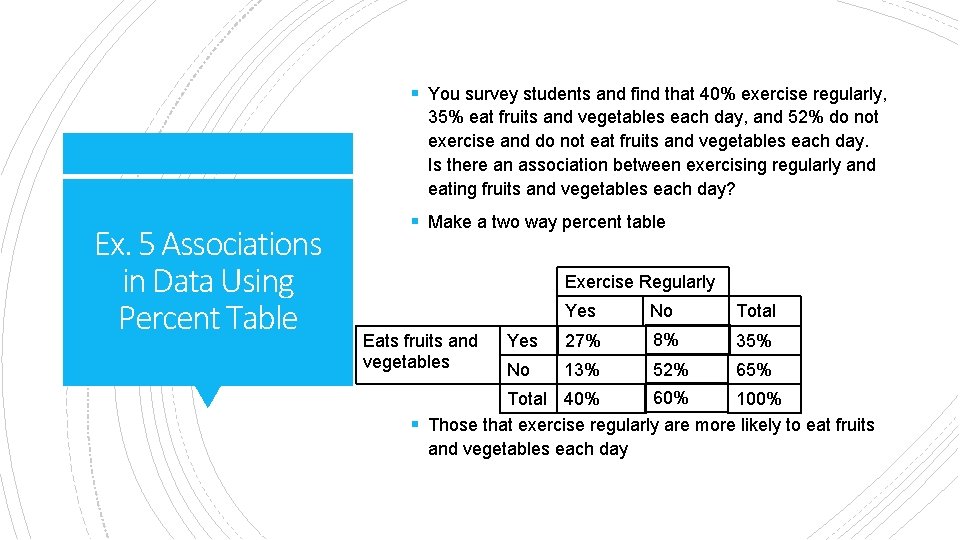
§ You survey students and find that 40% exercise regularly, 35% eat fruits and vegetables each day, and 52% do not exercise and do not eat fruits and vegetables each day. Is there an association between exercising regularly and eating fruits and vegetables each day? Ex. 5 Associations in Data Using Percent Table § Make a two way percent table Exercise Regularly Eats fruits and vegetables Yes No Total Yes 27% 8% 35% No 13% 52% 65% 60% Total 40% 100% § Those that exercise regularly are more likely to eat fruits and vegetables each day
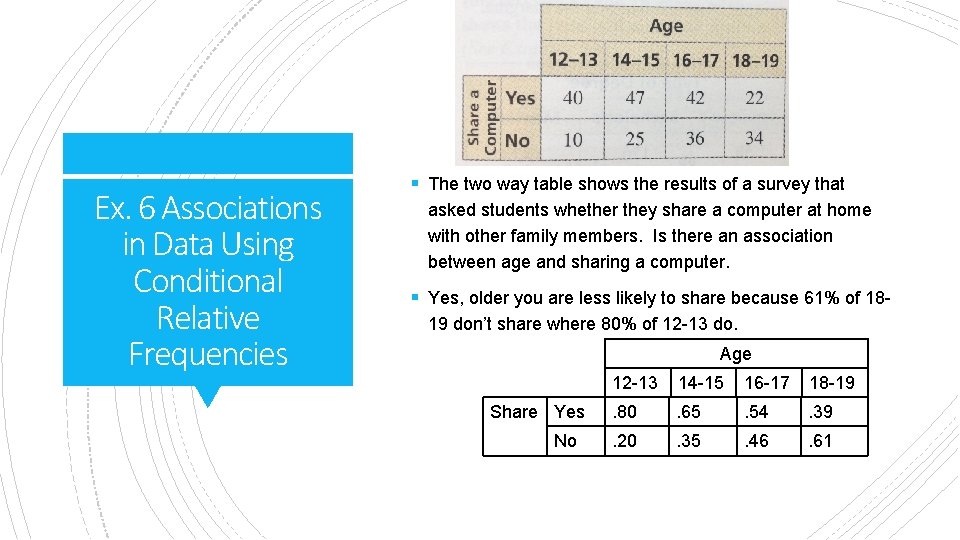
Ex. 6 Associations in Data Using Conditional Relative Frequencies § The two way table shows the results of a survey that asked students whether they share a computer at home with other family members. Is there an association between age and sharing a computer. § Yes, older you are less likely to share because 61% of 1819 don’t share where 80% of 12 -13 do. Age Share Yes No 12 -13 14 -15 16 -17 18 -19 . 80 . 65 . 54 . 39 . 20 . 35 . 46 . 61
- Slides: 11