
11 4 Perform Quantitative Risk Analysis The process
- Slides: 6
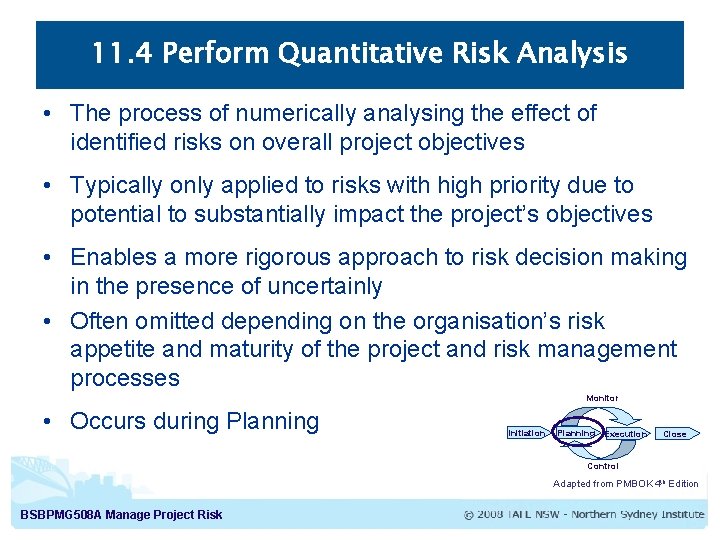
11. 4 Perform Quantitative Risk Analysis • The process of numerically analysing the effect of identified risks on overall project objectives • Typically only applied to risks with high priority due to potential to substantially impact the project’s objectives • Enables a more rigorous approach to risk decision making in the presence of uncertainly • Often omitted depending on the organisation’s risk appetite and maturity of the project and risk management processes Monitor • Occurs during Planning Initiation Planning Execution Close Control Adapted from PMBOK 4 th Edition BSBPMG 508 A Manage Project Risk
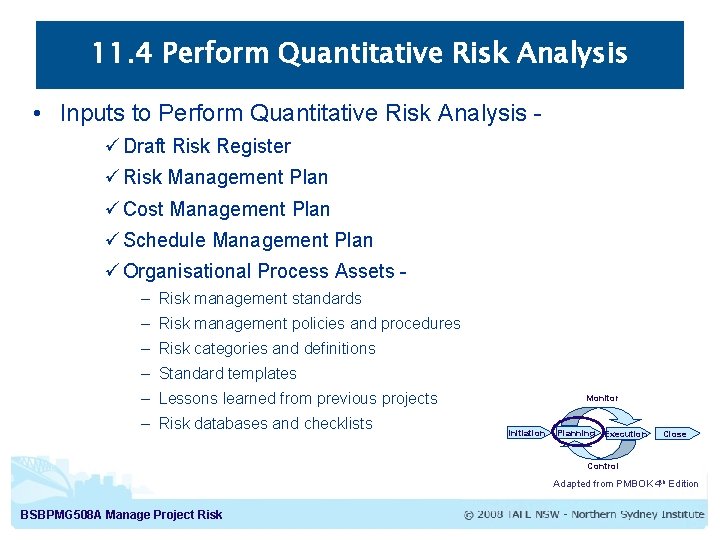
11. 4 Perform Quantitative Risk Analysis • Inputs to Perform Quantitative Risk Analysis ü Draft Risk Register ü Risk Management Plan ü Cost Management Plan ü Schedule Management Plan ü Organisational Process Assets – Risk management standards – Risk management policies and procedures – Risk categories and definitions – Standard templates – Lessons learned from previous projects – Risk databases and checklists Monitor Initiation Planning Execution Close Control Adapted from PMBOK 4 th Edition BSBPMG 508 A Manage Project Risk
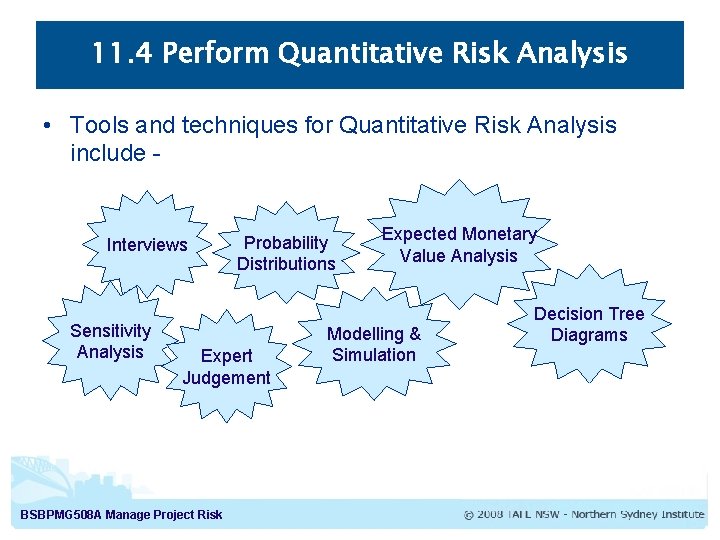
11. 4 Perform Quantitative Risk Analysis • Tools and techniques for Quantitative Risk Analysis include - Interviews Sensitivity Analysis Probability Distributions Expert Judgement BSBPMG 508 A Manage Project Risk Expected Monetary Value Analysis Modelling & Simulation Decision Tree Diagrams
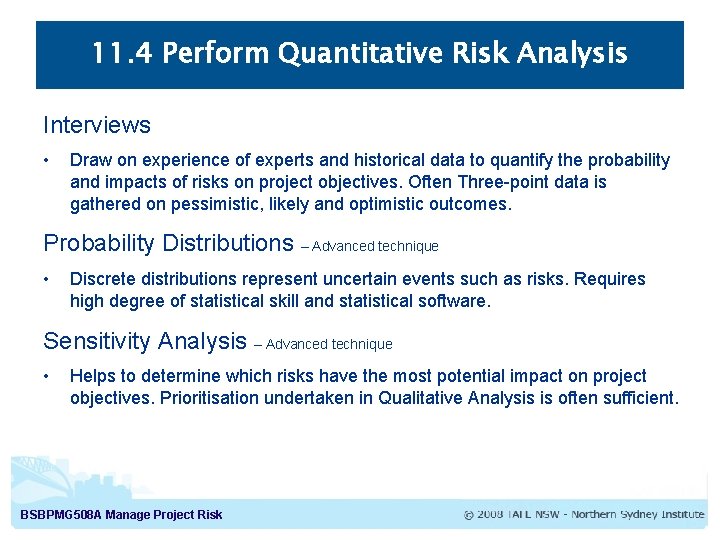
11. 4 Perform Quantitative Risk Analysis Interviews • Draw on experience of experts and historical data to quantify the probability and impacts of risks on project objectives. Often Three-point data is gathered on pessimistic, likely and optimistic outcomes. Probability Distributions – Advanced technique • Discrete distributions represent uncertain events such as risks. Requires high degree of statistical skill and statistical software. Sensitivity Analysis – Advanced technique • Helps to determine which risks have the most potential impact on project objectives. Prioritisation undertaken in Qualitative Analysis is often sufficient. BSBPMG 508 A Manage Project Risk
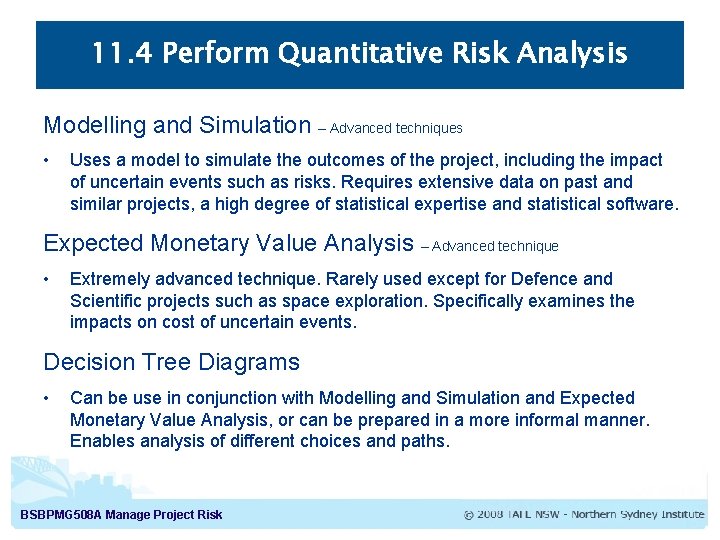
11. 4 Perform Quantitative Risk Analysis Modelling and Simulation – Advanced techniques • Uses a model to simulate the outcomes of the project, including the impact of uncertain events such as risks. Requires extensive data on past and similar projects, a high degree of statistical expertise and statistical software. Expected Monetary Value Analysis – Advanced technique • Extremely advanced technique. Rarely used except for Defence and Scientific projects such as space exploration. Specifically examines the impacts on cost of uncertain events. Decision Tree Diagrams • Can be use in conjunction with Modelling and Simulation and Expected Monetary Value Analysis, or can be prepared in a more informal manner. Enables analysis of different choices and paths. BSBPMG 508 A Manage Project Risk
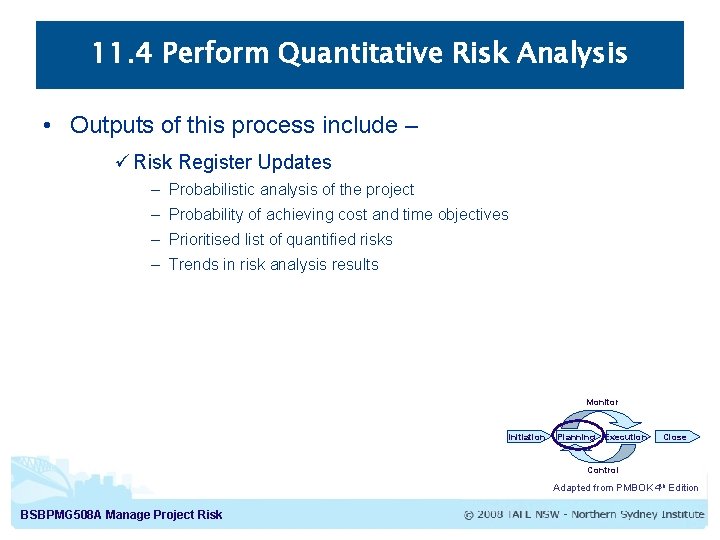
11. 4 Perform Quantitative Risk Analysis • Outputs of this process include – ü Risk Register Updates – Probabilistic analysis of the project – Probability of achieving cost and time objectives – Prioritised list of quantified risks – Trends in risk analysis results Monitor Initiation Planning Execution Close Control Adapted from PMBOK 4 th Edition BSBPMG 508 A Manage Project Risk